


Report Overview
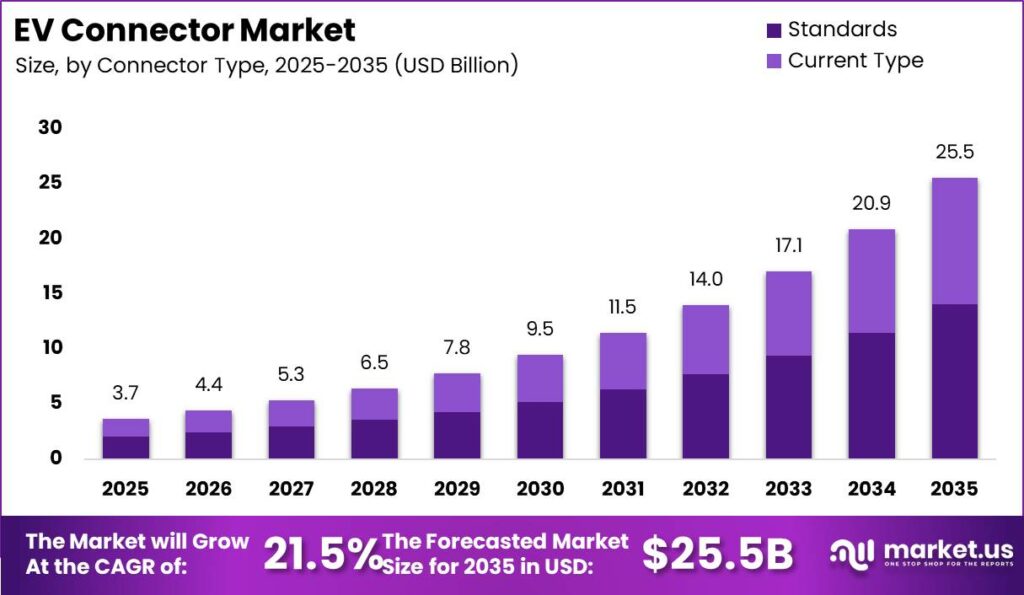
Global EV Connector Market size is expected to be worth around USD 25.50 Billion by 2035 from USD 3.70 Billion in 2025, growing at a CAGR of 21.5% during the forecast period 2026 to 2035. This expansion reflects rapid electrification of road fleets and denser charging hardware deployment. Suppliers who scale multi-standard tooling early will lock multi-year OEM and infrastructure contracts.
Therefore, the EV Connector Market covers conductive interfaces that link vehicles to AC and DC power sources across inlets, plugs, and cable assemblies. Product structure spans connector standards, current type, propulsion architecture, application load points, and vehicle class. Buyers select designs that balance voltage rating, thermal limits, and regional homologation rules.
Key Takeaways
- The market reaches USD 3.70 Billion in 2025 and USD 25.50 Billion by 2035 at a 21.5% CAGR.
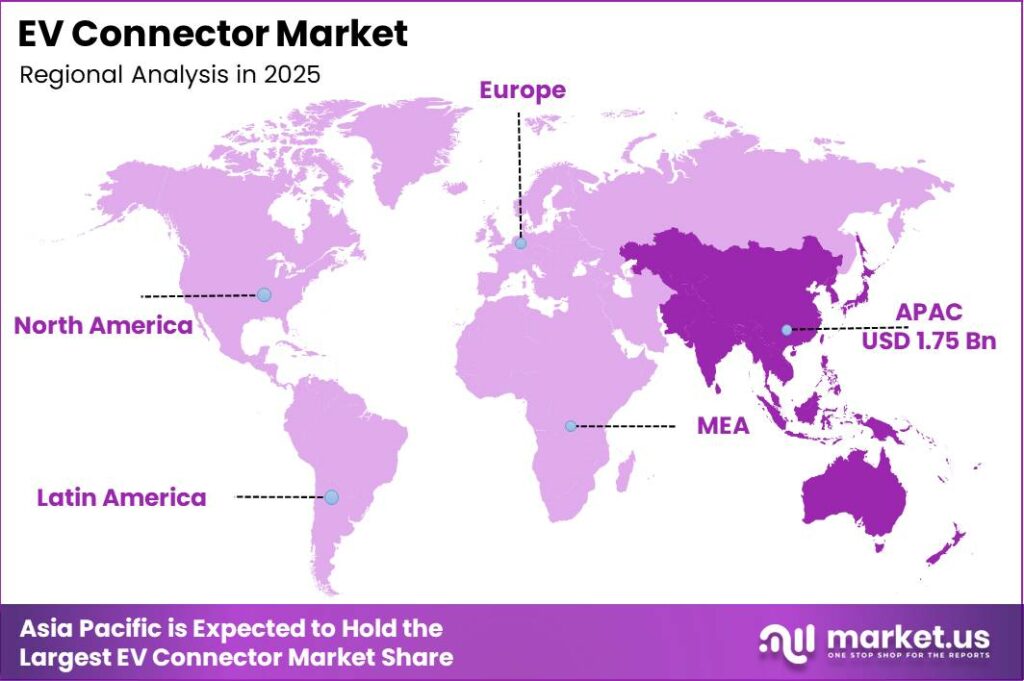
- Asia Pacific leads with a 47.60% share valued at USD 1.75 Billion.
- Standards lead By Connector Type with a 55.00% share.
- Type 2 ranks as the fastest growing connector type sub-segment.
- Battery Electric Vehicles lead By Propulsion Type with a 73.00% share.
- Charging Systems lead By Application with a 31.00% share.
- Passenger Cars lead By Vehicle Type with a 70.00% share.
ChargePoint reported in February 2026 that network charging sessions rose 34% year over year while ports rose only 16%. More than 1 million EV drivers used the network each month. This means utilization outruns hardware buildout and raises urgency for higher-duty connectors on busy bays. In November 2025, Amphenol Industrial Operations introduced a 12 mm two-pole UPC high-current connector for hybrid and electric platforms, supporting denser power packaging in compact vehicle layouts.
As a result, end-use growth in public and depot charging lifts demand for durable inlet and plug sets that survive high session counts. Based on SAE data, operating SAE J3400 connectors at 277 V AC cuts current needs by 33% versus 208 V AC systems. Copper line losses fall by over 50% and site efficiency rises 2% to 8%. Site operators who redesign electrical rooms around this voltage gain lower cable cost and cooler thermal envelopes.
Connector Type Analysis
Standards dominates with 55.00% due to multi-region homologation compliance requirements.
In 2025, Standards held a dominant market position in the By Connector Type segment of EV Connector Market, with a 55.00% share. IEA tracking shows public chargers surpassed 5 million globally after doubling since 2022. This installed base favors connectors that already clear national type-approval paths. Vendors with certified standard families win fleet and network RFPs faster than niche pin designs.
Type 2 is the fastest growing connector type and anchors European AC charging under IEC 62196 with single-phase and three-phase support. European electric car sales reached 4.2 million in 2025, or 28% of new cars sold in that regional pool per IEA figures. This sales density pulls AC inlet volume toward Type 2 geometries. Suppliers who dual-tool Type 2 and CCS2 pins capture both home and public duty cycles.
Combined Charging System designs add DC pins to Type 1 or Type 2 bodies and commonly deliver up to 350 kW on public corridors. In May 2025, Phoenix Contact released a second-generation CHARX connect professional liquid-cooled CCS connector supporting up to 1 MW in boost mode. This power step shortens dwell time for highway operators. Investors should track liquid-cooling attach rates as margin differentiators versus air-cooled SKUs.
CHAdeMO remains central in Japan-linked fleets and now targets higher current through CHAdeMO 2.1 pathways. GB/T governs China with separate AC and DC pin families rather than a single combo inlet. Type 1 continues to serve North American AC legacy inlets. These three hold the remaining share collectively and still require parallel tooling for export programs.
Current Type Analysis
AC charging (slow/medium) dominates with workplace and residential dwell-time economics.
AC charging (slow/medium) serves overnight residential and long-dwell workplace posts where lower continuous current keeps copper cross-sections modest. IEA electromobility coverage stresses public access for drivers without private parking while private AC still carries most energy transfer overnight. This split keeps AC inlet volumes high even as DC headlines grow. Component makers who standardize IP-rated AC pins cut field failure rates for utilities and landlords.
DC charging (fast/rapid) focuses on corridor and depot stops that restore range in minutes rather than hours. Global electric car sales are expected near 23 million in 2026, about 28% of total car sales worldwide per IEA outlook material. Higher BEV stock multiplies peak-power bay demand. Suppliers of high-amp DC contacts gain pricing power where thermal and contact resistance specs tighten.
AC and DC product lines share sealing, latch, and proximity-pilot elements yet diverge on pin mass and cooling. Network operators balance AC bay count for dwell parking against fewer high-cost DC stalls. This creates dual SKU roadmaps for connector houses. Firms that modularize shells across AC and DC cut mold amortization per unit.
Propulsion Type Analysis
Battery Electric Vehicles dominates with 73.00% due to full-electric drivetrain connector density.
In 2025, Battery Electric Vehicles held a dominant market position in the By Propulsion Type segment of EV Connector Market, with a 73.00% share. IEA notes BEVs were about 65% of total electric car sales in 2025. Pure battery packs need high-voltage charge inlets plus multiple pack and distribution connectors. Full-BEV platforms therefore pull more connector content per vehicle than mild hybrid layouts.
Hybrid Electric Vehicles still need charge inlets on plug-in variants and high-voltage junctions inside the pack and inverter path. Their lower pure-electric miles reduce public DC session frequency versus BEVs. This means hybrid programs favor cost-optimized mid-power inlets. Tier-1s who offer scalable pin counts across hybrid and BEV platforms protect share when mix shifts.
Others cover niche propulsion layouts and specialty industrial electric platforms outside mainstream passenger programs. Volumes stay smaller yet often demand rugged sealing and higher vibration ratings. This creates specialty margin pockets for aerospace-grade contact makers. Portfolio players should ring-fence engineering slots for these low-volume high-spec bids.
Application Analysis
Charging Systems dominates with 31.00% due to inlet and plug hardware intensity.
In 2025, Charging Systems held a dominant market position in the By Application segment of EV Connector Market, with a 31.00% share. Public charging networks grew connector counts sharply, with industry tallies near 6.7 million connectors after roughly 28% growth in 2025 in one major outlook dataset. Each new bay multiplies coupler and inlet shipments. Charging-system SKUs therefore remain the clearest volume lever for connector suppliers.
Battery Management Systems rely on high-voltage, low-current signal and sense connectors that protect cell stacks and isolation monitors. Pack designers specify creepage, clearance, and interlock features that raise qualification time. This complexity supports premium pricing on BMS connector families. Vendors with automotive PPAP depth lock multi-year pack programs.
Powertrain Systems route traction inverter and e-axle power through heavy copper interfaces under vibration and heat. Body Control and Comfort Systems, Safety and Security Systems, and Other Applications absorb the remaining share collectively through lower-current distribution and sensor links. Integrated harness strategies that reuse contact technology across these domains lower piece price for OEMs.
Vehicle Type Analysis
Passenger Cars dominates with 70.00% due to high global light-duty EV volumes.
In 2025, Passenger Cars held a dominant market position in the By Vehicle Type segment of EV Connector Market, with a 70.00% share. Passenger EV sales trajectories point to more than 20 million electric cars in the mid-decade sales band and about 23 million units in 2026 per IEA-linked outlooks. High unit counts make passenger inlets the volume core of the market. Platform-common charge inlets amortize tooling across trims and regions.
Light Commercial Vehicles adopt depot AC overnight charging and selective DC opportunity charge on urban routes. Duty cycles stress connector mating life and sealing against dust and moisture. Fleet buyers therefore specify higher cycle ratings than many retail passenger programs. Suppliers who publish verified mating-cycle data win municipal and logistics tenders.
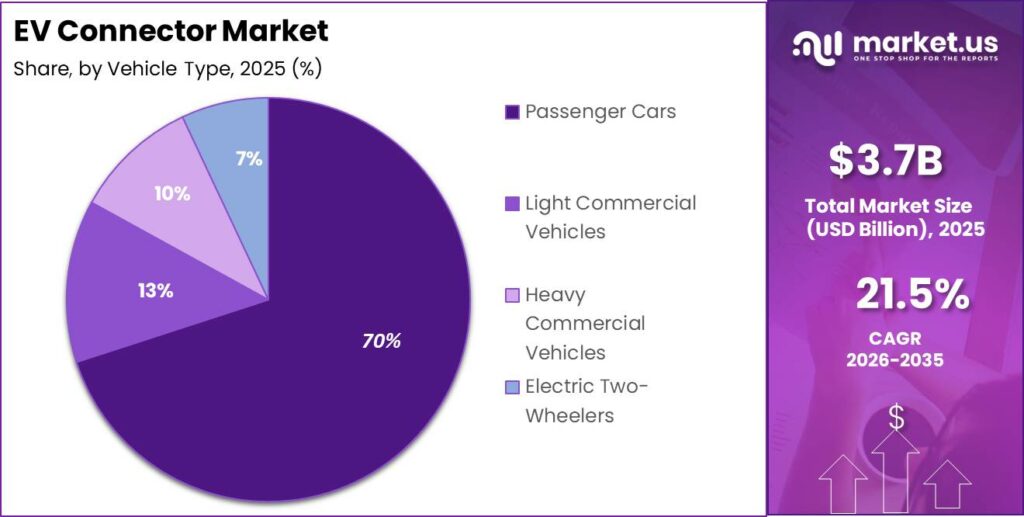
Heavy Commercial Vehicles push toward megawatt-class conductive charging for long-haul rest stops. Electric Two-Wheelers concentrate in Asia with compact, lower-voltage couplers and frequent swap or slow-charge patterns. Heavy commercial and two-wheeler lines hold the remaining share collectively. Regional specialists who tool two-wheeler couplers early gain density in India and Southeast Asia city fleets.
Key Market Segments
By Connector Type
- Standards
- Type 1
- Type 2
- Combined Charging System
- CHAdeMO
- GB/T
By Current Type
- AC charging (slow/medium)
- DC charging (fast/rapid)
By Propulsion Type
- Battery Electric Vehicles
- Hybrid Electric Vehicles
- Others
By Application
- Battery Management Systems
- Charging Systems
- Powertrain Systems
- Body Control and Comfort Systems
- Safety and Security Systems
- Other Applications
By Vehicle Type
- Passenger Cars
- Light Commercial Vehicles
- Heavy Commercial Vehicles
- Electric Two-Wheelers
Regional Analysis
Asia Pacific Dominates the EV Connector Market with a Market Share of 47.60%, Valued at USD 1.75 Billion
Asia Pacific leads on the back of China manufacturing scale, dense public charging rollouts, and fast two-wheeler electrification. The region’s share of 47.60% and USD 1.75 Billion value in 2025 give local connector plants unmatched volume leverage. GB/T compliance remains a gate for domestic programs. Global suppliers need joint ventures or local certification teams to access this order book.
North America is among the fastest structural growth arenas as NACS and SAE J3400 redesigns force inlet and adapter refreshes across non-Tesla OEMs. Dual-standard bays raise connector content per charging stall. This creates a short-cycle retrofit wave for stations and vehicles. European growth follows mandatory CCS2 fitment paths and strong passenger EV mix.
Europe, Latin America, and Middle East and Africa together add diversified demand through type-approval rules, emerging fleet pilots, and corridor charging projects. Latin American ports and Middle East logistics fleets open adjacent commercial niches. Regional SKU proliferation still raises tooling cost. Multi-standard platforms remain the practical hedge for exporters.
Key Regions and Countries
North America
- US
- Canada
Europe
- Germany
- France
- The UK
- Spain
- Italy
- Rest of Europe
Asia Pacific
- China
- Japan
- South Korea
- India
- Australia
- Rest of APAC
Latin America
- Brazil
- Mexico
- Rest of Latin America
Middle East and Africa
- GCC
- South Africa
- Rest of MEA
Market Dynaimcs
Market Opportunity Analysis - Two-wheeler, hybrid, and secondary regions still under-served relative to passenger BEV charging core
Electric Two-Wheelers remain under-penetrated in global connector portfolios despite dense Asian city fleets. Passenger Cars already hold a 70.00% vehicle-type share, so engineering attention skews to four-wheel inlets. Compact low-voltage couplers for two-wheelers need different cost and cycle targets. New entrants who tool India and Southeast Asia two-wheeler standards can avoid head-on battles with passenger inlet leaders.
Hybrid Electric Vehicles sit below the 73.00% Battery Electric Vehicles propulsion share yet still require charge inlets on plug-in variants. Many supplier catalogs optimize only for full-BEV high-power pins. Mid-power hybrid SKUs therefore face thinner competition. Investors can back modular pin families that scale from hybrid to BEV without full redesign.
By contrast, Charging Systems already own a 31.00% application share while Battery Management Systems and powertrain links draw less independent go-to-market focus. BMS high-voltage low-current lines demand strict isolation features. Specialists who certify creepage-heavy BMS connectors early win pack awards with less price pressure. This niche rewards quality systems over pure amp marketing.
Latin America and Middle East and Africa trail Asia Pacific’s 47.60% lead and still build corridor and fleet pilots. Local assembly and simplified SKU sets reduce import friction. Regional fabricators who pair with global contact technology can fill installation gaps. Early movers secure utility and logistics framework contracts before multinationals fully localize.
Technology and Innovation Landscape - Higher current, liquid cooling, and megawatt standards redefine connector value
CHAdeMO 2.1 in 2026 raised supported capability to 800 A and up to 800 kW while adding Plug-and-Charge support. This upgrade keeps Japanese-linked corridors competitive on dwell time. Network owners can market faster sessions without full standard migration. Connector makers who ship 2.1-ready contacts protect installed CHAdeMO bay value.
Uncooled NACS connectors reach up to 500 kW in Boost Mode and 375 kW continuous at a 1,000 V DC rating. Removing liquid loops lowers bay maintenance complexity for many urban sites. However, thermal headroom still limits extreme-duty depots. Operators should match uncooled NACS to moderate dwell profiles and reserve cooled systems for peak freight lanes.
High-power liquid-cooled CCS Type 2 systems deliver continuous current up to 800 A and peak output up to 1,000 A, or 1 MW, in Boost Mode at 1,000 V DC. Cooling unlocks highway power without oversized copper alone. Site CapEx rises but energy dispensed per stall climbs. Investors in corridor assets should model cooled CCS as a utilization multiplier.
The Megawatt Charging System under IEC TS 63379 defines hardware up to 1,500 V DC and 3,000 A continuous, transferring as much as 4.5 MW. Heavy truck rest stops become viable electrification nodes under this envelope. Insulation monitoring and contact erosion controls become board-level risks. Suppliers with proven high-voltage safety stacks will gatekeep MCS awards.
Drivers
Ford and General Motors committed to Tesla connector geometry in 2023, and SAE formalized NACS as SAE J3400 in late 2024. Non-Tesla OEMs in North America redesign inlets and adapters for model years 2025 to 2026. ICCT fleet data show NACS-compatible new EV registrations crossed a majority threshold in North America during 2025. NEVI guidance that allows NACS beside CCS accelerates dual-standard hardware orders.
This shift compresses legacy CCS-only connector margins by an estimated 4 to 6 percentage points on tooling amortization. Dual-standard and adapter SKUs gain premium pricing power of roughly 15 to 20%. Suppliers move from single-standard commodity runs toward platform-flexible production inside an 18 to 24 month CapEx cycle. Buyers and investors should favor vendors already shipping auto-detecting multi-standard ports.
| Driver | (~) % Impact on CAGR Forecast | Geographic Relevance | Impact Timeline |
|---|---|---|---|
| NACS/SAE J3400 standardization retrofit wave | +3.2% | North America | Short term (2 years or less) |
| Mandatory CCS2 fitment under EU type-approval rules | +2.1% | Europe | Short term (2 years or less) |
| Rising public DC fast-charging network buildout | +2.6% | Global | Medium term (2 to 4 years) |
| OEM shift to high-voltage 800V architectures | +1.4% | Global | Medium term (2 to 4 years) |
| India IS 17017 and Bharat DC001/AC001 codified standards | +0.9% | India | Short term (2 years or less) |
| Fleet electrification of commercial and logistics vehicles | +1.1% | North America, Europe | Medium term (2 to 4 years) |
Restraints
At least four incompatible pin architectures coexist across NACS, CCS2, GB/T, and India Bharat AC001/DC001 lines. Manufacturers must run parallel tooling rather than one global platform. Unit tooling costs rise an estimated 25 to 30% versus a single-standard case. Customs and homologation dwell can extend 4 to 8 weeks beyond single-standard markets per cross-border trade patterns.
Consequently, export order books freeze when firms cannot fund multiple certifications at once. Blended gross margins compress roughly 3 to 5 percentage points. New fabrication-line CapEx decisions slip two to three fiscal quarters. Market participants should budget multi-standard certification as a standing cost, not a one-time project.
| Restraint | (~) % Impact on CAGR Forecast | Geographic Relevance | Impact Timeline |
|---|---|---|---|
| Fragmented national connector standards (GB/T, CCS2, NACS, Bharat) | -2.4% | Global | Short term (2 years or less) |
| High interest rate environment delaying charging infrastructure CapEx | -1.8% | North America, Europe | Short term (2 years or less) |
| Explicit import tariffs on connector-grade copper and aluminum | -1.3% | North America | Short term (2 years or less) |
| Certification and homologation bottlenecks under IS 17017 and IEC frameworks | -0.7% | India, Asia-Pacific | Short term (2 years or less) |
| Capital scarcity among small-scale connector component fabricators | -0.6% | Global | Short term (2 years or less) |
Challenges
New copper mining capacity still averages roughly 10 years to come online per World Bank commodity outlook framing. EV-related copper demand expanded from about 27.5 thousand tons in 2015 to well over a million tons by 2025 in industry association estimates. Spot prices can swing 15 to 25% inside a single fiscal quarter. Fixed-price connector contracts break and force mid-cycle renegotiation.
This creates a new revenue stream in recycled-copper qualification, alloy substitution, and structured hedging services sold alongside hardware. Working-capital needs rise an estimated 8 to 12% without higher unit shipments. Margin predictability stays under pressure even while headline connector demand climbs. Early movers who certify recycled content win OEM sustainability scorecards.
| Challenge | (~) % CAGR Friction Drag | Geographic Relevance | Mitigation Horizon |
|---|---|---|---|
| Copper price volatility and mining lead times | -1.6% | Global | Long term (4 years or more) |
| Precision connector engineering talent shortage | -1.1% | North America, Europe | Medium term (2 to 4 years) |
| Thermal management complexity in high-power pins | -0.9% | Global | Medium term (2 to 4 years) |
| Multi-tier supplier qualification cycle delays | -0.7% | Global | Medium term (2 to 4 years) |
| Rare earth and specialty alloy sourcing concentration | -0.5% | Global | Long term (4 years or more) |
Opportunities
Plug and Charge authentication still sits in pilot and early commercial stages as of 2026 rather than full mandate status. Connectors that embed authentication chips can take a unit-price premium of about 10 to 18% over standard parts. Network operators may cut per-session transaction-processing costs by an estimated 20 to 30%. This white space sits outside much of today’s baseline hardware forecast.
Capturing it requires a hybrid hardware-plus-software-licensing model instead of pure unit sales. Blended gross margins can expand roughly 3 to 6 percentage points for suppliers who own certificate lifecycle tools. Early movers who ship ISO 15118-ready contacts lock network design wins before commoditization. Investors should track software attach rate as closely as amp ratings.
| Opportunity | (~) % Potential CAGR Upside | Geographic Relevance | Execution Window |
|---|---|---|---|
| Universal Plug and Charge protocol monetization | +1.9% | Global | Medium term (2 to 4 years) |
| Bidirectional V2G-enabled connector retrofits | +1.5% | North America, Europe | Long term (4 years or more) |
| Two-wheeler and light electric vehicle connector adjacency | +1.2% | India, Southeast Asia | Medium term (2 to 4 years) |
| Roll-up consolidation of small regional connector fabricators | +0.8% | Global | Long term (4 years or more) |
| Recycled-copper and alloy-substituted connector lines | +0.6% | Global | Long term (4 years or more) |
Key Company Insights
TE Connectivity Ltd. positions around high-power vehicle inlets that restore about 200 miles of range in roughly 7 minutes on its AMP+ Charging Inlet 500 Series at up to 500 kW, 1,000 V DC, and 500 A continuous. The AMP+ 200 Series adds flexible CCS Type 1 and Type 2 power bands up to 200 kW DC. This breadth anchors OEM platform awards across voltage classes.
Aptiv PLC holds depth in vehicle architecture, high-voltage distribution, and connector integration tied to propulsion and charge paths. Its systems approach links inlet hardware to broader electrical architecture decisions inside the vehicle. This creates stickiness beyond discrete pin sales. However, standard wars still force rapid SKU refreshes that raise engineering load on every regional program.
Key Players
- TE Connectivity Ltd.
- Aptiv PLC
- Yazaki Corporation
- Molex LLC
- Amphenol Corporation
- Sumitomo Electric Industries, Ltd.
- Hirose Electric Co., Ltd.
- Japan Aviation Electronics Industry, Ltd.
- Rosenberger Group
- HUBER+SUHNER AG
- Fujikura Ltd.
- Robert Bosch GmbH
- ITT Inc.
- Phoenix Contact GmbH & Co. KG
- Harting Technology Group
Recent Developments
- May 2025: Japan Aviation Electronics Industry launched the MY05 Series, a 1,000 V high-voltage, low-current connector designed for electric-vehicle battery-management systems.
- May 2025: Phoenix Contact launched ready-to-install CHARX connect universal CCS Type 2 charging inlets with assembled cable sets, supporting charging power of up to 700 kW.
Geopolitical Impact Analysis
According to UNCTAD, maritime trade growth slows to about 0.5% in 2025 after 2.2% growth in 2024, stretching lead times for connector housings and copper terminals. Figures from logistics trackers show China to U.S. West Coast ocean transit near 32.5 days and East Coast near 57.5 days. These delays raise safety-stock needs for EV inlet programs. Manufacturers should dual-source contacts across regions to protect OEM launch gates.
As a result, metal tariffs directly hit connector bill-of-materials costs. U.S. authorities have enforced Section 232 duties at 50% on covered steel and aluminum imports, with some derivative aluminum cases facing duties as high as 200% when smelt origin is unclear. Copper-intensive pins and aluminum shells therefore face landed-cost spikes in North America. Buyers who redesign toward higher voltage and lower current can cut copper mass and tariff exposure together.
Report Scope
| Report Features | Description |
|---|---|
| Market Value (2025) | USD 3.70 Billion |
| Forecast Revenue (2035) | USD 25.50 Billion |
| CAGR (2026-2035) | 21.5% |
| Base Year for Estimation | 2025 |
| Historic Period | 2020-2024 |
| Forecast Period | 2026-2035 |
| Report Coverage | Revenue Forecast, Market Dynamics, Market Opportunity Analysis, Technology and Innovation Landscape, Competitive Landscape, Recent Developments |
| Segments Covered | By Connector Type (Standards, Type 1, Type 2, Combined Charging System, CHAdeMO, GB/T), By Current Type (AC charging (slow/medium), DC charging (fast/rapid)), By Propulsion Type (Battery Electric Vehicles, Hybrid Electric Vehicles, Others), By Application (Battery Management Systems, Charging Systems, Powertrain Systems, Body Control and Comfort Systems, Safety and Security Systems, Other Applications), By Vehicle Type (Passenger Cars, Light Commercial Vehicles, Heavy Commercial Vehicles, Electric Two-Wheelers) |
| Regional Analysis | North America (US and Canada), Europe (Germany, France, The UK, Spain, Italy, and Rest of Europe), Asia Pacific (China, Japan, South Korea, India, Australia, and Rest of APAC), Latin America (Brazil, Mexico, and Rest of Latin America), Middle East and Africa (GCC, South Africa, and Rest of MEA) |
| Competitive Landscape | TE Connectivity Ltd., Aptiv PLC, Yazaki Corporation, Molex LLC, Amphenol Corporation, Sumitomo Electric Industries, Ltd., Hirose Electric Co., Ltd., Japan Aviation Electronics Industry, Ltd., Rosenberger Group, HUBER+SUHNER AG, Fujikura Ltd., Robert Bosch GmbH, ITT Inc., Phoenix Contact GmbH & Co. KG, Harting Technology Group |
| Customization Scope | Customization for segments, region / country-level will be provided. Additional customization can be done based on requirements. |
| Purchase Options | We have three licenses to opt for: Single User License | Multi-User License (Up to 5 Users) | Corporate Use License (Unlimited User and Printable PDF) |





































