


Report Overview
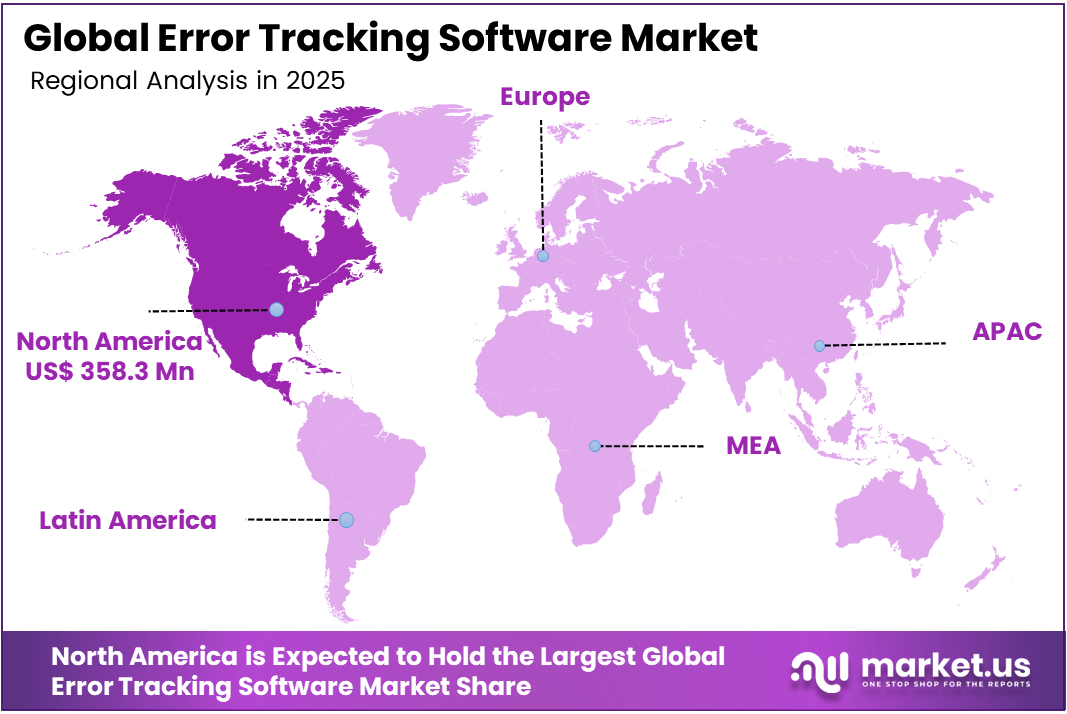
The Global Error Tracking Software Market size is expected to be worth around USD 2,562.8 million by 2035, from USD 799.9 million in 2025, growing at a CAGR of 12.3% during the forecast period from 2026 to 2035. North America held a dominant market position, capturing more than a 44.8% share, holding USD 358.3 million in revenue.
Error Tracking Software refers to a tool that helps development teams detect, record, and analyze software errors across web, mobile, and cloud applications. It shows where an issue started, how often it happens, and which users are affected. This helps teams fix bugs faster, improve application stability, and protect user experience.
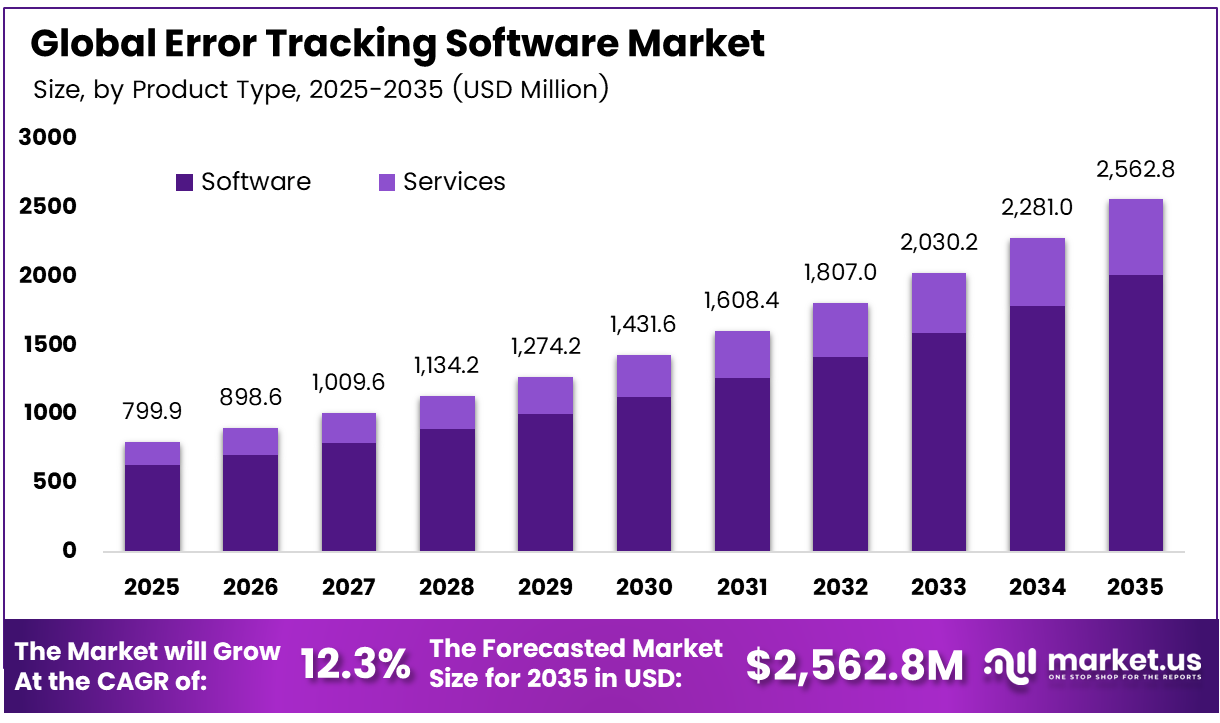
Top driving factors include the rising need to reduce bug-fixing time across engineering teams. Developers report spending up to 50% of their time fixing bugs, making tools that cut diagnosis time by 20–30% highly valuable. Frequent errors in complex web and mobile apps are pushing companies to monitor releases, environments, and key user flows more closely.
The market for Error Tracking Software is driven by the growing complexity of digital applications and the need for faster issue resolution. As businesses rely more on cloud platforms, mobile apps, and frequent software releases, even small errors can affect user experience. Error tracking tools help teams detect problems early, reduce downtime, improve product quality, and support smoother application performance.
Demand analysis shows strong adoption across sectors that release code several times a day and cannot afford downtime. Digital services and online platforms face a high risk, as even a few minutes of disruption can affect thousands of users. As software stacks expand across services and clouds, teams are shifting from ad hoc logging to structured error tracking.
For instance, in February 2026, PostHog added full error-tracking to its product analytics platform, letting teams move from a spike in user drop-offs to the underlying exceptions within one tool. This blurs the line between analytics and monitoring, and shows how younger vendors are challenging incumbents with integrated, product-led offerings.
Key Takeaway
- In 2025, the Software segment held a dominant market position, capturing a 78.5% share of the Global Error Tracking Software Market.
- In 2025, the Cloud-based segment held a dominant market position, capturing a 72.3% share of the Global Error Tracking Software Market.
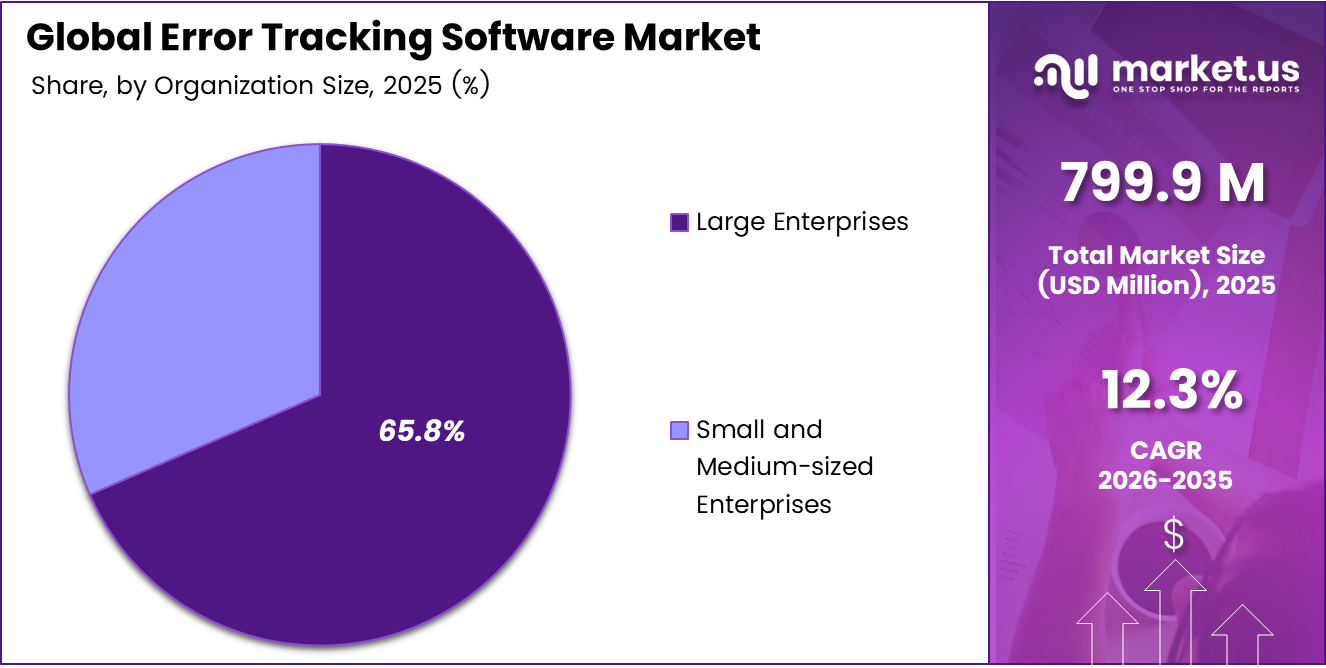
- In 2025, the Large Enterprises segment held a dominant market position, capturing a 65.8% share of the Global Error Tracking Software Market.
- In 2025, the Application Performance Monitoring segment held a dominant market position, capturing a 38.2% share of the Global Error Tracking Software Market.
- In 2025, the IT and Telecommunications segment held a dominant market position, capturing a 42.5% share of the Global Error Tracking Software Market.
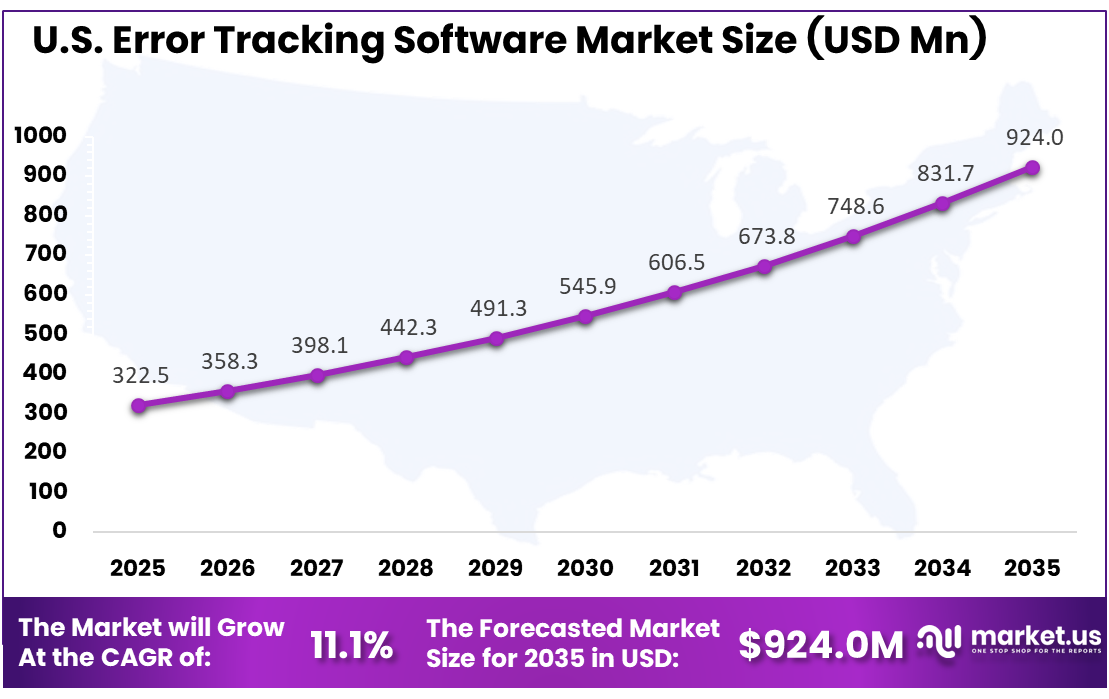
- The U.S. Error Tracking Software Market was valued at USD 322.5 Million in 2025, with a robust CAGR of 11.1%.
- In 2025, North America held a dominant market position in the Global Error Tracking Software Market, capturing more than a 44.8% share.
Role of Generative AI
Generative AI is reshaping how teams detect, classify, and fix software errors in cloud and microservice environments. As telemetry data grows every second, manual log review becomes less effective. More than 40% of IT teams already use AI for monitoring, AIOps, and machine learning model oversight.
AI is also becoming a built-in part of observability platforms. Around 71% of organizations using observability tools now rely on embedded AI features such as automated correlation, AI assistants, and AI-driven recommendations. However, concerns around incorrect analysis and weak recommendations make explainability and human review important.
Investment and Business Benefits
Investment opportunities are growing in tools built for cloud native and microservice-heavy systems. These environments can generate thousands of events per second, so firms need platforms that convert noise into a short and trusted alert list. Vendors combining error tracking, performance metrics, user experience data, and security signals can attract stronger enterprise budgets.
Business benefits are clear as reliable error tracking helps firms improve uptime and availability targets, often set at 99% or higher. Better visibility into production issues supports revenue protection and brand trust. Faster diagnosis also reduces pressure on engineers, limits overtime during incidents, and helps product teams manage releases with greater confidence.
Regional Analysis
In 2025, North America held a dominant market position in the Global Error Tracking Software Market, capturing more than a 44.8% share, holding USD 358.3 million in revenue. This dominance is due to the region’s strong software development base, high cloud adoption, and advanced digital business environment. Companies across North America rely heavily on web, mobile, and enterprise applications, which increases the need for faster error detection and resolution. The presence of mature DevOps practices, frequent software releases, and strict uptime expectations further supports the adoption of error tracking tools across industries.
For instance, in October 2025, New York-based Datadog promoted its Error Tracking product, which automatically aggregates application errors into actionable issues and is bundled for RUM customers, helping North American enterprises triage frontend and backend failures in one observability platform.
U.S. Error Tracking Software Market Size
The market for Error Tracking Software within the U.S. is growing tremendously and is currently valued at USD 322.5 million; the market has a projected CAGR of 11.1%. The market is growing due to the strong presence of digital businesses, software-led enterprises, and cloud-based application environments. Companies are releasing updates more frequently, which increases the need to detect and fix errors before they affect users. Rising use of microservices, mobile apps, and online platforms is also making real-time error visibility important for improving uptime, customer experience, and developer productivity.
For instance, in September 2025, Sentry expanded its industry-leading error monitoring and crash reporting platform to support game consoles like Xbox Series X and Series S, reinforcing U.S. leadership in cross-platform error tracking from its San Francisco base and deepening adoption among North American developers.
Key Regions and Countries
North America
- US
- Canada
Europe
- Germany
- France
- The UK
- Spain
- Italy
- Russia
- Netherlands
- Rest of Europe
Asia Pacific
- China
- Japan
- South Korea
- India
- Australia
- Singapore
- Thailand
- Vietnam
- Rest of APAC
Latin America
- Brazil
- Mexico
- Rest of Latin America
Middle East & Africa
- South Africa
- Saudi Arabia
- UAE
- Rest of MEA
Component Analysis
In 2025, the Software segment held a dominant market position, capturing a 78.5% share of the Global Error Tracking Software Market. This dominance is due to the strong need for tools that can detect, group, and explain application errors in real time. Software solutions help development teams track bugs across releases, user sessions, and environments, which improves issue visibility and supports faster fixes during production incidents.
Software is also preferred because it can connect easily with existing development, testing, and monitoring workflows. Teams can use it to review error patterns, assign issues, and understand failure impact without depending on manual log checks. This makes it useful for improving application stability and release quality.
For instance, in September 2025, Sentry announced AI-powered code review and expanded its Seer debugging agent, helping teams catch defects earlier in the development cycle and tighten the link between code changes and production issues. These advances show how richer software capabilities are driving deeper use of error tracking tools.
Deployment Mode Analysis
In 2025, the Cloud-Based segment held a dominant market position, capturing a 72.3% share of the Global Error Tracking Software Market. Cloud-based deployment is gaining strong preference because it offers easier access, faster setup, and better support for distributed teams. It allows developers and operations teams to monitor application errors across locations, services, and environments without maintaining heavy internal infrastructure.
This model also supports modern software delivery, where applications are updated often and hosted across cloud platforms. Cloud-based error tracking can scale with application traffic and provide centralized visibility. This helps teams respond faster when issues affect users across web, mobile, or enterprise systems.
For instance, in October 2025, Datadog promoted its cloud native error tracking as part of an integrated observability platform, allowing teams to see real-time error streams alongside logs and traces in a hosted environment. This underlines why cloud-based deployments dominate new implementations.
Organization Size Analysis
In 2025, the Large Enterprises segment held a dominant market position, capturing a 65.8% share of the Global Error Tracking Software Market. Large enterprises lead adoption because they manage complex digital systems, multiple applications, and high user traffic. These organizations need reliable error tracking to reduce downtime, protect service quality, and support large development teams working across different business units and technology environments.
For large firms, even small application failures can affect customer trust, employee productivity, and revenue operations. Error tracking software helps teams identify critical issues, prioritize fixes, and maintain accountability across releases. This makes it an important part of enterprise application management.
For instance, in July 2025, New Relic integrated its errors inbox into workload views so large organizations can see problems in the context of specific services and teams. This change helps enterprises cut noise, focus on critical issues, and manage error flows across many applications from a unified, enterprise-ready interface.
Application Analysis
In 2025, the Application Performance Monitoring segment held a dominant market position, capturing a 38.2% share of the Global Error Tracking Software Market. Performance monitoring is a key application because errors often affect speed, availability, and user experience. Teams use error tracking to understand whether slow pages, failed requests, or service delays are linked to code defects, infrastructure issues, or recent deployment changes.
By combining error insights with performance data, teams can find the cause of application problems more clearly. This helps reduce repeated incidents and supports better product quality. It also gives engineering leaders a practical view of how technical issues affect real users.
For instance, in December 2025, Bugsnag introduced a performance score alongside its existing stability metrics, plus better visibility into app hangs and Unreal Engine support. By blending performance and error data, the platform helps teams understand how failures influence responsiveness, mirroring the broader shift toward performance-oriented error monitoring.
End-User Industry Analysis
In 2025, the IT and Telecommunications segment held a dominant market position, capturing a 42.5% share of the Global Error Tracking Software Market. IT and telecommunication companies show strong adoption because they depend on reliable digital platforms, APIs, networks, and customer-facing applications. Continuous service delivery is important in these industries, so error tracking helps teams detect failures early and maintain smooth system performance.
These companies often run large and distributed technology environments where issues can spread quickly across services. Error tracking software supports faster incident response by showing where errors happen and how users are affected. This improves operational control and helps maintain service trust.
For instance, in September 2025, Firebase Crashlytics introduced AI-powered crash insights that help mobile and backend teams in digital services quickly understand why failures happen and what to fix. These capabilities are especially valuable for IT and telecom providers running large user bases.
Key Market Segments
By Component
- Software
- Services
By Deployment Mode
- Cloud-based
- On-premises
By Organization Size
- Large Enterprises
- Small and Medium-sized Enterprises
By Application
- Application Performance Monitoring
- Bug Tracking and Resolution
- Log Management
- Real-time Error Monitoring
- Others
By End-User Industry
- IT and Telecommunications
- Banking, Financial Services, and Insurance
- Healthcare
- Retail and E-commerce
- Others
Emerging Trends
Generative AI is reshaping how teams detect, classify, and fix software errors in cloud and microservice environments. As telemetry data grows every second, manual log review becomes less effective. More than 40% of IT teams already use AI for monitoring, AIOps, and machine learning model oversight.
AI is also becoming a built-in part of observability platforms. Around 71% of organizations using observability tools now rely on embedded AI features such as automated correlation, AI assistants, and AI-driven recommendations. However, concerns around incorrect analysis and weak recommendations make explainability and human review important.
Growth Factors
Growth is supported by wider observability adoption across enterprises. A recent 451 Research survey showed observability tool usage rising by almost 10 percentage points to reach about 45% of organizations. As teams rely on application performance monitoring and log analytics, error tracking becomes important for finding specific exceptions and failed deployments.
Operational pressure on IT and DevOps teams is another key growth factor. One global survey found around 280 hours of median annual downtime, with teams spending nearly a third of their time responding to disruptions. With 42% already using AI for monitoring and 39% planning AIOps adoption, demand is rising.
Market Dynamics
Drivers - Rising Complexity of Digital Systems
The market is driven by the rising complexity of digital systems across web, mobile, cloud, and enterprise applications. As software environments become more distributed, errors are harder to trace manually. Companies need reliable tools that can detect issues quickly and show where failures begin.
Growing use of microservices, APIs, and frequent software releases is increasing the need for structured error tracking. Development teams must monitor many services at the same time to protect application performance. This makes error tracking important for faster debugging, better release control, and stronger user experience.
For instance, in April 2026, Sentry launched its Seer Agent, which lets developers investigate production problems in plain language across all their telemetry. This reflects how complex, distributed systems now demand tools that connect traces, logs, and errors so engineers can understand issues that span many services without digging through fragmented data sources.
Restraint - High Implementation Cost
High implementation cost can restrain adoption, especially among small and mid-sized businesses with limited technology budgets. Error tracking platforms often require setup, integration, training, and ongoing configuration. These added costs may slow buying decisions when firms already use basic logging or internal monitoring tools.
Cost concerns also increase when companies need advanced features, cloud storage, security controls, or support for large application environments. Some firms may delay adoption if they cannot clearly measure the return on investment. This makes pricing flexibility and simple deployment important for vendors.
For instance, in February 2025, Rollbar announced updates to its Python and Java SDKs aimed at improving payload handling and reliability. While these upgrades support complex environments, teams still need to allocate time to update agents, test integrations, and review configuration, which can slow adoption where engineering capacity is tight.
Opportunities - Integration with AI and Automation
Integration with AI and automation creates a strong opportunity for Error Tracking Software providers. AI can help classify errors, reduce duplicate alerts, suggest likely causes, and support faster incident response. This gives engineering teams more time to focus on fixing critical issues instead of reviewing large volumes of logs.
Automation also improves workflow efficiency by routing issues to the right teams and linking errors with recent code changes. As companies seek faster release cycles, automated error tracking can support better software quality. Vendors that offer practical AI features with clear explanations can gain stronger enterprise interest.
For instance, in December 2025, Bugsnag highlighted an MCP-based action for faster AI-assisted error resolution, giving teams the option to use AI tools on top of their error data. This integration can automate repetitive investigation steps and help prioritize issues across large event volumes.
Challenges - Intense Competition
Intense competition remains a key challenge in the Error Tracking Software Market, as many monitoring, observability, and developer tool providers offer similar capabilities. Buyers often compare platforms based on ease of use, integration depth, alert quality, and pricing. This makes product differentiation difficult for newer vendors.
Competition also increases as broader observability platforms add error tracking as part of their wider monitoring suites. Standalone providers must prove that their tools offer deeper insights, faster diagnosis, and better developer workflows. Strong customer support, simple setup, and accurate alerting are becoming important factors for retention.
For instance, in November 2025, TrackJS promoted itself as a focused front-end error monitoring alternative with an emphasis on data quality and simpler pricing compared to larger suites. Positioning around value and specialization reflects intense competition where some customers prefer lean tools over broader, potentially costlier observability platforms.
Key Players Analysis
One of the leading players in November 2025, Rollbar expanded its AI-assisted root-cause analysis features within its error monitoring suite, aiming to cut mean time to resolution for engineering teams. The update prioritizes noisy production environments, where thousands of similar exceptions must be grouped and triaged quickly to protect user experience.
Top Key Players in the Market
- Sentry
- Rollbar
- Raygun
- TrackJS
- Bugsnag
- Airbrake
- LogRocket
- Honeybadger
- Datadog
- New Relic
- Splunk
- Elastic
- Instabug
- Embrace
- Firebase Crashlytics
- Others
Recent Developments
- In December 2025, New Relic refreshed its error analytics in the Telemetry Data Platform, adding richer filters and anomaly detection around application exceptions. The update is aimed at teams consolidating tools, positioning New Relic as a single pane of glass for logs, metrics, traces, and errors.
- In November 2025, Splunk expanded error and exception monitoring use cases within Observability Cloud, emphasizing AI-driven pattern discovery across vast log datasets. For enterprises running distributed microservices, this helps surface recurring failure modes faster and directly supports reliability and SRE objectives.
Report Scope
| Report Features | Description |
|---|---|
| Market Value (2025) | USD 799.9 Million |
| Forecast Revenue (2035) | USD 2,562.8 Million |
| CAGR (2026-2035) | 12.3% |
| Base Year for Estimation | 2025 |
| Historic Period | 2020-2024 |
| Forecast Period | 2026-2035 |
| Report Coverage | Revenue Forecast, Market Dynamics, Competitive Landscape, Recent Developments |
| Segments Covered | By Component (Software, Services), By Deployment Mode (Cloud-based, On-premises), By Organization Size (Large Enterprises, Small and Medium-sized Enterprises), By Application (Application Performance Monitoring, Bug Tracking and Resolution, Log Management, Real-time Error Monitoring, Others), By End-User Industry (IT and Telecommunications, Banking, Financial Services, and Insurance, Healthcare, Retail and E-commerce, Others) |
| Regional Analysis | North America (US and Canada), Europe (Germany, France, The UK, Spain, Italy, and Rest of Europe), Asia Pacific (China, Japan, South Korea, India, Australia, and Rest of APAC), Latin America (Brazil, Mexico, and Rest of Latin America), Middle East & Africa (GCC, South Africa, and Rest of MEA) |
| Competitive Landscape | Sentry, Rollbar, Raygun, TrackJS, Bugsnag, Airbrake, LogRocket, Honeybadger, Datadog, New Relic, Splunk, Elastic, Instabug, Embrace, Firebase Crashlytics, Others |
| Customization Scope | Customization at the segment and region/country levels will be provided. Moreover, customization can be tailored to the requirements. |
| Purchase Options | We have three licenses to opt for: Single User License, Multi-User License (Up to 5 Users), Corporate Use License (Unlimited Users and Printable PDF) |





























