


Report Overview
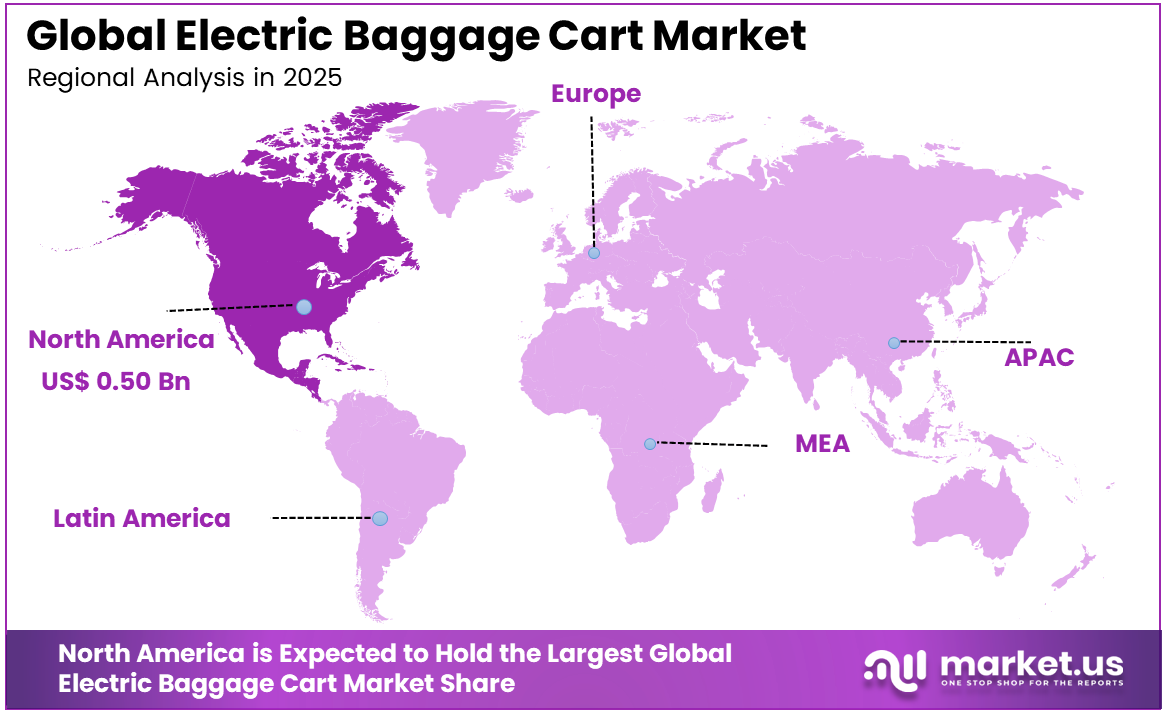
The Global Electric Baggage Cart Market size is expected to be worth around USD 3.36 billion by 2035, from USD 1.37 billion in 2025, growing at a CAGR of 9.4% during the forecast period from 2025 to 2035. North America held a dominant market position, capturing more than a 36.8% share, holding USD 0.50 billion in revenue.
An electric baggage cart refers to a battery-powered ground support vehicle used at airports to transport passenger luggage between terminals, aircraft, and sorting areas. It operates with low noise and no direct emissions, improving ramp conditions. These carts support efficient baggage handling, reduce fuel use, and help airports meet environmental and operational efficiency goals.
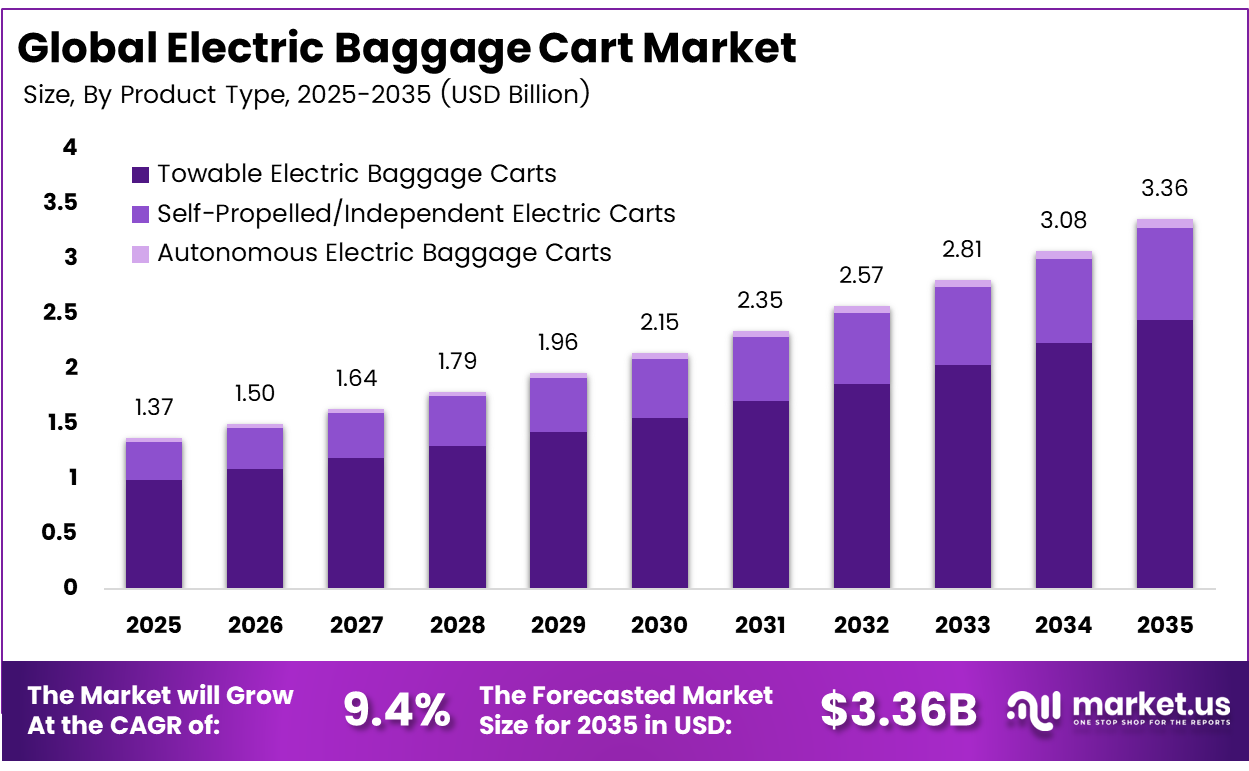
Strict emission rules and rising passenger volumes are shaping demand for cleaner airport operations. Many hubs report year-on-year growth in the mid single to high single digit range, pushing baggage systems to run 24 hours a day. This creates strong pressure to replace aging diesel fleets with efficient and low-emission electric solutions.
The market for electric baggage carts is driven by rising air travel, airport expansion, and the need for cleaner ground operations. Airports are adopting electric equipment to reduce noise and local emissions while improving efficiency. Advances in battery technology and lower maintenance needs are also supporting adoption, as operators look for reliable and cost-effective solutions for daily baggage handling tasks.
Demand continues to increase as airports expand terminals and add new gates to manage traffic growth. There is also a clear shift toward quieter apron operations near runways and stands. Electric carts enable near-zero emissions at the point of use, helping operators meet internal carbon targets without full fleet replacement.
For instance, in October 2025, MULAG Fahrzeugwerk gained fresh attention in market studies as a specialist in customized electric towing and baggage cart solutions, with airports increasingly specifying its low-emission tractors in multi-year fleet renewal tenders, especially where quiet operation and reduced lifetime operating costs are critical.
Key Takeaway
- In 2025, the Towable Electric Baggage Carts (Trains) segment held a dominant market position, capturing a 72.6% share of the Global Electric Baggage Cart Market.
- In 2025, the Medium-Duty (5-15 Tons) segment held a dominant market position, capturing a 65.2% share of the Global Electric Baggage Cart Market.
- In 2025, the Lithium-Ion (Li-ion) Battery segment held a dominant market position, capturing a 58.4% share of the Global Electric Baggage Cart Market.
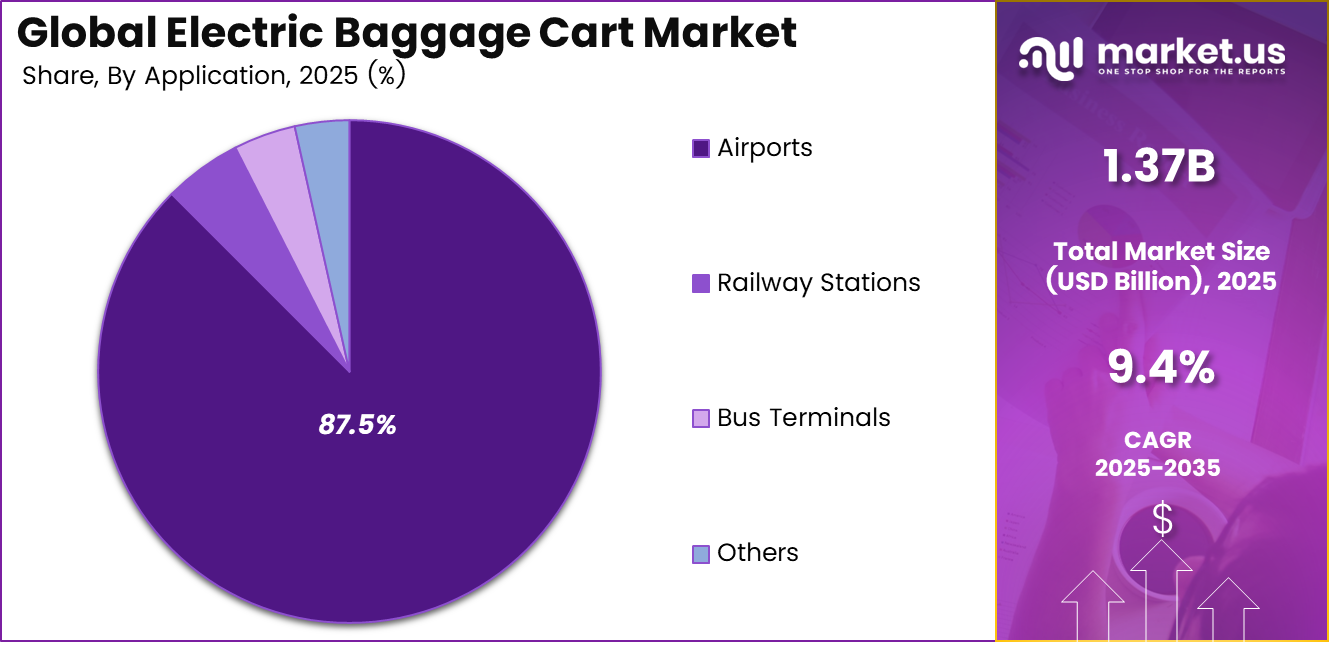
- In 2025, the Airports segment held a dominant market position, capturing a 87.5% share of the Global Electric Baggage Cart Market.
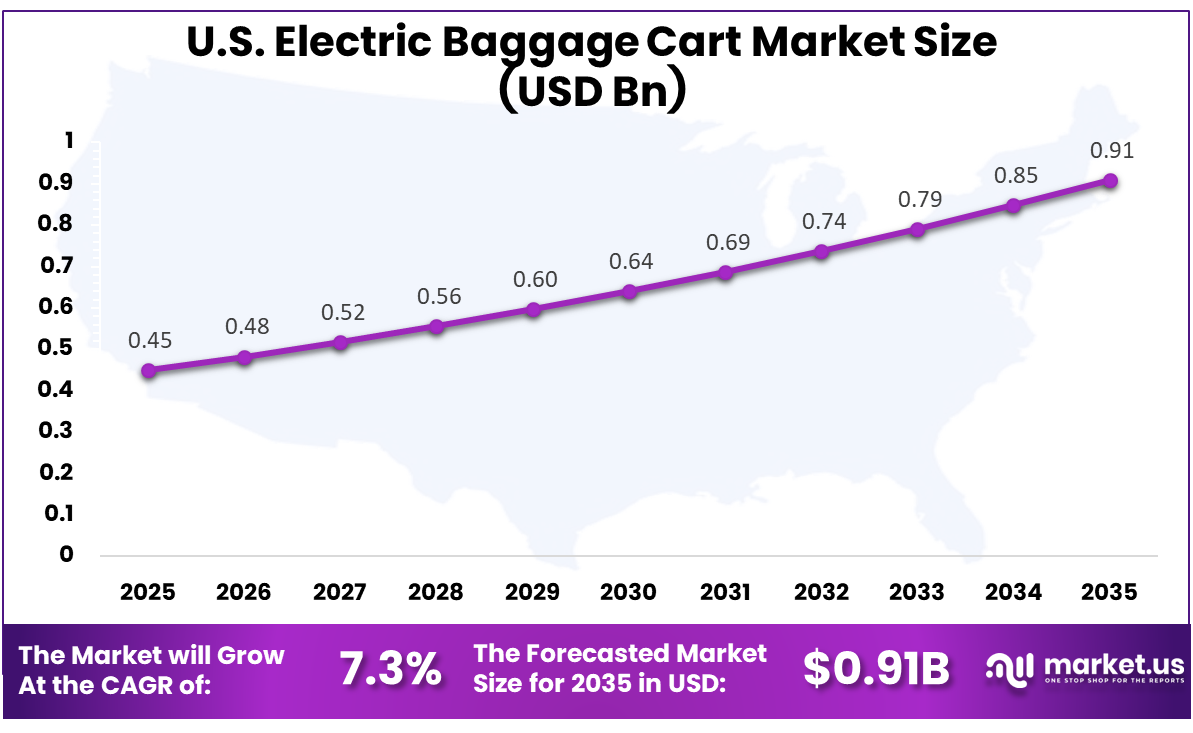
- The U.S. Electric Baggage Cart Market was valued at USD 0.45 Billion in 2025, with a robust CAGR of 7.3%.
- In 2025, North America held a dominant market position in the Global Electric Baggage Cart Market, capturing more than a 36.8% share.
Role of Generative AI
Generative AI is emerging as a digital control layer in baggage handling, using live inputs from carts, conveyors, and scanners to detect issues early. It supports faster decisions by identifying faults before disruptions occur, helping teams maintain continuous operations across complex airport environments with reduced manual monitoring efforts.
Operational trials indicate that applying generative models can reduce unplanned equipment downtime by around 20–30%. Airports are also reporting double-digit improvements in reducing mishandled bags when AI copilots are used. More than 40% of new baggage analytics pilots now reference generative AI, showing growing adoption across aviation systems.
Investment and Business Benefits
Strong investment potential is seen in charging infrastructure, battery leasing, and telematics integration. Large hubs handling tens of thousands of bags per day require scalable and connected solutions. Vendors offering bundled services, including carts, chargers, and software, are well-positioned to benefit from growing green airport budgets and ESG-driven funding.
Electric baggage carts improve operational efficiency through quieter ramps and safer working conditions. They support consistent speeds, which helps reduce minor collisions and bag damage by noticeable double-digit percentages. Connected systems provide real-time data, allowing quick route adjustments and enabling managers to redeploy units within minutes during peak demand.
Regional Analysis
In 2025, North America held a dominant market position in the Global Electric Baggage Cart Market, capturing more than a 36.8% share, holding USD 0.50 billion in revenue. This dominance is due to advanced airport infrastructure, high passenger traffic, and early adoption of electric ground support equipment. Strong environmental policies and continuous investment in airport modernization also support this growth, while operators focus on improving efficiency, reducing emissions, and maintaining reliable baggage handling operations.
For instance, in October 2025, JBT Corporation strengthened North American leadership in electric baggage handling as a named key player in the region’s electric baggage cart and tractor market, benefiting from U.S. airport modernization and sustainability mandates that favor zero-emission ground support equipment across major hubs.
U.S. Electric Baggage Cart Market Size
The market for Electric Baggage Cart within the U.S. is growing tremendously and is currently valued at USD 0.45 billion; the market has a projected CAGR of 7.3%. The market is growing due to rising air passenger traffic across major U.S. airports, which is increasing pressure on baggage handling efficiency. Airports are also focusing on reducing emissions and noise on ramps, leading to a shift from diesel to electric equipment. In addition, ongoing terminal expansions and modernization programs are encouraging the adoption of electric baggage carts to improve operational performance and meet sustainability targets.
For instance, in June 2025, Textron GSE, owner of the TUG brand, reinforced North American dominance with its TUG Endurance all-electric baggage tractor line, offering lithium battery options and long-run reliability that make TUG units a backbone of electric baggage towing fleets at U.S. airports and GSE lessors.
Key Regions and Countries
North America
- US
- Canada
Europe
- Germany
- France
- The UK
- Spain
- Italy
- Russia
- Netherlands
- Rest of Europe
Asia Pacific
- China
- Japan
- South Korea
- India
- Australia
- Singapore
- Thailand
- Vietnam
- Rest of APAC
Latin America
- Brazil
- Mexico
- Rest of Latin America
Middle East & Africa
- South Africa
- Saudi Arabia
- UAE
- Rest of MEA
Product Type Analysis
In 2025, the Towable Electric Baggage Carts (Trains) segment held a dominant market position, capturing a 72.6% share of the Global Electric Baggage Cart Market. This dominance is due to the strong suitability of towable electric baggage carts for routine airport operations where multiple loads must be moved together efficiently. These carts align well with established ground handling practices and help maintain smooth baggage flow across terminals, sorting areas, and aircraft stands during busy schedules.
Towable systems are also preferred because they support continuous and organized movement across the ramp. Airports benefit from better coordination, reduced congestion, and improved handling efficiency. Their ability to operate in structured formations makes them ideal for high-frequency baggage transfers and consistent turnaround performance.
For instance, in December 2024, JBT Corporation introduced its AmpCart towable charging station to help airports electrify ground support fleets without waiting for major infrastructure work. The system allows several chargers to run from a single power input and can be moved around the ramp, which aligns well with the growing use of towable electric baggage cart trains.
Load Capacity Analysis
In 2025, the Medium-Duty (5-15 Tons) segment held a dominant market position, capturing a 65.2% share of the Global Electric Baggage Cart Market. This dominance is due to the balanced performance offered by medium-duty electric baggage carts in airport environments. They provide sufficient strength to handle regular baggage loads while remaining easy to maneuver in tight apron areas, service roads, and near aircraft stands where space and precision are important.
Operators prefer this capacity range because it supports frequent loading cycles without creating operational strain. It allows teams to manage baggage efficiently during peak hours while maintaining control and flexibility in movement, which is essential for maintaining smooth airport ground operations throughout the day.
For instance, in December 2023, Eindhoven Airport invested in new lifting aids and an electric tug to move linked baggage carts more easily on the apron. The electric tug is suited for pulling several medium-duty carts at once, easing physical strain on staff and reinforcing the shift toward powered movement of heavier luggage trains.
Battery Type Analysis
In 2025, the Lithium-Ion (Li-ion) Battery segment held a dominant market position, capturing a 58.4% share of the Global Electric Baggage Cart Market. This dominance is due to the growing preference for lithium-ion batteries in airport operations. These batteries offer faster charging and better energy efficiency, which supports continuous usage during busy airport schedules. Operators benefit from improved reliability and reduced interruptions during high-demand periods.
Lithium-ion technology also supports longer operational cycles, which reduces the need for frequent charging breaks. This improves fleet availability and ensures that baggage movement remains uninterrupted. As airports focus on efficiency and sustainability, lithium-ion systems are becoming a preferred choice in electric ground support equipment.
For instance, in December 2024, JBT’s AmpCart towable charging station was introduced to help airports run electric ground support fleets with modern battery systems and quicker charging in remote ramp areas. Solutions like this are built around lithium-ion technology and make it easier for operators to keep carts in service through the day.
Application Analysis
In 2025, the Airports segment held a dominant market position, capturing a 87.5% share of the Global Electric Baggage Cart Market. This dominance is due to the central role of airports in global baggage handling operations, where continuous movement of luggage is required across multiple zones. Electric baggage carts are specifically designed to support these activities, making airports the primary environment where such equipment is actively deployed.
Airports also prioritize efficient and organized ground operations to handle rising passenger volumes. Electric carts help maintain steady baggage flow while supporting quieter and cleaner apron conditions, which aligns with the operational and environmental expectations of modern airport infrastructure.
For instance, in January 2025, Cavotec announced a contract with a European airport to supply a complete charging and control system for a fleet of electric baggage tractors. The project shows how airports are linking electric towing vehicles and baggage carts with centralized power and control platforms to support day-to-day ramp operations.
Key Market Segments
By Product Type
- Towable Electric Baggage Carts
- Self-Propelled/Independent Electric Carts
- Autonomous Electric Baggage Carts
By Load Capacity
- Light-Duty (Below 5 Tons)
- Medium-Duty (5-15 Tons)
- Heavy-Duty (Above 15 Tons)
By Battery Type
- Lead-Acid Battery
- Lithium-Ion (Li-ion) Battery
- Others (Fuel Cell, etc.)
By Application
- Airports
- Railway Stations
- Bus Terminals
- Others
Emerging Trends
Electric baggage carts are evolving with advancements in battery technology, connectivity, and early automation. Airports are increasingly shifting from lead-acid to lithium-ion batteries due to faster charging and longer operational life. This transition is supported by declining battery costs and higher efficiency in high usage airport environments.
Fleet connectivity is becoming standard, with IoT telematics, GPS, and RFID enabling real-time tracking and monitoring. Operators can manage location, load, and system health from a unified interface. Early adoption of semi-autonomous towing is also emerging, allowing carts to follow routes or operate in coordinated groups for improved efficiency.
Growth Factors
Air travel recovery is driving higher baggage volumes, increasing the need for efficient ground support systems. Electric carts are being adopted to manage rising loads without increasing emissions or workforce demands. Many airports are also focusing on reducing noise and improving air quality around terminals through cleaner equipment alternatives.
Cost dynamics are improving for electric carts as lithium-ion battery prices decline and performance improves. Longer operating cycles and fewer charging interruptions support high-demand periods. Over time, reduced fuel and maintenance costs are helping offset initial investments, making electric solutions more attractive for airport operators managing tight budgets.
Market Dynamics
Drivers - Airport Electrification Push
Airports are steadily moving toward cleaner ground operations as part of broader sustainability goals. Electric baggage carts are being adopted to replace fuel-based equipment, helping reduce local emissions and improve air quality around terminals. This shift is becoming a priority as airports modernize infrastructure and align with environmental expectations.
Operational efficiency is also improving with electric fleets as they offer quieter performance and smoother handling. Airports benefit from better working conditions on ramps and more predictable equipment behavior. This makes electric carts a practical choice for managing growing passenger traffic while maintaining consistent and reliable baggage movement.
For instance, in October 2023, JBT AeroTech teamed up with a hydrogen aviation start-up to develop H2AmpCart, a fuel-cell-powered mobile charger for electric ground support fleets, giving airports another path to decarbonise ramp operations. The project shows how large GSE suppliers are aligning with airport electrification plans and helping operators keep electric baggage tractors and carts powered without relying on diesel generators.
Restraint - High Initial Investment
The adoption of electric baggage carts is limited by the higher upfront investment required for vehicles and charging infrastructure. Airports must allocate funds for equipment purchase, installation of charging systems, and staff training. This financial burden can slow decision-making, especially for smaller airports managing tight operational budgets.
In addition, transitioning from traditional systems requires operational adjustments that may increase short-term costs. Managing battery usage, scheduling charging cycles, and maintaining new systems can create added complexity. These factors often lead operators to delay adoption until clear long-term benefits are established.
For instance, in March 2026, industry analyses of electric baggage tow tractors note Textron among suppliers of lithium-powered models that promise lower lifetime costs but need higher upfront spending on vehicles and compatible chargers. For some operators, the combination of premium tractors and new fast charging infrastructure slows decision-making, even when long-term fuel and maintenance savings look compelling on paper.
Opportunities - Smart and Connected Systems
There is strong potential in integrating electric baggage carts with smart technologies such as telematics and real-time monitoring systems. Connected fleets allow operators to track movement, manage loads, and optimize routes, improving overall efficiency in baggage handling operations across airport environments.
As airports expand and upgrade infrastructure, the demand for intelligent ground support solutions continues to grow. Vendors that offer integrated systems combining vehicles, software, and service support can benefit from this shift. These solutions help airports improve coordination, reduce delays, and enhance operational visibility.
For instance, in October 2023, the H2AmpCart project by JBT is not only about alternative power; it is intended to support data collection and intelligent charging management for electric GSE on the ramp. By linking mobile power units with fleet information, JBT positions itself to offer smarter charging strategies that can be integrated into wider airport energy and asset platforms.
Challenges - Charging and Operational Constraints
Managing charging schedules remains a key challenge for electric baggage carts in busy airport environments. Equipment must remain available throughout the day, and poorly planned charging can disrupt operations. Airports need well-designed charging strategies to ensure continuous workflow without affecting baggage handling timelines.
Operational reliability can also be affected by battery performance under heavy usage. Factors such as frequent cycles and varying environmental conditions can influence efficiency. Maintaining consistent performance requires careful monitoring, regular maintenance, and proper planning to ensure that electric carts meet the demands of daily airport operations.
For instance, in February 2024, reports on electric baggage tow tractors highlight that even with longer ranges, operators must plan charging windows carefully to avoid downtime at peak periods. For suppliers like Textron, this means supporting fast charging and modular batteries while working with airports that may not yet have dense charging networks in all baggage handling areas.
Key Players Analysis
One of the leading players in March 2025, JBT expanded its ground-support footprint by acquiring G & A Equipment, strengthening its service coverage for electric baggage carts and tow tractors across North America. The deal helps JBT cross-sell its Textron-Lektro-style electric tugs into existing GSE fleets and underlines its push into lower-emission airport handling solutions.
Top Key Players in the Market
- JBT Corporation
- Schmaco
- MULAG
- Flygprestanda
- Cavotec
- Aero Specialties
- Ground Support Equipment
- NMCWollard
- TLD Group
- Tronair
- Textron
- SinoGalaxy
- TUG Technologies
- Boeing
- Eagle Tugs
- Others
Recent Developments
- In May 2025, Aero Specialties rolled out a next-generation electric luggage cart platform featuring integrated telematics and modular lithium battery packs to extend runtime while cutting maintenance downtime. The design targets airports upgrading to fully electric baggage flows and gives operators better visibility of cart utilisation, energy consumption, and health status across fleets.
- In October 2025, Eagle Tugs continues to be cited as a specialist in heavy-duty electric tugs used to move baggage cart trains and other GSE in congested ramp environments. Its focus on high-torque, low-maintenance drivetrains and towbarless designs taps into airports’ need to cut emissions without compromising on towing capacity or manoeuvrability.
Report Scope
| Report Features | Description |
|---|---|
| Market Value (2025) | USD 1.37 Billion |
| Forecast Revenue (2035) | USD 3.36 Billion |
| CAGR (2026-2035) | 9.4% |
| Base Year for Estimation | 2025 |
| Historic Period | 2020-2024 |
| Forecast Period | 2026-2035 |
| Report Coverage | Revenue Forecast, Market Dynamics, Competitive Landscape, Recent Developments |
| Segments Covered | By Product Type (Towable Electric Baggage Carts, Self-Propelled/Independent Electric Carts, Autonomous Electric Baggage Carts), By Load Capacity (Light-Duty (Below 5 Tons), Medium-Duty (5-15 Tons), Heavy-Duty (Above 15 Tons)), By Battery Type (Lead-Acid Battery, Lithium-Ion (Li-ion) Battery, Others (Fuel Cell, etc.)), By Application (Airports, Railway Stations, Bus Terminals, Others) |
| Regional Analysis | North America (US and Canada), Europe (Germany, France, The UK, Spain, Italy, and Rest of Europe), Asia Pacific (China, Japan, South Korea, India, Australia, and Rest of APAC), Latin America (Brazil, Mexico, and Rest of Latin America), Middle East & Africa (GCC, South Africa, and Rest of MEA) |
| Competitive Landscape | JBT Corporation, Schmaco, MULAG, Flygprestanda, Cavotec, Aero Specialties, Ground Support Equipment, NMCWollard, TLD Group, Tronair, Textron, SinoGalaxy, TUG Technologies, Boeing, Eagle Tugs, Others |
| Customization Scope | Customization for segments and region/country levels will be provided. Moreover, customization can be tailored to the requirements. |
| Purchase Options | We have three licenses to opt for: Single User License, Multi-User License (Up to 5 Users), Corporate Use License (Unlimited Users and Printable PDF) |





































