


Report Overview
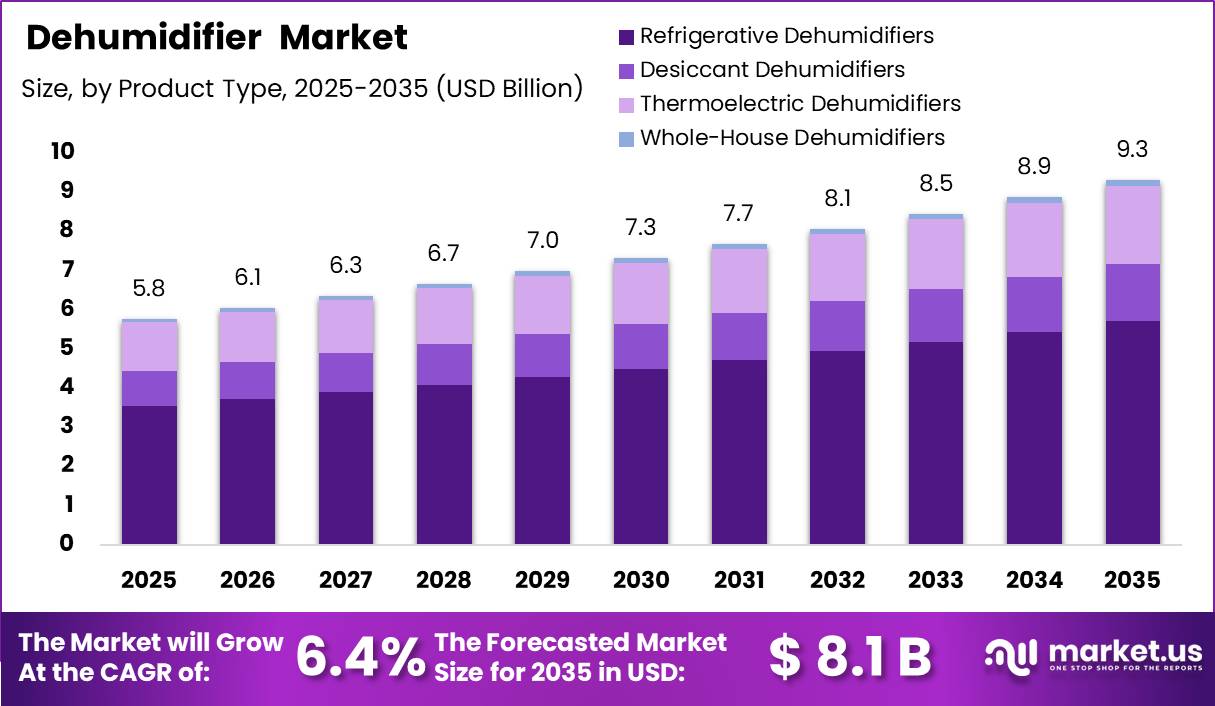
Global Dehumidifier Market size is expected to be worth around USD 8.1 Billion by 2035 from USD 4.4 Billion in 2025, growing at a CAGR of 6.4% during the forecast period 2026 to 2035. This trajectory reflects durable structural demand across residential, commercial, and industrial end-use segments worldwide.
The dehumidifier market encompasses equipment designed to extract excess moisture from air, spanning refrigerative, desiccant, thermoelectric, and whole-house system types. Products are deployed across residential spaces, commercial facilities, and industrial production environments. Distribution occurs through offline retail stores, online channels, and direct sales. Portable units and fixed whole-house systems form the two primary installation categories.
Key Takeaways
- Market size in 2025: USD 4.4 Billion
- Forecast market size by 2035: USD 8.1 Billion
- CAGR (2026–2035): 6.4%
- Dominant product type: Refrigerative Dehumidifiers with 61.30% share
- Dominant capacity segment: 20–50 Liters/Day with 46.80% share
- Dominant application: Residential with 54.60% share
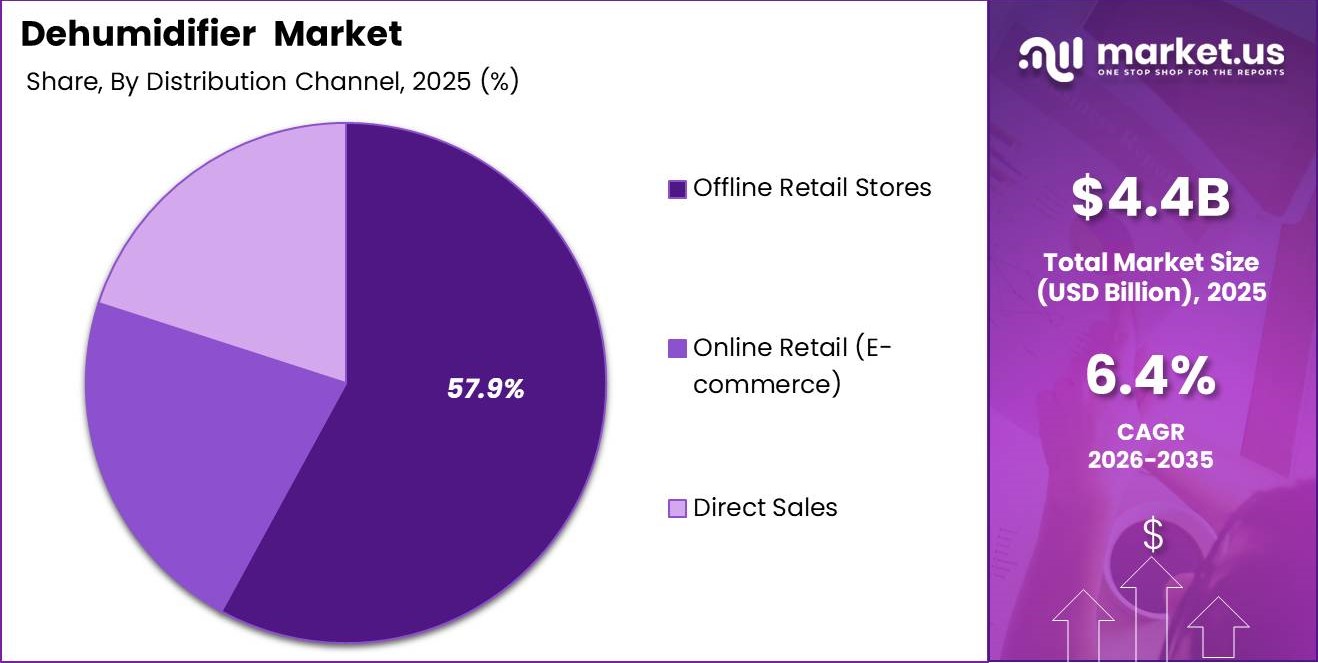
- Dominant distribution channel: Offline Retail Stores with 57.90% share
- Dominant installation type: Portable Dehumidifiers with 63.20% share
- Dominant technology: Compressor-Based with 68.40% share
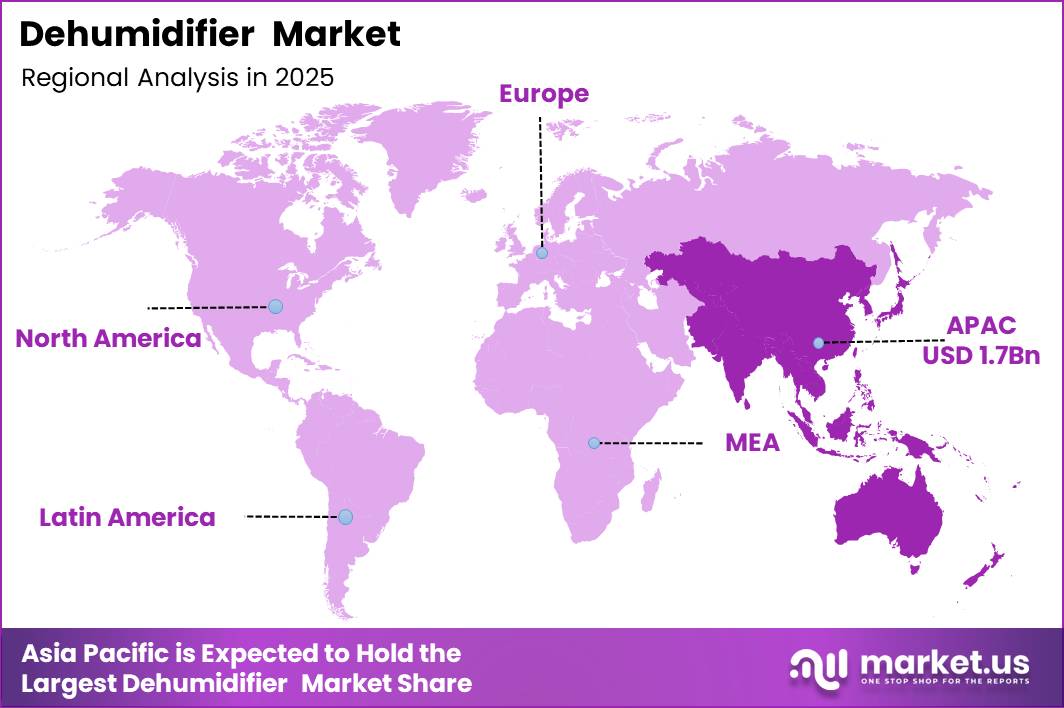
- Leading region: Asia-Pacific with 38.70% share, valued at USD 1.7 Billion
Government regulation and industrial policy are reshaping the competitive landscape for dehumidifier manufacturers. The U.S. EPA’s AIM Act mandates an 85% phasedown of HFC refrigerants across a fifteen-year window, forcing product-line redesigns across the industry. Manufacturers that delay refrigerant transitions face market access restrictions that will compound over time.
Data infrastructure investment is creating durable industrial demand for precision humidity control. According to the U.S. Department of Energy, data centers account for approximately 2% of total U.S. electricity consumption, making environmental control a mission-critical infrastructure requirement. This positions dehumidification suppliers with industrial-grade offerings at the center of a structurally growing procurement cycle.
Data from the IEA shows global data-center electricity consumption reached approximately 415 TWh in 2024. This scale of energy use makes precision humidity management an unavoidable operational requirement, not a discretionary upgrade. Suppliers targeting data-center operators with purpose-built moisture control systems stand to capture a high-value, contract-driven revenue stream that carries superior margin versus residential units.
Product Type Analysis
Refrigerative Dehumidifiers dominate with 61.30% due to widespread residential and commercial cost efficiency.
In 2025, Refrigerative Dehumidifiers held a dominant market position in the By Product Type segment of the Dehumidifier Market, with a 61.30% share. Refrigerative units use compressor-driven condensation to extract moisture, delivering reliable performance across the broadest range of ambient temperature conditions. This technical versatility makes them the default specification for residential buyers, commercial property managers, and post-disaster restoration contractors alike, securing their structural dominance across all major distribution channels.
Desiccant Dehumidifiers serve a functionally distinct role, operating effectively at lower temperatures where refrigerant-based systems lose efficiency. This positions desiccant units as the preferred choice in cold-chain logistics, pharmaceutical cold storage, and industrial facilities requiring sub-zero dew point control. Buyers in these segments accept a higher operating cost in exchange for performance reliability that compressor-based systems cannot match at low temperatures.
Thermoelectric Dehumidifiers address a narrow but stable sub-segment defined by noise sensitivity and space constraints. These units use Peltier cooling elements rather than compressors, producing near-silent operation preferred in bedrooms, server rooms, and small enclosed spaces. Their lower moisture-removal capacity limits their appeal to compact residential applications, which constrains volume potential but sustains consistent retail demand at the entry-level price point.
Whole-House Dehumidifiers serve buyers seeking centralized humidity management integrated directly into existing HVAC ducting. This sub-segment benefits from the broader trend of whole-home air quality investment. Thermoelectric and whole-house units together hold the remaining share of the product type segment, with growth potential linked to new residential construction activity and smart-home integration adoption rates.
Capacity Analysis
20–50 Liters/Day dominates with 46.80% due to optimal sizing for mainstream residential and light-commercial use.
In 2025, 20–50 Liters/Day held a dominant market position in the By Capacity segment of the Dehumidifier Market, with a 46.80% share. This capacity range aligns precisely with the moisture-removal needs of standard residential floor plans and light-commercial spaces such as offices, retail units, and small warehouses. As per our research, moisture contamination can significantly reduce lithium-ion battery quality and manufacturing yield, making ultra-low-humidity environments mandatory rather than optional. This creates additional demand for mid-capacity units in battery assembly pre-treatment zones where full industrial-grade systems are cost-prohibitive.
Below 20 Liters/Day units serve compact applications including single-room residential use, small enclosed storage areas, and portable personal-use scenarios. Price sensitivity governs purchasing behavior in this sub-segment, with buyers prioritizing low upfront cost over energy efficiency ratings. This segment functions primarily as an entry point for first-time buyers in price-sensitive emerging markets rather than a high-margin revenue driver for established brands.
Above 50 Liters/Day units address heavy-duty industrial, large-scale commercial, and critical-infrastructure applications where continuous high-volume moisture removal is non-negotiable. In 2025, industrial dehumidification suppliers increased deployment of ultra-low humidity systems designed to maintain battery production environments below -40°C dew point. This technical requirement pushes procurement toward specialized high-capacity units, expanding average transaction values and lifting revenue per deployment well above residential-category averages.
Application Analysis
Residential dominates with 54.60% due to broad household demand across all climate zones.
In 2025, Residential held a dominant market position in the By Application segment of the Dehumidifier Market, with a 54.60% share. Homeowners purchasing dehumidifiers prioritize moisture-related health outcomes, including mold prevention and allergen reduction, alongside structural protection for basements and crawl spaces. This broad motivational base sustains stable volume demand independent of any single climate event, making residential the most defensible volume segment in the market.
Commercial applications span hospitality, retail, healthcare facilities, and office buildings where humidity management directly affects asset preservation and occupant comfort. Based on EPA data, humidity-control equipment can represent a significant portion of HVAC energy consumption in commercial buildings. This energy cost reality drives procurement decisions toward higher-efficiency systems, creating a clear commercial incentive for suppliers to position energy-rated dehumidifiers as cost-reduction tools rather than simple comfort upgrades.
Industrial applications represent the highest-value demand category on a per-unit and per-contract basis. FDA manufacturing guidance requires environmental conditions, including humidity, to be monitored and controlled whenever product quality could be affected. ISPE indicates that humidity control is a critical environmental parameter in sterile and biologics manufacturing facilities. Together, these regulatory mandates eliminate discretionary spending behavior in the industrial segment, converting humidity control from an optional capital expenditure into a compliance requirement with enforceable consequences.
Distribution Channel Analysis
Offline Retail Stores dominate with 57.90% due to consumer preference for in-store product evaluation.
In 2025, Offline Retail Stores held a dominant market position in the By Distribution Channel segment of the Dehumidifier Market, with a 57.90% share. Physical retail gives buyers the ability to assess unit size, noise level, and build quality before purchase, reducing return rates and supporting higher average transaction values. Home improvement chains and appliance retailers benefit from add-on sales of accessories, filters, and installation services, reinforcing the structural advantage of the offline channel for bulky appliance categories.
Online Retail has established a clear growth trajectory as product familiarity increases and consumer confidence in appliance e-commerce improves. Parks Associates found that more than 45% of U.S. internet households have at least one smart-home device connected to a management platform. This connectivity baseline signals buyer readiness for digitally marketed and app-integrated dehumidifier products, giving online platforms a natural advantage in promoting premium connected units to an already-qualified audience.
Direct Sales channels serve industrial, commercial, and government buyers who require customized specifications, volume pricing, and contracted service agreements. This channel bypasses standard retail margin structures, allowing manufacturers to capture a larger share of revenue per transaction while building long-term procurement relationships with institutional clients. Direct Sales also supports after-sales service contracts, which generate recurring revenue that retail and e-commerce channels cannot replicate.
Installation Type Analysis
Portable Dehumidifiers dominate with 63.20% due to flexibility and low installation cost for residential buyers.
In 2025, Portable Dehumidifiers held a dominant market position in the By Installation Type segment of the Dehumidifier Market, with a 63.20% share. Portable units require no professional installation, no ductwork modification, and no structural alteration, removing the primary friction points that delay purchasing decisions for residential buyers. This plug-and-use convenience also makes portable dehumidifiers the default choice for rental properties, temporary commercial spaces, and emergency water damage response scenarios.
Fixed/Whole-House Systems address buyers seeking permanent, centralized humidity management integrated into residential or commercial HVAC infrastructure. This sub-segment commands a significantly higher average unit price and generates installation service revenue for HVAC contractors. Fixed systems hold the remaining share of the installation type segment, with growth linked to new construction activity and renovation projects where HVAC upgrades are already planned, reducing the incremental cost barrier for buyers.
Technology Analysis
Compressor-Based dominates with 68.40% due to cost efficiency and broad temperature range performance.
In 2025, Compressor-Based technology held a dominant market position in the By Technology segment of the Dehumidifier Market, with a 68.40% share. Compressor-based systems deliver the best energy efficiency ratio across the widest ambient temperature range, making them the default engineering choice for mainstream residential and commercial dehumidifier product lines. Their well-established supply chain and component standardization further reinforce cost advantages that deter displacement by alternative technologies in volume segments. Benchmark Mineral Intelligence reported that 401 gigafactories were planned to be operational by 2030, a buildout scale that will require precision dehumidification across battery cell production lines and drive incremental demand for compressor-based industrial systems.
Heat Pump Technology represents a smaller but strategically important sub-segment positioned around energy recovery and operating cost reduction. Heat pump dehumidifiers recapture latent heat from the moisture removal process and redirect it for space heating or process warming applications, delivering measurable energy cost benefits in facilities where both dehumidification and heating loads coexist. This sub-segment holds the remaining share of the technology segment and will benefit as industrial buyers intensify focus on total cost of ownership rather than capital purchase price alone.
Key Market Segments
By Product Type
- Refrigerative Dehumidifiers
- Desiccant Dehumidifiers
- Thermoelectric Dehumidifiers
- Whole-House Dehumidifiers
By Capacity
- 20–50 Liters/Day
- Below 20 Liters/Day
- Above 50 Liters/Day
By Application
- Residential
- Commercial
- Industrial
By Distribution Channel
- Offline Retail Stores
- Online Retail (E-commerce)
- Direct Sales
By Installation Type
- Portable Dehumidifiers
- Fixed/Whole-House Systems
By Technology
- Compressor-Based
- Heat Pump Technology
Regional Analysis
Asia-Pacific Dominates the Dehumidifier Market with a Market Share of 38.70%, Valued at USD 1.7 Billion
Asia-Pacific commands the largest regional position in the global dehumidifier market, driven by high ambient humidity across tropical and subtropical climates, rapid urbanization across China, India, Vietnam, and Indonesia, and accelerating industrial output requiring process humidity control. The region’s expanding middle class is converting discretionary air quality spending into a mainstream residential purchase category, sustaining volume demand across both premium and entry-level product tiers.
North America holds the second-largest regional position, supported by structural demand from water damage restoration activity, pharmaceutical manufacturing compliance requirements, and whole-home HVAC integration in new residential construction. The U.S. market faces near-term product transition costs driven by AIM Act HFC phasedown mandates. However, these compliance requirements simultaneously create procurement cycles as commercial and industrial buyers upgrade non-compliant installed equipment ahead of enforcement deadlines.
Europe’s dehumidifier market is shaped by stringent F-Gas regulations, energy efficiency mandates, and increasing frequency of extreme rainfall events across Northern and Western European markets. The EU’s Regulation 2024/573 has accelerated refrigerant transition timelines, compressing product development windows for manufacturers serving European retail and commercial channels. Buyers in Germany, France, and the UK are increasingly specifying low-GWP refrigerant systems as the standard, not the premium, option.
Latin America and the Middle East and Africa represent structurally early-stage markets where residential penetration remains limited by price sensitivity, product awareness gaps, and fragmented distribution infrastructure. Both regions carry long-term volume potential linked to urban construction growth and expanding cold-chain logistics networks. Suppliers entering these markets early through direct sales partnerships or distributor agreements will hold durable channel advantages before mainstream retail competition intensifies.
Key Regions and Countries
North America
- US
- Canada
Europe
- Germany
- France
- The UK
- Spain
- Italy
- Rest of Europe
Asia-Pacific
- China
- Japan
- South Korea
- India
- Australia
- Rest of APAC
Latin America
- Brazil
- Mexico
- Rest of Latin America
Middle East and Africa
- GCC
- South Africa
- Rest of MEA
Market Dynamics
Market Opportunity Analysis - Underserved industrial segments and emerging regional markets offer high-value entry points for dehumidifier suppliers
The industrial application sub-segment remains structurally underpenetrated relative to its compliance-driven demand potential. Pharmaceutical manufacturers, biologics storage operators, and electronics production facilities face regulatory mandates that convert humidity control from optional to required capital expenditure. Suppliers that position industrial-grade systems around compliance documentation and audit-ready performance data will displace generalist vendors in this procurement category.
The Above 50 Liters/Day capacity segment carries the highest per-unit revenue potential in the market, yet it serves a narrower buyer base concentrated in data centers, battery gigafactories, and cold-chain logistics. This concentration means that winning a single long-term supply agreement with a hyperscale operator or a gigafactory developer delivers revenue equivalent to thousands of residential unit sales. Suppliers with certified industrial system performance data hold a decisive specification advantage in these procurement processes.
Latin America and the Middle East and Africa remain the least penetrated regional markets relative to underlying humidity and infrastructure conditions. Residential awareness gaps and fragmented distribution networks are the primary barriers, not consumer income levels alone. By contrast, direct sales partnerships with regional construction conglomerates and cold-chain operators offer an alternative channel that bypasses retail infrastructure gaps entirely and captures commercial demand ahead of mainstream residential market development.
The Fixed/Whole-House Systems sub-segment is constrained today by HVAC technician shortages across the U.S., Canada, the UK, and Australia. This creates a structural entry opportunity for suppliers who bundle installation services with product sales, either through proprietary service networks or certified contractor partnerships. This reflects a broader market pattern where the highest-margin sub-segments are gated not by product price but by installation and service access.
Technology and Innovation Landscape - Cloud connectivity, AI control, desiccant rotor advances, and heat recovery integration are redefining competitive differentiation in the dehumidifier market
Cloud-connected dehumidifiers capable of remote diagnostics and fleet-wide performance monitoring are shifting the competitive basis in industrial and commercial segments from unit price to total lifecycle cost. Operators managing large equipment fleets gain predictive maintenance capability that reduces unplanned downtime and extends asset service life. Suppliers that deliver proven uptime data alongside connected hardware will command contract renewal advantages that standalone product vendors cannot replicate.
AI-controlled dehumidification systems are producing measurable energy efficiency gains at scale. Munters reported energy savings of up to 30% from AI-controlled systems during 2025 industrial deployments, a performance level that directly reduces operating cost arguments against continuous dehumidifier use in energy-cost-sensitive facilities. This creates a commercial justification for facility managers to upgrade from basic digital-display units to AI-enabled platforms, expanding the addressable market for premium industrial systems.
Desiccant rotor technologies are displacing compressor-based systems in low-temperature applications where refrigerant efficiency declines sharply. Battery gigafactory dry rooms, pharmaceutical cold storage, and cold-chain logistics facilities all require sub-zero dew point environments where desiccant rotors maintain performance advantages. Suppliers with established desiccant rotor product lines are positioned to capture specification wins in these critical-infrastructure segments as global gigafactory buildout scales through 2030.
Heat-recovery module integration addresses the energy cost barrier that limits industrial dehumidifier adoption in facilities with tight energy budgets. By redirecting latent heat captured during moisture removal back into facility heating or process warming loads, heat-recovery systems reduce net energy consumption per unit of moisture removed. This positions heat-recovery-equipped dehumidifiers as capital investments with calculable payback periods rather than pure operating cost items, accelerating procurement approval cycles in industrial buyer organizations.
Drivers
Extreme weather events are generating two distinct demand surges for dehumidifiers: emergency restoration deployments and sustained post-event replacement purchases. NOAA recorded 28 separate billion-dollar weather and climate disaster events in 2023 and 23 in 2024. Water damage restoration accounts for an estimated 35–45% of all commercial-grade dehumidifier deployments, growing at a CAGR of approximately 5–7% annually. Industrial LGR dehumidifiers command 3–5× the unit price of residential counterparts, materially lifting the market’s overall revenue composition toward higher-margin products.
Pharmaceutical, food and beverage, and electronics sectors are expanding industrial process demand for precision humidity control across India, China, and Southeast Asia. Construction and real estate activity across South and Southeast Asia and the Middle East is simultaneously driving post-construction drying demand. HVAC integration and whole-home dehumidifier adoption in new construction across North America, Australia, and the Gulf Cooperation Council is adding a medium-term structural demand layer. Asia-Pacific urbanization and rising middle-class purchasing power across China, India, Vietnam, and Indonesia convert these industrial and residential demand signals into durable volume growth.
| Driver | (~) % Impact on CAGR Forecast | Geographic Relevance | Impact Timeline |
|---|---|---|---|
| Climate Change-Driven Extreme Weather & Flood Event Frequency | +2.1% | North America, South & Southeast Asia, Europe | Short term (≤ 2 years) |
| Rising Indoor Air Quality & Health Awareness (Mold, Allergen Prevention) | +1.6% | Global, led by North America, Japan, South Korea, Germany | Short term (≤ 2 years) |
| Construction & Real Estate Boom Driving Commercial & Post-Construction Drying Demand | +1.3% | South & Southeast Asia, Middle East, North America | Medium term (2–4 years) |
| Pharmaceutical, Food & Beverage, and Electronics Industrial Process Demand | +1.0% | Global, accelerating in India, China, Southeast Asia | Medium term (2–4 years) |
| HVAC Integration & Whole-Home Dehumidifier Adoption in New Construction | +0.9% | North America, Australia, Gulf Cooperation Council | Medium term (2–4 years) |
| Asia-Pacific Urbanization & Rising Middle-Class Purchasing Power | +0.8% | China, India, Vietnam, Indonesia, Thailand | Medium term (2–4 years) |
Restraints
The mandatory transition away from high-GWP HFC refrigerants is the most structurally disruptive restraint in the dehumidifier market. The EU’s Regulation 2024/573 restricts new equipment using refrigerants with GWP above 750 from 2025, while the U.S. EPA’s AIM Act sets a GWP threshold of 700 or below under SNAP approval. Re-tooling capital expenditure for a mid-tier OEM across 8–15 SKUs is estimated at $12–$35 million per product platform, compressing operating margins by an estimated 3–6 percentage points on affected lines through at least 2027.
High upfront purchase costs suppress residential adoption across India, Southeast Asia, Latin America, and Africa, where price sensitivity governs appliance buying decisions. Elevated operating energy costs further limit consumer willingness to run units continuously across Europe, North America, and Japan. U.S.–China tariff escalation is raising compressor and component import costs for North American assemblers, adding further margin pressure across the supply chain.
| Restraint | (~) % Impact on CAGR Forecast | Geographic Relevance | Impact Timeline |
|---|---|---|---|
| HFC Refrigerant Phase-Down Compliance Disrupting Product Supply & CapEx | -1.8% | European Union, United States (AIM Act), California, Washington State | Short term (≤ 2 years) |
| High Upfront Purchase Cost Suppressing Residential Adoption in Price-Sensitive Markets | -1.2% | India, Southeast Asia, Latin America, Africa | Medium term (2–4 years) |
| Elevated Operating Energy Costs Limiting Consumer Willingness to Run Units Continuously | -0.9% | Europe, North America, Japan | Short term (≤ 2 years) |
| U.S.–China Tariff Escalation Raising Compressor & Component Import Costs | -0.8% | United States, import-dependent assembly markets | Short term (≤ 2 years) |
| Regulatory Uncertainty Post-DOE Standards Rescission Proposal (May 2025) | -0.5% | United States | Short term (≤ 2 years) |
Challenges
Compressor and electronic component supply concentration is the most persistent long-term friction drag on the dehumidifier market. An estimated 70–80% of hermetic compressors used globally originate in China, with a further 10–12% concentrated in South Korea and Japan. During the 2021–2023 supply chain disruption, compressor lead times extended from a baseline of 8–12 weeks to 28–40 weeks at peak shortage. Nearshoring compressor procurement to ASEAN or Mexico carries a 15–25% unit cost premium over Chinese-sourced equivalents at current production scale.
Consumer education gaps across India, Southeast Asia, the Middle East, Africa, and Latin America slow residential market formalization in high-potential geographies. Seasonal demand volatility in North America, Northern Europe, and Japan creates inventory risk that compresses distributor margins. HVAC technician shortages in the U.S., Canada, the UK, and Australia are slowing whole-home installation uptake, directly limiting the fixed-system sub-segment’s growth rate relative to its structural demand potential.
| Challenge | (~) % CAGR Friction Drag | Geographic Relevance | Mitigation Horizon |
|---|---|---|---|
| Compressor & Component Supply Concentration | -1.5% | Global, most acute in North America & Europe (China-sourced inputs) | Long term (≥ 4 years) |
| Consumer Education & Product Awareness Gap | -1.1% | India, Southeast Asia, Middle East, Africa, Latin America | Medium term (2–4 years) |
| Seasonal Demand Volatility & Inventory Risk | -0.9% | North America, Northern Europe, Japan | Short term (≤ 2 years) |
| Fragmented Service & Maintenance Infrastructure | -0.7% | Emerging markets globally | Long term (≥ 4 years) |
| HVAC Technician Shortage Slowing Whole-Home Installation | -0.6% | United States, Canada, United Kingdom, Australia | Medium term (2–4 years) |
Opportunities
The smart and IoT-connected dehumidifier segment represents the market’s most actionable near-term premiumization opportunity. Consumer surveys from AHAM indicate that over 60% of dehumidifier buyers in the $300+ residential segment prefer app-based control, yet fewer than 12–15% of retail models carry Wi-Fi connectivity as standard. Smart units carry an average retail price premium of $80–$140 per unit over comparable non-connected models, while the incremental bill-of-materials cost for Wi-Fi and sensor capability is approximately $8–$15 per unit at production scale. Brands executing this upgrade capture an incremental gross margin contribution of $65–$125 per smart unit.
Dry-room humidity control systems for lithium-ion battery and EV cell manufacturing facilities represent a structurally expanding industrial revenue stream. Moisture-sensitive biologics storage and advanced drug environments require tighter atmospheric control standards, creating contract-driven demand for precision systems. Modular dehumidification units for temporary warehouses, construction sites, and mobile industrial operations extend addressable market reach into project-based procurement cycles that recurring service models can follow.
| Opportunity | (~) % Potential CAGR Upside | Geographic Relevance | Execution Window |
|---|---|---|---|
| Smart & IoT-Connected Dehumidifier Premiumization | +2.0% | North America, Western Europe, Japan, South Korea, premium Asia-Pacific | Medium term (2–4 years) |
| Dehumidifier-as-a-Service & Rental Model Expansion | +1.6% | North America, Europe, India (corporate & industrial tenants) | Medium term (2–4 years) |
| South & Southeast Asia Emerging Residential Market Formalization | +1.4% | India, Vietnam, Indonesia, Philippines, Bangladesh | Long term (≥ 4 years) |
| Data Center & Cold Chain Precision Humidity Control | +1.1% | Global, accelerating in North America, Southeast Asia, Middle East | Medium term (2–4 years) |
| Atmospheric Water Generation (AWG) Hybrid Dehumidifier Convergence | +0.8% | Water-scarce markets: Middle East, Sub-Saharan Africa, South Asia | Long term (≥ 4 years) |
Key Company Insights
Honeywell holds a structural advantage in the dehumidifier market through its integrated position across residential, commercial, and industrial HVAC ecosystems. This cross-segment presence allows Honeywell to bundle dehumidification within broader building automation and air quality solutions. The IEA estimates building-efficiency improvements could deliver more than one-third of required global emissions reductions, a policy context that strengthens the commercial case for Honeywell’s energy-efficient product portfolio.
De’Longhi competes on design differentiation and premium residential positioning, targeting buyers who place equal weight on aesthetics and performance in appliance categories. This brand strategy commands higher retail price points in Western European and North American markets where premium home appliance spending is concentrated.
Munters reported energy savings of up to 30% from AI-controlled dehumidification systems during 2025 customer deployments, setting a performance benchmark that premium residential brands like De’Longhi will need to address in product roadmaps to retain specification-driven buyers. In 2025, Munters expanded its battery-manufacturing dry-room focus as global gigafactory projects surpassed 400 facilities under development, signaling the competitive frontier is shifting toward industrial precision applications where brand heritage alone provides no durable moat.
Key Players
- Honeywell
- De’Longhi
- LG Electronics
- Panasonic
- Whirlpool
- Frigidaire
- GE Appliances
- Midea Group
- Haier Group
- SoleusAir
- Friedrich Air Conditioning
- Stadler Form
- Ebac Group
- Santa Fe (Therma-Stor)
- Danby
Recent Developments
- January 2026 – Munters introduced an expanded AI Control platform for dehumidification systems, reporting field-tested energy savings of up to 30% while maintaining humidity setpoints across industrial facility deployments.
- 2025 – The U.S. EPA continued implementation of the AIM Act, requiring an 85% phasedown of HFC refrigerants over a fifteen-year period, driving product redesign activity across HVAC and dehumidification equipment suppliers globally.
Report Scope
| Report Features | Description |
|---|---|
| Market Value (2025) | USD 4.4 Billion |
| Forecast Revenue (2035) | USD 8.1 Billion |
| CAGR (2026-2035) | 6.4% |
| Base Year for Estimation | 2025 |
| Historic Period | 2020-2024 |
| Forecast Period | 2026-2035 |
| Report Coverage | Revenue Forecast, Market Dynamics, Market Opportunity Analysis, Technology and Innovation Landscape, Competitive Landscape, Recent Developments |
| Segments Covered | By Product Type (Refrigerative Dehumidifiers, Desiccant Dehumidifiers, Thermoelectric Dehumidifiers, Whole-House Dehumidifiers), By Capacity (20–50 Liters/Day, Below 20 Liters/Day, Above 50 Liters/Day), By Application (Residential, Commercial, Industrial), By Distribution Channel (Offline Retail Stores, Online Retail (E-commerce), Direct Sales), By Installation Type (Portable Dehumidifiers, Fixed/Whole-House Systems), By Technology (Compressor-Based, Heat Pump Technology) |
| Regional Analysis | North America (US and Canada), Europe (Germany, France, The UK, Spain, Italy, and Rest of Europe), Asia Pacific (China, Japan, South Korea, India, Australia, and Rest of APAC), Latin America (Brazil, Mexico, and Rest of Latin America), Middle East and Africa (GCC, South Africa, and Rest of MEA) |
| Competitive Landscape | Honeywell, De’Longhi, LG Electronics, Panasonic, Whirlpool, Frigidaire, GE Appliances, Midea Group, Haier Group, SoleusAir, Friedrich Air Conditioning, Stadler Form, Ebac Group, Santa Fe (Therma-Stor), Danby |
| Customization Scope | Customization for segments, region/country-level will be provided. Additional customization can be done based on requirements. |
| Purchase Options | We have three licenses to opt for: Single User License, Multi-User License (Up to 5 Users), Corporate Use License (Unlimited User and Printable PDF) |





































