


Report Overview
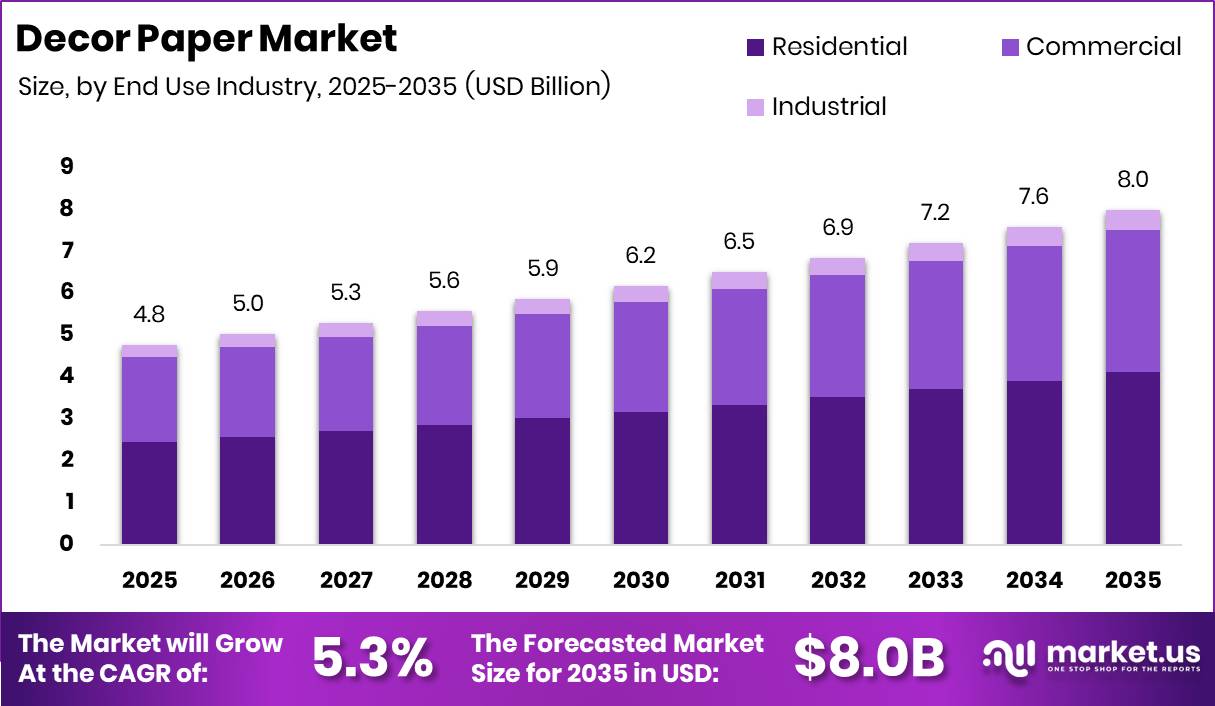
Global Decor Paper Market size is expected to be worth around USD 8.0 Billion by 2035 from USD 4.8 Billion in 2025, growing at a CAGR of 5.3% during the forecast period 2026 to 2035. This trajectory reflects sustained demand from furniture manufacturing, flooring, and interior surface applications worldwide.
The decor paper market encompasses specialty paper grades used to create decorative and functional surfaces across furniture panels, flooring systems, laminates, wall panels, and related interior products. Producers supply paper in impregnated and unimpregnated forms, processed using resins including melamine, urea, and phenolic variants. The market serves residential, commercial, and industrial end users through direct sales and distributor channels globally.
Key Takeaways
- The global Decor Paper Market is valued at USD 4.8 Billion in 2025 and is forecast to reach USD 8.0 Billion by 2035.
- The market grows at a CAGR of 5.3% during the forecast period 2026 to 2035.
- Impregnated Decor Paper dominates the By Product Type segment with a 54.70% share in 2025.
- Furniture dominates the By Application segment with a 48.60% share in 2025.
- Melamine Resin dominates the By Resin Type segment with a 62.30% share in 2025.
- Residential dominates the By End Use Industry segment with a 51.40% share in 2025.
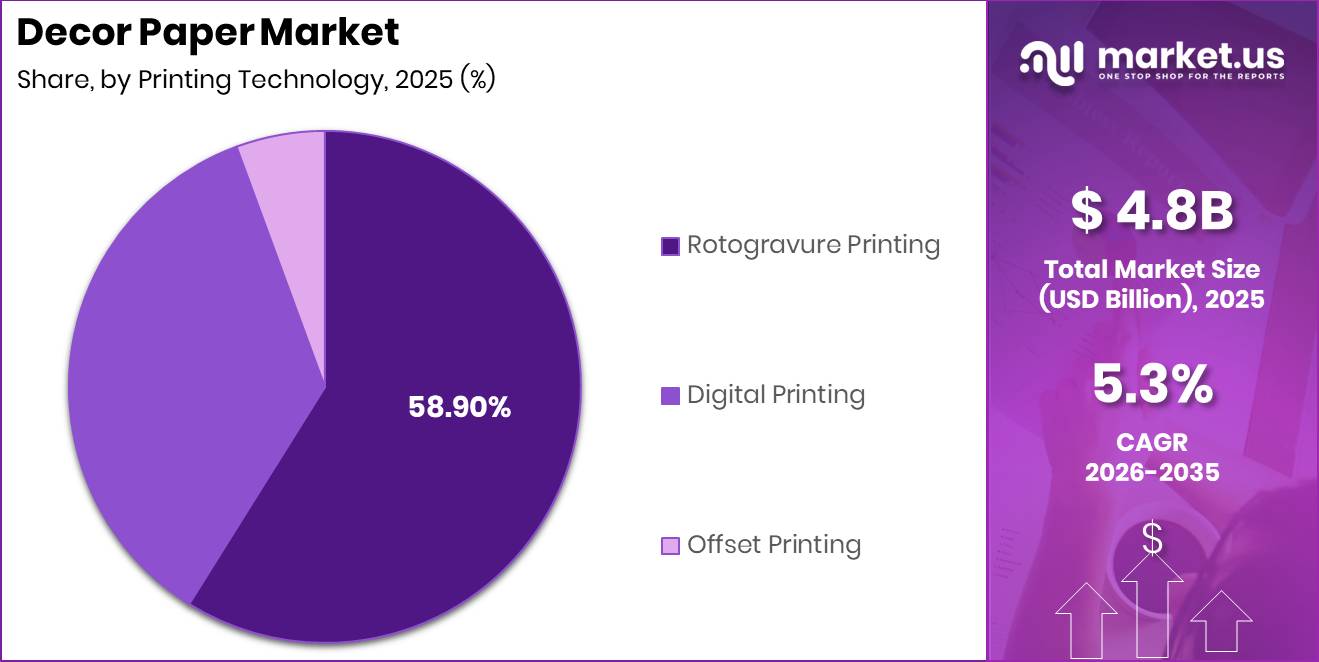
- Rotogravure Printing dominates the By Printing Technology segment with a 58.90% share in 2025.
- Direct Sales (B2B) dominates the By Distribution Channel segment with a 69.20% share in 2025.
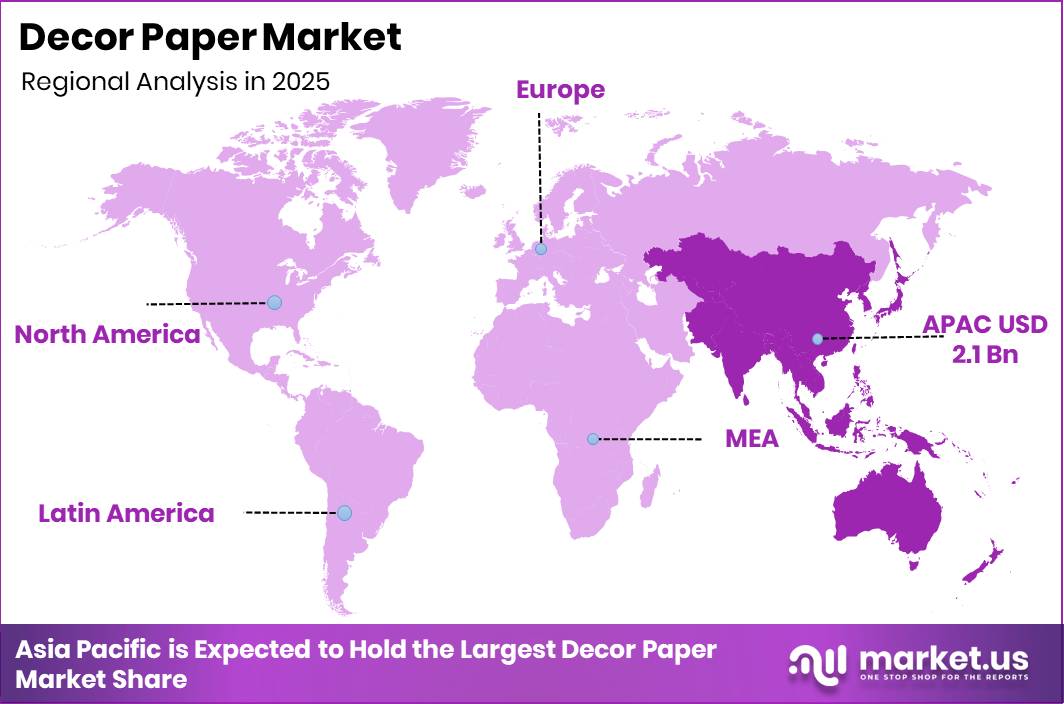
- Asia-Pacific is the leading region with a 43.80% share, valued at USD 2.1 Billion in 2025.
The 2025 Trend Tracker study surveyed more than 12,400 consumers across Europe, the Americas, Oceania, and South Africa, establishing a broad empirical base for understanding how consumer sentiment toward paper-based materials is shifting. This scale of evidence supports the case for continued investment in paper-based interior surface products at a global level.
As reported by the Trend Tracker 2025 study, 75% of consumers identify paper and cardboard as the most compostable and biodegradable packaging material. Sustainability perception now carries direct purchasing consequences for producers throughout the paper value chain. Decor paper manufacturers that communicate environmental credentials clearly are better positioned to retain specification in sustainability-driven procurement decisions.
Based on FSC Consumer Study 2025 data, 78% of consumers familiar with the FSC certification label say they trust brands more when the FSC logo appears on products. Certification has shifted from a compliance requirement into an active sales tool. This signals that decor paper producers holding FSC certification can command specification preference, particularly in commercial and retail furniture markets where buyer scrutiny of environmental claims is intensifying.
Product Type Analysis
Impregnated Decor Paper dominates with 54.70% due to superior resin bonding and surface durability.
In 2025, Impregnated Decor Paper held a dominant market position in the By Product Type segment of the Decor Paper Market, with a 54.70% share. Resin impregnation delivers the surface hardness and moisture resistance that furniture and flooring buyers require as baseline specifications. Producers supplying impregnated grades retain preferred vendor status across the highest-volume panel manufacturing accounts globally.
Unimpregnated Decor Paper serves markets where downstream processors handle their own impregnation in-house, giving them full control over resin chemistry and surface performance. This segment appeals to large panel producers with integrated impregnation lines. As per our research, 53% of consumers consider paper and cardboard the most environmentally friendly packaging material, a preference trend that is beginning to influence interior surface specification decisions in commercial fit-out procurement.
Overlay Paper functions as a protective top layer applied above the decor layer in high-pressure laminate systems, contributing abrasion resistance and surface clarity. This sub-segment benefits directly from commercial construction activity, where high-traffic surface performance requirements are non-negotiable. Backing Paper provides structural balance to panel boards, preventing warping during manufacturing and in-service use, and its consumption scales proportionally with total panel output volumes.
Application Analysis
Furniture dominates with 48.60% due to its position as the primary panel surface end market.
In 2025, Furniture held a dominant market position in the By Application segment of the Decor Paper Market, with a 48.60% share. Furniture manufacturing represents the single largest consumption channel for decorative surface materials because every cabinet, wardrobe, table, and shelving unit requires a printed and finished surface substrate. As per our research, 64% of consumers prefer products ordered online to be delivered in paper packaging, a preference that correlates with broader consumer trust in paper-based materials including decorative surfaces used in furniture they purchase.
Flooring is the fastest-growing application sub-segment, driven by laminate flooring adoption across residential renovation and new build projects globally. Laminate flooring systems depend on high-resolution decor paper for realistic wood and stone visual effects that deliver premium aesthetics at accessible price points. This positions flooring as the highest-velocity demand channel for decor paper producers seeking volume growth.
Laminates serve both vertical and horizontal surface applications in furniture, countertops, and wall cladding, functioning as a versatile substrate across residential and commercial interiors. Two Sides North America found that 57% of North American consumers associate packaging waste with climate change impacts. This environmental awareness is elevating scrutiny of all surface materials in commercial fit-out projects, making low-emission laminate decor paper an increasingly competitive specification requirement.
Wall Panels represent a growing application channel in hospitality and commercial interiors where large-area decorative surface coverage creates high per-project decor paper consumption. According to Two Sides North America, 42% of European consumers have avoided purchasing products because of excessive or environmentally unfriendly packaging. This sentiment is shaping procurement standards for interior surface materials in European commercial construction, where designers now specify certified and low-emission decor paper grades.
Resin Type Analysis
Melamine Resin dominates with 62.30% due to its hardness, heat resistance, and surface clarity.
In 2025, Melamine Resin held a dominant market position in the By Resin Type segment of the Decor Paper Market, with a 62.30% share. Melamine resin delivers the surface hardness, scratch resistance, and visual clarity that furniture and flooring producers require across standard and premium grade laminates. Producers using melamine impregnation retain the broadest compatibility with global panel manufacturing equipment installed bases.
Urea Resin serves lower-cost interior-grade applications where surface performance requirements are less demanding than premium furniture or commercial flooring. This resin type competes primarily on price and processing efficiency in markets where specification standards allow lower-emission thresholds than EU regulatory requirements demand. As per our research, 65% of consumers prefer reading printed books rather than digital books, reflecting a durable consumer connection to physical paper-based products that extends to tactile surface material preferences in home environments.
Phenolic Resin addresses high-pressure laminate applications requiring extreme durability, chemical resistance, and structural integrity for industrial and heavy-use commercial surfaces. Its higher processing temperature requirements limit adoption to producers with specialized press equipment. European market pulp production increased by 2.1% in 2025, as reported by CEPI, signaling that upstream fiber supply capacity supports continued growth in resin-impregnated decor paper output across European mills.
End Use Industry Analysis
Residential dominates with 51.40% due to consistent furniture and flooring replacement cycles.
In 2025, Residential held a dominant market position in the By End Use Industry segment of the Decor Paper Market, with a 51.40% share. Homeowners replacing flooring, kitchen cabinetry, and bedroom furniture generate recurring demand for decorative surface materials across all price segments. Data from WSJ shows 37% of consumers in the United States and Canada have decided not to purchase a product because of unsustainable packaging, a trend that is extending into consumer preference for certified interior surface materials in home renovation purchases.
Commercial is the fastest-growing end use segment, driven by office fit-out, retail interior renovation, and hospitality construction projects that demand high-specification decorative surfaces. Commercial projects generate concentrated high-volume demand per project site compared to fragmented residential purchases. FSC Consumer Study 2025 indicates that 51% of consumers in Spain recognize the FSC certification label, illustrating the market readiness for certified decor paper products in European commercial interior applications.
Printing Technology Analysis
Rotogravure Printing dominates with 58.90% due to high-speed volume output and consistent color fidelity.
In 2025, Rotogravure Printing held a dominant market position in the By Printing Technology segment of the Decor Paper Market, with a 58.90% share. Rotogravure delivers unmatched print consistency across very high production run lengths, making it the technology of choice for standard décor patterns produced at industrial scale. Producers with established rotogravure infrastructure retain cost advantages in high-volume commodity decor paper categories.
Digital Printing is the fastest-growing printing technology sub-segment, enabling short-run customization and rapid design iteration without the cylinder preparation costs that rotogravure requires. This positions digital printing as the preferred technology for producers targeting the design-intensive commercial and premium residential segments. Offset Printing serves niche specialty applications where specific ink formulations or substrate characteristics make rotogravure or digital approaches less practical.
Distribution Channel Analysis
Direct Sales (B2B) dominates with 69.20% due to volume contract efficiency with panel producers.
In 2025, Direct Sales (B2B) held a dominant market position in the By Distribution Channel segment of the Decor Paper Market, with a 69.20% share. Panel manufacturers, laminate producers, and large furniture groups source decor paper directly from mills under long-term supply agreements that lock in volume, price, and quality specifications. This channel structure gives direct-selling producers stable revenue visibility and reduces exposure to spot market price volatility.
Distributors represent the fastest-growing distribution channel, serving mid-sized and smaller furniture producers that lack the purchasing volume to qualify for direct mill supply agreements. The distributor channel enables decor paper producers to access a broader base of smaller accounts without building dedicated sales infrastructure for each market. This channel is expanding fastest in Asia-Pacific and Latin America, where fragmented furniture manufacturing ecosystems rely on regional distribution networks.
Key Market Segments
By Product Type
- Impregnated Decor Paper
- Unimpregnated Decor Paper
- Overlay Paper
- Backing Paper
By Application
- Furniture
- Flooring
- Laminates
- Wall Panels
- Others
By Resin Type
- Melamine Resin
- Urea Resin
- Phenolic Resin
- Others
By End Use Industry
- Residential
- Commercial
- Industrial
By Printing Technology
- Rotogravure Printing
- Digital Printing
- Offset Printing
By Distribution Channel
- Direct Sales (B2B)
- Distributors
Regional Analysis
Asia-Pacific Dominates the Decor Paper Market with a Market Share of 43.80%, Valued at USD 2.1 Billion
Asia-Pacific holds the largest regional position in the global Decor Paper Market, supported by China’s and India’s scale in furniture manufacturing and engineered wood panel output. The region concentrates the highest density of MDF and particleboard production facilities worldwide. This manufacturing base creates structural pull demand for decor paper that no other region can currently match in volume or growth velocity.
Europe represents the second-largest regional market, underpinned by established furniture manufacturing clusters in Germany, Italy, Poland, and Austria. As reported by CEPI, paper and board production in CEPI member countries decreased by 1.5% in 2025, reflecting operational pressures on European mills from energy costs and demand softness. This contraction signals that European producers must prioritize high-value specialty grades, including premium decor paper, to defend margins against lower-cost regional competitors.
North America occupies the third regional position, with the United States providing the largest manufacturing base. As per our research, U.S. printing-writing paper mills achieved an operating rate of 82.8% in 2025, up from 76.8% in 2024, demonstrating improved asset utilization across specialty paper manufacturing infrastructure relevant to decor paper production. U.S. paper and paperboard production totaled 66.3 million tons in 2025 despite a 3.7% year-over-year decline, indicating the scale of manufacturing capacity available to decor paper producers in the region.
Latin America is an emerging regional market where Brazil and Mexico anchor furniture manufacturing activity and domestic construction demand supports surface material consumption growth. The region benefits from proximity to North American and European export markets, creating opportunities for cost-competitive decor paper production serving multiple demand centers. As per our research, European graphic paper production declined by 7.2% in 2025, reflecting ongoing capacity reallocation within European specialty paper operations that creates a competitive opening for Latin American producers in export channels.
The Middle East and Africa region is at an early stage of market penetration for decorative surface materials, with GCC construction activity driving the most concentrated demand. Saudi Arabia’s Vision 2030 program generates continuous multi-phase construction activity across commercial, residential, and hospitality assets, creating new decor paper consumption opportunities. The GCC interior design services market is valued at approximately USD 13.30 Billion in 2025, confirming the scale of downstream surface material demand that decor paper producers can access through regional partnerships.
Key Regions and Countries
North America
- US
- Canada
Europe
- Germany
- France
- The UK
- Spain
- Italy
- Rest of Europe
Asia Pacific
- China
- Japan
- South Korea
- India
- Australia
- Rest of APAC
Latin America
- Brazil
- Mexico
- Rest of Latin America
Middle East and Africa
- GCC
- South Africa
- Rest of MEA
Market Dynamics
Market Opportunity Analysis - Underserved regions and niche segments offer early movers structural entry advantages in the Decor Paper Market
The Middle East and Africa region, led by GCC construction activity, presents the most concentrated near-term opportunity for decor paper producers. Saudi Vision 2030 mega-projects generate continuous multi-phase demand for interior surface materials across commercial, hospitality, and residential assets. Producers that establish regional supply partnerships now can lock in specification before European and Asian competitors build local distribution infrastructure.
The Commercial end use segment is the fastest-growing demand channel yet remains underpenetrated relative to Residential, which still holds a 51.40% dominant share. Office fit-out, retail renovation, and hospitality construction projects demand high-specification certified decor paper grades that command premium pricing. This creates a margin expansion opportunity for producers that invest in commercial-grade product certification and direct specification engagement with interior designers and contractors.
The Distributors channel is the fastest-growing distribution route yet holds a structurally smaller share compared to Direct Sales (B2B) at 69.20%. Mid-sized furniture producers in Asia-Pacific and Latin America cannot access direct mill supply agreements, leaving a large and fragmented addressable base underserved. Decor paper producers that build regional distributor networks in these geographies gain volume exposure to markets their direct sales teams cannot efficiently cover.
Digital Printing is the fastest-growing printing technology sub-segment yet operates far below Rotogravure’s 58.90% dominant share. Short-run design customization is a capability gap that most volume-oriented rotogravure producers cannot fill. By contrast, producers investing in digital printing capacity can capture the premium design-intensive commercial segment and reduce their exposure to commodity decor paper pricing cycles.
Technology and Innovation Landscape - Resin efficiency, sustainability benchmarks, and digital printing capability define the next competitive frontier in decor paper
Felix Schoeller’s TECHNOCELL® RSP® resin-saving decor paper technology reduces resin consumption during impregnation by up to 14% compared with conventional decor papers, as stated on the Felix Schoeller product page. The same technology lowers energy requirements in the subsequent drying process by up to 14%. Producers adopting this technology simultaneously reduce input costs and lower their environmental footprint, creating a dual competitive advantage in cost and compliance positioning.
As reported by UPM Communication Papers, a 38% reduction in fossil CO₂ emissions per tonne of paper produced was achieved in 2025 versus its 2023 baseline. Decor paper manufacturers share many of the same papermaking and finishing processes, making this a directly relevant sustainability benchmark for the sector. Producers that match or exceed this emissions reduction trajectory will hold specification advantage in EU procurement processes where carbon performance is an evaluated criterion.
UPM’s 2025 climate performance demonstrates progress toward a target of not more than 100 kg fossil CO₂ emissions per tonne of paper by 2030, as reported by UPM. This target establishes a quantified sustainability threshold that will increasingly influence buyer procurement standards across European interior surface supply chains. Decor paper producers that set and publish comparable carbon reduction targets will be better positioned to retain and win commercial specification contracts in sustainability-screened procurement environments.
Digital printing technology enables short-run design customization without the cylinder preparation costs and lead times that rotogravure requires. This capability is becoming a structural differentiator as commercial buyers demand faster design cycles and smaller batch sizes for fit-out projects. Producers that invest in digital printing infrastructure reduce their dependency on high-volume rotogravure runs and gain access to the premium design-intensive commercial segment where margins are structurally higher.
Drivers
EU Regulation (EU) 2023/1464 under REACH tightens formaldehyde emission limits for wood-based furniture placed on the EU market after August 6, 2026. The permissible formaldehyde concentration drops to 0.062 mg/m³, effectively halving the previous E1 class threshold of 0.1 ppm. This applies to all furniture and wood-based articles without grandfathering of existing compliant grades. Only manufacturers with advanced low-emission resin chemistry and in-house R&D capacity can meet the new standard efficiently.
Compliance requires updated testing under EN 717-1 conditions and tighter control of resin and impregnation processes. Transition costs are estimated at EUR 40,000 to 100,000 per product grade for reformulation and recertification. This raises the baseline material requirement across the EU furniture industry and drives a structural shift toward low-emission decor paper supply chains. Producers unable to absorb these costs face displacement from EU-bound furniture procurement pipelines.
| Driver | (~) % Impact on CAGR Forecast | Geographic Relevance | Impact Timeline |
|---|---|---|---|
| Engineered Wood Panel Output Expansion: MDF & Chipboard Volume Growth Pulling Decor Paper Demand | +2.1% | APAC (China, India, Vietnam dominant); EU secondary | Short term (≤ 2 years) |
| Residential Construction & Affordable Housing Push: Government-Backed Housing Pipelines Driving Surface Demand | +2.4% | India (PMAY), Southeast Asia, Middle East; EU renovation spill-over | Short-to-Medium term (1–3 years) |
| REACH Regulation (EU) 2023/1464: Formaldehyde Emission Mandate Forcing Low-Emission Decor Paper Upgrade Cycle | +1.9% | EU-27 regulatory core; North America TSCA spill-over; ANZ | Short term (≤ 2 years) |
| Renovation & Remodeling Wave: Post-Rate-Cut Consumer Spending on Surface Replacement Driving Laminate Adoption | +1.8% | North America core; EU (Germany, Poland, Nordics); APAC emerging | Medium term (2–4 years) |
| Global Furniture Market Expansion: China & India Production Scale Multiplying Decorative Substrate Consumption | +2.2% | China dominant; India ascending; Vietnam, Poland, Mexico export-led | Medium term (2–4 years) |
| Design Trend Democratization: Aesthetic Premiumization in Mid-Market Interiors Elevating Decor Paper Specification Grade | +1.5% | APAC (India, Indonesia, Thailand); Latin America; MENA | Long term (≥ 4 years) |
Restraints
U.S. housing starts declined 15.4% month-on-month in May 2026 to a seasonally adjusted annual rate of 1.177 million units, the lowest level since May 2020. Multi-family starts fell 41.6% to 284,000 units, while single-family starts declined 1.9% to 882,000 units. The average 30-year mortgage rate held at 6.53% in late May 2026, continuing to suppress housing affordability and new residential construction activity.
Pending home sales were down 5.8% year over year, and the typical home required 67 days to go under contract. Housing starts remain well below the 2021 to 2022 peak range of 1.6 to 1.8 million units. This reduced construction environment directly limits demand for flooring, cabinetry, and residential furniture, which are major end-use channels for decor paper. Subdued North American construction continues to constrain decor paper consumption across the region’s furniture and building products value chain.
| Restraint | (~) % Impact on CAGR Forecast | Geographic Relevance | Impact Timeline |
|---|---|---|---|
| US Housing Start Collapse: Rate-Suppressed Construction Volume Depressing Furniture & Flooring Surface Demand | -2.1% | North America (US primary); Canada secondary | Short term (≤ 2 years) |
| PVC & Decorative Film Substitution: Lower-Cost Alternative Surface Materials Displacing Decor Paper Across Key Applications | -1.9% | Global; APAC (China, India, SEA) most aggressive; North America mid-market | Long term (≥ 4 years) |
| EU Deforestation Regulation (EUDR) 2026 Deadline: Wood Pulp Chain-of-Custody Compliance Blocking Non-Traceable Supply | -1.6% | EU-27 (large/medium operators by Dec 30, 2026); EU import partners globally | Short term (≤ 2 years) |
| Austrian & EU Residential Construction Permit Collapse: New Build Activity Contraction Eliminating Surface Volume | -1.3% | Austrian (critical); Germany (recovering); EU peripheral markets — Sweden, Finland | Short-to-Medium term (1–3 years) |
| Consumer Discretionary Spending Compression: Mortgage Rate-Driven Affordability Crisis Deferring Home Upgrade Spending | -1.5% | North America (US, Canada); EU (Germany, Austria, Netherlands) | Short term (≤ 2 years) |
| Unorganized Sector Price Undercutting: Informal Furniture Manufacturers Bypassing Certified Decor Paper Supply Chains | -1.1% | India; Southeast Asia (Vietnam, Indonesia); Sub-Saharan Africa | Long term (≥ 4 years) |
Challenges
European decor paper mills face a structural energy cost disadvantage driven by the post-2022 shift to LNG-dependent gas imports and reduced pipeline supply. European gas benchmark prices at TTF experienced extreme volatility in the 2022 energy shock, reaching levels multiple times above pre-crisis norms and remaining structurally elevated in subsequent years. Energy-intensive paper production, coating, and printing operations are disproportionately affected due to high electricity and thermal energy demands across drying and finishing processes.
European producers face persistent margin pressure relative to competitors in lower-energy-cost geographies including the United States and parts of Asia. Structural responses such as long-term renewable energy procurement, on-site cogeneration, and process heat recovery require significant capital allocation and long implementation cycles. This constraint slows capacity expansion and limits incremental output growth. Investors evaluating European decor paper assets must factor in energy transition capital requirements as a structural cost component in return models.
| Challenge | (~) % CAGR Friction Drag | Geographic Relevance | Mitigation Horizon |
|---|---|---|---|
| Wood Pulp & Fiber Cost Volatility: Geopolitical & Climate-Driven Input Price Instability | -1.6% | EU paper mills (primary); India, Southeast Asia; Latin American pulp originators | Medium term (2–4 years) |
| European Energy Cost Structural Disadvantage: LNG-Indexed Electricity Price Inflation | -1.4% | EU-27 mill base (Germany, Austria, Finland, Poland); UK secondary | Long term (≥ 4 years) |
| EU Anti-Dumping Duty Navigation: Chinese Origin Decor Paper Trade Compliance Complexity | -1.2% | EU-27 import channels; China export pipeline; India re-export risk | Short-to-Medium (1–3 years) |
| Rotogravure Design Cycle Rigidity: Cylinder Cost & Lead-Time Suppressing SKU Velocity | -1.0% | Global; EU & North America design-intensive producers most exposed | Medium term (2–4 years) |
| Melamine Resin Price & Supply Volatility: China Overcapacity-Driven Price Distortion | -1.1% | EU, North America, India (impregnation processors); APAC secondary | Short-to-Medium (1–3 years) |
| Industry 4.0 Digital Skills Deficit: Print Technology & Color Science Talent Gap | -0.9% | EU (Germany, Italy, Austria); India emerging; APAC transition markets | Long term (≥ 4 years) |
Opportunities
Saudi Arabia’s Vision 2030 infrastructure program includes approximately USD 1 Trillion in planned real estate and infrastructure investment through 2030. Mega-projects including NEOM, Red Sea Project, Diriyah Gate, and Qiddiya drive continuous multi-phase construction activity across commercial, residential, and hospitality assets. Industrial policy mandates require up to 50% local content in construction materials, pushing localization of interior supply chains including decor paper inputs.
The GCC interior design services market is valued at approximately USD 13.30 Billion in 2025 and is forecast to reach USD 19.97 Billion by 2030. Hospitality and government projects generate high surface-area usage in wall panels, cabinetry, and interior cladding systems. This creates new demand for localized panel manufacturing ecosystems and upstream decor paper supply. GCC localization mandates are forming a new in-region consumption base that early-mover decor paper producers can anchor through direct supply agreements.
| Opportunity | (~) % Potential CAGR Upside | Geographic Relevance | Execution Window |
|---|---|---|---|
| Digital Inkjet Decor Printing: Short-Run Mass Customization as a Standalone B2B Service Revenue Layer | +2.8% | EU (Germany, Italy, Spain core); North America; China emerging | Medium term (2–4 years) |
| Modular & Prefabricated Construction: Decor Paper as Structural Interior Surface Input for Off-Site Build Systems | +2.3% | APAC (India, China, Southeast Asia); Middle East (GCC); North America | Medium term (2–4 years) |
| Functional Decor Paper: Antimicrobial & Hygienic Surface Coatings Entering Healthcare and Hospitality Verticals | +2.0% | North America, EU, Middle East; high-density commercial-build markets globally | Short-to-Medium term (1–3 years) |
| GCC & Middle East Demand Activation: Saudi Vision 2030 Infrastructure Wave Unlocking a Near-Zero Penetration TAM | +1.8% | Saudi Arabia, UAE, Qatar, Oman; wider MENA secondary | Short term (≤ 2 years) |
| M&A Roll-Up: Consolidating Specialty Decor Paper Producers into Vertically Integrated Platform Companies | +2.1% | EU (Germany, Italy); India; China ASEAN export-oriented capacity | Short-to-Medium term (1–3 years) |
| Bio-Based Resin Impregnation: Replacing Formaldehyde-Melamine Chemistry with Circular Cellulose-Compatible Finishes | +1.7% | EU (REACH-driven); North America; Australia; Japan | Long term (≥ 4 years) |
Key Company Insights
Surteco Group is positioned as a vertically integrated surface materials supplier operating across decor paper, edgeband, and foil segments. This integration gives Surteco direct control over the full decorative surface value chain from paper production through finished profile. In February 2026, Schattdecor launched its Prime Collection 2026/27, introducing new decor designs and surface concepts for furniture and interior applications, signaling that the segment is responding to design cycle competition with faster product refresh strategies.
Sappi Limited competes in the global specialty paper market with operations spanning Europe, North America, and South Africa, giving it geographic diversification that most single-region decor paper producers cannot match. Figures from Two Sides North America show 67% of consumers prefer paper packaging because it is the most compostable and biodegradable option. This consumer sustainability preference strengthens the commercial argument for paper-based interior surface materials, a segment where Sappi holds established technical and supply chain credentials. As per our research, 49% of consumers say paper/cardboard packaging is best for the environment overall, reinforcing the case for certified paper-based surface products that Sappi’s sustainability program supports.
Key Players
- Surteco
- Sappi Limited
- Munksjö (Ahlstrom-Munksjö)
- Fritz Egger GmbH & Co.
- Swiss Krono Group
- Kronospan
- Schattdecor
- Lamigraf
- ITC Limited
- Jaya Shree Textiles (Aditya Birla Group)
- Arpa Industriale
- Pfleiderer Group
- Kastamonu Entegre
- Fantoni Group
- Ahlstrom
Recent Developments
- June 2026 – Schattdecor announced a realignment of Executive Board responsibilities to support its next phase of growth and strengthen global management structures.
- March 2025 – Felix Schoeller announced price adjustments for its TECHNOCELL® decor paper products, effective April 1, 2025, reflecting strategic operational changes within its decor paper business.
- March 2025 – Neodecortech reaffirmed its strategic focus on decorative surfaces through its integrated printing, impregnation, and lamination operations serving the furniture and flooring industries.
Report Scope
| Report Features | Description |
|---|---|
| Market Value (2025) | USD 4.8 Billion |
| Forecast Revenue (2035) | USD 8.0 Billion |
| CAGR (2026-2035) | 5.3% |
| Base Year for Estimation | 2025 |
| Historic Period | 2020-2024 |
| Forecast Period | 2026-2035 |
| Report Coverage | Revenue Forecast, Market Dynamics, Market Opportunity Analysis, Technology and Innovation Landscape, Competitive Landscape, Recent Developments |
| Segments Covered | By Product Type (Impregnated Decor Paper, Unimpregnated Decor Paper, Overlay Paper, Backing Paper); By Application (Furniture, Flooring, Laminates, Wall Panels, Others); By Resin Type (Melamine Resin, Urea Resin, Phenolic Resin, Others); By End Use Industry (Residential, Commercial, Industrial); By Printing Technology (Rotogravure Printing, Digital Printing, Offset Printing); By Distribution Channel (Direct Sales (B2B), Distributors) |
| Regional Analysis | North America (US and Canada), Europe (Germany, France, The UK, Spain, Italy, and Rest of Europe), Asia Pacific (China, Japan, South Korea, India, Australia, and Rest of APAC), Latin America (Brazil, Mexico, and Rest of Latin America), Middle East and Africa (GCC, South Africa, and Rest of MEA) |
| Competitive Landscape | Surteco Group, Sappi Limited, Munksjö (Ahlstrom-Munksjö), Fritz Egger GmbH & Co., Swiss Krono Group, Kronospan, Schattdecor, Lamigraf, ITC Limited, Jaya Shree Textiles (Aditya Birla Group), Arpa Industriale, Pfleiderer Group, Kastamonu Entegre, Fantoni Group, Ahlstrom |
| Customization Scope | Customization for segments, region/country-level will be provided. Additional customization can be done based on requirements. |
| Purchase Options | We have three licenses to opt for: Single User License, Multi-User License (Up to 5 Users), Corporate Use License (Unlimited User and Printable PDF) |





































