Report Overview
Global Cycling Sunglasses Market size is expected to be worth around USD 2.0 Billion by 2035 from USD 1.1 Billion in 2025, growing at a CAGR of 6.6% during the forecast period 2026 to 2035.
The cycling sunglasses market covers purpose-built eyewear designed for road, mountain, gravel, and recreational cycling. Products span polarized and non-polarized lens formats, serving men, women, and youth riders across specialty retail, sports shops, hypermarkets, and online channels. This structure distinguishes it from the broader sunglasses category by optical performance and fit requirements.
Key Takeaways
- Cycling Sunglasses Market size reaches USD 2.0 Billion by 2035, up from USD 1.1 Billion in 2025.
- CAGR of 6.6% is recorded over the forecast period 2026 to 2035.
- Polarized lenses dominate the By Type segment with a 65.78% share in 2025.
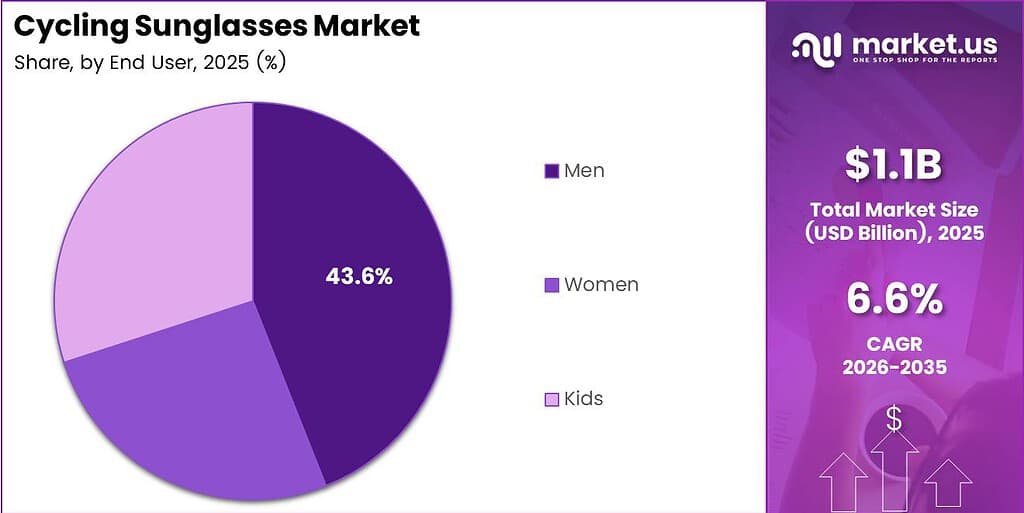
- Men lead the By End User segment with a 43.67% share in 2025.
- Specialty Stores dominate the By Sales Channel segment with a 45.78% share in 2025.
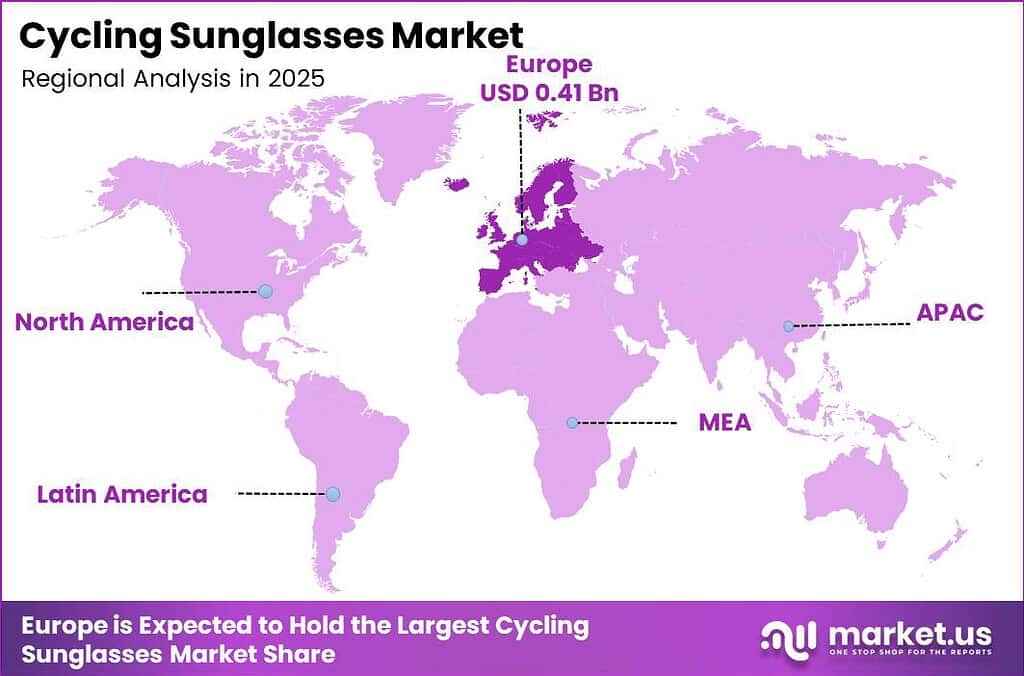
- Europe holds the dominant regional position with a 37.56% share, valued at USD 0.41 Billion in 2025.
- Asia-Pacific is identified as the fastest-growing regional market.
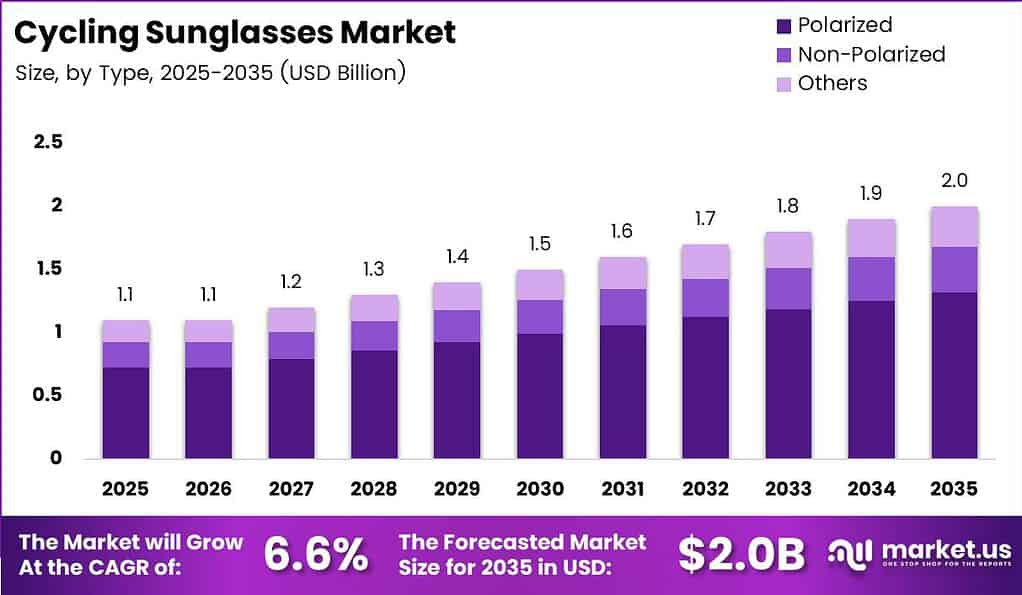
According to Market.us data, WHO reported that global adult physical inactivity increased by approximately 5% between 2010 and 2022, expanding the addressable base for activity-focused product categories. This trend widens the first-purchase funnel for cycling eyewear. Brands targeting health-conscious new cyclists gain early positioning before mature competitors consolidate share.
Eurostat reported that the EU produced 9.7 million bicycles and other non-motorised cycles in 2023, confirming Europe as a structurally active manufacturing and participation region. This volume signals sustained domestic demand for cycling accessories. Suppliers with established European distribution gain a structural cost and timing advantage over import-dependent competitors.
As per our research, the World Bank projected a 24% increase in energy prices during 2026, raising input and logistics costs for eyewear manufacturers globally. This pressure compresses margins on entry-level and mid-range SKUs most acutely. Brands that locked in multi-year supplier contracts or diversified production origins before this period carry a measurable cost advantage. EssilorLuxottica and Meta launched Oakley Meta HSTN in June 2025, with the standard collection starting at USD 399, signaling premium tier expansion as a margin-protection strategy.
Type Analysis
Polarized dominates with 65.78% due to glare reduction on reflective road surfaces.
In 2025, Polarized held a dominant market position in the By Type segment of the Cycling Sunglasses Market, with a 65.78% share. Polarized lenses filter reflected light from roads, water surfaces, and wet terrain, reducing visual fatigue on long rides. This optical advantage makes polarized the default choice for performance and recreational cyclists alike, limiting the switching argument for non-polarized alternatives in most conditions.
Non-Polarized lenses serve riders who require unfiltered light transmission, particularly in low-light or variable conditions where polarized coatings reduce contrast on uneven surfaces. Competitive cyclists and mountain riders often avoid polarization for this reason. This creates a structurally stable niche with repeat buyers who prioritize optical clarity over glare reduction, supporting consistent demand independent of the polarized segment’s growth trajectory.
Others within the By Type segment include photochromic, mirrored, and interchangeable lens systems that adapt to changing light conditions across a single ride. These formats command higher price points and attract equipment-conscious riders seeking versatility. As a result, brands offering lens-swap systems can reduce per-unit margin pressure by monetizing accessories and replacement lenses independently of the base frame purchase.
End User Analysis
Men dominate with 43.67% due to higher recreational and competitive cycling participation rates.
In 2025, Men held a dominant market position in the By End User segment of the Cycling Sunglasses Market, with a 43.67% share. WHO reported that 29% of adult men worldwide were insufficiently physically active in 2022, suggesting a large addressable population not yet reached by performance eyewear brands. Closing even a fraction of this gap through targeted health and performance messaging creates measurable unit demand growth for the men’s segment.
Women represent a structurally underpenetrated segment relative to their share of the global adult cycling population. WHO reported that 34% of adult women worldwide were insufficiently physically active in 2022, which means women who convert to active cycling represent a high-value acquisition cohort. Brands that invest in women-specific frame geometry, sizing, and marketing will capture disproportionate share as female participation continues to rise.
Kids constitute the smallest reported end-user segment by share but benefit directly from rising youth participation rates. PeopleForBikes data cited in the Drivers section notes that youth cycling participation rose from 49% to 56% between study waves in the US alone. This growth in younger riders creates a pipeline of early brand loyalists, and suppliers who establish youth-specific fits and safety-rated lenses position themselves to retain these customers as adults.
Sales Channel Analysis
Specialty Stores dominate with 45.78% due to expert fit guidance and performance product assortment.
In 2025, Specialty Stores held a dominant market position in the By Sales Channel segment of the Cycling Sunglasses Market, with a 45.78% share. EssilorLuxottica operates approximately 18,000 direct-to-consumer stores, including optical and non-optical retail banners, establishing a dense physical retail presence for performance eyewear. This scale gives specialty-aligned brands consistent access to fit-driven buyers who require in-person lens consultation before committing to premium price points.
Hypermarkets and Supermarkets serve price-sensitive and impulse-driven buyers who encounter cycling eyewear alongside broader sporting goods assortments. Carrefour operated 1,189 hypermarkets under its banners at the end of 2025, illustrating the volume-distribution potential of this channel. However, the format limits brand storytelling and technical product education, which constrains average selling prices and reduces the share of premium SKUs moving through this route. In September 2025, VSP Vision agreed to acquire Marcolin, a signal that vertically integrated optical retail players are consolidating specialty distribution access ahead of pure-play hypermarket competitors.
Online channels are expanding their share of cycling eyewear purchases, supported by broader e-commerce adoption. In 2024, 77% of EU internet users purchased or ordered goods and services online for personal use during the previous 12 months. The US Census Bureau reported that e-commerce represented 16.4% of US retail sales in Q2 2026 on a non-seasonally adjusted basis. These figures confirm online as a structurally growing acquisition channel, though fit-related return friction constrains net revenue retention compared to physical retail. As per our research, 16% of people in the EU purchased sports equipment, excluding sportswear, online during the previous three months in 2024, confirming meaningful but not yet dominant online penetration in the sports category.
Key Market Segments
By Type
- Polarized
- Non-Polarized
- Others
By End User
- Men
- Women
- Kids
By Sales Channel
- Specialty Stores
- Hypermarkets/Supermarkets
- Sports Shops
- Online
Regional Analysis
Europe Dominates the Cycling Sunglasses Market with a Market Share of 37.56%, Valued at USD 0.41 Billion
Europe holds the largest regional share at 37.56%, valued at USD 0.41 Billion in 2025, supported by a dense cycling culture and established specialty retail infrastructure across Western and Northern markets. This regional concentration creates a defensible revenue base for brands with local distribution agreements. Suppliers without a direct European presence face meaningful barriers from distribution cost and lead time alone.
Asia-Pacific is identified as the fastest-growing regional market in the Cycling Sunglasses Market. WHO reported a 48% physical-inactivity rate in high-income Asia-Pacific in 2022, indicating a large addressable population that health and infrastructure investment is converting to active riders. As this conversion accelerates, demand for protective and performance cycling accessories follows directly. In September 2025, EssilorLuxottica and Meta launched Oakley Meta Vanguard with explicit cycling-helmet compatibility, a product specification that signals early mover positioning in technically demanding Asia-Pacific urban cycling markets.
Key Regions and Countries
North America
- US
- Canada
Europe
- Germany
- France
- The UK
- Spain
- Italy
- Rest of Europe
Asia Pacific
- China
- Japan
- South Korea
- India
- Australia
- Rest of APAC
Latin America
- Brazil
- Mexico
- Rest of Latin America
Middle East and Africa
- GCC
- South Africa
- Rest of MEA
Market Dynamics
Market Opportunity Analysis - Underserved end-user segments and fast-growing regional markets offer entry points for new players
The Kids segment remains structurally underserved relative to the youth participation gains documented by PeopleForBikes, where US youth cycling participation rose from 49% to 56% between study waves. No major brand has established a dominant position in youth-specific cycling eyewear with safety-rated lenses and adjustable fit systems. This absence creates a first-mover window for suppliers willing to invest in age-specific product architecture and retail placement in family-oriented cycling outlets.
Women represent the most underpenetrated adult end-user segment in the cycling sunglasses market relative to their share of the overall adult cycling population. Brands competing primarily on men’s performance positioning leave the women’s segment open to challengers who invest in gender-specific frame geometry and dedicated marketing. This gap is particularly actionable in Europe, where the dominant regional position and established specialty retail infrastructure reduce the distribution investment required to reach female cyclists at scale.
Asia-Pacific is identified as the fastest-growing region yet holds a smaller base share compared to Europe’s 37.56% dominance. This creates an asymmetric opportunity for brands entering early with locally adapted products before the region’s performance eyewear category matures. By contrast, established European distributors face diminishing share-capture returns and must defend margin rather than build volume, making Asia-Pacific the higher-return regional bet for growth-oriented capital allocation.
Sports Shops represent a channel that sits between specialty stores and hypermarkets in terms of assortment depth and buyer expertise. This middle-ground positioning is underexploited by brands that concentrate investment at the specialty end or chase online volume, leaving sports shop buyers without the product education and display support they need to drive conversion on higher-margin SKUs. Brands that build dedicated sports shop sell-in programs and in-store fixture support can capture incremental revenue from buyers who want guided purchasing without the price premium of a dedicated cycling specialist.
Technology and Innovation Landscape - Lens technology and smart eyewear integration redefine the performance ceiling for cycling-specific products
Shimano’s official RIDESCAPE announcement identifies 3 new cycling-specific lens options: BR for bright conditions, AR for all-road riding, and TR for trail riding. This segmentation moves lens selection from a binary polarized versus non-polarized decision to a condition-matched system. Brands and retailers that adopt condition-specific lens messaging convert technically informed buyers at higher average selling prices than generic optical positioning allows.
Oakley specifies 17% visible-light transmission and a Category 3 classification for the Prizm Grey lens in its Matte Black Plantaris configuration, establishing a quantified optical standard that buyers can evaluate before purchase. This level of technical disclosure raises the bar for competing brands that rely on non-specific lens descriptions. Suppliers that publish verifiable optical performance metrics gain credibility with performance-oriented buyers who treat sunglasses as technical equipment rather than lifestyle accessories.
Oakley’s OO Red Iridium Polarized lens cuts 99% of glare from paths and pavement, according to the manufacturer’s lens-performance data. This specification anchors the value proposition of the polarized segment’s 65.78% share dominance in concrete optical terms rather than lifestyle association. Competing brands that cannot match or exceed published glare-reduction metrics face a structural disadvantage in the high-margin performance tier where Oakley operates. In March 2026, Oakley announced Prizm Transitions for Vanguard, scheduled for June 30, 2026, adding adaptive lens technology that automatically adjusts to changing light conditions, further widening the optical performance gap between premium and mid-tier offerings.
EssilorLuxottica and Meta launched Oakley Meta Vanguard in September 2025 with a 12-megapixel camera, 122-degree field of view, IP67 water-and-dust resistance, and up to 9 hours of typical mixed-use battery life, with preorders starting at USD 499. The company explicitly identified cycling-helmet compatibility, making this the first mass-market example of smart eyewear designed with cycling infrastructure in mind. This product signals that the technology frontier for cycling sunglasses now includes embedded sensors, connectivity, and media capture, creating a new premium tier that commodity lens manufacturers cannot address without fundamental product redesign.
Drivers
A larger active rider population expands the pool of first-time buyers without requiring suppliers to win share exclusively from established performance brands. PeopleForBikes reported in April 2025 that 112 million Americans, or 35% of people aged 3 and older, cycled at least once during 2024. Youth participation rose from 49% to 56% between study waves, based on a survey of 16,000 adults, widening the acquisition funnel for entry-level cycling eyewear.
Existing riders upgrading optical performance and established online specialist distribution add near-term demand layers above first-time buyer growth. Wear-driven replacement purchases sustain baseline volume across the installed rider base. This replacement dynamic reduces reliance on net-new participant acquisition and gives brands with strong after-sale service programs a predictable recurring revenue stream independent of participation trends.
| Driver | (~) % Impact on CAGR Forecast | Geographic Relevance | Impact Timeline |
|---|---|---|---|
| Expanding recreational cycling participation | +0.55% | Global; strongest evidence in North America | Short term (≤ 2 years) |
| Existing riders upgrading optical performance | +0.30% | North America; Western Europe; developed Asia | Short term (≤ 2 years) |
| Established online specialist distribution | +0.25% | North America; Europe; urban Asia-Pacific | Short term (≤ 2 years) |
| Wear-driven replacement purchases | +0.20% | Global installed rider base | Short term (≤ 2 years) |
| Performance-to-lifestyle crossover demand | +0.15% | North America; Europe; East Asia | Medium term (2–4 years) |
Restraints
The US Food and Drug Administration requires sunglasses lenses to comply with its impact-resistance regulation and mandates compliance certification with imported lots. Its import alert provides for refusal of admission when testing or documentation requirements are not met, creating a direct market-access barrier for non-compliant shipments. Suppliers must fund pre-shipment verification and auditable lot records before committing inventory to the US market.
Premium purchase affordability limits constrain volume in price-sensitive households and emerging markets, where cycling sunglasses compete directly with general-purpose alternatives at a fraction of the price. Ordinary sunglasses substitution reduces the addressable performance segment among casual riders who do not prioritize optical standards. Seasonal outdoor-riding shutdowns in Northern Europe, Canada, and severe-climate regions further compress annual sell-through windows for performance-focused SKUs.
| Restraint | (~) % Impact on CAGR Forecast | Geographic Relevance | Impact Timeline |
|---|---|---|---|
| Noncompliant product import exclusion | -0.35% | United States; foreign manufacturing origins | Short term (≤ 2 years) |
| Premium purchase affordability limits | -0.30% | Price-sensitive households; emerging markets | Short term (≤ 2 years) |
| Ordinary sunglasses substitution | -0.25% | Global casual-rider segment | Medium term (2–4 years) |
| Seasonal outdoor-riding shutdowns | -0.15% | Northern Europe; Canada; severe-climate regions | Short term (≤ 2 years) |
| Prescription incompatibility in stock shields | -0.10% | Global high-correction rider segment | Medium term (2–4 years) |
Challenges
Variation in facial geometry, helmet interfaces, and frame retention makes remote fit assessment an ongoing operating problem for online sales channels. In an illustrative operating model, fit-related dissatisfaction affects a measurable share of online transactions, and a portion of that demand is permanently lost rather than exchanged. This creates a structural drag on net revenue retention that grows as online channels expand their share of total cycling eyewear sales.
Coating yield process variability in Asian production hubs introduces quality inconsistency across batches, raising inspection costs and increasing the rate of non-conforming inventory. Seasonal inventory forecasting complexity across multichannel distribution adds further operational friction, while supplier concentration continuity risk exposes import-dependent North American and European brands to single-source disruptions. Counterfeit marketplace authentication burdens on global third-party platforms erode brand equity and reduce consumer confidence in online price discovery.
| Challenge | (~) % CAGR Friction Drag | Geographic Relevance | Mitigation Horizon |
|---|---|---|---|
| Fit-driven online return friction | -0.30% | Global online sales channels | Medium term (2–4 years) |
| Coating yield process variability | -0.25% | Asian production hubs; global sourcing networks | Medium term (2–4 years) |
| Seasonal inventory forecasting complexity | -0.20% | Global multichannel distribution | Short term (≤ 2 years) |
| Supplier concentration continuity risk | -0.15% | Import-dependent North America and Europe | Medium term (2–4 years) |
| Counterfeit marketplace authentication burden | -0.10% | Global third-party marketplaces | Short term (≤ 2 years) |
Opportunities
Employer-funded cycling eyewear benefits represent institutional white space that bypasses the consumer acquisition funnel entirely. An illustrative program reaching eligible employees equivalent to 2% of annual category unit demand, with 25% redemption and 80% genuinely incremental purchases, produces a 0.40% annual demand-growth equivalent. Consolidated fulfillment and account-level acquisition reduce selling costs, improving contribution margins for brands that establish employer channel infrastructure early.
Integrated cycling telemetry eyewear, paid refurbishment and trade-in services, guided-tour fleet supply contracts, and adaptive cycling accessibility designs collectively offer conditional upside of 1.30% above the baseline. This takes the supplied 6.6% baseline to an illustrative 7.9% execution case. Brands that prioritize even one of these verticals in the medium term build revenue streams that are structurally insulated from consumer price sensitivity and seasonal demand fluctuations.
| Opportunity | (~) % Potential CAGR Upside | Geographic Relevance | Execution Window |
|---|---|---|---|
| Employer-funded cycling eyewear benefits | +0.40% | Europe; North America; corporate commuting hubs | Medium term (2–4 years) |
| Integrated cycling telemetry eyewear | +0.30% | North America; Western Europe; developed Asia | Long term (≥ 4 years) |
| Paid refurbishment and trade-in services | +0.25% | Europe; North America | Medium term (2–4 years) |
| Guided-tour fleet supply contracts | +0.20% | European cycling destinations; Asia-Pacific tourism hubs | Short term (≤ 2 years) |
| Adaptive cycling accessibility designs | +0.15% | Global adaptive-sport and rehabilitation channels | Long term (≥ 4 years) |
Key Company Insights
Adidas AG reported consolidated net sales of €24,811 million and operating profit of €2,056 million in 2025, reflecting a financially strong parent platform for eyewear investment. Marcolin extended its global eyewear licensing agreement for Adidas Sport and Adidas Originals through 2032, locking in long-term brand distribution infrastructure. This continuity gives Adidas a stable route to market across optical and performance retail without owning manufacturing assets directly.
Decathlon SA operates a worldwide network of 1,902 stores at the end of 2025 and reported selling 1.23 billion products across its business in 2025, confirming unmatched physical distribution depth for accessible cycling eyewear. Safilo signed an exclusivity agreement with Bollé Brands aimed at acquiring SPY+ and Serengeti, with those two brands generating approximately USD 39 million in combined sales in 2025. This consolidation move signals that mid-tier performance eyewear is attracting strategic aggregation, creating competitive pressure on Decathlon’s own-label positioning in the accessible performance segment.
Oakley introduced Shield Fusion prescription technology for Sutro, Sutro Lite, and Sutro Lite Sweep in September 2026, with compatibility from -3.00 to +3.00, directly addressing the prescription-incompatibility restraint that limits stock shield penetration among high-correction riders.
Key Players
- Adidas AG
- Liberty Sports, Inc.
- Shimano, Inc.
- Nike, Inc.
- Under Armour, Inc.
- Oakley, Inc.
- Puma SE
- Titan Company Limited
- Safilo Group S.p.A.
- Decathlon SA
- Other Key Players
Recent Developments
- September 24, 2026 – Oakley announced the Cactus Jack Chapter 001 collection comprising 3 eyewear models: Plantaris, Straight Jacket 99, and Eye Jacket Redux, with availability beginning through Travis Scott’s website and Oakley’s website on consecutive days.
- June 23, 2026 – EssilorLuxottica and Meta announced Meta Glasses starting at USD 299, featuring 3 prescription-compatible styles in rectangle, square, and oval shapes, with clear, sun, and Transitions lens options.
- February 24, 2026 – Oakley introduced Plantaris SQ in 8 colourways, using a square lens shape, removable vented nose cone, and adjustable wire-core temples as an everyday and performance eyewear launch.
- September 18, 2025 – EssilorLuxottica and Meta announced Meta Ray-Ban Display with US retail availability beginning September 30, 2025, starting at USD 799, integrating an in-lens display and Meta Neural Band.
- July 1, 2025 – Safilo and Victoria Beckham announced a 10-year global licensing agreement covering optical frames and sunglasses, with the first collection scheduled for January 2026.
- May 27, 2025 – Marcolin and Adidas announced the extension of their global eyewear licensing agreement for Adidas Sport and Adidas Originals through 2032.
Report Scope
| Report Features | Description |
|---|---|
| Market Value (2025) | USD 1.1 Billion |
| Forecast Revenue (2035) | USD 2.0 Billion |
| CAGR (2026-2035) | 6.6% |
| Base Year for Estimation | 2025 |
| Historic Period | 2020-2024 |
| Forecast Period | 2026-2035 |
| Report Coverage | Revenue Forecast, Market Dynamics, Market Opportunity Analysis, Technology and Innovation Landscape, Competitive Landscape, Recent Developments |
| Segments Covered | By Type (Polarized, Non-Polarized, Others), By End User (Men, Women, Kids), By Sales Channel (Specialty Stores, Hypermarkets/Supermarkets, Sports Shops, Online) |
| Regional Analysis | North America (US and Canada), Europe (Germany, France, The UK, Spain, Italy, and Rest of Europe), Asia Pacific (China, Japan, South Korea, India, Australia, and Rest of APAC), Latin America (Brazil, Mexico, and Rest of Latin America), Middle East and Africa (GCC, South Africa, and Rest of MEA) |
| Competitive Landscape | Adidas AG, Liberty Sports, Inc., Shimano, Inc., Nike, Inc., Under Armour, Inc., Oakley, Inc., Puma SE, Titan Company Limited, Safilo Group S.p.A., Decathlon SA, Other Key Players |
| Customization Scope | Customization for segments, region/country-level will be provided. Additional customization can be done based on requirements. |
| Purchase Options | We have three licenses to opt for: Single User License, Multi-User License (Up to 5 Users), Corporate Use License (Unlimited User and Printable PDF) |