Report Overview
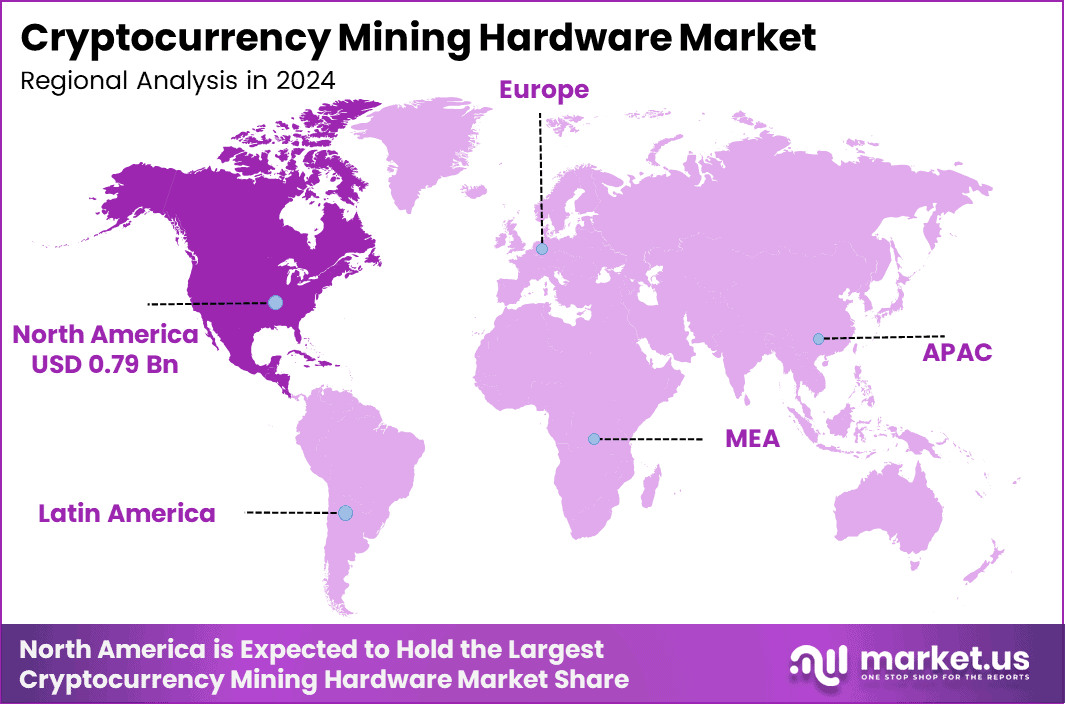
In 2024, the Global Cryptocurrency Mining Hardware Market was valued at USD 2.31 billion. The market is projected to grow at a CAGR of 8.4% during 2024–2034, reaching approximately USD 5.17 billion by 2034. North America dominated the global market in 2024, accounting for 34.41% of the total market share and generating approximately USD 0.79 billion in revenue.
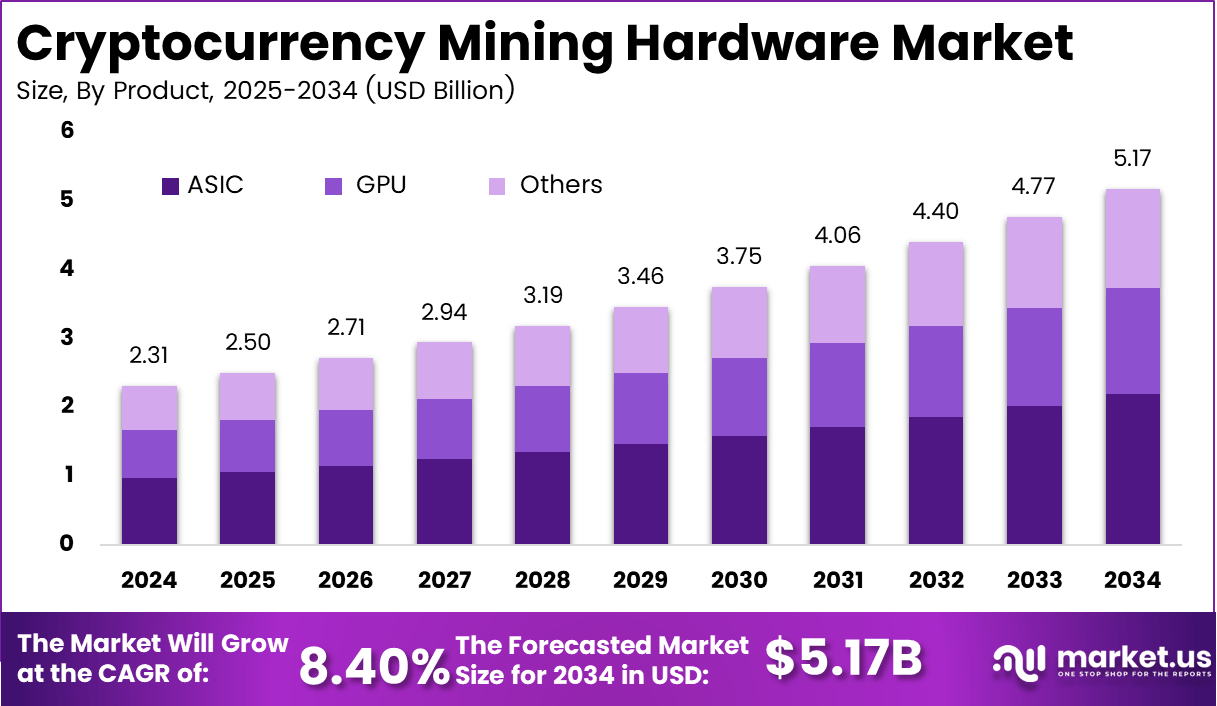
This growth is closely tied to the rising computational demand of the Bitcoin network, whose global hash rate climbed roughly fivefold, from below 200 exahashes per second (EH/s) a few years ago to around 955 EH/s by August 2025, according to industry hash rate trackers cited alongside JPMorgan data. Higher hash rate means miners need more processing power per unit of reward, which pushes operators to keep buying newer, faster mining rigs (ASICs) to stay competitive.
The U.S. Energy Information Administration (EIA) reports that electricity demand tied to U.S. crypto mining has grown very rapidly, with the Cambridge Bitcoin Electricity Consumption Index estimating global Bitcoin mining power draw at around 19.0 gigawatts as of January 2024, translating into roughly 170 TWh of annual electricity use.
This scale of power draw only exists because mining hardware fleets have expanded significantly, directly supporting hardware demand and, in turn, market revenue. The EIA notes that the United States accounts for close to 38% of global Bitcoin mining activity, drawing between 25 TWh and 91 TWh of the nation’s power supply for mining operations, which is comparable to the annual electricity use of three to six million homes.
Key Takeaways
- The global Cryptocurrency Mining Hardware Market was valued at USD 2.31 billion in 2024.
- The global Cryptocurrency Mining Hardware Market is projected to grow at a CAGR of 8.4% and is estimated to reach USD 5.17 billion by 2034.
- On the basis of product, the ASIC segment dominated the market, accounting for 42.3% of the total market share.
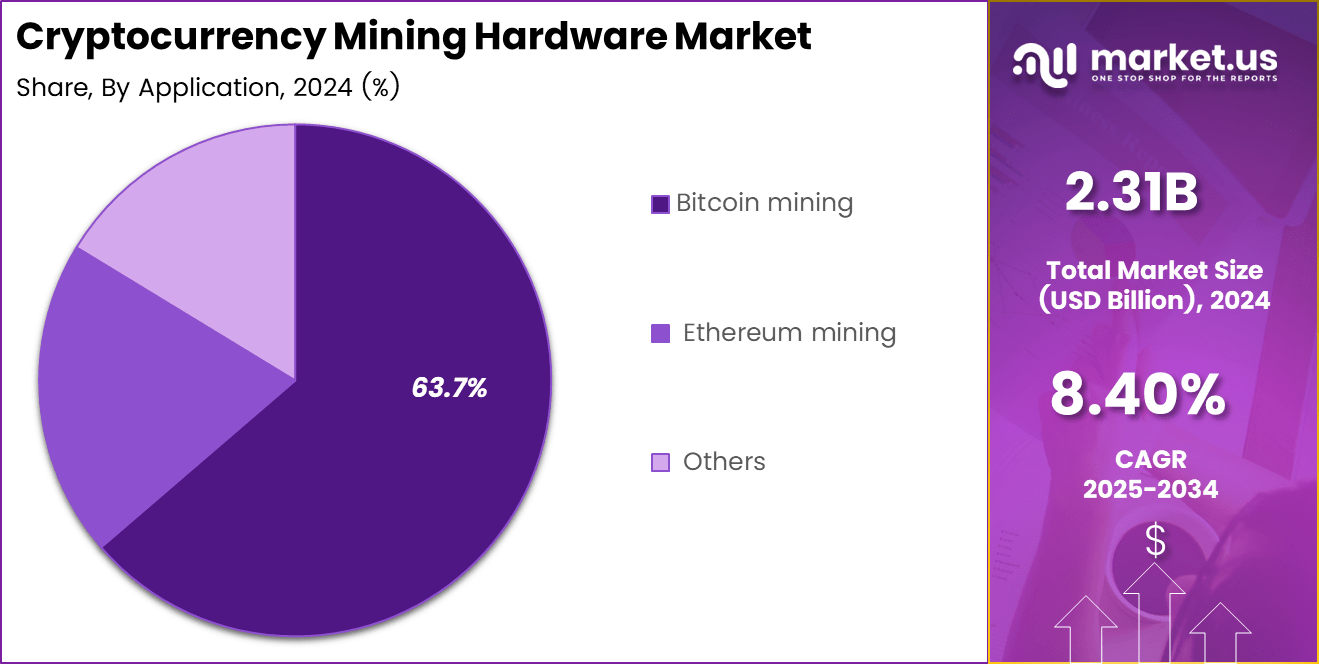
- By application, the Bitcoin Mining segment dominated the market, accounting for 63.7% of the total market share.
- In 2024, North America was the most dominant region in the Cryptocurrency Mining Hardware Market, accounting for 34.41% of the total market share and generating approximately USD 0.79 billion in revenue.
By Product
The ASIC product segment leads the cryptocurrency mining hardware market, holding a 42.3% share. ASIC miners are purpose-built devices optimized for cryptocurrency mining, specifically designed to offer superior computational power and energy efficiency for tasks like Bitcoin mining.
While ASICs dominate, GPU miners, although less efficient, are still popular due to their flexibility and ability to mine a variety of cryptocurrencies beyond Bitcoin, such as Ethereum. GPUs can be repurposed for other tasks, which offers a degree of versatility not available with ASICs.
The Others category encompasses additional mining hardware types, including FPGAs and custom-built rigs, but these hold a smaller market share compared to ASICs and GPUs. The dominance of ASIC miners reflects the trend toward specialized hardware tailored for high-efficiency cryptocurrency mining.
By Application
Bitcoin mining is the leading application, commanding a 63.7% share. This dominance is largely due to Bitcoin’s status as the first and most widely recognized cryptocurrency, with a strong mining network that relies heavily on proof-of-work algorithms. Bitcoin mining requires high computational power, which drives the demand for specialized hardware like ASIC miners, making it the primary application for mining equipment.
Ethereum mining also plays a significant role in the market, though it holds a smaller share compared to Bitcoin. Ethereum’s shift to a proof-of-stake consensus mechanism may impact its future mining demand, but it continues to be a major player. The Others category includes mining for other cryptocurrencies, such as Litecoin, Dash, and Monero, which collectively account for a smaller share of the market but still contribute to the overall demand for mining hardware.
Key Market Segments
By Product
- ASIC
- GPU
- Others
By Application
- Bitcoin mining
- Ethereum mining
- Others
Investment and Business Benefits
Investment in the cryptocurrency mining hardware market offers significant growth potential, with expectations of substantial returns as cryptocurrency adoption continues to rise. Ongoing technological innovations in mining hardware present opportunities for investors to support businesses that are developing more efficient and powerful solutions.
As cryptocurrency continues to gain traction, investing in mining hardware presents a long-term growth opportunity, offering consistent returns over time. Additionally, the market’s scalability enables investors to benefit as the demand for advanced mining solutions grows, fueled by both established and emerging cryptocurrencies. This combination of growth, innovation, and scalability makes the sector an attractive investment opportunity.
Businesses in the cryptocurrency mining hardware sector can benefit from revenue diversification by offering solutions to both individual miners and large-scale operations, tapping into multiple revenue streams. Early investment in mining hardware can position companies as market leaders, enabling them to capture significant market share through innovation and strategic partnerships.
Additionally, businesses that adapt to evolving regulations and technological trends can gain a competitive advantage, becoming key players in the rapidly expanding market. The market’s scalability and growth offer 124.7% upside potential by 2034.
Regional Analysis
North America is expected to hold the largest share of the global cryptocurrency mining hardware market, with a projected value of USD 0.79 billion. This dominance is attributed to the region’s strong technological infrastructure, high adoption rates of cryptocurrencies, and the presence of major mining companies.
North America’s robust market position is further supported by favorable regulatory frameworks and a growing demand for advanced mining hardware solutions, making it a key player in the global market for cryptocurrency mining equipment.
North America’s dominance in the cryptocurrency mining hardware market is driven by several factors, including technological advancements, a well-established infrastructure, and a favorable regulatory environment. North American market growth is expected at 66.2% from USD 0.79 billion in 2024 to USD 1.31 billion by 2034.
U.S Market Size
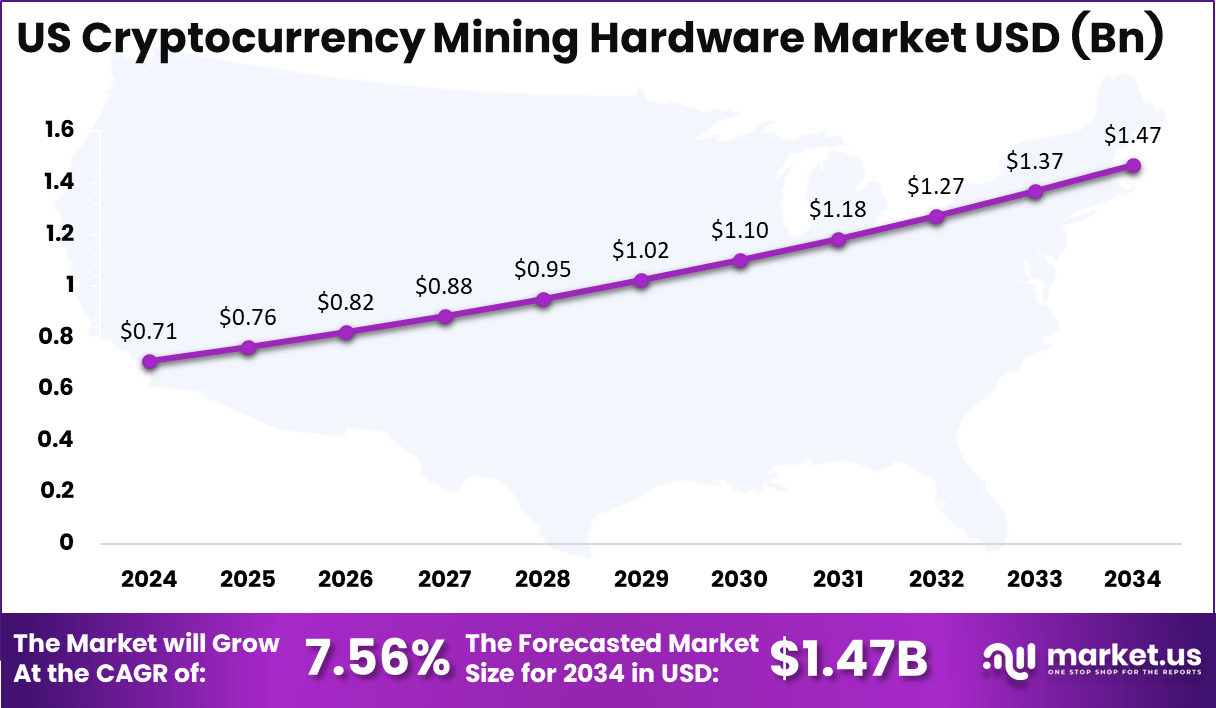
The U.S. cryptocurrency mining hardware market is expected to grow significantly from USD 0.71 billion in 2024 to USD 1.47 billion by 2034. This growth is driven by the increasing demand for more efficient and advanced mining hardware to support the expanding cryptocurrency industry.
The market is anticipated to have a CAGR of 7.56%. The market continues to grow, reaching USD 1.47 billion by 2034. The U.S. cryptocurrency mining hardware market is experiencing steady growth as demand for mining solutions rises with the expanding cryptocurrency sector.
Estimated value prediction: Growth of 93.4% from USD 0.76 billion in 2024 to USD 1.47 billion by 2034.
Key Regions and Countries
- North America
- US
- Canada
- Europe
- Germany
- France
- The UK
- Spain
- Italy
- Rest of Europe
- Asia Pacific
- China
- Japan
- South Korea
- India
- Australia
- Singapore
- Rest of Asia Pacific
- Latin America
- Brazil
- Mexico
- Rest of Latin America
- Middle East & Africa
- South Africa
- Saudi Arabia
- UAE
- Rest of MEA
Drivers
| Driver | (~) % Impact on CAGR Forecast | Geographic Relevance | Impact Timeline |
|---|---|---|---|
| Post-halving efficiency arms race | +2.1% | Global (US, China-adjacent Asia) | Short term (≤ 2 years) |
| Institutional mining capacity build-out | +1.6% | North America | Medium term (2–4 years) |
| Next-gen ASIC node migration | +1.3% | Asia-Pacific | Short term (≤ 2 years) |
| Rising Bitcoin price supporting CapEx | +1.0% | Global | Short term (≤ 2 years) |
| Immersion and liquid-cooling adoption | +0.7% | North America, Asia-Pacific | Medium term (2–4 years) |
| Publicly listed mining company fleet refresh cycles | +0.5% | North America | Medium term (2–4 years) |
Post-halving efficiency arms race
The root cause of this driver is the fourth Bitcoin halving executed on April 20, 2024, which cut the block subsidy from 6.25 BTC to 3.125 BTC per block, instantly compressing miner revenue per hash by roughly 50%; the quantitative mechanism that follows is that operators with legacy rigs above 38 joules per terahash became unprofitable at prevailing electricity rates above USD 0.06 per kilowatt-hour, forcing fleet-wide replacement demand for units delivering closer to 18-21 joules per terahash.
The strategic impact is a compressed replacement cycle that pulled forward capital expenditure by an estimated 12-18 months for publicly disclosed miners, shifting the competitive baseline from a slower depreciation-driven upgrade cadence toward an efficiency-driven arms race that materially lifts near-term unit shipment volumes and modestly compresses hardware vendor gross margins by an estimated 3-5 percentage points as buyers negotiate harder on bulk fleet orders.
Restraints
| Restraint | (~) % Impact on CAGR Forecast | Geographic Relevance | Impact Timeline |
|---|---|---|---|
| Advanced semiconductor export controls | -1.8% | China, United States | Short term (≤ 2 years) |
| Blanket domestic mining and trading bans | -1.2% | China | Short term (≤ 2 years) |
| High benchmark interest rates restricting fleet financing | -0.9% | Global | Short term (≤ 2 years) |
| Import tariffs on foreign-made mining rigs | -0.6% | United States | Short term (≤ 2 years) |
| Foundry capacity allocation prioritizing AI chips | -0.5% | Taiwan, Global | Short term (≤ 2 years) |
Advanced semiconductor export controls
The root cause is the tightening of U.S. Bureau of Industry and Security licensing rules on advanced logic chips destined for China-linked entities, a framework strengthened progressively since 2018 and reinforced through subsequent rule updates that restrict sub-16-nanometer node access for mining-adjacent silicon.
The strategic business impact is a hard stop on unit availability for a subset of manufacturers, forcing CapEx deferrals of new fleet deployments by two to three fiscal quarters and compressing hardware vendor operating margins by an estimated 4-6 percentage points as firms absorb redesign costs to shift toward non-restricted foundry partners or older process nodes.
Challenges
| Challenge | (~) % CAGR Friction Drag | Geographic Relevance | Mitigation Horizon |
|---|---|---|---|
| Grid capacity and power constraints | -1.1% | North America, Central Asia | Long term (≥ 4 years) |
| Specialized cooling engineering talent gap | -0.8% | Global | Medium term (2–4 years) |
| Component and lead-time volatility | -0.7% | Asia-Pacific | Medium term (2–4 years) |
| Rapid hardware obsolescence cycles | -0.6% | Global | Medium term (2–4 years) |
| E-waste disposal compliance burden | -0.4% | Europe, North America | Long term (≥ 4 years) |
Grid capacity and power constraints
The structural vulnerability stems from mining farms concentrating in regions with constrained transmission capacity, where interconnection queue wait times for large industrial loads above 50 megawatts now commonly exceed 24-36 months in parts of North America
The quantitative friction manifests as curtailment agreements that cut effective operating hours for hardware fleets by an estimated 8-15% during peak-demand periods, directly eroding the realized hash-rate output per installed unit and extending payback periods on new hardware purchases by roughly six to nine months.
The long-term corporate adjustment required is a shift toward behind-the-meter power generation, flared-gas capture, and colocated renewable agreements, which raises upfront infrastructure spend per site by an estimated 15-20% but is necessary to decouple future hardware deployment volume from grid-queue bottlenecks that would otherwise cap fleet expansion regardless of unit economics.
Opportunities
| Opportunity | (~) % Potential CAGR Upside | Geographic Relevance | Execution Window |
|---|---|---|---|
| Stranded and flared-gas powered mining sites | +1.9% | North America, Middle East | Medium term (2–4 years) |
| Dual-use ASIC/AI inference chip repurposing | +1.4% | Global | Long term (≥ 4 years) |
| Hardware-as-a-service leasing models | +1.1% | North America, Europe | Medium term (2–4 years) |
| Emerging-market untapped mining hosting demand | +0.8% | Latin America, Africa | Long term (≥ 4 years) |
| Refurbished and secondary-market rig resale platforms | +0.6% | Global | Short term (≤ 2 years) |
Stranded and flared-gas powered mining sites
This is untapped rather than a current driver because the vast majority of stranded and flared natural gas volumes at oilfields remain uncontracted for mining use today, representing a significant portion of unmet demand for low-cost power-hardware pairing that current market participants have only begun to capture.
The white-space mechanism is that flared-gas generation can deliver electricity at an estimated USD 0.02-0.03 per kilowatt-hour versus a grid-average cost near USD 0.06-0.08, meaning hardware deployed at these sites could see effective operating margin expansion of 10-14 percentage points relative to grid-connected fleets.
Key Players Analysis
The Cryptocurrency Mining Hardware Market exhibits extreme concentration at the manufacturing layer, where Tier-1 leaders, Bitmain Group, MicroBT, and Canaan Inc., collectively command over 95% of global ASIC hardware supply, with Bitmain alone holding an estimated 80%+ share via its Antminer S21 XP/Pro lineup shipped across 100+ countries.
Bitmain’s dominance is underscored by a reported 223% year-on-year revenue surge to $1.652 billion with $1.6 billion in cash reserves, dwarfing Tier-2 challenger Canaan, whose FY2024 quarterly revenue reached only $73.6 million, up 120.9% YoY, before climbing to $150.5 million in Q3 2025. Ebang International, a distant Tier-2 player, posted just $6.5 million in FY2025 net revenue, illustrating the steep drop-off below the top three ASIC producers.
Among mining-operator “consumers” of this hardware, capital deployment scale defines tiering: MARA Holdings generated $656.4 million in FY2024 revenue, 69% YoY growth, while scaling energized hashrate 115% to 53.2 EH/s, and Riot Platforms grew revenue to $376.7 million in 2024, up from $280.7 million, with Bitcoin Mining segment revenue of $321.0 million, deploying 31.5 EH/s.
Hut 8 Corp’s strategic pivot is evidenced by its $990 million all-stock “merger of equals” with US Bitcoin Corp, diversifying into Compute/HPC revenue, which hit $70.0 million in Q3 2025 versus $13.7 million a year earlier, reflecting an AI-infrastructure hedge against pure-play ASIC dependence.
Top Key Players
- HIVE Blockchain Technologies Ltd.
- Hut 8 Corp.
- INNOSILICON Technology Ltd.
- Intelion Mine LLC
- Marathon Digital Holdings Inc.
- NiceHash Ltd.
- Riot Blockchain Inc.
- Argo Blockchain Plc
- BIT Digital Inc.
- Bitfarms Ltd.
- BitMain Group
- Canaan Inc.
- Ebang International Holdings Inc.
- Elite Mining Inc.
- ePIC Blockchain Technologies Inc.
- Genesis Mining Ltd.
- GMO Internet Group Inc
- Helium Systems Inc.
- Others
Recent Developments
- In July 2025, a leading mining hardware manufacturer introduced an option for miners to extend warranty and insurance coverage for their rigs up to 60 days after purchase, offering extended protection and improved customer retention. Customer retention and service adoption by 15-20% by 2034 due to enhanced protection and seamless claims integration.
- In June 2025, a major insurance provider launched a new suite of comprehensive protection plans for cryptocurrency mining equipment, covering theft, hardware malfunctions, and damage from environmental factors such as overheating. Premiums are flexible, starting as low as $8 per month, providing more accessible coverage for miners.
- In May 2025, a prominent mining hardware firm expanded its global support network with over 500 service centers offering fast, in-person repairs and technical support. Global support expansion is expected to reduce downtime by 30-35%, improving customer satisfaction and retention by 25-30% over the next 5 years.
Report Scope
| Report Features | Description |
|---|---|
| Market Value (2024) | USD 2.31 Bn |
| Forecast Revenue (2034) | USD 5.17 Bn |
| CAGR(2025-2034) | 8.4% |
| Base Year for Estimation | 2024 |
| Historic Period | 2020-2023 |
| Forecast Period | 2025-2034 |
| Report Coverage | Revenue forecast, AI impact on Market trends, Share Insights, Company ranking, competitive landscape, Recent Developments, Market Dynamics, and Emerging Trends |
| Segments Covered | By Product (ASIC, GPU, Others), By Application (Bitcoin mining, Ethereum mining, Others) |
| Regional Analysis | North America – US, Canada; Europe – Germany, France, The UK, Spain, Italy, Russia, Netherlands, Rest of Europe; Asia Pacific – China, Japan, South Korea, India, New Zealand, Singapore, Thailand, Vietnam, Rest of Latin America; Latin America – Brazil, Mexico, Rest of Latin America; Middle East & Africa – South Africa, Saudi Arabia, UAE, Rest of MEA |
| Competitive Landscape | HIVE Blockchain Technologies Ltd., Hut 8 Corp., INNOSILICON Technology Ltd., Intelion Mine LLC, Marathon Digital Holdings Inc., NiceHash Ltd., Riot Blockchain Inc., Argo Blockchain Plc, BIT Digital Inc., Bitfarms Ltd., BitMain Group, Canaan Inc., Ebang International Holdings Inc., Elite Mining Inc., ePIC Blockchain Technologies Inc., Genesis Mining Ltd., GMO Internet Group Inc., Helium Systems Inc., Others. |
| Customization Scope | Customization for segments, region/country-level will be provided. Moreover, additional customization can be done based on the requirements. |
| Purchase Options | We have three licenses to opt for: Single User License, Multi-User License (Up to 5 Users), Corporate Use License (Unlimited Users and Printable PDF) |