


Report Overview
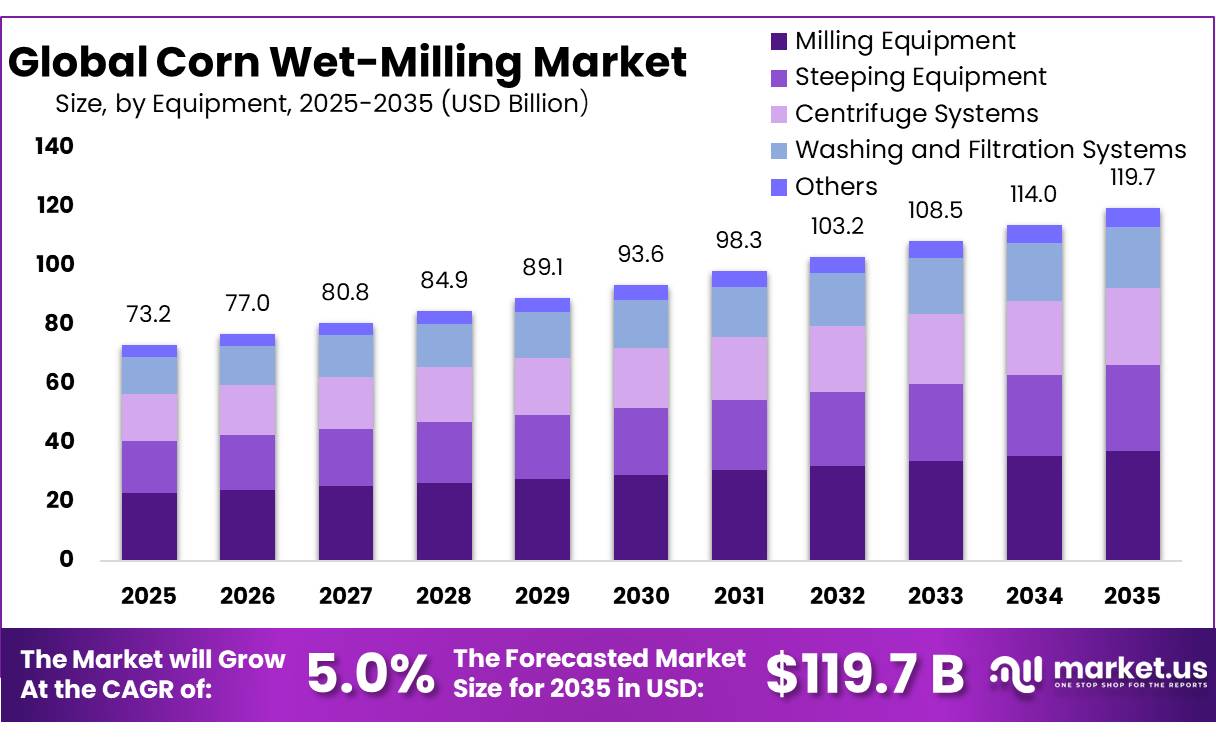
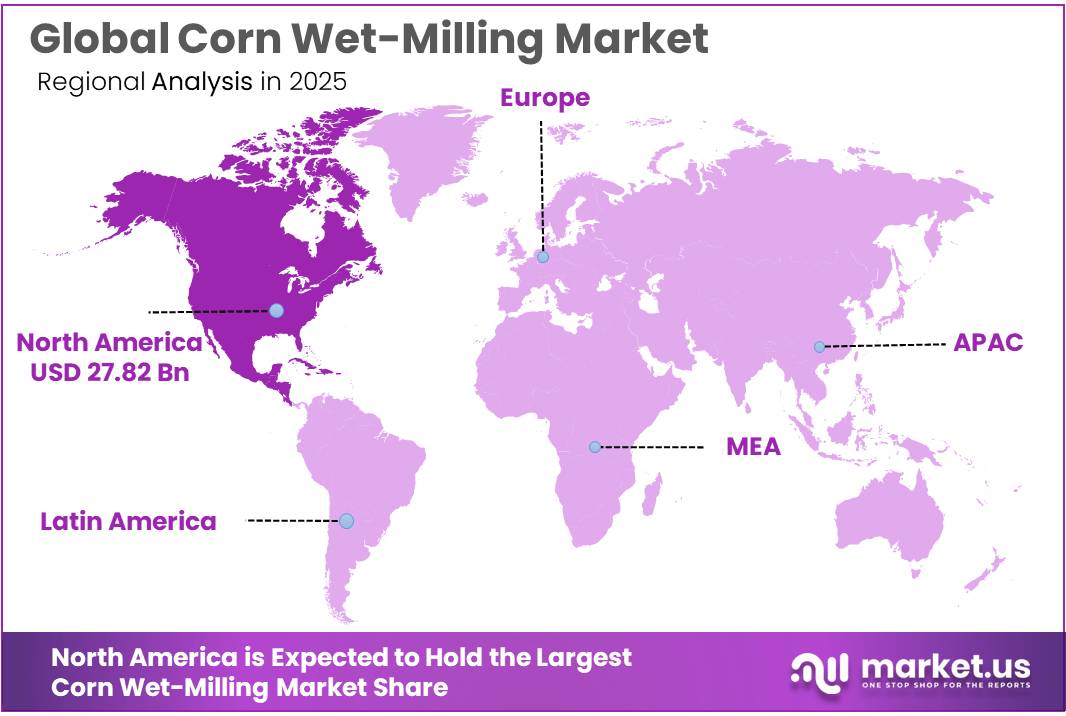
The Global Corn Wet-Milling Market size is expected to be worth around USD 119.7 Billion by 2035, from USD 73.2 Billion in 2025, growing at a CAGR of 5.0% during the forecast period from 2026 to 2035. In 2025, North America held a dominant market position, capturing more than a 38.00% share, holding USD 27.82 Billion revenue.
The corn wet-milling industry forms an important part of the food, feed, chemical, and bio-based manufacturing value chain. The process separates corn into starch, germ, fiber, and protein, allowing processors to manufacture starches, sweeteners, corn oil, animal-feed ingredients, fermentation inputs, and advanced bioproducts. In 2025, the U.S. corn refining industry operated 25 corn-grinding plants across 10 states and generated around USD 61.4 billion in economic output, showing the industrial importance of integrated corn processing.
- Feedstock availability remains one of the strongest supporting factors for wet-milling operations. USDA reported that U.S. corn production reached a record 17.0 billion bushels in 2025, providing a large raw-material base for starch, sweetener, feed, oil, and fermentation production. Average corn yield also reached a record 186.5 bushels per acre, while harvested area was estimated at 91.3 million acres. This combination of higher productivity and large crop availability gives wet-milling plants greater flexibility in procurement and helps maintain reliable operating rates.
The operating environment also shows steady utilization of wet-milling capacity. USDA NASS reported that in January 2026, corn consumed for wet-mill products other than fuel reached 33.96 million bushels, while wet mills used another 38.021 million bushels for fuel-alcohol production. During the same reporting period, wet mills produced 251,479 tons of corn gluten feed. These volumes show how facilities generate value from several product streams at the same time, helping processors balance demand across food ingredients, feed products, industrial inputs, and energy applications.
- Demand from food and industrial applications continues to provide a broad commercial base. USDA estimated U.S. food, seed, and industrial corn use at 6.96 billion bushels for 2025/26, while corn use for ethanol was projected at 5.6 billion bushels. Separately, the Corn Refiners Association reported that high-fructose corn syrup, glucose syrup, and dextrose together account for about 745 million bushels of corn use.
Future opportunities are expected to come from advanced starch derivatives, bio-based chemicals, fermentation products, renewable materials, higher-value feed ingredients, and better recovery of corn oil and protein fractions. Policy support for renewable fuels may also encourage continued investment in integrated corn-processing infrastructure. The U.S. EPA established total applicable renewable-fuel volumes of 26.81 billion RINs for 2026 and 27.02 billion RINs for 2027, while U.S. fuel-ethanol production capacity stood at about 18.375 billion gallons in June 2026.
Key Takeaways
- Corn Wet-Milling Market size is expected to be worth around USD 119.7 Billion by 2035, from USD 73.2 Billion in 2025, growing at a CAGR of 5.0%.
- Milling Equipment held a dominant market position, capturing more than a 30.00% share.
- Starches held a dominant market position, capturing more than a 48.70% share.
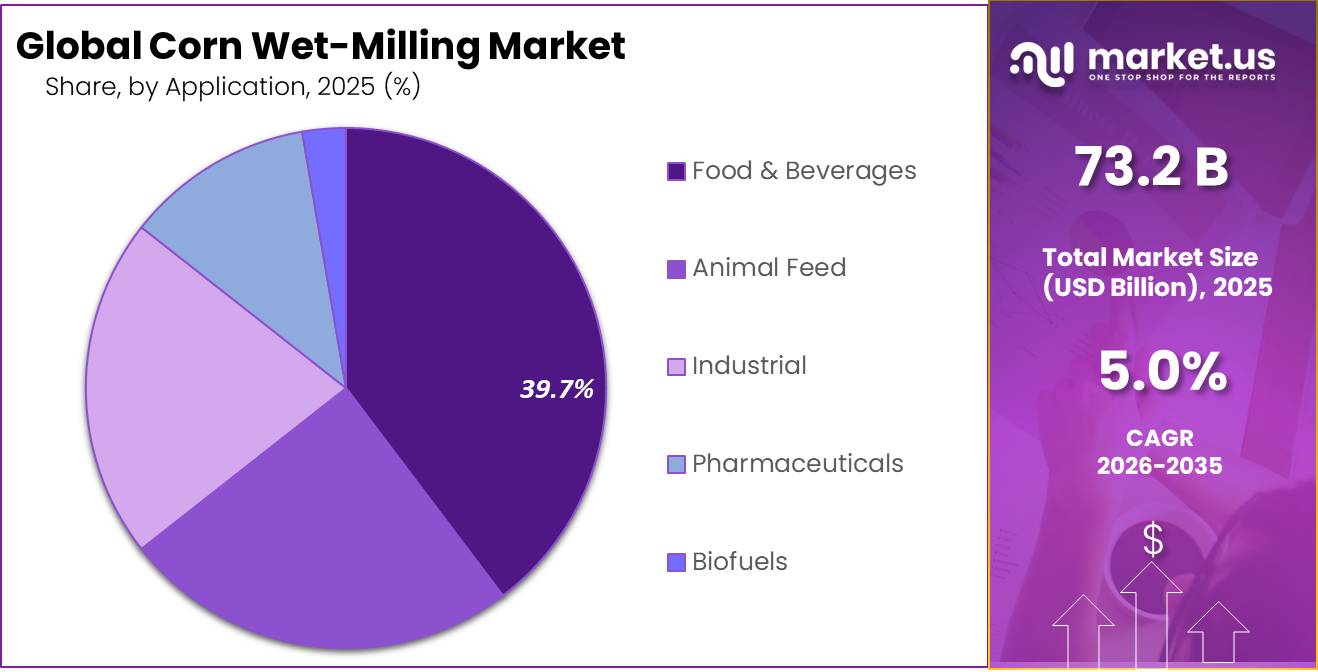
- Food & Beverages held a dominant market position, capturing more than a 39.00% share.
- Food Grade held a dominant market position, capturing more than a 62.00% share.
- North America remained the dominant region in the Corn Wet-Milling Market in 2025, accounting for 38.00% of the market and reaching USD 27.82 billion.
By Equipment Analysis
Milling Equipment leads with more than 30.00% share as high corn-processing volumes keep grinding systems at the center of wet milling
In 2025, Milling Equipment held a dominant market position, capturing more than a 30.00% share of the Corn Wet-Milling Market by equipment. Milling equipment remains essential because it breaks softened corn kernels after steeping and helps release germ, fiber, starch, and protein for further separation. Its strong position is supported by the large volume of corn moving through industrial processing systems.
- USDA reported in January 2026 that U.S. corn production for 2025 reached a record 17.0 billion bushels, while average yield reached 186.5 bushels per acre and harvested area stood at 91.3 million acres. This large feedstock base supports continuous demand for dependable de-germinating, attrition, and fine-grinding equipment in high-capacity wet-milling plants.
Steeping Equipment held an important position in the Corn Wet-Milling Market in 2025, supported by its role as the main conditioning stage before corn enters milling and separation equipment. In 2026, operating demand remained supported by the record 17.0 billion bushels of U.S. corn produced during 2025, with 91.3 million acres harvested and an average yield of 186.5 bushels per acre, according to USDA. Steeping tanks allow processors to soften corn, loosen the protein structure surrounding the starch, and prepare kernels for efficient germ and fiber separation.
By End Product Analysis
Starches dominate with more than 48.70% share, supported by their broad use across food and industrial processing
In 2025, Starches held a dominant market position, capturing more than a 48.70% share of the Corn Wet-Milling Market by end product. The segment maintained a strong position because corn starch serves as a basic ingredient for food thickening, paper manufacturing, adhesives, fermentation, pharmaceuticals, and further conversion into glucose and other corn-based products.
- In January 2026, USDA data showed that U.S. wet mills consumed 33.96 million bushels of corn for wet-mill products other than fuel, highlighting the large processing base available for starch and related products. USDA also projected U.S. food, seed, and industrial corn use at 6.96 billion bushels for 2025/26, while indicating that starch, glucose, and dextrose demand remains an established part of non-ethanol industrial corn use. The wide application base and ability of starch to serve as both a finished ingredient and a raw material for downstream processing continue to support the segment.
Sweeteners remained an important end-product segment of the Corn Wet-Milling Market in 2025, supported by established demand for high-fructose corn syrup, glucose syrup, and dextrose across beverages, bakery products, confectionery, dairy foods, and processed foods. USDA reported in May 2026 that U.S. food, seed, and industrial corn use for 2025/26 was forecast at 6.96 billion bushels, with high-fructose corn syrup, glucose, and dextrose forming part of this industrial use.
By Application Analysis
Food & Beverages — 39.00% share reflects the strong use of starch-based ingredients across processed foods and beverages
In 2025, “Food & Beverages” held a dominant market position, capturing more than a 39.00% share. Within food and beverage applications, corn wet-milling products are widely used because they provide starch, glucose, dextrose and high-fructose corn syrup for processed foods, beverages, bakery products, dairy foods and confectionery. USDA explains that wet millers separate corn into starch and sweetener streams that can be further processed for different food formulations.
Animal Feed remained an important application for the corn wet-milling industry in 2026 because the process generates corn gluten feed, corn gluten meal and wet corn gluten feed that can be incorporated into livestock diets.
USDA National Agricultural Statistics Service data show that U.S. wet mills produced 242,839 tons of corn gluten feed, 97,129 tons of corn gluten meal, and 188,569 tons of wet corn gluten feed in April 2026. These production volumes show the significant flow of wet-milling co-products into the feed supply chain. Corn gluten feed is especially useful where livestock producers require energy, protein and digestible fiber ingredients, allowing wet millers to generate additional value from material remaining after starch separation.
By Grade Analysis
Food Grade leads with a 62.00% share as corn-derived ingredients remain widely used across food processing
In 2025, “Food Grade” held a dominant market position, capturing more than a 62.00% share. Food-grade corn wet-milling products are widely used in bakery products, beverages, confectionery, dairy foods, sauces and other processed foods because they offer thickening, stabilizing, sweetening and texture-control properties. The U.S. Food and Drug Administration lists cornstarch for several food functions, including use as a formulation aid, humectant, nutritive sweetener, stabilizer or thickener, and texturizer. This wide range of permitted food applications keeps food-grade material at the center of commercial corn wet-milling demand.
- Government data also show the large processing base supporting corn-derived ingredients. In its May 2026 Feed Outlook, the USDA Economic Research Service estimated U.S. corn use for food, seed and industrial purposes at 6.96 billion bushels for the 2025/26 marketing year. USDA also noted that high-fructose corn syrup, glucose and dextrose remain important components of this use category. This large processing volume supports steady availability of starches and sweeteners used by food manufacturers.
Industrial Grade continues to hold an important position in the Corn Wet-Milling Market as manufacturers use corn starch and other wet-milled derivatives in paper processing, adhesives, fermentation, industrial alcohol and chemical applications. USDA states that wet millers process corn into starch, glucose, dextrose, corn oil, beverage alcohol, industrial alcohol and fuel ethanol, showing how the same wet-milling platform serves both food and non-food manufacturing chains.
Key Market Segments
By Equipment
- Steeping Equipment
- Milling Equipment
- Centrifuge Systems
- Washing and Filtration Systems
- Others
By End Product
- Starches
- Sweeteners
- Ethanol
- Corn Oil
- Gluten Feed & Gluten Meal
By Application
- Food & Beverages
- Animal Feed
- Industrial
- Pharmaceuticals
- Biofuels
By Grade
- Food Grade
- Industrial Grade
- Pharmaceutical Grade
Driver Analysis
Ethanol Co-Product Pull
Fuel-ethanol throughput remains the principal utilization anchor for corn wet milling because high corn grind creates monetizable streams of starch, sweeteners, corn oil, gluten feed, and gluten meal alongside alcohol production; U.S. ethanol output reached a record 16.49 billion gallons in 2025, while USDA estimates 5.55 billion bushels of corn use for ethanol in 2025/26, approximately 2% above 2024/25, and forecasts 5.60 billion bushels for 2026/27.
The U.S. industry operated 191 fuel-ethanol plants with 18.477 billion gallons of annual nameplate capacity as of January 1, 2025, creating a large installed processing base for enzyme optimization, higher solids loading, co-product drying, oil recovery, carbon-intensity reduction, and integration of wet-milling fractions into food and industrial channels.
This supports a modelled +1.9 percentage-point CAGR contribution because higher utilization spreads fixed energy, labor, and depreciation expenses across more grind volume while raising the quantity of saleable co-products, allowing integrated operators to hedge ethanol-margin cyclicality with starch and feed revenues; value capture shifts from maximizing ethanol gallons to optimizing contribution margin per bushel, with each processor incentivized to allocate protein, fiber, oil, and refined carbohydrate streams toward the highest netback market rather than treat co-products as residual output.
Drivers Impact Analysis
| Driver | (\~) % Impact on CAGR Forecast | Geographic Relevance | Impact Timeline |
|---|---|---|---|
| Ethanol co-product pull | +1.9 pp | North America, Brazil, APAC | Short term (≤ 2 years) |
| Low-carbon fuel credits | +1.6 pp | North America core | Medium term (2-4 years) |
| Bio-based materials shift | +1.4 pp | EU, North America, APAC | Medium term (2-4 years) |
| Food-grade starch demand | +1.2 pp | APAC, Middle East, Africa | Medium term (2-4 years) |
| Protein-feed valorization | +1.0 pp | North America, EU, APAC | Short term (≤ 2 years) |
| Biorefinery retrofit finance | +0.8 pp | US, EU, Brazil, India | Long term (≥ 4 years) |
Restraint Analysis
Corn-Price Volatility
Corn represents the dominant variable-cost input for a wet mill, so changes in farm-gate and delivered-grain pricing rapidly compress processing spreads when starch, glucose, dextrose, high-fructose corn syrup, ethanol, corn oil, and gluten-product contracts cannot reset at the same frequency; USDA’s August 2026 baseline raised the 2026/27 season-average corn price to USD 4.50 per bushel while reducing ending stocks to 1.7 billion bushels and raising total use to 16.3 billion bushels, illustrating a tighter balance sheet after prices near USD 4.15 per bushel in 2025/26.
Global sensitivity is also elevated: the OECD-FAO outlook reported maize prices rising to USD 221 per tonne in February 2025 amid lower global production and stocks, strong U.S. export demand, and uncertain crop conditions in Argentina and Brazil. A USD 0.20–0.50-per-bushel move can raise feedstock cost by roughly 5–12% before freight and basis, but industrial-product contracts may be fixed for 30–90 days or longer, leaving millers exposed to negative grind margins and encouraging inventory drawdowns rather than full-capacity operation.
The model assigns a -1.8-point CAGR deduction because volatility interrupts capacity utilization and capital planning across North America, Europe, and Asian import markets; mitigation requires hedge programs aligned to product-pricing formulas, diversified sourcing, grain-storage optimization, flexible product routing, and customer contracts with indexed corn pass-through clauses.
Restraint Impact Analysis
| Restraint | (\~) % Impact on CAGR Forecast | Geographic Relevance | Impact Timeline |
|---|---|---|---|
| Corn-price volatility | -1.8 pp | North America, EU, APAC | Short term (≤ 2 years) |
| Energy-intensive processing | -1.5 pp | Europe, APAC, import hubs | Short term (≤ 2 years) |
| Water-effluent compliance | -1.1 pp | North America, EU, China | Medium term (2-4 years) |
| Sweetener demand pressure | -1.0 pp | North America, Europe, Japan | Long term (≥ 4 years) |
| Feed co-product weakness | -0.8 pp | North America, EU, APAC | Medium term (2-4 years) |
| Climate-driven crop risk | -0.7 pp | Americas, Europe, APAC | Long term (≥ 4 years) |
Opportunity Analysis
Carbon-Smart Biorefineries
This is an upside opportunity rather than a baseline driver because most wet mills still monetize corn primarily through conventional starch, sweetener, ethanol, and feed streams, whereas a carbon-smart biorefinery model deliberately bundles fermentation efficiency, renewable electricity, low-carbon steam, anaerobic digestion, carbon capture, traceable grain sourcing, and lifecycle-carbon accounting into a premium product architecture; the U.S. Section 45Z Clean Fuel Production Credit began in 2025 and, subject to lifecycle-emissions performance and labor requirements, can reach USD 1.00 per gallon for non-aviation fuel and USD 1.75 per gallon for sustainable aviation fuel.
USDA’s Section 9003 program provides loan guarantees up to USD 250 million for construction and retrofitting of facilities producing advanced biofuels, renewable chemicals, and biobased products, with an updated rule effective 9 July 2026 and funding cycles in April and October. A mill that reduces carbon intensity by 15–30 gCO2e/MJ through energy integration and capture can potentially move from commodity ethanol pricing into credit-eligible, contracted low-carbon fuel supply, while deploying shared utilities across starch and fermentation operations; the model assigns +1.9 percentage points of upside because a stacked revenue model—fuel credits, avoided energy cost, premium ethanol or SAF intermediates, biogas generation, and lower wastewater load—can lift asset utilization and EBITDA per bushel, provided operators secure verifiable farm-to-fuel data, pipeline or sequestration access, and long-term offtake before committing capital.
Opportunity Impact Analysis
| Opportunity | (\~) % Potential CAGR Upside | Geographic Relevance | Execution Window |
|---|---|---|---|
| Carbon-smart biorefineries | +1.9 pp | US Midwest, Brazil, EU | Medium term (2-4 years) |
| Specialty resistant starch | +1.6 pp | North America, EU, Japan, APAC | Short term (≤ 2 years) |
| Bio-based material platforms | +1.5 pp | EU, US, China, India | Medium term (2-4 years) |
| Corn-oil fuel integration | +1.3 pp | North America, EU, Brazil | Short term (≤ 2 years) |
| Precision co-product exports | +1.1 pp | MENA, Southeast Asia, China | Medium term (2-4 years) |
| Modular retrofit roll-ups | +0.9 pp | US, Europe, India, Brazil | Long term (≥ 4 years) |
Challenges Analysis
Energy-Water Intensity
Corn wet milling combines long steeping cycles, fine grinding, multi-stage separation, evaporation, drying, fermentation, and wastewater treatment, making it one of the most energy-intensive food-processing operations; a typical 100,000-bushel-per-day facility has historically required USD 15–25 million in annual energy expenditure against USD 250–300 million of plant capital, while the category accounts for approximately 15% of total energy use within the food-manufacturing group.
Water intensity compounds the problem: integrated wet- or dry-mill ethanol conversion has historically consumed about 3–15 gallons of water per gallon of ethanol depending on recycling, cooling, boiler, and process configuration, and membrane separation can reduce drying-related energy demand substantially but introduces pumping, fouling, replacement, and high-pressure recirculation burdens. With global energy prices projected to rise 24% in 2026 and natural gas alone increasing 10.1% in August, a sustained 10% utility-cost uplift can reduce conversion margins sharply where starch and sweetener contracts lag spot energy costs.
The estimated -1.4-point drag persists until operators deploy combined heat and power, waste-heat integration, mechanical-vapor recompression, high-solids processing, anaerobic digestion, closed-loop cooling, membrane systems with robust anti-fouling protocols, and plant-level digital optimization that balances marginal water savings against electricity consumption and reliability risk.
Challenges Impact Analysis
| Challenge | (\~) % CAGR Friction Drag | Geographic Relevance | Mitigation Horizon |
|---|---|---|---|
| Energy-Water Intensity | -1.4 pp | North America, EU, APAC | Medium term (2-4 years) |
| Feedstock Quality Variability | -1.2 pp | Americas, EU, APAC | Long term (≥ 4 years) |
| Skilled Operations Gap | -1.0 pp | North America, EU, Japan | Long term (≥ 4 years) |
| Co-Product Margin Volatility | -0.9 pp | North America, EU, APAC | Medium term (2-4 years) |
| Decarbonization Data Burden | -0.8 pp | US, EU, Brazil | Medium term (2-4 years) |
| Global Logistics Disruption | -0.7 pp | MENA, APAC, Europe | Medium term (2-4 years) |
Geopolitical Impact Analysis
Russia–Ukraine War and Middle East Tensions Raise Corn Wet-Milling Supply and Energy Risks
The ongoing Russia–Ukraine war continues to affect the Corn Wet-Milling Market through grain availability, Black Sea logistics, energy costs and freight risk. Ukraine remains an important corn supplier, so disruptions to ports, storage facilities and transport routes can quickly influence international corn flows and procurement costs for wet millers.
- In February 2026, USDA Foreign Agricultural Service estimated Ukraine’s 2025/26 corn production at 30.0 million metric tons and exports at 23.2 million metric tons, showing that the country still plays a meaningful role in global supply despite wartime operating pressures.
Middle East tensions are adding another layer of cost pressure. Corn wet-milling plants depend heavily on electricity, natural gas, transport fuels and reliable shipping for starches, sweeteners, corn oil and feed co-products. In September 2026, the U.S. Energy Information Administration reported that Brent crude averaged $91 per barrel in August, while Middle East production shut-ins averaged 6.7 million barrels per day. Higher fuel prices and longer shipping routes can raise corn delivery, processing and export costs.
As a result, wet millers are increasingly focused on diversified sourcing, inventory planning, regional suppliers and energy efficiency to reduce exposure to geopolitical shocks. These conditions may also increase short-term price volatility across processing margins.
Regional Insights
North America Leads the Corn Wet-Milling Market with 38.00% Share and USD 27.82 Billion
North America remained the dominant region in the Corn Wet-Milling Market in 2025, accounting for 38.00% of the market and reaching USD 27.82 billion. The region benefits from a developed corn-processing network, large raw-material availability, and demand for starches, sweeteners, corn oil, feed ingredients, and fermentation products. USDA estimates show that the United States produced 432.34 million metric tons of corn in 2025/26, equal to 32.5% of global production, while Canada produced 14.87 million metric tons and Mexico 24.70 million metric tons.
The Corn Refiners Association also reported 25 U.S. corn-grinding plants across 10 states in 2025, supporting USD 61.4 billion in economic output and 166,556 jobs. This established processing base, together with strong food, beverage, pharmaceutical, paper, chemical, and biofuel demand, continues to support North America’s leading position. Large-scale processors also benefit from established grain logistics, storage infrastructure, technical expertise, and access to major industrial customers.
Asia Pacific is positioned as the fastest-growing regional segment, supported by expanding corn production, food processing, feed consumption, fermentation capacity, and investment in value-added starch applications. China remains the region’s largest corn producer and produced 301.24 million metric tons in 2025/26, representing 22.6% of global output, according to USDA Foreign Agricultural Service data. The country also harvested about 45 million hectares of corn, giving processors a broad domestic feedstock base.
USDA’s July 2026 Grain and Feed Update raised China’s 2026/27 corn production forecast to 306 million metric tons as yields and planted area improved. FAO separately estimated China’s 2025 maize crop at a record 299 million tonnes and noted that around 80% of national maize production comes from the North China Plain. This large agricultural base supports further wet-milling investment in starch, sweetener, feed, industrial fermentation, and bio-based chemical applications across Asia Pacific, while growing manufacturing capacity creates additional opportunities for wet-milling facilities.
Key Regions and Countries Insights
- North America
- US
- Canada
- Europe
- Germany
- France
- The UK
- Spain
- Italy
- Rest of Europe
- Asia Pacific
- China
- Japan
- South Korea
- India
- Australia
- Rest of APAC
- Latin America
- Brazil
- Mexico
- Rest of Latin America
- Middle East & Africa
- GCC
- South Africa
- Rest of MEA
Key Players Analysis
Archer Daniels Midland Company (ADM) remains a major participant in corn wet-milling through its Carbohydrate Solutions business, which produces starches, sweeteners, ethanol and other corn-based ingredients. In 2025, ADM generated USD 80.269 billion in total revenue, while Carbohydrate Solutions contributed USD 10.737 billion. The segment delivered USD 1.211 billion in operating profit, including USD 1.059 billion from Starches and Sweeteners. ADM also processed 18.525 million metric tons of corn during 2025 across food and industrial markets.
Cargill, Incorporated holds a strong position in corn wet-milling through its starch, corn sweetener and derivative portfolio serving food, beverage and industrial customers. In 2026, the company reported more than 155,000 employees across 70 countries and 161 years of operating experience. Its corn-based portfolio includes glucose syrups, high-fructose corn syrup, dextrose and starch derivatives.
Ingredion Incorporated is closely positioned in corn wet-milling through its starches, sweeteners, texturizers and other corn-derived ingredients for food and industrial applications. In 2025, the company recorded USD 7.219 billion in net sales, USD 1.016 billion in operating income and USD 729 million in net income. Its Food & Industrial Ingredients U.S./Canada business generated USD 2.013 billion in sales to unaffiliated customers.
Top Key Players Outlook
- Archer Daniels Midland Company (ADM)
- Cargill, Incorporated
- Ingredion Incorporated
- Tate & Lyle PLC
- Roquette Frères S.A.
- Grain Processing Corporation
- AGRANA Beteiligungs-AG
- Tereos S.A.
- COFCO Corporation
- Global Bio-Chem Technology Group Company Limited
- Bunge Limited
- The Andersons, Inc.
- Flint Hills Resources LP
- Gujarat Ambuja Exports Limited
- Sanstar Limited
Recent Developments
- In March 2026, Roquette Frères S.A opened a new starch and polyol pilot center at its Lianyungang site in China, covering more than 1,000 square meters and combining laboratory research, physicochemical analysis and pilot-scale processing.
- In February 2026, Tate & Lyle and Manus launched Yume™ M Stevia Sweetener, extending the company’s sugar-reduction portfolio, while in May 2026 it expanded its development agreement with BioHarvest Sciences for multiple plant-based sweetener molecules. Investment also remained strong, with £86 million directed to innovation and solution selling during FY2026, while continuing-operations revenue reached £2.0 billion.
Report Scope
| Report Features | Description |
|---|---|
| Market Value (2025) | USD 73.2 Bn |
| Forecast Revenue (2035) | USD 119.7 Bn |
| CAGR (2026-2035) | 5.0% |
| Base Year for Estimation | 2025 |
| Historic Period | 2020-2024 |
| Forecast Period | 2026-2035 |
| Report Coverage | Revenue Forecast, Market Dynamics, Competitive Landscape, Recent Developments |
| Segments Covered | By Equipment (Steeping Equipment, Milling Equipment, Centrifuge Systems, Washing and Filtration Systems, Others), By End Product (Starches, Sweeteners, Ethanol, Corn Oil, Gluten Feed & Gluten Meal), By Application (Food & Beverages, Animal Feed, Industrial, Pharmaceuticals, Biofuels), By Grade (Food Grade, Industrial Grade, Pharmaceutical Grade) |
| Regional Analysis | North America – US, Canada; Europe – Germany, France, The UK, Spain, Italy, Rest of Europe; Asia Pacific – China, Japan, South Korea, India, Australia, Singapore, Rest of APAC; Latin America – Brazil, Mexico, Rest of Latin America; Middle East & Africa – GCC, South Africa, Rest of MEA |
| Competitive Landscape | Archer Daniels Midland Company (ADM), Cargill, Incorporated, Ingredion Incorporated, Tate & Lyle PLC, Roquette Frères S.A., Grain Processing Corporation, AGRANA Beteiligungs-AG, Tereos S.A., COFCO Corporation, Global Bio-Chem Technology Group Company Limited, Bunge Limited, The Andersons, Inc., Flint Hills Resources LP, Gujarat Ambuja Exports Limited, Sanstar Limited |
| Customization Scope | Customization for segments, region/country-level will be provided. Moreover, additional customization can be done based on the requirements. |
| Purchase Options | We have three licenses to opt for: Single User License, Multi-User License (Up to 5 Users), Corporate Use License (Unlimited User and Printable PDF) |





































