


Market Overview
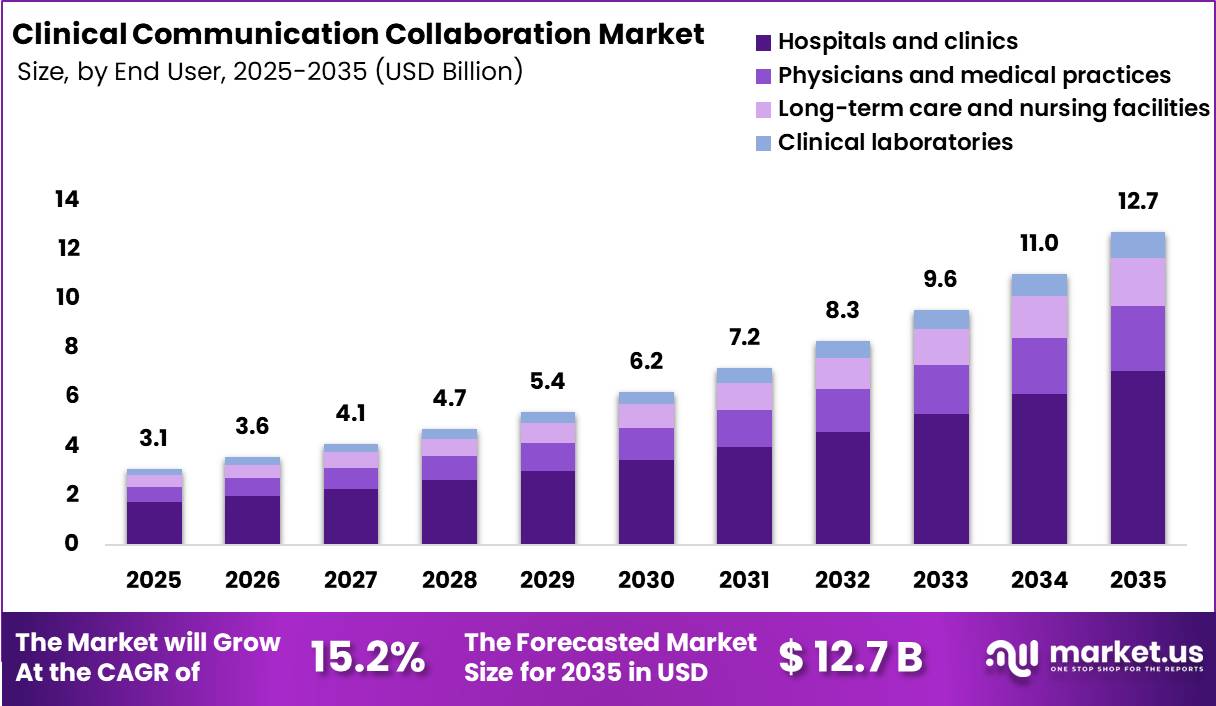
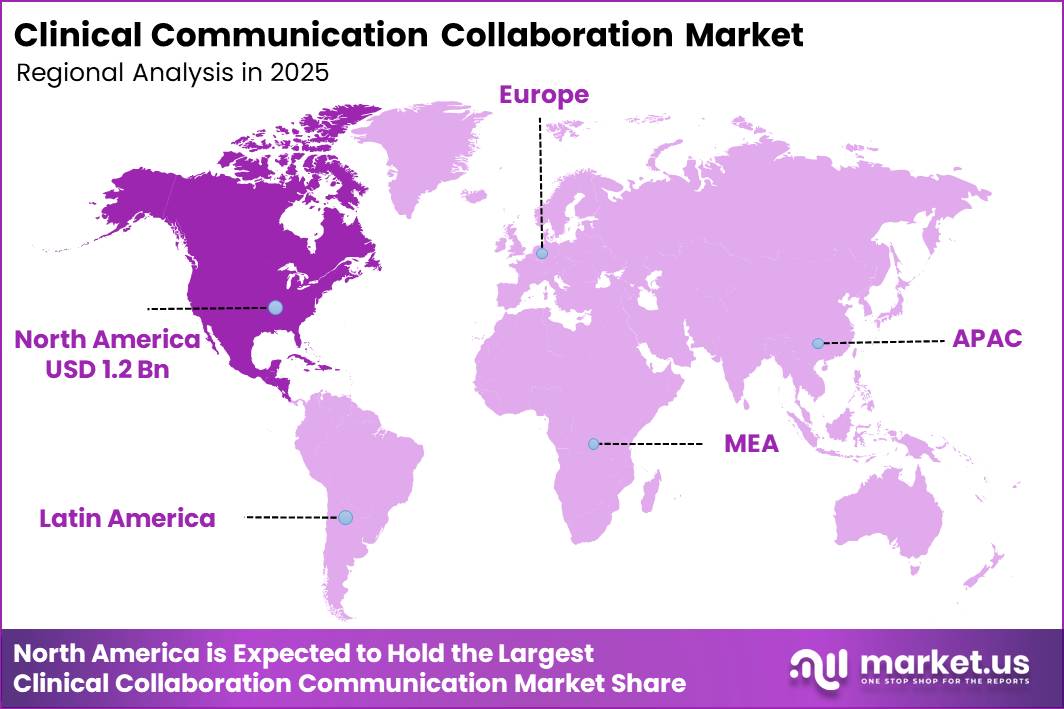
Global Clinical Communication Collaboration Market size is expected to be worth around US$ 12.7 Billion by 2035 from US$ 3.1 Billion in 2025, growing at a CAGR of 15.2% during the forecast period from 2026 to 2035. In 2025, North America led the market, achieving over 40.3% share with a revenue of US$ 1.2 Billion.
The Clinical Communication and Collaboration Market is experiencing steady growth as healthcare providers increasingly adopt digital technologies to improve patient care, enhance staff coordination, and reduce communication delays. Hospitals and healthcare systems are investing in secure messaging platforms, voice communication tools, nurse call systems, and integrated collaboration solutions to support faster clinical decision-making and better care delivery.
According to the U.S. Centers for Disease Control and Prevention (CDC), the United States records more than 139 million emergency department visits annually, highlighting the need for efficient communication systems that can support high patient volumes and rapid information exchange.
Additionally, the World Health Organization (WHO) estimates a global shortage of approximately 10 million healthcare workers by 2030, creating demand for technologies that help optimize workforce productivity and streamline clinical workflows.
The increasing adoption of electronic health records, mobile health applications, and cloud-based healthcare platforms is further supporting market expansion. Healthcare organizations are prioritizing interoperable communication systems that enable physicians, nurses, and care teams to share critical patient information in real time.
Growing emphasis on patient safety, reduction of medical errors, and improvements in operational efficiency continues to drive innovation within the Clinical Communication and Collaboration Market, making it an important component of modern connected healthcare infrastructure.
Key Takeaways
- Market Size : Clinical Communication Collaboration Market size is expected to be worth around US$ 12.7 Billion by 2035 from US$ 3.1 Billion in 2025.
- Market Share : The Market is growing at a CAGR of 15.2% during the forecast period from 2026 to 2035.
- Component Analysis : The solutions/software segment dominated the Clinical Communication Collaboration Market accounting for 70.3% of the total market share in 2025.
- Deployment Mode Analysis : The on-premise segment held the largest share of the Clinical Communication Collaboration Market in 2025, capturing 55.6% of total revenue.
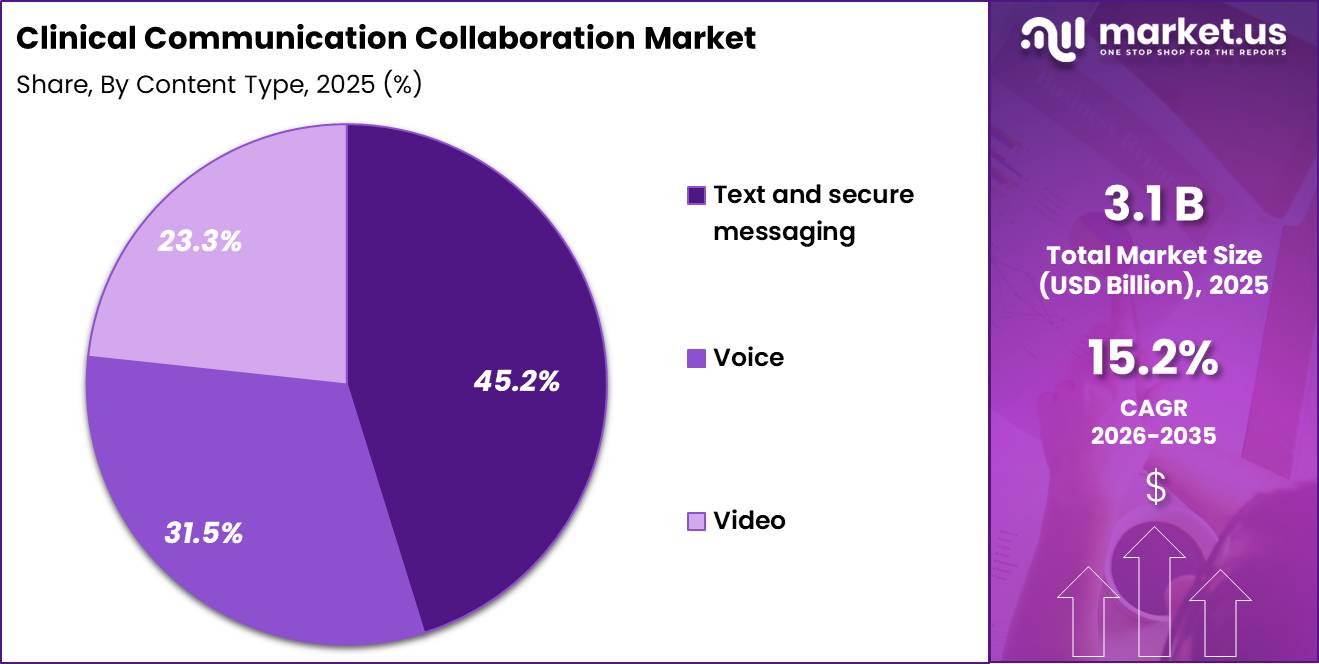
- Content Type Analysis : Text and secure messaging emerged as the leading content type in the Clinical Communication Collaboration Market, accounting for 45.2% of the market share in 2025.
- End-user Analysis : Hospitals and Clinics dominated the Clinical Communication Collaboration Market in 2025, accounting for 55.6% of the total market share.
- Regional Analysis : In 2025, North America led the market, achieving over 40.3% share with a revenue of US$ 1.2 Billion.
Component Analysis
The solutions/software segment dominated the Clinical Communication Collaboration Market in 2025, accounting for 70.3% of the total market share. This dominance is driven by the increasing adoption of secure messaging applications, clinical workflow management platforms, nurse call systems, alert notification tools, and unified communication solutions across healthcare facilities.
Healthcare providers are prioritizing software platforms that enable real-time information exchange, improve care coordination, and reduce communication delays among clinical teams. Integration with electronic health records (EHRs), mobile devices, and patient monitoring systems further supports demand for advanced communication solutions. The growing emphasis on interoperability and digital transformation initiatives is also contributing to segment growth.
Meanwhile, the services segment represented 29.7% of the market in 2025. This category includes implementation, consulting, training, maintenance, and technical support services. Increasing deployment complexity and the need for continuous system optimization are encouraging healthcare organizations to invest in professional services to ensure efficient adoption and long-term performance of communication and collaboration technologies.
Deployment Mode Analysis
The on-premise segment held the largest share of the Clinical Communication Collaboration Market in 2025, capturing 55.6% of total revenue. Hospitals and healthcare organizations continue to prefer on-premise deployment because it offers greater control over sensitive patient information, supports regulatory compliance requirements, and allows customization according to specific operational needs.
Large healthcare institutions often maintain existing IT infrastructure, making on-premise solutions a practical choice for managing clinical communications and data security. Additionally, organizations handling critical patient information prioritize internal data management systems to minimize cybersecurity concerns.
However, cloud-based or hosted solutions accounted for 44.4% of the market and are gaining significant traction. Their growth is supported by lower upfront costs, scalability, remote accessibility, and simplified system upgrades.
Cloud deployments enable healthcare professionals to communicate effectively across multiple locations, supporting telehealth expansion, remote care services, and integrated healthcare networks. Rising investments in digital health infrastructure are expected to further strengthen demand for cloud-based communication platforms.
Content Type Analysis
Text and secure messaging emerged as the leading content type in the Clinical Communication Collaboration Market, accounting for 45.2% of the market share in 2025. The segment’s dominance is attributed to the widespread use of encrypted messaging platforms for sharing patient updates, laboratory results, care instructions, and emergency notifications among healthcare professionals.
Secure messaging improves response times, enhances collaboration, and helps reduce communication errors in fast-paced clinical environments. Healthcare providers increasingly rely on mobile communication tools to facilitate efficient workflow management and ensure compliance with patient privacy regulations.
Voice communication also remains an important segment, particularly for urgent clinical discussions, critical alerts, and direct physician consultations. Meanwhile, video communication is witnessing steady growth due to expanding telemedicine adoption, virtual consultations, and multidisciplinary care meetings.
Healthcare organizations are integrating multiple communication formats into unified platforms to improve care coordination, streamline decision-making processes, and support more effective interactions between healthcare teams.
End-user Analysis
Hospitals and Clinics dominated the Clinical Communication Collaboration Market in 2025, accounting for 55.6% of the total market share. The segment benefits from increasing patient volumes, complex clinical workflows, and growing demand for efficient communication systems that support timely decision-making and coordinated care delivery. Hospitals are adopting integrated communication platforms to enhance patient safety, improve staff productivity, and reduce delays in information exchange among multidisciplinary teams.
Physicians and medical practices represent another important segment, utilizing communication technologies to manage patient interactions, coordinate referrals, and support remote consultations. Long-term care and nursing facilities are also expanding their use of collaboration platforms to improve resident monitoring, staff coordination, and emergency response capabilities.
Additionally, clinical laboratories are increasingly implementing secure communication systems to accelerate test result sharing, streamline reporting procedures, and strengthen collaboration with healthcare providers. Continued healthcare digitalization is expected to drive adoption across all end-user categories in the coming years.
Market Segmentations
By Component
- Solutions / Software
- Services
By Deployment Mode
- On‑Premise
- Cloud‑based / Hosted
By Content Type
- Text and Secure Messaging
- Voice
- Video
By End-user
- Hospitals and Clinics
- Physicians and Medical Practices
- Long‑term care and Nursing facilities
- Clinical laboratories
Opportunities
Ambient AI workflow layer
This is an upside opportunity rather than a current market driver because secure clinical messaging and staff coordination are already embedded in the baseline, whereas the next monetizable layer is the conversion of communication platforms into ambient clinical operating systems that capture, summarize, route, and document conversations across outpatient, inpatient, and virtual encounters.
NHS England’s 2025 guidance on ambient scribing and live 2026 deployment activity signal that ambient documentation is moving from pilot to scaled procurement, while ONC’s HTI-1 framework and USCDI v3 baseline improve the feasibility of structured downstream write back into certified health IT.
For vendors, this expands revenue per licensed clinician from a messaging centric model toward a hybrid seat plus usage model, where an estimated $1,200 to $2,500 annual AI attach per high intensity physician seat could lift account ACV by 25% to 45%, reduce note completion time by roughly 30% to 50%, and improve clinician retention economics enough to justify enterprise bundling.
The white space is especially attractive because most CCC platforms still monetize communication events, not documentation intelligence; integrating ambient capture, task extraction, referral prompts, and auto escalation logic could expand the vendor’s served TAM into physician documentation budgets, compliance tooling, and EHR workflow modules, supporting an incremental market CAGR uplift of about 2.8 percentage points if scaled across large health systems by 2030.
| Opportunity | (~) % Potential CAGR Upside | Geographic Relevance | Execution Window |
|---|---|---|---|
| Ambient AI workflow layer | +2.8% | North America core, UK, EU tertiary systems | Short term |
| Virtual acute care orchestration | +2.3% | U.S. core, Canada, Australia, Nordics | Medium term |
| Independent clinic network roll-up | +1.9% | U.S., APAC urban private care, LATAM private systems | Medium term |
| Interoperability monetization APIs | +1.7% | U.S. core, EU, Gulf states, advanced APAC | Short term |
| Behavioral + chronic care engagement | +1.5% | U.S., UK, Western Europe, India metros | Medium term |
| Compliance analytics and audit SaaS | +1.2% | U.S., UK, EU regulated providers | Short term |
Drivers
FHIR/USCDI interoperability compliance accelerating platform replacement
The strongest structural driver in 2026 is the conversion of clinical communication from a standalone messaging layer into an interoperability dependent workflow layer integrated with certified health IT. ONC’s HTI-1 framework made USCDI v3 the new baseline in the Health IT Certification Program as of January 1, 2026, while also tightening standards based exchange expectations and reinforcing information sharing logic under TEFCA oriented policy design.
Because FHIR is now the accepted exchange architecture for sharing clinical information across heterogeneous systems, vendors that cannot surface patient context, roles, encounters, medications, and task signals inside clinician workflows are increasingly disadvantaged in RFPs and renewal cycles.
This changes the commercial model from simple seat based secure messaging toward embedded workflow platforms that monetize on integration depth, care pathway orchestration, and API enabled extensibility, which is why this driver contributes an estimated +2.3 percentage points to CAGR rather than a one time compliance spike.
| Driver | (~) % Impact on CAGR Forecast | Geographic Relevance | Impact Timeline |
|---|---|---|---|
| FHIR/USCDI interoperability compliance accelerating platform replacement | +2.3% | North America core, EU digital-health adopters, APAC tier-1 hospital groups | Short term (≤ 2 years) |
| Secure texting and mobile order workflows replacing pagers and fragmented calling trees | +1.9% | North America core, UK, Australia, GCC hospitals | Short term (≤ 2 years) |
| Cybersecurity and breach-response spending shifting budgets toward encrypted clinical collaboration | +1.7% | North America core, EU, mature APAC provider networks | Short term (≤ 2 years) |
| Workforce shortages and burnout driving workflow automation, routing, and alert reduction | +1.5% | US, Canada, UK, Western Europe, developed APAC | Medium term (2-4 years) |
| Hospital-at-home and cross-continuum care expansion increasing off-site care-team coordination | +1.4% | North America core, Western Europe pilots, APAC urban systems | Medium term (2-4 years) |
| AI-assisted triage, message orchestration, and contextual escalation improving unit economics | +1.2% | North America core, EU innovation hubs, advanced APAC health systems | Medium term (2-4 years) |
Challenges
Cybersecurity and ransomware risk
Escalating cybersecurity and ransomware exposure forces CC&C buyers to hard gate deployments with stringent security reviews and extended vendor due diligence, slowing deal closure and cloud migration even as cyber risk itself creates demand for resilient communication channels.
Healthcare remains the top industry for ransomware attacks heading into 2026, with projections that over 40% of health systems in the US will experience a ransomware incident and around 60% of hospitals will see care delivery disrupted, pushing CIOs to require SOC 2/HITRUST compliance, detailed penetration test evidence, and zero trust architectures from CC&C suppliers, adding 2–4 months to typical procurement timelines.
Average healthcare breach costs surpassing 12 million dollars per incident elevate board level risk sensitivity, prompting more conservative rollouts with phased pilots (e.g., 100–300 users at a time instead of immediate 3,000–5,000 user activations) and stricter mobile device management policies, which can cut initial seat activation by 20–30% versus planned volumes in year one.
Vendors must absorb 10–15% of revenue into security engineering, endpoint hardening, and threat monitoring operations while also supporting redundant data centers and high availability architectures with recovery time objectives under 15 minutes and recovery point objectives under 5 minutes, raising unit hosting costs by an estimated 10–20% relative to non healthcare SaaS.
Strategically, winning players embed real time threat detection, role based access control, and encrypted on device storage as standard, while building playbooks for operating during client cyber outages, including offline modes, SMS fallbacks, and rapid re provisioning to clean environments; over a 2–4 year horizon these investments normalize security expectations but continue to shave around 1.2 percentage points off potential CAGR by inflating sales friction, compliance overhead, and capital intensity.
| Challenge | (~) % CAGR Friction Drag | Geographic Relevance | Mitigation Horizon |
|---|---|---|---|
| Fragmented EHR interoperability | -1.4% | North America, EU, APAC hospitals | Long term (≥ 4 years) |
| Cybersecurity and ransomware risk | -1.2% | North America, EU, APAC urban hubs | Medium term (2-4 years) |
| Clinician adoption fatigue | -0.9% | North America, EU, GCC, ANZ | Medium term (2-4 years) |
| Constrained health IT staffing | -1.0% | North America, EU, advanced APAC | Long term (≥ 4 years) |
| Legacy infrastructure dependence | -0.8% | Community providers, LATAM, emerging APAC | Long term (≥ 4 years) |
| Fragmented procurement and ROI proof | -0.7% | Global hospital groups, IDNs, public systems | Short term (≤ 2 years) |
Restraints
Cybersecurity, data residency and compliance drag
Escalating cybersecurity risk, stringent data residency rules, and complex compliance regimes are creating a multi layer drag on CC&C adoption because platforms must handle PHI and clinical workflows in an environment where healthcare ransomware incidents have surged and regulators in North America, the EU, and advanced APAC economies are tightening oversight and penalties.
High profile ransomware attacks in 2023–2025, some of which forced temporary hospital shutdowns and diverted emergency cases for several days, have driven boards and regulators to treat any new cloud connected clinical system as an expanded attack surface, requiring 3–6 additional months of security architecture review, penetration testing, and third party risk assessments before go live.
For cloud first CC&C vendors, this translates into significant capex and opex: maintaining region specific data centers or cloud regions to satisfy EU GDPR, US HIPAA, and emerging sovereignty requirements in regions like Japan and the Middle East can add 15–25% to infrastructure costs, while ongoing investments in encryption, zero trust architectures, and security operations can consume 8–12% of annual revenue.
Hospitals, in turn, demand contractual risk sharing, cyber insurance alignment, and detailed audit trails, which prolongs procurement cycles and can lead to 10–15% of late stage deals being pushed into subsequent fiscal years when security approvals or procurement committees are not satisfied.
Additionally, regulatory ambiguity around clinical decision support vs communication tools, especially where AI powered triage and alert prioritization features are involved, forces vendors to either limit functionality or absorb the cost of pursuing more stringent regulatory classifications, both of which dampen the monetization of advanced modules that could otherwise lift ARPU by 20–30%.
Strategically, this environment compresses growth and margins simultaneously sales cycles elongate by 3–9 months in highly regulated markets like the US, Germany, France, Japan, and Australia, and cybersecurity driven capex diverts 10–20% of hospital IT budgets toward foundational security upgrades rather than new CC&C deployments leaving the market growing approximately 1.7% points slower than its unconstrained demand side trajectory through the 2026–2030 window.
| Restraint | (~) % Impact on CAGR Forecast | Geographic Relevance | Impact Timeline |
|---|---|---|---|
| High integration & rollout cost | -2.2% | North America, EU, Japan, GCC | Medium term (2–4 years) |
| Fragmented interoperability & legacy IT | -1.9% | North America, EU, APAC corridors | Long term (≥ 4 years) |
| Cybersecurity, data residency & compliance drag | -1.7% | North America, EU, Japan, ANZ | Medium term (2–4 years) |
| Workforce adoption fatigue & change resistance | -1.4% | North America, EU, APAC Tier-1 | Short–Medium (≤ 3 years) |
| Capital budget constraint & competing digital priorities | -2.0% | Emerging APAC, LatAm, CEE, MEA | Short–Medium (≤ 3 years) |
| Connectivity gaps in secondary & rural care | -1.3% | APAC emerging, LatAm, Africa | Long term (≥ 4 years) |
Regional Analysis
In 2025, North America dominated the Clinical Communication and Collaboration Market, accounting for over 40.3% of the global market share and generating revenue of approximately US$ 1.2 billion. The region’s leadership is supported by widespread adoption of digital healthcare technologies, strong healthcare infrastructure, and increasing investments in connected care solutions.
Hospitals and healthcare systems across the United States and Canada are actively implementing secure messaging platforms, nurse call systems, and integrated communication tools to improve workflow efficiency and patient outcomes.
Europe represents another significant market, driven by growing demand for interoperable healthcare systems, supportive digital health initiatives, and increased emphasis on patient safety. Countries such as Germany, the United Kingdom, and France are expanding the use of cloud-based clinical communication platforms to enhance care coordination among healthcare professionals.
The Asia-Pacific region is expected to witness the fastest growth during the forecast period due to expanding healthcare infrastructure, rising healthcare expenditures, and rapid digital transformation across emerging economies such as China, India, and Japan.
Meanwhile, Latin America and the Middle East & Africa are gradually adopting clinical collaboration technologies, supported by ongoing healthcare modernization efforts and increasing awareness regarding efficient communication systems in medical settings.
Key Regions and Countries
North America
- The US
- Canada
Europe
- Germany
- France
- The U.K.
- Italy
- Spain
- Russia & CIS
- Rest of Europe
Asia Pacific
- China
- India
- Japan
- South Korea
- ASEAN
- Australia & New Zealand
- Rest of Asia Pacific
Middle East & Africa
- GCC
- South Africa
- Rest of Middle East & Africa
Latin America
- Brazil
- Mexico
- Rest of Latin America
Key Player Analysis
The Clinical Communication Collaboration Market is highly competitive, with leading companies focusing on secure messaging, workflow optimization, and integrated communication platforms to improve care coordination across healthcare settings. Cisco Systems Inc., Microsoft Corporation, and Oracle are strengthening their market positions by offering cloud-based communication tools, collaboration platforms, and advanced data integration capabilities that support real-time information sharing among healthcare professionals.
Baxter International, through its Hillrom and Welch Allyn businesses, continues to enhance clinical communication solutions by combining patient monitoring technologies with connected care systems. Avaya LLC and Ascom Holding AG are recognized for their expertise in unified communication solutions, nurse call systems, and mobile communication platforms designed to improve clinical efficiency and patient outcomes.
Vocera Communications, now part of Stryker, remains a key player with its voice-enabled communication technologies that streamline workflows and support faster clinical decision-making. Spok Inc. also maintains a strong presence by providing secure healthcare messaging, alerting systems, and critical communication solutions tailored to hospitals and healthcare organizations.
Top Key Players
- Cisco Systems Inc.
- Oracle
- Microsoft Corporation
- Baxter International (Hillrom / Welch Allyn)
- Avaya LLC
- Ascom Holding AG
- Vocera Communications (Stryker)
- Spok Inc.
- Symplr
- NEC Corporation
- Everbridge
- Imprivata Inc.
- TigerConnect
- PerfectServe, Inc.
- QliqSOFT Inc.
- Others
Recent Developments
- In September 2025, PerfectServe surpassed $100 million in contracted annual recurring revenue (ARR), driven by adoption of its unified clinical communication, provider scheduling, call-center, and workflow platform. The company also reported strong growth in multi-solution deployments and interoperability investments.
- In May 2025, TigerConnect launched CareConduit, a cloud-native workflow automation platform designed to connect fragmented hospital systems and automate clinical communication workflows. The platform was developed to improve interoperability and streamline care-team coordination across healthcare organizations
- In July 2025, Symplr acquired AMN Healthcare’s Smart Square scheduling software business to strengthen its healthcare operations platform with AI-driven workforce scheduling capabilities. The transaction was accompanied by a commercial partnership between Symplr and AMN Healthcare to integrate workforce planning, scheduling, and operational technologies for health systems.
Report Scope
| Report Features | Description |
|---|---|
| Market Value (2025) | US$ 3.1 Billion |
| Forecast Revenue (2035) | US$ 12.7 Billion |
| CAGR (2026-2035) | 15.2% |
| Base Year for Estimation | 2025 |
| Historic Period | 2020-2024 |
| Forecast Period | 2026-2035 |
| Report Coverage | Revenue Forecast, Market Dynamics, Competitive Landscape, Recent Developments |
| Segments Covered | By Component (Solutions / software, Services), By Deployment Mode (On‑premise, Cloud‑based / hosted), By Content Type (Text and secure messaging, Voice, Video), By End-user (Hospitals and clinics, Physicians and medical practices, Long‑term care and nursing facilities, Clinical laboratories) |
| Regional Analysis | North America – The US, Canada; Europe – Germany, France, U.K., Italy, Spain, Russia & CIS, Rest of Europe; Asia Pacific – China, India, Japan, South Korea, ASEAN, Australia & New Zealand, Rest of Asia Pacific; Middle East & Africa – GCC, South Africa, Rest of Middle East & Africa; Latin America – Brazil, Mexico, Rest of Latin America |
| Competitive Landscape | Cisco Systems Inc., Oracle, Microsoft Corporation, Baxter International (Hillrom / Welch Allyn), Avaya LLC, Ascom Holding AG, Vocera Communications (Stryker), Spok Inc., Symplr, NEC Corporation, Everbridge, Imprivata Inc., TigerConnect, PerfectServe, Inc., QliqSOFT Inc., Others. |
| Customization Scope | Customization for segments, region/country-level will be provided. Moreover, additional customization can be done based on the requirements. |
| Purchase Options | We have three licenses to opt for: Single User License, Multi-User License (Up to 5 Users), Corporate Use License (Unlimited User and Printable PDF) |





































