


Global Cellular GNSS Combo Module Market Size, Share, Growth Analysis By Product Type (2G, 3G, 4G/LTE, 5G), By Application (Automotive, Industrial, Consumer Electronics, Transportation & Logistics, Healthcare, Others), By Module Interface (UART, USB, SPI, I2C, Others), By End-User (OEMs, Aftermarket, Others), By Region and Companies - Industry Segment Outlook, Market Assessment, Competition Scenario, Statistics, Trends and Forecast 2025-2035
- Published date: Mar 2026
- Report ID: 181977
- Number of Pages: 384
- Format:
-
keyboard_arrow_up
Quick Navigation
- Report Overview
- Core Key Insights
- Future Predictions
- Market Outlook
- Key Market Segments
- Research-Based Segments
- By Product Type
- By Application
- By Module Interface
- By End-User
- Regional Analysis
- US Market Size
- Driving Factors
- Restraint Factors
- Growth Opportunities
- Trending Factors
- Competitive Analysis
- Recent Developments
- Report Scope
Report Overview
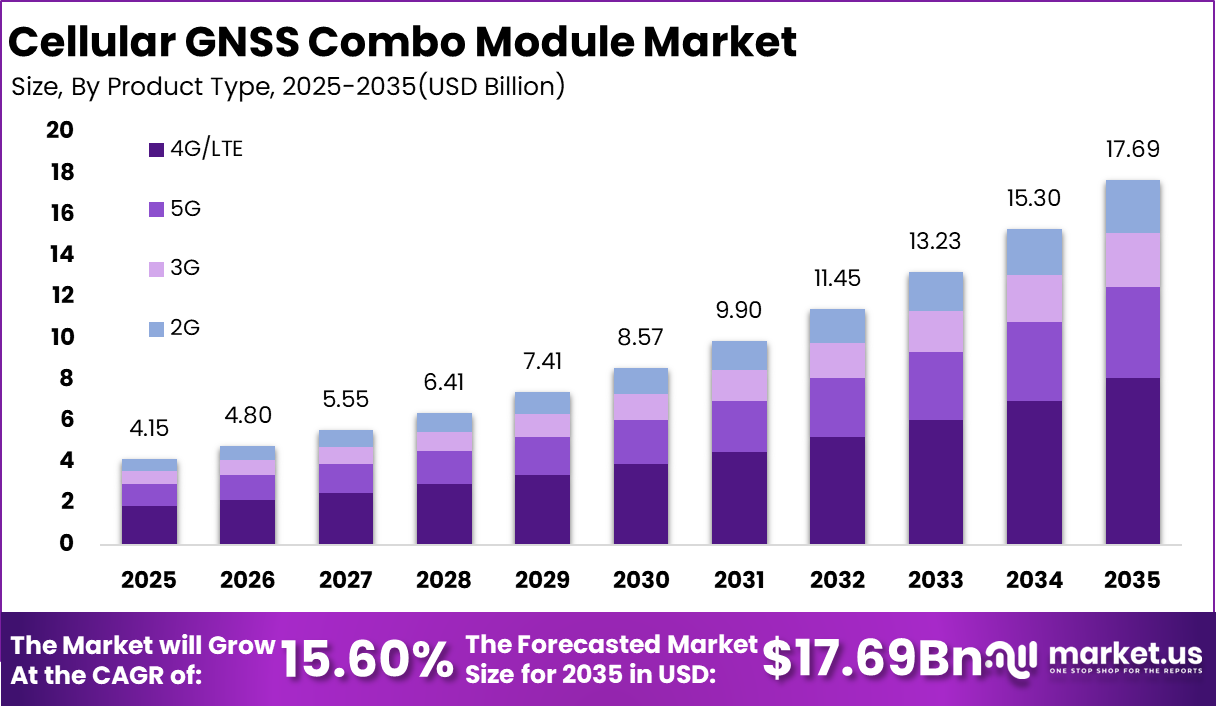
The Cellular GNSS Combo Module Market is experiencing strong growth, supported by rising demand for integrated connectivity and positioning solutions across multiple industries. In 2025, the market is valued at USD 4.15 billion and is projected to reach USD 17.69 billion by 2035, expanding at a CAGR of 15.60%.
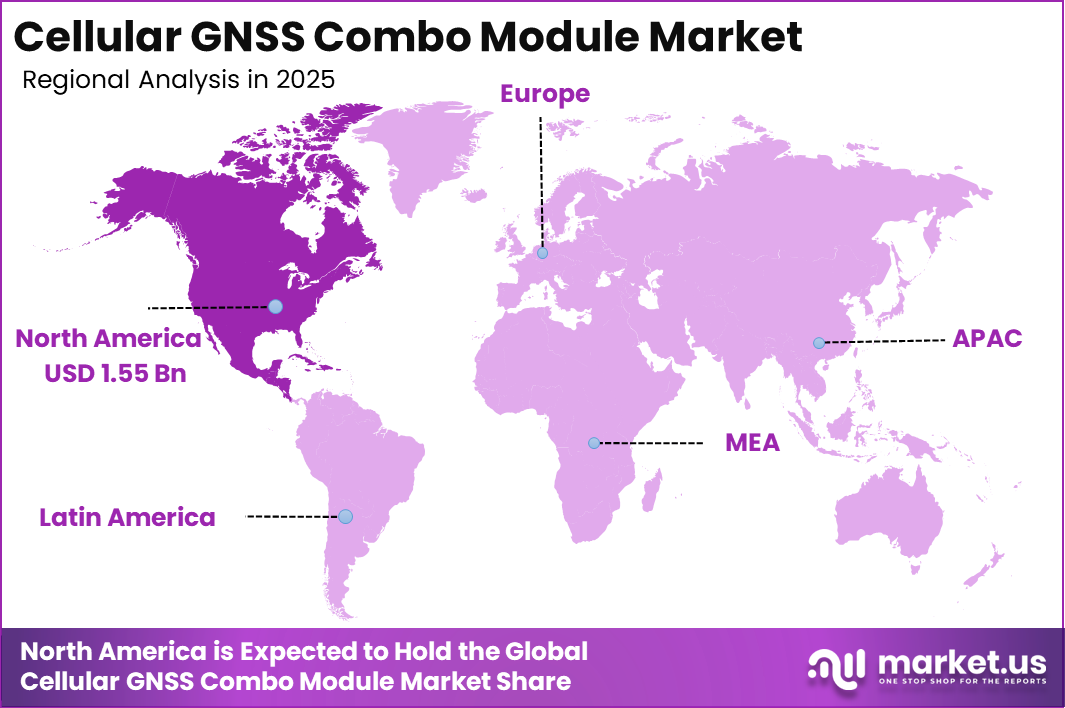
North America holds a dominant share of 37.3%, accounting for USD 1.55 billion in 2025. Within this region, the US represents a significant portion with a market size of USD 1.34 billion and is anticipated to reach USD 4.39 billion by 2035, growing at a CAGR of 12.6%.
From a client standpoint, this market presents a compelling opportunity driven by the increasing convergence of communication and navigation technologies. Cellular GNSS combo modules enable devices to achieve real-time positioning while maintaining continuous network connectivity, which is becoming essential for modern applications.
Industries such as automotive, transportation, logistics, and consumer electronics are rapidly adopting these modules to enhance operational efficiency, safety, and user experience. For instance, connected vehicles rely on these modules for navigation, emergency response systems, and vehicle tracking, while logistics companies use them for fleet management and asset monitoring.
The demand is further supported by the expansion of IoT ecosystems and the rollout of advanced cellular networks, including 5G. These developments are enabling faster data transmission, improved accuracy, and lower latency, which are critical for applications like smart cities, precision agriculture, and industrial automation. Additionally, the trend toward miniaturization and energy-efficient designs is encouraging manufacturers to develop compact combo modules that can be easily integrated into a wide range of devices.
For clients evaluating this market, the focus should be on identifying solutions that offer high accuracy, low power consumption, and compatibility with evolving network standards. Strategic investments in innovation and partnerships with technology providers are expected to play a key role in capturing long-term value in this rapidly evolving market.
The Cellular GNSS combo module ecosystem is supported by strong underlying technology adoption and infrastructure expansion across global markets. According to global telecom bodies, more than 5.6 billion people were using mobile services by 2024, creating a large base for cellular-enabled positioning devices.
In parallel, over 2.3 billion GNSS chipsets were shipped globally in recent years, reflecting widespread integration of satellite navigation across consumer and industrial devices. The automotive sector alone accounts for a significant share, with over 85 million vehicles produced annually, many of which now incorporate embedded connectivity and navigation systems.
In logistics and transportation, over 30 million commercial fleet vehicles worldwide are equipped with GPS-based tracking systems, highlighting the need for reliable combo modules. Additionally, global IoT connections have surpassed 16 billion devices, with projections indicating steady expansion driven by smart infrastructure and industrial automation.
Government-led initiatives such as intelligent transport systems and digital mapping programs are further strengthening adoption. These data points indicate a solid foundation for sustained demand, driven by real-world deployment across mobility, asset tracking, and connected device ecosystems.
Core Key Insights
- The market is valued at USD 4.15 billion in 2025. It is expected to reach USD 17.69 billion by 2035. CAGR stands at 15.60%.
- North America holds 37.3% share in 2025. The market size is USD 1.55 billion.
- The US market is USD 1.34 billion in 2025. It is projected to reach USD 4.39 billion by 2035. CAGR is 12.6%.
- 4G/LTE leads the product type segment with 45.6% share.
- Automotive leads the application segment with 38.8% share.
- UART holds 35.7% share in the module interface.
- OEMs dominate the end-user segment with 52.7% share.
Future Predictions
The future of the Cellular GNSS Combo Module Market is expected to be shaped by rapid expansion in connected ecosystems and satellite navigation upgrades. Global GNSS device shipments are projected to exceed 3 billion units annually by the early 2030s, driven by rising integration across smartphones, vehicles, wearables, and industrial equipment.
At the same time, the number of IoT-connected devices is expected to cross 29 billion by 2030, creating a strong demand base for modules that combine positioning with seamless cellular communication. In the automotive sector, over 90% of new vehicles sold in developed markets are anticipated to include embedded connectivity and navigation systems, increasing reliance on combo modules.
Fleet telematics is also expanding, with more than 45 million commercial vehicles expected to be equipped with advanced tracking and monitoring systems within the next decade. Additionally, the rollout of 5G standalone networks is gaining pace, with over 120 countries already investing in nationwide deployments, improving real-time data transmission and positioning accuracy.
Government-backed smart mobility and digital infrastructure programs are further accelerating adoption. For example, intelligent transport systems are being deployed across major urban regions, supporting traffic management and vehicle safety. These developments indicate a strong future pipeline, with demand increasingly linked to real-time location intelligence and connected device ecosystems.
Market Outlook
The Cellular GNSS Combo Module Market is evolving steadily, supported by strong fundamentals in connectivity and positioning technologies. Globally, more than 5.4 billion people are connected through mobile networks, creating a broad base for cellular-enabled devices.
At the same time, global navigation satellite systems such as GPS, Galileo, GLONASS, and BeiDou collectively support billions of active receivers, with over 6.5 billion GNSS-enabled devices currently in use worldwide. This widespread adoption highlights the growing need for integrated modules that can deliver both communication and precise location tracking.
From an application perspective, the automotive and mobility sector continues to play a major role. Around 80 million vehicles are produced annually, and a large portion now includes embedded telematics and navigation features. In logistics, more than 25 million fleet vehicles globally are already connected through tracking systems, supporting route optimization and asset visibility. In addition, global IoT connections have reached approximately 17 billion devices, with industrial IoT contributing a significant share across manufacturing, energy, and smart infrastructure.
Looking ahead, the continued expansion of 5G networks, with over 300 commercial deployments worldwide, is expected to enhance real-time data exchange and positioning accuracy. These factors indicate a stable and expanding market outlook, driven by real-world demand across transportation, consumer electronics, and industrial ecosystems.
Key Market Segments
The 4G/LTE segment holds a dominant share of 45.6% in the Cellular GNSS Combo Module Market. This leadership is supported by the widespread availability of LTE networks across both developed and emerging regions.
4G/LTE modules are preferred due to their stable connectivity, lower latency compared to older networks, and compatibility with existing infrastructure. These modules are widely integrated into tracking devices, automotive systems, and industrial applications where consistent communication and positioning are essential.
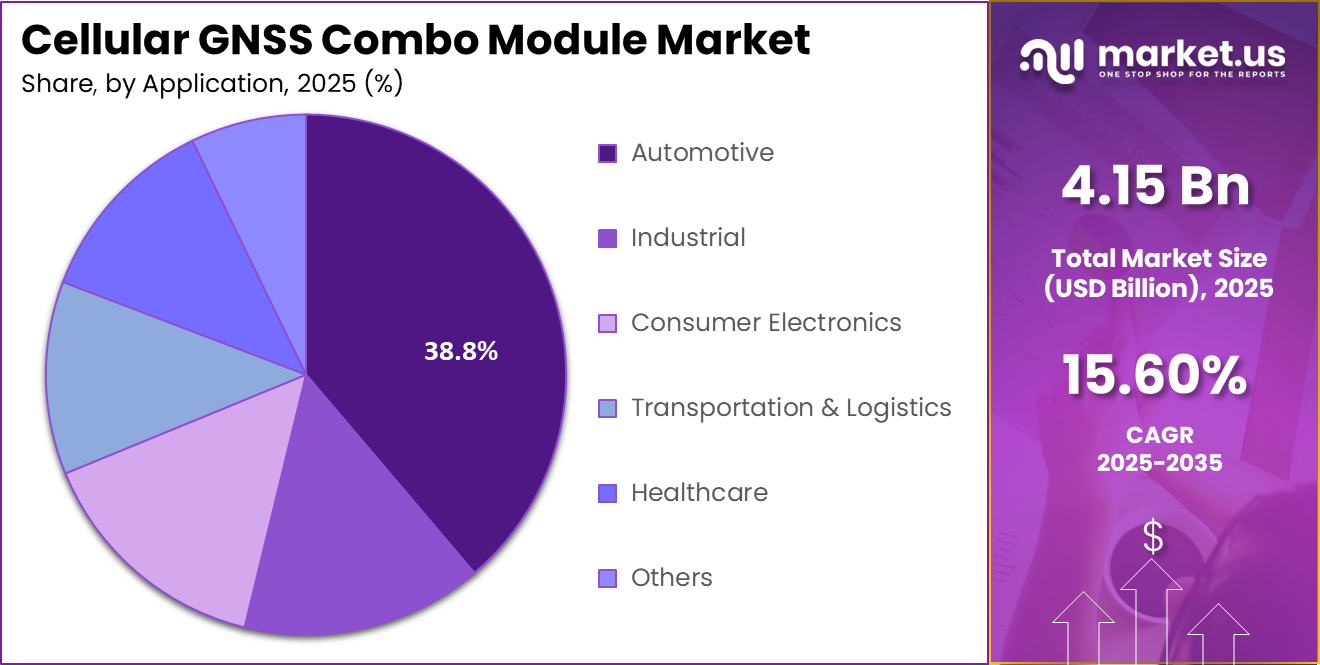
The automotive segment accounts for 38.8% of the market, driven by the growing adoption of connected vehicles and advanced telematics systems. Automakers are increasingly integrating GNSS and cellular modules to support navigation, vehicle tracking, emergency response systems, and fleet management. Rising demand for safety features and real-time data exchange in vehicles continues to support this segment’s growth.
The UART interface segment captures 35.7% share, reflecting its strong adoption in embedded systems. UART is widely used due to its simple architecture, cost efficiency, and ease of integration with microcontrollers. It is particularly suitable for applications where reliable serial communication is required without complex configurations.
The OEMs segment dominates the end-user category with a 52.7% share. This is driven by the increasing integration of combo modules directly into devices during the manufacturing process, especially in automotive, consumer electronics, and industrial equipment sectors.
Research-Based Segments
By Product Type
- 2G
- 3G
- 4G/LTE
- 5G
By Application
- Automotive
- Industrial
- Consumer Electronics
- Transportation & Logistics
- Healthcare
- Others
By Module Interface
- UART
- USB
- SPI
- I2C
- Others
By End-User
- OEMs
- Aftermarket
- Others
By Product Type
The 4G/LTE segment holds a dominant share of 45.6% in the Cellular GNSS Combo Module Market. This dominance is supported by the extensive global coverage of LTE networks and their ability to deliver reliable data connectivity with moderate power consumption. 4G/LTE modules are widely used across automotive telematics, asset tracking, and industrial IoT applications where stable and continuous communication is required. Their compatibility with existing infrastructure and cost-effectiveness make them a preferred choice for large-scale deployments.
The 2G segment continues to maintain relevance in select regions, particularly for low-data applications such as basic tracking and legacy systems. However, gradual network shutdowns in several countries are limiting its long-term growth. The 3G segment is also witnessing a decline due to global phase-out initiatives, although it still supports some transitional use cases where LTE migration is ongoing.
The 5G segment is emerging as a high-growth category, driven by increasing deployment of advanced networks. 5G modules offer ultra-low latency, higher bandwidth, and improved positioning accuracy, making them suitable for applications such as autonomous vehicles, smart infrastructure, and real-time industrial monitoring. As 5G coverage expands, its adoption in combo modules is expected to increase steadily.
By Application
The automotive segment holds a leading share of 38.8% in the Cellular GNSS Combo Module Market. This growth is driven by increasing integration of connected vehicle technologies such as navigation systems, emergency response solutions, and real-time vehicle tracking. Automakers are focusing on enhancing driver safety, regulatory compliance, and in-vehicle connectivity, which continues to support strong demand for combo modules.
The industrial segment is expanding steadily as manufacturers adopt smart factory solutions and asset monitoring systems. These modules are used for equipment tracking, remote diagnostics, and operational efficiency improvements across production environments. The consumer electronics segment is also gaining traction, supported by the rising adoption of smart devices such as wearables, tablets, and personal trackers that rely on accurate positioning and connectivity.
Transportation and logistics represent a key application area, driven by the need for fleet management, route optimization, and shipment tracking. Increasing global trade and e-commerce activities are supporting adoption in this segment. The healthcare segment is witnessing gradual growth, particularly in applications such as patient monitoring, emergency location tracking, and connected medical devices. The other segment includes niche applications across agriculture, defense, and smart city infrastructure, contributing to overall market expansion.
By Module Interface
The UART segment holds a leading share of 35.7% in the Cellular GNSS Combo Module Market. This dominance is driven by its simple architecture and ease of integration with microcontrollers and embedded systems. UART is widely used in automotive, tracking devices, and industrial applications where stable serial communication is required with low implementation complexity and cost.
The USB segment is gaining traction, particularly in consumer electronics and development environments. It offers faster data transfer rates and plug-and-play functionality, making it suitable for applications such as portable devices and testing systems. The SPI segment is also widely adopted in high-speed data communication scenarios. It provides better performance than UART in applications that require faster data exchange and lower latency.
The I2C segment is commonly used in compact and low-power devices where multiple peripherals need to communicate over a shared bus. It is suitable for space-constrained designs and is often used in sensors and small embedded systems. The other segment includes alternative interfaces tailored for specific industrial or customized applications, supporting diverse integration requirements across different end-use environments.
By End-User
The OEMs segment holds a dominant share of 52.7% in the Cellular GNSS Combo Module Market. This leadership is driven by the increasing integration of combo modules directly into devices during the manufacturing stage. Industries such as automotive, industrial equipment, and consumer electronics are embedding these modules to enable real-time connectivity and positioning. OEMs benefit from better design optimization, cost efficiency at scale, and seamless system compatibility, which supports large-volume adoption.
The aftermarket segment is growing steadily, supported by rising demand for retrofitting and upgrading existing systems. Fleet operators, logistics companies, and individual users are increasingly installing GNSS and cellular modules in older vehicles and equipment to enable tracking, monitoring, and connectivity features. This segment is particularly relevant in regions where replacement cycles are longer and cost sensitivity is higher.
The other segment includes specialized users such as system integrators, government agencies, and niche application providers. These users deploy combo modules for customized solutions across sectors like defense, agriculture, and smart infrastructure. Although smaller in share, this segment contributes to market diversity and supports adoption in emerging and application-specific use cases.
Regional Analysis
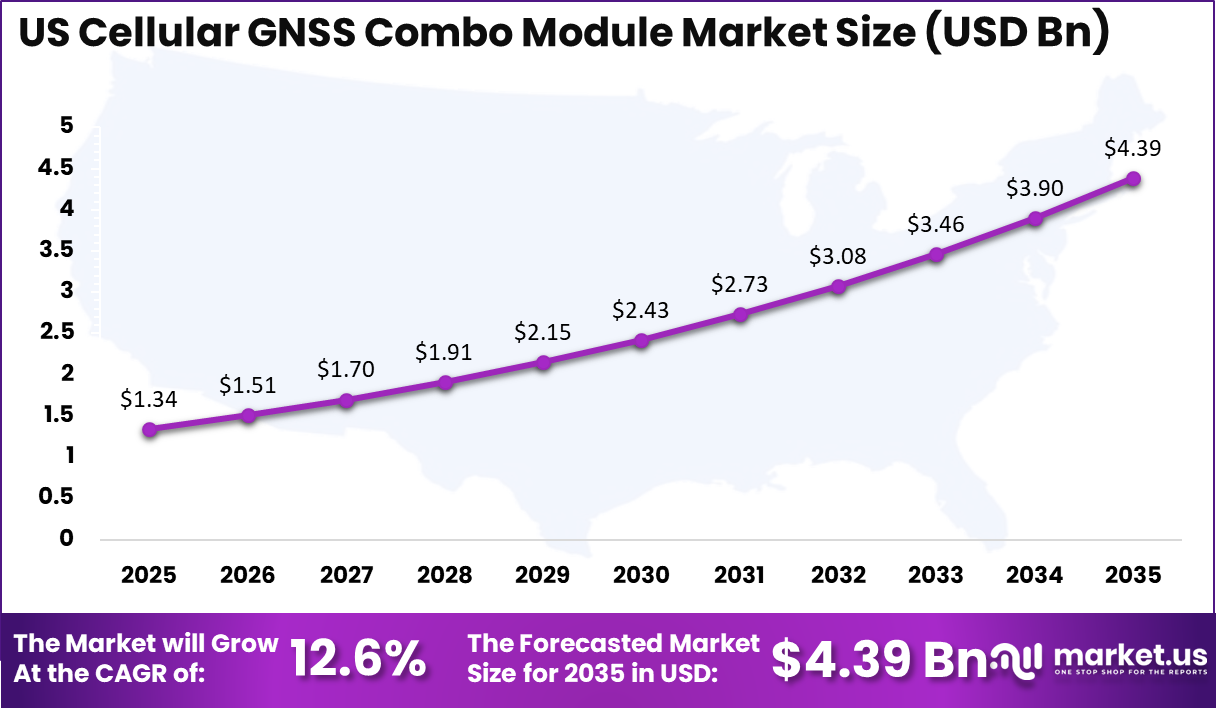
North America holds a dominant share of 37.3% in the Cellular GNSS Combo Module Market, with a market size of USD 1.55 billion in 2025. This leadership is supported by strong adoption of connected technologies across automotive, logistics, and industrial sectors. The region benefits from advanced telecom infrastructure, early rollout of next-generation networks, and high penetration of IoT-enabled devices, which continues to drive demand for integrated cellular and positioning modules.
The United States plays a central role in regional growth, supported by widespread deployment of connected vehicles, fleet tracking systems, and smart mobility solutions. Automotive manufacturers and technology providers are actively integrating GNSS combo modules to support navigation, safety features, and real-time data exchange. In addition, the presence of large-scale logistics networks and e-commerce operations is increasing the need for accurate tracking and asset management solutions.
Canada is also contributing to market expansion, particularly through investments in smart infrastructure and digital connectivity projects. Government initiatives focused on intelligent transport systems and remote monitoring are encouraging adoption across public and private sectors. Overall, North America is expected to maintain its leading position, supported by continuous technological advancements and strong demand for connected and location-based services.
US Market Size
The US Cellular GNSS Combo Module Market is valued at USD 1.34 billion in 2025 and is projected to reach USD 4.39 billion by 2035, expanding at a CAGR of 12.6%. This steady growth is supported by strong adoption of connected technologies across automotive, logistics, and industrial sectors. The country’s advanced telecom infrastructure and early deployment of 5G networks are creating a favorable environment for integrated communication and positioning solutions.
The automotive industry remains a key contributor, with increasing integration of telematics, navigation, and safety systems in both passenger and commercial vehicles. Regulatory focus on emergency response systems and vehicle tracking is further supporting demand for GNSS combo modules. In addition, the logistics and transportation sector is expanding rapidly, driven by the growth of e-commerce and the need for efficient fleet management and real-time asset tracking.
Industrial applications are also gaining traction, particularly in smart manufacturing and remote monitoring systems. Companies are adopting connected devices to improve operational efficiency and reduce downtime, which is increasing reliance on accurate positioning and reliable connectivity. With continuous investments in digital infrastructure and IoT ecosystems, the US market is expected to witness consistent demand across multiple application areas over the forecast period.
Regional Analysis and Coverage
- North America
- US
- Canada
- Europe
- Germany
- France
- The UK
- Spain
- Italy
- Russia
- Netherlands
- Rest of Europe
- Asia Pacific
- China
- Japan
- South Korea
- India
- Australia
- Singapore
- Thailand
- Vietnam
- Rest of Latin America
- Latin America
- Brazil
- Mexico
- Rest of Latin America
- Middle East & Africa
- South Africa
- Saudi Arabia
- UAE
- Rest of MEA
Driving Factors
The market for cellular GNSS combo modules is driven by the rapid expansion of connected devices and mobile networks worldwide. More than 5.4 billion people are currently using mobile services, creating a strong base for cellular-enabled positioning solutions. In parallel, global GNSS receiver shipments have crossed 2.5 billion units annually, reflecting widespread adoption across smartphones, vehicles, and industrial equipment.
The automotive sector is a major contributor, with over 80 million vehicles produced each year, many of which now integrate telematics and navigation systems. Additionally, global IoT connections have exceeded 17 billion devices, increasing demand for modules that combine connectivity and location tracking.
Governments are also supporting adoption through smart mobility and digital infrastructure programs, including intelligent transport systems and urban traffic monitoring solutions. These factors collectively strengthen demand for integrated modules that enable real-time communication and precise positioning.
Restraint Factors
Despite strong growth, the market faces challenges related to infrastructure limitations and cost sensitivity. In several developing regions, stable cellular coverage remains below 75% of the population, which restricts reliable deployment of combo modules. GNSS performance can also be affected by signal obstruction in dense urban environments, reducing accuracy in high-rise areas.
Additionally, module costs remain a concern for price-sensitive applications, especially in low-margin industries. Semiconductor supply chain disruptions have previously impacted availability, with global chip shortages affecting production cycles across electronics and automotive sectors.
Power consumption is another limitation, particularly in battery-operated devices where energy efficiency is critical. Furthermore, the ongoing shutdown of legacy 2G and 3G networks in many countries requires system upgrades, adding to implementation costs for existing users.
Growth Opportunities
The expansion of 5G networks presents a significant opportunity for the market. More than 300 commercial 5G networks have been deployed globally, enabling faster data transmission and lower latency. This supports advanced applications such as autonomous driving, real-time asset tracking, and smart city infrastructure.
The number of connected vehicles worldwide is expected to exceed 400 million units within the next decade, creating sustained demand for integrated modules. In logistics, over 30 million fleet vehicles are already equipped with tracking systems, with further growth anticipated as supply chains become more digitized.
Precision agriculture is another emerging area where GNSS-enabled devices are used for automated farming and field monitoring. Additionally, increasing investments in smart infrastructure projects across Asia and Europe are opening new avenues for deployment in traffic management, public safety, and environmental monitoring systems.
Trending Factors
One of the key trends shaping the market is the shift toward multi-constellation GNSS support, including GPS, Galileo, GLONASS, and BeiDou, which improves positioning accuracy and reliability. Over 6 billion GNSS-enabled devices are currently active worldwide, and demand is rising for solutions that offer enhanced precision.
Another trend is the integration of edge computing with positioning modules, allowing faster data processing directly on devices. The rise of low-power wide-area networks and energy-efficient chipsets is also influencing product development, especially for battery-operated IoT devices.
In the automotive sector, advanced driver assistance systems are increasingly relying on high-accuracy positioning, supporting safer navigation and route optimization. Additionally, the adoption of eSIM technology is growing, with hundreds of millions of eSIM-enabled devices already in use, enabling seamless connectivity across regions without physical SIM cards.
Competitive Analysis
The Cellular GNSS Combo Module Market is characterized by strong competition among semiconductor manufacturers, module providers, and connectivity solution companies. Leading players focus on integrating multi-constellation GNSS support with advanced cellular technologies to improve accuracy and performance.
Globally, more than 60% of GNSS chipsets are supplied by a limited group of major semiconductor firms, indicating a moderately concentrated supply landscape. Companies are investing heavily in research and development, with annual semiconductor R&D spending exceeding USD 70 billion across the industry, enabling continuous innovation in low-power and high-precision modules.
Strategic partnerships and ecosystem collaborations are also shaping competition. Module providers are working closely with telecom operators and IoT platform developers to ensure seamless connectivity and device compatibility.
For example, over 200 mobile network operators worldwide are actively supporting IoT connectivity standards, creating opportunities for integrated module solutions. In addition, manufacturing scale plays a critical role, as global semiconductor fabrication capacity has expanded to over 1,000 fabrication facilities, allowing leading players to achieve cost efficiencies and faster time-to-market.
The market is also witnessing increased competition from emerging players offering cost-effective solutions, particularly in Asia. These companies are leveraging localized manufacturing and design capabilities to capture price-sensitive segments, intensifying competition and driving innovation across the value chain.
Top Key Players in the Market
- u-blox
- Quectel Wireless Solutions
- Telit Cinterion
- Sierra Wireless
- Thales Group
- Fibocom Wireless
- SIMCom Wireless Solutions
- Murata Manufacturing
- SkyTraq Technology
- Neoway Technology
- Laird Connectivity
- Sony Semiconductor Israel (Altair Semiconductor)
- Nordic Semiconductor
- MediaTek
- Queclink Wireless Solutions
- MeiG Smart Technology
- Sunsea AIoT
- Coban Electronics
- Shanghai Mobiletek Communication
- Quectel Communications
- Others
Recent Developments
- In 2025, global cellular IoT module shipments expanded by over 20% year-on-year, driven by rising demand across asset tracking, automotive telematics, and smart devices.
- In 2025, LTE Cat. 1 bis technology accounted for nearly 60% of total IoT module deployments, reflecting strong adoption of cost-efficient and power-optimized connectivity solutions.
- In 2025, more than 25 million GNSS-enabled modules were deployed in connected vehicle safety systems across Europe, supported by regulatory mandates for emergency response capabilities.
Report Scope
Report Features Description Market Value (2025) USD 4.15 Billion Forecast Revenue (2035) USD 17.69 Billion CAGR(2025-2035) 15.60% Base Year for Estimation 2025 Historic Period 2020-2024 Forecast Period 2026-2035 Report Coverage Revenue forecast, AI impact on Market trends, Share Insights, Company ranking, competitive landscape, Recent Developments, Market Dynamics, and Emerging Trends Segments Covered By Product Type (2G, 3G, 4G/LTE, 5G), By Application (Automotive, Industrial, Consumer Electronics, Transportation & Logistics, Healthcare, Others), By Module Interface (UART, USB, SPI, I2C, Others), By End-User (OEMs, Aftermarket, Others) Regional Analysis North America – US, Canada; Europe – Germany, France, The UK, Spain, Italy, Russia, Netherlands, Rest of Europe; Asia Pacific – China, Japan, South Korea, India, New Zealand, Singapore, Thailand, Vietnam, Rest of Latin America; Latin America – Brazil, Mexico, Rest of Latin America; Middle East & Africa – South Africa, Saudi Arabia, UAE, Rest of MEA Competitive Landscape u-blox, Quectel Wireless Solutions, Telit Cinterion, Sierra Wireless, Thales Group, Fibocom Wireless, SIMCom Wireless Solutions, Murata Manufacturing, SkyTraq Technology, Neoway Technology, Laird Connectivity, Sony Semiconductor Israel (Altair Semiconductor), Nordic Semiconductor, MediaTek, Queclink Wireless Solutions, MeiG Smart Technology, Sunsea AIoT, Coban Electronics, Shanghai Mobiletek Communication, Quectel Communications, Others Customization Scope Customization for segments, region/country-level will be provided. Moreover, additional customization can be done based on the requirements. Purchase Options We have three licenses to opt for: Single User License, Multi-User License (Up to 5 Users), Corporate Use License (Unlimited Users and Printable PDF)  Cellular GNSS Combo Module MarketPublished date: Mar 2026add_shopping_cartBuy Now get_appDownload Sample
 -
-
- u-blox
- Quectel Wireless Solutions
- Telit Cinterion
- Sierra Wireless
- Thales Group
- Fibocom Wireless
- SIMCom Wireless Solutions
- Murata Manufacturing
- SkyTraq Technology
- Neoway Technology
- Laird Connectivity
- Sony Semiconductor Israel (Altair Semiconductor)
- Nordic Semiconductor
- MediaTek
- Queclink Wireless Solutions
- MeiG Smart Technology
- Sunsea AIoT
- Coban Electronics
- Shanghai Mobiletek Communication
- Quectel Communications
- Others
Our Clients

- 181977
- Mar 2026









