


Report Overview
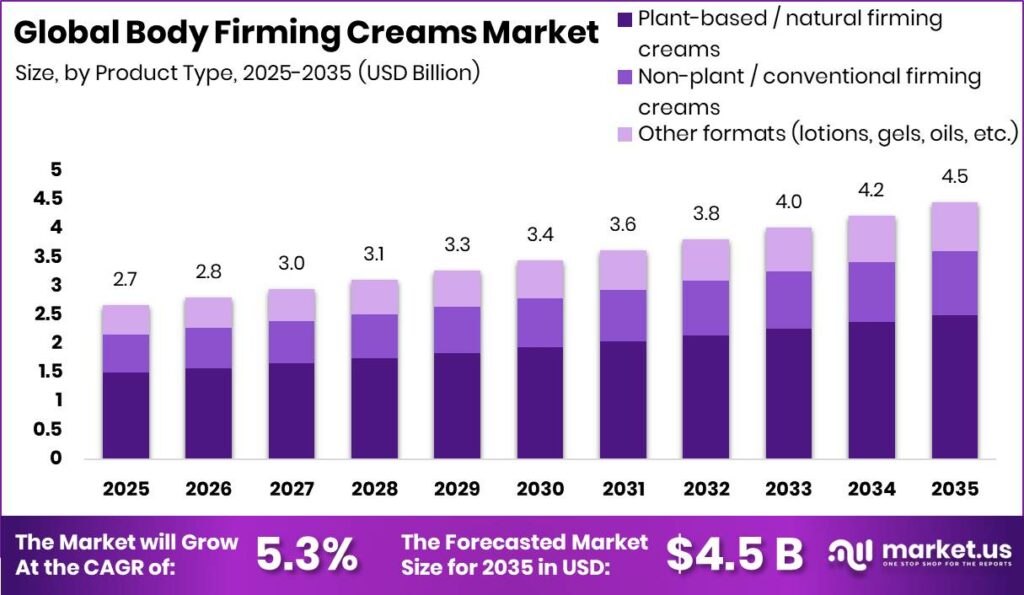
Global Body Firming Creams Market size is expected to be worth around USD 4.5 Billion by 2035 from USD 2.7 Billion in 2025, growing at a CAGR of 5.3% during the forecast period 2026 to 2035. This growth reflects steady demand across aging and post-weight-loss consumer cohorts. Brands that align formulation claims with measurable skin outcomes will capture the most loyal repeat buyers over the next decade.
Body firming creams are topical Skin Care Products formulated to improve skin elasticity, reduce sagging, and tighten body contours through actives like retinol, peptides, and hyaluronic acid. Therefore, the market structures around product type, skin type, gender, and distribution channel. Manufacturers compete on active-ingredient efficacy and delivery technology, while retailers segment shelves by price tier and clinical positioning to serve distinct buyer intent.
Key Takeaways
- Global market reached USD 2.7 Billion in 2025 and will hit USD 4.5 Billion by 2035 at a 5.3% CAGR.
- Plant-based / natural firming creams led product type with a 56.2% share and rank as the fastest growing sub-segment.
- All-skin / normal and combination formulations held 40.1% of the skin type segment.
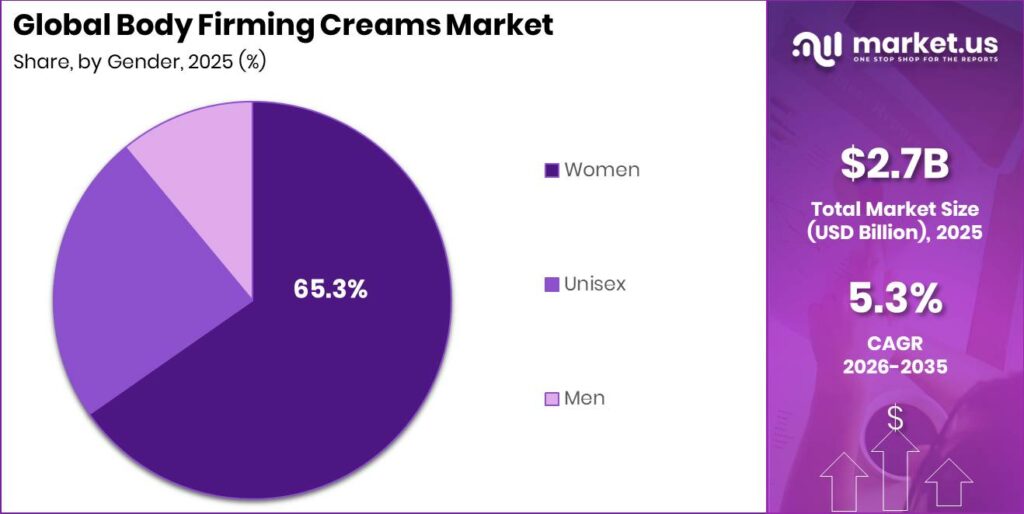
- Women accounted for 65.3% of buyers within the gender segment.
- Offline channels captured 60.3% of total distribution.
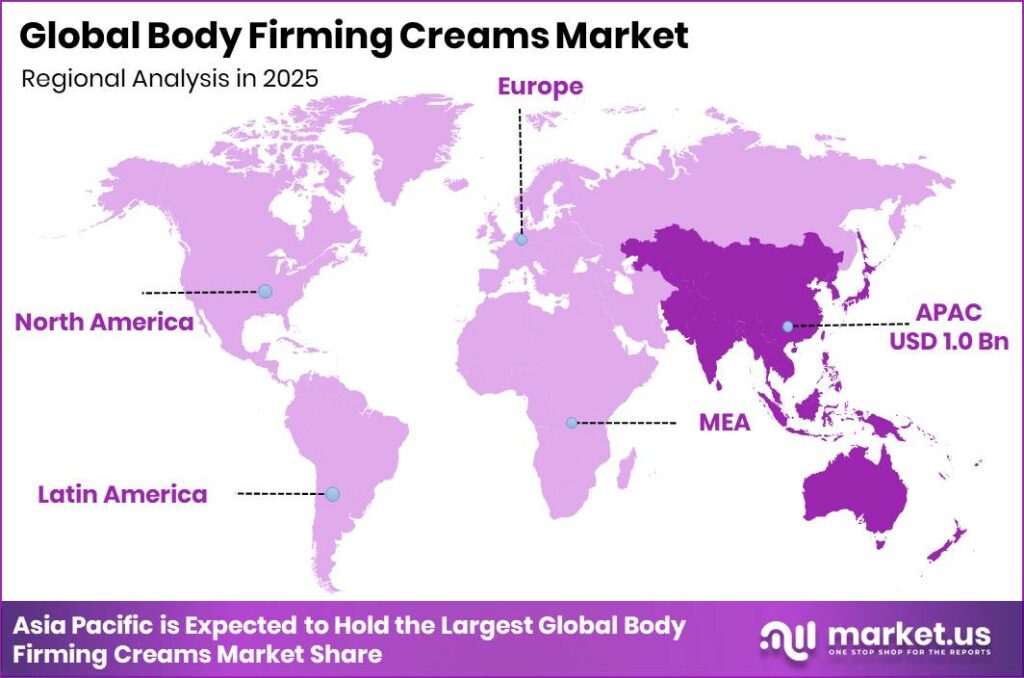
- Asia Pacific dominated with a 36.1% regional share valued at USD 1.0 Billion.
Government bodies increasingly shape this category through cosmetic claim regulation and ingredient safety rules. As a result, brands invest in clinical substantiation to keep efficacy messaging compliant. As per our research, cellulite affects up to 85% of women over age 20, creating a large addressable buyer base. This means firming brands can anchor marketing to a near-universal skin concern rather than niche appeal.
Clinical evidence now drives purchase conversion in this category. As per our research, botanical topical cream showed 44.4% improvement in cellulite appearance after 8 weeks. This result gives brands defensible proof points for premium positioning. Therefore, companies that publish measurable trial data will convert skeptical shoppers faster than rivals relying on vague promises. In October 2025, Dove launched its Pro-Ceramide body serums, signaling mainstream players entering clinical-adjacent firming territory.
Product Type Analysis
Plant-based / natural firming creams dominate with 56.2% due to clean-label consumer preference shift.
In 2025, Plant-based / natural firming creams held a dominant market position in the By Product Type segment of Body Firming Creams Market, with a 56.2% share. Global exports under HS Code 3304 reached USD 96.33 Billion in 2023, reflecting strong trade flows for skincare preparations. This scale rewards brands that certify natural sourcing. Therefore, suppliers with transparent botanical supply chains gain shelf priority as retailers prioritize clean-label credibility.
Non-plant / conventional firming creams serve buyers prioritizing proven synthetic actives like retinol and peptide complexes. Clinical data shows Cutometer measurement recorded up to +35% improvement in skin firmness after 84 days. This performance sustains loyalty among efficacy-driven shoppers. Consequently, conventional formulators can defend margin by leading with instrument-verified results rather than competing on natural positioning alone.
Other formats such as lotions, gels, and oils address texture preferences and layered application routines. A 28-day Cutometer study reported a 20.44% reduction in skin distension after twice-daily use of a sculpting cream. This measurable outcome validates lighter formats for daily regimens. As a result, brands can extend firming lines into gels and oils to capture consumers who reject heavy cream textures collectively.
Skin Type Analysis
All-skin / normal and combination dominates with 40.1% due to broad universal formulation compatibility.
In 2025, All-skin / normal & combination held a dominant market position in the By Skin Type segment of Body Firming Creams Market, with a 40.1% share. Collagen makes up about 75% of dermis dry weight, making collagen-support actives central to universal formulas. This biology favors broad-spectrum products. Therefore, brands maximizing compatibility across skin types capture the widest retail distribution and reduce SKU fragmentation costs.
Dry skin buyers seek firming creams that combine elasticity actives with intensive moisture barriers. A 70-person consumer study found 98% reported softer skin after 6 weeks of use. This satisfaction rate supports dual-benefit positioning. Consequently, formulators pairing hydration with firming claims can command loyalty in colder climates where dryness intensifies visible skin laxity.
Oily skin and Sensitive / others cover remaining demand through lightweight, non-comedogenic, and low-irritant formulations. A multicenter trial enrolled 91 participants aged 30 to 50 testing HA and Vitamin C actives over 8 weeks. This research base guides gentle formulation design. As a result, brands targeting these two groups together can address underserved skin profiles with clinically calibrated actives.
Gender Analysis
Women dominate with 65.3% due to established anti-sagging skincare purchase behavior.
In 2025, Women held a dominant market position in the By Gender segment of Body Firming Creams Market, with a 65.3% share. A split-body clinical trial enrolled 40 female subjects aged 40 to 60 for structural firmness validation. This research focus reflects where demand concentrates. Therefore, brands designing trials around female skin biology generate the most relevant proof points for their core buyers.
Unisex products target households and couples seeking shared body care efficiency. A nutricosmetic biomechanics trial reported 44.73% improvement in skin firmness after 57 days across active users. This cross-applicable result supports gender-neutral branding. Consequently, unisex lines let brands widen basket size by serving multiple household members with one formulation and simplified messaging.
Men represent an emerging cohort recruited through sports, wellness, and grooming channels. A usability evaluation found 97% of participants rated firming cream texture as easy to apply. This ease lowers the adoption barrier for first-time male buyers. As a result, brands entering the male segment can convert wellness-focused men by leading with simple, fast-absorbing formats.
Distribution Channel Analysis
Offline dominates with 60.3% due to tactile product testing and pharmacy trust.
In 2025, Offline held a dominant market position in the By Distribution Channel segment of Body Firming Creams Market, with a 60.3% share. A 2025 randomized firming trial used a fixed 12 week regimen with twice-daily application across all participants. This protocol mirrors in-store education needs. Therefore, brands leveraging pharmacy and beauty-counter staff to explain regimens sustain the offline channel advantage.
Online channels capture the remaining share through DTC discovery, subscription refills, and influencer-led recruitment. A skin analysis system achieved a mean absolute error of 12.55 microns for wrinkle reconstruction, enabling objective digital efficacy claims. This precision strengthens online product pages. Consequently, brands using verified measurement data can lift e-commerce conversion where shoppers cannot physically test texture. In September 2025, Bansk Group acquired a majority stake in barrier-repair brand BYOMA to accelerate digital distribution reach.
Key Market Segments
By Product Type
- Plant-based / natural firming creams
- Non-plant / conventional firming creams
- Other formats (lotions, gels, oils, etc.)
By Skin Type
- All-skin / normal & combination
- Dry skin
- Oily skin
- Sensitive / others
By Gender
- Women
- Unisex
- Men
By Distribution Channel
- Offline
- Online
Regional Analysis
Asia Pacific Dominates the Body Firming Creams Market with a Market Share of 36.1%, Valued at USD 1.0 Billion
Asia Pacific led the Body Firming Creams Market in 2025 with a 36.1% share worth USD 1.0 Billion. Rising disposable income across China, India, and Southeast Asia expands the middle-class beauty buyer base. This income growth lifts body care spending directly. Therefore, brands localizing affordable firming formulations for regional skin concerns will capture the fastest volume gains across these high-population markets.
Anti-Aging Products demand anchors the fastest-growing cohorts in North America and Europe, where aging populations aged 40 to 65 drive anti-sagging purchases. Premiumization pushes buyers toward clinically positioned firming creams. This shift raises average selling prices. Consequently, brands in these mature regions can defend margin by converging body care with facial skincare actives that consumers already trust.
Latin America and the Middle East and Africa contribute remaining regional demand through influencer-driven body confidence culture and premium ritual positioning. Brazil anchors social-media-led younger buyer recruitment across the category. This cultural momentum expands entry-level demand. As a result, brands entering these markets can seed loyalty early by pairing affordable formats with aspirational wellness messaging collectively.
Key Regions and Countries
North America
- US
- Canada
Europe
- Germany
- France
- The UK
- Spain
- Italy
- Rest of Europe
Asia Pacific
- China
- Japan
- South Korea
- India
- Australia
- Rest of APAC
Latin America
- Brazil
- Mexico
- Rest of Latin America
Middle East and Africa
- GCC
- South Africa
- Rest of MEA
Market Dynamics
Market Opportunity Analysis - Underserved male buyers, emerging Asian markets, and personalized services offer entry points for new players
The Men sub-segment remains structurally underexploited within the gender split dominated by Women at 65.3%. Sports and wellness channels can recruit male buyers who currently avoid traditional firming marketing. This gap leaves demand unmet. Therefore, new entrants building male-focused branding around performance and recovery can capture first-mover loyalty before larger players adapt their messaging to this cohort.
India and Southeast Asia sit under the broader Asia Pacific 36.1% regional lead yet remain thinly penetrated at the mass-market tier. Affordable local formulations can convert first-time firming buyers among rising middle-class consumers. This creates volume-led white space. Consequently, brands offering value-priced products tuned to regional skin concerns can build scale ahead of premium-focused multinationals.
Online distribution, holding the minority share behind Offline at 60.3%, offers room for personalized diagnostic and custom formulation service models. DTC platforms can pair skin assessment with tailored firming products. This deepens engagement beyond one-off sales. As a result, investors backing subscription-based custom services can lock in recurring revenue that traditional retail cannot easily replicate.
Technology and Innovation Landscape - Delivery systems, biotech actives, and digital measurement redefine firming efficacy
Advanced delivery technologies including liposomal encapsulation and nanoemulsion systems tackle the dermal penetration barrier that limits firming efficacy. These platforms help actives above 500 Daltons reach fibroblast-active depths. This unlocks real structural skin change. Therefore, manufacturers licensing encapsulation technology can justify premium pricing while delivering the measurable outcomes that build category credibility.
Biotech-derived and microbiome-targeted actives represent the next innovation frontier for ultra-premium positioning. These science-led ingredients differentiate brands beyond conventional retinol and peptide formulas. This appeals to high-trust professional channels. Consequently, brands investing early in biotech actives can command the highest margins among clinically credentialed dermo-cosmetic buyers in France, the US, and South Korea.
Digital measurement tools now enable objective firmness validation for both R&D and marketing. A skin analysis system reached a mean absolute error of 12.55 microns for wrinkle reconstruction. This precision supports defensible efficacy claims. As a result, brands using instrument-verified data on product pages can lift conversion and satisfy regulators demanding substantiated firming performance.
Drivers
The aging global population and rising anti-sagging concern among the 40 to 65 cohort push demand forward, contributing about +1.60% to CAGR across North America, Europe, and Japan. This driver expands the high-value repeat-buyer base. Therefore, brands targeting mature skin with clinically credible actives secure durable demand in wealthy, elasticity-conscious markets.
The GLP-1 drug adoption wave adds roughly +0.95% to forecast CAGR by creating post-weight-loss skin tightening demand. Patients losing 15% to 25% of body weight develop pronounced skin laxity firming creams address. This means a new high-intent buyer emerges. Consequently, brands positioning firming products as GLP-1 companion skincare unlock premium pricing and higher repurchase frequency.
| Driver | (~) % Impact on CAGR Forecast | Geographic Relevance | Impact Timeline |
|---|---|---|---|
| Ageing Global Population & Rising Skin Elasticity & Anti-Sagging Concern Among 40–65 Age Cohort | +1.60% | North America, Europe, Japan, South Korea, Australia | Short term (≤ 2 years) |
| Social Media & Influencer-Driven Body Confidence Culture Expanding Younger Buyer Recruitment | +1.20% | Global — North America, Europe, Brazil, India, Southeast Asia | Short term (≤ 2 years) |
| Post-Weight-Loss & Post-Pregnancy Skin Tightening Demand Fuelled by GLP-1 Drug Adoption Wave | +0.95% | United States, United Kingdom, Germany, Canada, Australia | Short term (≤ 2 years) |
| Premiumisation of Body Care Routine & Convergence with Facial Skincare Actives Technology | +0.75% | North America, Europe, South Korea, Japan, GCC | Medium term (2–4 years) |
| Rising Disposable Income & Beauty Spending Expansion in Asia Pacific Emerging Middle Class | +0.52% | China, India, Indonesia, Vietnam, Thailand | Medium term (2–4 years) |
| E-Commerce & DTC Brand Growth Enabling Specialty Firming SKU Discovery & Repeat Purchase | +0.38% | Global — North America, Europe, China, India most active | Short term (≤ 2 years) |
Restraints
Regulatory crackdown on unsubstantiated efficacy claims under EU Regulation 1223/2009 and FTC guidelines drags CAGR by about -1.20%. Substantiation programs cost roughly EUR 80,000 to 250,000 per claim set, straining mid-tier brands. This burden diverts 5% to 12% of small-brand revenue to compliance. Therefore, smaller players lose sharp efficacy messaging that drives conversion, ceding ground to multinationals with shared platform studies.
Consumer skepticism and a thin clinical evidence base further suppress repeat purchase. Quantified claims such as firmer skin in 4 weeks lift digital conversion by 18% to 30% when substantiated. This means credibility gaps directly cut sales. Consequently, brands unable to fund proof studies face weaker loyalty in North America and Northern Europe, where buyers demand hard evidence.
| Restraint | (~) % Impact on CAGR Forecast | Geographic Relevance | Impact Timeline |
|---|---|---|---|
| Regulatory Crackdown on Unsubstantiated Efficacy Claims Under EU Cosmetics Regulation & FTC Guidelines | -1.20% | European Union, United States, United Kingdom, Canada, Australia | Short term (≤ 2 years) |
| Consumer Scepticism & Low Clinical Evidence Base Suppressing Repeat Purchase & Category Credibility | -0.80% | Global — most acute in North America & Northern Europe | Short term (≤ 2 years) |
| Ingredient Cost Inflation in Key Actives (Retinol, Peptide Complexes, Hyaluronic Acid) Compressing Margins | -0.55% | Global — most acute for mid-tier brands without ingredient purchasing scale | Short term (≤ 2 years) |
| Competition from Non-Invasive Aesthetic Devices (RF, Ultrasound Body Contouring) Capturing High-Intent Buyers | -0.38% | North America, Europe, GCC, South Korea, Japan | Medium term (2–4 years) |
| Ingredient Restriction & Reformulation Mandates (Parabens, Certain Preservatives) Adding Compliance Cost | -0.28% | European Union, United Kingdom, Canada | Short term (≤ 2 years) |
Challenges
Active ingredient penetration remains the category’s core technical challenge, dragging CAGR by about -0.90%. The stratum corneum blocks molecules above roughly 500 Daltons, while actives must reach the dermis at 1,000 to 2,000 microns depth. This barrier limits real efficacy. Therefore, brands investing in advanced delivery systems can turn a shared constraint into a defensible innovation advantage.
Advanced delivery platforms add R&D spend of USD 300,000 to 1,500,000 per active and raise unit cost by 15% to 35%. This compresses gross margins from 60% to 72% down toward 48% to 60%. This means brands must reposition into premium tiers to protect margin. Consequently, this challenge creates a new revenue stream for encapsulation and nanoemulsion technology licensors.
| Challenge | (~) % CAGR Friction Drag | Geographic Relevance | Mitigation Horizon |
|---|---|---|---|
| Active Ingredient Penetration & Dermal Delivery Limitation | -0.90% | Global — universal technical constraint across all markets | Long term (≥ 4 years) |
| SKU Proliferation & Retail Shelf Fragmentation | -0.70% | North America, Europe, China — high-competition retail environments | Long term (≥ 4 years) |
| Sustainability & Clean Beauty Reformulation Pressure | -0.55% | Europe, North America, Australia, South Korea | Medium term (2–4 years) |
| Counterfeit & Grey Market Online Channel Erosion | -0.35% | China, Southeast Asia, Middle East, Latin America | Long term (≥ 4 years) |
| Male Consumer Segment Underdevelopment & Marketing Barrier | -0.25% | Global — most acute in North America, Europe, Middle East | Long term (≥ 4 years) |
Opportunities
Clinically validated prescription-adjunct positioning opens about +1.40% of CAGR upside through dermo-cosmetic channel expansion. In France, pharmacy-dispensed cosmeceuticals generate 38% to 42% of prestige skincare channel revenue, showing the untapped professional pipeline. This means firming brands can credential products for doctor recommendation. Therefore, early movers investing in trials capture the highest-trust, lowest-price-sensitivity buyers first.
Entering the professional channel lifts average selling price by 35% to 55% and raises repurchase to 6 to 9 times yearly versus 2 to 4 in beauty retail. This creates a 4 to 5 times lifetime value gain. This signals a clear payoff on clinical investment. Consequently, brands funding USD 500,000 to 2,500,000 trials position to win the fastest-growing premium demand.
| Opportunity | (~) % Potential CAGR Upside | Geographic Relevance | Execution Window |
|---|---|---|---|
| Clinically Validated Prescription-Adjunct Positioning & Dermo-Cosmetic Channel Expansion | +1.40% | United States, France, Germany, United Kingdom, Canada, Australia | Medium term (2–4 years) |
| Male Body Firming Segment Development via Sports & Wellness Channel Entry | +0.90% | North America, Europe, GCC, South Korea, Brazil | Long term (≥ 4 years) |
| Biotech-Derived & Microbiome-Targeted Active Innovation Commanding Ultra-Premium Positioning | +0.75% | United States, France, South Korea, Japan, Germany | Long term (≥ 4 years) |
| India & Southeast Asia Mass-Market Firming Cream Penetration via Affordable Local Formulation | +0.58% | India, Indonesia, Philippines, Vietnam, Thailand | Short term (≤ 2 years) |
| Personalised Skin Firming Diagnostic & Custom Formulation DTC Service Model | +0.42% | North America, Europe, South Korea, Japan, GCC | Long term (≥ 4 years) |
Key Company Insights
L’Oréal S.A. holds a structural advantage through its scale in clinical substantiation and global distribution across mass and prestige tiers. In June 2026, the company acquired a majority stake in Indian digital-first personal care house Innovist, absorbing body treatment labels into its Consumer Products Division. This move strengthens its Asia Pacific position. However, heavy reliance on multi-brand complexity can slow niche firming innovation against agile challengers.
Beiersdorf AG competes through dermatological credibility and mass-market accessibility, anchored by trusted skincare heritage. Its formulation focus on barrier science aligns firming products with proven elasticity actives that consumers already recognize. This creates strong repeat-purchase loyalty in Europe. However, its conservative premium expansion leaves an opening for clinical-adjacent brands targeting high-value GLP-1 and post-procedure buyers with sharper positioning.
Key Players
- L’Oréal S.A.
- Beiersdorf AG
- Johnson & Johnson
- Unilever PLC
- The Estée Lauder Companies Inc.
- Shiseido Co., Ltd.
- Clarins Group
- Procter & Gamble Co.
- Kao Corporation
- Coty Inc.
- E.T. Browne Drug Co. Inc.
- Sol de Janeiro USA, Inc
- SkinMedica, Inc.
- Natura &Co
- L’Occitane en Provence
- Others
Recent Developments
- May 2025: e.l.f. Beauty announced a definitive agreement to acquire Hailey Bieber’s skin-health brand Rhode in a deal valued at up to $1 Billion, with $800 Million upfront and a $200 Million performance payout.
- September 2025: Bansk Group entered a definitive agreement to acquire a majority stake in barrier-repair skin health brand BYOMA from Yellow Wood Partners to accelerate distribution and product reach.
- March 2026: Advent International signed a definitive agreement to acquire a majority stake in premium active body care brand Salt & Stone, known for high-performance formulas and upscale aromatic rituals.
Geopolitical Impact Analysis
According to UNCTAD, elevated container freight rates could raise global consumer prices by 0.6% through 2025, directly affecting imported firming cream actives and packaging. Global container fleet capacity expands 6.7% in 2025 before slowing to 4.0% in 2026. This volatility raises landed costs for cross-border cosmetic shipments. Therefore, brands sourcing peptides and retinol overseas face margin pressure unless they diversify logistics routing.
Data from the WTO shows global trade under HS Code 3304 reached USD 96.33 Billion in 2023, growing 6.69% year over year. Supply chain rerouting around regional conflicts lengthens transit for beauty ingredient imports. This inflates working capital needs for firming cream makers. Consequently, manufacturers building regional formulation hubs reduce exposure to tariff shifts and shipping disruption that threaten stable retail pricing.
Report Scope
| Report Features | Description |
|---|---|
| Market Value (2025) | USD 2.7 Billion |
| Forecast Revenue (2035) | USD 4.5 Billion |
| CAGR (2026-2035) | 5.3% |
| Base Year for Estimation | 2025 |
| Historic Period | 2020-2024 |
| Forecast Period | 2026-2035 |
| Report Coverage | Revenue Forecast, Market Dynamics, Market Opportunity Analysis, Technology and Innovation Landscape, Competitive Landscape, Recent Developments |
| Segments Covered | By Product Type (Plant-based / natural firming creams, Non-plant / conventional firming creams, Other formats such as lotions, gels, oils), By Skin Type (All-skin / normal & combination, Dry skin, Oily skin, Sensitive / others), By Gender (Women, Unisex, Men), By Distribution Channel (Offline, Online) |
| Regional Analysis | North America (US and Canada), Europe (Germany, France, The UK, Spain, Italy, and Rest of Europe), Asia Pacific (China, Japan, South Korea, India, Australia, and Rest of APAC), Latin America (Brazil, Mexico, and Rest of Latin America), Middle East and Africa (GCC, South Africa, and Rest of MEA) |
| Competitive Landscape | L’Oréal S.A., Beiersdorf AG, Johnson & Johnson, Unilever PLC, The Estée Lauder Companies Inc., Shiseido Co., Ltd., Clarins Group, Procter & Gamble Co., Kao Corporation, Coty Inc., E.T. Browne Drug Co. Inc., Sol de Janeiro USA, Inc, SkinMedica, Inc., Natura &Co, L’Occitane en Provence, Others |
| Customization Scope | Customization for segments, region / country-level will be provided. Additional customization can be done based on requirements. |
| Purchase Options | We have three licenses to opt for: Single User License | Multi-User License (Up to 5 Users) | Corporate Use License (Unlimited User and Printable PDF) |





































