


Report Overview
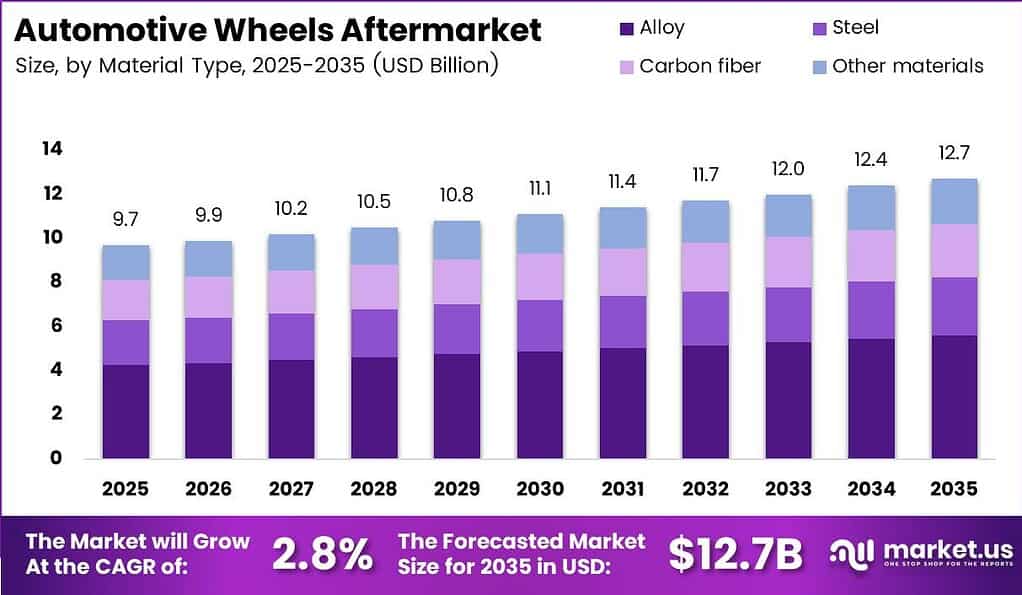
Global Automotive Wheels Aftermarket Market size is expected to be worth around USD 12.7 Billion by 2035 from USD 9.7 Billion in 2025, growing at a CAGR of 2.8% during the forecast period 2026 to 2035.
The automotive wheels aftermarket covers replacement, upgrade, and refurbishment of wheels sold outside original equipment manufacturer channels. It spans passenger cars, light trucks, SUVs, and commercial vehicles across retail, wholesale, and online distribution. Product categories include alloy, steel, carbon fiber, and other material wheels across rim sizes from below 13 inches to above 21 inches.
Key Takeaways
- Market size in 2025 stands at USD 9.7 Billion, reaching USD 12.7 Billion by 2035 at a CAGR of 2.8%.
- Passenger cars dominate the By Vehicle Type segment with a 70.00% share.
- New wheel replacement leads the By Aftermarket Type segment with a 72.00% share.
- Alloy wheels hold the largest share in the By Material Type segment at 43.20%.
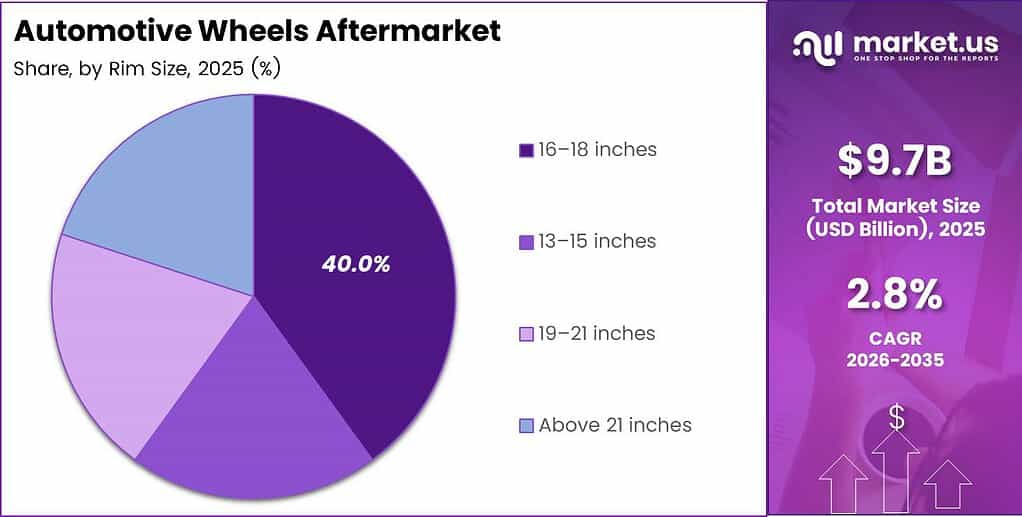
- The 16–18 inch rim size leads the By Rim Size segment with a 40.00% share.
- Retailers dominate the By Distribution Channel segment with a 60.00% share.
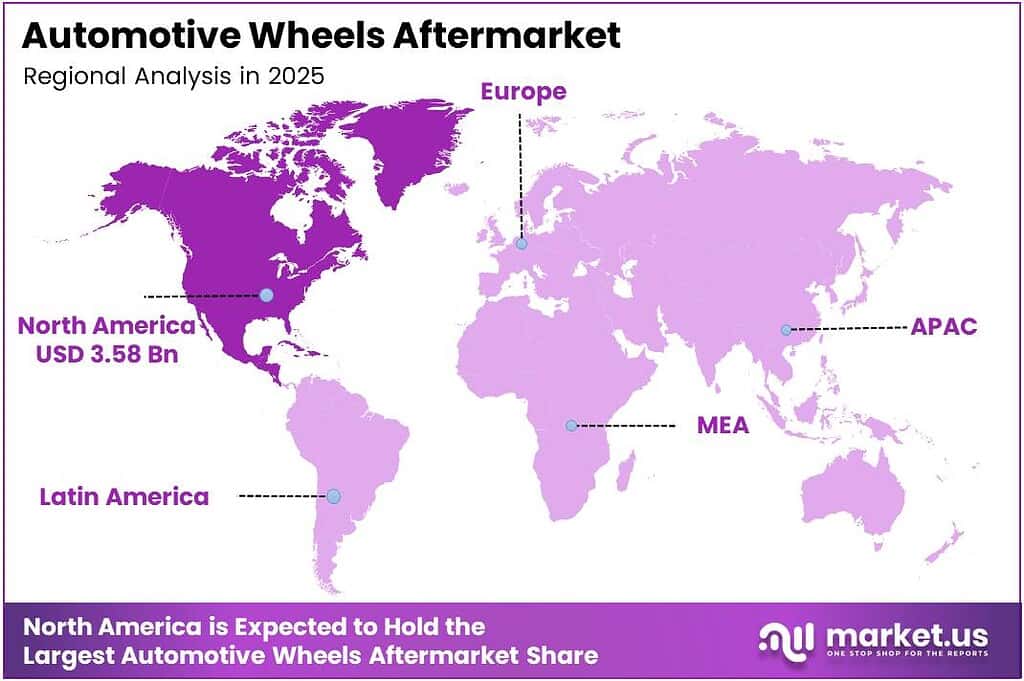
- North America leads all regions with a 37.60% market share, valued at USD 3.58 Billion.
According to OICA, global vehicle production rose from 92.7 million units in 2024 to 96.4 million units in 2025, a 3.9% increase. ACEA found that global car production grew 4.2% to 78.7 million units in 2025. This expanding vehicle base directly widens the addressable pool for aftermarket wheel sales across all product tiers.
As reported by S&P Global Mobility, the average age of light vehicles in the United States reached 12.8 years in 2025. Older vehicles accumulate more wheel damage from road hazards, corrosion, and curb contact. This means replacement demand is structurally embedded rather than discretionary, creating a resilient revenue floor for distributors and manufacturers throughout the forecast period.
As per our research, Maxion Wheels prepared serial production of forged-aluminum truck wheels at its 24,500-square-meter Manisa, Türkiye facility with approximately 350,000 annual-wheel initial capacity as of November 2025. IMF data projected global GDP growth at 3.0% in 2025 and 3.1% in 2026. Stable macroeconomic conditions support consumer spending on vehicle maintenance and wheel upgrades across mature and emerging markets.
Passenger Vehicle Type Analysis
Passenger Cars dominates with 70.00% due to high global parc size and replacement frequency.
In 2025, Passenger Cars held a dominant market position in the By Vehicle Type segment of the Automotive Wheels Aftermarket Market, with a 70.00% share. As reported by OICA, global vehicle sales increased from 95.3 million units in 2024 to 99.8 million units in 2025, up 4.7%. A larger active car fleet translates directly into higher replacement wheel volumes across all distribution channels.
Commercial Vehicles represent the secondary vehicle type segment in this market. OICA data shows India alone recorded domestic sales of more than 1 million trucks and buses in fiscal year 2025–26. This commercial fleet scale drives consistent demand for heavy-duty steel and alloy replacement wheels, particularly across fleet maintenance channels in Asia and emerging markets.
OICA further reported that India produced 6.49 million total motor vehicles in 2025. This output reflects the broader vehicle parc expansion across Asia-Pacific that creates a growing base of vehicles requiring aftermarket wheel service within three to five years of initial sale. As per our research, Maxion Wheels’ commercial-vehicle investment program increased global steel truck-wheel installed capacity by approximately 25%, from 8 million to 10 million wheels annually, signaling capacity expansion aligned to this rising demand.
Aftermarket Type Analysis
New Wheel Replacement dominates with 72.00% due to safety requirements and insurance-backed repair volumes.
In 2025, New Wheel Replacement held a dominant market position in the By Aftermarket Type segment of the Automotive Wheels Aftermarket Market, with a 72.00% share. World Bank data projected global trade growth in goods and services to slow to 1.8% in 2025 from 3.4% in 2024. Slower trade conditions pressure import-reliant distributors on landed cost, which reinforces buyer preference for domestically sourced replacement wheels at competitive price points.
Refurbished Wheel Fitment accounts for the remaining share of this segment. This sub-segment serves value-conscious buyers and fleet operators seeking cost reduction without compromising structural integrity. As the certified refurbishment infrastructure matures, this channel is positioned to capture a growing share of non-urgent replacement volume, particularly in North America and Europe where circular-economy compliance requirements are tightening.
Material Type Analysis
Alloy dominates with 43.20% due to weight, appearance, and performance advantages over steel.
In 2025, Alloy held a dominant market position in the By Material Type segment of the Automotive Wheels Aftermarket Market, with a 43.20% share. RONAL GROUP launched the RF1 FORGED aftermarket wheel in February 2025, initially in 9.0×20-inch size, with 8.5×20-inch and 10.0×20-inch versions planned. This product launch signals that premium alloy wheels are an active and competitive product tier, not a saturated one.
Steel wheels serve the highest-volume, price-sensitive replacement segment, particularly for commercial vehicles, fleet operators, and budget-conscious passenger car owners in emerging markets. Steel remains structurally dominant in cold-weather regions where seasonal wheel changes drive recurring replacement cycles. This consistent, predictable demand profile makes steel wheel distribution a reliable margin base for full-range aftermarket suppliers.
Carbon fiber and other materials represent the remaining share of the By Material Type segment. Carbon fiber commands premium positioning in performance and luxury vehicle applications where weight reduction directly affects handling. Other materials serve specialized segments including heritage vehicles and utility applications. These sub-segments collectively serve a smaller but higher-margin buyer profile that is less sensitive to commodity input cost fluctuations.
Rim Size Analysis
16–18 Inches dominates with 40.00% due to broad fitment compatibility across mainstream passenger vehicles.
In 2025, the 16–18 inch rim size held a dominant market position in the By Rim Size segment of the Automotive Wheels Aftermarket Market, with a 40.00% share. This size range covers the majority of passenger cars and crossovers sold globally over the past decade. High fitment compatibility across multiple vehicle makes and models reduces inventory risk for distributors and supports faster turnover at retail.
The 13–15 inch segment serves economy cars, compact vehicles, and older passenger car platforms in emerging markets. This size range remains relevant in price-sensitive geographies where vehicle parc aging is pronounced and buyers prioritize low cost over cosmetic upgrade. Distributors serving this segment benefit from simpler SKU structures and lower per-unit logistics costs relative to larger rim sizes.
The 19–21 inch and above-21-inch segments address SUVs, performance vehicles, and luxury platforms. Both segments carry higher per-unit margins and serve buyers who actively upgrade from factory specifications. The SUV and pickup fitment mix is an active short-term driver in North America, Gulf States, and Australia, creating recurring demand for large-diameter wheels beyond standard replacement volumes.
Distribution Channel Analysis
Retailers dominate with 60.00% due to proximity to end consumers and broad product range availability.
In 2025, Retailers held a dominant market position in the By Distribution Channel segment of the Automotive Wheels Aftermarket Market, with a 60.00% share. UNCTAD data shows global trade in goods and services is projected to exceed $35 trillion in 2025, approximately $2.2 trillion or 7% above 2024. Expanding trade flows increase product availability across retail networks, enabling retailers to stock wider assortments and serve more fitment configurations.
Wholesalers and distributors serve as the upstream supply layer connecting manufacturers to garages, tire shops, and independent retailers. This channel benefits from bulk purchasing leverage and geographic coverage in markets where retail penetration is limited. Wholesalers that invest in fitment data systems and rapid fulfillment infrastructure will retain competitive advantage as online channels compete on speed and transparency.
Online channels represent the fastest-evolving distribution format in this market. E-commerce removes geographic constraints on product availability, enabling buyers in secondary cities to access fitment-verified wheels that local retailers may not stock. This channel requires real-time inventory visibility, precise vehicle identification number matching, and reliable last-mile logistics to convert browsing intent into completed sales.
Key Market Segments
By Vehicle Type
- Passenger Cars
- Commercial Vehicles
By Aftermarket Type
- New Wheel Replacement
- Refurbished Wheel Fitment
By Material Type
- Alloy
- Steel
- Carbon Fiber
- Other Materials
By Rim Size
- 13–15 Inches
- 16–18 Inches
- 19–21 Inches
- Above 21 Inches
By Distribution Channel
- Retailers
- Wholesalers and Distributors
- Online Channels
Regional Analysis
North America Dominates the Automotive Wheels Aftermarket Market with a Market Share of 37.60%, Valued at USD 3.58 Billion
North America leads all regions in this market, supported by one of the world’s largest and oldest vehicle fleets. S&P Global Mobility data shows U.S. vehicles in operation reached 289 million in 2025, up by 3 million from 2024. U.S. passenger cars averaged 14.5 years in service in 2025, while light trucks averaged 11.9 years. This aging fleet produces a structurally high and recurring wheel replacement cycle that sustains regional revenue leadership throughout the forecast period.
Asia-Pacific is the fastest-growing region in this market. As reported by OICA, Asia-Pacific vehicle production grew 7.6% to approximately 59.2 million units in 2025, accounting for more than 61% of world output. Maxion Wheels announced a ₹350 crore investment for a Maharashtra passenger-car aluminum-wheel facility with 2 million wheels of first-phase annual capacity and potential expansion to 4 million wheels. Wheels India reported 11 manufacturing units, approximately 8,700 employees, and about $130 million in exports as of March 2025. These capacity commitments confirm that Asia-Pacific is both the production and demand growth engine for the forecast period.
Europe represents a mature but structurally active market for aftermarket wheels. ACEA data shows the EU vehicle parc included 249 million cars in 2023, up 1.4% year over year, along with approximately 30.1 million vans, up 1.7%, and approximately 6 million trucks, up 0.8%. The average age of EU cars reached 12.3 years in 2022 versus 10.6 years in 2016. European vehicle production declined 0.8% to 17.2 million units in 2025, which means fleet servicing rather than new-vehicle supply is the primary demand mechanism for aftermarket wheel suppliers in this region. The Americas as a whole saw production decline 2.1% to 18.74 million units in 2025 while sales grew 2.9% to 24.86 million units, indicating that import-driven markets are absorbing volume that regional production cannot meet.
Key Regions and Countries
North America
- US
- Canada
Europe
- Germany
- France
- The UK
- Spain
- Italy
- Rest of Europe
Asia Pacific
- China
- Japan
- South Korea
- India
- Australia
- Rest of APAC
Latin America
- Brazil
- Mexico
- Rest of Latin America
Middle East and Africa
- GCC
- South Africa
- Rest of MEA
Drivers
Longer vehicle retention is expanding the repair cycle for damaged and corroded wheels across mature markets where owners defer full vehicle replacement but continue funding safety-critical maintenance. The U.S. light-vehicle fleet reached a record average age of approximately 12.6 years in 2024, while the repair-and-maintenance price index increased 2.3% year over year through March 2025. This economic logic of component replacement over vehicle turnover widens the addressable replacement-wheel market.
Older vehicles accumulate greater exposure to potholes, curb strikes, winter-road chemicals, and corrosion, lifting replacement-wheel demand across independent garages, collision shops, salvage networks, and direct-to-consumer channels. For wheel distributors, this expands recurring replacement volume and raises the value of broad SKU coverage across legacy bolt patterns, offsets, diameters, and load ratings. Manufacturers benefit from sustained utilization of replacement-oriented casting and finishing capacity rather than reliance on slower OEM production cycles.
| Driver | (~) % Impact on CAGR Forecast | Geographic Relevance | Impact Timeline |
|---|---|---|---|
| Aging Vehicle Parc Replacement | +0.65% | North America, Europe, Japan | Short term (≤ 2 years) |
| SUV and Pickup Fitment Mix | +0.45% | North America, Gulf States, Australia | Short term (≤ 2 years) |
| Collision Repair Wheel Demand | +0.35% | North America, Europe, China | Short term (≤ 2 years) |
| Alloy Wheel Upgrade Culture | +0.30% | North America, Europe, India, Southeast Asia | Medium term (2–4 years) |
| E-commerce Parts Availability | +0.25% | Global urban markets | Medium term (2–4 years) |
| Fleet Refurbishment Cycles | +0.20% | North America, Europe, Latin America | Medium term (2–4 years) |
Restraints
Trade measures have created an immediate cost barrier for import-reliant wheel brands and distributors because aluminum and steel form the core material base for cast, flow-formed, forged, and stamped-wheel products. U.S. Section 232 actions raised aluminum tariffs from 10% to 25% effective March 12, 2025, eliminated country exemptions, and broadened covered-product scope. Tariffs on steel and aluminum were subsequently raised to 50% in June 2025 for most trading partners.
A wheel importer cannot fully absorb a material-linked landed-cost increase while preserving freight, warehousing, warranty, dealer, and retailer economics. The commercial effect is most acute in price-sensitive replacement categories where distributors delay inventory replenishment, retailers narrow assortment depth, and buyers defer non-essential alloy upgrades. This limits the market’s ability to translate replacement need into unit sales at the baseline 2.8% CAGR.
| Restraint | (~) % Impact on CAGR Forecast | Geographic Relevance | Impact Timeline |
|---|---|---|---|
| Metal Tariff Cost Shock | -0.70% | United States import-dependent channels | Short term (≤ 2 years) |
| Low-cost Counterfeit Imports | -0.45% | North America, Europe, Middle East, Southeast Asia | Short term (≤ 2 years) |
| Consumer Discretionary Spending Pressure | -0.35% | Global consumer aftermarket | Short term (≤ 2 years) |
| Wheel-and-Tire Bundle Deferral | -0.25% | North America, Europe, Australia | Short term (≤ 2 years) |
| Insurance Repair Cost Controls | -0.20% | North America, Europe | Medium term (2–4 years) |
| Used-Wheel Salvage Substitution | -0.15% | North America, Europe, Latin America | Medium term (2–4 years) |
Challenges
The aftermarket wheel value chain must reconcile a high-dimensional fitment problem involving bolt-circle diameter, center bore, offset, width, brake-clearance envelope, load rating, tire specification, suspension modification, and regional vehicle trim variation. A single incorrect compatibility decision creates reverse-logistics expense, workshop downtime, safety exposure, and reputational damage that materially exceeds the gross profit earned on a standard replacement-wheel transaction. This challenge compounds as aging vehicle platforms coexist with new electrified platforms across the same distribution networks.
Online channels increasingly require near-real-time vehicle identification number matching and inventory visibility, which most distributors cannot deliver at scale without structured master data investment. The absence of uniform, validated cross-market fitment records slows catalog onboarding and raises working-capital requirements. Structured vehicle master data, digital wheel-scanning workflows, and integrated catalog systems can reduce fitment-related returns by an estimated 20–35% relative to manual lookup processes, improving both conversion rates and dealer confidence.
| Challenge | (~) % CAGR Friction Drag | Geographic Relevance | Mitigation Horizon |
|---|---|---|---|
| Fitment Data Fragmentation | -0.55% | Global multi-brand aftermarket | Medium term (2–4 years) |
| Quality Traceability Gaps | -0.45% | Global import supply chains | Medium term (2–4 years) |
| Volatile Ocean Freight Routing | -0.35% | Asia-to-Western-market trade lanes | Short term (≤ 2 years) |
| Multi-SKU Inventory Complexity | -0.30% | North America, Europe, Asia-Pacific | Medium term (2–4 years) |
| EV Load Rating Transition | -0.25% | China, Europe, North America | Long term (≥ 4 years) |
| Refinishing Labor Shortages | -0.20% | North America, Europe | Medium term (2–4 years) |
Opportunities
Certified refurbishment remains underpenetrated because the current used-wheel trade is fragmented, condition grading is inconsistent, and buyers lack documented verification of runout, crack inspection, structural repair limits, coating quality, and load-rating traceability. A scaled platform can source damaged but repairable aluminum wheels, apply controlled straightening and finishing, and deliver a certified product at an estimated 25–40% lower consumer price than a comparable new premium wheel. This price gap creates immediate buyer appeal across value-conscious consumers, collision repairers, and fleet operators.
Gross margins on certified refurbished wheels can run potentially 5–10 percentage points above conventional one-time resale through core recovery, batch processing, and warranty attachment. Inspection automation reduces manual assessment time by roughly 15–30%, and local refurbishment avoids a substantial share of cross-border freight and import-cost exposure. Suppliers that build standardized inspection protocols and digital condition records ahead of informal salvage channels will capture the largest share of this structurally underserved circular-demand pool.
| Opportunity | (~) % Potential CAGR Upside | Geographic Relevance | Execution Window |
|---|---|---|---|
| Certified Refurbished Wheel Platforms | +0.75% | North America, Europe, Japan | Medium term (2–4 years) |
| EV-Specific Replacement Wheels | +0.60% | China, Europe, North America | Long term (≥ 4 years) |
| Digital Fitment Subscription Tools | +0.45% | Global professional service channels | Medium term (2–4 years) |
| Fleet Wheel Lifecycle Contracts | +0.40% | North America, Europe, Gulf States | Medium term (2–4 years) |
| Regional Finishing Microfactories | +0.35% | North America, Europe, India, Southeast Asia | Long term (≥ 4 years) |
| Circular-Core Collection Networks | +0.30% | Europe, North America, Japan | Medium term (2–4 years) |
Key Company Insights
RONAL GROUP launched the RF1 FORGED in February 2025 as a monoblock wheel made from high-strength 6061 aluminum, initially in 9.0×20-inch size. This product directly targets the premium aftermarket upgrade segment where buyers prioritize weight reduction and structural integrity over price. The launch signals RONAL GROUP’s intent to compete at the high-margin performance tier rather than the commoditized replacement-wheel base.
Maxion Wheels announced commercial-vehicle wheel investments exceeding $150 million for 2021–2025, including 1.5 million new truck-wheel capacity in Türkiye and more than 500,000 additional commercial-vehicle wheels in Brazil. This capital commitment across two continents gives Maxion Wheels a supply-chain redundancy advantage that single-geography competitors cannot replicate. India produced 4,991,413 passenger cars in 2024, reinforcing why Maxion’s Maharashtra facility investment positions the company ahead of the next wave of Asia-Pacific aftermarket demand.
Key Players
- RONAL GROUP
- BORBET GmbH
- Enkei Corporation
- Superior Industries International, Inc.
- Maxion Wheels
- BBS GmbH
- OZ S.p.A.
- Alcoa Wheels
- Topy Industries Limited
- Accuride Corporation
- Wanfeng Auto Wheel Co., Ltd.
- Konig Wheels
- Vossen Wheels, Inc.
- RAYS Co., Ltd.
- Steel Strips Wheels Limited
Recent Developments
- November 2025 – Maxion Wheels completed a 24,500-square-meter forged-aluminum truck-wheel facility in Manisa, Türkiye, with initial annual capacity of approximately 350,000 wheels.
- May 2025 – Iochpe-Maxion reported first-quarter 2025 net operating revenue of R$3,938.1 million, up 9.5% year over year.
- May 2025 – Uno Minda approved ₹200 crore for a Bawal, Haryana alloy-wheel facility with annual capacity of 1.5 million wheels.
- February 2026 – Uno Minda approved ₹7.64 billion for a Chhatrapati Sambhajinagar four-wheeler alloy-wheel expansion adding 1.8 million wheels of annual capacity.
- March 2025 – Wheels India’s FY2025 investor presentation reported ₹4,424.86 crore in gross revenue and alloy-wheel capacity-expansion capital expenditure.
- November 2024 – Bridgestone announced an approximately $85 million India investment, including a Pune capacity program expected to add about 1.1 million tires annually by 2029.
- August 2025 – Jupiter Wagons announced an approximately ₹2,500 crore Odisha facility investment that will expand forged wheel-and-axle capacity from 20,000 to 100,000 units annually.
Report Scope
| Report Features | Description |
|---|---|
| Market Value (2025) | USD 9.7 Billion |
| Forecast Revenue (2035) | USD 12.7 Billion |
| CAGR (2026-2035) | 2.8% |
| Base Year for Estimation | 2025 |
| Historic Period | 2020-2024 |
| Forecast Period | 2026-2035 |
| Report Coverage | Revenue Forecast, Market Dynamics, Market Opportunity Analysis, Technology and Innovation Landscape, Competitive Landscape, Recent Developments |
| Segments Covered | By Vehicle Type (Passenger Cars, Commercial Vehicles), By Aftermarket Type (New Wheel Replacement, Refurbished Wheel Fitment), By Material Type (Alloy, Steel, Carbon Fiber, Other Materials), By Rim Size (13-15 Inches, 16-18 Inches, 19-21 Inches, Above 21 Inches), By Distribution Channel (Retailers, Wholesalers and Distributors, Online Channels) |
| Regional Analysis | North America (US and Canada), Europe (Germany, France, The UK, Spain, Italy, and Rest of Europe), Asia Pacific (China, Japan, South Korea, India, Australia, and Rest of APAC), Latin America (Brazil, Mexico, and Rest of Latin America), Middle East and Africa (GCC, South Africa, and Rest of MEA) |
| Competitive Landscape | RONAL GROUP, BORBET GmbH, Enkei Corporation, Superior Industries International Inc., Maxion Wheels, BBS GmbH, OZ S.p.A., Alcoa Wheels, Topy Industries Limited, Accuride Corporation, Wanfeng Auto Wheel Co. Ltd., Konig Wheels, Vossen Wheels Inc., RAYS Co. Ltd., Steel Strips Wheels Limited |
| Customization Scope | Customization for segments, region/country-level will be provided. Additional customization can be done based on requirements. |
| Purchase Options | We have three licenses to opt for: Single User License, Multi-User License (Up to 5 Users), Corporate Use License (Unlimited User and Printable PDF) |





































