


Automotive Fuel Delivery Market Report Overview
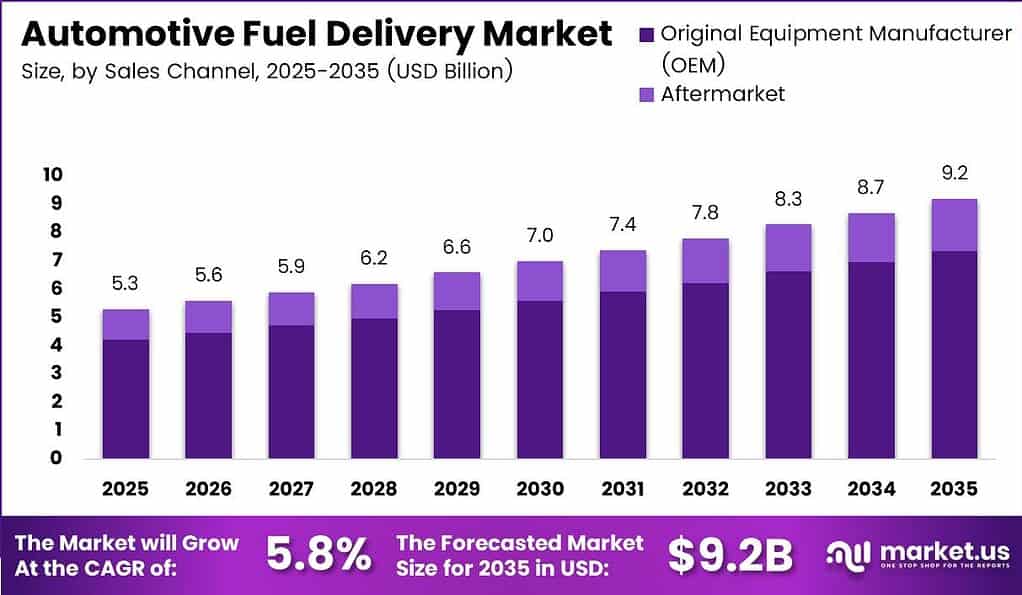
Global Automotive Fuel Delivery Market size is expected to be worth around USD 9.2 Billion by 2035 from USD 5.6 Billion in 2026, growing at a CAGR of 5.8% during the forecast period 2026 to 2035.
The automotive fuel delivery market covers all components that store, pressurize, meter, and deliver fuel to internal combustion and hybrid powertrain systems. This includes fuel pumps, injectors, pressure regulators, fuel tanks, fuel rails, lines, and associated electronic controls. The market serves passenger cars, light and heavy commercial vehicles, and two-wheelers across OEM and aftermarket sales channels.
Key Takeaways
- The Global Automotive Fuel Delivery Market is valued at USD 5.6 Billion in 2026 and is forecast to reach USD 9.2 Billion by 2035, growing at a CAGR of 5.8% during the forecast period 2026 to 2035.
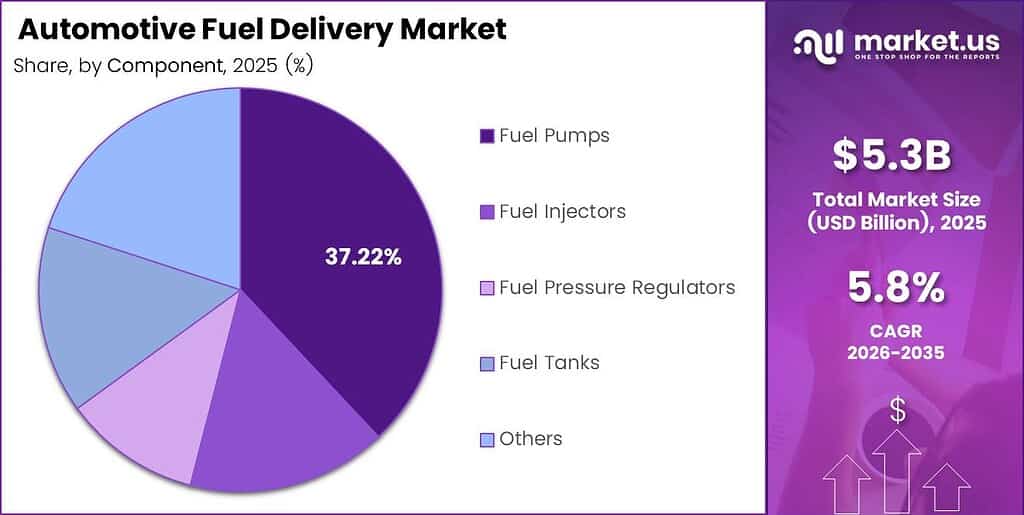
- By Component, Fuel Pumps dominate the market with a 37.22% share in 2025.
- By Fuel Type, Gasoline leads with a 53.00% market share in 2025.
- By Vehicle Type, Passenger Cars hold the largest share at 63.62% in 2025.
- By Sales Channel, the OEM segment accounts for 80.25% of market share in 2025.
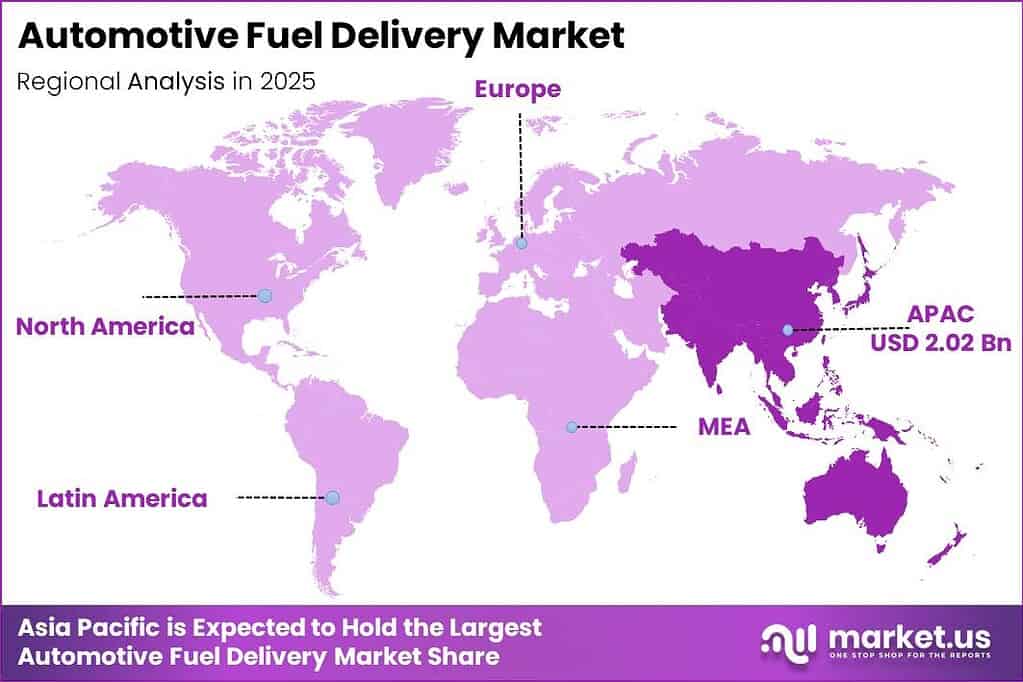
- Asia Pacific is the dominant region with a 38.25% market share, valued at USD 2.02 Billion in 2025.
- Europe is the fastest-growing region in the Automotive Fuel Delivery Market during the forecast period.
As per our research, road transport accounts for approximately 45% of global oil demand. This structural dependency keeps fuel delivery systems commercially essential across every combustion and hybrid powertrain segment. Suppliers that serve high-volume OEM platforms retain captive revenue streams regardless of near-term fuel-type transitions.
According to IEA data, renewable energy is projected to reach 8% of road-transport energy consumption by 2030. This shift compels fuel delivery suppliers to develop systems compatible with ethanol blends, CNG, LPG, and hydrogen combustion. Vendors that move early on multi-fuel compatibility will defend platform nominations against electrification headwinds.
Global oil consumption increased 0.8%, adding approximately 830,000 barrels per day to reach 193 EJ in 2024, according to IEA data. Global seaborne trade grew 2.2% in 2024, reflecting sustained logistics activity that supports commercial vehicle utilization and replacement part demand. In July 2026, Bosch, Toyota, BMW and Repsol launched a real-world pilot of around 20 vehicles running on 100% renewable gasoline, signaling active industry investment in combustion-compatible low-carbon fuel pathways.
Component Analysis
In 2025, Fuel Pumps held a dominant market position in the By Component segment of the Automotive Fuel Delivery Market, with a 37.22% share. Direct-injection and high-pressure pump adoption across gasoline and diesel platforms has made fuel pumps the single largest value-added component in this market. OEM programs that specify electric fuel pumps with integrated pressure regulation create multi-year content opportunities that are difficult for aftermarket entrants to displace.
Fuel Injectors represent the second-largest component category, driven by tightening emissions standards that require precise fuel metering across all combustion cycles. Real-driving emissions compliance in Europe and India pushes OEMs toward piezo and solenoid injector upgrades on existing platforms. This creates a strong retrofit pull within the aftermarket channel as older vehicles require injector replacement to pass tightened inspection standards.
Fuel Pressure Regulators and Fuel Tanks, along with other components, collectively account for the remaining market share. Pressure regulators gain traction as operating pressures rise with direct-injection system adoption, requiring more durable and precisely calibrated units. Fuel tank complexity is also increasing as OEMs integrate multi-chamber designs and vapor management systems to meet evaporative emission limits.
Fuel Type Analysis
Gasoline dominates with 53.00% due to passenger car volume and direct-injection adoption.
In 2025, Gasoline held a dominant market position in the By Fuel Type segment of the Automotive Fuel Delivery Market, with a 53.00% share. As reported by ACEA, global passenger-car production increased 4.2% to 78.7 million units in 2025, anchoring gasoline system demand across OEM build schedules. However, the EU registered 1,309,153 petrol cars in H1 2026, even as petrol’s market share fell to 22.2% from 28.4%, signaling a structural share decline that suppliers must price into platform roadmaps.
Diesel fuel delivery systems retain strategic importance in commercial vehicle segments. Data from ACEA shows diesel trucks accounted for 93.6% of new EU truck registrations in H1 2025, even as diesel registrations fell 17%. High-pressure common-rail injection technology at the core of these systems commands a significant per-unit content value. Suppliers focused on heavy-duty diesel injection remain insulated from passenger-car electrification trends in the near term.
Alternative fuel systems covering CNG, LPG, LNG, and flex-fuel hold the remaining market share but carry disproportionate long-term upside. PHINIA launched its CR350 common-rail system in September 2024, operating at up to 350 bar and delivering fuel-efficiency improvement of up to 7%, demonstrating that alternative-fuel hardware is reaching performance parity with conventional systems. Vendors that certify alternative-fuel systems across multiple vehicle platforms secure early pipeline advantage in emerging-market mandates.
Vehicle Type Analysis
Passenger Cars dominate with 63.62% due to global fleet scale and high OEM content per unit.
In 2025, Passenger Cars held a dominant market position in the By Vehicle Type segment of the Automotive Fuel Delivery Market, with a 63.62% share. Indian passenger-vehicle sales reached 4.643 million units in FY2025 to 26, increasing 7.9% according to SIAM, confirming that emerging-market passenger car volume is a primary volume anchor for fuel delivery demand. Suppliers that hold OEM nominations on India-bound platforms benefit directly from this growth without requiring incremental platform development spend.
Light Commercial Vehicles form the second-largest vehicle type segment, supported by sustained fleet activity across logistics and last-mile delivery operations. ACEA data shows approximately 30.1 million vans operated on EU roads in 2023, an increase of 1.7%. Fleet operators in this segment require reliable, high-cycle fuel delivery components, making aftermarket replacement demand relatively predictable and recurring for suppliers with established distribution networks.
Heavy Commercial Vehicles represent a structurally important segment given the high per-unit content value of heavy-duty fuel delivery systems. More than 6.4 million medium and heavy commercial vehicles operated on EU roads in 2021, an increase of 3.2%, according to ACEA. This fleet base generates steady replacement demand for high-pressure fuel pumps, injectors, and common-rail components, which carry premium pricing compared to passenger-car equivalents.
Two-Wheelers and any remaining vehicle categories account for the balance of market share. Two-wheeler fuel delivery systems are typically simpler in design but benefit from high production volumes across India and Southeast Asia. Marelli secured court approval in July 2025 to access an additional $130 million from a $1.1 billion financing facility, allowing it to maintain supply commitments across vehicle type segments during its restructuring period.
Sales Channel Analysis
OEM dominates with 80.25% due to platform nomination lock-in and volume scale.
In 2025, OEM held a dominant market position in the By Sales Channel segment of the Automotive Fuel Delivery Market, with a 80.25% share. World merchandise-trade volume growth was projected at 2.4% in 2025 according to WTO data, reflecting the global supply chain activity that supports OEM procurement at scale. Platform-based supplier nominations create multi-year, sole-sourced revenue that gives OEM-focused suppliers predictable utilization of capital-intensive testing and production infrastructure.
The Aftermarket channel holds the remaining share but commands higher per-unit margins and serves a growing installed base of aging combustion vehicles. Average global commodity prices were projected to rise 16% in 2026 according to World Bank data, increasing the cost of new vehicle ownership and extending the service life of existing fleets. This dynamic accelerates replacement part demand across fuel pumps, injectors, and pressure regulators in price-sensitive markets where fleet renewal cycles are long.
Automotive Fuel Delivery Market Segments
By Component
- Fuel Pumps
- Fuel Injectors
- Fuel Pressure Regulators
- Fuel Tanks
- Others
By Fuel Type
- Gasoline
- Diesel
- Alternative Fuels
- CNG
- LPG
- LNG
- Flex-Fuel
By Vehicle Type
- Passenger Cars
- Light Commercial Vehicles (LCVs)
- Heavy Commercial Vehicles (HCVs)
- Two-Wheelers
By Sales Channel
- Original Equipment Manufacturer (OEM)
- Aftermarket
Automotive Fuel Delivery Market Regional Analysis
Asia Pacific Dominates the Automotive Fuel Delivery Market with a Market Share of 38.25%, Valued at USD 2.02 Billion
Asia Pacific holds the largest regional share of the automotive fuel delivery market at 38.25%, valued at USD 2.02 Billion in 2025. Indian passenger-vehicle sales reached 4.3 million units in FY2024 to 25, increasing 2% year over year according to SIAM, anchoring fuel delivery demand across passenger car OEM programs in the region. AISIN committed approximately ¥32 billion in February 2026 to expanded and new Indian production facilities, reflecting supplier confidence in sustained South Asian vehicle output growth.
Europe is the fastest-growing region in the automotive fuel delivery market. As reported by ACEA, UK factories produced 717,371 cars and 47,344 commercial vehicles in 2025, sustaining OEM demand for fuel delivery components across both passenger and commercial platforms. The EU passenger-car fleet increased 1.4% to 255,999,373 vehicles in 2024, according to ACEA, creating a large and aging installed base that drives aftermarket fuel system replacement at scale. Continental invested $90 million in a 900,000-square-foot Aguascalientes facility in August 2025, indicating continued commitment to supply chain capacity serving both European and North American OEM demand.
Key Regions and Countries
North America
- US
- Canada
Europe
- Germany
- France
- The UK
- Spain
- Italy
- Rest of Europe
Asia Pacific
- China
- Japan
- South Korea
- India
- Australia
- Rest of APAC
Latin America
- Brazil
- Mexico
- Rest of Latin America
Middle East and Africa
- GCC
- South Africa
- Rest of MEA
Key Company Insights
Robert Bosch GmbH generated €91 billion in sales during 2025, positioning it as the largest global automotive supplier by revenue. Bosch secured $225 million in CHIPS funding in July 2026 to support its Roseville silicon-carbide investment, reinforcing its semiconductor self-sufficiency strategy. This vertical integration into power electronics gives Bosch a durable cost and supply security advantage over fuel delivery competitors that remain dependent on external chip suppliers.
DENSO Corporation generated ¥7,161.8 billion in FY2025 revenue, an increase of 0.2%, demonstrating revenue resilience despite a challenging global production environment. DENSO committed approximately ¥69 billion to a new Zenmyo plant in September 2024, expanding its precision fuel injection manufacturing capacity. This investment in dedicated high-volume production infrastructure strengthens DENSO’s ability to hold OEM nominations on next-generation direct-injection programs across Asia and North America. PHINIA completed its acquisition of Swedish Electromagnet Invest for approximately $47 million in July 2025, expanding its electromagnetic component supply base for fuel system applications.
Key Players
- Robert Bosch GmbH
- DENSO Corporation
- Continental AG
- PHINIA Inc.
- BorgWarner Inc.
- Hitachi Astemo Ltd.
- Marelli Holdings Co., Ltd.
- TI Fluid Systems plc
- MAHLE GmbH
- AISIN Corporation
- Stanadyne LLC
- Cummins Inc. — Cummins Fuel Systems
- Aisan Industry Co., Ltd.
- Mikuni Corporation
- Landi Renzo S.p.A.
Recent Developments
- May 26, 2026 – BorgWarner announced a $100 million expansion in Hendersonville, adding 140,000 square feet of facility space and 378 new jobs.
- July 29, 2026 – MAHLE began series production of battery-cooling plates at its Montblanc plant, with capacity of up to 15,000 plates per week, backed by a double-digit million-euro investment.
- August 27, 2026 – MAHLE launched e-compressor production in India at a facility representing a €7 million investment with annual capacity exceeding 300,000 units.
- May 4, 2026 – Stanadyne unveiled a production-ready 200-bar propane direct-injection system designed for GM 6.6-litre engines.
- March 20, 2025 – Standard Motor Products expanded its gasoline fuel-injection portfolio to more than 1,100 injectors.
- April 15, 2025 – ABC Technologies completed its acquisition of TI Fluid Systems at an enterprise value exceeding £1.8 billion.
- October 24, 2024 – DENSO announced a $100 million expansion at its Athens facility, adding 54,560 square feet and 200 new jobs.
- January 8, 2024 – Cummins announced a $580 million modernization project at its Rocky Mount Engine Plant.
- December 16, 2025 – Hitachi and Honda completed a share-transfer agreement for a 21% Astemo interest valued at approximately ¥152.3 billion.
Porter’s Five Forces Analysis
Competitive rivalry in the automotive fuel delivery market is intense. A concentrated group of global Tier-1 suppliers including Robert Bosch GmbH, DENSO Corporation, Continental AG, and PHINIA Inc. compete for OEM platform nominations that lock in sole-source revenue for the full production lifecycle. Price compression at the OEM level is severe, pushing suppliers to recover margin through aftermarket channels and value-added service contracts.
Supplier power within the fuel delivery ecosystem is moderately high. Precision-engineered sub-components such as piezo actuators, automotive-grade semiconductors, and high-pressure sealing materials source from a narrow base of qualified vendors. Semiconductor lead times reached approximately 16.8 weeks in Q1 2026, their highest level since Q3 2023. This concentration gives upstream component suppliers meaningful pricing leverage over fuel system assemblers during supply-constrained periods.
Buyer power at the OEM level is high and structurally reinforced. Global vehicle manufacturers use competitive nomination processes, dual-sourcing strategies, and long development cycles to extract price concessions from fuel delivery suppliers. By contrast, aftermarket buyers including independent workshops and fleet operators exercise limited switching power due to fitment specificity and certification requirements. This asymmetry rewards suppliers that build dual-channel OEM and aftermarket commercial models.
The threat of substitutes is the single most consequential force reshaping this market. Global electric-car sales surpassed 20 million units in 2025, with approximately 1 in 4 new cars sold globally being electric. Battery-electric vehicles eliminate conventional fuel pumps, tanks, rails, and injectors entirely. Suppliers without a credible hybrid-compatible or alternative-fuel product roadmap face accelerating content loss on electrified platforms through the forecast period.
Barriers to entry remain high across all tiers of this market. OEM qualification processes for fuel delivery components require multi-year validation programs, substantial capital investment in precision manufacturing, and embedded software certification. BorgWarner committed $100 million to expand its Hendersonville facility in May 2026, illustrating the scale of capital commitment required to compete at OEM volume. New entrants without validated manufacturing infrastructure and existing OEM relationships face effective exclusion from the primary demand channel.
Value Chain Analysis
The upstream layer of the automotive fuel delivery value chain covers raw material supply and sub-component manufacturing. Key inputs include high-grade steel for pump housings and fuel rails, aluminum for tank components, piezo ceramic materials for injector actuators, and automotive-grade semiconductors for electronic control modules. Average global commodity prices were projected to rise 16% in 2026 according to World Bank data, applying direct cost pressure across every upstream input category in this chain.
The precision manufacturing layer converts upstream materials into validated fuel delivery components. This stage requires advanced machining tolerances, cleanroom assembly environments, and multi-stage pressure testing. DENSO invested approximately ¥69 billion in its new Zenmyo plant in September 2024 to expand high-precision fuel injection manufacturing capacity. Capital intensity at this layer creates durable barriers and rewards suppliers that achieve high fixed-cost absorption through OEM platform volume commitments.
The OEM integration layer connects validated components into complete vehicle fuel systems through nominated supply agreements. OEM channel revenue accounts for 80.25% of total market value, reflecting the dominance of this layer in determining supplier revenue and utilization rates. Platform nominations at this stage lock in supplier content for model production runs that typically span 5 to 7 years, creating structural revenue predictability that aftermarket-only suppliers cannot replicate.
The aftermarket distribution layer serves the global installed base of combustion vehicles through independent distributors, dealer networks, and direct fleet supply agreements. EU passenger cars averaged 12.7 years in age in 2024, sustaining high-frequency replacement demand for pumps, injectors, and pressure regulators. This layer offers suppliers structurally higher per-unit margins than OEM supply, with pricing power tiered by brand certification, fitment coverage breadth, and channel exclusivity arrangements.
The end-user service layer encompasses vehicle workshops, fleet maintenance operations, and diagnostic service providers. Growing electronic complexity in fuel delivery systems creates demand for proprietary diagnostic tools and software calibration services alongside physical replacement parts. Suppliers that extend into this layer through connected diagnostic platforms and software subscriptions capture recurring revenue streams that are independent of new vehicle production cycles and provide direct early-warning signals on component failure patterns across the installed base.
Regulatory and Policy Landscape
Euro-7 emission standards represent the most technically demanding regulatory shift currently facing European fuel delivery suppliers. Real-driving emissions compliance requirements push OEMs toward higher-pressure direct-injection systems, advanced injector calibration, and tighter fuel metering tolerances across all combustion platforms. Suppliers that qualify Euro-7-compliant injection hardware on European OEM programs secure nominations that are structurally protected from lower-specification competitors throughout the standard’s enforcement lifecycle.
India’s BS-VI Phase 2 and E20 mandate create a parallel regulatory demand pull in the Asia Pacific region. From April 2026, new BS-VI vehicles must meet E20 emission requirements, mandating hardware upgrades across fuel pumps, seals, injectors, and control software. India’s ethanol blend reached 20% during November 2025 to June 2026, confirming that the policy is driving active market change rather than remaining a future aspiration. Suppliers with validated E20-compatible portfolios hold an immediate commercial advantage in the world’s third-largest vehicle market.
Section 232 automotive parts tariffs in North America apply a structural cost burden on cross-border fuel delivery component supply chains. This policy accelerates nearshoring decisions and supplier qualification of North American manufacturing alternatives. Continental’s $90 million investment in its Aguascalientes facility in August 2025 reflects this regulatory pressure, positioning local production capacity to serve North American OEM programs while reducing tariff exposure on imported components.
Urban diesel access restrictions across European and selected Asian cities are reshaping demand composition within the commercial vehicle segment. Diesel trucks still accounted for 93.6% of new EU truck registrations in H1 2025, but diesel registrations fell 17% in the same period, confirming that restriction policies are already compressing volume. Fuel delivery suppliers with CNG and LNG system capabilities are best positioned to capture replacement content as fleet operators transition away from diesel in regulated urban zones.
The EU’s renewable energy transport targets add a forward regulatory layer that extends beyond current emission certification cycles. Renewable energy is projected to reach 8% of road-transport energy consumption by 2030 according to IEA data. Bosch, Toyota, BMW, and Repsol launched a real-world pilot of approximately 20 vehicles on 100% renewable gasoline in July 2026, testing regulatory compatibility of existing combustion hardware with synthetic fuel pathways. Suppliers that engage early with regulatory bodies on synthetic and renewable fuel certification build influence over the hardware standards that will govern the next OEM nomination cycle.
Pricing Analysis
OEM-level pricing in the automotive fuel delivery market operates under sustained downward pressure. Vehicle manufacturers use competitive nomination processes and multi-year cost-reduction agreements that typically demand annual price concessions of 2 to 4% from nominated suppliers. This pricing structure compresses gross margins at the OEM layer and forces suppliers to recover profitability through volume scale, manufacturing efficiency, and platform consolidation across multiple vehicle programs.
High-pressure direct-injection systems command a meaningful price premium over conventional port-injection hardware. PHINIA’s GDI fuel pumps operating above 500 bar and Bosch piezo common-rail injectors rated at 2,000 to 2,700 bar represent the premium end of the component pricing spectrum. These systems carry higher material, validation, and calibration costs that support defensible selling prices. Suppliers that hold technology leadership at this pressure tier face less aggressive OEM price negotiations than commodity-specification component vendors.
Alternative-fuel system pricing carries a structural cost premium that the market is beginning to absorb through regulatory mandate rather than voluntary adoption. Corrosion-resistant materials and adaptive calibration for E20-compatible systems add an estimated 1.5 to 2.5% to unit manufacturing cost but support a 4 to 6% selling-price premium according to our research. This premium is sustainable where regulatory compliance creates a non-negotiable upgrade cycle, as seen in India’s April 2026 BS-VI E20 mandate.
Aftermarket pricing operates on a tiered structure governed by brand certification, fitment breadth, and channel position. Independent aftermarket suppliers price at a discount to OEM-branded replacement parts, typically 15 to 30% below OEM list price, to capture price-sensitive workshop and fleet buyers. Average global commodity prices were projected to rise 16% in 2026, squeezing aftermarket supplier margins unless cost increases are passed through pricing. Suppliers with proprietary brand recognition and wide fitment coverage retain stronger aftermarket pricing power than generic or private-label competitors.
Semiconductor cost volatility introduces an unpredictable input price variable across electronically controlled fuel delivery components. Controller lead times reaching approximately 16.8 weeks in Q1 2026 drove premium spot procurement costs that could not be recovered within fixed OEM supply agreements. Suppliers that secure long-term semiconductor supply contracts or invest in dual-source controller architectures reduce their exposure to spot-market price spikes that directly erode per-unit profitability on electronically managed pump and injector programs.
Market Dynamics
Market Opportunity Analysis - Aging fleets, emerging-market motorization, and underpenetrated aftermarket channels offer structured entry points for fuel delivery suppliers
The aftermarket channel currently holds a minority share against OEM’s dominant 80.25%, yet it serves an installed base of combustion vehicles with an average age of 12.7 years across the EU fleet. This aging profile creates a predictable, high-frequency replacement cycle for fuel pumps, injectors, and pressure regulators. Suppliers that build direct aftermarket distribution rather than relying on OEM-adjacent wholesale networks capture significantly higher per-unit margins.
Asia Pacific holds 38.25% of global market share but contains high-growth sub-markets in India and Southeast Asia that remain underpenetrated for high-pressure and alternative-fuel delivery systems. Indian passenger-vehicle sales are growing at nearly 8% annually, yet local content for flex-fuel and E20-compatible systems remains limited. New entrants that localize flex-fuel component manufacturing in India address both an OEM compliance mandate and a gap in current supply chain depth.
Two-wheelers and light commercial vehicles represent structurally underserved segments relative to passenger cars, which absorb the majority of product development investment. The LCV fleet across the EU alone surpassed 30.1 million units in 2023, creating a dense and geographically concentrated aftermarket demand pool. Suppliers that develop dedicated LCV fuel delivery SKUs rather than adapted passenger-car components position themselves for preferred-vendor status in fleet procurement programs.
Heavy commercial vehicle fuel delivery systems carry premium per-unit economics but represent a smaller share of current supplier product portfolios compared to passenger-car-focused lines. The HCV segment operates at sustained high load cycles, accelerating replacement intervals for high-pressure pumps and injectors beyond passenger-car norms. Suppliers that certify HCV-specific durability ratings and establish direct fleet maintenance partnerships capture aftermarket revenue with lower price sensitivity than retail channels.
Technology and Innovation Landscape - High-pressure injection, alternative-fuel hardware, and direct-injection pump advances redefine supplier positioning across combustion and hybrid platforms
PHINIA’s gasoline direct-injection fuel pumps support pressures above 500 bar, according to PHINIA technical data. This operating range exceeds conventional port-injection systems by a substantial margin and enables finer fuel atomization, which directly reduces particulate emissions and improves combustion efficiency. OEM programs that specify GDI hardware at these pressure thresholds create a technical barrier that lower-cost, lower-pressure competitors cannot match without significant capital reinvestment.
Bosch piezo common-rail injectors support pressure levels between 2,000 and 2,700 bar, according to Bosch Mobility data. This precision metering capability at extreme pressures reduces fuel consumption and meeting Euro-7 and Bharat Stage VI emission standards without aftertreatment alone. Suppliers that qualify piezo injection systems on new platform programs secure long-duration sole-source nominations that are structurally difficult to displace during a vehicle’s production lifecycle.
Bosch CNG systems supply gas from the pressure regulator to the fuel rail at below 10 bar, according to Bosch Mobility technical specifications. This low delivery-pressure architecture simplifies sealing requirements and reduces system weight compared to high-pressure gaseous fuel alternatives. As CNG fleet penetration expands in South Asia and Latin America, suppliers offering validated low-pressure CNG rail systems gain a cost-per-unit advantage over unvalidated or adapted gasoline rail solutions.
Stanadyne launched a production-ready 200-bar propane direct-injection system for GM 6.6-litre engines in May 2026, demonstrating that alternative gaseous fuel systems are reaching commercial-grade pressure performance. Bosch, Toyota, BMW, and Repsol launched a real-world pilot in July 2026 of approximately 20 vehicles running on 100% renewable gasoline, validating that existing combustion fuel delivery hardware is compatible with synthetic fuel pathways. These parallel technology tracks create a bifurcated innovation landscape where suppliers must simultaneously advance alternative-fuel hardware and maintain combustion system performance standards.
Drivers
Global motor-vehicle output rose from approximately 92.7 million units in 2024 to 96.4 million in 2025, a 3.9% increase, with Asia Pacific producing about 59.2 million vehicles and representing more than 61% of worldwide output. Each incremental combustion or hybrid vehicle creates an immediate requirement for pumps, rails, lines, and injectors. This recovery supports an estimated +0.8-percentage-point contribution to baseline CAGR through higher OEM volumes and improved supplier-capacity utilization.
High-pressure direct injection, aging combustion fleets, commercial fleet utilization, emerging-market motorization, and real-driving emissions compliance each add incremental CAGR support ranging from +0.2 to +0.6 percentage points. EU passenger cars averaged 12.7 years in age in 2024, sustaining aftermarket replacement demand across fuel pumps and injectors. Suppliers that align capacity to these compounding drivers across both OEM and aftermarket channels will capture the broadest share of this cumulative upside.
| Driver | (~) % Impact on CAGR Forecast | Geographic Relevance | Impact Timeline |
|---|---|---|---|
| Global Vehicle Output Recovery | +0.8% | Global, led by Asia-Pacific | Short term (≤ 2 years) |
| High-Pressure Direct Injection | +0.6% | North America, Europe, China, Japan | Medium term (2–4 years) |
| Aging Combustion-Vehicle Parc | +0.5% | Europe, North America, Latin America | Medium term (2–4 years) |
| Commercial Fleet Utilization | +0.4% | Global logistics corridors | Short term (≤ 2 years) |
| Emerging-Market Motorization | +0.3% | South Asia, Southeast Asia, Africa | Long term (≥ 4 years) |
| Real-Driving Emissions Compliance | +0.2% | Europe, India, North America | Medium term (2–4 years) |
Restraints
Global electric-car sales exceeded 20 million units in 2025, with approximately 1 in 4 new cars sold globally being electric. Battery-electric vehicles eliminate conventional tanks, fuel pumps, high-pressure rails, and injectors entirely. Conventional internal-combustion car sales had already fallen approximately 30% from their 2017 peak by 2024, compressing the addressable OEM volume base for traditional fuel delivery suppliers in China, Europe, and North America.
Section 232 parts tariffs, OEM nomination lock-in, costly fleet-financing conditions, urban diesel sales restrictions, and fuel-price tax burdens collectively apply an additional -1.7 percentage points of CAGR drag across geographic segments. These restraints are most acute in Latin America, Africa, and South Asia, where fleet-financing costs limit new vehicle uptake and extend replacement cycles. Suppliers with diversified geographic exposure and multi-channel distribution reduce their concentration risk against these compounding pressures.
| Restraint | (~) % Impact on CAGR Forecast | Geographic Relevance | Impact Timeline |
|---|---|---|---|
| Battery-Electric Powertrain Substitution | -0.9% | China, Europe, North America | Medium term (2–4 years) |
| Section 232 Parts Tariffs | -0.6% | North America and export suppliers | Short term (≤ 2 years) |
| OEM Nomination Lock-In | -0.4% | Global | Medium term (2–4 years) |
| Costly Fleet-Financing Conditions | -0.3% | Latin America, Africa, South Asia | Short term (≤ 2 years) |
| Urban Diesel Sales Restrictions | -0.2% | Europe and selected Asian cities | Medium term (2–4 years) |
| Fuel-Price Tax Burden | -0.2% | Europe and import-dependent economies | Short term (≤ 2 years) |
Challenges
Electronically controlled pumps, pressure sensors, and injector-control modules remain exposed to concentrated automotive-grade semiconductor capacity, with selected controller lead times extending to approximately 16 to 26 weeks during 2025. Average automotive semiconductor lead times increased by nearly 2.5 weeks in Q1 2026, reaching approximately 16.8 weeks, their highest level since Q3 2023. This volatility creates an estimated -0.4-percentage-point CAGR friction drag through rescheduled assembly, premium spot procurement, and delayed system validation.
Multi-fuel material compatibility, high-pressure durability tradeoffs, embedded software integration, validation engineering scarcity, and pump-motor material volatility impose additional friction totaling -1.3 percentage points of CAGR drag. These challenges are most acute in markets mandating rapid fuel-type transitions without consistent hardware certification frameworks. Suppliers that invest in modular, software-defined fuel system architectures reduce per-platform validation costs and accelerate compliance across multiple regional certification regimes simultaneously.
| Challenge | (~) % CAGR Friction Drag | Geographic Relevance | Mitigation Horizon |
|---|---|---|---|
| Automotive Chip Supply Volatility | -0.4% | Global | Short term (≤ 2 years) |
| Multi-Fuel Material Compatibility | -0.4% | India, Southeast Asia, Latin America | Medium term (2–4 years) |
| High-Pressure Durability Tradeoffs | -0.3% | Global | Medium term (2–4 years) |
| Embedded Software Integration | -0.3% | North America, Europe, East Asia | Medium term (2–4 years) |
| Validation Engineering Scarcity | -0.2% | Global automotive clusters | Long term (≥ 4 years) |
| Pump-Motor Material Volatility | -0.1% | Asia and Europe | Short term (≤ 2 years) |
Opportunities
India’s average ethanol blend increased from approximately 14.6% in ethanol-supply year 2023 to 24 to 19.2% in 2024 to 25, reaching 20% during November 2025 to June 2026. From April 2026, new BS-VI vehicles must meet E20 emission requirements, creating a mandatory hardware upgrade cycle. A flexible-fuel portfolio targeting this mandate could add approximately +0.5 percentage points to CAGR, supported by corrosion-resistant materials and adaptive calibration that command a 4 to 6% selling-price premium.
Hydrogen combustion injection, connected diagnostic services, low-voltage hybrid pumps, modular localized platforms, and aftermarket channel roll-ups offer a combined potential upside of +1.0 percentage point in CAGR. Connected diagnostic services stand out as near-term revenue with low incremental hardware cost, as software-defined service contracts layer onto existing fuel system architectures. Suppliers that move first on subscription-based diagnostics capture recurring revenue streams that are structurally independent of vehicle production cycles.
| Opportunity | (~) % Potential CAGR Upside | Geographic Relevance | Execution Window |
|---|---|---|---|
| E20+ Flexible-Fuel Systems | +0.5% | India, Southeast Asia, Latin America | Medium term (2–4 years) |
| Hydrogen Combustion Injection | +0.4% | Europe, Japan, Korea, North America | Long term (≥ 4 years) |
| Connected Diagnostic Services | +0.3% | Global | Medium term (2–4 years) |
| Low-Voltage Hybrid Pumps | +0.2% | Europe, China, Japan, India | Medium term (2–4 years) |
| Modular Localized Platforms | +0.2% | South Asia, Southeast Asia, Africa | Medium term (2–4 years) |
| Aftermarket Channel Roll-Ups | +0.1% | Global fragmented markets | Medium term (2–4 years) |
Report Scope
| Report Features | Description |
|---|---|
| Market Value (2026) | USD 5.6 Billion |
| Forecast Revenue (2035) | USD 9.2 Billion |
| CAGR (2026-2035) | 5.8% |
| Base Year for Estimation | 2025 |
| Historic Period | 2020-2024 |
| Forecast Period | 2026-2035 |
| Report Coverage | Revenue Forecast, Market Dynamics, Market Opportunity Analysis, Technology and Innovation Landscape, Competitive Landscape, Recent Developments |
| Segments Covered | By Component (Fuel Pumps, Fuel Injectors, Fuel Pressure Regulators, Fuel Tanks, Others), By Fuel Type (Gasoline, Diesel, Alternative Fuels: CNG, LPG, LNG, Flex-Fuel), By Vehicle Type (Passenger Cars, Light Commercial Vehicles, Heavy Commercial Vehicles, Two-Wheelers), By Sales Channel (OEM, Aftermarket) |
| Regional Analysis | North America (US and Canada), Europe (Germany, France, The UK, Spain, Italy, and Rest of Europe), Asia Pacific (China, Japan, South Korea, India, Australia, and Rest of APAC), Latin America (Brazil, Mexico, and Rest of Latin America), Middle East and Africa (GCC, South Africa, and Rest of MEA) |
| Competitive Landscape | Robert Bosch GmbH, DENSO Corporation, Continental AG, PHINIA Inc., BorgWarner Inc., Hitachi Astemo Ltd., Marelli Holdings Co. Ltd., TI Fluid Systems plc, MAHLE GmbH, AISIN Corporation, Stanadyne LLC, Cummins Inc., Aisan Industry Co. Ltd., Mikuni Corporation, Landi Renzo S.p.A. |
| Customization Scope | Customization for segments, region/country-level will be provided. Additional customization can be done based on requirements. |
| Purchase Options | We have three licenses to opt for: Single User License, Multi-User License (Up to 5 Users), Corporate Use License (Unlimited User and Printable PDF) |





































