


Report Overview
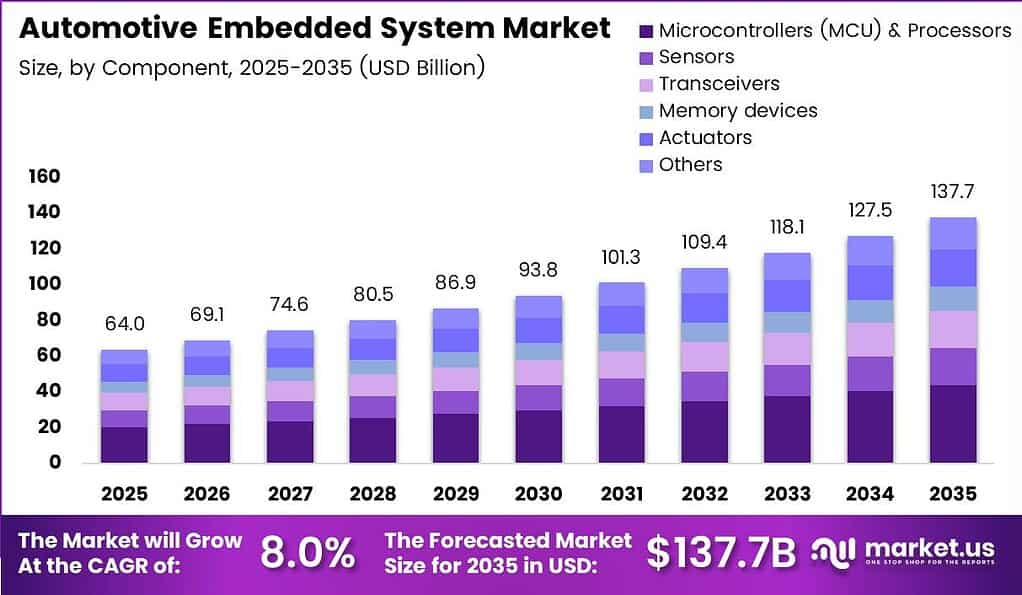
Global Automotive Embedded System Market size is expected to be worth around USD 137.7 Billion by 2035 from USD 64.0 Billion in 2025, growing at a CAGR of 8.0% during the forecast period 2026 to 2035.
The automotive embedded system market covers hardware and software components integrated directly into vehicles to manage and control functions across powertrain, safety, infotainment, connectivity, and chassis systems. These systems combine microcontrollers, sensors, actuators, transceivers, and memory devices with real-time software to deliver precise, reliable vehicle operation. This reflects rising vehicle complexity across all propulsion types.
Key Takeaways
- The global Automotive Embedded System Market is valued at USD 64.0 Billion in 2025 and is forecast to reach USD 137.7 Billion by 2035 at a CAGR of 8.0%.
- By Type, Embedded Hardware dominates with a 57.80% share in 2025.
- By Component, Microcontrollers (MCU) and Processors lead with a 32.00% share in 2025.
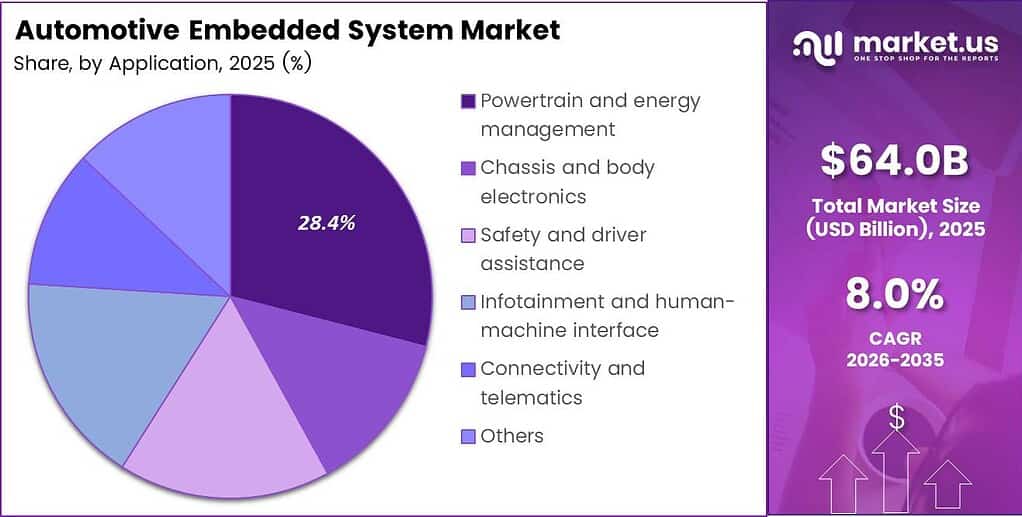
- By Application, Powertrain and Energy Management holds the largest share at 28.40% in 2025.
- By Propulsion, Internal Combustion Engine Vehicles dominate with a 64.10% share in 2025.
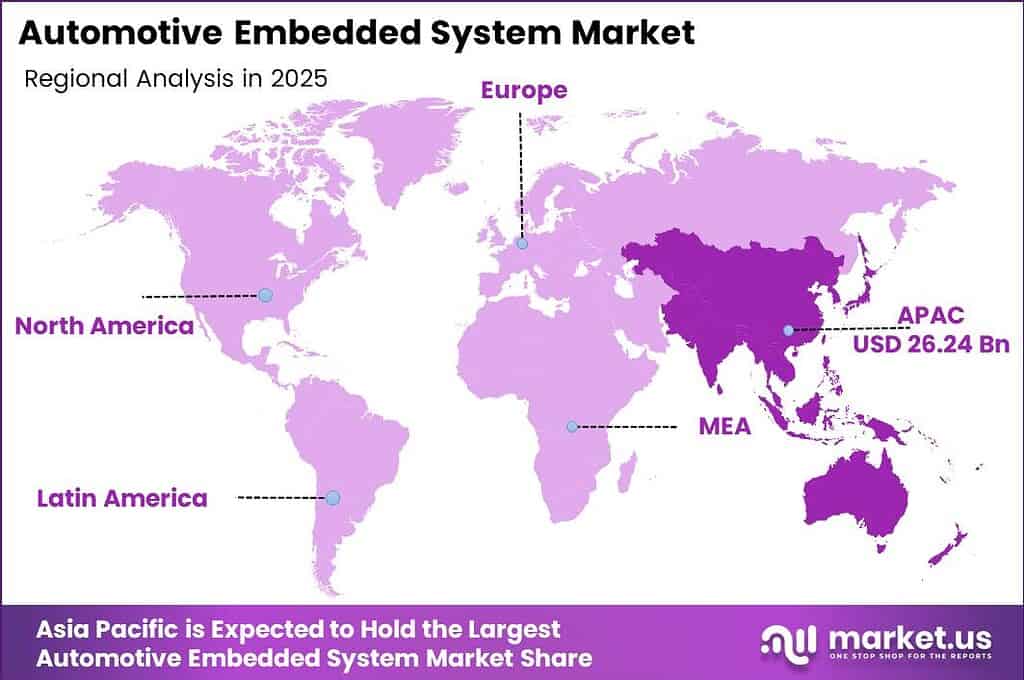
- Asia Pacific is the dominant region with a 41.60% market share, valued at USD 26.24 Billion in 2025.
According to the International Energy Agency, global electric-car sales grew 20% in 2025 to exceed 20 million vehicles and account for 25% of new-car sales worldwide. Electric vehicles carry approximately twice the semiconductor content of conventional vehicles. This mix shift creates direct, measurable volume growth for embedded hardware and software suppliers across every major region.
As per our research, global motor-vehicle production rose from 92.7 million units in 2024 to 96.4 million units in 2025, an increase of 3.9%. Global new-car registrations reached 77.6 million units in 2025, increasing 3.5% from 2024. Higher production volumes translate directly into more embedded controllers, sensors, and software stacks shipped per calendar year, compounding addressable market size for tier-one suppliers.
Texas Instruments announced an investment exceeding $60 billion for seven semiconductor fabs across three US manufacturing sites, signaling long-term confidence in domestic chip supply for automotive applications. Continental announced an approximately $90 million investment in a new manufacturing facility in Aguascalientes, Mexico, expected to create more than 200 jobs. These capital commitments indicate that leading suppliers are locking in capacity ahead of forecasted demand growth through 2035.
Type Analysis
Embedded Hardware dominates with 57.80% due to high physical component count per vehicle.
In 2025, Embedded Hardware held a dominant market position in the By Type segment of the Automotive Embedded System Market, with a 57.80% share. Physical components including microcontrollers, sensors, memory modules, and power management units must be installed in every vehicle at the point of manufacture. This hardware dependency makes the segment structurally resistant to displacement, giving established component suppliers a durable revenue base regardless of software strategy shifts at OEM level.
Embedded Software holds the remaining share of the By Type segment and is the faster-moving revenue layer within the market. Software complexity has reached a scale where a typical automobile uses approximately 100 million lines of code, according to IEEE. This volume requires ongoing validation, compliance, and update infrastructure, creating recurring revenue streams for suppliers beyond the initial vehicle production event.
Component Analysis
Microcontrollers (MCU) and Processors dominate with 32.00% due to central control role across all vehicle systems.
In 2025, Microcontrollers (MCU) and Processors held a dominant market position in the By Component segment of the Automotive Embedded System Market, with a 32.00% share. Every electronic control unit in a vehicle requires at least one microcontroller to execute real-time commands. This universal deployment across powertrain, body, safety, and infotainment domains makes MCUs the single highest-volume component category in the embedded system stack.
Sensors form the second largest component category and are directly tied to expanding active-safety and driver-assistance mandates. NHTSA estimates that mandatory automatic emergency braking requirements will save at least 360 lives and prevent at least 24,000 injuries annually in the United States. This regulatory commitment guarantees sustained sensor volume growth across new vehicle programs through the forecast period.
Transceivers, Memory Devices, and Actuators each serve distinct functional roles within vehicle electronic architectures. Transceivers manage signal conversion between hardware and network buses. Memory devices store calibration data, software images, and event logs. Actuators execute physical responses from control signals in braking, steering, and thermal systems. Together, these components and the Others sub-segment hold the remaining share.
Application Analysis
Powertrain and Energy Management dominates with 28.40% due to direct control of propulsion and fuel efficiency.
In 2025, Powertrain and Energy Management held a dominant market position in the By Application segment of the Automotive Embedded System Market, with a 28.40% share. Engine control units, battery management systems, and inverter controllers all fall within this application domain. As electric-vehicle platforms require separate high-voltage control layers alongside thermal and charging management, powertrain embedded content per vehicle increases materially, concentrating revenue in this segment.
Safety and Driver Assistance is the fastest-advancing application category driven by regulatory mandates across major markets. In IIHS evaluations, 22 of 30 vehicles tested earned a good or acceptable rating in the higher-speed front-crash-prevention assessment. This performance data confirms widespread deployment of embedded safety hardware and accelerates regulatory expectations for future model years, sustaining capital allocation toward this application domain.
Infotainment and Human-Machine Interface is expanding as digital cockpit content becomes standard across mid-range vehicle segments. NXP agreed to acquire Kinara in a transaction valued at $307 million to advance edge AI capabilities directly applicable to in-vehicle interface systems. Chassis and Body Electronics, Connectivity and Telematics, and Others collectively hold the remaining application share across the segment.
Propulsion Analysis
Internal Combustion Engine Vehicles dominate with 64.10% due to large global installed base and production volumes.
In 2025, Internal Combustion Engine Vehicles held a dominant market position in the By Propulsion segment of the Automotive Embedded System Market, with a 64.10% share. Petrol and diesel cars represented 37% of EU registrations through September 2025, down from 46.8% one year earlier, as reported by ACEA. This share decline signals that while ICE vehicles retain volume dominance globally, the segment is contracting in regulated markets, pressuring embedded suppliers to diversify their ICE-era product revenue.
Hybrid Electric Vehicles are the fastest-growing propulsion sub-segment in Europe and several Asia Pacific markets. ACEA data shows hybrid-electric vehicles represented 34.7% of EU registrations through September 2025, totaling 2,793,079 vehicles. Hybrid platforms require both conventional powertrain control units and additional battery and energy-recovery embedded modules, making them higher embedded-content vehicles than pure ICE models and a near-term volume driver for component suppliers.
Battery Electric Vehicles carry the highest embedded semiconductor content per unit across all propulsion types. Panasonic Energy opened its approximately 300-acre Kansas battery factory in July 2025 with planned annual capacity of approximately 32 GWh, directly expanding the battery supply chain that underpins BEV embedded system demand. World merchandise-trade volume increased 4.6% in 2025 according to the WTO, supporting cross-border movement of battery cells and embedded components that serve this sub-segment.
Key Market Segments
By Type
- Embedded Hardware
- Embedded Software
By Component
- Microcontrollers (MCU) and Processors
- Sensors
- Transceivers
- Memory Devices
- Actuators
- Others
By Application
- Powertrain and Energy Management
- Chassis and Body Electronics
- Safety and Driver Assistance
- Infotainment and Human-Machine Interface
- Connectivity and Telematics
- Others
By Propulsion
- Internal Combustion Engine Vehicles
- Hybrid Electric Vehicles
- Battery Electric Vehicles
Regional Analysis
Asia Pacific Dominates the Automotive Embedded System Market with a Market Share of 41.60%, Valued at USD 26.24 Billion
Asia Pacific commands 41.60% of the global Automotive Embedded System Market, valued at USD 26.24 Billion in 2025. China anchors this dominance through its position as the world’s largest vehicle production and EV sales market. India produced 31,034,174 passenger vehicles, commercial vehicles, three-wheelers, two-wheelers, and quadricycles in fiscal 2024-25, as reported by SIAM, adding a second major production hub that draws embedded component investment toward the region.
North America is a high-value regional market anchored by regulatory-driven embedded content requirements. The United States recorded 16,675,488 motor-vehicle sales in 2025 according to OICA, providing a large and consistent demand base for safety, infotainment, and connectivity embedded systems. NXP completed its acquisition of Aviva Links for $243 million in October 2025, reinforcing North American supplier capability in high-speed in-vehicle networking. Continental announced an investment exceeding $85 million to expand its Mount Pleasant, Iowa, manufacturing operations in October 2025, adding regional production capacity directly serving North American OEM demand.
Europe benefits from a large installed vehicle fleet and strict safety mandates that sustain embedded system volumes. The EU passenger-car fleet reached nearly 256 million vehicles in 2024, increasing 1.4% from 2023, as reported by ACEA. This fleet scale creates a durable market for both new-vehicle embedded content and aftermarket safety and connectivity retrofit applications across the region.
Key Regions and Countries
North America
- US
- Canada
Europe
- Germany
- France
- The UK
- Spain
- Italy
- Rest of Europe
Asia Pacific
- China
- Japan
- South Korea
- India
- Australia
- Rest of APAC
Latin America
- Brazil
- Mexico
- Rest of Latin America
Middle East and Africa
- GCC
- South Africa
- Rest of MEA
Market Dynamics
Market Opportunity Analysis - Underserved propulsion segments and emerging regional production hubs offer measurable entry points for new embedded suppliers
Battery Electric Vehicles represent the highest embedded-content opportunity per unit across all propulsion types, yet BEV-specific embedded platform development remains concentrated among a small set of established tier-one suppliers. New entrants with battery management, high-voltage safety, and thermal control software capabilities can compete for program awards on emerging EV architectures from OEMs that are not yet locked into incumbent supply relationships.
The two-wheeler and three-wheeler segments in India and Southeast Asia hold substantial digitalization potential. India’s fiscal 2024-25 production of over 31 million vehicles across all categories confirms that two-wheelers and three-wheelers represent a significant share of total output, yet these categories carry far lower average embedded content than passenger cars. Suppliers offering cost-optimized microcontroller and sensor modules for this segment face limited incumbent competition.
Latin America and the Middle East and Africa regions represent underpenetrated markets for aftermarket safety and connectivity embedded retrofits. Commercial fleet operators in these regions face growing pressure to meet safety and telematics compliance requirements without the capital to replace vehicles entirely. This creates a retrofit opportunity for embedded hardware suppliers that can offer modular, vehicle-agnostic solutions at accessible price points.
The Connectivity and Telematics application sub-segment remains below its structural revenue ceiling in markets outside North America, Europe, and China. FCC rules dedicate 30 MHz of spectrum in the 5.9 GHz band to C-V2X and intelligent-transportation applications, establishing a regulatory framework that supports embedded connectivity hardware deployment. Suppliers who develop C-V2X-compatible modules now position ahead of the infrastructure rollout curve in markets where V2X mandates are still forming.
Technology and Innovation Landscape - Semiconductor integration, edge AI deployment, and wireless connectivity standards redefine embedded system value in automotive platforms
Automotive-grade semiconductor packaging is advancing toward panel-level formats that reduce chip footprint and improve thermal performance in space-constrained vehicle electronic control units. STMicroelectronics announced an investment exceeding $60 million in a panel-level-packaging pilot line in Tours, France, in September 2025. Suppliers that qualify panel-level packaging for automotive reliability standards gain a materials cost and miniaturization advantage on next-generation embedded hardware platforms.
Edge AI processing within the vehicle is shifting from cloud-dependent inference to on-device domain controllers capable of real-time decision execution. WIPO data shows more than 900,000 published patent families relate to land-transportation technologies, with AI and sensor fusion representing the most active filing areas. This patent volume signals sustained R&D investment in on-vehicle intelligence and creates freedom-to-operate risk for suppliers who delay proprietary IP development in edge inference architectures.
Approximately 6 billion people used the internet in 2025, while 5G networks covered an estimated 55% of the global population, according to ITU. This connectivity infrastructure enables embedded telematics and OTA update systems to operate at scale. Automotive embedded suppliers integrating 5G-compatible modules into vehicle platforms gain access to high-bandwidth, low-latency communication channels that support real-time diagnostics, predictive maintenance, and post-sale feature activation.
The FCC allocation of 30 MHz of spectrum in the 5.9 GHz band to C-V2X and intelligent-transportation applications establishes a dedicated communication layer for vehicle-to-infrastructure embedded systems. Embedded hardware suppliers developing C-V2X-compatible transceivers and processing modules now build toward a federally defined technical standard. This regulatory certainty reduces go-to-market risk for hardware investment in the vehicle connectivity embedded stack.
Drivers
Electric-car sales exceeded 17 million units in 2024, rising more than 25%, and climbed approximately 20% further to about 21 million units in 2025. Electric vehicles carry approximately twice the semiconductor weight of conventional vehicles and require battery management, inverter control, charging, thermal management, and high-voltage safety functions as standard embedded content. This mix shift moves supplier economics toward integrated power-electronics platforms and safety-certified software modules.
EV Electronics Intensity contributes an estimated +1.8 percentage points to the 8.0% baseline CAGR, making it the single largest individual driver in the forecast. Suppliers positioned in battery management and power-electronics embedded platforms capture the highest per-unit content uplift as EV share in new-car sales continues to expand across China, Europe, and North America through 2035.
| Driver | (~) % Impact on CAGR Forecast | Geographic Relevance | Impact Timeline |
|---|---|---|---|
| EV Electronics Intensity | +1.8% | Global; China-led | Short term (≤ 2 years) |
| Mandatory Active-Safety Content | +1.4% | Europe, North America, Japan, South Korea | Short term (≤ 2 years) |
| Digital Cockpit Proliferation | +0.9% | Global passenger vehicles | Medium term (2–4 years) |
| Commercial Fleet Telematics | +0.6% | North America, Europe, China, India | Medium term (2–4 years) |
| Comfort Electronics Expansion | +0.4% | Global mid-range and premium segments | Medium term (2–4 years) |
Restraints
Elevated vehicle prices and high financing costs are delaying replacement purchases across major markets. Average US commercial-bank rates on 60-month new-car loans held near 8.22% in the first quarter of 2024 and 8.20% in the second quarter. Consumers retaining vehicles longer compounds this effect: average US light-vehicle age reached 12.8 years in 2025, while the average EU passenger car was 12.7 years old in 2024.
Because embedded-system revenue is predominantly booked when new vehicles or refreshed platforms enter production, deferred purchases reduce near-term controller and sensor volumes. Vehicle Affordability Pressure supports an estimated -1.2 percentage point drag against the 8.0% baseline CAGR, increasing pricing pressure, capacity underutilization, and program-payback periods for component suppliers across North America, Europe, and selected emerging markets.
| Restraint | (~) % Impact on CAGR Forecast | Geographic Relevance | Impact Timeline |
|---|---|---|---|
| Vehicle Affordability Pressure | -1.2% | North America, Europe, selected emerging markets | Short term (≤ 2 years) |
| Qualification Entry Barriers | -0.8% | Global automotive supply chains | Medium term (2–4 years) |
| Export-Control Market Segmentation | -0.6% | United States, China, allied markets | Short term (≤ 2 years) |
| OEM Platform Lock-In | -0.5% | Global tiered supply chains | Medium term (2–4 years) |
| Low-Volume Program Economics | -0.3% | Emerging OEMs and specialty vehicles | Medium term (2–4 years) |
Challenges
A limited pool of engineers combining embedded development with functional safety, real-time performance, cybersecurity, and vehicle-level validation constrains delivery speed across automotive programs. General software employment is projected to grow 10% from 2025 to 2035 and generate approximately 106,100 openings annually in the United States alone. Automotive-specific demand for safety-certified embedded talent is not matched by that general supply pipeline.
Staffing gaps force repeated test cycles, slower feature releases, and delayed production approvals rather than a halt in underlying demand. Software Validation Complexity applies an estimated friction of -1.0 percentage point from the market’s maximum growth potential. Suppliers who invest in virtual validation, hardware-in-the-loop automation, and reusable middleware accumulate a measurable time-to-market advantage over those dependent on manual validation cycles.
| Challenge | (~) % CAGR Friction Drag | Geographic Relevance | Mitigation Horizon |
|---|---|---|---|
| Software Validation Complexity | -1.0% | Global engineering centers | Medium term (2–4 years) |
| Semiconductor Supply Concentration | -0.7% | Global; Asia-centered exposure | Long term (≥ 4 years) |
| Cybersecurity Lifecycle Burden | -0.5% | Europe, North America, Asia-Pacific | Long term (≥ 4 years) |
| Compute Thermal Constraints | -0.4% | Global EV and premium platforms | Medium term (2–4 years) |
| Multi-Architecture Integration | -0.3% | Global legacy OEM platforms | Medium term (2–4 years) |
Opportunities
Software-update regulations began applying to relevant new EU whole-vehicle approvals from July 2024, with complete-vehicle applicability extending from July 2026. This regulatory foundation enables secure over-the-air feature delivery without guaranteeing commercial activation. Suppliers who convert this infrastructure into modular feature licensing and predictive-maintenance services open a post-sale revenue channel that did not exist under hardware-only embedded business models.
If OTA Feature Monetization reaches execution scale, it could add +1.3 percentage points above the 8.0% baseline CAGR. This would lift embedded-platform lifecycle revenue per activated vehicle by approximately 10 to 20%, reduce remote-diagnostics and campaign costs by 15 to 25%, and move eligible software gross margins toward approximately 60 to 80%. Early movers who build compliance-grade update pipelines now capture the margin advantage before this capability becomes a baseline OEM expectation.
| Opportunity | (~) % Potential CAGR Upside | Geographic Relevance | Execution Window |
|---|---|---|---|
| OTA Feature Monetization | +1.3% | China, North America, Europe | Medium term (2–4 years) |
| Two-Wheeler Digitalization | +1.0% | India, Southeast Asia, Latin America | Medium term (2–4 years) |
| Edge-AI Domain Controllers | +0.9% | China, North America, Europe, Japan | Long term (≥ 4 years) |
| Aftermarket Safety Retrofits | +0.6% | Emerging markets and commercial fleets | Medium term (2–4 years) |
| Vehicle-Grid Energy Orchestration | +0.4% | Europe, North America, China, Japan | Long term (≥ 4 years) |
Key Company Insights
Robert Bosch GmbH reported €91.0 billion in sales in 2025, an exchange-rate-adjusted increase of 4.1%, confirming its position as the highest-revenue embedded systems supplier in the automotive sector. This scale gives Bosch purchasing leverage over semiconductor inputs and the R&D capacity to certify safety-critical software across multiple OEM platforms simultaneously, a structural advantage that smaller tier-one suppliers cannot replicate at equivalent cost.
Continental AG reported €19.7 billion in 2025 sales and €1.0 billion in adjusted free cash flow from continuing operations. Its Timișoara electronics factory produces more than 17 million products annually, demonstrating high-volume manufacturing depth in embedded hardware. HARMAN agreed to acquire ZF Group’s ADAS business for €1.5 billion in December 2025, intensifying competition in the safety and driver-assistance embedded application segment where Continental holds established positions. NXP agreed to acquire TTTech Auto in a transaction valued at $625 million, strengthening NXP’s software-defined vehicle platform against Continental’s in-house software offerings.
Key Players
- Robert Bosch GmbH
- Continental AG
- DENSO Corporation
- Aptiv PLC
- Panasonic Holdings Corporation
- Harman International Industries, Inc.
- NXP Semiconductors N.V.
- Infineon Technologies AG
- Texas Instruments Incorporated
- Renesas Electronics Corporation
- STMicroelectronics N.V.
- NVIDIA Corporation
- Qualcomm Incorporated
- Mitsubishi Electric Corporation
- Hyundai Mobis Co., Ltd.
Recent Developments
- 14 August 2025 – Infineon completed its $2.5 billion acquisition of Marvell Technology’s Automotive Ethernet business, expanding its in-vehicle networking portfolio for high-bandwidth embedded applications.
- 24 April 2024 – Hyundai Mobis announced a KRW 170 billion Spanish battery-system plant with annual capacity for 360,000 battery systems, supporting embedded power management demand in European EV programs.
- 30 October 2025 – NVIDIA and Hyundai Motor Group announced a physical-AI collaboration involving 50,000 NVIDIA Blackwell GPUs and approximately $3 billion of investment in Korea, targeting AI-enabled vehicle and manufacturing applications.
- 17 September 2025 – STMicroelectronics announced an investment exceeding $60 million in a panel-level-packaging pilot line in Tours, France, advancing packaging technology for automotive-grade embedded chips.
- 1 August 2024 – Renesas completed its acquisition of Altium for approximately AUD 9.1 billion, integrating printed circuit board design software into its embedded microcontroller and processor ecosystem.
- 9 June 2025 – Qualcomm agreed to acquire Alphawave Semi at an implied enterprise value of approximately $2.4 billion, adding high-speed connectivity IP relevant to next-generation automotive embedded platforms.
- 1 August 2025 – Bosch completed the acquisition of Johnson Controls’ residential and light-commercial HVAC business in a transaction valued at $8.1 billion, extending its thermal management technology base into adjacent embedded control applications.
- 15 January 2026 – DENSO announced a $69 million investment in a 280,000-square-foot logistics center in Lebanon, Tennessee, strengthening North American supply chain infrastructure for automotive embedded components.
Report Scope
| Report Features | Description |
|---|---|
| Market Value (2025) | USD 64.0 Billion |
| Forecast Revenue (2035) | USD 137.7 Billion |
| CAGR (2026-2035) | 8.0% |
| Base Year for Estimation | 2025 |
| Historic Period | 2020-2024 |
| Forecast Period | 2026-2035 |
| Report Coverage | Revenue Forecast, Market Dynamics, Market Opportunity Analysis, Technology and Innovation Landscape, Competitive Landscape, Recent Developments |
| Segments Covered | By Type (Embedded Hardware, Embedded Software), By Component (Microcontrollers (MCU) and Processors, Sensors, Transceivers, Memory Devices, Actuators, Others), By Application (Powertrain and Energy Management, Chassis and Body Electronics, Safety and Driver Assistance, Infotainment and Human-Machine Interface, Connectivity and Telematics, Others), By Propulsion (Internal Combustion Engine Vehicles, Hybrid Electric Vehicles, Battery Electric Vehicles) |
| Regional Analysis | North America (US and Canada), Europe (Germany, France, The UK, Spain, Italy, and Rest of Europe), Asia Pacific (China, Japan, South Korea, India, Australia, and Rest of APAC), Latin America (Brazil, Mexico, and Rest of Latin America), Middle East and Africa (GCC, South Africa, and Rest of MEA) |
| Competitive Landscape | Robert Bosch GmbH, Continental AG, DENSO Corporation, Aptiv PLC, Panasonic Holdings Corporation, Harman International Industries Inc., NXP Semiconductors N.V., Infineon Technologies AG, Texas Instruments Incorporated, Renesas Electronics Corporation, STMicroelectronics N.V., NVIDIA Corporation, Qualcomm Incorporated, Mitsubishi Electric Corporation, Hyundai Mobis Co., Ltd. |
| Customization Scope | Customization for segments, region/country-level will be provided. Additional customization can be done based on requirements. |
| Purchase Options | We have three licenses to opt for: Single User License, Multi-User License (Up to 5 Users), Corporate Use License (Unlimited User and Printable PDF) |





































