


Global Automotive Air Suspension Market Size, Share, Growth Analysis By Suspension Architecture (Passive Air Suspension, Semi-Active/Adaptive Air Suspension, Fully Active Air Suspension), By Type (Electronic, Non-electronic), By Component (Air Spring/Airbag, Compressor, Tank, Others), By Propulsion (ICE, EV), By Vehicle Type (PC & Vans, Buses & Trucks), By Sales Channel (Direct to OEM, Tier-1/Module Supplier), By Region and Companies - Industry Segment Outlook, Market Assessment, Competition Scenario, Statistics, Trends and Forecast 2026-2035
- Published date: Feb 2026
- Report ID: 177443
- Number of Pages: 349
- Format:
-
keyboard_arrow_up
Quick Navigation
Report Overview
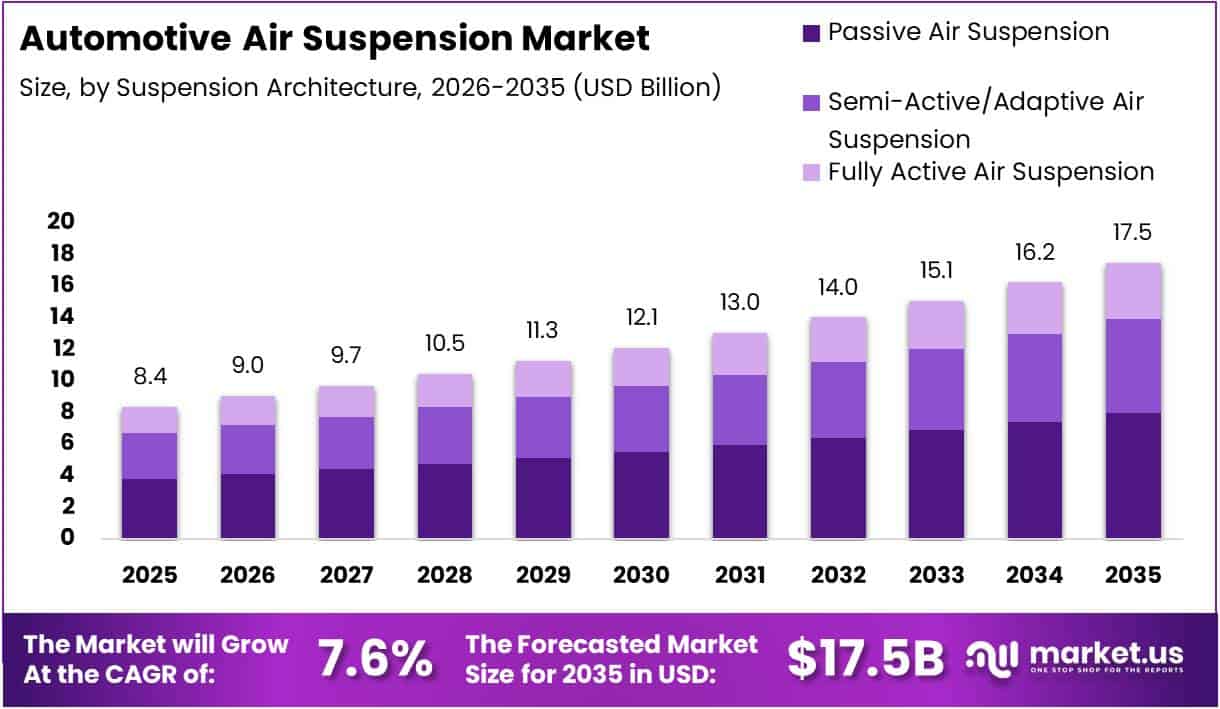
The Global Automotive Air Suspension Market size is expected to be worth around USD 17.5 Billion by 2035 from USD 8.4 Billion in 2025, growing at a CAGR of 7.6% during the forecast period 2026 to 2035.
Automotive air suspension represents an advanced vehicle suspension technology that uses air springs instead of conventional steel springs. This system employs compressed air to support vehicle weight and adjust ride height dynamically. Moreover, it integrates electronic controls to optimize comfort and handling performance across varying road conditions.
The market experiences robust growth driven by increasing consumer demand for enhanced ride quality and vehicle stability. Additionally, original equipment manufacturers prioritize adaptive suspension integration to optimize performance characteristics. Consequently, the technology gains traction across passenger cars, commercial vehicles, and premium automotive segments.
Government regulations promoting fuel efficiency and emission reduction further accelerate market expansion. Furthermore, urbanization and rising disposable incomes in emerging economies create substantial opportunities. Therefore, manufacturers invest heavily in research and development to enhance system capabilities and reduce production costs.
Electric and hybrid vehicle adoption presents significant growth opportunities for air suspension technology. Moreover, urban bus fleets and long-haul commercial vehicles increasingly adopt these systems for operational efficiency. Additionally, mass-market vehicle segments demonstrate rising demand for customizable ride experiences and enhanced comfort features.
According to research published in IJMRSET, vehicles equipped with air suspension systems demonstrated a 5-7% increase in fuel efficiency compared to vehicles without air suspension. Additionally, such vehicles showed a 6-9% reduction in CO₂ emissions, highlighting environmental benefits alongside performance improvements.
Furthermore, according to ResearchGate, fuzzy PID-controlled air suspension systems optimized via genetic algorithm resulted in significant performance enhancements. Specifically, these systems achieved a 30% reduction in vertical body acceleration, 26% reduction in suspension deflection, and 9% reduction in wheel dynamic load.
The market landscape continues evolving with technological advancements in predictive suspension controls and sensor integration. Consequently, manufacturers focus on developing software-driven tuning capabilities and over-the-air update functionalities. Therefore, the automotive air suspension market demonstrates strong potential for sustained growth throughout the forecast period.
Key Takeaways
- Global Automotive Air Suspension Market valued at USD 8.4 Billion in 2025, projected to reach USD 17.5 Billion by 2035 at 7.6% CAGR
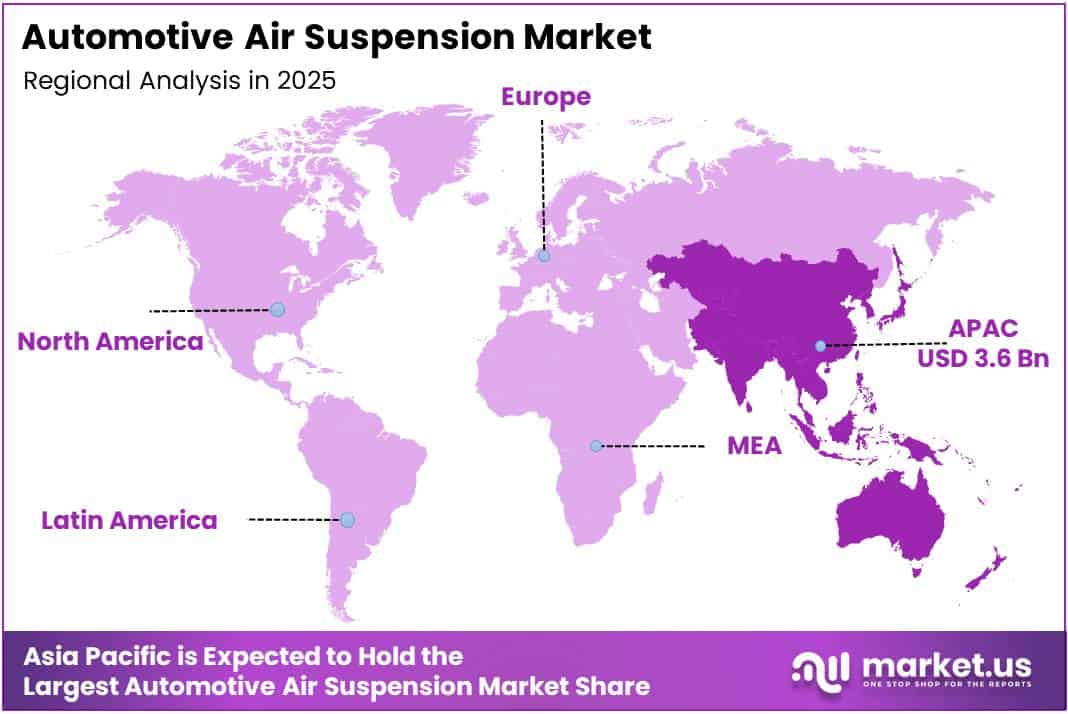
- Asia Pacific dominates with 43.80% market share, valued at USD 3.6 Billion
- Passive Air Suspension leads Suspension Architecture segment with 45.8% market share
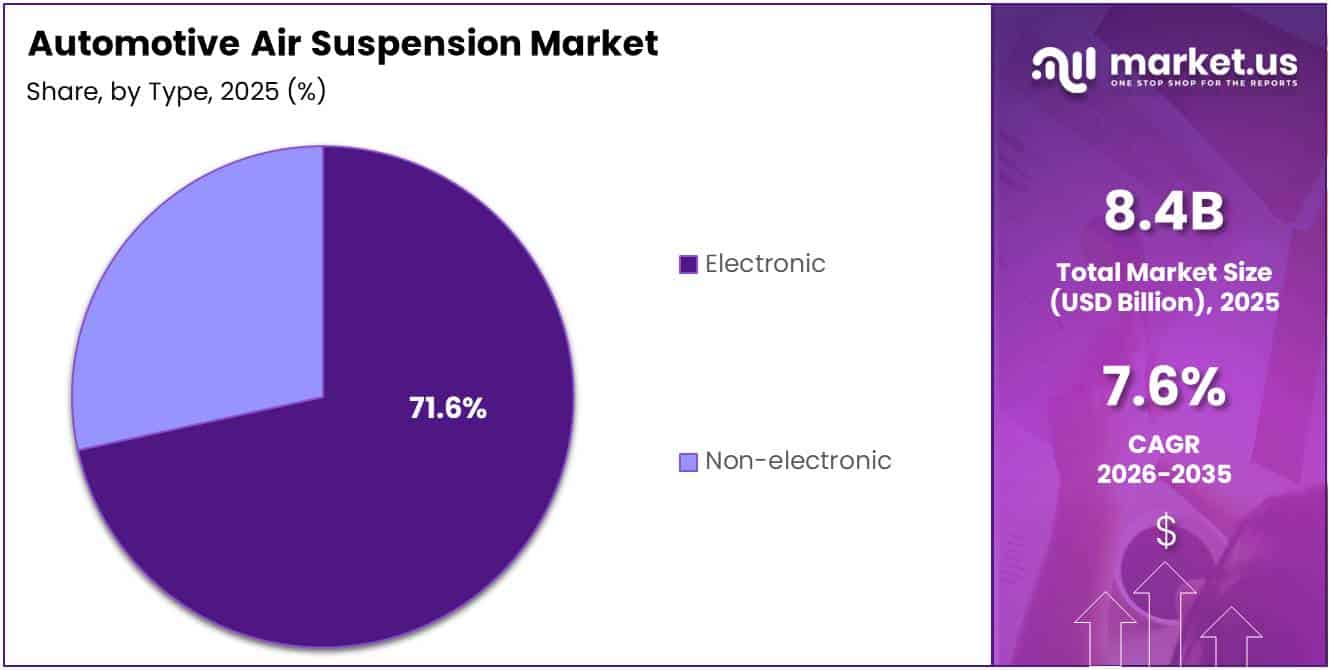
- Electronic type holds 71.6% dominance in Type segment
- Air Spring/Airbag component accounts for 48.5% of Component segment
- ICE propulsion represents 77.3% of Propulsion segment
- PC & Vans dominate Vehicle Type with 67.2% share
- Direct to OEM channel leads Sales Channel with 76.1% market share
Suspension Architecture Analysis
Passive Air Suspension dominates with 45.8% due to cost-effectiveness and proven reliability.
In 2025, Passive Air Suspension held a dominant market position in the By Suspension Architecture segment of Automotive Air Suspension Market, with a 45.8% share. This technology offers reliable load-leveling capabilities at lower implementation costs compared to advanced alternatives. Therefore, it remains preferred for commercial vehicles and entry-level passenger car applications requiring basic suspension functionality.
Semi-Active/Adaptive Air Suspension demonstrates significant growth potential through electronically controlled damping adjustments. This technology enables real-time suspension tuning based on driving conditions and driver preferences. Moreover, automotive manufacturers increasingly integrate these systems in mid-range and premium vehicles. Consequently, it bridges the gap between passive systems and fully active solutions.
Fully Active Air Suspension represents the most advanced technology with individual wheel control and predictive capabilities. These systems utilize sophisticated sensors and algorithms to optimize ride quality and handling dynamics continuously. Additionally, they integrate seamlessly with vehicle stability control and advanced driver assistance systems. However, higher costs currently limit adoption primarily to luxury and performance vehicle segments.
Type Analysis
Electronic dominates with 71.6% due to superior control precision and integration capabilities.
In 2025, Electronic held a dominant market position in the By Type segment of Automotive Air Suspension Market, with a 71.6% share. Electronic systems provide precise air pressure management through advanced control modules and sensor networks. Moreover, they enable seamless integration with vehicle telematics and driver assistance technologies. Therefore, manufacturers prioritize electronic variants for modern vehicle platforms requiring sophisticated suspension control.
Non-electronic air suspension systems utilize mechanical valves and simpler control mechanisms for basic functionality. These systems offer cost advantages and reduced complexity for applications requiring straightforward load-leveling capabilities. Additionally, they demonstrate reliability in harsh operating environments with minimal electronic component exposure. Consequently, they remain relevant for specific commercial vehicle applications and budget-conscious market segments.
Component Analysis
Air Spring/Airbag dominates with 48.5% as the primary load-bearing element.
In 2025, Air Spring/Airbag held a dominant market position in the By Component segment of Automotive Air Suspension Market, with a 48.5% share. Air springs serve as the fundamental load-bearing components that replace traditional coil or leaf springs. Moreover, they enable variable spring rates and ride height adjustment through controlled air pressure modulation. Therefore, continuous innovation in airbag materials and design drives component market growth.
Compressor components generate and maintain the compressed air supply essential for system operation. These units must deliver consistent performance across varying temperature and humidity conditions. Additionally, manufacturers focus on developing quieter, more energy-efficient compressor technologies. Consequently, compressor reliability directly impacts overall system performance and customer satisfaction levels.
Tank components store compressed air to ensure immediate system response during dynamic driving conditions. Proper tank sizing balances system responsiveness with packaging constraints and weight considerations. Moreover, advanced tank designs incorporate pressure sensors and moisture management features. Therefore, tank technology continues evolving to support increasingly sophisticated suspension control strategies.
Others include valves, control modules, sensors, and connecting hardware essential for system integration. These components enable precise air distribution and pressure management across individual suspension corners. Additionally, electronic control units coordinate system operation with broader vehicle dynamics management. Consequently, component suppliers invest in miniaturization and enhanced durability to meet evolving automotive requirements.
Propulsion Analysis
ICE dominates with 77.3% due to established market presence and vehicle population.
In 2025, ICE held a dominant market position in the By Propulsion segment of Automotive Air Suspension Market, with a 77.3% share. Internal combustion engine vehicles represent the majority of current global vehicle production and installed base. Moreover, air suspension technology has mature integration pathways with traditional powertrain platforms. Therefore, ICE vehicles continue driving substantial air suspension system demand across passenger and commercial segments.
EV propulsion vehicles demonstrate rapidly accelerating air suspension adoption rates despite smaller current market share. Electric vehicle architectures benefit significantly from air suspension’s load-leveling capabilities and range optimization potential. Additionally, EVs battery weight distribution challenges make adaptive suspension particularly valuable. Consequently, nearly all premium electric vehicle platforms integrate air suspension as standard or optional equipment.
Vehicle Type Analysis
PC & Vans dominate with 67.2% driven by premium segment adoption and comfort prioritization.
In 2025, PC & Vans held a dominant market position in the By Vehicle Type segment of Automotive Air Suspension Market, with a 67.2% share. Passenger cars and vans increasingly incorporate air suspension to deliver superior ride comfort and handling refinement. Moreover, SUV proliferation within this category drives substantial demand for load-leveling and ride height adjustment capabilities. Therefore, manufacturers expand air suspension availability across broader vehicle price points beyond traditional luxury segments.
Buses & Trucks represent critical commercial vehicle applications where air suspension delivers operational and economic benefits. These vehicles benefit from improved cargo protection, reduced driver fatigue, and enhanced vehicle stability during loaded operations. Additionally, regulatory pressures for emission reduction make air suspension’s fuel efficiency advantages increasingly valuable. Consequently, commercial fleet operators prioritize air suspension in vehicle specification decisions.
Sales Channel Analysis
Direct to OEM dominates with 76.1% reflecting integrated design and validation requirements.
In 2025, Direct to OEM held a dominant market position in the By Sales Channel segment of Automotive Air Suspension Market, with a 76.1% share. Original equipment manufacturers require deep supplier integration throughout vehicle development and production processes. Moreover, air suspension systems demand extensive vehicle-specific calibration and validation activities. Therefore, direct OEM relationships enable optimized system performance and streamlined production integration.
Tier-1/Module Supplier channels provide consolidated system delivery and integration expertise for automotive manufacturers. These suppliers offer complete suspension modules with pre-validated components and tested performance characteristics. Additionally, they assume responsibility for coordinating multiple component suppliers and ensuring system-level quality. Consequently, this channel gains traction as OEMs outsource more complex subsystem development.
Drivers
Rising Consumer Preference for Superior Ride Comfort and Vehicle Stability Drives Market Growth
Consumer expectations for automotive comfort and refinement continue escalating across all vehicle segments globally. Air suspension technology delivers superior vibration isolation and road disturbance mitigation compared to conventional systems. Moreover, adjustable ride characteristics enable drivers to optimize comfort versus handling based on preferences. Therefore, manufacturers increasingly position air suspension as a key product differentiator.
Automotive original equipment manufacturers recognize air suspension’s contribution to overall vehicle dynamics and safety performance. These systems enhance vehicle stability during emergency maneuvers and varying load conditions through active ride height management. Additionally, improved tire contact patch consistency delivers better braking and cornering performance. Consequently, OEMs integrate adaptive suspension capabilities to optimize comprehensive vehicle performance attributes.
Growing demand for automatic load-leveling functionality in SUVs and commercial vehicles accelerates technology adoption rates. Vehicles carrying variable passenger and cargo loads benefit significantly from air suspension’s self-leveling capabilities. Furthermore, maintaining consistent ride height improves aerodynamics, lighting aim, and overall vehicle aesthetics. Therefore, these practical advantages drive strong customer preference for air suspension equipped vehicles.
Restraints
Complex System Architecture Requiring Specialized Technical Expertise Limits Market Adoption
Air suspension systems incorporate numerous electromechanical components requiring sophisticated integration and calibration expertise. This complexity increases initial development costs and extends vehicle program timelines for manufacturers. Moreover, service and maintenance require specialized diagnostic equipment and trained technician capabilities. Consequently, some automotive manufacturers hesitate to adopt air suspension technology across volume vehicle platforms.
System reliability concerns emerge from the increased component count and exposure to harsh operating environments. Air springs, compressors, and electronic controls face continuous stress from road conditions, temperature extremes, and contamination. Additionally, component failures can significantly impact vehicle operability and safety performance. Therefore, manufacturers must invest heavily in durability testing and quality assurance processes.
Performance degradation risks due to extreme temperature and environmental exposure present ongoing technical challenges. Compressed air systems experience moisture accumulation that can freeze in cold climates and damage components. Furthermore, high-temperature conditions accelerate seal degradation and reduce component longevity. Consequently, engineering solutions for environmental robustness add cost and complexity to system designs.
Growth Factors
Expanding Application of Air Suspension Systems in Electric and Hybrid Vehicles Accelerates Market Expansion
Electric vehicle manufacturers increasingly specify air suspension to optimize range performance through aerodynamic management capabilities. Variable ride height adjustment reduces aerodynamic drag at highway speeds, directly improving energy efficiency. Moreover, air suspension’s lighter weight compared to some conventional systems benefits electric vehicle range optimization. Therefore, nearly all premium electric vehicle platforms incorporate air suspension technology as standard equipment.
Urban bus fleets and long-haul commercial vehicle operators adopt air suspension for operational efficiency improvements. These systems reduce driver fatigue on extended routes while protecting sensitive cargo from vibration damage. Additionally, fuel consumption benefits and reduced vehicle maintenance costs deliver attractive total cost of ownership improvements. Consequently, commercial fleet specifications increasingly mandate air suspension across new vehicle purchases.
Mass-market vehicle segments demonstrate rising demand for enhanced ride customization and comfort features previously limited to luxury vehicles. Automotive manufacturers respond by developing cost-optimized air suspension variants suitable for volume production applications. Furthermore, consumer willingness to pay for comfort and convenience technologies supports broader market penetration. Therefore, air suspension availability expands significantly beyond traditional premium and commercial vehicle segments.
Emerging Trends
Shift Toward Predictive and Sensor-Based Smart Suspension Technologies Reshapes Market Landscape
Advanced driver assistance system integration enables predictive suspension adjustments based on forward-looking road condition detection. Camera and radar sensors identify upcoming road irregularities, allowing suspension systems to pre-adjust damping characteristics. Moreover, vehicle-to-infrastructure communication will enable suspension optimization based on detailed road surface databases. Therefore, manufacturers invest heavily in developing next-generation predictive suspension control algorithms.
Air suspension systems increasingly integrate with comprehensive vehicle dynamics and stability control architectures for holistic performance management. These integrated systems coordinate suspension, braking, steering, and powertrain controls to optimize safety and handling. Additionally, machine learning algorithms enable continuous system refinement based on individual driver behavior patterns. Consequently, suspension technology evolves from isolated component systems to integral vehicle intelligence elements.
Software-driven suspension tuning and over-the-air update capabilities transform product development and customer experience paradigms. Manufacturers can deploy suspension characteristic refinements remotely without physical vehicle service interventions. Furthermore, drivers access multiple suspension modes and personalized settings through intuitive digital interfaces. Therefore, air suspension technology increasingly emphasizes software innovation alongside traditional mechanical engineering development efforts.
Regional Analysis
Asia Pacific Dominates the Automotive Air Suspension Market with a Market Share of 43.80%, Valued at USD 3.6 Billion
Asia Pacific represents the largest automotive air suspension market driven by robust vehicle production and rising premium segment penetration. The region’s strong commercial vehicle manufacturing base and growing SUV popularity accelerate air suspension adoption rates. Moreover, China, Japan, and South Korea lead technology development and component manufacturing capabilities. Additionally, in 2025, the region holds 43.80% market share valued at USD 3.6 Billion, reflecting dominant market position.
North America Automotive Air Suspension Market Trends
North America demonstrates strong air suspension demand concentrated in premium SUV segments and commercial truck applications. The region’s preference for large vehicles and long-distance driving conditions favor air suspension technology benefits. Moreover, established luxury vehicle manufacturers maintain high air suspension specification rates. Additionally, commercial fleet modernization initiatives drive replacement demand for advanced suspension technologies throughout the region.
Europe Automotive Air Suspension Market Trends
Europe exhibits mature air suspension adoption across passenger cars, commercial vehicles, and premium automotive segments. The region’s stringent emission regulations encourage air suspension adoption for fuel efficiency improvements. Moreover, European automotive manufacturers lead innovation in adaptive and active suspension control technologies. Additionally, strong commercial vehicle manufacturing presence drives consistent demand for air suspension systems across transportation applications.
Middle East & Africa Automotive Air Suspension Market Trends
Middle East and Africa show growing air suspension interest driven by luxury vehicle imports and commercial vehicle modernization. The region’s challenging road conditions and extreme temperatures test suspension system durability and performance. Moreover, expanding logistics infrastructure investments drive commercial vehicle technology upgrades. Additionally, premium vehicle preference among affluent consumer segments supports steady market growth throughout the region.
Latin America Automotive Air Suspension Market Trends
Latin America presents emerging opportunities as automotive production recovers and premium vehicle segments expand gradually. The region’s commercial vehicle fleets increasingly recognize air suspension operational benefits for challenging road conditions. Moreover, growing middle-class populations drive demand for enhanced vehicle comfort and refinement features. Additionally, local manufacturing capabilities development supports more competitive air suspension system pricing for regional markets.
Key Regions and Countries
North America
- US
- Canada
Europe
- Germany
- France
- The UK
- Spain
- Italy
- Rest of Europe
Asia Pacific
- China
- Japan
- South Korea
- India
- Australia
- Rest of APAC
Latin America
- Brazil
- Mexico
- Rest of Latin America
Middle East & Africa
- GCC
- South Africa
- Rest of MEA
Key Company Insights
ZF Friedrichshafen AG maintains a leading position in automotive air suspension technology through comprehensive product portfolios and global manufacturing presence. The company delivers integrated chassis solutions combining air suspension with advanced damping control and vehicle dynamics management systems. Moreover, ZF invests significantly in electric vehicle suspension adaptation and software-driven control capabilities. Additionally, their extensive OEM relationships across passenger car and commercial vehicle segments ensure sustained market influence and technology leadership.
Continental AG leverages its broad automotive systems expertise to deliver sophisticated air suspension solutions integrated with vehicle electronics. The company’s strength in sensor technology and electronic control units enables advanced predictive suspension capabilities. Furthermore, Continental develops complete air supply modules incorporating compressors, valves, and control electronics in compact packages. Consequently, their holistic approach to suspension system development attracts major automotive manufacturers seeking integrated technology partners.
ThyssenKrupp AG through its automotive division provides engineered air spring components and complete suspension modules for diverse vehicle applications. The company emphasizes material science innovation to improve air spring durability and performance characteristics under extreme conditions. Moreover, ThyssenKrupp’s manufacturing expertise enables cost-effective production scaling for volume automotive applications. Additionally, their engineering capabilities support custom suspension solutions tailored to specific vehicle platform requirements across global markets.
SAF Holland specializes in commercial vehicle air suspension systems with particular strength in trailer and truck axle applications. The company’s products focus on enhancing cargo protection, driver comfort, and vehicle stability for demanding commercial operations. Furthermore, SAF Holland maintains strong aftermarket presence supporting fleet maintenance and upgrade requirements. Consequently, their commercial vehicle focus positions them strategically as logistics industry demand for advanced suspension technology accelerates globally.
Key players
- ZF Friedrichshafen AG
- Continental AG
- ThyssenKrupp AG
- SAF Holland
- Hendrickson International
- Firestone Industrial Products Company, LLC
- Vibracoustic SE
- HL Mando Corporation
- Hitachi Astemo Ltd.
- AccuAir Control Systems, LL.C.
Recent Developments
- October 2025 – Infinity Engineered Products, a portfolio company of Turnspire Capital Partners, completed its acquisition of Meklas Otomotiv to expand air suspension component manufacturing capabilities and strengthen European market presence through enhanced production capacity.
- September 2025 – Hendrickson International launched the next-generation AIRTEK NXT steerable air suspension for Class 8 trucks, delivering improved handling characteristics and reducing overall vehicle weight to enhance fuel efficiency and operational performance across long-haul applications.
- May 2025 – Baolong and WEIFU established a joint venture focused on developing fully active suspension systems, combining expertise in sensor technology and actuation systems to advance next-generation predictive suspension capabilities for premium and electric vehicle applications.
Report Scope
Report Features Description Market Value (2025) USD 8.4 Billion Forecast Revenue (2035) USD 17.5 Billion CAGR (2026-2035) 7.6% Base Year for Estimation 2025 Historic Period 2020-2024 Forecast Period 2026-2035 Report Coverage Revenue Forecast, Market Dynamics, Competitive Landscape, Recent Developments Segments Covered By Suspension Architecture (Passive Air Suspension, Semi-Active/Adaptive Air Suspension, Fully Active Air Suspension), By Type (Electronic, Non-electronic), By Component (Air Spring/Airbag, Compressor, Tank, Others), By Propulsion (ICE, EV), By Vehicle Type (PC & Vans, Buses & Trucks), By Sales Channel (Direct to OEM, Tier-1/Module Supplier) Regional Analysis North America (US and Canada), Europe (Germany, France, The UK, Spain, Italy, and Rest of Europe), Asia Pacific (China, Japan, South Korea, India, Australia, and Rest of APAC), Latin America (Brazil, Mexico, and Rest of Latin America), Middle East & Africa (GCC, South Africa, and Rest of MEA) Competitive Landscape ZF Friedrichshafen AG, Continental AG, ThyssenKrupp AG, SAF Holland, Hendrickson International, Firestone Industrial Products Company, LLC, Vibracoustic SE, HL Mando Corporation, Hitachi Astemo Ltd., AccuAir Control Systems, LL.C. Customization Scope Customization for segments, region/country-level will be provided. Moreover, additional customization can be done based on the requirements. Purchase Options We have three licenses to opt for: Single User License, Multi-User License (Up to 5 Users), Corporate Use License (Unlimited User and Printable PDF)  Automotive Air Suspension MarketPublished date: Feb 2026add_shopping_cartBuy Now get_appDownload Sample
 -
-
- ZF Friedrichshafen AG
- Continental AG
- ThyssenKrupp AG
- SAF Holland
- Hendrickson International
- Firestone Industrial Products Company, LLC
- Vibracoustic SE
- HL Mando Corporation
- Hitachi Astemo Ltd.
- AccuAir Control Systems, LL.C.
Our Clients

- 177443
- Feb 2026






