
Quick Navigation
Report Overview
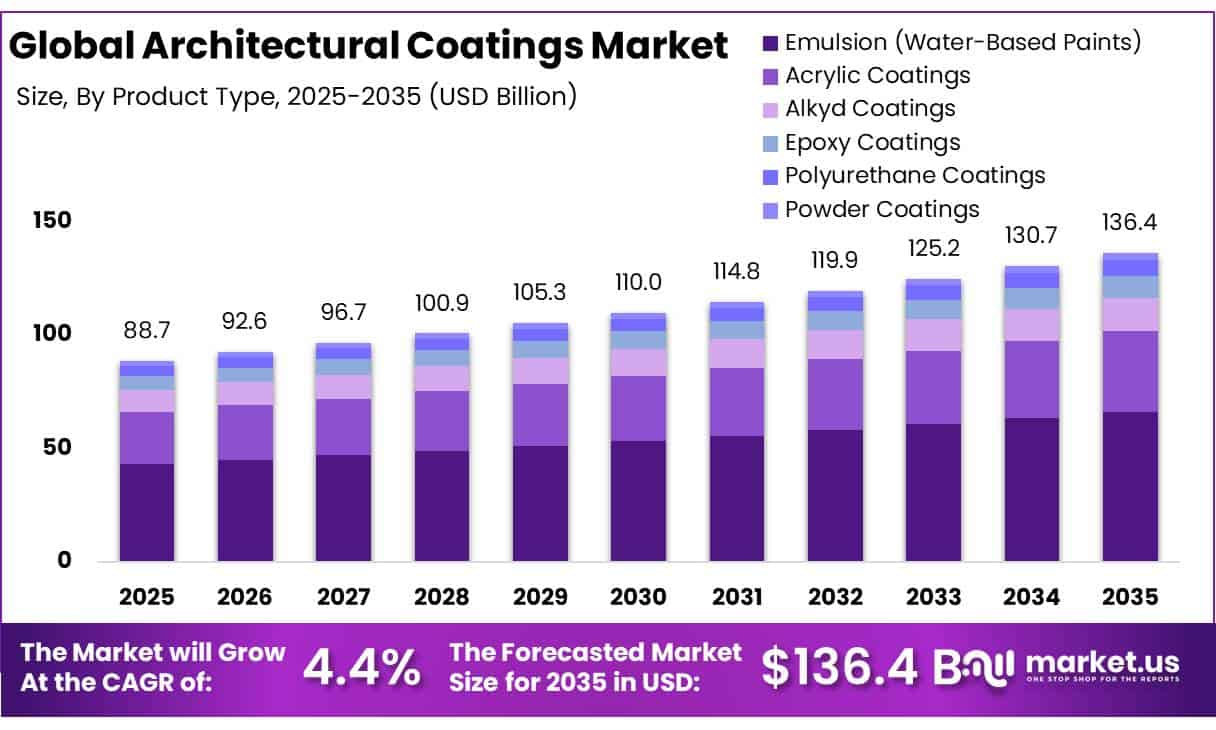
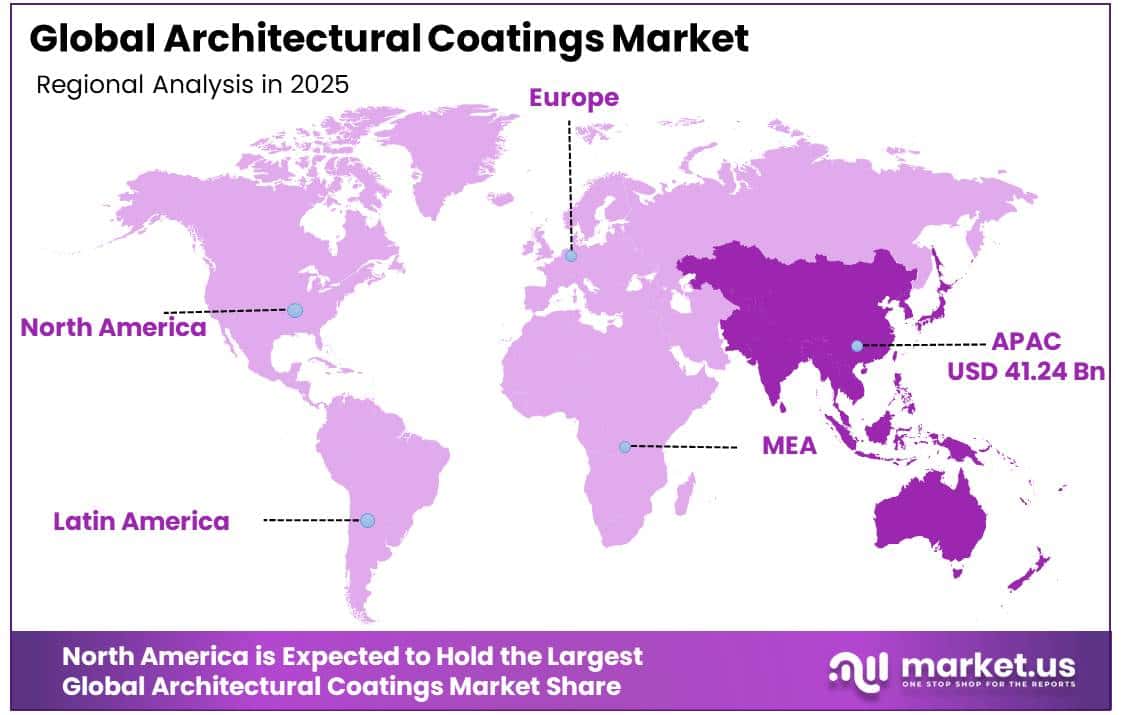
In 2025, the Architectural Coatings Market was valued at USD 88.7 Billion, and between 2026 and 2035, this market is estimated to register a CAGR of 4.4%, reaching about USD 136.4 Billion by 2035. Asia Pacific held a dominant market position, capturing more than a 46.5% share, holding USD 41.24 Billion in revenue.
Key Takeaways
- The Global Architectural Coatings Market was valued at US$88.70 billion in 2025.
- The global architectural coatings market is projected to grow at a CAGR of 4.4% and is estimated to reach US$136.40 billion by 2035.
- On the basis of product type, Emulsion (Water-Based Paints) dominated the market, constituting 48.6% of the total market share.
- Based on the technology, Water-Based Coatings dominated the market, accounting for 62.3% of the total market share.
- Based on the application, Residential Buildings dominated the market, accounting for 54.1% of the total market share.
- Based on the end user, Homeowners dominated the market, accounting for 46.8% of the total market share.
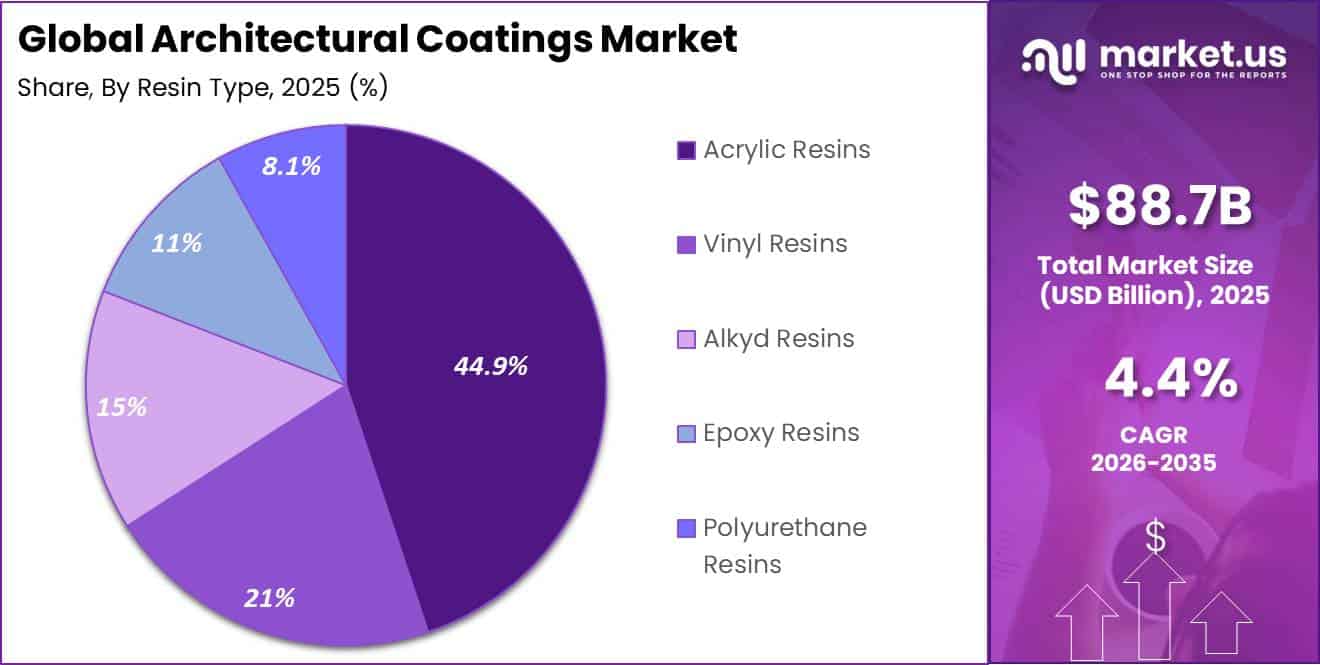
- Based on the resin type, Acrylic Resins dominated the market, accounting for 44.9% of the total market share.
- Based on the distribution channel, Retail (Paint Stores & Hardware Shops) dominated the market, accounting for 59.8% of the total market share.
- Based on the functionality, Decorative Coatings dominated the market, accounting for 68.2% of the total market share.
- In 2025, Asia-Pacific was the most dominant region in the architectural coatings market, accounting for 46.5% of the global market.
The architectural coatings market covers paints, primers, and finishes applied to residential, commercial, and institutional structures for surface protection, weather resistance, and aesthetic value. This segment represents one of the largest components of the broader paint and coatings industry, with demand linked to construction activity, renovation cycles, and tightening environmental regulations across the United States and the European Union.
The industrial scenario remains construction driven. The United States Census Bureau reported residential construction spending of 917.9 billion U.S. dollars in 2024, up 5.9% from 866.9 billion U.S. dollars in 2023, while nonresidential construction reached 743.8 billion U.S. dollars, a 5.3% rise. The American Coatings Association recorded 312,000 workers and 33.2 billion U.S. dollars in product shipments across the U.S. paint and coatings industry in 2023, spread across 53,400 establishments nationwide. Industry employment grew 16% over the preceding decade, adding 43,900 jobs since 2013.
Renovation activity and export demand are key growth drivers. The American Coatings Association reported 2.8 billion U.S. dollars in paint and coatings exports in 2024, generating a trade surplus of nearly 1.6 billion U.S. dollars, with Canada and Mexico together accounting for close to 70% of shipments. Aging housing stock and repaint cycles continue sustaining steady volume demand for waterborne and low volatile organic compound formulations. The National Association of Home Builders estimates the construction sector needs 723,000 new workers annually to match demand, underscoring labor constraints shaping project timelines and coatings application capacity.
Government initiatives are shaping long-term opportunity. The United States Environmental Protection Agency’s national Volatile Organic Compound Emission Standards for Architectural Coatings rule reduces VOC emissions by 103,000 megagrams annually. Separately, the European Commission’s Renovation Wave targets renovating 35 million buildings by 2030, supporting the European Union’s goal of cutting building energy consumption 11.7% by 2030, sustaining architectural coatings demand tied to regulatory-driven upgrades.
Architectural Coatings Market Segmentation
By Product Type
Emulsion (Water-Based Paints) dominates with 48.6% share due to strong preference for low-emission and easy-to-apply coating solutions.
In 2025, Emulsion (Water-Based Paints) held a dominant market position, capturing more than a 48.6% share. The segment maintained its leading position as residential and commercial building owners increasingly preferred water-based paints for interior and exterior applications because of their low odor, quick drying properties, and easier cleanup compared to solvent-based alternatives. Across many countries, environmental policies continued encouraging the use of coatings with lower volatile organic compound (VOC) emissions, supporting greater adoption of water-based formulations. Government construction programs and renovation projects also favored these products as sustainability standards became more common in public infrastructure and housing developments. The growing focus on improving indoor air quality and reducing environmental impact further strengthened demand, allowing emulsion paints to remain the preferred choice across new construction as well as repainting activities during 2025.
Acrylic Coatings emerged as the fastest-growing product type during the forecast period, supported by their excellent durability, weather resistance, and color retention across a wide range of building applications. Their compatibility with modern water-based coating systems and ability to perform well under different climatic conditions increased their use in both new construction and renovation projects. As governments and industry bodies continued promoting sustainable and longer-lasting building materials in 2025 and 2026, manufacturers expanded the use of acrylic-based technologies to meet changing performance and environmental requirements. The combination of longer service life, lower maintenance needs, and compliance with evolving environmental standards contributed to the rapid growth of this segment.
By Technology
Water-Based Coatings dominate with 62.30% share as environmental regulations and sustainable building practices drive wider adoption.
In 2025, Water-Based Coatings held a dominant market position, capturing more than a 62.30% share. The segment remained the preferred technology across the architectural coatings industry because it aligned well with stricter environmental regulations and the growing demand for low-emission building materials. Government agencies in several countries continued encouraging the use of coatings with lower volatile organic compound (VOC) emissions, while public and private construction projects increasingly incorporated environmentally responsible products. Water-based coatings also gained broad acceptance due to their ease of application, low odor, quick drying time, and suitability for residential and commercial buildings. In 2025, the continued rise in renovation activities and sustainable construction practices further reinforced the strong position of this technology, making it the leading choice for a wide range of architectural coating applications.
Solvent-Based Coatings represented the fastest-growing technology segment, mainly driven by demand from industrial and specialized architectural applications where higher durability and superior performance under challenging environmental conditions remained essential. During 2025 and into 2026, these coatings continued to find greater use in projects requiring strong adhesion, chemical resistance, and long-term protection for exposed surfaces. Although environmental regulations encouraged wider adoption of water-based products, solvent-based coatings maintained growth in applications where specific technical performance requirements outweighed regulatory preferences, particularly in demanding industrial and infrastructure-related environments.
By Application
Residential Buildings dominate with 54.10% share as housing construction and renovation activities remain the primary demand source.
In 2025, Residential Buildings held a dominant market position, capturing more than a 54.10% share. The segment accounted for the largest portion of architectural coatings demand as new housing construction, home renovation, and regular repainting projects continued across both developed and developing economies. Government housing initiatives, urban expansion, and investments in residential infrastructure supported consistent demand for interior and exterior coatings. Homeowners also continued to invest in maintenance and aesthetic improvements to extend the life of residential properties, creating steady consumption of architectural paints and finishes. During 2025, the emphasis on energy-efficient homes, improved indoor living conditions, and environmentally compliant coating products further strengthened the use of architectural coatings in the residential sector, allowing it to maintain its leading position.
Commercial Buildings emerged as the fastest-growing application segment, supported by rising investments in offices, retail spaces, healthcare facilities, educational institutions, hotels, and mixed-use developments. Throughout 2025 and into 2026, the expansion of commercial infrastructure and the modernization of existing buildings increased the need for durable, low-maintenance, and environmentally compliant coating solutions. Building owners and developers increasingly selected advanced coatings to improve appearance, protect structures from weather exposure, and meet evolving sustainability requirements, contributing to the segment’s strong growth trajectory.
By End User
Homeowners dominate with 46.80% share as home improvement and repainting projects continue to support coating demand.
In 2025, Homeowners held a dominant market position, capturing more than a 46.80% share. The segment remained the largest end user of architectural coatings as regular home maintenance, interior decoration, and exterior repainting continued to generate steady demand. Many property owners invested in protective and decorative coatings to improve the appearance of their homes, extend building life, and maintain property value. Government support for energy-efficient housing and the growing preference for environmentally compliant coating products also encouraged the adoption of modern water-based paints in residential properties. Throughout 2025, ongoing renovation activities, aging housing stock, and routine maintenance needs helped homeowners retain the leading share of architectural coatings consumption.
Construction Contractors emerged as the fastest-growing end-user segment, driven by increasing involvement in residential, commercial, and institutional construction projects. During 2025 and into 2026, contractors handled a growing number of new building developments and renovation projects that required efficient coating application and compliance with updated building and environmental standards. Their preference for durable, easy-to-apply, and high-performance coating systems increased as project schedules became more demanding and quality expectations continued to rise. This expanding role in large-scale construction and refurbishment activities supported the strong growth of the construction contractors segment.
By Resin Type
Acrylic Resins dominate with 44.90% share due to their durability and compatibility with modern water-based coatings.
In 2025, Acrylic Resins held a dominant market position, capturing more than a 44.90% share. The segment maintained its leadership because acrylic resins are widely used in architectural coatings for their excellent weather resistance, color stability, and long-lasting performance on both interior and exterior surfaces. Their strong compatibility with water-based coating technologies also supported their widespread adoption as environmental regulations continued encouraging lower volatile organic compound (VOC) emissions. During 2025, the growing focus on sustainable construction, building renovation, and long-life protective finishes further strengthened the demand for acrylic resin-based coatings. Their ability to provide good adhesion, ease of application, and reduced maintenance requirements helped the segment retain its leading position across residential and commercial building applications.
Vinyl Resins emerged as the fastest-growing resin type, supported by their increasing use in cost-effective architectural coating formulations for interior walls and selected exterior applications. Throughout 2025 and into 2026, manufacturers expanded the use of vinyl resin technologies to meet the demand for coatings that offered good adhesion, flexibility, and reliable performance while remaining economically competitive. Continued construction activity, renovation projects, and the need for efficient coating solutions in both residential and commercial buildings contributed to the steady growth of this segment.
By Distribution Channel
Retail (Paint Stores & Hardware Shops) dominates with 59.80% share as consumers continue to prefer in-store product selection and expert guidance.
In 2025, Retail (Paint Stores & Hardware Shops) held a dominant market position, capturing more than a 59.80% share. The segment remained the leading distribution channel as homeowners, small contractors, and renovation professionals continued purchasing architectural coatings through physical retail outlets. Paint stores and hardware shops offered customers the advantage of product comparison, color matching, technical guidance, and immediate product availability, making them the preferred purchasing point for many building and maintenance projects. During 2025, demand from home improvement activities and routine repainting supported strong sales through these outlets. Retail stores also benefited from their wide product range and established local distribution networks, helping them maintain their leading position across both urban and suburban markets.
Direct Sales (Contractors & Builders) emerged as the fastest-growing distribution channel, driven by the increasing number of large-scale residential, commercial, and institutional construction projects. Throughout 2025 and into 2026, manufacturers expanded direct relationships with contractors and builders to supply coatings in larger volumes, improve delivery efficiency, and provide technical support for complex projects. As construction companies increasingly sought consistent product quality, timely supply, and customized coating solutions, direct sales continued to gain momentum, making this channel the fastest-growing segment in the architectural coatings market.
By Functionality
Decorative Coatings dominate with 68.20% share as aesthetic upgrades and repainting remain the primary use of architectural coatings.
In 2025, Decorative Coatings held a dominant market position, capturing more than a 68.20% share. The segment remained the largest functionality category because architectural coatings are widely used to improve the appearance of residential, commercial, and institutional buildings. Homeowners and property developers continued investing in interior and exterior painting projects to enhance visual appeal, maintain property value, and refresh aging structures. During 2025, rising renovation activity, urban housing development, and growing consumer interest in modern colors and finishes supported steady demand for decorative coatings. The increasing preference for low-odor and environmentally compliant water-based paints also encouraged wider adoption across both new construction and repainting projects, helping the segment maintain its leading position.
Protective Coatings emerged as the fastest-growing functionality segment, driven by the need to extend building life and reduce maintenance costs. Throughout 2025 and into 2026, demand increased for coatings that provide resistance against moisture, weather exposure, corrosion, and surface wear, particularly in commercial buildings, industrial facilities, and infrastructure projects. Building owners and contractors increasingly selected protective coating systems to improve durability and meet evolving construction and sustainability requirements, supporting the strong growth of this segment.
Key Market Segments
Product Type
- Emulsion (Water-Based Paints)
- Acrylic Coatings
- Alkyd Coatings
- Epoxy Coatings
- Polyurethane Coatings
- Powder Coatings
Technology
- Water-Based Coatings
- Solvent-Based Coatings
- Powder-Based Coatings
Application
- Residential Buildings
- Commercial Buildings
- Industrial Facilities
- Infrastructure Projects
End User
- Homeowners
- Construction Contractors
- Real Estate Developers
- Government & Institutional Bodies
Resin Type
- Acrylic Resins
- Vinyl Resins
- Alkyd Resins
- Epoxy Resins
- Polyurethane Resins
Distribution Channel
- Retail (Paint Stores & Hardware Shops)
- Direct Sales (Contractors & Builders)
- Online Retail
- Specialty Dealers
Functionality
- Decorative Coatings
- Protective Coatings
- Energy-Efficient / Cool Roof Coatings
Geopolitical Impact Analysis
Ongoing Geopolitical Conflicts Increase Raw Material Costs and Supply Chain Challenges for the Architectural Coatings Market.

The architectural coatings market continues to experience indirect effects from the Russia Ukraine war and the ongoing Middle East conflict, as both have disrupted global trade routes and increased uncertainty in energy and chemical supply chains. Architectural coatings rely on petrochemical based raw materials such as resins, solvents, and additives, making production costs sensitive to fluctuations in crude oil markets. According to the International Energy Agency, heightened geopolitical risks and policy uncertainty continued to reshape global oil markets during 2025, with upstream oil investment projected to decline by 6% to around USD 420 billion in 2025 as producers adjusted investment plans amid market volatility. These developments have influenced manufacturing costs for coating producers worldwide.
Shipping disruptions have also affected the movement of coating raw materials and finished products. The U.S. Energy Information Administration reported that 76% of the world’s petroleum and other liquids supply moved through seaborne trade during the first half of 2025, while the United Nations Conference on Trade and Development stated that tonnage through the Suez Canal remained 70% below 2023 levels by May 2025 because many vessels continued using longer routes around the Cape of Good Hope. Higher freight costs and longer transit times have increased supply chain complexity for coating manufacturers. Despite these challenges, environmental regulations remain supportive of the sector. The U.S. Environmental Protection Agency estimates that its Architectural Coatings VOC standards reduce emissions by 103,000 megagrams per year, encouraging continued adoption of low emission coating technologies even during geopolitical uncertainty.

Regional Analysis
Regional Analysis: Asia-Pacific.
Asia-Pacific stands as the dominating region in the global architectural coatings market, holding a 46.5% share valued at 41.24 billion U.S. dollars. This leading position stems from the region’s scale of construction activity, rapid urbanization, and the concentration of major coatings-producing economies including China, Japan, South Korea, and Australia. Within Asia-Pacific, China represents the largest single contributor, accounting for roughly 60% of the region’s total coatings volume, according to the American Coatings Association, reflecting its dominant manufacturing base and extensive residential and commercial construction pipeline. The American Coatings Association further reported that Asia-Pacific paints and coatings revenues expanded from 56.2 billion U.S. dollars to 74.2 billion U.S. dollars over a recent five-year period, underscoring sustained regional demand growth.




Australia contributes meaningfully to regional construction-linked coatings demand through its steady building sector. The Australian Bureau of Statistics reported that the total value of building work done reached 44.8 billion Australian dollars in the March 2026 quarter, with non-residential building work rising 2.2% to 17.7 billion Australian dollars and new residential building work totaling 23.2 billion Australian dollars in the same period.

Rising middle-class populations, expanding home-supply retail networks, and growing infrastructure investment across Indonesia, Vietnam, and other Southeast Asian economies continue reinforcing Asia-Pacific’s leadership position in the global coatings landscape. Developed markets such as Japan and South Korea, meanwhile, are shifting toward higher-value, higher-performance coating technologies as construction activity matures. Collectively, these dynamics confirm Asia-Pacific’s position as the largest and most dynamic regional market for architectural coatings, supported by diversified demand across both emerging and mature economies within the region.
Key Regions and Countries Covered
- North America
- The US
- Canada
- Europe
- Germany
- France
- The UK
- Spain
- Italy
- Russia & CIS
- Rest of Europe
- APAC
- China
- Japan
- South Korea
- India
- ASEAN
- Rest of APAC
- Latin America
- Brazil
- Mexico
- Rest of Latin America
- Middle East & Africa
- GCC
- South Africa
- Rest of MEA
Key Players Analysis
Manufacturers in the architectural coatings market focus on expanding product performance, environmental compliance, and distribution strength to maintain a competitive position. A major priority is the development of low volatile organic compound (VOC), water based, and high durability coating formulations that meet evolving environmental regulations while delivering longer service life. Companies continue investing in advanced resin technologies, improved pigment dispersion, and enhanced weather resistance to meet the needs of residential, commercial, and institutional buildings. Product innovation also includes coatings with better stain resistance, antimicrobial properties, improved washability, and energy efficient reflective finishes. In addition, manufacturers strengthen research and development activities to produce coatings that offer faster drying times, better color retention, and reduced maintenance requirements, helping differentiate their product portfolios across mature and emerging construction markets.
Leading companies also prioritize expanding manufacturing capacity, improving supply chain resilience, and strengthening regional distribution networks to meet growing construction and renovation demand. Strategic partnerships with raw material suppliers help secure a stable supply of resins, pigments, and additives while reducing exposure to input cost fluctuations. Many producers continue modernizing production facilities through automation and digital quality control systems to improve operational efficiency and maintain consistent product quality. Companies are also expanding direct relationships with contractors, builders, architects, and retail distributors to strengthen market reach and customer loyalty. Alongside organic growth, businesses pursue acquisitions and technology collaborations to broaden product offerings and increase their presence in high growth regions. Continuous investment in sustainable manufacturing processes, recyclable packaging, and environmentally responsible coating technologies further supports long term competitiveness while aligning with changing regulatory standards and customer expectations.
Market Key Players
- AkzoNobel N.V.
- PPG Industries, Inc.
- Sherwin-Williams Company
- BASF SE
- Asian Paints Limited
- Nippon Paint Holdings Co., Ltd.
- Jotun Group
- RPM International Inc.
- Kansai Paint Co., Ltd.
- Berger Paints India Limited
- Axalta Coating Systems
- Hempel A/S
- Masco Corporation
- DAW SE
- KCC Corporation
Key Development
- In January 2026, PPG Industries, Inc. reported fourth quarter and full-year 2025 financial results, with its Global Architectural Coatings segment posting full-year net sales of 838 billion U.S. dollars and total company net sales of 15.9 billion U.S. dollars for 2025.
- In January 2026, The Sherwin-Williams Company reported 2025 year-end and fourth quarter results, with Paint Stores Group net sales reaching 61 billion U.S. dollars for the year, up from 13.19 billion U.S. dollars in 2024, and consolidated net sales increasing 2.1% to 23.57 billion U.S. dollars.
- In February 2026, AkzoNobel N.V. reported full-year 2025 results, with revenue of 10,158 million euros and adjusted EBITDA margin expanding to 2%, while confirming a proposed all-stock merger with Axalta Coating Systems to create a combined global coatings company.
- In April 2026, PPG Industries, Inc. reported first quarter 2026 results, with its Global Architectural Coatings segment net sales increasing 13% compared with the first quarter of 2025, driven by higher selling prices and favorable foreign currency translation. Organic sales growth was supported by Latin America and Asia Pacific.
Report Scope
| Report Features | Description |
|---|---|
| Market Value (2025) | US$88.7 Bn |
| Forecast Revenue (2035) | US$136.4 Bn |
| CAGR (2026 2035) | 4.4% |
| Base Year for Estimation | 2025 |
| Historic Period | 2020-2024 |
| Forecast Period | 2026-2035 |
| Report Coverage | Revenue Forecast, Market Dynamics, Competitive Landscape, Recent Developments |
| Segments Covered | By Product Type (Emulsion (Water-Based Paints), Acrylic Coatings, Alkyd Coatings, Epoxy Coatings, Polyurethane Coatings, Powder Coatings), By Technology (Water-Based Coatings, Solvent-Based Coatings, Powder-Based Coatings), By Application (Residential Buildings, Commercial Buildings, Industrial Facilities, Infrastructure Projects), By End User (Homeowners, Construction Contractors, Real Estate Developers, Government & Institutional Bodies), By Resin Type (Acrylic Resins, Vinyl Resins, Alkyd Resins, Epoxy Resins, Polyurethane Resins), By Distribution Channel (Retail (Paint Stores & Hardware Shops), Direct Sales (Contractors & Builders), Online Retail, Specialty Dealers), By Functionality (Decorative Coatings, Protective Coatings, Energy-Efficient/Cool Roof Coatings) |
| Regional Analysis | North America The US & Canada; Europe Germany, France, The UK, Spain, Italy, Russia & CIS, Rest of Europe; APAC China, Japan, South Korea, India, ASEAN & Rest of APAC; Latin America Brazil, Mexico & Rest of Latin America; Middle East & Africa GCC, South Africa, & Rest of MEA |
| Competitive Landscape | AkzoNobel N.V., PPG Industries, Inc., The Sherwin-Williams Company, BASF SE, Asian Paints Limited, Nippon Paint Holdings Co., Ltd., Jotun Group, RPM International Inc., Kansai Paint Co., Ltd., Berger Paints India Limited, Axalta Coating Systems, Hempel A/S, Masco Corporation, DAW SE, and KCC Corporation. |
| Customization Scope | Customization for segments, region/country level will be provided. Moreover, additional customization can be done based on the requirements. |
| Purchase Options | We have three licenses to opt for: Single User License, Multi User License (Up to 5 Users), Corporate Use License (Unlimited Users and Printable PDF) |
























