Report Overview
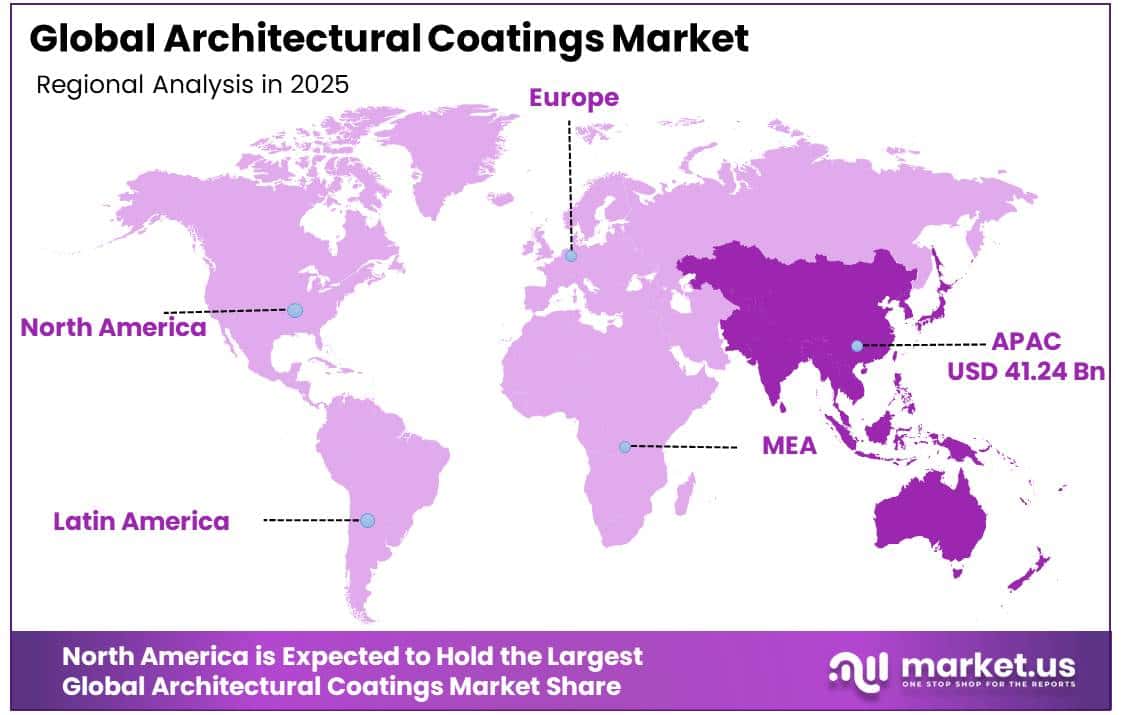
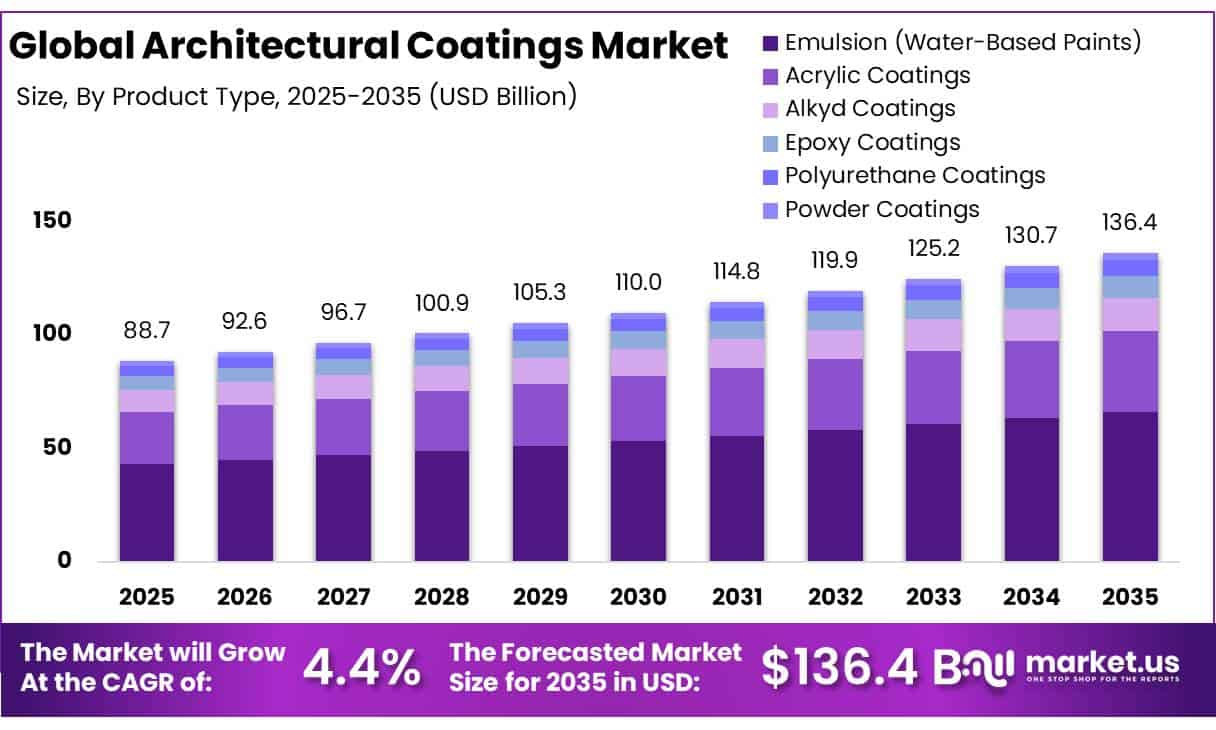
In 2025, the Architectural Coatings Market was valued at USD 88.7 Billion, and between 2026 and 2035, this market is estimated to register a CAGR of 4.4%, reaching about USD 136.4 Billion by 2035. Asia Pacific held a dominant market position, capturing more than a 46.5% share, holding USD 41.24 Billion in revenue.
The architectural coatings market covers paints, primers, and finishes applied to residential, commercial, and institutional structures for surface protection, weather resistance, and aesthetic value. This segment represents one of the largest components of the broader paint and coatings industry, with demand linked to construction activity, renovation cycles, and tightening environmental regulations across the United States and the European Union.
- The United States Census Bureau reported residential construction spending of 917.9 billion U.S. dollars in 2024, up 5.9% from 866.9 billion U.S. dollars in 2023, while nonresidential construction reached 743.8 billion U.S. dollars, a 5.3% rise.
- The American Coatings Association recorded 312,000 workers and 33.2 billion U.S. dollars in product shipments across the U.S. paint and coatings industry in 2023, spread across 53,400 establishments nationwide. Industry employment grew 16% over the preceding decade, adding 43,900 jobs since 2013.
Key Takeaways
- The Global Architectural Coatings Market was valued at US$88.70 billion in 2025.
- The global architectural coatings market is projected to grow at a CAGR of 4.4% and is estimated to reach US$136.40 billion by 2035.
- On the basis of product type, Emulsion (Water-Based Paints) dominated the market, constituting 48.6% of the total market share.
- Based on the technology, Water-Based Coatings dominated the market, accounting for 62.3% of the total market share.
- Based on the application, Residential Buildings dominated the market, accounting for 54.1% of the total market share.
- Based on the end user, Homeowners dominated the market, accounting for 46.8% of the total market share.
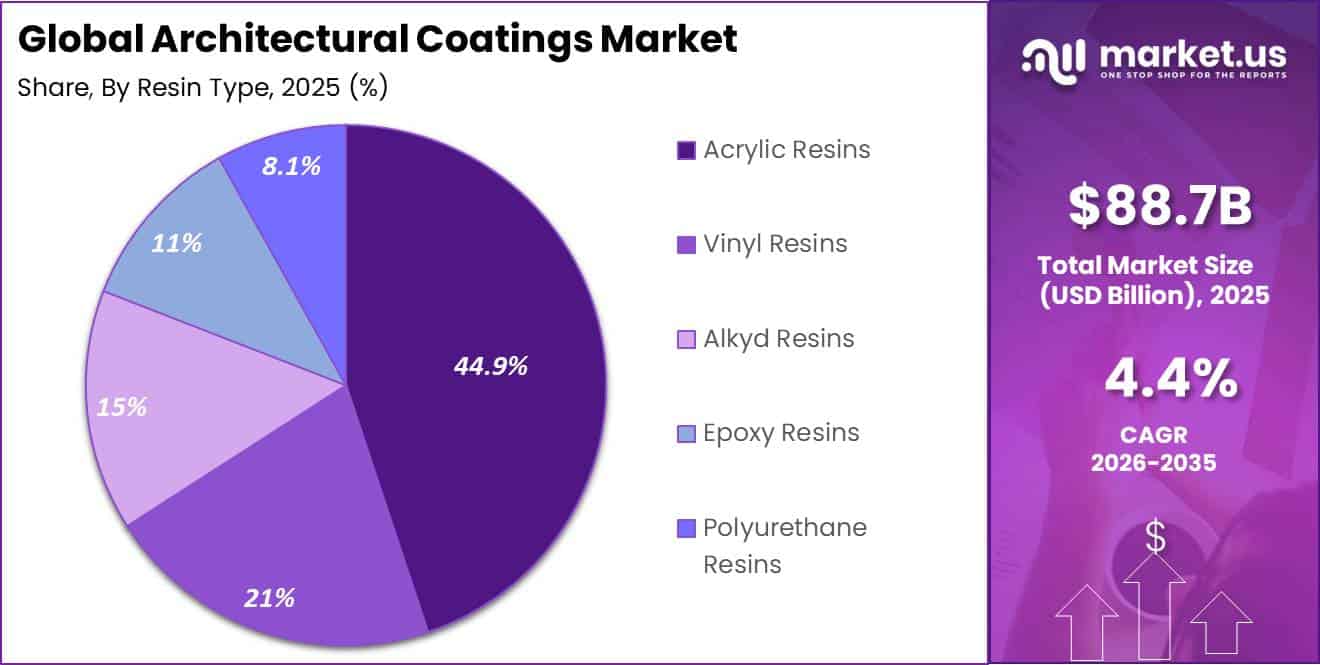
- Based on the resin type, Acrylic Resins dominated the market, accounting for 44.9% of the total market share.
- Based on the distribution channel, Retail (Paint Stores & Hardware Shops) dominated the market, accounting for 59.8% of the total market share.
- Based on the functionality, Decorative Coatings dominated the market, accounting for 68.2% of the total market share.
- In 2025, Asia-Pacific was the most dominant region in the architectural coatings market, accounting for 46.5% of the global market.
Renovation activity and export demand are key growth drivers. The American Coatings Association reported 2.8 billion U.S. dollars in paint and coatings exports in 2024, generating a trade surplus of nearly 1.6 billion U.S. dollars, with Canada and Mexico together accounting for close to 70% of shipments. Aging housing stock and repaint cycles continue sustaining steady volume demand for waterborne and low volatile organic compound formulations. The National Association of Home Builders estimates the construction sector needs 723,000 new workers annually to match demand, underscoring labor constraints shaping project timelines and coatings application capacity.
Government initiatives are shaping long-term opportunity. The United States Environmental Protection Agency’s national Volatile Organic Compound Emission Standards for Architectural Coatings rule reduces VOC emissions by 103,000 megagrams annually. Separately, the European Commission’s Renovation Wave targets renovating 35 million buildings by 2030, supporting the European Union’s goal of cutting building energy consumption 11.7% by 2030, sustaining architectural coatings demand tied to regulatory-driven upgrades.
By Product Type
Emulsion (Water-Based Paints) dominates with 48.6% share due to strong preference for low-emission and easy-to-apply coating solutions.
In 2025, Emulsion (Water-Based Paints) held a dominant market position, capturing more than a 48.6% share. The segment maintained its leading position as residential and commercial building owners increasingly preferred water-based paints for interior and exterior applications because of their low odor, quick drying properties, and easier cleanup compared to solvent-based alternatives. Across many countries, environmental policies continued encouraging the use of coatings with lower volatile organic compound (VOC) emissions, supporting greater adoption of water-based formulations.
Acrylic Coatings emerged as the fastest-growing product type during the forecast period, supported by their excellent durability, weather resistance, and color retention across a wide range of building applications. Their compatibility with modern water-based coating systems and ability to perform well under different climatic conditions increased their use in both new construction and renovation projects.
By Technology
Water-Based Coatings dominate with 62.30% share as environmental regulations and sustainable building practices drive wider adoption.
In 2025, Water-Based Coatings held a dominant market position, capturing more than a 62.30% share. The segment remained the preferred technology across the architectural coatings industry because it aligned well with stricter environmental regulations and the growing demand for low-emission building materials. Government agencies in several countries continued encouraging the use of coatings with lower volatile organic compound (VOC) emissions, while public and private construction projects increasingly incorporated environmentally responsible products. Water-based coatings also gained broad acceptance due to their ease of application, low odor, quick drying time, and suitability for residential and commercial buildings.
Solvent-Based Coatings represented the fastest-growing technology segment, mainly driven by demand from industrial and specialized architectural applications where higher durability and superior performance under challenging environmental conditions remained essential. During 2025 and into 2026, these coatings continued to find greater use in projects requiring strong adhesion, chemical resistance, and long-term protection for exposed surfaces.
By Application
Residential Buildings dominate with 54.10% share as housing construction and renovation activities remain the primary demand source.
In 2025, Residential Buildings held a dominant market position, capturing more than a 54.10% share. The segment accounted for the largest portion of architectural coatings demand as new housing construction, home renovation, and regular repainting projects continued across both developed and developing economies. Government housing initiatives, urban expansion, and investments in residential infrastructure supported consistent demand for interior and exterior coatings.
Commercial Buildings emerged as the fastest-growing application segment, supported by rising investments in offices, retail spaces, healthcare facilities, educational institutions, hotels, and mixed-use developments. Throughout 2025 and into 2026, the expansion of commercial infrastructure and the modernization of existing buildings increased the need for durable, low-maintenance, and environmentally compliant coating solutions.
By End User
Homeowners dominate with 46.80% share as home improvement and repainting projects continue to support coating demand.
In 2025, Homeowners held a dominant market position, capturing more than a 46.80% share. The segment remained the largest end user of architectural coatings as regular home maintenance, interior decoration, and exterior repainting continued to generate steady demand. Many property owners invested in protective and decorative coatings to improve the appearance of their homes, extend building life, and maintain property value.
Construction Contractors emerged as the fastest-growing end-user segment, driven by increasing involvement in residential, commercial, and institutional construction projects. During 2025 and into 2026, contractors handled a growing number of new building developments and renovation projects that required efficient coating application and compliance with updated building and environmental standards. Their preference for durable, easy-to-apply, and high-performance coating systems increased as project schedules became more demanding and quality expectations continued to rise.
By Resin Type
Acrylic Resins dominate with 44.90% share due to their durability and compatibility with modern water-based coatings.
In 2025, Acrylic Resins held a dominant market position, capturing more than a 44.90% share. The segment maintained its leadership because acrylic resins are widely used in architectural coatings for their excellent weather resistance, color stability, and long-lasting performance on both interior and exterior surfaces. Their strong compatibility with water-based coating technologies also supported their widespread adoption as environmental regulations continued encouraging lower volatile organic compound (VOC) emissions.
Vinyl Resins emerged as the fastest-growing resin type, supported by their increasing use in cost-effective architectural coating formulations for interior walls and selected exterior applications. Throughout 2025 and into 2026, manufacturers expanded the use of vinyl resin technologies to meet the demand for coatings that offered good adhesion, flexibility, and reliable performance while remaining economically competitive. Continued construction activity, renovation projects, and the need for efficient coating solutions in both residential and commercial buildings contributed to the steady growth of this segment.
By Distribution Channel
Retail (Paint Stores & Hardware Shops) dominates with 59.80% share as consumers continue to prefer in-store product selection and expert guidance.
In 2025, Retail (Paint Stores & Hardware Shops) held a dominant market position, capturing more than a 59.80% share. The segment remained the leading distribution channel as homeowners, small contractors, and renovation professionals continued purchasing architectural coatings through physical retail outlets. Paint stores and hardware shops offered customers the advantage of product comparison, color matching, technical guidance, and immediate product availability, making them the preferred purchasing point for many building and maintenance projects. During 2025, demand from home improvement activities and routine repainting supported strong
Direct Sales (Contractors & Builders) emerged as the fastest-growing distribution channel, driven by the increasing number of large-scale residential, commercial, and institutional construction projects. Throughout 2025 and into 2026, manufacturers expanded direct relationships with contractors and builders to supply coatings in larger volumes, improve delivery efficiency, and provide technical support for complex projects.
By Functionality
Decorative Coatings dominate with 68.20% share as aesthetic upgrades and repainting remain the primary use of architectural coatings.
In 2025, Decorative Coatings held a dominant market position, capturing more than a 68.20% share. The segment remained the largest functionality category because architectural coatings are widely used to improve the appearance of residential, commercial, and institutional buildings. Homeowners and property developers continued investing in interior and exterior painting projects to enhance visual appeal, maintain property value, and refresh aging structures. During 2025, rising renovation activity, urban housing development, and growing consumer interest in modern colors and finishes supported steady demand for decorative coatings.
Protective Coatings emerged as the fastest-growing functionality segment, driven by the need to extend building life and reduce maintenance costs. Throughout 2025 and into 2026, demand increased for coatings that provide resistance against moisture, weather exposure, corrosion, and surface wear, particularly in commercial buildings, industrial facilities, and infrastructure projects. Building owners and contractors increasingly selected protective coating systems to improve durability and meet evolving construction and sustainability requirements, supporting the strong growth of this segment.
Key Market Segments
Product Type
- Emulsion (Water-Based Paints)
- Acrylic Coatings
- Alkyd Coatings
- Epoxy Coatings
- Polyurethane Coatings
- Powder Coatings
Technology
- Water-Based Coatings
- Solvent-Based Coatings
- Powder-Based Coatings
Application
- Residential Buildings
- Commercial Buildings
- Industrial Facilities
- Infrastructure Projects
End User
- Homeowners
- Construction Contractors
- Real Estate Developers
- Government & Institutional Bodies
Resin Type
- Acrylic Resins
- Vinyl Resins
- Alkyd Resins
- Epoxy Resins
- Polyurethane Resins
Distribution Channel
- Retail (Paint Stores & Hardware Shops)
- Direct Sales (Contractors & Builders)
- Online Retail
- Specialty Dealers
Functionality
- Decorative Coatings
- Protective Coatings
- Energy-Efficient / Cool Roof Coatings