


Market Overview
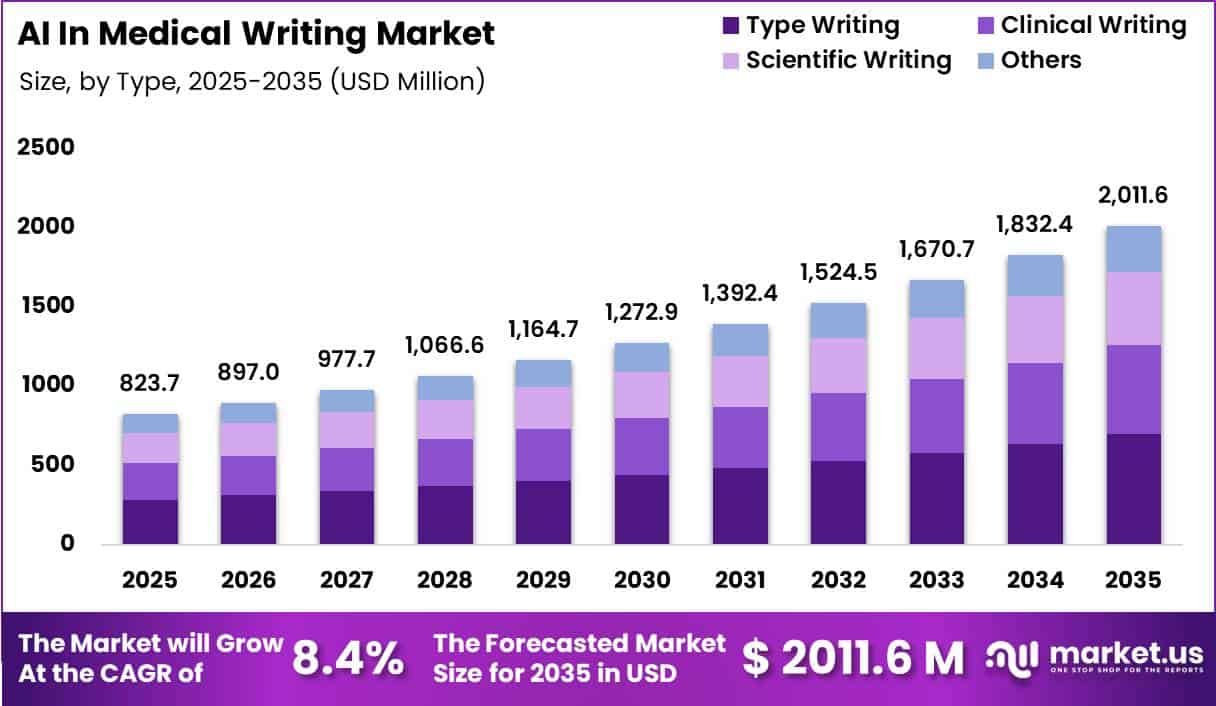
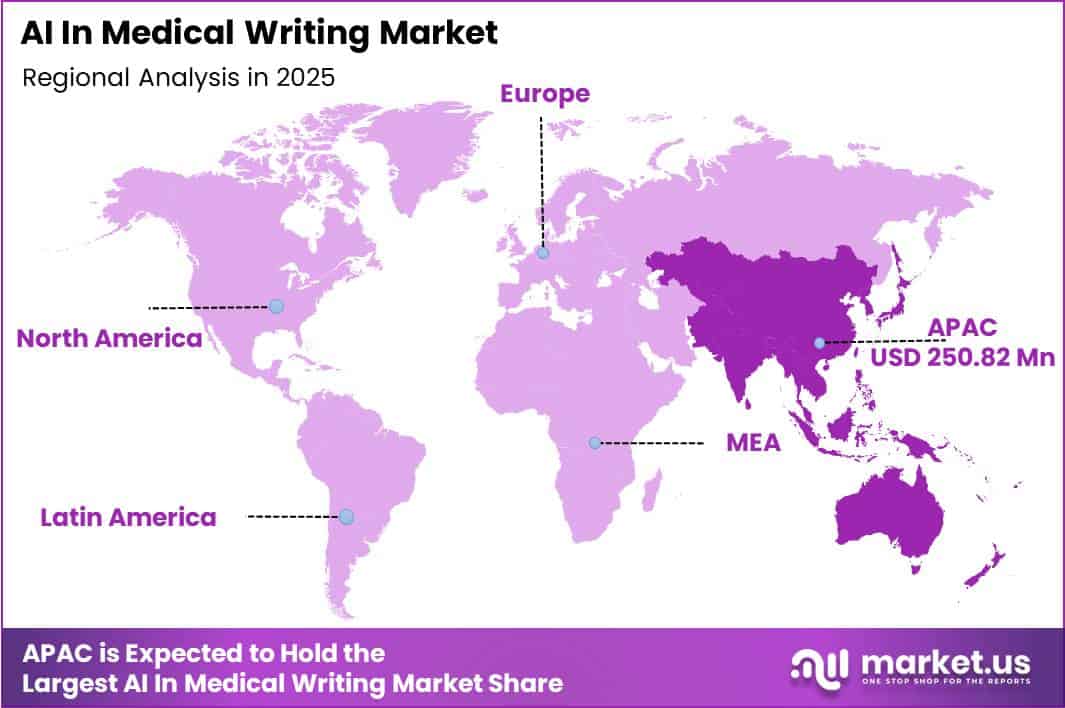
The Global AI in Medical Writing Market size is expected to be worth around US$ 2,011.6 Million by 2035 from US$ 823.7 Million in 2025, growing at a CAGR of 8.4% during the forecast period from 2026 to 2035. In 2025, Asia Pacific led the market, achieving over 30.45% share with a revenue of US$ 250.82 Million.
The Global AI in Medical Writing Market is witnessing rapid transformation as healthcare organizations, pharmaceutical companies, clinical research organizations, and regulatory teams increasingly adopt artificial intelligence, natural language processing, and generative AI technologies to improve the speed, accuracy, and consistency of medical documentation.
AI-powered medical writing solutions are being integrated for clinical study reports, regulatory submissions, scientific publications, patient information materials, safety reports, and electronic health record documentation. The growing volume of clinical research data is a major factor accelerating AI adoption in medical writing.
The U.S. Food and Drug Administration has highlighted the expanding role of AI across healthcare and medical product development, including the use of AI systems for generating and evaluating information supporting regulatory decision-making for drugs and biological products.
FDA also reported that more than 1,000 AI-enabled medical devices have received authorization through established regulatory pathways, reflecting broader acceptance of AI technologies in healthcare environments.
AI-based medical writing platforms help reduce manual documentation workloads, improve regulatory compliance, and accelerate the preparation of complex scientific content. These technologies support automated literature reviews, data summarization, clinical trial documentation, and quality checks while maintaining human oversight for accuracy and ethical compliance.
Regulatory focus on transparency, lifecycle management, and responsible AI development is further shaping market growth. FDA’s 2025 guidance initiatives emphasize documentation, performance monitoring, and risk management throughout the lifecycle of AI-enabled healthcare technologies.
As healthcare data generation continues to increase, AI-driven medical writing is expected to become an important tool for improving efficiency, reducing administrative burden, and supporting evidence-based healthcare innovation.
Key Takeaways
- Market Size: The Global AI in Medical Writing Market size was US$ 823.7 Million in 2025. The market is estimated to grow to US$ 2,011.6 million by 2035.
- Market Share: The Compound Annual Growth Rate (CAGR) of the market from 2026 to 2035 will be 8.4%.
- Type: Type Writing has the largest market share, accounting for 34.7% of total sales.
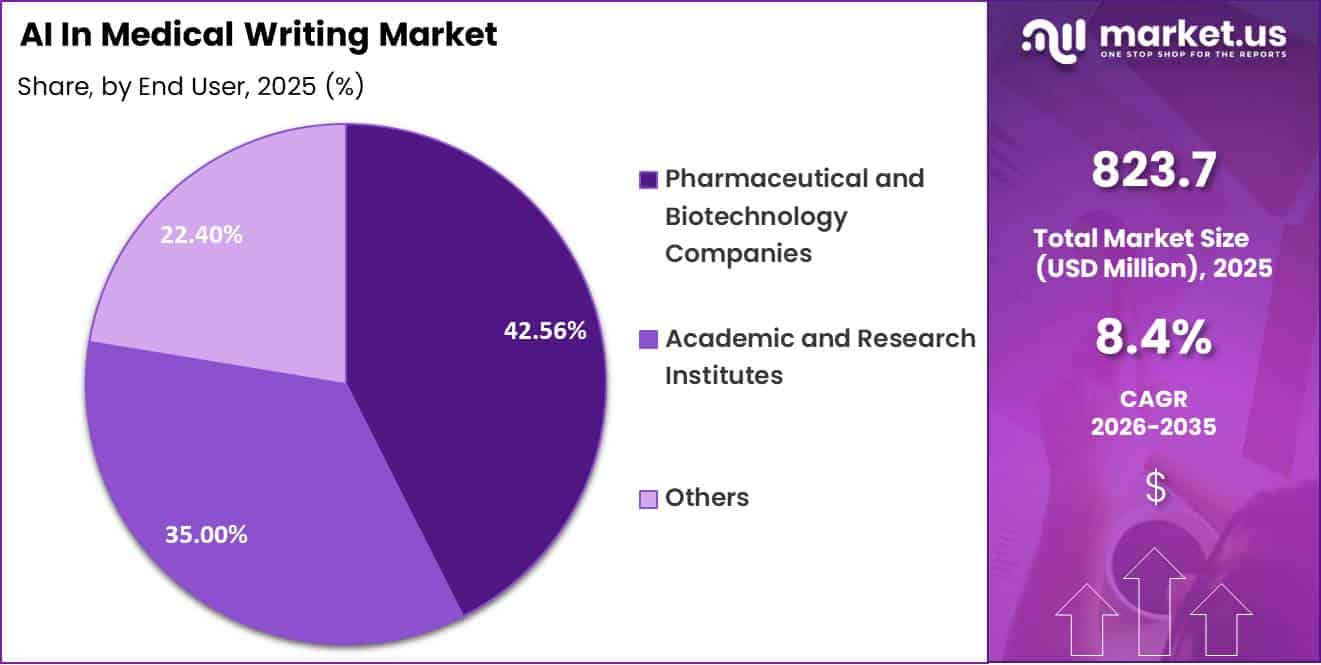
- End User: Pharmaceutical and Biotechnology Companies dominate the segment, accounting for 42.56% of total revenue.
- Regional: Asia Pacific holds 30.45% of global sales, generating US$ 250.82 million in revenue.
Type Analysis
The Type Writing segment dominated the Global AI in Medical Writing Market in 2025, accounting for 34.7% market share, driven by the increasing demand for AI-assisted content generation, editing, formatting, and quality optimization across healthcare and life sciences documentation.
AI-powered writing tools are being widely adopted to support medical content creation, improve language consistency, reduce turnaround time, and enhance compliance with scientific and regulatory communication standards.
The growing requirement for accurate and structured medical documents, including manuscripts, summaries, reports, and educational materials, is strengthening the adoption of AI-based type writing solutions. The Clinical Writing segment held 28.0% market share in 2025, supported by the rising complexity of clinical trial documentation, regulatory submissions, clinical study reports, and safety documentation.
AI technologies assist medical writers by automating data extraction, summarization, and document review processes while maintaining regulatory standards. The Scientific Writing segment accounted for 23.0% market share, driven by increasing research publications, biomedical literature generation, and the need for efficient scientific communication.
AI tools help researchers analyze large volumes of literature and prepare publication-ready content. The Others segment contributed 14.3% market share, including specialized medical content such as patient education materials, healthcare communications, and regulatory support documents, where AI adoption continues to expand.
End User Analysis
The Pharmaceutical and Biotechnology Companies segment dominated the Global AI in Medical Writing Market in 2025, accounting for 42.56% market share, due to the extensive use of AI solutions in drug development, clinical research documentation, regulatory submissions, and scientific communication. Pharmaceutical and biotechnology organizations generate large volumes of complex medical data requiring accurate, compliant, and timely documentation.
AI-enabled medical writing platforms help these companies streamline clinical trial reports, investigator brochures, regulatory documents, and publication workflows while improving operational efficiency. The Academic and Research Institutes segment held 35.00% market share in 2025, supported by increasing research activities, biomedical publications, and the growing need for efficient analysis of scientific information.
Universities and research organizations are adopting AI-based writing tools to assist researchers with literature reviews, manuscript preparation, and research documentation while managing expanding volumes of healthcare knowledge. The Others segment accounted for 22.40% market share, including contract research organizations (CROs), healthcare communication agencies, hospitals, and medical associations.
Organizations are increasingly implementing AI-powered writing solutions to improve documentation processes, enhance productivity, and support evidence-based healthcare communication. The rising adoption of AI across diverse healthcare stakeholders is expected to expand the role of automated medical writing solutions globally.
Key Market Segments
By Type
- Clinical Writing
- Type Writing
- Scientific Writing
- Others
By End User
- Pharmaceutical and Biotechnology Companies
- Academic and Research Institutes
- Others
Driver
FDA-Guided Human-in-the-Loop Regulatory AI Adoption
FDA guidance is increasingly distinguishing between AI used as a drafting assistant and AI used for autonomous regulatory decision-making, reducing uncertainty for medical writing and compliance software vendors that operate under supervised human-in-the-loop workflows. Recent FDA frameworks reinforce a risk-based approach where AI-generated content used in regulated submissions still requires qualified human review, clear accountability, and documented validation.
Regulatory clarity improves adoption by allowing organisations to integrate AI into existing compliance processes without redesigning end-to-end workflows. In practice, AI tools are expected to deliver 25–45% efficiency gains in drafting, formatting, and quality-checking tasks, while final approval remains with human experts.
As a result, vendors are shifting from replacement-focused narratives to augmentation models, supporting faster procurement decisions and smoother enterprise adoption. Revenue models are also evolving toward SaaS pricing based on seats, document volume, and audit trail capabilities rather than standalone tool licensing.
| Driver | (~) % Impact on CAGR Forecast | Geographic Relevance | Impact Timeline |
|---|---|---|---|
| FDA-regulated drafting acceptance with human review controls | +2.4% | North America core, EU follow-through, APAC regulated hubs | Short term (≤ 2 years) |
| Protocol-to-submission cycle compression in clinical development | +2.1% | North America core, EU, Japan, South Korea, India service corridors | Short term (≤ 2 years) |
| Ambient and structured clinical documentation expansion | +1.8% | North America core, UK/EU, urban APAC provider systems | Medium term (2-4 years) |
| HHS/WHO-style governance and enterprise AI operating models | +1.5% | North America core, EU, Middle East digital health adopters, APAC | Medium term (2-4 years) |
| CMS interoperability and prior-authorization digitization spillover | +1.3% | U.S. core with limited spill-over to other digitally mature payer-provider markets | Medium term (2-4 years) |
| Domain-tuned LLMs and evidence-linked quality improvement | +1.7% | North America core, EU research centers, Japan, South Korea, Singapore | Long-term (≥ 4 years) |
Challenge
Escalating Clinical Documentation Burden Driving AI Adoption in Medical Writing
Rising documentation demands across clinical care and research are a primary near-term driver for AI adoption in medical writing, as health systems face sustained increases in administrative workload alongside expanding EHR and regulatory requirements.
Clinician surveys consistently show that documentation consumes more than 3.5 hours per day in many specialities, up from roughly 2.5 to 3.0 hours in the pre-pandemic period, contributing to widespread burnout and reduced patient-facing time. This growing burden creates strong economic justification for AI tools that can reduce drafting and structuring time by 30 to 50 % per document.
At scale, even modest time savings per clinician translate into millions of labor hours annually across hospital systems and research organizations, improving throughput for discharge summaries, clinical notes, regulatory submissions, and quality reporting. As a result, AI is increasingly positioned as a workflow accelerator rather than a replacement for human oversight.
Medical writers and clinicians remain essential for validation, interpretation, and compliance review, but their role is shifting toward higher-value editing and quality control. Vendors are therefore optimizing solutions around measurable efficiency gains such as reduced note completion time and improved coding accuracy, driving sustained demand growth for AI-assisted medical writing platforms.
| Driver | (~) % Impact on CAGR Forecast | Geographic Relevance | Impact Timeline |
|---|---|---|---|
| Escalating documentation burden | +2.4% | North America, EU, APAC hospitals | Short term (≤ 2 years) |
| Regulatory AI guidance momentum | +1.9% | US, EU, Japan regulatory hubs | Medium term (2-4 years) |
| Generative model performance gains | +2.7% | Global pharma & CRO networks | Medium term (2-4 years) |
| Clinical trial volume expansion | +2.2% | North America core, EU, APAC corridors | Long-term (≥ 4 years) |
| EHR and CDS digitalization wave | +1.6% | US, EU, China urban systems | Medium term (2-4 years) |
| Multilingual, global submissions | +1.3% | EU, APAC, Latin America | Long-term (≥ 4 years) |
Restraints
High-Risk Healthcare AI Regulatory Compliance Drag
Regulatory requirements for high-risk healthcare AI are increasingly slowing adoption in medical writing and clinical documentation workflows. Frameworks such as the EU AI Act, the EU MDR, GDPR, and emerging U.S. FDA guidance impose strict obligations around transparency, bias control, validation, and continuous post-deployment monitoring.
Because most healthcare AI tools fall under high-risk classification, vendors must maintain extensive documentation, human oversight, and lifecycle governance. This often limits AI use to narrow drafting assistance rather than full automation of regulated outputs like clinical study reports or labeling documents.
In practice, these requirements extend implementation timelines by 6–12 months and force organizations to run parallel manual and AI-assisted workflows, increasing operational costs. As a result, theoretical productivity gains of 30–40% are often reduced to 10–15% in real-world compliant environments.
Overall, regulatory complexity slows large-scale deployment until standardized compliance frameworks mature, reducing near term adoption speed and limiting the pace of efficiency gains in AI-enabled medical writing.
| Restraint | (~) % Impact on CAGR Forecast | Geographic Relevance | Impact Timeline |
|---|---|---|---|
| High-risk AI regulatory drag | -2.2% | EU core, US, UK | Medium term (2–4 years) |
| Data privacy & PHI governance overhead | -1.6% | US, EU, APAC hospitals | Long-term (≥ 4 years) |
| Limited validated medical AI tooling | -1.2% | Global biopharma, CROs | Short–Medium (≤ 4 years) |
| Talent & workflow integration friction | -1.0% | Global medcomms hubs | Short term (≤ 2 years) |
| Client liability & trust concerns | -0.8% | Global sponsors, HCP orgs | Medium term (2–4 years) |
| Reimbursement & documentation compliance risk | -0.7% | US, EU payers & providers | Long-term (≥ 4 years) |
Opportunity
End-to-End Regulatory Dossier Automation Opportunity
This opportunity focuses on full lifecycle AI automation of regulatory documentation, extending beyond today’s limited use of AI for drafting sections or templates into complete dossier generation across clinical study reports, integrated summaries, labeling content, and agency response documents. It remains largely untapped due to strict validation, auditability, and liability constraints that prevent full automation in regulated submissions.
A viable system would be built on 21 CFR Part 11-compliant architecture with full traceability, version control, and machine-readable outputs aligned with FDA and EMA eCTD requirements. Such platforms could reduce dossier preparation timelines by 20 to 30 % and cut rework rates by 10 to 15 % in large sponsors managing high submission volumes annually.
Given the multi-billion-dollar regulatory writing market, even partial penetration into end-to-end workflows could generate several hundred million dollars in incremental value by 2030. The main constraint remains regulatory acceptance of fully AI-generated submissions, requiring proven auditability and consistent inspection readiness.
| Opportunity | (~) % Potential CAGR Upside | Geographic Relevance | Execution Window |
|---|---|---|---|
| End-to-end regulatory dossier automation | +2.5% | North America, EU, Japan | Medium term (2-4 years) |
| Real-time payer & HEOR evidence drafting | +1.8% | North America, EU | Medium term (2-4 years) |
| Patient-facing education & adherence content | +1.5% | North America, EU, APAC emerging markets | Short term (≤ 2 years) |
| Integrated multilingual medical communication hubs | +1.7% | EU, APAC, Latin America | Long-term (≥ 4 years) |
| AI co-pilot platforms for CROs and hospitals | +2.2% | North America, EU, Middle East | Medium term (2-4 years) |
| Safety signal & pharmacovigilance narrative automation | +1.6% | North America, EU, Global pharma hubs | Medium term (2-4 years) |
Regional Analysis
In 2025, Asia Pacific led the market, achieving over 30.45% share with a revenue of US$ 250.82 million. The region’s leading position is attributed to the rapid digital transformation of healthcare systems, increasing clinical research activities, expansion of pharmaceutical and biotechnology industries, and growing adoption of artificial intelligence solutions across medical documentation workflows.
Countries across Asia Pacific are investing in healthcare information technology infrastructure, electronic health records (EHRs), and AI-enabled solutions to improve research efficiency and regulatory compliance. The increasing number of clinical trials conducted in countries such as China, Japan, South Korea, and Australia is driving demand for AI-powered clinical documentation, regulatory writing, and scientific content management solutions.
Pharmaceutical companies and contract research organizations (CROs) are adopting AI tools to manage large volumes of clinical data, accelerate reporting processes, and improve the accuracy of medical documents. North America represents another significant market, supported by advanced healthcare infrastructure, strong presence of pharmaceutical companies, high AI adoption, and increasing investments in digital health technologies.
The region benefits from regulatory initiatives promoting responsible AI implementation in healthcare and life sciences. Europe is also witnessing steady growth due to increasing focus on healthcare digitalization, regulatory documentation requirements, and AI-driven research support.
Meanwhile, Latin America, the Middle East & Africa regions are gradually adopting AI medical writing solutions as healthcare organizations modernize their data management and research capabilities.
Key Regions and Countries
North America
- The US
- Canada
Europe
- Germany
- France
- The U.K.
- Italy
- Spain
- Russia & CIS
- Rest of Europe
Asia Pacific
- China
- India
- Japan
- South Korea
- ASEAN
- Australia & New Zealand
- Rest of Asia Pacific
Middle East & Africa
- GCC
- South Africa
- Rest of Middle East & Africa
Latin America
- Brazil
- Mexico
- Rest of Latin America
Key Player Analysis
Competitive advantage in the global AI in medical writing market is achieved through natural language processing and large language model capabilities trained on regulatory and clinical documentation datasets, established relationships with pharmaceutical and biotechnology company regulatory affairs and medical communications departments, and continued investment in AI platform development improving document generation accuracy, regulatory compliance verification, and clinical data interpretation automation.
Major strategic priorities for leading providers include expansion of clinical trial documentation automation capabilities addressing the dominant pharmaceutical end-user segment, development of scientific writing AI tools supporting academic and research institute publishing and grant application workflows, and growing investment in regulatory submission-ready document generation platforms reducing time-to-submission for pharmaceutical companies navigating FDA, EMA, and ICH guideline requirements.
Strong pharmaceutical and biotechnology company procurement relationships, combined with expanding academic research institute platform adoption, represent a critical competitive differentiator for providers serving the dominant type writing and clinical writing application segments globally.
Top Key Players
- Parexel International (MA) Corporation
- Certara, Inc.
- Trilogy Writing & Consulting GmbH
- Freyr
- Cactus Communications
- GENINVO
- IQVIA Inc.
- ICON plc
- Syneos Health
- IBM
- Teladoc Health, Inc.
- SmarterDx
- Abridge AI, Inc.
- Suki AI, Inc.
- Other Key Players
Recent Developments
- In January 2026, IQVIA Inc. launched an expanded AI-powered clinical study report generation platform, targeting pharmaceutical and biotechnology regulatory affairs teams seeking automated draft generation for Phase II and Phase III clinical trial documentation submissions.
- In February 2026, Certara, Inc. introduced a new regulatory submission document automation module integrating AI-driven eCTD compilation capabilities, targeting pharmaceutical company regulatory affairs departments seeking reduced submission preparation timelines across FDA and EMA filing requirements.
- In March 2026, Abridge AI, Inc. expanded its AI medical documentation platform with new clinical writing capabilities targeting hospital and academic research institute buyers, supporting automated generation of clinical case reports and research documentation from structured clinical data inputs.
- In April 2026, ICON plc secured a multi-year contract with a leading global pharmaceutical company covering AI-assisted medical writing services across its clinical development portfolio, expanding its AI medical writing service capacity to support late-stage regulatory submission documentation requirements.
Report Scope
| Report Features | Description |
|---|---|
| Market Value (2025) | US$ 823.7 Million |
| Forecast Revenue (2035) | US$ 2,011.6 Million |
| CAGR (2026-2035) | 8.4% |
| Base Year for Estimation | 2025 |
| Historic Period | 2020-2024 |
| Forecast Period | 2026-2035 |
| Report Coverage | Revenue Forecast, Market Dynamics, Competitive Landscape, Recent Developments |
| Segments Covered | By Type (Clinical Writing, Type Writing, Scientific Writing, Others), By End User (Pharmaceutical and Biotechnology Companies, Academic and Research Institutes, Others) |
| Regional Analysis | North America – The US, Canada; Europe – Germany, France, U.K., Italy, Spain, Russia & CIS, Rest of Europe; Asia Pacific – China, India, Japan, South Korea, ASEAN, Australia & New Zealand, Rest of Asia Pacific; Middle East & Africa – GCC, South Africa, Rest of Middle East & Africa; Latin America – Brazil, Mexico, Rest of Latin America |
| Competitive Landscape | Parexel International (MA) Corporation, Certara, Inc., Trilogy Writing & Consulting GmbH, Freyr, Cactus Communications, GENINVO, IQVIA Inc., ICON plc, Syneos Health, IBM, Teladoc Health, Inc., SmarterDx, Abridge AI, Inc., Suki AI, Inc., Other Key Players |
| Customization Scope | Customization for segments, region/country-level will be provided. Moreover, additional customization can be done based on the requirements. |
| Purchase Options | We have three licenses to opt for: Single User License, Multi-User License (Up to 5 Users), Corporate Use License (Unlimited User and Printable PDF) |





































