


Global Acetylene Market Size, Share, And Business Benefits By Purity (Upto 99%, Above 99%), By Storage Method (Dissolved Acetylene (DA), Compressed Acetylene, Acetylene Generators), By Application (Chemical Production, Metal Fabrication, Pharmaceuticals, Food and Beverage), By End-Use (Manufacturing, Automotive, Construction, Healthcare), By Region and Companies - Industry Segment Outlook, Market Assessment, Competition Scenario, Trends, and Forecast 2025-2034
- Published date: November 2025
- Report ID: 165275
- Number of Pages: 298
- Format:
-
keyboard_arrow_up
Quick Navigation
Report Overview
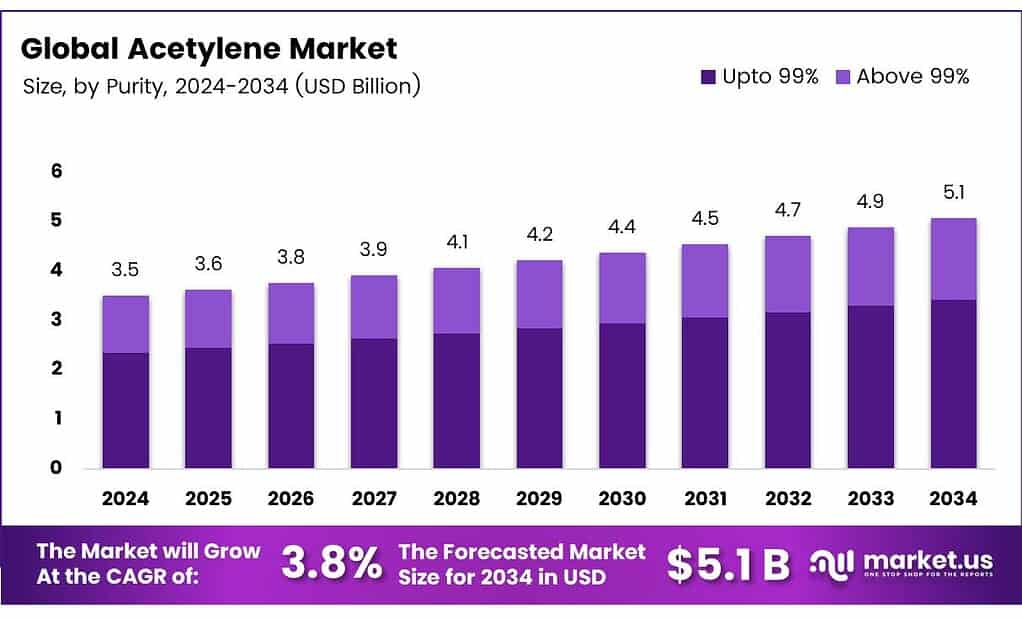
The Global Acetylene Market size is expected to be worth around USD 5.1 billion by 2034, from USD 3.5 billion in 2024, growing at a CAGR of 3.8% during the forecast period from 2025 to 2034.
Acetylene (C₂H₂), represented structurally as HC≡CH, is a colorless gas with a faint garlic-like odor, though often described as odorless in its pure form. It is lighter than air, with a density of 1.1772 kg/m³ at 0°C and 101.3 kPa. The gas has a melting point of −80.8°C and is slightly soluble in water and alcohol but readily soluble in acetone and benzene. Highly flammable, acetylene ignites easily and burns with a sooty flame, with a risk of flashback to the leak source.
Prolonged exposure to fire or intense heat can cause containers to rupture violently and rocket. Chemically, acetylene consists of two carbon atoms connected by a triple bond and two hydrogen atoms, yielding a molar mass of 26.038 g/mol. It adopts a linear molecular geometry with sp hybridization, resulting in a 180° bond angle. The high s-orbital character (50%) in the sp-hybridized carbons weakens the C-H bonds, conferring mild acidity.
This allows the hydrogen atoms to be deprotonated by strong bases, forming acetylide ions (C₂²⁻). As the only widely produced petrochemical featuring a carbon-carbon triple bond, acetylene serves as a versatile intermediate in chemical synthesis. Its reactivity stems from the triple bond, which undergoes diverse addition reactions, and from the replaceable hydrogen atoms that form acetylide salts with strong bases.
Cheaper alternatives have largely supplanted Acetylene. Safer olefin feedstocks, such as ethylene and propylene, are preferred due to the high production costs and hazards associated with handling and transporting them at high pressures. Consumption typically occurs near production sites because of shipping difficulties. Acetylene retains niche but critical roles in producing vinyl chloride monomer, 1,4-butanediol, and carbon black, with some applications experiencing renewed or sustained growth despite its diminished status as a broad-spectrum feedstock.
Key Takeaways
- The Global Acetylene Market is projected to grow from USD 3.5 billion in 2024 to USD 5.1 billion by 2034 at a 3.8% CAGR (2025-2034).
- Up to 99% purity segment dominated by Purity Analysis in 2024, with a 67.3% share due to affordability and performance.
- Dissolved Acetylene (DA) led by Storage Method Analysis in 2024, with a 72.9% share for safety and remote usability.
- Chemical Production held the top position in By Application Analysis in 2024 with 39.4% share for vinyls and polymers.
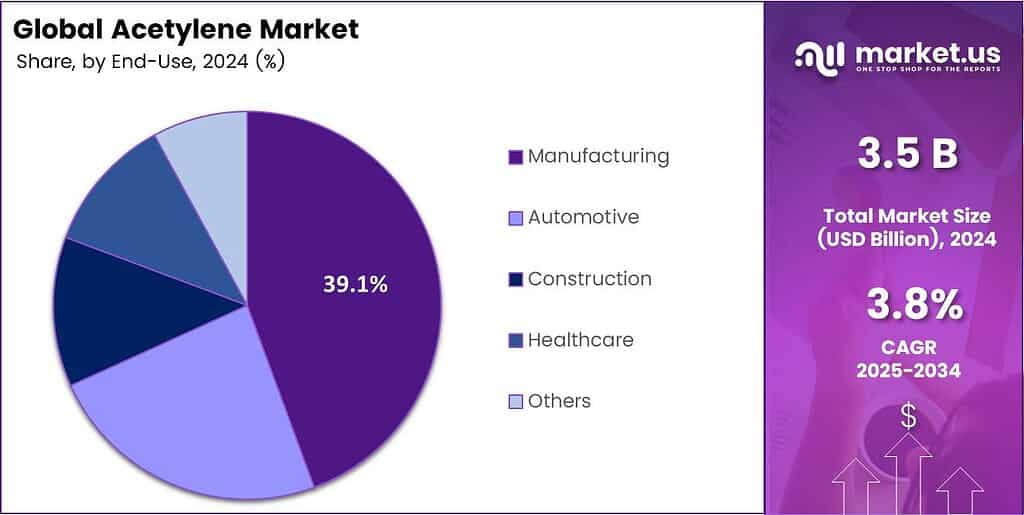
- Manufacturing dominated By End-Use Analysis in 2024, with a 39.1% share for welding and synthesis efficiency.
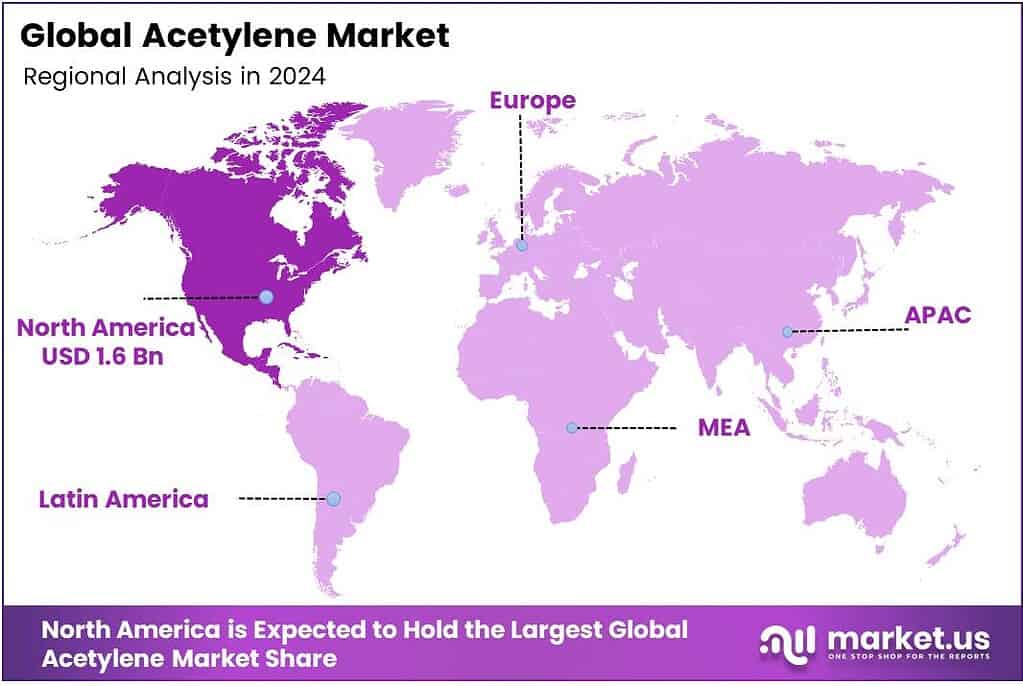
- North America commanded 48.2% of the global market in 2024, valued at USD 1.6 billion, driven by the U.S. industrial infrastructure.
By Purity Analysis
Upto 99% dominates with 67.3% due to its cost-effective production and broad industrial applicability.
In 2024, up to 99% held a dominant market position in the By Purity Analysis segment of the Acetylene Market, with a 67.3% share. This purity level thrives because manufacturers prioritize affordability without sacrificing essential performance.
Industries like welding and chemical synthesis favor it, as it meets standard requirements efficiently. Demand surges from cost-sensitive sectors, ensuring steady growth. Above 99% captures the remaining share, appealing to precision-driven applications.
It excels where ultra-high purity prevents contamination, such as in advanced electronics. Producers invest in refined processes to meet stringent specs, boosting their niche appeal. As technology advances, this segment grows steadily, complementing lower-purity options.
By Storage Method Analysis
Dissolved Acetylene (DA) dominates with 72.9% due to its superior safety and ease of handling in transport.
In 2024, Dissolved Acetylene (DA) held a dominant market position in the By Storage Method Analysis segment of the Acetylene Market, with a 72.9% share. This method dissolves gas in acetone within cylinders, minimizing explosion risks. It supports widespread use in remote sites, driving adoption across industries. Safety regulations further propel its lead.
Compressed Acetylene offers a viable alternative for high-volume storage. It packs gas under pressure for efficient delivery, suiting large-scale operations. However, it demands rigorous safety protocols to avoid hazards. Users value its density, yet it trails due to handling complexities.
Acetylene Generators provide on-site production flexibility. They convert calcium carbide and water into gas instantly, reducing transport needs. Ideal for construction, they cut costs and ensure freshness. This method gains traction in decentralized setups, enhancing overall efficiency.
By Application Analysis
Chemical Production dominates with 39.4% due to acetylene’s role as a key feedstock in synthesis.
In 2024, Chemical Production held a dominant market position in the By Application Analysis segment of the Acetylene Market, with a 39.4% share. Acetylene fuels reactions for vinyls and polymers, powering vast chemical chains. Its triple bond enables versatile additions, spurring innovation. Industries rely on it for scalable output.
Metal Fabrication harnesses acetylene for oxy-fuel welding and cutting. It delivers intense flames for precise joins, vital in heavy machinery. Demand rises with infrastructure booms, as it outperforms alternatives in speed. This application sustains steady volumes.
Pharmaceuticals utilize acetylene in fine chemical intermediates. It aids the synthesis of active ingredients, ensuring purity in drugs. Growth ties to healthcare expansion, where precision matters. This segment evolves with R&D, carving a specialized niche.
By End-Use Analysis
Manufacturing dominates with 39.1% due to acetylene’s integral role in industrial processes.
In 2024, Manufacturing held a dominant market position in the By End-Use Analysis segment of the Acetylene Market, with a 39.1% share. Factories leverage it for welding and synthesis, boosting productivity. Its reliability cuts downtime, fueling broad adoption. Economic recoveries amplify its core status.
Automotive employs acetylene in component fabrication and repairs. It enables strong welds for frames and exhausts, supporting vehicle assembly. With EV shifts, it adapts to lightweight materials. This sector drives consistent demand through innovation.
Construction uses acetylene for on-site cutting and joining steel. It accelerates the building of bridges and buildings, enhancing efficiency. Urbanization trends heighten its utility, as crews value portability. Growth mirrors global development paces.
Key Market Segments
By Purity
- Upto 99%
- Above 99%
By Storage Method
- Dissolved Acetylene (DA)
- Compressed Acetylene
- Acetylene Generators
By Application
- Chemical Production
- Metal Fabrication
- Pharmaceuticals
- Food and Beverage
- Others
By End-Use
- Manufacturing
- Automotive
- Construction
- Healthcare
- Others
Emerging Trends
Feedstock Shift: Acetylene moving from welding to high-value chemical building blocks
Acetylene is increasingly being used not only for traditional oxy-fuel welding but as a chemical feedstock for specialty products. Historically, welding and metal fabrication dominated acetylene use, but newer pathways are gaining traction.
- On the policy side, for instance, in India, the central planning body NITI Aayog launched a vision for the chemical industry: from a current 3.5% share of the global chemical value chain in India to a target of 5-6%. This means that feedstocks like acetylene could gain value if they are embedded into higher-value chemical manufacturing, localised rather than imported.
Acetylene is no longer just a welding gas, but is gradually being repositioned as a versatile chemical feedstock. For stakeholders in acetylene production, supply chain, and downstream chemistry, this trend suggests a shift in end-use mix, from metal-fabrication toward higher‐value chemical applications — driven by industrialisation, cost pressures, and policy imperatives.
Drivers
Infrastructure and Industrial Expansion
Acetylene is the surge in infrastructure development and industrialisation. In countries such as India, government-led initiatives are playing a major role. The National Infrastructure Pipeline (NIP) plans to boost India’s infrastructure spend substantially in the coming years. With this boost, sectors like construction, metal fabrication, and heavy manufacturing.
- In the context of the chemical industry, the NITI Aayog-led report points out that India’s chemical sector has a size of about USD 220 billion, and is expected to grow towards USD 400-450 billion. This growth translates into greater demand for feedstocks, specialty chemicals, gases, and process input, among which acetylene has a place, both in welding/metal fabrication and as a raw material for chemical intermediates.
The underlying driving factor is that as more industrial facilities go up, more welding, cutting, and chemical processing is required, and that pulls up acetylene demand. The synergy between government infrastructure strategy and chemical industry growth creates a favourable backdrop for acetylene’s expanded role.
Restraints
Safety & Handling Risks of Acetylene
One of the major restraints for acetylene lies in its inherent safety and handling risks, which impose significant operational and regulatory burdens. Acetylene is not only highly flammable but also has the potential to decompose explosively under certain conditions.
- The Mine Safety and Health Administration (MSHA) notes that acetylene can undergo a violent, explosive decomposition reaction when exposed to excess pressure, heat, or shock — even in the absence of oxygen. Under typical circumstances, the lower flammability limit (LFL) of acetylene in air is about 2.5% by volume, and the upper flammability limit is extraordinarily high, around 81% by volume.
These characteristics mean that firms handling large volumes of acetylene must invest heavily in special safety systems. For example, in the UK, the Health and Safety Executive (HSE) emphasises that under the Acetylene Safety (England & Wales and Scotland) Regulations, operations with compressed acetylene at 0.62 barg or more will require a licence and must comply with additional controls.
Opportunity
Expansion of India’s Chemical & Manufacturing Ecosystem
One of the strongest growth drivers for the Acetylene market is the rapid expansion of India’s broader chemical and manufacturing base, which serves as a direct upstream opportunity for acetylene usage. India’s chemicals and petrochemicals sector was valued at approximately USD 250 billion in 2024 and is expected to climb toward USD 300 billion.
- The NITI Aayog report titled Powering India’s Participation in Global Value Chains aims for India to secure about a 12% share in global chemical value chains, signalling clear policy support for domestic chemical manufacturing. With this vision, there’s growing investment in upstream feedstock capability, infrastructure for chemical parks, and incentives for heavy-end manufacturing.
The invisible role of a gas like acetylene becomes instrumental. It’s not just a welding cylinder ― it’s part of how car bodies, piping, heavy machines, and chemical plants are built. With India leaning into Make in India and aiming to climb global value chains in chemicals, the demand for acetylene from both traditional uses (welding/cutting) and newer chemical-feedstock uses is set to benefit.
Regional Analysis
North America leads with a 48.2% share and a USD 1.6 Billion market value.
The North American region commands a dominant position in the global acetylene market, accounting for approximately 48.2% of the total regional share, representing an estimated value of USD 1.6 billion. This strong performance is underpinned by the mature industrial infrastructure in the United States,
Key drivers in North America include well-established end-use industries such as metal fabrication, manufacturing, and chemical intermediates, where acetylene is integral for oxy-acetylene cutting, heat treatment, and as a feedstock for chemicals. The region’s advanced logistics and distribution networks facilitate the timely supply of acetylene gas and cylinders to fabrication shops and chemical plants alike.
Canada is emerging as a notable growth market within the region, supported by investments in fabrication and sustainable industrial practices. From a competitive perspective, North America’s dominance reflects not only demand strength but also the presence of major industrial-gas and chemical producers investing in regional supply chains and technological upgrades.
The market in North America faces modest growth rates compared with emerging regions; constraints such as tight feedstock supplies, environmental regulations on industrial gases, and substitution by alternative cutting or chemical processes temper expansion. North America remains a cornerstone of the global acetylene industry.
Key Regions and Countries
- North America
- US
- Canada
- Europe
- Germany
- France
- The UK
- Spain
- Italy
- Rest of Europe
- Asia Pacific
- China
- Japan
- South Korea
- India
- Australia
- Rest of APAC
- Latin America
- Brazil
- Mexico
- Rest of Latin America
- Middle East & Africa
- GCC
- South Africa
- Rest of MEA
Key Players Analysis
Air Liquide holds a dominant position in the acetylene market. Its extensive production infrastructure, vast distribution network, and strong technical expertise serve a diverse range of global customers. The company leverages its scale and innovation capabilities to supply high-purity acetylene for metal fabrication and chemical synthesis. Its strategic focus on sustainability and expanding into emerging markets ensures its continued leadership and influences global acetylene pricing and supply chains.
Air Products is a major force in the acetylene sector. The company distinguishes itself through advanced production technologies and a strong focus on on-site supply solutions for large industrial clients. Its extensive gas processing experience and robust safety record make it a preferred partner in the energy and manufacturing industries. Air Products’ strategic investments in production capacity and supply reliability solidify its critical role in the North American and international markets.
Asia Technical Gas is a significant regional player, specializing in the supply of various industrial gases, including acetylene, within Asia. The company capitalizes on deep local market knowledge and a flexible, customer-centric approach to serve a broad base of small and medium enterprises. Its strength lies in reliable distribution, competitive pricing, and understanding regional industrial demands, making it a key supplier for metalworking and manufacturing sectors across its operational territories.
Top Key Players in the Market
- Air Liquide
- Air Products And Chemicals Inc.
- Asia Technical Gas Co Pte Ltd.
- Axcel Gases
- Butler Gas Products
- Denka Company Limited
- Gruppo SIAD
- Gulf Cryo
- Jinhong Gas Co. Ltd.
- Koatsu Gas Kogyo Co., Ltd.
Recent Developments
- In 2024, Air Liquide, a major player in industrial gases including acetylene production for applications like metal fabrication and chemicals, has focused recent developments on sustainability, low-carbon initiatives, and operational growth.
- In 2024, Asia Technical Gas, a Singapore-based producer and distributor of acetylene and other specialty gases in Asia. The company continues operations in gas supply for electronics and manufacturing, but no press releases, expansions, or sustainability updates were found.
Report Scope
Report Features Description Market Value (2024) USD 3.5 Billion Forecast Revenue (2034) USD 5.1 Billion CAGR (2025-2034) 3.8% Base Year for Estimation 2024 Historic Period 2020-2023 Forecast Period 2025-2034 Report Coverage Revenue Forecast, Market Dynamics, Competitive Landscape, Recent Developments Segments Covered By Purity (Up to 99%, Above 99%), By Storage Method (Dissolved Acetylene (DA), Compressed Acetylene, Acetylene Generators), By Application (Chemical Production, Metal Fabrication, Pharmaceuticals, Food and Beverage, Others), By End-Use (Manufacturing, Automotive, Construction, Healthcare, Others) Regional Analysis North America – US, Canada; Europe – Germany, France, The UK, Spain, Italy, Rest of Europe; Asia Pacific – China, Japan, South Korea, India, Australia, Singapore, Rest of APAC; Latin America – Brazil, Mexico, Rest of Latin America; Middle East & Africa – GCC, South Africa, Rest of MEA Competitive Landscape Air Liquide, Air Products And Chemicals Inc., Asia Technical Gas Co Pte Ltd., Axcel Gases, Butler Gas Products, Denka Company Limited, Gruppo SIAD, Gulf Cryo, Jinhong Gas Co. Ltd., Koatsu Gas Kogyo Co. Ltd. Customization Scope Customization for segments, region/country-level will be provided. Moreover, additional customization can be done based on the requirements. Purchase Options We have three licenses to opt for: Single User License, Multi-User License (Up to 5 Users), Corporate Use License (Unlimited Users and Printable PDF) 
-
-
- Air Liquide
- Air Products And Chemicals Inc.
- Asia Technical Gas Co Pte Ltd.
- Axcel Gases
- Butler Gas Products
- Denka Company Limited
- Gruppo SIAD
- Gulf Cryo
- Jinhong Gas Co. Ltd.
- Koatsu Gas Kogyo Co., Ltd.
Our Clients

- 165275
- November 2025






