Quick Navigation
Report Overview
In 2025, the Natural Language Processing Market was valued at USD 54.2 billion. The market is projected to grow at a CAGR of 33.9% during 2026–2035, reaching approximately USD 1,204.8 billion by 2035. North America dominated the global market in 2025, accounting for more than 30.5% of the total market share and generating approximately USD 16.54 billion in revenue.
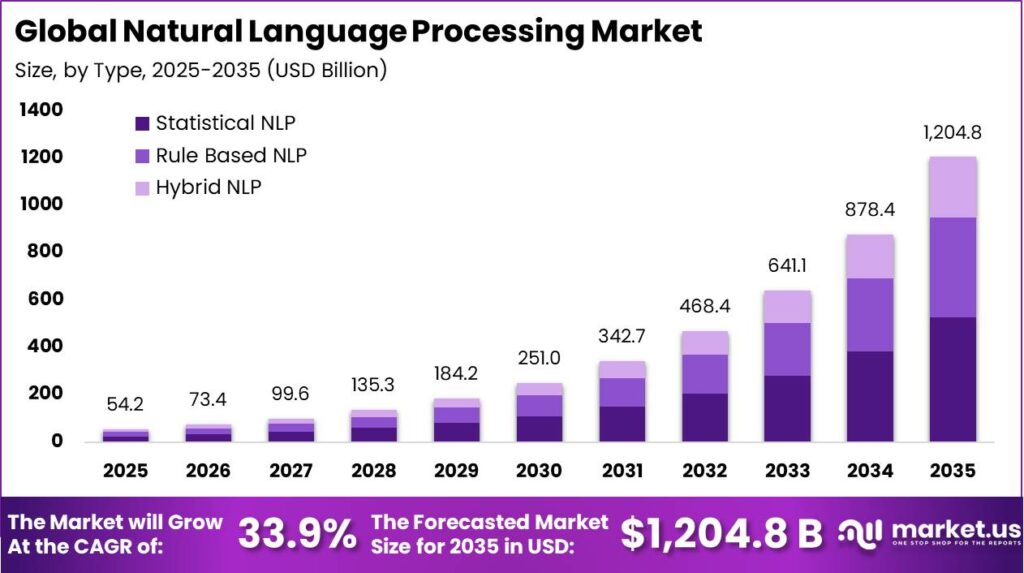
This strong growth is supported by the rapid expansion of digital data and online services. According to the World Bank, global internet users now exceed 5 billion and mobile broadband subscriptions are also in the billions, meaning that trillions of text messages, emails, social media posts, and voice interactions are created every year.
Each of these tasks involves reading or generating human language, so the more data and digital interactions there are, the more NLP tools are needed. When billions of documents and conversations must be processed every year, spending on NLP software and infrastructure can rise from about USD 54 billion in 2025 to over USD 1200 billion by 2035 while still being justified by clear productivity and cost savings.
North America’s leading share is explained by its high level of digitalization and technology investment. The U.S. Bureau of Economic Analysis estimates the U.S. digital economy at over USD 3 trillion in recent years, representing more than 10% of GDP; this includes cloud services, software, and data-driven platforms that embed NLP into everyday operations.
The U.S. Census Bureau shows very high adoption of broadband, cloud computing, and e-commerce among businesses, which multiplies the number of customer contacts handled online into the hundreds of billions per year. In healthcare, the World Health Organization reports billions of patient visits globally; U.S. providers and insurers rely on NLP to extract data from millions of clinical notes and claims records each day.
Key Takeaway
- The global natural language processing market was valued at USD 54.23 billion in 2025.
- The global natural language processing market is projected to grow at a CAGR of 33.90% and is estimated to reach USD 1,204.78 billion by 2035.
- On the basis of type, the statistical NLP segment dominated the market, accounting for 43.74% of the total market share.
- Based on deployment, the cloud segment dominated the market, accounting for 64.0% of the total market share.
- By component, the solutions segment dominated the market, accounting for 72.0% of the total market share.
- On the basis of enterprise size, the large enterprises segment dominated the market, accounting for 72.5% of the total market share.
- Based on technology, the text analytics segment dominated the market, accounting for 22.0% of the total market share.
- By industry, the high tech and telecom segment dominated the market, accounting for 22.1% of the total market share.
- On the basis of application, the automatic summarization segment dominated the market, accounting for 18.0% of the total market share.
- In 2025, North America was the most dominant region in the natural language processing market, accounting for 30.5% of the total market share, equivalent to approximately USD 16.54 billion.
Type
In 2025, Statistical NLP held a dominant market position, capturing more than a 43.74% share. Its lead came from classification, routing, and entity extraction, where buyers wanted measurable accuracy, transparent rules, and predictable computing costs.
Hybrid NLP is emerging as a fast-growing segment in 2025, at a projected 29% CAGR. Buyers joined language models with dictionaries, classifiers, and rules so outputs stayed flexible without losing control. A June 2025 standards pilot evaluated text systems and AI detectors, reflecting the need to test generated language.
Deployment
In 2025, Cloud held a dominant market position, capturing more than a 64% share. Demand reflected the ease of accessing language models, translation, and speech services without building dedicated infrastructure.
During 2025, 52.7% of European enterprises with at least 10 workers used paid cloud computing, giving NLP suppliers a base of cloud-ready customers. Internet use reached 6 billion people worldwide, after adding more than 240 million users, which increased the volume and spread of digital conversations available for support, search, and moderation.
On-premises is emerging as a fast-growing segment in 2025, advancing at a projected CAGR of 22%. It gained attention wherever medical notes, legal files, source code, or customer identifiers could not leave controlled networks. In 2025, 55.03% of large European enterprises used AI, showing how many organizations had reached the scale to justify dedicated security teams.
Component
In 2025, Solutions held a dominant market position, capturing more than a 72% share. Packaged software led as organizations wanted search, extraction, translation, and conversational functions rather than open-ended consulting projects.
Services held a significant share of the market in 2025 and are projected to expand at a 22.1% CAGR. Growth came from the gap between acquiring an NLP tool and making it reliable with documents, terminology, permissions, and workflows. In 2025, about 157,000 European enterprises were surveyed on digital adoption, highlighting varied readiness levels that implementation teams must address.
Enterprise Size
In 2025, Large Enterprises held a dominant market position, capturing more than a 72.5% share. Their lead reflected deep data stores, high service volumes, established budgets, and departments able to reuse one NLP platform.
Small and Medium Enterprises held a meaningful market position in 2025 and represent the fastest-growing size group, with a projected CAGR of 19.5%. Adoption steadily improved as hosted tools, prebuilt connectors, and smaller models reduced the need for specialists or costly equipment. In 2025, 20.0% of European businesses with at least 10 workers used AI, compared with 13.5% in 2024, a 6.5-point annual rise in the reachable customer pool.
Technology
In 2025, Text Analytics held a dominant market position, capturing more than a 22% share. It remained central because emails, reports, chats, reviews, claims, and regulations continued to grow faster than teams could read them manually.
Throughout 2025, 11.8% of European enterprises used AI to analyse written language, making it the most reported enterprise AI activity. Another 34.08% of AI-using firms applied the technology in marketing or sales, where topic detection and feedback analysis support decisions. In March 2025, authorities reported 6.5 million fraud, identity-theft, and related submissions, illustrating the scale of text-heavy records requiring triage.
Industry
In 2025, High Tech and Telecom held a dominant market position, capturing more than a 22.10% share. The industry produced vast volumes of tickets, network logs, documents, chats, and calls, making language automation useful across customer care and technical operations.
In November 2025, global internet users reached 6 billion, about three-quarters of the population, after rising by more than 240 million in 2025. Mobile broadband traffic was estimated at 1.5 zettabytes, while fixed broadband traffic reached 7.3 zettabytes, up from 6.2 zettabytes in 2024. These flows increased demand for automated routing, fault summaries, knowledge search, and agent assistance.
Healthcare is emerging as the fastest-growing industry segment in 2025, with a projected CAGR of 24%. Demand is centered on clinical documentation, coding support, patient messages, literature search, prior authorization, and fact extraction from medical records.
Application
In 2025, Automatic Summarization held a dominant market position, capturing more than an 18% share. Its position reflected employees facing longer meetings, reports, case files, research papers, and support histories than time allowed.
Sentiment Analysis is emerging as a fast-growing application segment in 2025, with a projected CAGR of 25%. Organizations use it to interpret views across surveys, reviews, chats, calls, and complaints without reading every message.
In 2025, 63.57% of European enterprises used social media, creating a large stream of language that could be grouped by topic, tone, and urgency. Marketing and sales represented 34.08% of business uses among enterprises already applying AI, supporting demand for campaign reaction and experience measurement.
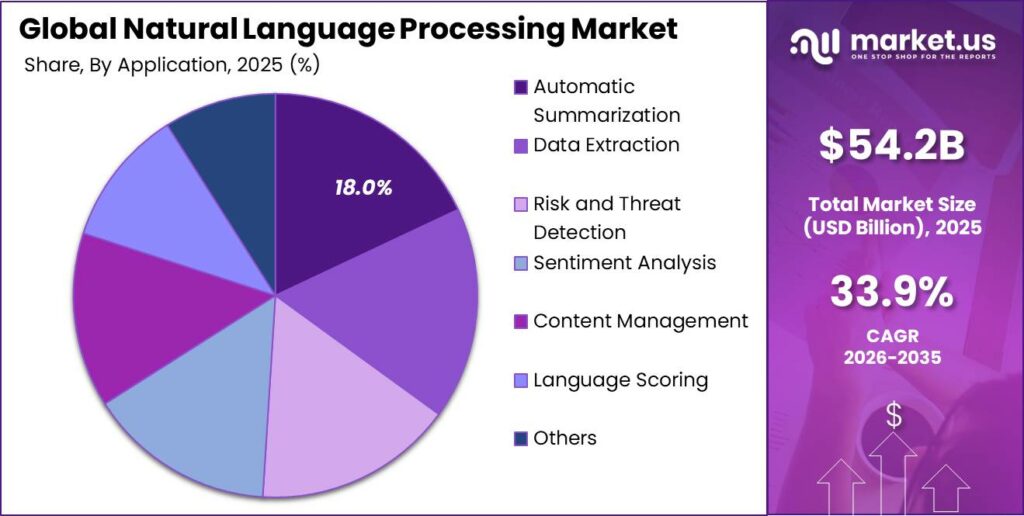
Key Market Segments
By Type
- Statistical NLP
- Rule-Based NLP
- Hybrid NLP
By Deployment
- On-premises
- Cloud
- Hybrid
By Component
- Solutions
- Platform
- Software tools
- Services
- Professional Services
- Consulting
- System integration and implementation
- Support and maintenance
- Managed Services
By Enterprise Size
- Large Enterprises
- Small & Medium Enterprises (SMEs)
By Technology
- Interactive voice response
- Optical character recognition
- Text analytics
- Speech analytics
- Classification and categorization
- Pattern and image recognition
- Others (Coding, Professional services, etc)
By Industry
- Energy utilities
- Government and public sector
- Education
- Transport and logistics
- Retail and ecommerce
- Healthcare
- Manufacturing
- Advertising and media
- Automotive and transportation
- Banking, financial services, and insurance (BFSI)
- High tech and telecom
By Application
- Sentiment Analysis
- Data Extraction
- Risk and Threat Detection
- Automatic Summarization
- Content Management
- Language Scoring
- Others (Advertising, HR and Recruiting, branding, Portfolio Monitoring)
Market Dynamics
Drivers
| Driver | (~) % Impact on CAGR Forecast | Geographic Relevance | Impact Timeline |
|---|---|---|---|
| Enterprise AI adoption surge | +8.0% | North America, Europe, Asia-Pacific | Short term (≤ 2 years) |
| Cloud-native NLP deployment | +6.0% | Global | Short term (≤ 2 years) |
| Consumer-facing conversational AI | +5.0% | Global | Medium term (2–4 years) |
| Language coverage in emerging markets | +4.0% | Asia-Pacific, Latin America, Middle East & Africa | Medium term (2–4 years) |
| Verticalized industry NLP solutions | +3.0% | Global | Medium term (2–4 years) |
| Open-source NLP ecosystem maturation | +2.9% | Global | Long term (≥ 4 years) |
Enterprise AI adoption surge
Between 2024 and 2026, large enterprises in sectors such as financial services, telecom, and healthcare have accelerated AI procurement cycles, with many reporting that more than 40% of new software spend involves embedded NLP capabilities and that AI-related opex is growing at high single-digit percentages of total IT budgets.
This sustained budget reallocation is translating into an incremental uplift of roughly 8.0 percentage points on the NLP market CAGR as enterprises shift from trial projects to production-scale deployments, moving from sub-10-seat pilots to thousands of daily active users per organization and increasing annual license volumes by 3–5x versus pre‑2024 baselines.
Commercially, this changes business models from one-off perpetual licenses and custom integrations toward recurring SaaS contracts with usage-based components, expanding average contract values by 20–30% while keeping gross margins above 70% for leading vendors; the higher renewal rates and multi-year agreements compress customer acquisition payback periods from roughly 24 months to near 12 months, supporting more aggressive go-to-market investment without eroding profitability.
Restraints
| Restraint | (~) % Impact on CAGR Forecast | Geographic Relevance | Impact Timeline |
|---|---|---|---|
| Compute cost inflation for large models | -7.0% | Global | Short term (≤ 2 years) |
| Stringent data privacy compliance | -5.0% | Europe, North America | Short term (≤ 2 years) |
| Enterprise procurement risk aversion | -4.0% | Global | Short term (≤ 2 years) |
| Limited high-quality labeled data | -3.0% | Asia-Pacific, Latin America, Middle East & Africa | Medium term (2–4 years) |
| On-premise integration complexity | -2.5% | Global | Medium term (2–4 years) |
| Regulatory uncertainty around AI liability | -2.4% | North America, Europe | Long term (≥ 4 years) |
Compute cost inflation for large models
Since around 2024, the rapid scaling of parameter counts and context windows in NLP models has driven significant upward pressure on cloud compute costs, with per-token inference costs in production environments often 2–3x higher for state-of-the-art architectures than for pre‑2024 baselines, and GPU instance pricing increasing in some regions by low double-digit percentages year-on-year.
This cost inflation creates an immediate restraint on the NLP market, subtracting an estimated 7.0 percentage points from potential CAGR as smaller vendors face gross margin compression from above 65% toward the 50% range, and as end customers cap usage volumes to stay within AI budget envelopes that are frequently limited to less than 10% of total IT spend.
Strategically, higher unit inference costs delay CapEx-heavy deployments in data-intensive verticals such as customer service and document processing, stretch payback periods by 6–12 months, and force providers to redesign pricing tiers, implement aggressive token-throttling, or invest in model optimization capabilities, all of which slow the conversion of pilots into full-scale rollouts.
Challenges
| Challenge | (~) % CAGR Friction Drag | Geographic Relevance | Mitigation Horizon |
|---|---|---|---|
| Specialized AI talent scarcity | -6.5% | Global | Medium term (2–4 years) |
| Complex enterprise change management | -5.5% | Global | Medium term (2–4 years) |
| Model reliability & governance | -4.5% | North America, Europe | Long term (≥ 4 years) |
| Fragmented language and domain coverage | -3.5% | Asia-Pacific, Middle East & Africa, Latin America | Long term (≥ 4 years) |
| Legacy system interoperability gaps | -3.0% | Global | Medium term (2–4 years) |
| Energy consumption and sustainability pressures | -2.8% | Global | Long term (≥ 4 years) |
Specialized AI talent scarcity
The global shortage of experienced machine learning engineers, applied NLP scientists, and AI product managers represents a structural vulnerability for the NLP market, with estimates suggesting that in 2025–2026 there are tens of thousands of open AI-related roles across major tech and enterprise buyers, while many regions report vacancy rates above 20% for senior AI positions.
This talent gap imposes an approximate friction drag of 6.5 percentage points on potential CAGR by extending model development cycles from 6–9 months to 12–18 months, limiting the number of concurrent NLP products a firm can bring to market, and raising fully loaded compensation costs for senior specialists by 30–50% compared with pre‑2024 levels.
Over the medium term, companies are forced to adjust by centralizing AI centers of excellence, increasing investment in internal training programs, and outsourcing more work to specialized vendors, but these measures add 5–10% to project opex and constrain the scale at which enterprises can safely deploy and maintain complex NLP systems, thereby tempering the market’s maximum achievable growth trajectory without halting ongoing sales.
Market Opportunities
| Opportunity | (~) % Potential CAGR Upside | Geographic Relevance | Execution Window |
|---|---|---|---|
| Domain-specific generative NLP platforms | +7.5% | Global | Medium term (2–4 years) |
| Usage-based and outcome-linked pricing | +5.5% | Global | Short term (≤ 2 years) |
| Expansion into low-resource languages | +5.0% | Asia-Pacific, Africa, Latin America | Long term (≥ 4 years) |
| NLP-driven automation in regulated industries | +4.5% | North America, Europe, Asia-Pacific | Medium term (2–4 years) |
| M&A roll-ups of niche NLP vendors | +3.5% | North America, Europe | Medium term (2–4 years) |
| Embedded NLP in edge and IoT devices | +3.0% | Global | Long term (≥ 4 years) |
Domain-specific generative NLP platforms
This opportunity targets future white space in deeply verticalized generative NLP platforms for legal, clinical, and industrial operations, where many deployments still rely on broadly trained models. Over the next 2–4 years, domain-tuned models, proprietary datasets, and workflow-specific tools could generate an additional 7.5 percentage points of CAGR upside, supported by subscription premiums of 20–40% and productivity gains of 15–30% per task.
Specialized platforms could sustain gross margins above 75% through model reuse across clients, while more efficient architectures and narrower task scopes could reduce inference costs by 20–30%. These improvements would strengthen unit economics and support wider adoption across underserved enterprise workflows.
Geopolitical Impact Analysis
Geopolitical tensions are exerting direct cost and timing pressure on the NLP market’s hardware, energy, and logistics stack, with measurable distortions in manufacturing economics. Following successive rounds of U.S.–China trade measures, average applied tariffs between the two economies rose from roughly 3 percent pre‑2018 to about 19 percent by 2023, with many information and communications technology (ICT) and semiconductor‑related lines facing duties of 10–25 percent, according to WTO monitoring reports.
Export controls on advanced chips to China have forced cloud providers and OEMs to reconfigure supply chains toward alternative assembly locations, increasing tooling and qualification lead times by several months and raising contract manufacturing costs by an estimated 5–8 percent where new facilities are required.
Logistics and energy shocks further compound pricing and distribution risk for NLP hardware and data‑center deployments. UNCTAD data show that average container shipping times on major East–West routes remained roughly 20–25 percent above pre‑pandemic baselines through 2023, with some Asia–Europe lanes experiencing delays of 5–10 extra days due to port congestion and rerouting.
On the energy side, the IEA reports that Brent crude prices rose from around 42 USD/barrel in 2020 to above 80 USD/barrel in 2023, with intrayear volatility exceeding 30 percent, while European natural gas prices spiked more than threefold at the peak of the Russia–Ukraine conflict before easing but remaining structurally elevated.
Regional Analysis
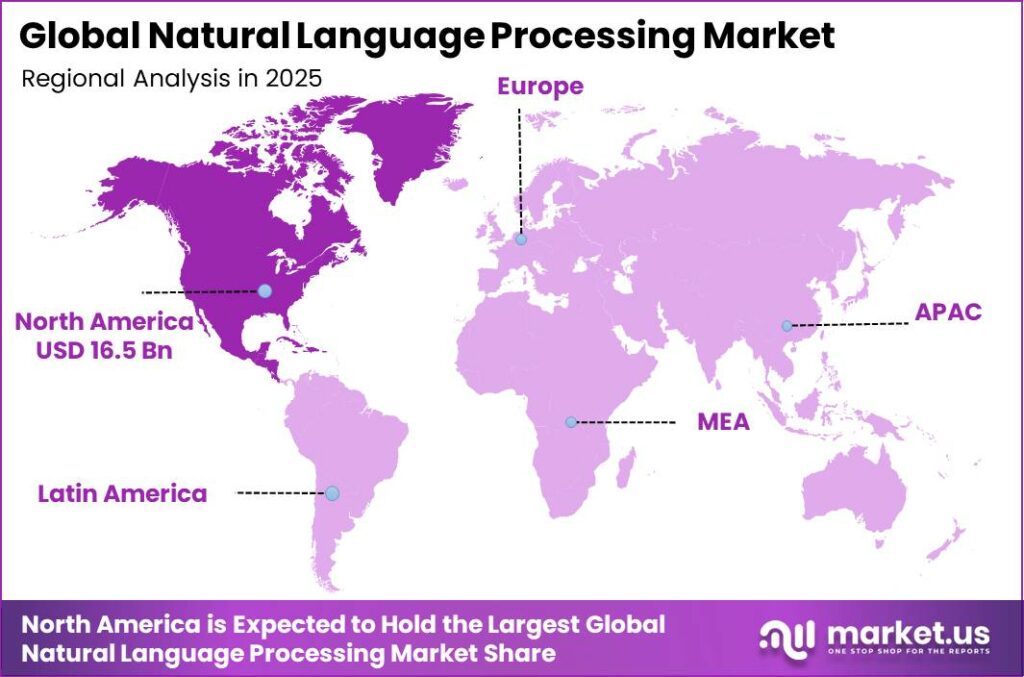
The global Natural Language Processing (NLP) market is characterized by strong regional dynamics, with North America currently holding the leading position. North America commands approximately 30.5% of the global NLP market, corresponding to an estimated market value of around USD 16.5 billion.
This dominance is driven by the presence of major technology companies, high levels of AI and cloud adoption, substantial R&D investments, and early implementation of NLP solutions across sectors such as BFSI, healthcare, retail, and IT & telecom. The region’s mature digital infrastructure and strong ecosystem of startups and established vendors further reinforce its leading role.
Enterprises in Asia Pacific are increasingly adopting NLP to enable local-language AI applications, intelligent customer engagement, and automation in sectors such as e-commerce, fintech, and smart cities. Other regions, including Latin America and the Middle East & Africa, are gradually expanding their NLP adoption, supported by improving connectivity and enterprise modernization initiatives.
Key Regions and Countries
North America
- US
- Canada
Europe
- Germany
- France
- The UK
- Spain
- Italy
- Rest of Europe
Asia Pacific
- China
- Japan
- South Korea
- India
- Australia
- Rest of APAC
Latin America
- Brazil
- Mexico
- Rest of Latin America
Middle East & Africa
- GCC
- South Africa
- Rest of MEA
Key Players Analysis
The NLP market is moderately concentrated around a Tier 1 cluster of hyperscale platforms, including Microsoft, Google (Alphabet), Amazon, OpenAI, and NVIDIA, that together command roughly 60% of enterprise NLP spending, with the remainder fragmented across Tier 2 software vendors and specialized startups.
Microsoft reported total revenue of about USD 211 billion in fiscal 2024, with R&D expenses of roughly USD 27 billion, around 13% of revenue, explicitly highlighting spend on Azure AI, Copilot, and language understanding capabilities embedded in Office and Dynamics. Given Azure’s dominant position, Microsoft is a de facto NLP infrastructure leader with an estimated low-to-mid-teens share of global NLP software and services revenue.
Alphabet generated approximately USD 307 billion in 2024 revenue, with Google Services, including search and ads, still its largest segment and Google Cloud surpassing USD 36 to 40 billion. Aggregate R&D spend was above USD 45 billion, a double-digit share of revenue, with a material portion directed to large language models such as Gemini and domain-specific NLP.
Amazon reported net sales of around USD 575 billion in 2024, with AWS contributing about USD 100 billion and operating income heavily skewed to cloud. AWS’s expanding portfolio of NLP APIs, including Comprehend, Bedrock hosted LLMs, and speech-to-text, positions it with a high single-digit to low teens share of enterprise NLP infrastructure.
Tier 2 challengers in NLP, including IBM, SAS Institute, Salesforce, and a long tail of conversational AI and text analytics vendors, compete in specific verticals such as BFSI, healthcare, and customer engagement, as well as across different deployment models, collectively accounting for an estimated 35 to 40% of market revenue.
IBM, with total revenue near USD 62 to 65 billion, reports annual R&D spend in the USD 6 to 7 billion range, focused on hybrid cloud and AI, including watsonx and NLP for regulatory and contract analytics, giving it a mid-single-digit share of enterprise NLP, especially in regulated industries.
Salesforce, with FY2025 revenue in the low to mid USD 40 billion range and R&D outlays above USD 4 to 5 billion, is actively integrating NLP into Einstein and its Data Cloud. Its 2025 agreement to acquire Doti AI, an agentic AI workplace tools provider, for roughly USD 100 million is a targeted move to deepen generative NLP capabilities in CRM workflows rather than to gain scale.
Top Key Players in the Market
- Microsoft Corporation
- SAS Institute Inc.
- IBM Corporation
- Google LLC
- NVIDIA Corporation
- 3M
- Apple Inc.
- Amazon Web Services, Inc.
- Baidu, Inc.
- Crayon Data
- Health Fidelity
- Inbenta Holdings Inc.
- IQVIA
- Meta Platforms, Inc.
- Oracle Corporation
- SparkCognition, Inc.
- Conversica
- Linguamatics
- Narrative Science
- SAP SE
- Veritone, Inc.
- Intel Corporation
- Hewlett Packard Enterprise Development LP
- Bitext
- Automated Insights
- Gnani.ai
- Niki
- Mihup
- Observe.AI
- Hyro
- Just AI Limited
- RaGaVeRa
- Amazon.com, Inc.
- SoundHound AI, Inc.
- NetBase Quid, Inc.
Recent Developments
- In January 2026, SAP SE and Anthropic finalize a strategic partnership to embed Claude 3’s advanced reasoning and NLP capabilities into SAP’s ERP suite, targeting automated financial reporting and supply chain analysis across a customer base of more than 24,000 SAP S/4HANA cloud customers; the deal is structured as a multi‑year, high eight‑figure subscription and co‑development commitment (estimated above USD 100 million) and is positioned by SAP as a core pillar of its Business AI portfolio expansion for 2026–2028.
- In September 2025, Workday, Inc. acquires AI‑native platform Sana for USD 1.1 billion in cash to integrate NLP‑powered agents into its HR and finance software, adding Sana’s reported 2,000‑plus enterprise customers and over 10 million end users to Workday’s installed base; the transaction, disclosed in Workday’s press materials as representing roughly 2.5 percent of its FY2025 revenue (USD 4.7 billion), accelerates Workday’s roadmap for generative NLP workflows across its cloud suites.
Report Scope
| Report Features | Description |
|---|---|
| Market Value (2025) | USD 54.2 Billion |
| Forecast Revenue (2035) | USD 1204.8 Billion |
| CAGR (2026-2035) | 33.9% |
| Base Year for Estimation | 2025 |
| Historic Period | 2020-2024 |
| Forecast Period | 2026-2035 |
| Report Coverage | Revenue Forecast, Market Dynamics, Competitive Landscape, Recent Developments |
| Segments Covered | By Component (Solutions, Platform, Software Tools, Services, Professional Services, Consulting, System Integration and Implementation, Support and Maintenance, Managed Services), By Enterprise Size (Large Enterprises, Small & Medium Enterprises (SMEs)), By Technology (Interactive Voice Response, Optical Character Recognition, Text Analytics, Speech Analytics, Classification and Categorization, Pattern and Image Recognition, Others), By Industry (Energy Utilities, Government and Public Sector, Education, Transport and Logistics, Retail and Ecommerce, Healthcare, Manufacturing, Advertising and Media, Automotive and Transportation, Banking Financial Services and Insurance (BFSI), High Tech and Telecom), By Application (Sentiment Analysis, Data Extraction, Risk and Threat Detection, Automatic Summarization, Content Management, Language Scoring, Others) |
| Regional Analysis | North America – US, Canada; Europe – Germany, France, The UK, Spain, Italy, Rest of Europe; Asia Pacific – China, Japan, South Korea, India, Australia, Singapore, Rest of APAC; Latin America – Brazil, Mexico, Rest of Latin America; Middle East & Africa – GCC, South Africa, Rest of MEA |
| Competitive Landscape | Microsoft Corporation, SAS Institute Inc., IBM Corporation, Google LLC, NVIDIA Corporation, 3M, Apple Inc., Amazon Web Services, Inc., Baidu, Inc., Crayon Data, Health Fidelity, Inbenta Holdings Inc., IQVIA, Meta Platforms, Inc., Oracle Corporation, SparkCognition, Inc., Conversica, Linguamatics, Narrative Science, SAP SE, Veritone, Inc., Intel Corporation, Hewlett Packard Enterprise Development LP, Bitext, Automated Insights, Gnani.ai, Niki, Mihup, Observe.AI, Hyro, Just AI Limited, RaGaVeRa, Amazon.com, Inc., SoundHound AI, Inc., NetBase Quid, Inc. |
| Customization Scope | Customization for segments, region/country-level will be provided. Moreover, additional customization can be done based on the requirements. |
| Purchase Options | We have three licenses to opt for: Single User License, Multi-User License (Up to 5 Users), Corporate Use License (Unlimited Users and Printable PDF) |