


Report Overview
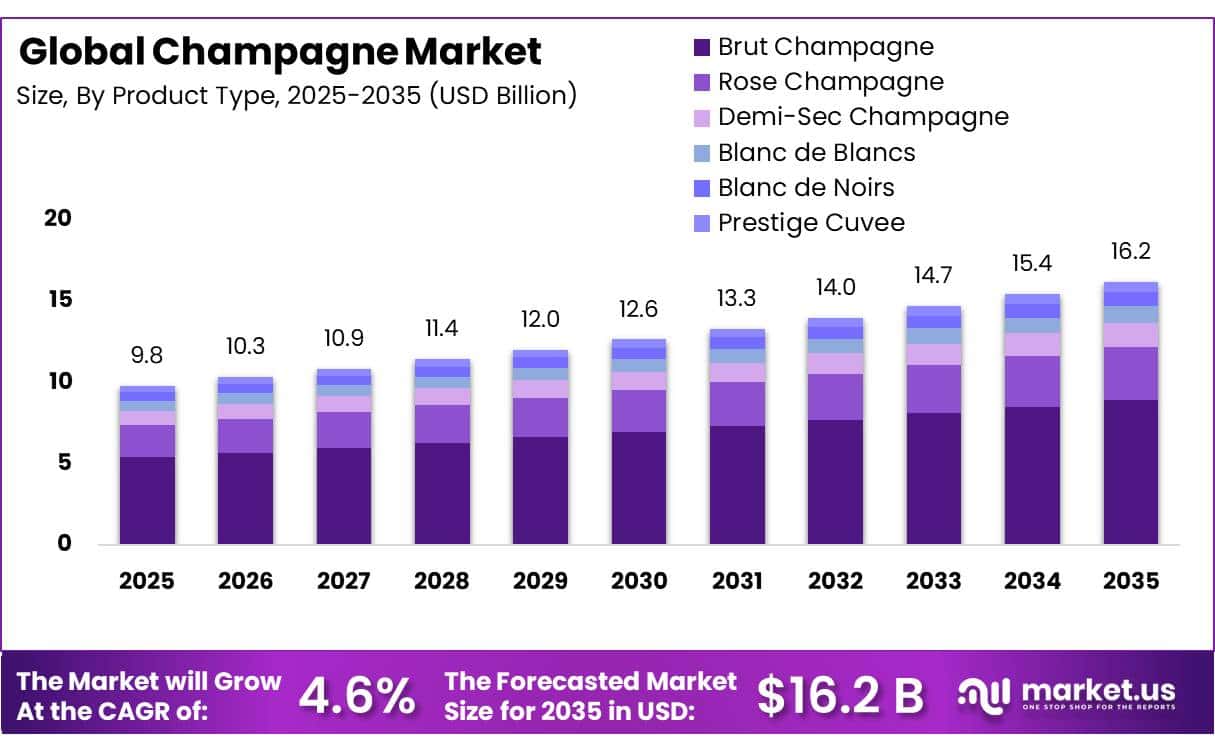
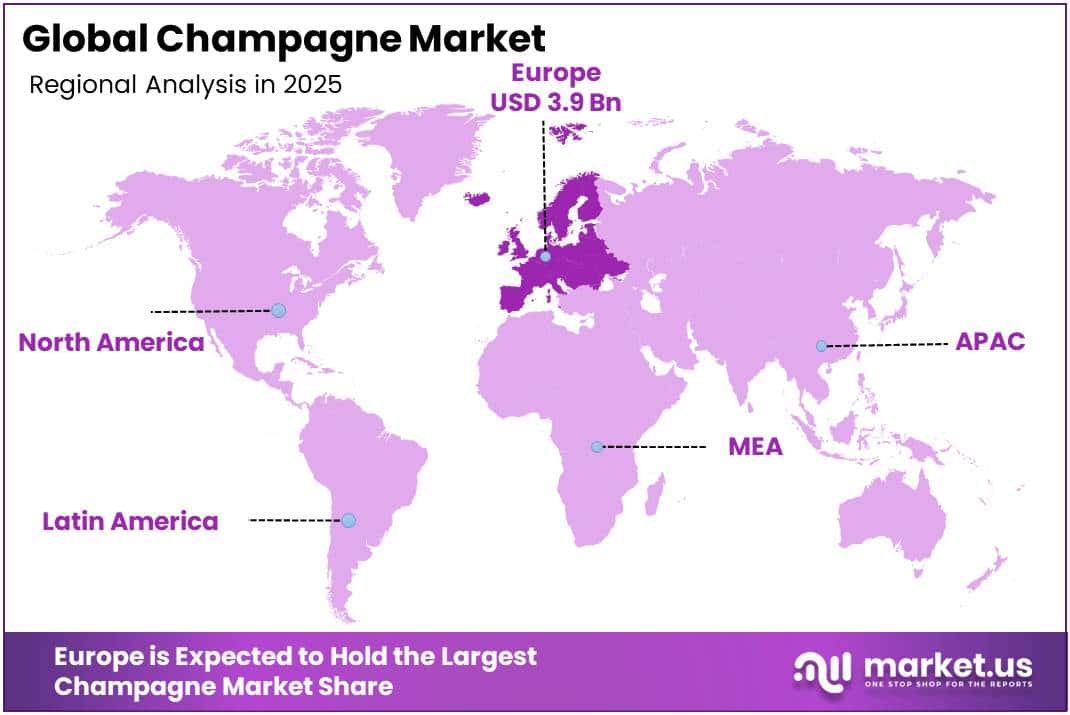
In 2025, the Champagne Market was valued at USD 9.8 billion, and between 2026 and 2035, this market is estimated to register a CAGR of 4.6%, reaching about USD 16.2 billion by 2035. Europe held a dominant market position, capturing more than a 40.2% share, holding USD 3.9 billion in revenue.
The Champagne industry represents one of the most prestigious segments of the global sparkling wine sector, centered in the Champagne region of northeastern France and governed under the Appellation d’Origine Controlee (AOC), a designation formally recognized in 1936.
- Production is regulated from permitted grape varieties to yield limits, ensuring consistent quality across the appellation and reinforcing its standing as a benchmark for premium sparkling wine worldwide, with the production zone covering some 34,300 hectares across 319 villages.
Key Takeaways
- The global champagne market was valued at USD 9.8 billion in 2025.
- The global market is projected to grow at a CAGR of 4.6% and is estimated to reach USD 16.2 billion by 2035.
- On the basis of product type, the Brut Champagne segment dominated the market, constituting 55.2% of the total market share.
- Based on the pricing segment, the Luxury (USD 150-USD 500) segment dominated the market, with a substantial market share of around 62.3%.
- Based on the consumer group, the Male segment dominated the champagne market, accounting for 69.5% of the total market share.
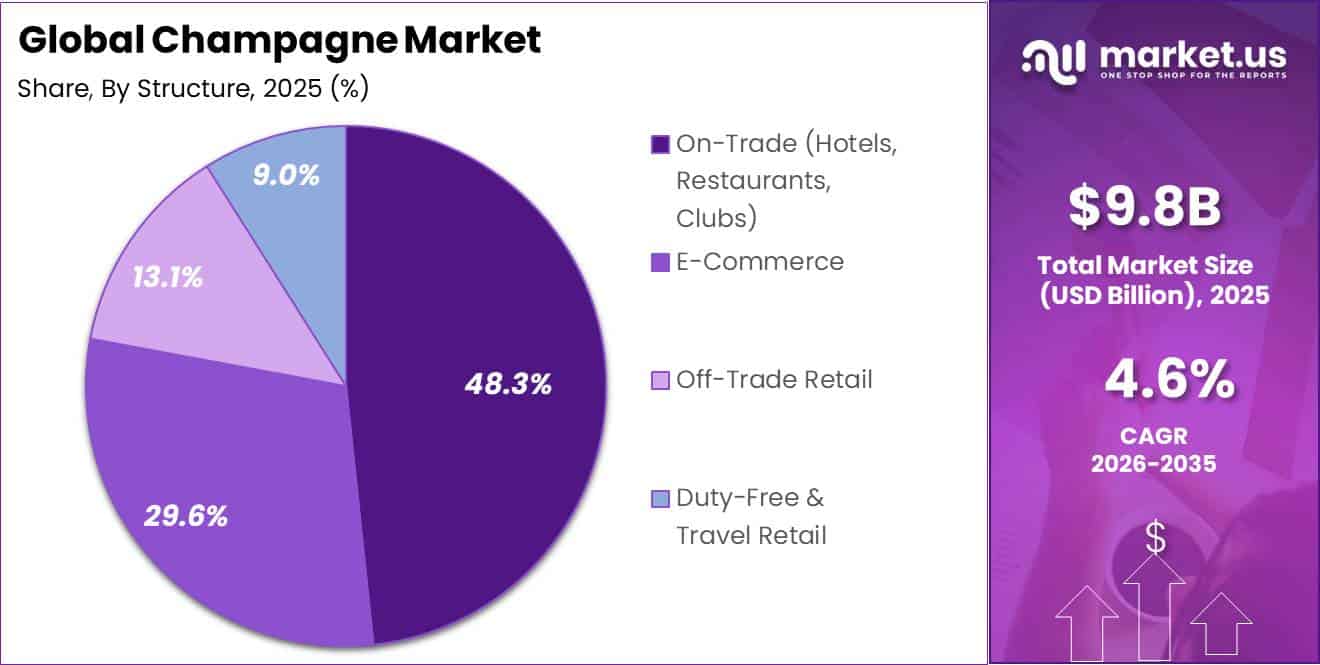
- Based on the distribution structure, the On-Trade (Hotels, Restaurants, Clubs) segment dominated the champagne market, accounting for 48.3% of the total market share.
- In 2025, Europe was the most dominant region in the champagne market, accounting for 40.2% of the global market.
In 2025, global Champagne shipments totaled 266 million bottles, a decline of approximately 2% when compared with 271.4 million bottles recorded in 2024. Of the 2025 total, international markets absorbed nearly 152 million bottles while the French domestic market accounted for around 114 million bottles, underscoring the appellation’s continued reliance on both export demand and home market consumption amid a challenging economic environment.
- The Grandes Marques of Champagne, present in across 200 countries, generate a combined turnover of three billion euros, with exports contributing 60% of that figure, reflecting sustained international appetite despite volume fluctuations. Diversification into new export markets and continued premiumization present ongoing opportunities for producers, as pricing has remained comparatively firm even during periods of softer shipment volumes.
Government and institutional frameworks continue to underpin industry stability. The AOC system, overseen by the Institut National de l’Origine et de la Qualite (INAO) together with the Comite Interprofessionnel du Vin de Champagne (CIVC), protects the Champagne designation and enforces production standards across the region. In parallel, the industry has committed to reducing its carbon footprint per bottle by 20% over fifteen years and targets Net Zero Carbon by 2050, reflecting the sector’s alignment with broader national and European environmental and sustainability initiatives.
By Product Type
Brut Champagne dominates with 55.2% share due to its broad consumer preference and consistent demand.
In 2025, Brut Champagne held a dominant market position, capturing more than a 55.2% share of the global champagne market. Its leading position was supported by strong consumer preference for dry sparkling wines across both everyday celebrations and premium occasions. Brut Champagne continued to be the preferred choice in restaurants, hotels, social gatherings, and festive events because of its balanced taste and versatility with different cuisines.
Rose Champagne is expected to register the fastest growth during the forecast period. Rising consumer interest in premium beverages, changing preferences toward visually distinctive sparkling wines, and increasing demand for celebration-focused products are supporting its growth. In 2025 and continuing into 2026, wine trade associations reported growing interest in rosé sparkling wines, particularly among younger consumers and in hospitality channels.
By Pricing Segment
Luxury (USD150-USD500) dominates with 62.3% share as buyers continue to favor premium champagne for celebrations.
In 2025, Luxury (USD150-USD500) held a dominant market position, capturing more than a 62.3% share of the global champagne market. This price segment remained the preferred choice for consumers looking for premium quality while staying within a price range commonly associated with luxury gifting, fine dining, and special occasions. Demand was supported by established champagne houses offering a wide selection of products in this category through hotels, restaurants, specialty retailers, and travel retail outlets.
The Ultra-Luxury (USD500+) segment is expected to witness the fastest growth during the forecast period. Increasing demand for rare and exclusive champagne, rising interest in collectible bottles, and higher spending on luxury experiences are contributing to its expansion. In 2025 and continuing into 2026, official trade associations reported growing global interest in prestige champagne labels, supported by luxury gifting, high-end hospitality, and limited-edition releases.
By Consumer Group
Male consumers dominate with 69.5% share driven by strong participation in premium champagne purchases.
In 2025, Male held a dominant market position, capturing more than a 69.5% share of the global champagne market. The segment maintained its leadership as male consumers continued to account for a significant portion of premium beverage purchases across hospitality venues, business events, celebrations, and luxury gifting. Consumption patterns observed by official wine trade organizations during 2025 reflected steady demand for premium champagne among male buyers, particularly through restaurants, hotels, and specialty retail channels.
The Female segment is expected to register the fastest growth during the forecast period. Rising interest in premium sparkling wines, increasing participation of women in social and fine dining occasions, and growing purchasing power are supporting this trend. During 2025 and into 2026, official wine and beverage industry associations noted expanding consumer engagement among women, supported by changing lifestyle preferences and broader product offerings across retail and hospitality channels.
By Structure
On-Trade (Hotels, Restaurants, Clubs) dominates with 48.3% share as champagne remains a preferred choice for dining and celebrations.
In 2025, On-Trade (Hotels, Restaurants, Clubs) held a dominant market position, capturing more than a 48.3% share of the global champagne market. The segment remained the leading sales channel as consumers continued to prefer enjoying champagne during celebrations, fine dining, weddings, corporate events, and other social occasions. Hotels, restaurants, and clubs offered premium champagne selections that supported higher consumption in hospitality settings.
The E-Commerce segment is expected to witness the fastest growth during the forecast period. Greater consumer preference for online shopping, wider availability of premium champagne through licensed digital platforms, and improved home delivery services are supporting this growth. In 2025 and continuing into 2026, official government agencies and wine industry associations reported continued expansion in online alcohol retailing in markets where regulations permit digital sales.
Key Market Segments
By Product Type
- Brut Champagne
- Rose Champagne
- Demi-Sec Champagne
- Blanc de Blancs
- Blanc de Noirs
- Prestige Cuvee
By Pricing Segment
- Premium (USD50-USD150)
- Luxury (USD150-USD500)
- Ultra-Luxury (USD500+)
By Consumer Group
- Male
- Female
By Structure
- On-Trade (Hotels, Restaurants, Clubs)
- Off-Trade Retail
- E-Commerce
- Duty-Free & Travel Retail
Driver Analysis
Luxury premiumisation and prestige cuvées
Champagne’s most material growth lever in 2026 is value capture rather than volume recovery: worldwide shipments were 266 million bottles in 2025, down 2% year on year, following 271 million bottles in 2024 and a post-pandemic high of 326 million in 2022. This resets producer economics around mix management higher-margin vintage, rosé, single-vineyard, prestige and limited-allocation cuvées rather than attempting to restore mass-market shipment volumes through discounting.
The United States remained the largest export destination at 26.4 million bottles in 2025, while exports overall approached 152 million bottles; that export exposure gives maisons a large addressable base for price architecture, collector releases, luxury gifting and on-trade visibility. The commercial implication is a migration from high-throughput distributor sell-in toward controlled allocations, tiered release calendars and customer-data-led replenishment: even modest annual realised-price improvement can offset a low-single-digit volume decline, provided brands protect scarcity, avoid broad promotional leakage, and maintain availability for entry-level non-vintage SKUs.
Drivers Impact Analysis
| Driver | (~) % Impact on CAGR | Geographic Relevance | Impact Timeline |
|---|---|---|---|
| Luxury premiumisation and prestige cuvées | +1.3 pp | North America, Japan, Gulf, China tier-1 | Medium term (2–4 years) |
| Travel retail, hospitality and wine tourism | +0.8 pp | France/EU core, US, Japan, GCC | Short term (≤ 2 years) |
| Digital luxury retail and DTC allocation | +0.7 pp | US, UK, EU, APAC metros | Short term (≤ 2 years) |
| Emerging-market celebration occasions | +0.9 pp | India, SE Asia, GCC, LatAm | Medium term (2–4 years) |
| Climate adaptation and controlled supply | +0.5 pp | Champagne region; global spill-over | Long term (≥ 4 years) |
| Transparency, sustainability and lighter formats | +0.4 pp | EU core, UK, North America | Medium term (2–4 years) |
Restraint Analysis
Tariff and export-policy uncertainty
Export-policy uncertainty is particularly damaging because approximately 57% of 2025 Champagne shipments were exported nearly 152 million of 266 million bottles making cross-border pricing, customs clearance and importer inventory timing central to category growth. The US, Champagne’s leading export market, received 26.4 million bottles in 2025, so any tariff threat, currency movement or change in EU–US agricultural-trade terms can alter landed costs across a meaningful share of high-value exports.
Wine-sector reporting cited a 15% US tariff on EU wine and spirits from August 2025, while other reporting during 2025 described unresolved exemption negotiations for agricultural products; regardless of final duty treatment by product and period, policy volatility alone encourages importers to either front-load purchases before a deadline or freeze orders until landed-cost clarity returns.
Restraint Impact Analysis
| Restraint | (~) % Impact on CAGR | Geographic Relevance | Impact Timeline |
|---|---|---|---|
| Luxury-demand volatility | -1.4 pp | France, North America, EU | Short term (≤ 2 years) |
| Climate-constrained grape supply | -1.2 pp | Champagne region; global exports | Long term (≥ 4 years) |
| Price escalation and trade-down | -1.0 pp | UK, EU, North America, APAC | Medium term (2–4 years) |
| Tariff and export-policy uncertainty | -0.8 pp | US, China, UK, EU corridors | Short term (≤ 2 years) |
| Packaging, labour and finance costs | -0.7 pp | France/EU production base | Medium term (2–4 years) |
| Label compliance and channel friction | -0.4 pp | EU core, UK, North America | Short term (≤ 2 years) |
Opportunity Analysis
Grower-Champagne consolidation roll-ups
A structured roll-up of high-quality grower estates, shared disgorgement/packaging assets and export sales platforms is a long-horizon opportunity because Champagne’s supply base remains highly fragmented: more than 16,000 growers tend nearly 280,000 plots, the average parcel is approximately 0.12 hectare, more than 10,000 growers sell grapes to houses, and around 4,700 growers market their own Champagne directly or through cooperatives.
A buyer consortium, cooperative or maison could aggregate a portfolio of 10–30 growers while retaining estate identity, centralising dry-goods purchasing, digital labelling, logistics, cellar capacity and international sales; a plausible operating target is 5–10% lower non-grape overhead per bottle plus a 10–25% net-price uplift for traceable single-village or single-parcel releases versus undifferentiated bulk-labelled offerings. This does not expand appellation acreage or undermine the protected origin; it expands the monetisable share of finite vineyard supply by converting fragmented production into branded, data-enabled and export-ready inventory.
Opportunity Impact Analysis
| Opportunity | (~) % Potential CAGR | Geographic Relevance | Execution Window |
|---|---|---|---|
| Allocation-led collector memberships | +1.1 pp | US, Japan, UK, EU | Short term (≤ 2 years) |
| Luxury hospitality revenue platforms | +0.9 pp | France, GCC, US, Japan | Medium term (2–4 years) |
| India and ASEAN occasion ecosystems | +1.0 pp | India, Singapore, Thailand, Vietnam | Medium term (2–4 years) |
| Corporate gifting and B2B subscriptions | +0.7 pp | North America, EU, GCC, APAC metros | Short term (≤ 2 years) |
| Grower-Champagne consolidation roll-ups | +0.8 pp | Champagne region; export markets | Long term (≥ 4 years) |
| Digital provenance and resale services | +0.5 pp | EU, UK, US, Japan | Medium term (2–4 years) |
Challenges Analysis
Vintage variability management
Vintage variability is a continuous quality-and-planning challenge rather than a current sales restraint because Champagne houses can use blending, reserve wines and multi-year inventories to maintain shipments, yet each irregular season raises the operational cost of delivering a consistent house style.
The available harvest yield was set at 10,000 kg/hectare in 2024, 9,000 kg/hectare in 2025 and 8,800 kg/hectare in 2026, a 12% decline from the 2024 level and roughly 27% below the 12,000 kg/hectare level used in 2022; the 2026 ceiling corresponds to an estimated 250 million bottles, below the 266 million bottles shipped worldwide in 2025.
Earlier harvest timing, uneven ripening, frost, hail, rainfall and mildew risk increase sampling intensity, selective picking, press scheduling and reserve-wine drawdown, while also creating greater dispersion in acidity, alcohol potential and blending requirements. The corporate response requires parcel-level climate data, diversified grower contracts, shared disease-monitoring protocols, reserve-wine optimisation and scenario-based inventory policies, but these measures consume cash and cellar capacity over several vintages rather than generating a near-term volume solution.
Challenges Impact Analysis
| Challenge | (~) % CAGR Friction | Geographic Relevance | Mitigation Horizon |
|---|---|---|---|
| Vintage variability management | -0.9 pp | Champagne region; global exports | Long term (≥ 4 years) |
| Fragmented grower coordination | -0.7 pp | France production base | Long term (≥ 4 years) |
| Cellar workforce renewal | -0.5 pp | France, EU hospitality hubs | Medium term (2–4 years) |
| Export inventory synchronisation | -0.6 pp | US, UK, Japan, APAC corridors | Medium term (2–4 years) |
| Premium-channel data gaps | -0.5 pp | North America, EU, APAC metros | Medium term (2–4 years) |
| Circular packaging transition | -0.4 pp | EU core, UK, North America | Long term (≥ 4 years) |
Geopolitical Impact Analysis
Geopolitical Tensions and Trade Disruptions Reshape the Global Champagne Market.
The ongoing geopolitical conflicts, including the Russia-Ukraine war and rising trade tensions in several regions, have created new challenges for the global champagne market in 2025. Champagne producers have faced higher transportation and logistics costs as shipping routes remain under pressure and fuel prices fluctuate. These conditions have increased the overall cost of moving premium beverages across international markets, affecting exporters and distributors.
Trade restrictions and economic uncertainty have also influenced consumer spending in some countries. As inflation continues to affect household budgets, some buyers have become more selective when purchasing luxury products, including champagne. At the same time, demand from established markets has remained stable because champagne is closely linked with celebrations, hospitality, and premium gifting.
European producers have also paid closer attention to supply chain security by improving inventory planning and strengthening relationships with distribution partners. Hospitality businesses have adjusted procurement strategies to manage changing import costs while maintaining product availability.
Regional Analysis
Champagne Market: Regional Analysis Europe.
Europe dominates the global Champagne market, accounting for a 40.2% share and reaching a value of USD 3.9 billion. France remains the cornerstone of this leadership as the world’s largest single Champagne market, consuming around 114 million bottles in 2025, a volume that surpasses any other individual market globally.
- According to the Comité Champagne, the official interprofessional trade association for the appellation, global Champagne shipments totaled 266 million bottles in 2025, with approximately 152 million bottles exported outside France. Within Europe, the Comité Champagne’s Corporate Social Responsibility Impact Report states that European Union countries received around 57 million bottles, highlighting the region’s continued importance alongside France in overall Champagne consumption.
Europe’s market strength is further reinforced by the Champagne appellation’s protected Appellation d’Origine Contrôlée (AOC) status, established in 1936 and administered by French authorities in collaboration with the Institut National de l’Origine et de la Qualité (INAO). This regulatory framework safeguards authenticity, strengthens consumer confidence, and supports premium pricing across European markets. Beyond France, established markets such as the United Kingdom continue to rank among Champagne’s key export destinations, reflecting long-standing trade relationships and strong consumer demand.
Key Regions and Countries Covered
- North America
- The US
- Canada
- Europe
- Germany
- France
- The UK
- Spain
- Italy
- Russia & CIS
- Rest of Europe
- APAC
- China
- Japan
- South Korea
- India
- ASEAN
- Rest of APAC
- Latin America
- Brazil
- Mexico
- Rest of Latin America
- Middle East & Africa
- GCC
- South Africa
- Rest of MEA
Key Players Analysis
Champagne producers focus on protecting their appellation status, refining blending expertise, and steadily strengthening grower relationships to stay competitive in a market where scarcity and prestige matter as much as taste. A major ongoing priority is long-term vineyard sourcing, with Houses signing multi-year contracts with growers to lock in grape supply and shield against price swings tied to weather and harvest yields.
Beyond production, Champagne Houses lean on brand heritage and controlled distribution to protect pricing power, often limiting volume growth in favour of maintaining exclusivity across export markets. Diversification into new international markets, alongside continued strength in traditional strongholds, helps producers balance demand even when shipments soften in any single region. Many Houses also partner with luxury groups or maintain strong family ownership structures, giving them the financial backing to invest in packaging, marketing, and long-term brand positioning.
Market Key Players
- LVMH Moët Hennessy Louis Vuitton
- Pernod Ricard SA
- Vranken-Pommery Monopole
- Laurent-Perrier Group
- Lanson-BCC Group
- Diageo plc
- Rémy Cointreau SA
- Taittinger CCVC
- Bollinger SA
- Piper-Heidsieck (CVRG)
- Nicolas Feuillatte (Coopp)
- Deutz & Geldermann SA
- Champagne AYALA
- André Champagne Cellars
- Cook’s Champagne Cellars
Key Development
- January 2026: LVMH Moët Hennessy Louis Vuitton released its 2025 Full Year Results, reporting that its Champagne houses maintained a market share of 22% of all Champagne appellation shipments during the year, alongside good resilience in Champagne despite weaker demand for cognac across the Wines and Spirits division.
- January 2026: Lanson-BCC Group announced the finalization of its acquisition of 100% of the share capital of Heidsieck and Company Monopole for a total transaction value of 50 million euros, with operational integration effective from January 1, 2026, and the brand to be developed within Maison Burtin.
- March 2026: Maison Pommery and Associés, the renamed Vranken-Pommery Monopole group, reported its 2025 annual results, posting consolidated revenue of 2 million euros and recording bottled Champagne volume growth of 3.6% even as overall industry shipment volumes declined by 2.2%.
- May 2026: Laurent-Perrier Group reported its results for the 2025-2026 financial year, with annual operating profit reaching 76.1 million euros, up from 4 million euros the previous year, despite a global Champagne market volume decline of 1.6% over the same period.
Report Scope
| Report Features | Description |
|---|---|
| Market Value (2025) | USD 9.8 Bn |
| Forecast Revenue (2035) | USD 16.2 Bn |
| CAGR (2026 2035) | 4.6% |
| Base Year for Estimation | 2025 |
| Historic Period | 2020-2024 |
| Forecast Period | 2026-2035 |
| Report Coverage | Revenue Forecast, Market Dynamics, Competitive Landscape, Recent Developments |
| Segments Covered | Product Type (Brut Champagne, Rosé Champagne, Demi-Sec Champagne, Blanc de Blancs, Blanc de Noirs, Prestige Cuvée), By Pricing Segment (Premium (USD 50-USD 150), Luxury (USD 150-USD 500), Ultra-Luxury (USD 500+)), By Consumer Group (Male, Female), By Distribution Channel (On-Trade (Hotels, Restaurants, Clubs), Off-Trade Retail, E-Commerce, Duty-Free & Travel Retail) |
| Regional Analysis | North America The US & Canada; Europe Germany, France, The UK, Spain, Italy, Russia & CIS, Rest of Europe; APAC China, Japan, South Korea, India, ASEAN & Rest of APAC; Latin America Brazil, Mexico & Rest of Latin America; Middle East & Africa GCC, South Africa, & Rest of MEA |
| Competitive Landscape | LVMH Moët Hennessy Louis Vuitton, Pernod Ricard SA, Vranken-Pommery Monopole, Laurent-Perrier Group, Lanson-BCC Group, Diageo plc, Rémy Cointreau SA, Taittinger CCVC, Bollinger SA, Piper-Heidsieck (CVRG), Nicolas Feuillatte (Coopp), Deutz & Geldermann SA, Champagne AYALA, André Champagne Cellars, and Cook’s Champagne Cellars. |
| Customization Scope | Customization for segments, region/country level will be provided. Moreover, additional customization can be done based on the requirements. |
| Purchase Options | We have three licenses to opt for: Single User License, Multi User License (Up to 5 Users), Corporate Use License (Unlimited Users and Printable PDF) |





































