


Quick Navigation
Report Overview
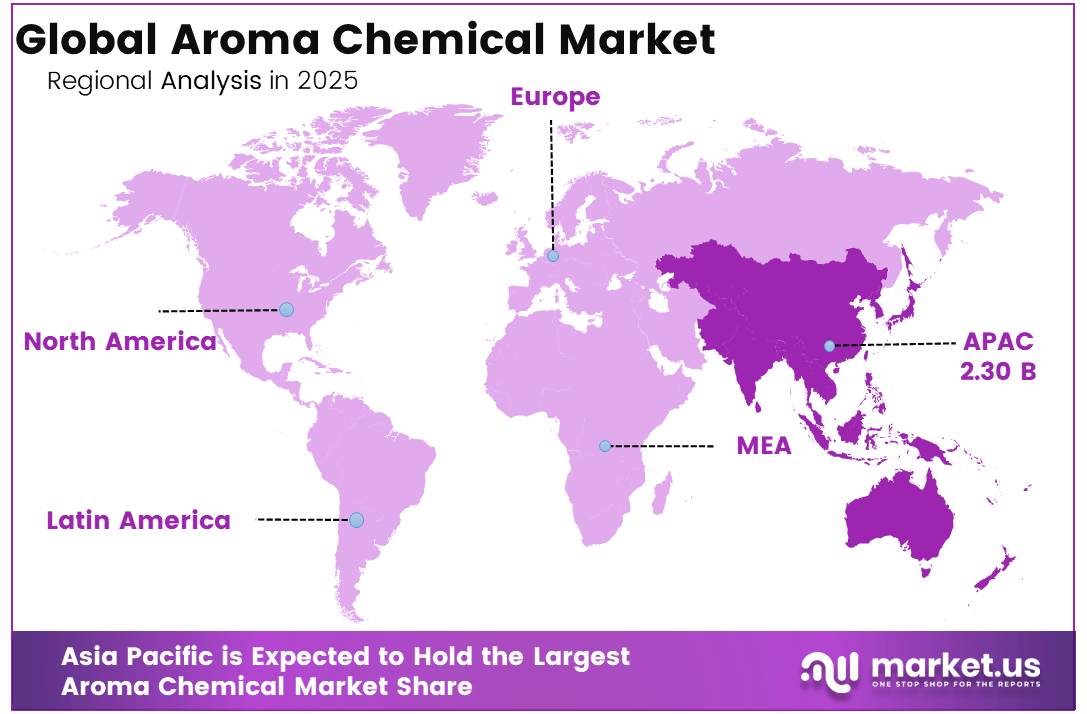
In 2025, the global Aroma Chemical Market was valued at USD 6.5 billion, and between 2026 and 2035, this market is estimated to register a CAGR of 5.6%, reaching about USD 11.3 billion by 2035. In 2025, Asia Pacific leads the market, achieving over 35.4% share with revenue of USD 2.30 Billion.
The global aroma chemicals market is expanding gradually as global demand for perfumes, tastes, personal care, and household products rises. Aroma compounds are commonly employed to improve aroma and flavor attributes in perfumes, cosmetics, soaps, detergents, food and beverage products, and pharmaceuticals. Rising consumer expenditure on luxury personal care products, combined with increased urbanization, are driving market expansion.
- In April 2025, according to the USDA Foreign Agricultural Service, worldwide essential oils trade reached $43.0 billion in 2024, marking a 25% increase compared to 2023. The same source noted that the United States, functioning as both the leading exporter and importer of essential oils, shipped a record $2.5 billion in 2024, with exports rising 21% since 2019.

Key Takeaways
- The global aroma chemical market was valued at USD 6.5 billion in 2025.
- The global market is projected to grow at a CAGR of 5.6% and is estimated to reach USD 11.3 billion by 2035.
- On the basis of chemical type, Terpenes and Terpenoids dominated the market, constituting 40.3% of the total market share.
- Based on the source, Synthetic Aroma Chemicals dominated the global aroma chemicals market, holding 64.9% of the market share.
- Based on the application, Soaps and Detergents led the market, accounting for 30.1% of the total market share.
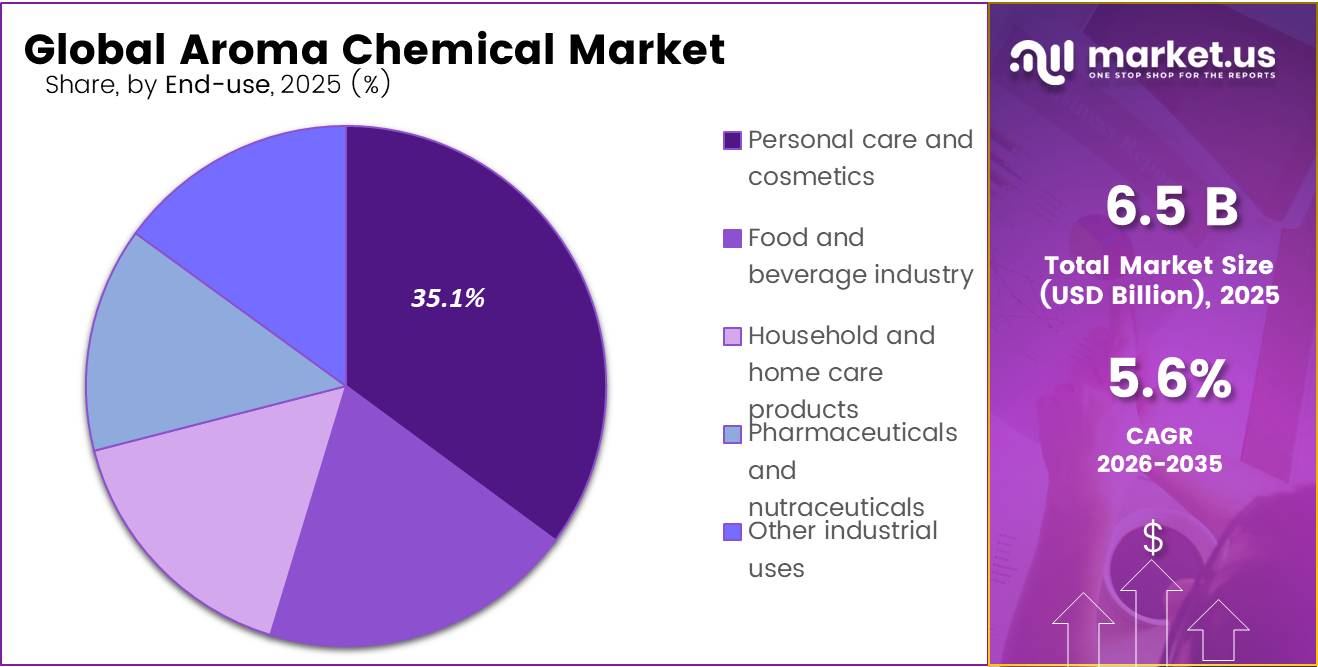
- Among the end use segment, Personal Care and Cosmetics held a dominant position in the aroma chemicals market, comprising 35.1% of the market share.
- In 2025, Asia Pacific was the most dominant region in the global aroma chemicals market, accounting for 35.4% of the total global aroma chemical market share.
Driving factors include expanding downstream demand from personal care, food, and household industries, supported by broader chemical sector momentum. In September 2025, according to Eurostat, EU exports of chemicals and related products, a category encompassing essential oils and perfume materials, reached €560 billion in 2024, a 7% rise from 2023. Future growth opportunities lie in sustainable sourcing, regulatory-compliant formulations, and diversified export channels across established manufacturing regions.
Aroma Chemical Market Segments
Chemical Analysis
Terpenes and terpenoids dominated the market
Terpenes and terpenoids lead the aroma chemicals landscape, holding a 40.3% market share, given their extensive use as base materials in citrus, floral, and woody scent profiles across fragrances, personal care, and food applications. In April 2025, according to the USDA Foreign Agricultural Service, the United States imported $5.6 billion worth of essential oils in 2024, largely terpene-rich citrus and botanical extracts sourced from the European Union. This import volume reflects the segment’s foundational role in global fragrance and flavor manufacturing, supported by abundant natural feedstock and established extraction infrastructure.
Musk chemicals represent the fastest-growing category, driven by expanding use in fine fragrances, fabric care, and personal care formulations. In January 2024, according to the U.S. Environmental Protection Agency, its New Chemicals Program convened a technical expert meeting to advance risk assessment methods for fragrance materials under the Toxic Substances Control Act, reflecting heightened regulatory engagement with this compound class.
Source Analysis
Synthetic is a significant source
Synthetic aroma chemicals dominate the sourcing landscape, holding a 64.9% market share, owing to their cost efficiency, consistent scent profiles, and scalability across fragrance, cosmetics, and household manufacturing. In 2024, according to Eurostat, the European Union’s total sold production of chemicals and related products, the broader industrial base supporting synthetic aroma chemical output, rose to €830 billion, up from €790 billion in 2023. This expanding production base underscores the segment’s deep integration into established manufacturing infrastructure worldwide.
Natural aroma chemicals represent the fastest-growing sourcing category, driven by rising consumer preference for plant-derived, clean-label formulations. In November 2025, according to the European Commission’s Scientific Committee on Consumer Safety, tea tree oil, a widely used natural aromatic ingredient, was confirmed safe for cosmetic use at concentrations up to 2.0% in shampoo formulations
Application Analysis
Soaps and detergents Held a Major Share of the market
Soaps and detergents lead application demand for aroma chemicals, holding a 30.1% market share, owing to their essential daily-use nature across households and institutional cleaning settings worldwide. Fragrance plays a functional as well as sensory role in this category, masking the raw odor of surfactants and cleaning agents while reinforcing perceptions of cleanliness and freshness that influence repeat purchase behavior. The scale and consistency of demand from this segment, spanning laundry care, dishwashing, and hard-surface cleaning, keeps it firmly ahead of every other application area, supported by manufacturers’ growing shift toward safer, skin-friendly, and environmentally conscious formulations.
Fine fragrances and perfumes represent the fastest-growing application, driven by rising consumer appetite for premium, personalized and long-lasting scent experiences. Growing disposable incomes, the rise of niche and artisanal perfumery, and increasing self-expression through signature scents are encouraging formulators to experiment with more sophisticated aroma chemical blends.
End-Use Analysis
Aroma chemicals Are Mostly Utilized in the Personal care and cosmetics
The personal care and cosmetics industry accounts for the largest share in the global aroma chemicals market and holds around 35.1%. The widespread incorporation of aroma chemicals into perfumes, skincare products, haircare products, deodorants, lotions, and other beauty products is one of the main reasons for growth within the industry segment. Increasing awareness among consumers regarding personal grooming, hygiene, and high-end beauty products has created a huge demand for aromatic ingredients in both developed and emerging markets. Rapid urbanization, changing lifestyles, increased income levels, and the growing trend of social media beauty products have further propelled the growth of the market.
For instance, in 2024, Estée Lauder Companies continued expanding its luxury fragrance and skincare portfolio, supporting rising demand for premium aroma chemicals used in high-end personal care and beauty products globally.
Other end-user applications in this category are the various household and home care products like detergents, air fresheners, cleaners, and any other products that require fragrance for increased consumer appeal. Increased awareness of hygiene in the modern era is driving demand for these products. Pharmaceutical and nutraceutical industries also utilize aroma chemicals for similar reasons.
Key Market Segments
By Chemical Type
- Terpenes and terpenoids
- Benzenoids
- Musk chemicals
- Others
By Sources
- Synthetic aroma chemicals
- Natural aroma chemicals
By Application
- Fine fragrances and perfumes
- Cosmetics and toiletries
- Soaps and detergents
- Food and beverages
- Home and household care products
By End Use
- Personal care and cosmetics
- Food and beverage industry
- Household and home care products
- Pharmaceuticals and nutraceuticals
- Other industrial uses
Drivers
Regulatory Compliance IFRA 51/52 & EU REACH Allergen Expansion
Regulatory pressure is an often underappreciated demand driver in specialty chemicals, functioning as a forced-innovation accelerator that compresses reformulation cycles and creates new revenue windows for compliant ingredient suppliers. The IFRA 51 standards, whose deadline for existing products passed on October 30, 2025, now mandate compliance across all products on market, with IFRA 52 expected to add further restrictions in the near term.
Critically, from July 31, 2026, new EU rules require the disclosure of 56 additional fragrance allergens on product labels — expanding total allergen declarations from 26 to 82 individual substances. This allergen expansion creates an immediate reformulation imperative: brands must either reformulate products to remove or reduce restricted compounds such as isoeugenol, hydroxycitronellal, HICC, and lyral, or absorb the compliance and labeling burden while managing consumer perception.
For aroma chemical producers offering compliant substitute molecules — such as Lilial alternatives, musk ketone replacements, or structurally modified terpene derivatives — this regulatory cycle translates directly into order uplift and multi-year supply agreements. REACH registration requirements under EU law additionally mandate Chemical Safety Reports (CSR) for substances exceeding 10 tonnes per year of EU manufacture or import, creating compliance infrastructure costs that smaller players struggle to absorb, thereby accelerating industry consolidation and favoring large integrated producers.
Drivers Impact Analysis
| Driver | (~) % Impact on CAGR | Geographic Relevance | Impact Timeline |
|---|---|---|---|
| Personal Care & Fine Fragrance Premiumization | +1.8% | North America core, EU, GCC/Middle East, APAC fast-growing | Medium term (2–4 years) |
| Food & Beverage Clean-Label Flavoring | +1.4% | North America, EU, India, Southeast Asia spill-over | Short–Medium term (1–3 years) |
| Regulatory Compliance (IFRA 51/52 + EU REACH allergen expansion) | +1.1% | EU core, UK, North America, India export corridor | Short term (≤ 2 years) |
| Bio-based & Synthetic Biology Production | +1.0% | EU, North America, APAC corridors (China, Singapore) | Medium–Long term (3–6 years) |
| Home Care & Household Products Fragrance Intensity Upgrade | +0.9% | APAC dominant, South Asia, South America spill-over | Short–Medium term (1–3 years) |
| Capacity Expansion & Supply Chain Regionalization | +0.7% | Global, with immediate impact in EU and East Asia | Short term (≤ 2 years) |
Restraints
IFRA/REACH Compliance Burden
Regulatory friction is now a hard cost center rather than a back-office issue: IFRA 51 compliance is already in force for existing products, while EU fragrance-allergen disclosure expanded from 26 to 82 substances in mid-2026, forcing reformulation, re-labeling, dossier updates, and retesting across multiple SKU families.
Under REACH, substances above the 1 tonne-per-year threshold require registration, and larger-volume substances trigger deeper safety documentation, which raises fixed overhead per molecule and disproportionately hurts small and mid-sized exporters. The commercial consequence is slower new-product introduction, higher legal and toxicology spend, and lower net pricing power when buyers push compliance obligations back onto suppliers, especially for firms shipping into the EU and UK.
Restraint Impact Analysis
| Restraint | (~) % Impact on CAGR | Geographic Relevance | Impact Timeline |
|---|---|---|---|
| Feedstock price volatility | -1.4% | APAC corridors, EU core, North America core | Short term (≤ 2 years) |
| IFRA/REACH compliance burden | -1.1% | EU core, UK, North America export lanes | Short term (≤ 2 years) |
| Legacy ingredient bans | -0.9% | EU core, North America premium, India export | Medium term (2-4 years) |
| Bio-based substitution pressure | -1.0% | EU, North America, APAC innovation hubs | Medium term (2-4 years) |
| Capacity concentration risk | -0.8% | Global, strongest in EU-APAC trade lanes | Short term (≤ 2 years) |
| Demand cyclicality in discretionary end-markets | -0.7% | North America core, EU core, GCC, urban APAC | Medium term (2-4 years) |
Opportunity
Aroma chemicals e-commerce & small-batch B2B portals
Today, catalog access, credit terms, regulatory documentation, and small-lot logistics are friction points that keep many potential customers either reliant on intermediaries or unable to experiment with a broad palette of molecules; a robust digital portal with verified quality, standardized safety documentation, usage guidelines, and transparent pricing could bring thousands of small buyers into the formal supply chain. If, for example, 5–10% of global aroma chemical volume by 2030 moves through such portals, with an average ticket size of USD 2,000–10,000 per SME and additional revenue from analytics, formulation tools, and subscription-based access to new molecules, producers can mine both data and margin by disintermediating traditional distribution layers in some segments.
Logistics optimization via regional warehouses and dynamic pricing (e.g., 5–8% premiums on expedited small orders) can further enhance economics. Taken together, this digitization play could add approximately 0.9 percentage points of CAGR upside globally, with particularly strong impact in North America and EU and APAC, including India, where SME perfumery and flavor operations are growing but still under-served by large distributors.
Opportunity Impact Analysis
| Opportunity | (~) % Potential CAGR Upside | Geographic Relevance | Execution Window |
|---|---|---|---|
| Direct-to-creator perfumery ecosystems | +1.5% | North America core, EU, GCC niche, urban APAC | Short–Medium term (≤ 3 years) |
| AI-enabled personalized aroma platforms | +1.4% | North America, EU, Japan, South Korea, Tier-1 India | Medium term (2–4 years) |
| Bio-based aroma chemicals JV & licensing | +1.6% | EU, North America, China, Singapore, India | Medium–Long term (3–6 years) |
| Functional wellness & mood-linked aromas | +1.2% | North America, EU, APAC metros | Medium term (2–4 years) |
| Emerging-market home & fabric care premiumization | +1.3% | India, Southeast Asia, Africa, LatAm | Medium–Long term (3–6 years) |
| Aroma chemicals e-commerce & small-batch B2B portals | +0.9% | Global, with NA/EU core and India/APAC corridors | Short term (≤ 2 years) |
Challenge
Supply chain reliability and ESG compliance
Supply chain reliability and ESG compliance form a systemic challenge rather than a short‑term restraint because the market continues to function, but with higher volatility and reputational risk; fragrance and aroma ingredient supply chains spanning citrus groves, resin tapping operations, and petrochemical complexes have dealt with pandemic after‑shocks, port congestions, freight price spikes, and regional conflicts that extend transit times by 5–15 days on average compared with pre‑2020 baselines, with occasional spikes far beyond that, while growing awareness of labor exploitation and environmental harm in origin countries pushes buyers to demand fair trade practices, certification, and traceability.
For producers and brand owners, that means additional layers of supplier audits, certification costs, and system investments in traceability and ESG reporting, often increasing overhead by low single‑digit percentages of sales and lengthening vendor qualification cycles by several months. These frictions collectively translate into higher safety stock requirements, more complex logistics networks, and occasional stock‑outs or forced reformulations when compliant supply is constrained, all of which shave roughly 1 percentage point off the theoretical maximum CAGR until the industry normalizes its ESG and resilience playbooks over a 2–4‑year horizon.
Challenges Impact Analysis
| Challenge | (~) % CAGR Friction | Geographic Relevance | Mitigation Horizon |
|---|---|---|---|
| Natural sourcing complexity | -1.2% | APAC sourcing hubs, EU, LatAm | Long term (≥ 4 years) |
| Dual portfolio transition (synthetic vs. bio-based) | -1.1% | APAC, EU regulatory hubs, North America core | Medium term (2–4 years) |
| IP lock-in on novel molecules | -0.9% | EU, North America, APAC R&D clusters | Long term (≥ 4 years) |
| Supply chain reliability and ESG compliance | -1.0% | APAC logistics corridors, Africa/LatAm origin, EU buyers | Medium term (2–4 years) |
| Skilled formulation and regulatory talent gap | -0.8% | Global, acute in APAC and emerging markets | Long term (≥ 4 years) |
| Data, digitalization and traceability fragmentation | -0.7% | Global, EU compliance hubs, North America brands | Medium term (2–4 years) |
Geopolitical Impact Analysis
Geopolitical Influence on the Global Aroma Chemical Market
Geopolitical factors play a profoundly significant role in shaping the dynamics of the global aroma chemical market, influencing trade policies, supply chain stability, raw material accessibility, and international regulatory frameworks. Ongoing geopolitical tensions, trade restrictions, and conflicts among major economies continue to disrupt the global supply chain of essential raw materials including petrochemical derivatives, natural oils, and botanical extracts that are critical to aroma chemical production.
However, the industry is responding proactively by diversifying its supply chain, expanding manufacturing facilities in emerging economies, and increasing investments in sustainable and biotechnology-driven production technologies, allowing market participants to effectively mitigate geopolitical risks and maintain long-term growth momentum across the global aroma chemical landscape.
Regional Analysis
Asia Pacific Held the Largest Share of the Global Aroma Chemical Market.
In 2025, the Asia Pacific dominated the global aroma chemical market, holding about 35.4% of the total global consumption representing USD 2.30 Billion valuations. The region’s dominant position is primarily due to its quickly expanding personal care and cosmetics business, huge and growing consumer base, rising disposable incomes, and increased urbanization in major nations like as China, India, Japan, and South Korea.
The presence of well-established manufacturing infrastructure, abundant availability of natural botanical raw materials, and cost-competitive production capabilities strengthen Asia Pacific’s position as the most significant and fastest-growing regional contributor to the global aroma chemical industry.
Europe and North America have considerable market shares, owing to strong demand for premium perfumes, tight sustainability requirements, and well-developed personal care sectors.Meanwhile, the Middle East and Africa, as well as Latin America, are emerging as viable regional markets, thanks to rising consumer awareness, expanding retail networks, and widespread adoption of fragrance-intensive personal care and household items.
Key Regions and Countries Covered
- North America
- The US
- Canada
- Europe
- Germany
- France
- The UK
- Spain
- Italy
- Russia & CIS
- Rest of Europe
- APAC
- China
- Japan
- South Korea
- India
- ASEAN
- Rest of APAC
- Latin America
- Brazil
- Mexico
- Rest of Latin America
- Middle East & Africa
- GCC
- South Africa
- Rest of MEA
Key Players Analysis
The global aroma chemicals industry is very competitive, with key competitors prioritizing product innovation, sustainable fragrance solutions, capacity development, and strategic alliances to strengthen their market position. Leading companies are investing extensively in R&D to create high-performance synthetic and natural aroma compounds that will suit changing consumer demands for premium fragrances, personal care products, and flavour applications.
Market participants are also focusing eco-friendly and bio-based aroma chemical synthesis in response to increased environmental laws and consumer demand for sustainable products. Furthermore, corporations are expanding their global footprint and client base through mergers, acquisitions, and collaborations with makers of cosmetics, food and beverage, and household products. Strong distribution networks, technological improvements, and constant portfolio diversification are still essential competitive strategies used by major players in the worldwide aroma chemicals market.
The Major Players In The Industry
- Givaudan
- International Flavors and Fragrances Inc IFF
- Symrise AG
- Firmenich
- BASF SE
- Solvay SA
- Takasago International Corporation
- Kao Corporation
- Privi Speciality Chemicals Limited Privi Organic
- S H Kelkar and Company Limited
- Robertet Group
- Mane SA
- Sensient Technologies Corporation
- Vigon International
- Other companies
Key Development
- In 2025, Givaudan reported CHF 7,472 million in total sales, while its Fragrance & Beauty division generated CHF 3,830 million, growing 7.9% LFL; however, Fragrance Ingredients and Active Beauty declined by 1.4% LFL, as weaker fragrance ingredient demand partly offset strong Active Beauty growth.
- In 2025, BASF generated about €60 billion in total sales and had around 108,000 employees, while its Nutrition & Care segment, which includes aroma-related activities, reported €6,509 million in sales and €649 million EBITDA before special items.
Report Scope
| Report Features | Description |
|---|---|
| Market Value (2025) | USD 6.5 Bn |
| Forecast Revenue (2035) | USD 11.3 Bn |
| CAGR (2026-2035) | 5.6% |
| Base Year for Estimation | 2025 |
| Historic Period | 2020-2024 |
| Forecast Period | 2026-2035 |
| Report Coverage | Revenue Forecast, Market Dynamics, Competitive Landscape, Recent Developments |
| Segments Covered | By Chemical Type (Terpenes and Terpenoids, Benzenoids, Musk Chemicals, and Others), By Source (Synthetic Aroma Chemicals and Natural Aroma Chemicals), By Application (Fine Fragrances and Perfumes, Cosmetics and Toiletries, Soaps and Detergents, Food and Beverages, and Home and Household Care Products), By End Use (Personal Care and Cosmetics, Food and Beverage Industry, Household and Home Care Products, Pharmaceuticals and Nutraceuticals, and Other Industrial Uses) |
| Regional Analysis | North America – The US & Canada; Europe – Germany, France, The UK, Spain, Italy, Russia & CIS, Rest of Europe; APAC– China, Japan, South Korea, India, ASEAN & Rest of APAC; Latin America– Brazil, Mexico & Rest of Latin America; Middle East & Africa– GCC, South Africa, & Rest of MEA |
| Competitive Landscape | Givaudan, International Flavors and Fragrances Inc. (IFF), Symrise AG, Firmenich, BASF SE, Solvay SA, Takasago International Corporation, Kao Corporation, Privi Speciality Chemicals Limited (Privi Organic), S H Kelkar and Company Limited, Robertet Group, Mane SA, Sensient Technologies Corporation, Vigon International, and other companies. |
| Customization Scope | Customization for segments, region/country-level will be provided. Moreover, additional customization can be done based on the requirements. |
| Purchase Options | We have three licenses to opt for: Single User License, Multi-User License (Up to 5 Users), Corporate Use License (Unlimited Users and Printable PDF) |





































