


Overview
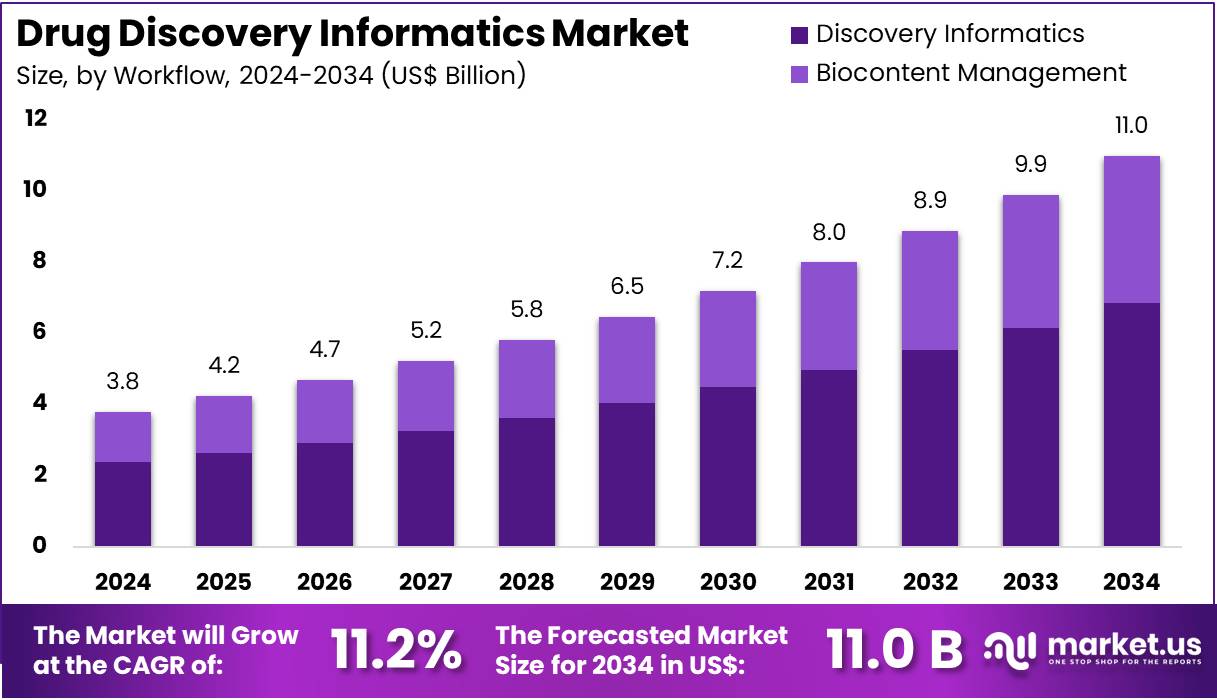
The Drug Discovery Informatics Market Size is expected to be worth around US$ 11.0 Billion by 2034 from US$ 3.8 Billion in 2024, growing at a CAGR of 11.2% during the forecast period 2025 to 2034.
The Drug Discovery Informatics Market is gaining momentum as pharmaceutical companies adopt artificial intelligence (AI), machine learning, advanced analytics, molecular modeling, and platforms to improve workflows. Informatics tools help researchers organize biological and chemical datasets, identify drug targets, evaluate molecular interactions, prioritize compounds, and support lead optimization.
The U.S. Food and Drug Administration (FDA) reported that the Center for Drug Evaluation and Research had reviewed more than 500 submissions containing AI components between 2016 and 2023, highlighting the expanding role of AI across the drug development lifecycle. The FDA received more than 800 external comments on its 2023 AI discussion paper. These developments underscore the importance of reliable data and transparent validation.
In January 2026, the FDA and European Medicines Agency published 10 guiding principles for good AI practice in drug development. The principles emphasize human-centered design, risk-based approaches, data governance, clear context of use, model performance assessment, documentation, and lifecycle management. In June 2026, the FDA finalized its M15 guidance on model-informed drug development, providing recommendations for planning, evaluating, and documenting model-derived evidence.
As pharmaceutical R&D becomes increasingly data-intensive, drug discovery informatics is positioned to benefit from AI-enabled analytics, cloud computing, knowledge graphs, high-throughput screening data, and integrated platforms. Stronger regulatory frameworks and improved data quality are expected to support adoption.
Key Takeaways
- In 2024, the global Drug Discovery Informatics Market generated approximately US$ 3.8 billion in revenue and is projected to grow at a CAGR of 11.2%, reaching around US$ 11.0 billion by 2033.
- By workflow, the market is segmented into discovery informatics and biocontent management, with discovery informatics dominating in 2024 with a 62.3% market share.
- Based on services, the market comprises sequence analysis platforms, molecular modelling, docking, clinical trial data management, and others. Sequence analysis platforms accounted for the largest share at 45.4% in 2024.
- Regionally, North America held the leading position in the Drug Discovery Informatics Market in 2024, capturing a 40.2% market share.
Statistical Information
- More than 747,000 participants are now available through the NIH’s All of Us Research Program, including more than 535,000 whole-genome sequences linked to nearly 482,000 electronic health records, creating a large-scale resource for genomic and clinical data analysis.
- The latest NIH release includes proteomics data from nearly 10,000 participants, RNA sequencing data from nearly 9,000 participants, and long-read whole-genome sequences from more than 14,500 participants, strengthening opportunities for multi-omics informatics.
- All of Us data has already supported more than 1,400 peer-reviewed publications involving nearly 23,000 researchers across all 50 U.S. states and internationally, demonstrating substantial research adoption of large-scale biomedical informatics resources.
- In the 2025 All of Us dataset, researchers had access to more than 414,000 short-read whole-genome sequences, more than 447,000 genotype-array datasets, and more than 393,000 electronic health records through the cloud-based Researcher Workbench.
- The All of Us genomic dataset has identified more than 1 billion genetic variants, including more than 275 million previously unreported variants, highlighting the enormous computational requirement for genomic analysis and interpretation.
- Researchers using the All of Us Researcher Workbench previously achieved a median access time of 29 hours from initial registration to individual-level genomic data access, demonstrating the potential of cloud-based informatics platforms to shorten research data-access workflows.
- The FDA reports a significant increase in drug application submissions containing AI components over recent years, with AI applications spanning nonclinical research, clinical development, postmarketing activities, and manufacturing.
- By April 2025, more than 860,000 participants had consented to share data through All of Us, with the program supporting more than 17,000 studies, highlighting the expanding demand for large-scale biomedical data infrastructure and analytical capabilities.
Market Segmentation Analysis
Workflow Analysis
The discovery informatics segment dominated the Drug Discovery Informatics Market in 2024, accounting for 62.3% of the market. Its leading position is driven by the growing need for advanced, data-driven technologies that can manage and analyze increasingly complex biological and chemical datasets.
As drug development becomes more sophisticated, discovery informatics helps researchers identify promising drug candidates, streamline workflows, enhance decision-making, and potentially reduce development timelines and costs. The rising emphasis on personalized medicine and precision healthcare is also expected to encourage greater adoption.
Moreover, integrating information from genomics, proteomics, and other data sources is becoming increasingly important, strengthening the role of discovery informatics platforms in supporting efficient and informed drug discovery processes.
Services Analysis
The sequence analysis platforms segment accounted for a significant 45.4% market share in 2024, supported by the expanding role of genomics and bioinformatics in pharmaceutical research. These platforms enable researchers to process, analyze, and interpret complex genetic information, helping identify disease mechanisms and potential therapeutic targets.
The increasing adoption of next-generation sequencing (NGS) technologies is expected to further strengthen demand for sequence analysis solutions as pharmaceutical and biotechnology companies manage growing volumes of genomic data.
At the same time, advances in molecular modeling and docking are enhancing the understanding of molecular interactions and supporting more targeted drug development. As the industry increasingly prioritizes precision therapies and data-driven research, sequence analysis platforms are expected to remain an essential component of drug discovery informatics services.
Regional Analysis
North America dominated the Drug Discovery Informatics Market in 2024, accounting for 40.2% of the global market, supported by strong pharmaceutical and biotechnology research capabilities, advanced computational infrastructure, and growing adoption of artificial intelligence and machine learning in drug discovery. The U.S. remains a major contributor, with government-supported initiatives and collaborations helping accelerate target identification, molecular design, virtual screening, and therapeutic development.
Meanwhile, Asia Pacific is expected to register the highest CAGR during the forecast period, driven by expanding pharmaceutical R&D, investments in healthcare and biotechnology infrastructure, and increasing adoption of AI-enabled drug discovery technologies.
China, Japan, and other regional markets are strengthening capabilities in genomics, molecular modeling, and computational research. The region’s growing pharmaceutical industry, demand for cost-efficient drug development, and increasing collaboration between academic institutions and industry players are expected to further accelerate adoption of drug discovery informatics solutions.
Business Opportunities
The Drug Discovery Informatics Market presents significant business opportunities as pharmaceutical and biotechnology companies increasingly adopt AI, machine learning, molecular modeling, and advanced analytics to improve research efficiency. AI is being applied across target identification, molecular design, virtual screening, preclinical studies, and clinical development, creating opportunities for specialized software platforms and integrated informatics solutions.
Companies can capitalize on demand for AI-powered drug design, predictive analytics, virtual screening, molecular docking, and multi-omics data integration. The growing availability of large biological and chemical datasets also creates opportunities for cloud-based data management, bioinformatics platforms, and analytics-as-a-service offerings.
FDA initiatives around AI credibility, data governance, model performance, and lifecycle management create additional opportunities for regulatory-focused informatics and validation solutions. Precision medicine and genomics provide further growth avenues through biomarker discovery, pharmacogenomics, and personalized therapeutic development. Partnerships between technology providers, pharmaceutical companies, research institutions, and CROs can accelerate commercialization and expand access to advanced discovery capabilities.
Emerging Trends
AI-powered digital twins are emerging: FDA research is developing virtual animal models and AI-generated digital twins to predict toxicology and clinical outcomes. This trend could reduce dependence on conventional experiments while creating demand for predictive modeling, simulation, and informatics platforms supporting safer drug-development decisions.
Spatial and single-cell data are gaining importance: Advanced omics technologies are providing researchers with cellular-level and location-specific biological information. These datasets can reveal disease mechanisms, identify new therapeutic targets, and support more precise drug development, increasing demand for specialized analytical informatics capabilities.
Organoid-based computational screening is advancing: Researchers are combining three-dimensional human organoids with automated screening and machine learning. One 2025 study tested 2,802 compounds using more than 10,000 organoid domes in 13 days, demonstrating potential for faster, data-rich preclinical screening workflows.
Regulatory-ready AI is becoming essential: FDA and EMA established 10 guiding principles for responsible AI use in drug development, emphasizing context, data governance, performance assessment, documentation, and lifecycle management. Informatics providers are therefore increasingly expected to build transparent, traceable, and controlled AI workflows.
Digital health data is moving deeper into development: FDA is supporting digital health technologies that capture continuous or frequent patient measurements and enable remote clinical activities. This is encouraging informatics systems capable of collecting, organizing, and analyzing sensor-generated clinical information alongside conventional research datasets.
Use Cases
AI-based toxicity prediction: FDA’s AI4TOX program uses artificial intelligence to evaluate toxicological endpoints before clinical trials. Informatics platforms can combine chemical, biological, and experimental information to predict potential safety problems earlier, helping researchers prioritize promising compounds and reduce unnecessary testing during development.
Digital pathology analysis: AI systems can analyze pathology images generated during preclinical studies. FDA’s PathologAI initiative specifically explores AI-assisted histopathological analysis, creating opportunities for informatics platforms that automatically detect patterns, quantify tissue changes, organize findings, and support consistent interpretation across research programs.
Remote clinical data integration: Digital health technologies can capture measurements through wearable and connected devices while participants remain outside traditional trial sites. Informatics systems can integrate these continuous observations with clinical datasets, enabling researchers to monitor outcomes, identify patterns, and improve decentralized study management.
Real-world evidence analytics: FDA highlights AI opportunities for extracting and organizing information from electronic health records, medical claims, and other unstructured sources. Drug developers can use informatics tools to structure these datasets, identify relevant evidence, evaluate treatment outcomes, and support development decisions.
Organoid drug-response prediction: Informatics platforms can analyze responses from human organoids to evaluate drug efficacy and toxicity. Combining organoid experiments with machine learning may help researchers compare compounds, identify promising candidates, understand response patterns, and improve translation from laboratory findings toward development.
Recent Developments
- In July 2026, Certara partnered with NVIDIA to integrate the NVIDIA BioNeMo Agent Toolkit into Certara’s AI platform, combining agentic AI with Certara’s biosimulation, proprietary datasets, and scientific expertise to accelerate drug discovery and development.
- In June 2026, Selvita expanded its antibody-discovery portfolio through a collaboration with Llamatech Nanobody Solutions, enabling bespoke VHH/nanobody libraries generated against clients’ specific antigens and subsequent phage-display optimization for drug-discovery programs.
- In May 2026, Certara completed the US$ 135 million sale of its Regulatory and Medical Writing business to Veristat, allowing Certara to sharpen its strategic focus on model-informed drug development, Clinical Intelligence, AI-integrated modeling, and simulation capabilities.
- In April 2026, Boehringer Ingelheim announced a £150 million investment over 10 years to establish an AI and machine-learning accelerator in London’s Knowledge Quarter, its fourth global computational innovation site, focused on using AI to advance disease research and drug discovery.
- In March 2026, Infosys reported that nearly 90% of drugs entering clinical trials never reach the market and highlighted AI, open biobanks, transparent data, and collaboration as approaches for improving drug-development efficiency and clinical-trial outcomes.
Conclusion
The Drug Discovery Informatics Market is entering a strong growth phase as pharmaceutical companies increasingly combine AI, advanced analytics, genomics, modeling, and integrated data platforms across drug development. Expanding regulatory guidance from the FDA and EMA is also encouraging more structured and responsible use of AI in pharmaceutical research.
Recent developments from major technology and life-science companies further demonstrate rising investment in AI-enabled discovery, biosimulation, data management, and digital research workflows. With growing biomedical datasets, improved computational capabilities, and increasing demand for faster and more efficient development, drug discovery informatics is positioned to remain an important technology area for pharmaceutical innovation through the coming years.




















