Report Overview
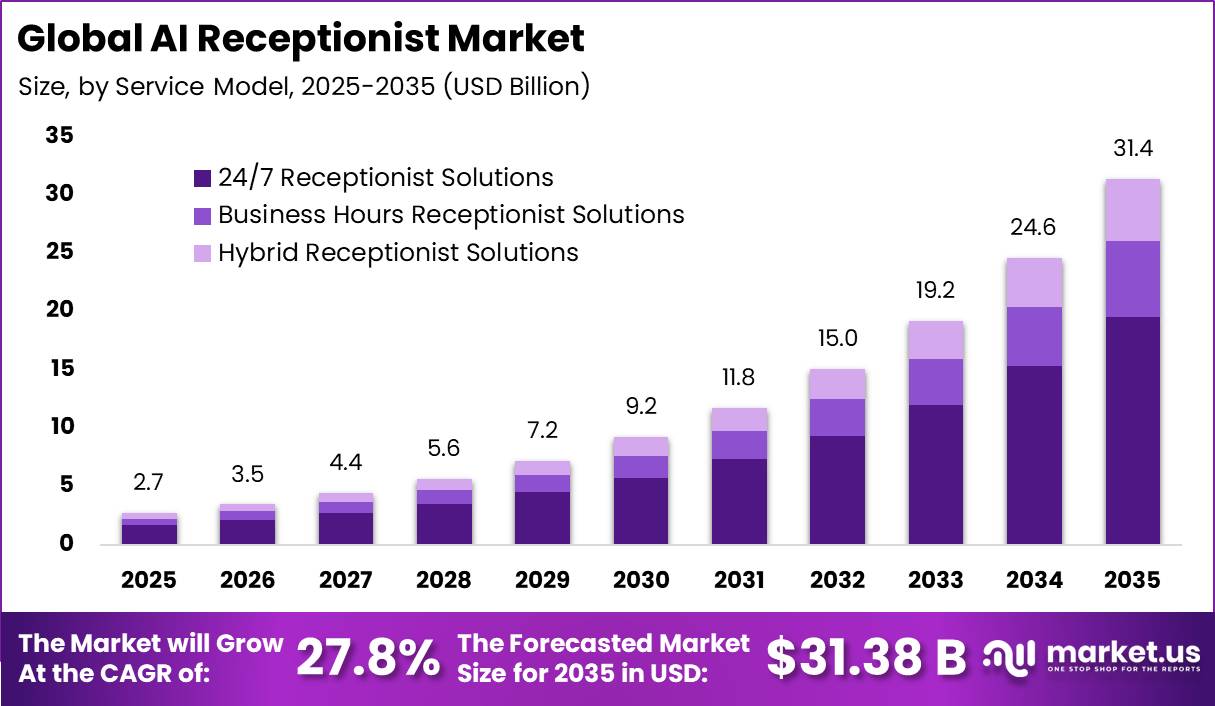
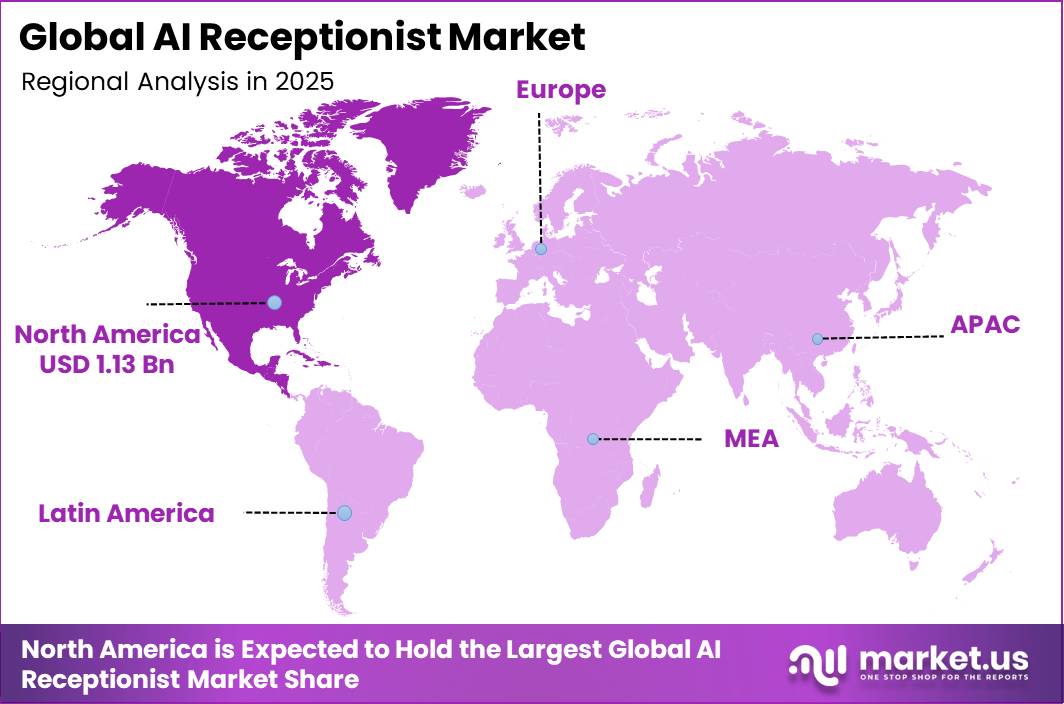
In 2025, the Global AI Receptionist Market was valued at USD 2.7 billion. The market is projected to grow at a CAGR of 27.8% during 2026–2035, reaching approximately USD 31.3 billion by 2035. North America dominated the global market in 2025, accounting for more than 42.0% of the total market share and generating approximately USD 1.1 billion in revenue.
Growth is supported by businesses seeking 24/7 call handling, shorter customer wait times, and automated management of bookings, enquiries, lead capture, and call routing without expanding front-desk teams at the same rate. In the United States, the Bureau of Labor Statistics reported 2.8 million customer service representative jobs in 2024, while employment is expected to decline by 5.5% by 2034, representing around 153,700 fewer roles. Despite this decline, approximately 341,700 openings are expected each year due mainly to employee turnover.
Demand is also rising across health care, where employment increased by 680,500 jobs, or 2.9%, between March 2025 and March 2026. U.S. health care added 55,000 jobs in July 2025, including 33,600 in ambulatory health care and 16,000 in hospitals. The 2022 Economic Census recorded 4,360 health care and social assistance establishments with 500 or more employees, together employing 7.1 million people and paying USD 518.4 billion annually.
Key Takeaway
- The AI Receptionist Market was valued at USD 2.7 billion in 2025 and is projected to reach USD 31.38 billion by 2035.
- The market is expected to expand at a CAGR of 27.8% during 2026–2035.
- The Solutions segment is dominated by components, capturing more than 76.0% share in 2025.
- The Cloud-Based segment was led by deployment, with more than 70.1% share in 2025.
- The 24/7 Receptionist Solutions segment was led by the service model with more than 62.3% share.
- Small and Medium Enterprises held the largest share by enterprise size, at more than 61.0%.
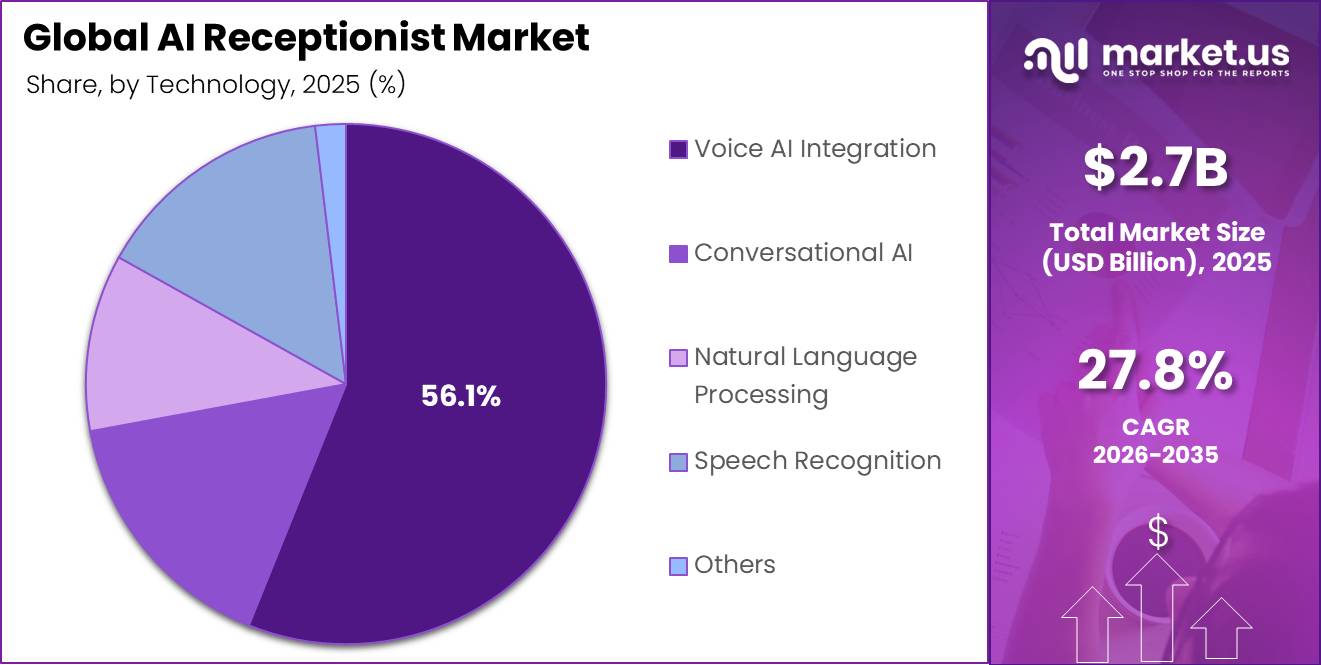
- Voice AI Integration led by technology with more than 56.1% share.
- Voice Reception Services led by service type with more than 54.5% share.
- The IT and Telecom segment led by end use with more than 19% share.
- North America led the market in 2025, holding more than 42.0% share and generating about USD 1.1 billion in revenue.
Market Statistics and Data Insights
- U.S. business AI adoption reached 17%–20% between December 2025 and May 2026, while 20%–23% of businesses expected to use AI within the following six months. Among firms with at least 250 employees, adoption reached 37%. This provides a strong installed base for AI receptionist adoption.
- AI adoption was especially high in customer-intensive U.S. sectors in May 2026. Around 39.7% of Information businesses and 33.9% of Finance and Insurance businesses used AI, compared with 19.8% nationally. Retail Trade adoption was around 14%, with about 17% expecting to use AI within six months.
- The Federal Reserve estimated that about 18% of U.S. firms had adopted AI by the end of 2025. Work-related generative AI use reached about 41% of the workforce in November 2025, while roughly 78% of workers were employed by firms that had adopted some form of AI.
- Zoom launched a standalone AI receptionist in July 2026 that works with existing phone systems. Pricing started at USD 29.99 per month for 100 minutes, or USD 24.99 per month for 100 minutes with annual billing. Its functions include 24/7 call handling, appointment scheduling, lead capture, contextual transfers, SMS, and support for English, Spanish, and 10+ additional languages.
- Cloud readiness is already high in Europe. Around 52.74% of EU enterprises purchased cloud services in 2025, up 7.42 percentage points from 2023. Adoption reached 84.67% among large enterprises, 66.78% among medium enterprises, and 49.3% among small enterprises.
- Among EU businesses purchasing cloud services, 96.44% used at least one SaaS application in 2025. Around 27.91% used cloud CRM applications, while 28.18% purchased cloud computing power to run business software. These figures support the integration of cloud AI receptionists with CRM and workflow systems.
- Twilio’s 2025 global survey covered 7,640 consumers and 637 business leaders across 18 countries. Around 54% of consumers said they wanted to know when they were interacting with AI rather than a human, while 84% wanted control over personalization settings.
- The same Twilio survey found that 71% of consumers abandon purchases when engagement is not relevant, while 88% are more likely to buy when engagement is personalized in real time. Only 44% of brands reported delivering personalization at that level.
- Salesforce research found that 39% of consumers were already comfortable allowing AI agents to schedule appointments, while 34% would interact with an AI agent instead of a person to avoid repeating information. Around 44% of U.S. consumers would use an AI agent as a personal assistant, increasing to 70% among Gen Z.
- Customer-service organizations using AI agents increased from 39% in 2025 to 66% in 2026, according to a Salesforce survey of 3,075 customer-service professionals. Overall, 85% of service organizations used at least one form of AI.
- The United States had 2.814 million customer-service representative jobs in 2024. BLS projects employment to fall 5% by 2034, representing 153,700 fewer positions, while still requiring about 341,700 replacement openings each year. Median pay was USD 20.59 per hour in May 2024.
- ITU estimated approximately 6.0 billion internet users in 2025, equal to 74% of the global population. Global mobile-cellular subscriptions reached 9.2 billion, or 112 subscriptions per 100 inhabitants, providing a massive communications base for voice and digital customer-service systems.
By Component
In 2025, the Solutions segment held a dominant market position, capturing more than a 76.0% share of the AI Receptionist Market. Its leadership is supported by strong business demand for ready-to-use platforms that answer calls, understand voice requests, book appointments, route calls, capture leads, and connect with CRM, calendar, and telephone systems.
U.S. Census Bureau data showed that 17%–20% of U.S. businesses used AI between December 2025 and May 2026, while 20%–23% expected to adopt AI within the following 6 months. Adoption was stronger among large companies, with 37% of businesses employing at least 250 people already using AI.
By Deployment
In 2025, the Cloud-Based segment held a dominant market position, capturing more than a 70.1% share of the AI Receptionist Market. Cloud deployment leads because businesses can introduce voice automation without purchasing, maintaining, or frequently upgrading on-site servers. Providers can centrally update voice models, call scripts, language features, and software integrations while supporting multiple business locations through one platform.
Eurostat reported that 52.7% of EU enterprises purchased cloud services in 2025, an increase of 7.4 percentage points compared with 2023. Cloud adoption was particularly strong among large enterprises, reaching 84.7%. This established cloud infrastructure makes it easier for businesses to deploy AI receptionists for call routing, appointment scheduling, lead capture, and 24/7 customer enquiry management.
By Service Model
In 2025, the 24/7 Receptionist Solutions segment held a dominant market position, capturing more than a 62.3% share of the AI Receptionist Market. The segment leads because many customer-facing businesses operate beyond normal working hours and need to respond quickly to calls, bookings, and service requests.
U.S. airlines carried 92.2 million passengers in July 2025, including 13.3 million international passengers, creating strong demand for continuous support related to flight status, rebooking, baggage, and travel enquiries across different time zones. The American Hotel & Lodging Association also projected U.S. hotel-related traveller spending of USD 777.2 billion in 2025, supported by expected hotel occupancy of 63.3%.
By Enterprise Size
In 2025, Small and Medium Enterprises (SMEs) held a dominant market position, capturing more than a 61.0% share of the AI Receptionist Market. SMEs lead because they make up the largest business group and often operate with small front-office teams and limited budgets for full-time reception staff. The U.S. Small Business Administration reported 36.2 million small businesses in 2025, representing 99.9% of all U.S. businesses.
These companies employed 62.3 million people, equal to 45.9% of the private-sector workforce. This creates a large customer base across clinics, law firms, real-estate agencies, restaurants, repair companies, and local retailers. AI receptionists help these businesses answer calls, schedule appointments, qualify leads, and manage urgent requests outside normal working hours at a lower cost.
The OECD’s 2025 survey found that 39% of surveyed SMEs were using AI applications, up from 26% in 2024. As AI adoption increases, subscription-based receptionist platforms offer SMEs a simpler and more affordable option than hiring additional administrative staff or building internal call-handling systems.
By Technology
In 2025, Voice AI Integration held a dominant market position, capturing more than a 56.1% share of the AI Receptionist Market. The segment leads because voice calls remain an important communication channel for customers seeking fast and hands-free support. The U.S. National Center for Health Statistics reported that 197 million adults lived in wireless-only households during the second half of 2023, showing the widespread use of mobile voice communication.
Voice technology is particularly important in health care, where 80.5% of office-based physicians used telemedicine for patient care in 2021, compared with 16.0% in 2019. As businesses and health care providers manage more customer interactions across telephone and digital channels, voice-enabled AI receptionists help reduce manual call handling, improve response times, and support more efficient customer service operations.
By Service Type
In 2025, Voice Reception Services held a dominant market position, capturing more than a 54.5% share of the AI Receptionist Market. The segment leads because voice remains one of the fastest ways for customers to get immediate support, confirm bookings, or request urgent call transfers.
The American Dental Association reports 135,665 dental practice establishments in the United States, while dental offices support around 2.5 million jobs and generate an estimated USD 487 billion in annual economic activity. This large service base receives regular calls for appointments, treatment questions, billing enquiries, cancellations, and emergency requests.
By End Use
In 2025, the IT and Telecom segment held a dominant market position, capturing more than a 19% share of the AI Receptionist Market. The segment leads because telecom operators, software companies, internet service providers, and technology support teams handle large volumes of billing, activation, service, and technical support calls.
The International Telecommunication Union estimated that 6.0 billion people, equal to 74% of the global population, used the internet in 2025. It also recorded 9.2 billion mobile-cellular subscriptions, equal to 112 subscriptions per 100 people, along with 99 mobile-broadband subscriptions per 100 people. This large connected population creates steady demand for account support and technical assistance.
AI receptionists help companies manage first-level calls, identify customer needs, provide basic outage information, authenticate users, and transfer complex cases to human agents. Meanwhile, automotive is the fastest-growing end-use segment, supported by global vehicle production increasing from 92.7 million units in 2024 to 96.4 million units in 2025.
Key Market Segments
By Component
- Solutions
- Services
By Deployment
- Cloud-based
- On-premise
By Service Model
- 24/7 Receptionist Solutions
- Business Hours Receptionist Solutions
- Hybrid Receptionist Solutions
By Enterprise Size
Small and Medium Enterprises
Large Enterprises
By Technology
By Service Type
- Voice Reception Services
- Chat Reception Services
- Appointment Scheduling
- Call Routing
- Lead Qualification
- Customer Support
By End Use
- Healthcare
- Legal Services
- Real Estate
- Retail and E-commerce
- Banking, Financial Services, and Insurance
- Hospitality
- Automotive
- Home Services
- IT and Telecom
- Others
Geopolitical Impact Analysis
AI receptionist platforms are mainly software-based, but their operation depends on semiconductors, AI servers, networking equipment, storage, cooling systems, and reliable electricity. As a result, trade restrictions and geopolitical disruptions can directly affect infrastructure costs and service pricing.
Since January 15, 2026, the United States has applied a 25% ad valorem duty on selected advanced computing chips and related products. The measure includes processors with total processing performance above 14,000 and DRAM bandwidth above 4,500 GB/s. This can increase the cost of imported AI hardware used for speech recognition, call routing, large-language-model inference, and 24/7 voice services.
The WTO expects global merchandise-trade volume growth to slow from 4.6% in 2025 to 1.9% in 2026, with prolonged high oil and LNG prices potentially reducing growth further to 1.4%. Supply-chain disruption is adding further pressure. UNCTAD reported that Suez Canal tonnage was around 70% below the 2023 average by May 2025.
Longer routes around the Cape of Good Hope increased global seaborne ton-miles by 5.9% in 2024, compared with maritime trade growth of only 2.2%. Average shipping distance increased from 4,831 miles in 2018 to 5,245 miles in 2024, while the Shanghai Containerized Freight Index averaged 2,496 points in 2024, up 149%.
Energy costs are another concern, with global energy prices projected to rise 24% in 2026 and Brent crude averaging USD 86 per barrel, versus USD 69 in 2025. Data-center electricity use of around 415 TWh in 2024 could reach 945 TWh by 2030, increasing cost exposure for cloud-based AI receptionist services.
Regional Analysis
In 2025, North America held a dominant market position, capturing more than a 42.0% share of the global AI Receptionist Market, valued at approximately USD 1.13 billion. The region benefits from a mature cloud ecosystem, high front-office labor costs, and early adoption of AI-based communication tools.
In the United States, 17%–20% of businesses used AI between December 2025 and May 2026, while another 20%–23% expected to adopt it within the following 6 months. Adoption reached 37% among businesses with at least 250 employees, compared with less than 20% among firms with 4 or fewer workers. Canada also supports regional growth, with 19.2% of businesses using AI to deliver goods or services in the second quarter of 2026, up from 12.2% a year earlier. Among AI-using Canadian firms, 28.2% used virtual agents or chatbots.
Asia Pacific is expected to be the fastest-growing regional market as companies expand digital customer service across telecom, retail, travel, automotive, financial services, and other industries. The International Telecommunication Union recorded 9.2 billion mobile-cellular subscriptions globally, equal to 112 subscriptions per 100 people, along with 6.0 billion internet users in 2025.
Key Regions and Countries
North America
- US
- Canada
Europe
- Germany
- France
- The UK
- Spain
- Italy
- Rest of Europe
Asia Pacific
- China
- Japan
- South Korea
- India
- Australia
- Rest of APAC
Latin America
- Brazil
- Mexico
- Rest of Latin America
Middle East & Africa
- GCC
- South Africa
- Rest of MEA
Market Dynamics
Drivers
| Driver | (~) % CAGR | Geographic Relevance | Impact Timeline |
|---|---|---|---|
| Business AI adoption | +3.8% | North America and Europe | Short term (2 years or less) |
| Front-office labor shortages | +3.1% | North America | Short term (2 years or less) |
| Digital scheduling demand | +2.5% | Global | Medium term (2 to 4 years) |
| Cloud telephony penetration | +2.2% | North America, Europe, and Asia Pacific | Medium term (2 to 4 years) |
| Service-sector digitization | +1.7% | Asia Pacific and Latin America | Long term (4 years or more) |
Business AI adoption
Business AI adoption is a major growth driver because it shifts call handling from fixed staffing costs toward scalable software subscriptions. U.S. Census Bureau data showed that 17%–20% of firms used AI between December 2025 and May 2026, while another 20%–23% expected near-term adoption. The Federal Reserve also estimated that around 18% of U.S. firms had adopted AI by the end of 2025.
Canada shows a similar trend, with AI use in delivering goods or services increasing from 12.2% in Q2 2025 to 19.2% in Q2 2026. This growing adoption makes businesses more willing to use AI receptionists for voice response, appointment scheduling, CRM updates, and lead capture. Wider business AI adoption could contribute an estimated +3.8% growth upside above the market’s baseline 27.8% CAGR.
Restraints
| Restraint | (~) % CAGR | Geographic Relevance | Impact Timeline |
|---|---|---|---|
| AI-call consent mandates | -3.4% | United States | Short term (2 years or less) |
| European AI compliance costs | -2.7% | European Union | Short term (2 years or less) |
| Healthcare privacy exposure | -2.0% | North America and Europe | Medium term (2 to 4 years) |
| Public-sector purchasing controls | -1.6% | North America and Europe | Medium term (2 to 4 years) |
| Recorded-call disclosure rules | -1.3% | North America | Short term (2 years or less) |
AI-call consent mandates
AI-call consent requirements are a major restraint because they can limit automated outbound calls for reminders, lead nurturing, debt collection, and customer reactivation. On February 8, 2024, the U.S. FCC confirmed that AI-generated voices fall under Telephone Consumer Protection Act rules for artificial or prerecorded voices. The FCC’s July 2024 proposal also defined AI-generated calls as those using computational technology or machine learning to create voice or text.
Compliance requirements are also increasing in Europe. General-purpose AI obligations under the EU AI Act began applying on August 2, 2025, covering technical documentation, copyright controls, and public training-content summaries. Vendors must therefore invest in consent records, disclosure scripts, audit trails, and location-based calling policies. These requirements could create an estimated -3.4% growth drag against the market’s baseline 27.8% CAGR.
Challenges
| Challenge | (~) % CAGR | Geographic Relevance | Mitigation Horizon |
|---|---|---|---|
| Rising inference energy costs | -2.8% | Global | Medium term (2 to 4 years) |
| Voice accuracy variance | -2.4% | Global | Medium term (2 to 4 years) |
| Legacy telephony integration | -2.0% | Global | Short term (2 years or less) |
| Data security exposure | -1.7% | Global | Long term (4 years or more) |
| Multilingual speech adaptation | -1.4% | Asia Pacific and Europe | Medium term (2 to 4 years) |
Rising inference energy costs
Rising inference energy costs can limit AI receptionist market growth because every voice interaction requires speech recognition, language-model processing, storage, and network activity. Data centres consumed around 415 TWh in 2024 and could reach about 945 TWh by 2030, equal to nearly 3% of global electricity demand. Energy prices are also projected to rise 24% in 2026, with Brent crude averaging around USD 86 per barrel.
Higher power and infrastructure costs can increase cloud-based voice AI pricing. Global merchandise-trade growth is expected to slow from 4.6% in 2025 to 1.9% in 2026, or potentially 1.4% under prolonged high-energy-price conditions. Providers will need smaller AI models, smarter intent routing, caching, and efficient infrastructure to limit an estimated -2.8% growth friction on the market.
Opportunities
| Opportunity | (~) % CAGR | Geographic Relevance | Execution Window |
|---|---|---|---|
| Vertical workflow platforms | +4.0% | North America, Europe, and Asia Pacific | Medium term (2 to 4 years) |
| Outcome-based pricing | +3.1% | Global | Medium term (2 to 4 years) |
| Multilingual regional expansion | +2.5% | Asia Pacific, Europe, and Middle East | Long term (4 years or more) |
| Private AI deployments | +2.1% | Government, finance, and healthcare | Long term (4 years or more) |
| Channel partner bundling | +1.8% | Global | Short term (2 years or less) |
Vertical workflow platforms
Vertical workflow platforms offer a strong growth opportunity as most AI receptionist tools still focus on general call answering. The U.S. Small Business Administration recorded 36.2 million small businesses in 2025, employing 62.3 million people, while the American Dental Association identifies more than 135,000 dental practices. These fragmented service markets can benefit from industry-specific templates for booking, claims, screening, and dispatch.
Purpose-built workflows can also improve commercial returns. Estimated revenue per account could increase by 15%–30%, while implementation effort may decline by 20%–40%. With 92.2 million airline passengers in July 2025 also creating high call volumes, specialized platforms could unlock additional demand and provide an estimated +4.0% upside above the baseline 27.8% CAGR.
Key Players Analysis
The AI Receptionist Market is led by Tier-1 cloud communication and contact-center providers, including Zoom, RingCentral, Five9, Nextiva, and Aircall. These companies benefit from large customer bases, strong enterprise sales networks, established telephony infrastructure, and broad integration capabilities.
Zoom generated USD 4.8 billion in fiscal 2026 revenue, with enterprise customers contributing 60.3%, while R&D spending reached USD 844.9 million, or about 17.4% of revenue. RingCentral reported USD 2.5 billion in 2025 revenue, including USD 2.4 billion, or more than 95%, from subscriptions, and invested USD 317.0 million in R&D.
Five9 recorded USD 1.15 billion in 2025 revenue, up 10%, with R&D spending of USD 152.3 million. Its enterprise AI revenue increased 50% year over year in the fourth quarter. Together, major platforms are estimated to represent around 35%–45% of addressable AI receptionist spending through UCaaS, CCaaS, voice AI, routing, and workflow solutions.
Tier-2 challengers compete through specialized voice AI, virtual reception, and industry-focused solutions. PolyAI raised USD 50 million in Series C funding in 2024, taking total external funding above USD 120 million. Aircall surpassed USD 175 million in annual recurring revenue in April 2025, growing 25% and reaching profitability. Its 2025 ARR later exceeded USD 204 million, up 26%.
Top Key Players in the Market
- Dialzara
- Rosie
- Goodcall
- Retell AI
- Zoom
- Quo
- Nextiva
- Moneypenny
- PATLive
- Abby Connect
- Nexa
- PolyAI
- Cognigy
- Five9
- RingCentral
- Aircall
- Smith.ai
- Ruby
- AnswerConnect
- AIRA
Recent Developments
- In July 2025, NiCE entered a definitive agreement to acquire Cognigy in a transaction valued at approximately USD 955 million, including a USD 50 million time-bound holdback. Cognigy’s conversational and agentic AI platform operates across more than 100 languages, while NiCE expected Cognigy to deliver around 80% ARR growth in 2026. The acquisition strengthens NiCE’s position in automated voice assistance, AI agents, and customer-service automation.
- In December 2025, PolyAI raised USD 86 million in Series D financing, taking its total funding above USD 200 million. The round supported further development of its enterprise voice-AI technology and global expansion. At the time, PolyAI served more than 100 enterprises, operated over 2,000 live deployments, supported 45 languages, and had deployments across more than 25 countries, highlighting its growing scale in automated customer-call handling.
Report Scope
| Report Features | Description |
|---|---|
| Market Value (2025) | USD 2.7 Billion |
| Forecast Revenue (2035) | USD 31.3 Billion |
| CAGR (2026-2035) | 27.8% |
| Base Year for Estimation | 2025 |
| Historic Period | 2020-2024 |
| Forecast Period | 2026-2035 |
| Report Coverage | Revenue Forecast, Market Dynamics, Competitive Landscape, Recent Developments |
| Segments Covered | By Component (Solutions, Services), By Deployment (Cloud-based, On-premise), By Service Model (24/7 Receptionist Solutions, Business Hours Receptionist Solutions, Hybrid Receptionist Solutions), By Enterprise Size (Small and Medium Enterprises, Large Enterprises), By Technology (Voice AI Integration, Conversational AI, Natural Language Processing, Speech Recognition, Others), By Service Type (Voice Reception Services, Chat Reception Services, Appointment Scheduling, Call Routing, Lead Qualification, Customer Support), By End Use (Healthcare, Legal Services, Real Estate, Retail and E-commerce, Banking, Financial Services, and Insurance, Hospitality, Automotive, Home Services, IT and Telecom, Others) |
| Regional Analysis | North America – US, Canada; Europe – Germany, France, The UK, Spain, Italy, Rest of Europe; Asia Pacific – China, Japan, South Korea, India, Australia, Singapore, Rest of APAC; Latin America – Brazil, Mexico, Rest of Latin America; Middle East & Africa – GCC, South Africa, Rest of MEA |
| Competitive Landscape | Dialzara, Rosie, Goodcall, Retell AI, Zoom, Quo, Nextiva, Moneypenny, PATLive, Abby Connect, Nexa, PolyAI, Cognigy, Five9, RingCentral, Aircall, Smith.ai, Ruby, AnswerConnect, and AIRA, among others |
| Customization Scope | Customization for segments, region/country-level will be provided. Moreover, additional customization can be done based on the requirements. |
| Purchase Options | We have three licenses to opt for: Single User License, Multi-User License (Up to 5 Users), Corporate Use License (Unlimited Users and Printable PDF) |