


Quick Navigation
Overview
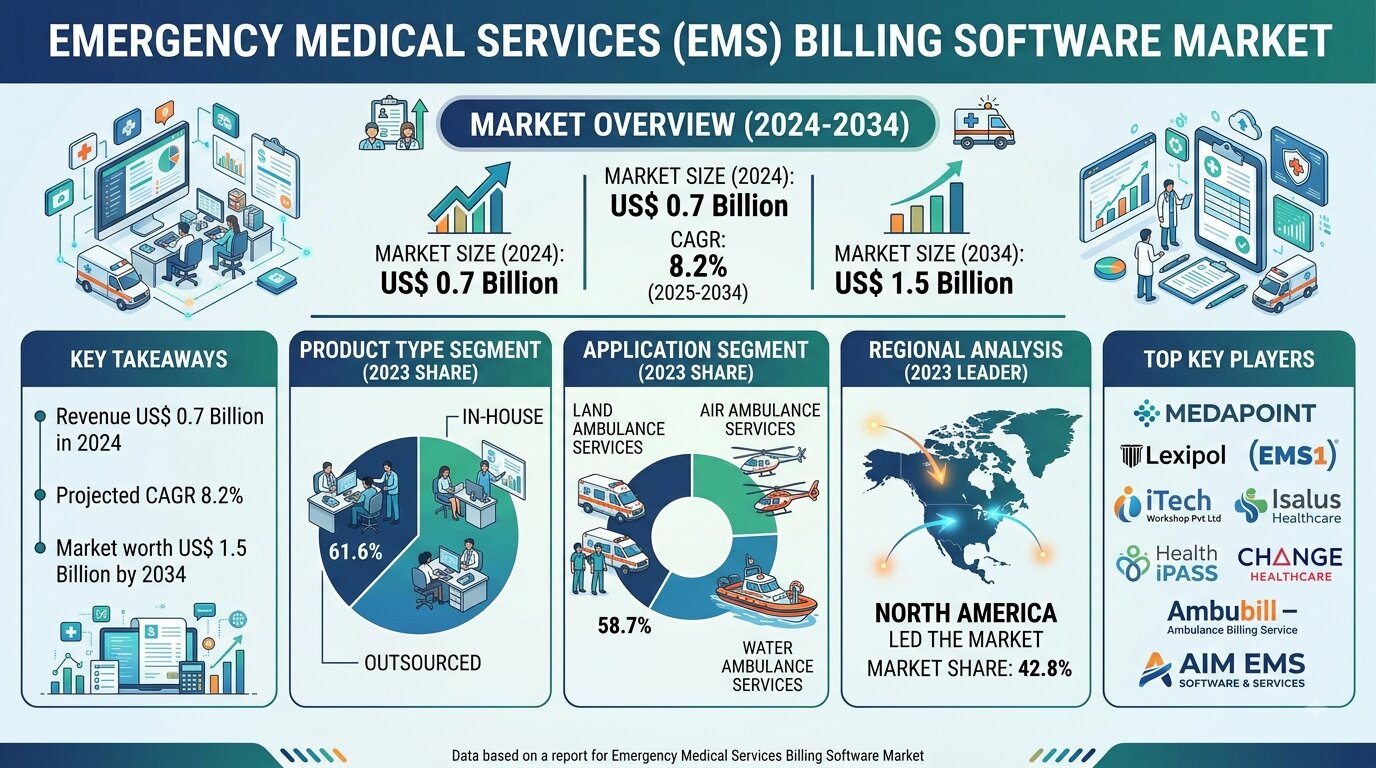
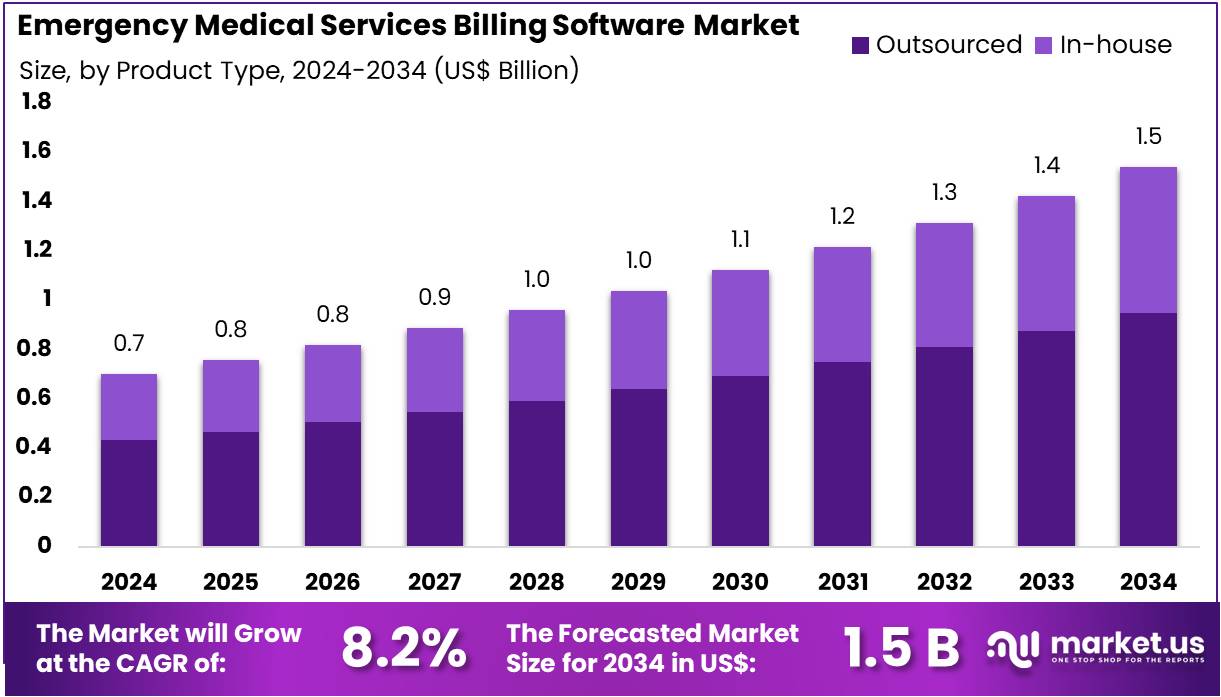
The Global Emergency Medical Services Billing Software Market Size is expected to be worth around US$ 1.5 Billion by 2034 from US$ 0.7 Billion in 2024, growing at a CAGR of 8.2% during the forecast period 2025 to 2034.
Emergency Medical Services (EMS) billing software is becoming an increasingly important component of healthcare administration as ambulance providers face growing reimbursement complexity, stricter compliance requirements, and rising documentation standards. These platforms automate claim creation, coding validation, payment tracking, denial management, and integration with electronic patient care records (ePCR), enabling EMS organizations to improve revenue cycle performance while reducing administrative burden.
As emergency medical services continue to expand across public, private, and hospital-based providers, digital billing solutions are helping organizations accelerate reimbursements, strengthen financial sustainability, and maintain compliance with evolving healthcare regulations.
Government initiatives and reimbursement frameworks continue to support the adoption of advanced EMS billing technologies. The U.S. Centers for Medicare & Medicaid Services (CMS) regularly updates the Medicare Ambulance Fee Schedule and maintains standardized billing guidance, encouraging providers to adopt accurate coding and electronic claims management systems for ambulance reimbursement.
The need for efficient billing platforms is further reinforced by increasing EMS activity and oversight. According to the U.S. Centers for Disease Control and Prevention (CDC), the 2020 National EMS Assessment identified approximately 1,030,760 licensed EMS clinicians across the United States, highlighting the scale of EMS operations that depend on reliable administrative and reimbursement processes.
Additionally, CMS reported that the 2024 Medicare Fee-for-Service improper payment rate for ambulance services was 13.2%, representing an estimated US$ 595.1 million in improper payments, emphasizing the importance of software that improves billing accuracy, documentation quality, and regulatory compliance.
Key Takeaways
- The global emergency medical services billing software market was valued at US$ 0.7 billion in 2024 and is projected to reach US$ 1.5 billion by 2034, expanding at a CAGR of 8.2% during the forecast period.
- Based on product type, the market is categorized into in-house and outsourced solutions. Among these, the outsourced segment dominated the market, accounting for a 61.6% share in 2023.
- By application, the market is segmented into land ambulance services, water ambulance services, and air ambulance services. The land ambulance services segment emerged as the leading category, capturing 58.7% of the market share in 2023.
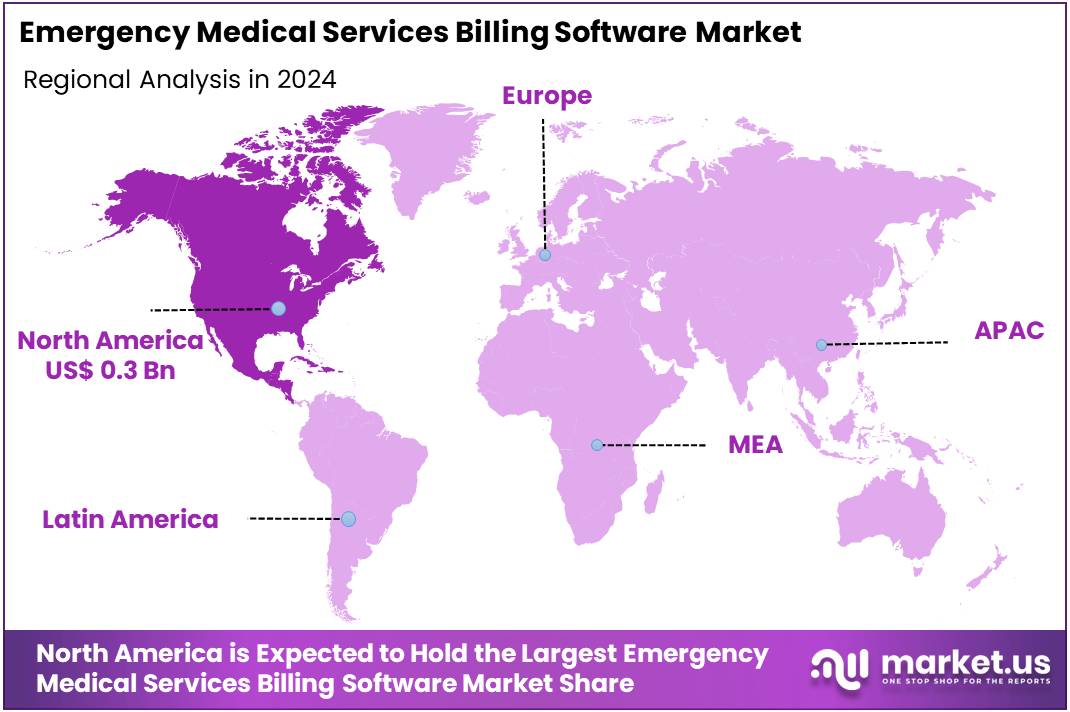
- North America held the dominant regional position in 2023, representing 42.8% of the global emergency medical services billing software market.
Statistical Information
- 60,298,684 EMS activations were reported to the U.S. National EMS Database in 2024, submitted by 14,756 EMS agencies across 50 states, Washington D.C., and four U.S. territories, highlighting the enormous volume of records requiring documentation and billing workflows.
- The 2025 NEMSIS national system has already processed 35,496,767 electronic patient care reports (PCRs) year-to-date from 13,225 reporting EMS agencies, demonstrating the rapid expansion of digital EMS documentation.
- The fastest transmission time from an EMS patient record being completed to its arrival in the National EMS Database is approximately 7 minutes, reflecting increasing adoption of real-time electronic reporting infrastructure.
- According to the U.S. Bureau of Labor Statistics, there were 282,900 EMTs and paramedics employed in 2024, including 181,000 emergency medical technicians and 101,900 paramedics, creating a large user base for EMS documentation and billing systems.
- Employment of EMTs and paramedics is projected to grow by 5% between 2024 and 2034, with approximately 19,000 job openings each year, increasing the demand for scalable EMS administrative and billing platforms.
- 45% of emergency medical technicians were employed by ambulance services in 2024, while 39% of paramedics worked for ambulance service providers, emphasizing the concentration of billing operations within dedicated EMS organizations.
- Analysis of the 2024 NEMSIS Public-Release Research Dataset found that approximately 24.9 million 9-1-1 EMS incidents resulted in both patient treatment and transport, representing one of the largest datasets supporting prehospital care and reimbursement activities.
- The National EMS Database receives tens of millions of EMS records annually from more than 10,000 EMS agencies nationwide, providing standardized data used for benchmarking EMS performance, reimbursement analysis, and operational planning.
Market Segmentation Analysis
Product Type Analysis
The outsourced segment held the leading position in the emergency medical services (EMS) billing software market, accounting for 61.6% of the total market share in 2023. Its dominance is driven by the growing preference among EMS providers to improve billing accuracy, ensure regulatory compliance, and reduce administrative workloads through specialized third-party services.
The continued adoption of cloud-based billing platforms, automated claims processing, and revenue cycle management solutions is expected to further strengthen the segment’s growth during the forecast period.
Application Analysis
The land ambulance services segment captured the largest share of the emergency medical services (EMS) billing software market, representing 58.7% in 2023. The segment’s growth is supported by the high volume of emergency transportation services, increasing demand for rapid medical response, and the need for accurate reimbursement management.
Rising adoption of digital documentation, integrated dispatch systems, and automated billing solutions is expected to further drive demand for specialized EMS billing software across land ambulance service providers.
Regional Analysis
North America accounted for the largest share of the emergency medical services (EMS) billing software market, capturing 42.8% in 2023. The region’s dominance is supported by a high volume of emergency medical responses, well-established reimbursement systems, and widespread adoption of digital healthcare technologies. In the United States, EMS incidents represented 65.2% of all fire department responses in 2023, highlighting the growing need for efficient billing, coding, and claims management solutions.
Canada is also experiencing rising demand for EMS services, with Grey County Paramedic Services responding to 30,931 calls for service in 2024, including 15,796 patient calls, reinforcing the need for automated revenue cycle management systems. Advanced EMS software platforms are increasingly integrating electronic patient care records (ePCR), automated claims processing, and compliance tools to improve reimbursement accuracy and operational efficiency.
Leading providers such as ImageTrend continue to strengthen the regional ecosystem by offering NEMSIS-compliant platforms used by thousands of EMS agencies across North America, supporting standardized reporting, regulatory compliance, and streamlined billing workflows.
Business Opportunities
The emergency medical services (EMS) billing software market presents strong business opportunities as ambulance providers continue to digitize revenue cycle management and comply with evolving healthcare regulations. The U.S. Centers for Medicare & Medicaid Services (CMS) requires electronic claims submission for most Medicare providers, encouraging EMS organizations to adopt automated billing platforms that improve claim accuracy, reduce processing time, and accelerate reimbursements.
Another major opportunity lies in the integration of EMS billing software with electronic patient care records (ePCRs), hospital electronic health records (EHRs), and health information exchanges. The National EMS Information System (NEMSIS) is advancing interoperability initiatives that enable secure data exchange between EMS agencies and hospitals, creating demand for software vendors offering integrated, standards-compliant billing and documentation solutions.
Cloud-based deployment, AI-assisted coding, automated denial management, and analytics-driven revenue optimization also represent attractive growth areas. Software developers can further expand opportunities by serving rural EMS agencies, municipal ambulance providers, and hospital-based transport networks seeking scalable, subscription-based platforms.
As healthcare organizations prioritize operational efficiency, compliance, and seamless data sharing, vendors delivering interoperable and secure EMS billing solutions will be well positioned to capture long-term market growth.
Emerging Trends
AI-powered documentation and coding assistance is becoming a key trend in EMS billing software. Vendors are developing automation tools that help convert clinical notes into structured billing information, reducing manual work. The demand is supported by the growing complexity of EMS records, with more than 60 million EMS activations recorded in 2024 nationwide.
Interoperability with broader healthcare systems is becoming essential for EMS software platforms. ONC continues expanding national health data standards through USCDI updates, with the agency receiving more than 60 proposals and over 330 comments during the USCDI Version 5 development process, encouraging connected billing and clinical workflows.
Automation of prior authorization and payer compliance is becoming an important trend in EMS billing software. Ambulance providers are increasingly adopting systems that help manage payer requirements, documentation checks, and approval workflows. CMS expanded prior authorization programs for repetitive scheduled non-emergency ambulance transport across all 50 states and U.S. territories, creating demand for compliance-focused billing solutions.
Data security and compliance management are becoming major priorities for EMS billing platforms. EMS software handles protected health information, payment records, and transport documentation. The ONC Health IT Certification Program continues strengthening certification requirements, with the program operating since 2010 to improve healthcare technology reliability and interoperability.
Analytics-driven EMS financial management is expanding as agencies seek operational insights. Billing platforms are increasingly adding dashboards for reimbursement tracking, service utilization, and cost analysis. CDC reports that EMS includes multiple provider models such as private ambulance companies, public agencies, hospitals, and fire departments, creating diverse software needs.
Use Cases
Automated insurance eligibility verification is becoming an important use case for EMS providers. Billing platforms help agencies verify payer information before claim submission, reducing delays caused by incorrect patient details. This supports smoother reimbursement workflows across Medicare, Medicaid, and private insurance billing environments.
Prior authorization management is emerging as a valuable EMS billing software application. These solutions help ambulance providers verify coverage requirements, submit authorization requests, and track payer decisions before services are billed. CMS data shows prior authorization programs are designed to reduce unnecessary claim denials and improve Medicare payment accuracy for ambulance services.
Fleet and financial performance analytics are emerging as practical applications. EMS organizations are using software dashboards to monitor transport volume, reimbursement trends, and operational costs. These capabilities support better resource allocation among different EMS models, including private ambulance providers, hospitals, and government-operated services.
Automated compliance reporting is becoming valuable for ambulance providers. Software platforms help agencies organize required operational and financial information for regulatory reviews. CMS and federal healthcare programs increasingly emphasize standardized healthcare data exchange, increasing demand for reporting-ready EMS billing solutions.
Integration with certified health IT systems is creating new opportunities for EMS billing platforms. ONC’s Certified Health IT Product List includes products tested against federal interoperability requirements, encouraging EMS software developers to build solutions compatible with broader healthcare information networks.
Recent Developments
- In December 2025, AIM EMS Software & Services published results from its AIM Intelligence implementation, reporting improvements in internal billing workflows by reducing manual processes such as explanation-of-benefits (EOB) posting and Medicaid verification activities, demonstrating the growing use of AI automation in EMS revenue cycle management.
- In July 2025, Health iPASS introduced its Partner-Led Implementation Platform, enabling reseller partners to independently onboard healthcare organizations with improved configuration access, implementation control, and digital payment workflow management. The launch strengthens healthcare revenue-cycle technology capabilities relevant to EMS billing environments.
- In May 2025, AIM EMS Software & Services highlighted the expansion of AI and automation capabilities within EMS billing operations, focusing on reducing administrative workload, improving claim submission quality, and supporting EMS agencies facing increasing payer complexity and staffing challenges.
Conclusion
The emergency medical services (EMS) billing software market is evolving rapidly as ambulance providers increasingly adopt digital solutions to improve reimbursement accuracy, compliance, and operational efficiency. Growing demand for automated claims processing, AI-driven documentation, interoperability with healthcare systems, and advanced analytics is creating new opportunities for software providers.
Government initiatives, electronic billing requirements, and the need for streamlined revenue cycle management continue to support market expansion. As EMS organizations face increasing administrative complexity and regulatory pressure, advanced billing platforms will play a crucial role in enhancing financial performance, reducing errors, and enabling more efficient emergency healthcare delivery worldwide.




















