


Report Overview
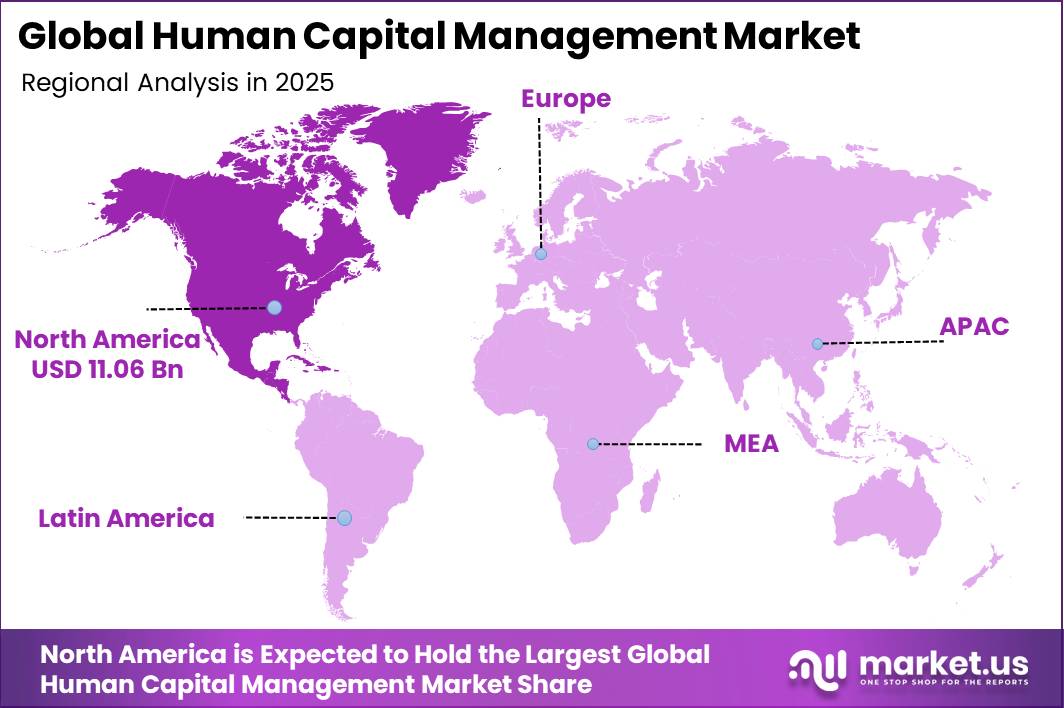
In 2025, the Global Human Capital Management Market was valued at USD 30.8 billion. The market is projected to grow at a CAGR of 9.2% during 2026–2035, reaching approximately USD 74.2 billion by 2035. North America dominated the global market in 2025, accounting for more than 35.9% of the total market share and generating approximately USD 11.06 billion in revenue.
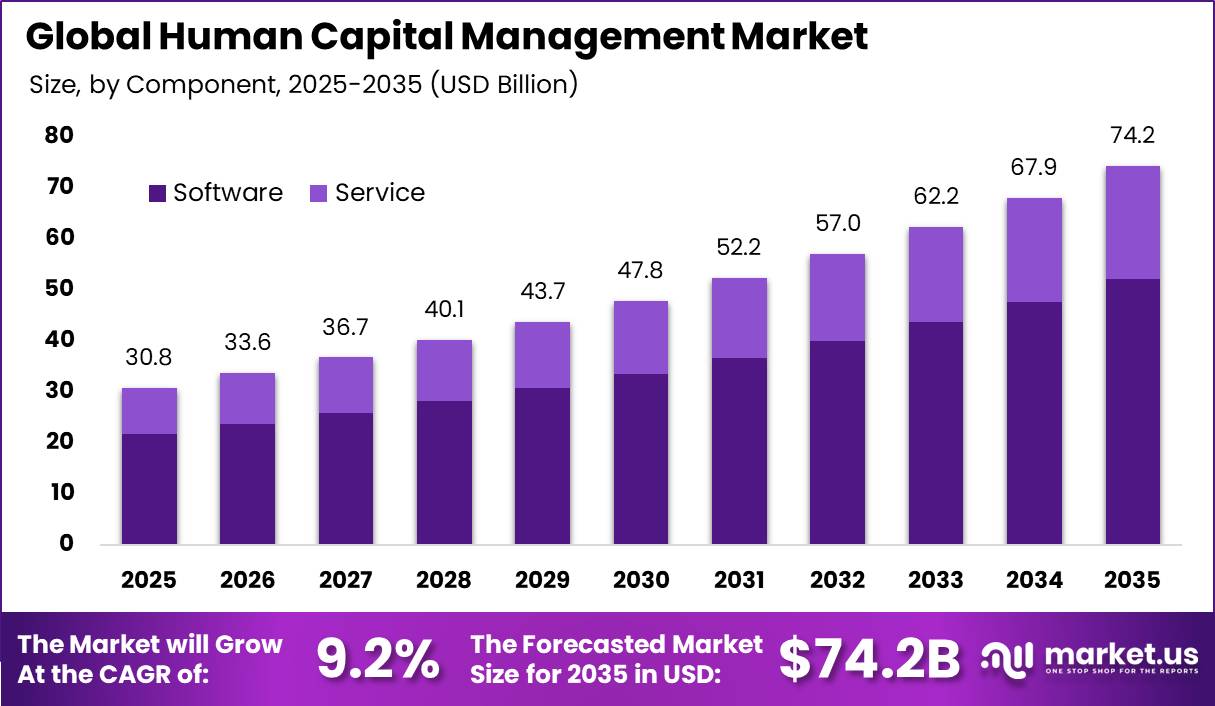
This represents an increase of around USD 43.4 billion over the forecast period. Growth is being supported by the need for businesses to manage larger, distributed, and increasingly regulated workforces through integrated digital platforms. HCM solutions support payroll, recruitment, employee records, time and attendance, learning, performance management, benefits, and workforce analytics.
The U.S. Bureau of Labor Statistics projects total U.S. employment to increase from 170.0 million jobs in 2024 to 175.2 million by 2034, adding about 5.2 million jobs. Growth in healthcare and social assistance and professional, scientific, and technical services is expected to create additional demand for automated HR and workforce management tools.
The U.S. Census Bureau recorded 446,993 new business applications in May 2025, including 159,009 high-propensity applications. These emerging businesses require payroll, hiring, tax reporting, employee records, and benefits management. Combined with the projected addition of 5.2 million U.S. jobs through 2034, this trend is expected to support continued HCM adoption across small, mid-sized, and large enterprises.
Key Takeaway
- The Human Capital Management market was valued at USD 30.8 billion in 2025 and is projected to reach USD 74.2 billion by 2035, growing at a CAGR of 9.2%.
- The software segment is dominated by components with a 70.2% share, supported by rising cloud adoption.
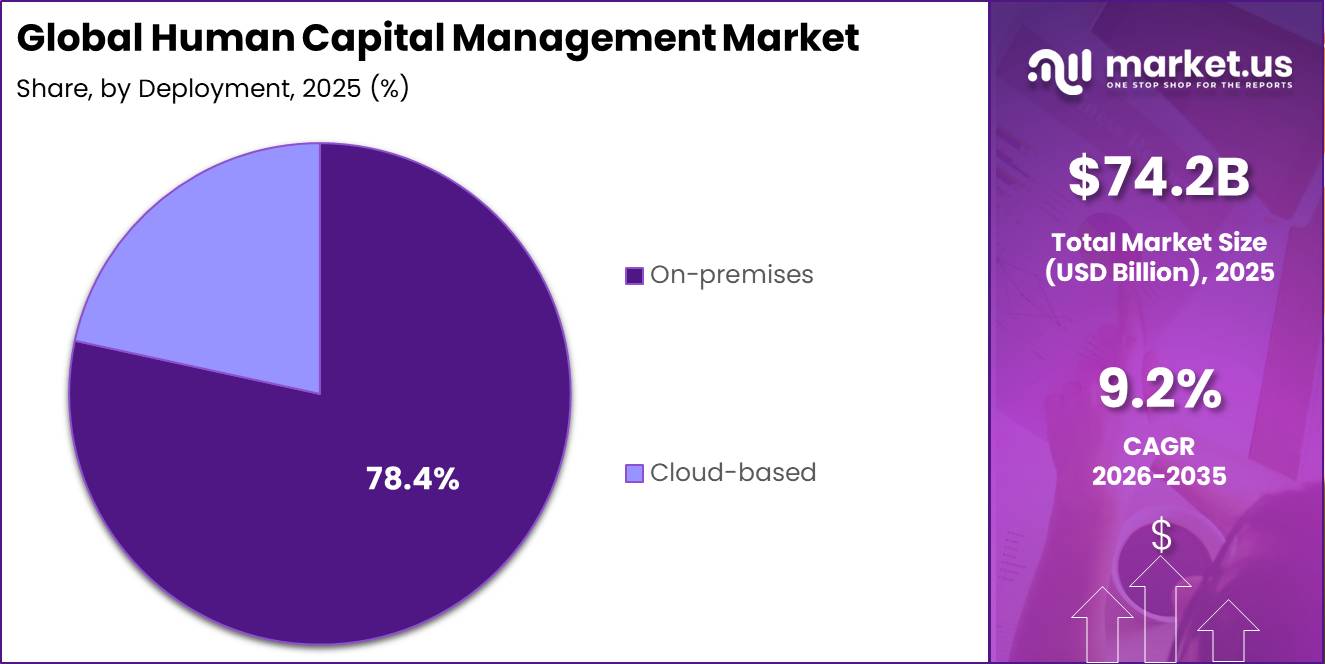
- The on-premises segment was led by deployment with a 78.4% share, driven by data security and control needs.
- The IT and telecom vertical led the industry with a 22.7% share, supported by a large, distributed technical workforce.
- North America led the market in 2025 with a 35.9% share, generating approximately USD 11.06 billion in revenue.
By Component
The Software segment dominates the Human Capital Management market with a 70.2% share, supported by its central role in managing employee records, payroll, recruitment, benefits, attendance, learning, and workforce reporting. Software remains part of everyday HR operations and also supports recurring subscription-based revenue for vendors.
Growing cloud adoption is further strengthening this segment. In 2025, around 52.7% of EU enterprises used paid cloud computing services, representing an increase of 7.4 percentage points from 2023. Cloud adoption among large enterprises reached 84.7%, showing strong demand for digital business systems. In addition, 46.5% of EU enterprises used enterprise resource planning software.
HCM software supports this trend by connecting workforce information with finance, compliance, payroll, and business planning. Demand is also driven by the scale of employee benefits administration. The U.S. Department of Labor oversees around 2.8 million health plans, 837,000 private pension plans, and 521,000 welfare benefit plans, covering nearly 155 million workers, retirees, and dependents.
By Deployment
The On-premises deployment segment dominates the Human Capital Management market with a 78.4% share, mainly because large enterprises, government organizations, and regulated industries require greater control over sensitive employee, payroll, identity, and benefits data. On-premises HCM systems allow organizations to store information within their own IT infrastructure, apply internal security rules, integrate with older finance and attendance systems, and manage customized compliance processes.
This approach remains important for public-sector and critical-service organizations where data security and operational control are major priorities. In FY2025, the U.S. federal government proposed around USD 75 billion for civilian-agency IT spending and approximately USD 13 billion for civilian cybersecurity activities, showing continued investment in secure technology infrastructure.
In 2025, the U.S. Government Accountability Office also identified 11 critical legacy systems across 10 major federal agencies, highlighting the continued dependence on older internal platforms. Since HCM systems are often connected with these existing enterprise applications, rapid migration can create security, data-transfer, and business-continuity risks.
By Industry Vertical
The IT and Telecom Vertical dominates the Human Capital Management market with a 22.7% share, supported by its large, skilled, globally distributed, and rapidly changing workforce. According to the International Telecommunication Union, around 6 billion people used the internet in 2025, while global 5G subscriptions reached about 3 billion and network coverage expanded to 55% of the global population.
The continued growth of digital networks, software platforms, cloud services, and connected technologies is increasing the need for technology and telecom companies to recruit, train, schedule, pay, and retain technical employees across multiple locations. In the United States, the Bureau of Labor Statistics projects software developer employment to increase by 267,700 jobs, or 15.8%, between 2024 and 2034.
Key Market Segments
By Component
- Software
- Service
By Deployment
- Cloud-based
- On-premises
By Industry Vertical
- IT and Telecom
- BFSI
- Retail
- Healthcare
- Hospitality
- Government
- Manufacturing
- Others
Geopolitical Impact Analysis
Geopolitical disruption affects the Human Capital Management (HCM) market mainly by increasing the cost and reducing the availability of the technology infrastructure required to deliver HCM software. These platforms depend on cloud data centres, servers, networking equipment, semiconductors, and skilled implementation teams.
Trade tensions can increase the cost of imported servers, storage systems, and network equipment used by cloud providers and enterprise IT departments. The World Trade Organization projected global merchandise trade volume to decline by 0.2% in 2025 under conditions prevailing in April 2025, while wider trade-policy uncertainty could reduce growth by another 0.8 percentage points.
Regional conflicts and shipping disruptions can also increase data-centre operating and equipment costs. UNCTAD reported that Red Sea and Suez Canal disruptions added 148 percentage points to the 120% cumulative increase in the China Containerized Freight Index between October 2023 and June 2024, as vessels were rerouted around the Cape of Good Hope.
Higher shipping costs affect servers, networking hardware, backup systems, and replacement parts. Energy prices add further pressure. The International Energy Agency reported average EU wholesale electricity prices of about USD 90/MWh in the first half of 2025, around 30% higher than the same period in 2024.
Regional Analysis
North America dominated the global Human Capital Management (HCM) market in 2025, accounting for 35.9% of total revenue and generating approximately USD 11.06 billion. The region’s strong position is supported by a large base of digitally advanced enterprises, high labour costs, widespread enterprise software adoption, and complex requirements related to payroll, benefits, tax reporting, workforce scheduling, and employee-data management.
The United States remains the largest demand centre, supported by major employers across technology, financial services, healthcare, retail, and professional services. Canada also supports regional growth through its expanding digital economy. The country’s ICT sector generated CAD 131.6 billion in GDP in 2024, representing 5.8% of national GDP, and employed more than 802,900 people.
Asia Pacific is expected to be the fastest-growing regional HCM market, supported by rapid digitalisation, expanding service industries, a large workforce, and increasing adoption of cloud-based business applications. East Asia and Pacific economies accounted for 56% of developing-country cloud-service revenue in 2021, while regional cloud-market growth was projected at 36% through 2025.
Key Regions and Countries
North America
- US
- Canada
Europe
- Germany
- France
- The UK
- Spain
- Italy
- Rest of Europe
Asia Pacific
- China
- Japan
- South Korea
- India
- Australia
- Rest of APAC
Latin America
- Brazil
- Mexico
- Rest of Latin America
Middle East & Africa
- GCC
- South Africa
- Rest of MEA
Market Dynamics
Drivers
| Driver | (~) % CAGR | Geographic Relevance | Impact Timeline |
|---|---|---|---|
| Workforce compliance digitisation | +1.8% | North America & Europe | Short term (2 years or less) |
| Skills-based workforce planning | +1.5% | OECD economies | Medium term (2 to 4 years) |
| Enterprise cloud migration | +1.3% | Global | Short term (2 years or less) |
| Payroll process automation | +1.1% | Global | Medium term (2 to 4 years) |
| Ageing workforce management | +0.9% | Europe, Japan & North America | Long term (4 years or more) |
Workforce compliance digitisation
Workforce compliance digitisation is a major HCM market driver as employers need accurate and auditable payroll, tax, benefits, working-time, and employee-record processes. OECD data show that employment across member economies reached 668 million in May 2025, while the unemployment rate stood at 4.9%, supporting high volumes of workforce administration.
Eurostat reported that 46.5% of EU enterprises used ERP software in 2025, creating a strong integration base for HCM platforms. The EU AI Act became broadly applicable on 2 August 2026, increasing governance needs for workplace technologies. These trends are supporting demand for HCM platforms with automated compliance updates, audit trails, access controls, and reporting, contributing an estimated +1.8% to the 9.2% baseline CAGR.
Restraints
| Restraint | (~) % CAGR | Geographic Relevance | Impact Timeline |
|---|---|---|---|
| Data residency restrictions | -1.4% | Europe, China & Middle East | Short term (2 years or less) |
| Enterprise budget deferrals | -1.1% | Global | Short term (2 years or less) |
| Legacy contract lock-in | -0.9% | North America & Europe | Medium term (2 to 4 years) |
| Public procurement constraints | -0.7% | Global public sector | Medium term (2 to 4 years) |
| Small-business cost sensitivity | -0.6% | Emerging markets | Short term (2 years or less) |
Data residency restrictions
Data residency restrictions remain a major restraint for HCM providers because these platforms manage sensitive employee, payroll, tax, medical-benefit, and performance information. The European Commission states that general-purpose AI obligations became applicable on 2 August 2025, while employment-related high-risk AI requirements are scheduled for 2 December 2027, increasing compliance and localisation costs.
Eurostat reported that 52.7% of EU enterprises used paid cloud services in 2025, creating a large installed base that must review hosting locations, processor contracts, and cross-border data safeguards. These requirements can delay multinational HCM deployments, raise legal and local-hosting expenses, and create an estimated -1.4% drag on the baseline CAGR.
Challenges
| Challenge | (~) % CAGR | Geographic Relevance | Mitigation Horizon |
|---|---|---|---|
| Fragmented payroll rules | -1.3% | Global | Long term (4 years or more) |
| HR data quality | -1.0% | Global | Medium term (2 to 4 years) |
| Cybersecurity operating burden | -0.9% | Global | Long term (4 years or more) |
| Implementation talent shortages | -0.8% | North America, Europe & Asia Pacific | Medium term (2 to 4 years) |
| Multi-system integration complexity | -0.7% | Global | Medium term (2 to 4 years) |
Fragmented payroll rules
Fragmented payroll rules remain a major operational challenge for global HCM providers. Employers must manage different wage rules, taxes, social contributions, leave policies, and reporting requirements across countries. OECD data show that the old-age dependency ratio increased from 19% in 1980 to 31% in 2023 and could reach 52% by 2060, increasing pension and benefits-administration complexity.
Labour shortages add further pressure. In April 2025, 1 in 4 service-sector firms in the euro area reported labour shortages as a production constraint. The International Labour Organization also identifies more than 170 countries and territories with different labour-law frameworks. Maintaining local payroll rules, compliance updates, testing, and implementation capabilities creates an estimated -1.3% drag on maximum market growth.
Opportunities
| Opportunity | (~) % Potential CAGR Upside | Geographic Relevance | Execution Window |
|---|---|---|---|
| Agentic HR workflow monetisation | +1.9% | North America, Europe & Asia Pacific | Medium term (2 to 4 years) |
| Frontline workforce platforms | +1.4% | Asia Pacific & Latin America | Medium term (2 to 4 years) |
| Embedded financial wellness | +1.1% | Global | Medium term (2 to 4 years) |
| Cross-border employer services | +1.0% | Global | Long term (4 years or more) |
| Workforce analytics subscriptions | +0.8% | OECD economies | Short term (2 years or less) |
Agentic HR workflow monetisation
Agentic HR workflow monetisation remains a future growth opportunity, as most employers still use HCM mainly for payroll, compliance, and employee records. The European Commission states that general-purpose AI obligations started on 2 August 2025, while employment-related high-risk AI rules are expected from 2 December 2027.
OECD data show that the employment rate reached 72.1% in Q1 2025, while the working-age population could decline by 8% by 2060. ITU also reported 6.0 billion internet users in 2025, expanding the digital workforce base. By automating repetitive HR workflows, vendors could reduce service-handling effort by around 20%–35% and potentially add about +1.9% above the baseline CAGR.
Key Players Analysis
The Human Capital Management market is led by Tier-1 platform providers, including ADP, Workday, SAP, Oracle, UKG, and Dayforce, which together are estimated to account for around 55–65% of global HCM spending. ADP remains the largest payroll-focused provider. In FY2025, the company generated USD 20.5 billion in revenue, up 7%, and invested USD 1.3 billion in research and development.
Workday reported USD 7.7 billion in subscription revenue, increasing 16.9%, while product-development spending reached USD 2.6 billion, representing about 31% of total revenue. Its subscription backlog stood at USD 25.06 billion.
SAP and Oracle maintain strong positions among multinational enterprises by integrating HCM with ERP, finance, procurement, and supply-chain systems. SAP generated EUR 21.02 billion in cloud revenue in 2025, including EUR 18.1 billion from its Cloud ERP Suite, which grew 28%.
Oracle invested USD 9.9 billion in R&D during FY2025, while applications cloud services and licence support generated USD 19.3 billion. Dayforce also remains an important workforce-management provider, with Thoma Bravo agreeing to acquire it for approximately USD 12.3 billion.
Tier-2 challengers include Cegid, JazzHR, Cezanne HR, Mercer, CompTIA, and Accenture. Accenture reported USD 69.7 billion in FY2025 revenue, invested USD 1.5 billion across 23 acquisitions, spent USD 800 million on R&D, and generated USD 2.7 billion from generative-AI work.
Top Key Players in the Market
- ADP Inc.
- Workday Inc.
- SAP SE
- Oracle Corporation
- JazzHR
- UKG Inc.
- CompTIA Inc.
- Accenture
- Cegid
- Dayforce, Inc.
- Cezanne HR
- Mercer LLC
Recent Developments
- In 2026, Thoma Bravo completed its acquisition of Dayforce on February 4 for approximately USD 12.3 billion, taking the HCM software provider private. Under the transaction, Dayforce shareholders became entitled to receive USD 70.0 per share in cash, while the company’s shares ceased trading and were set to be delisted from the New York Stock Exchange and Toronto Stock Exchange.
- In 2026, Workday reported on February 24 that it had completed the acquisition of Pipedream, an integration platform designed for AI agents. Pipedream provides more than 3,000 pre-built connectors to business applications, expanding Workday’s ability to connect HR, finance, and AI-agent workflows with external enterprise systems.
Report Scope
| Report Features | Description |
|---|---|
| Market Value (2025) | USD 30.8 Billion |
| Forecast Revenue (2035) | USD 74.2 Billion |
| CAGR (2026-2035) | 9.2% |
| Base Year for Estimation | 2025 |
| Historic Period | 2020-2024 |
| Forecast Period | 2026-2035 |
| Report Coverage | Revenue Forecast, Market Dynamics, Competitive Landscape, Recent Developments |
| Segments Covered | By Component (Software, Service); By Deployment (Cloud-based, On-premises); By Industry Vertical (IT and Telecom, BFSI, Retail, Healthcare, Hospitality, Government, Manufacturing, Others) |
| Regional Analysis | North America – US, Canada; Europe – Germany, France, The UK, Spain, Italy, Rest of Europe; Asia Pacific – China, Japan, South Korea, India, Australia, Singapore, Rest of APAC; Latin America – Brazil, Mexico, Rest of Latin America; Middle East & Africa – GCC, South Africa, Rest of MEA |
| Competitive Landscape | ADP Inc., Workday Inc., SAP SE, Oracle Corporation, JazzHR, UKG Inc., CompTIA Inc., Accenture, Cegid, Dayforce, Inc., Cezanne HR, Mercer LLC |
| Customization Scope | We will provide customization for segments and region/country levels. Additional customization can be done based on requirements. |
| Purchase Options | We have three licenses to opt for: Single User License, Multi-User License (Up to 5 Users), Corporate Use License (Unlimited Users and Printable PDF) |





























