Quick Navigation
- Introduction
- Editor’s Choice
- Historical Facts
- General Huawei Statistics and Facts
- Huawei Mobile Market Share
- Huawei Mobile Statistics by Country
- Huawei’s Revenue by Geographical Region
- Huawei Revenue by Segment
- Huawei Tablet Market Statistics
- Operating System Statistics of Huawei Technologies
- Huawei Technologies Demographics Statistics
- Huawei Technologies Statistics by Device
- Financial Statistics of Huawei Technologies
- Huawei Technologies Impact of Digital Intelligence
- Huawei Technologies Innovations and Performance Statistics
- Fun Facts
- Recent Developments
- Huawei Future Predictions
- Conclusion
Introduction
Huawei Technologies Statistics: Huawei is a prominent global provider of information and communications technology (ICT) that has evolved since its establishment in 1987 into a significant enterprise serving over one-third of the global population across more than 170 nations.
The organisation operates in multiple sectors, including carrier networks, enterprise solutions, consumer products, and cloud computing, and has made substantial investments in research and development, which serve as a key driver of its innovation. In spite of encountering challenges due to sanctions, it continues to hold the position of the largest smartphone vendor in China and the foremost telecommunications equipment manufacturer worldwide.
Recently, the company has made a notable impact on the international market. The utilisation of Huawei statistics, which have become increasingly common, encompasses insights from various sectors that illuminate the industry’s remarkably rapid growth in different regions around the globe.
Editor’s Choice
- In 2023, Huawei significantly contributed to the advancement of 5G technology, accounting for 58% of all 5G base stations in China.
- In the first quarter of 2023, Huawei achieved a smartphone market share of 25.31% in China.
- In February 2024, the United States held a market share of 0.41% for Huawei Mobile.
- In 2023, Huawei reported a revenue of approximately 471 billion yuan (around USD 66.2 billion) from its operations within China.
- According to global tablet shipment statistics, in the fourth quarter of 2023, Huawei delivered approximately 2.815 million tablets, securing a market share of 7.5%.
- As of February 2024, the distribution of users on the website by gender is 64.44% male and 35.56% female.
- The highest profit over the past five years occurred in 2020, amounting to CNY 121.41 billion.
Historical Facts
- Ren Zhengfei, who previously served as the deputy director of the engineering corps of the People’s Liberation Army, established Huawei in 1987 in Shenzhen.
- Huawei indicates that at the time of its inception, it had registered capital amounting to RMB 21,000 (approximately $5,000 at that time), contributed by Ren Zhengfei and five other investors, each providing RMB 3,500.
- To thrive amid challenging competition from Alcatel, Lucent, and Nortel Networks, Huawei concentrated on low-income and hard-to-reach market segments in 1992.
- In 1997, Huawei secured a contract to supply fixed-line network products to Hutchison Whampoa, a company based in Hong Kong.
- In May 2003, Huawei entered into a partnership with 3Com to form a joint venture called H3C, which specialized in enterprise networking equipment.
- By 2005, Huawei’s orders from foreign contracts surpassed its domestic sales for the first time.
- In 2007, Huawei initiated a joint venture with the US security software firm Symantec Corporation, which was named Huawei Symantec.
- In July 2010, Huawei made its debut on the Global Fortune 500 list published by Fortune magazine, thanks to annual sales of US$21.8 billion and a net profit of US$2.67 billion.
- In October 2012, it was revealed that Huawei would relocate its UK headquarters to Green Park, Reading, Berkshire.
- Since 2016, Huawei has broadened its operations in Ireland. In addition to a headquarters in Dublin, it has established facilities in Cork and Westmeath.
- In April 2019, Huawei inaugurated the Huawei Malaysia Global Training Centre (MGTC) in Cyberjaya, Malaysia.
- By 2020, Huawei played a significant role in the establishment of approximately 70% of Africa’s 4G networks.
- In February 2023, Huawei was accepted as an associate member of the UNESCO Global Alliance for Literacy (GAL).
General Huawei Statistics and Facts
- In 2023, Huawei significantly contributed to the advancement of 5G technology, accounting for 58% of all 5G base stations in China.
- The company’s smartphone division performed admirably, achieving USD 98.5 billion in revenue, reflecting a 9% increase compared to 2022.
- Nevertheless, despite being the leading smartphone brand in China with a 23.22% market share, this figure was still 10.24% lower than the previous year.
- In terms of website traffic, 83.02% of visitors accessed Huawei.com via mobile devices, while +16.98% utilized desktop computers.
- In July 2023, Huawei was recognized as the world’s sixth-largest smartphone manufacturer, holding a 4% market share.
- Conversely, the Trade Union Committee possesses 98.99% of the company’s shares, with over 121,000 employees involved in ownership.
- The Middle East and Africa emerged as crucial international markets, generating over 145 billion yuan in revenue.
- Revenue recorded for the first three quarters of 2023 amounted to USD 62.4 billion, marking a 2.4% increase from the previous year.
- During the same timeframe, Huawei shipped around 14.3 million smartphones in China, reflecting a 40% increase.
- In the first half of 2023, Huawei’s global revenue was approximately CNY 310.9 billion (USD 42.9 billion), with its net profit margin increasing by 15%.
- Huawei’s consumer revenue reached USD 14.27 billion.
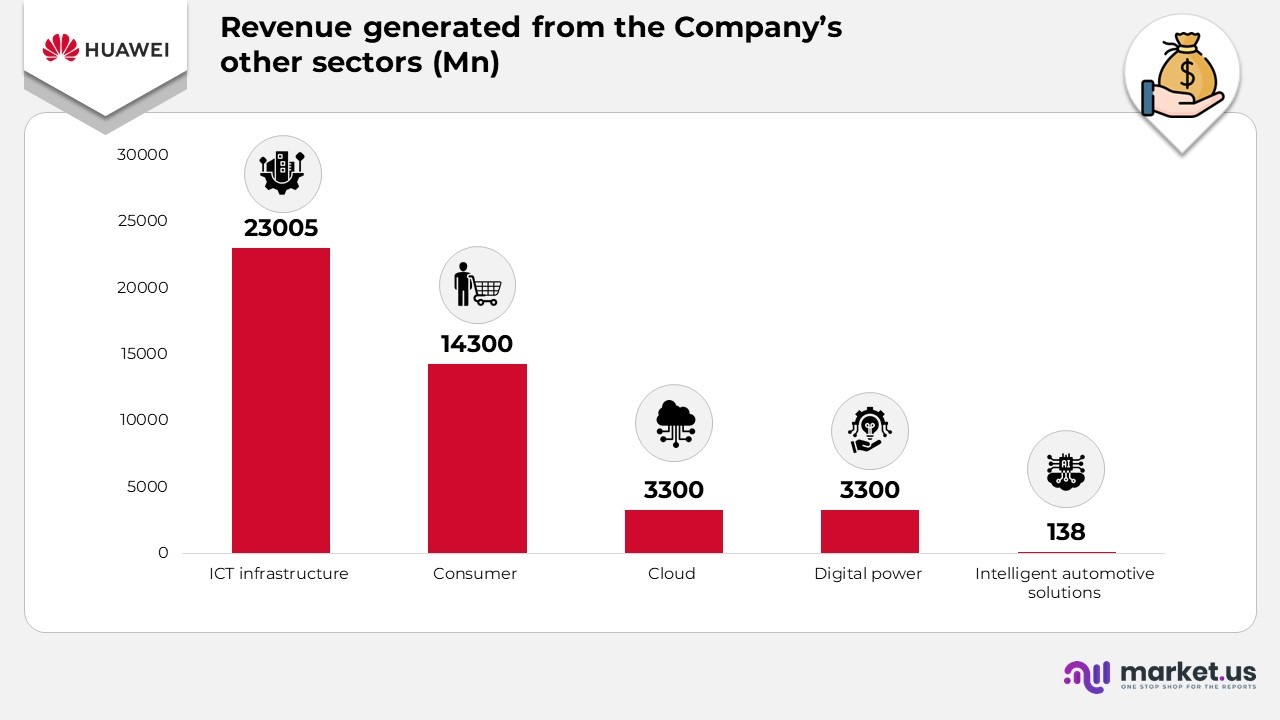
- Furthermore, Huawei Statistics indicate that revenue generated from the Company’s other sectors includes ICT infrastructure (USD 23.05 billion), Consumer (USD 14.3 billion), Cloud (USD 3.3 billion), Digital power (USD 3.3 billion), and Intelligent automotive solutions (USD 137.8 million).
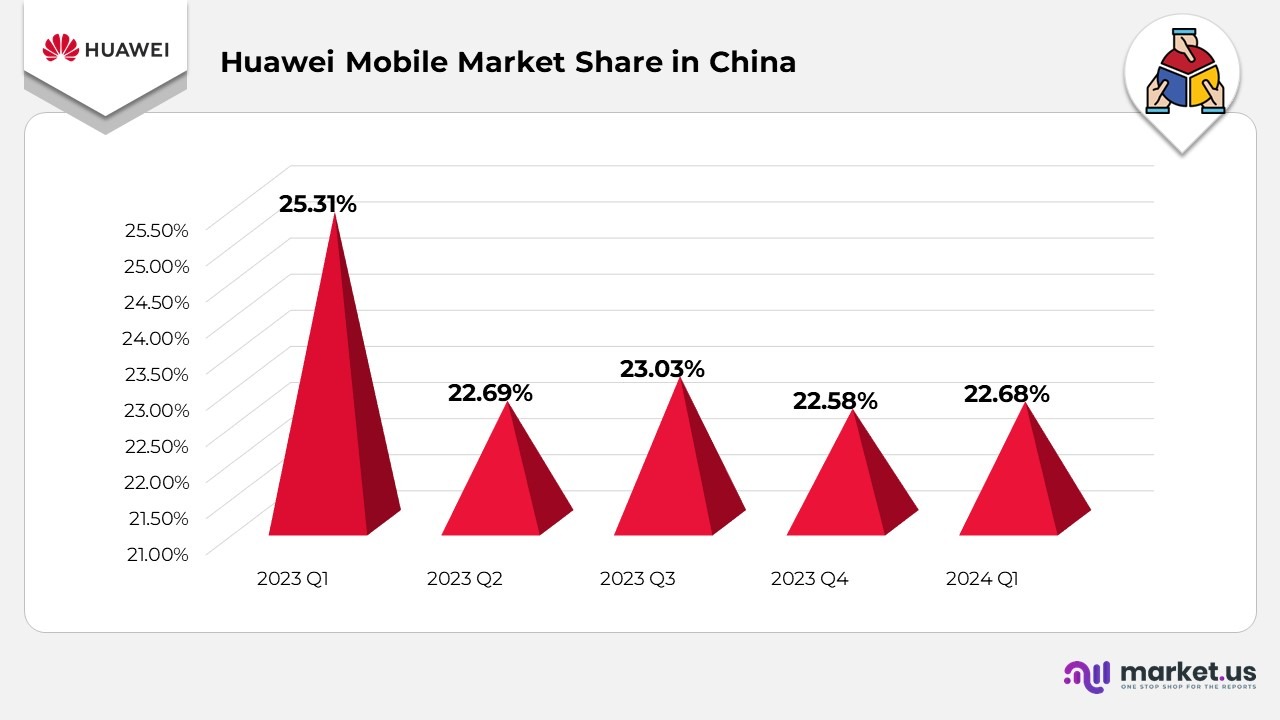
- In the first quarter of 2023, Huawei achieved a smartphone market share of 25.31% in China.
- Other quarterly market shares include Q2 at 22.69%, Q3 at 23.03%, and Q4 at 22.85%.
- For the first quarter of 2024, Huawei’s market share is projected to be 22.68%, indicating a minor decrease of 2.63% compared to 2023.
- As of 2024, Huawei holds the second position in the Chinese smartphone market, having shipped 46.0 million units, which represents a 37% increase year-on-year.
- In 2024, Huawei’s smartphone shipments experienced a growth of over 50%.
Huawei Mobile Statistics by Country
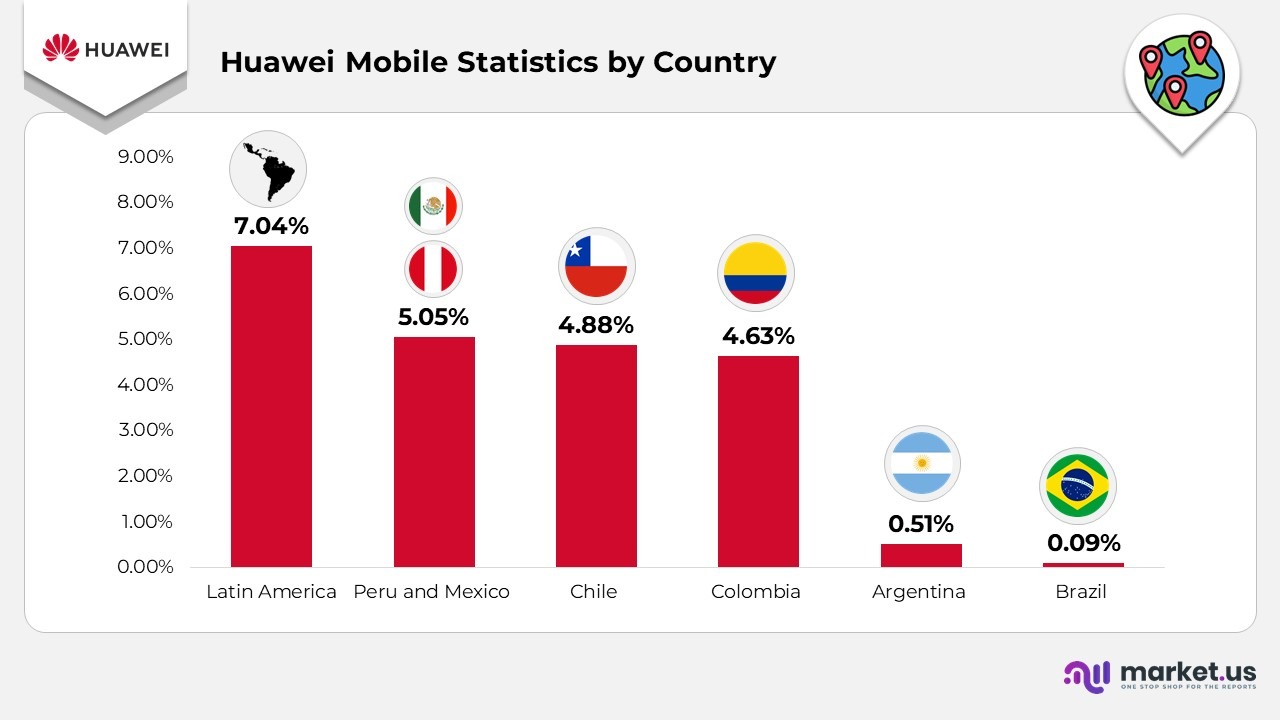
- In the second quarter of 2024, Huawei’s smartphone market share in Latin American nations was recorded at 7.04%, with Peru and Mexico both at 5.05%, followed by Chile at 4.88%, Colombia at 4.63%, Argentina at 0.51%, and Brazil at 0.09%.
- In February 2024, the United States held a market share of 0.41% for Huawei Mobile.
- Additionally, the market shares in other countries include the United Kingdom at 2.13%, Canada at 0.88%, Germany at 3.78%, Australia at 0.92%, Belgium at 2.64%, China at 20.88%, Denmark at 2.35%, Egypt at 9.72%, France at 4.35%, Hong Kong at 3.77%, and Indonesia at 0.28%.
Huawei’s Revenue by Geographical Region
- In 2023, Huawei reported a revenue of approximately 471 billion yuan (around USD 66.2 billion) from its operations within China.
- Huawei’s headquarters is situated in Shenzhen, China, which serves as a significant center for technological progress.
- In recent years, the company has redirected its business emphasis from carrier networks to technological innovations.
- From its ICT infrastructure sector, Huawei generated over 360 billion yuan (approximately USD 50.6 billion).
- Since 2012, Huawei’s investment in research and development has risen dramatically, increasing from nearly 30 billion yuan (about USD 4.2 billion) to over 162 billion yuan (approximately USD 22.8 billion).
- The global recognition of Huawei’s brand has notably enhanced, establishing it as a prominent technology brand internationally.
- During the first quarter of 2012, Huawei’s smartphones represented roughly 3% of global shipments.
- Huawei’s global market share reached a peak of 20%, but the company faced a considerable decline in its market position by 2021.
Huawei Revenue by Segment
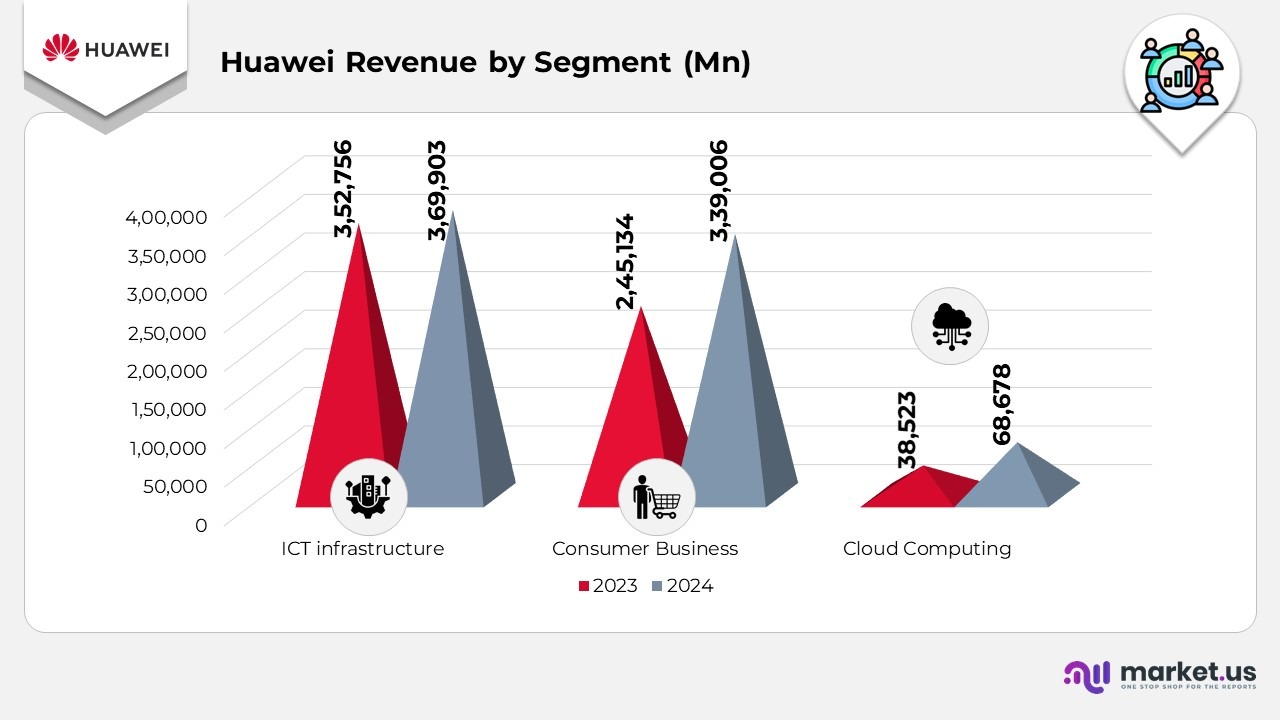
- Huawei’s total revenue rose to CNY 862,072 million in 2024, marking a significant increase from CNY 704,174 million in 2023, which reflects the company’s strong growth across all sectors.
- The ICT infrastructure segment remained the primary contributor, generating CNY 369,903 million, an uptick from the previous year’s CNY 352,756 million.
- The Consumer Business also saw a remarkable increase, with revenue climbing from CNY 245,134 million in 2023 to CNY 339,006 million in 2024, largely driven by smartphone and wearable sales.
- Cloud Computing steadily grew to CNY 38,523 million, while Digital Power saw a substantial rise from CNY 55,229 million to CNY 68,678 million, underscoring Huawei’s dedication to green energy initiatives.
- The Intelligent Automotive Solution achieved the highest growth rate, soaring from CNY 4,588 million to CNY 26,353 million, thereby affirming Huawei’s leadership in the smart mobility sector.
- Revenue from Other items also increased, rising from CNY 10,953 million to CNY 19,609 million, which serves as evidence of overall business growth through diversification.
Huawei Tablet Market Statistics
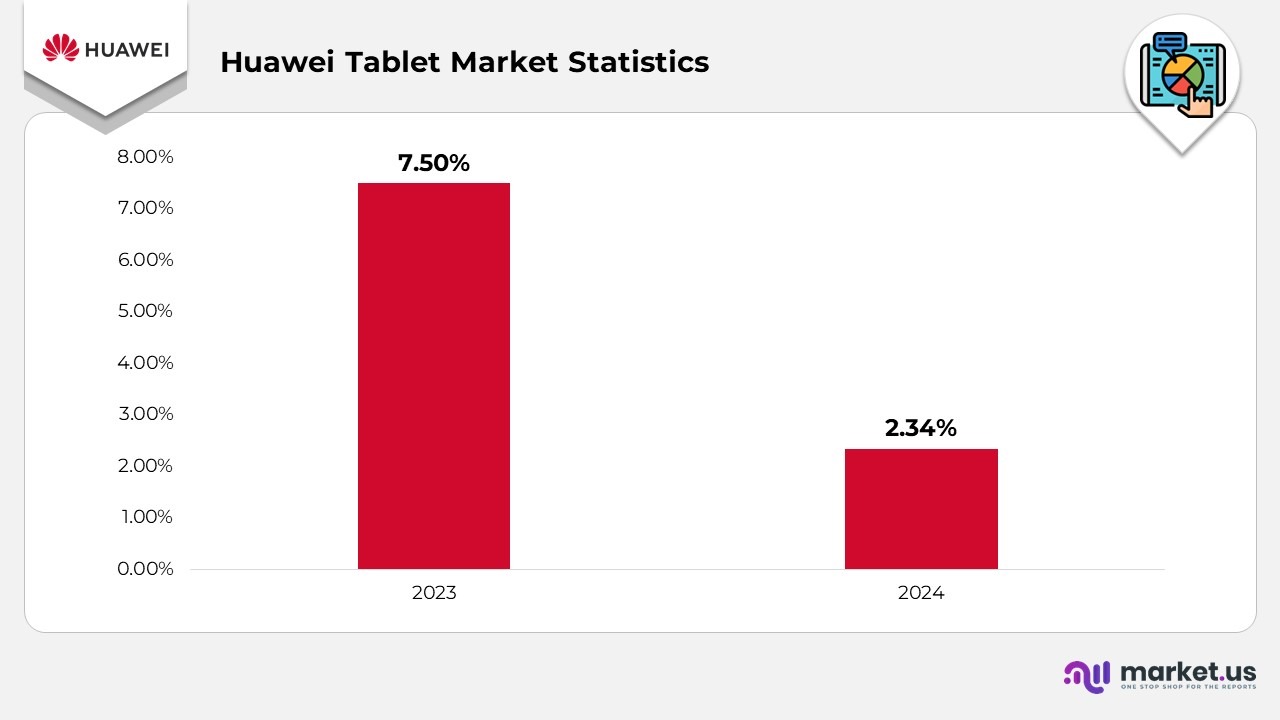
- According to global tablet shipment statistics, in the fourth quarter of 2023, Huawei delivered approximately 2.815million tablets, securing a market share of 7.5%.
- In the first quarter of 2024, Huawei’s tablet market share is projected to be 2.34%, reflecting a decrease of 0.10% from the previous quarter.
- Based on Huawei’s statistics, the quarterly tablet market shares for 2023 are as follows: Q1 (2.55%), Q2 (2.39%), Q3 (2.17%), and Q4 (2.34%).
Operating System Statistics of Huawei Technologies
- Harmony OS is recognized as the third-largest mobile operating system, following Android and iOS.
- According to Huawei Statistics, in the second quarter of 2023, Harmony OS by Huawei accounted for a 10% market share.
- Approximately 60 million users were utilizing Harmony OS 4 in 2023.
- In the third quarter of 2023, Harmony OS maintained a 3% share of the global smartphone operating system market and a 13% share within the Chinese market.
Huawei Technologies Demographics Statistics
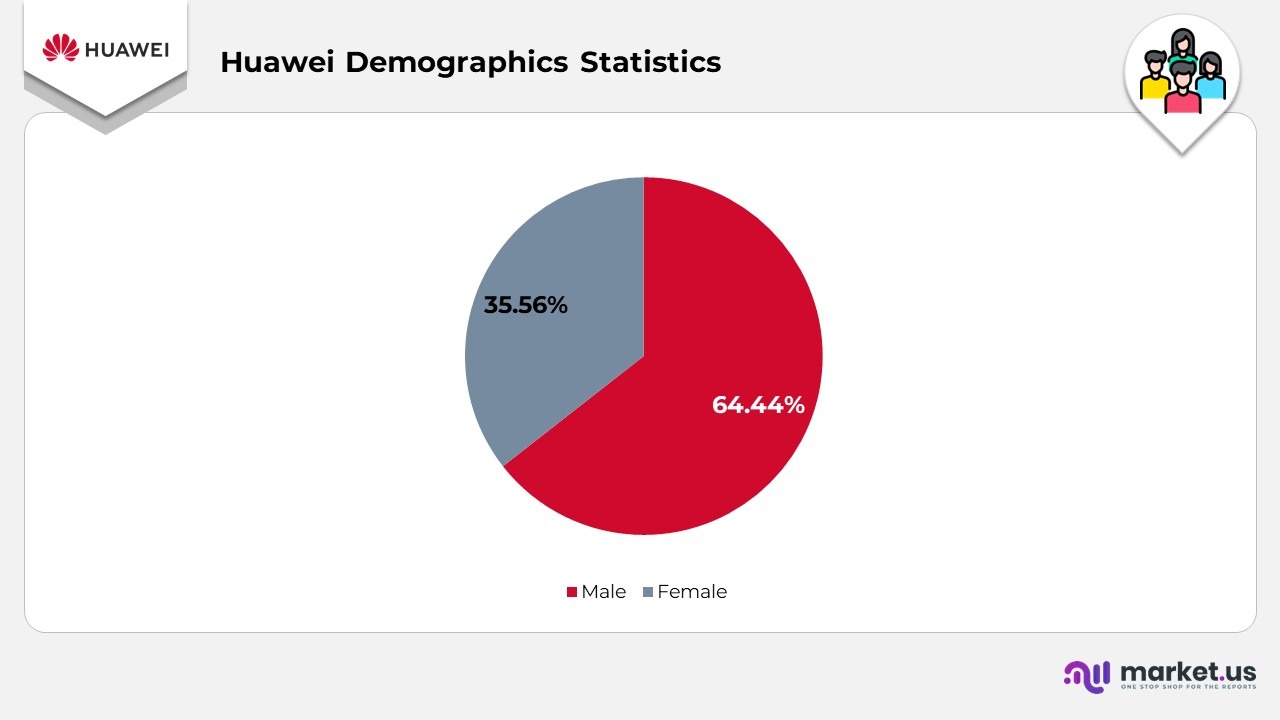
- As of February 2024, the distribution of users on the website by gender is 64.44% male and 35.56% female.
- According to Huawei Statistics by age group, the largest segment of website users is found in the 25 to 34 years age range, accounting for 36.24%.
- The next largest user share is from the 35 to 44 years age group, which represents 22.49%.
- Users aged 18 to 24 years and those aged 45 to 54 years make up 54% and 13.64% respectively.
- Additionally, 4% of users on Huawei.com are between the ages of 55 and 64 years.
- Finally, approximately 4.69% of users fall within the age group of 65 years and older.
Huawei Technologies Statistics by Device
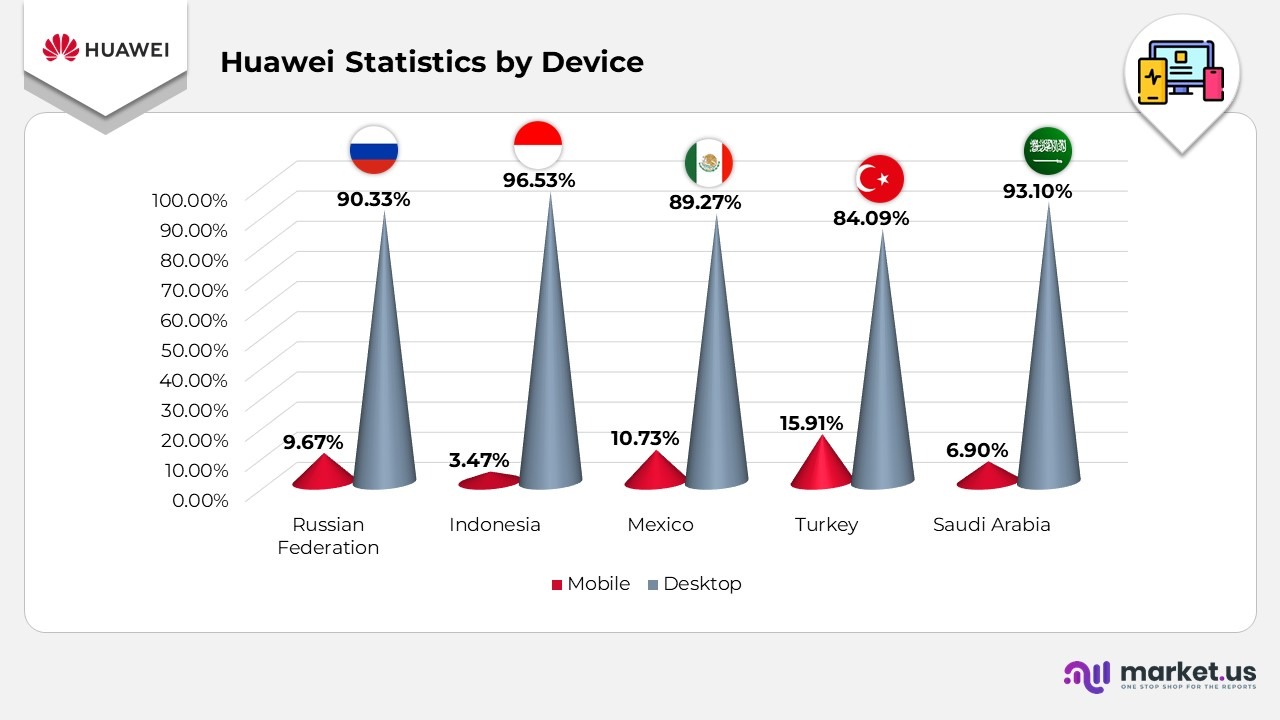
- On huawei.com, mobile users account for 83.02% of the traffic, while desktop visits make up 16.98%.
- 2% of Huawei’s market share is attributed to the Russian Federation, which possesses 8.22 million devices. Desktop visitors contribute 9.67% of the total, whereas mobile users represent 90.33%.
- Indonesia has 7.55 million users, corresponding to 9.37% of the market share. Among these, 3.47% are desktop users and 96.53% are mobile users.
- From the overall user base, 7.44% originate from Mexico, equating to 6 million devices, with 10.75% utilizing the desktop version and 89.27% accessing mobile devices.
- Turkey and Saudi Arabia each have approximately 3.39 million and 3.57 million devices, leading to user shares of 4.88% and 4.43%, respectively.
- In Mexico, 91% of users access via desktop and 84.09% via mobile; conversely, in Saudi Arabia, 6.9% use desktop while 93.1% use mobile.
Financial Statistics of Huawei Technologies
- In 2021, the company reported a revenue of CNY 642.34 billion, an increase from CNY 636.81 billion in 2020, yet a decline from its peak of CNY 891.37 billion in 2019, prior to the imposition of sanctions.
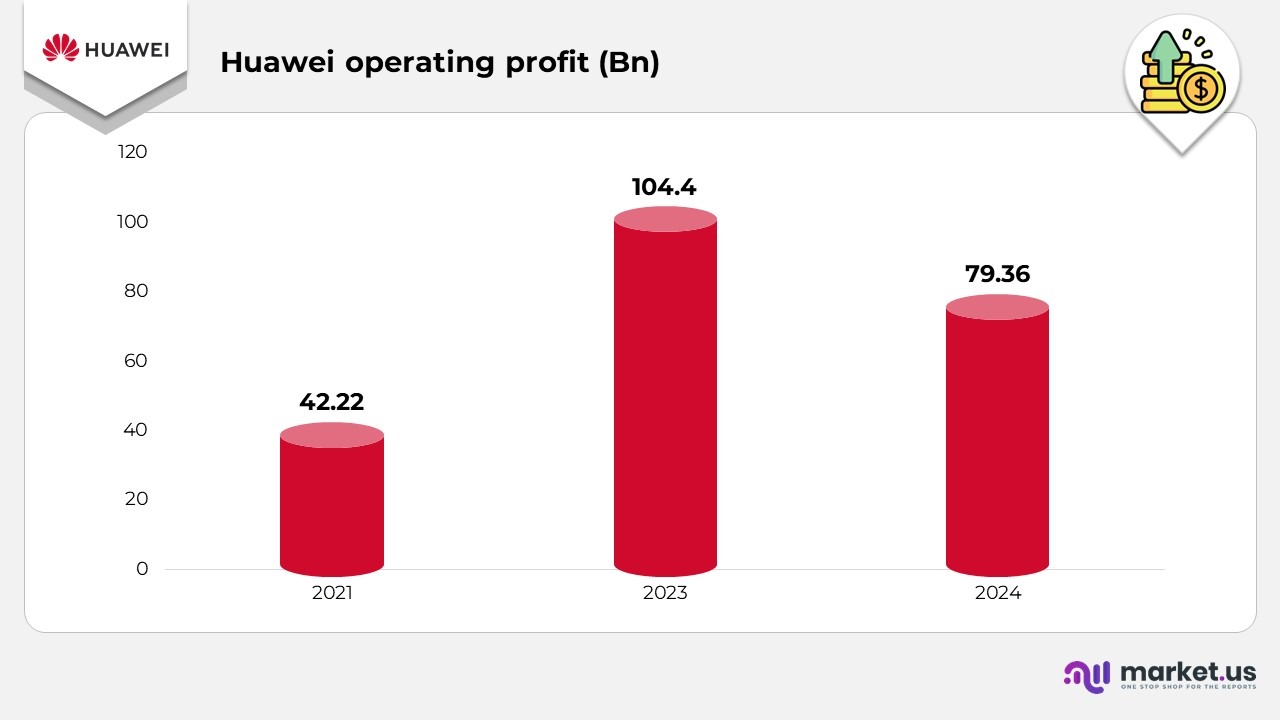
- The operating profit for 2024 was recorded at US$10.88 billion (CNY 79.36 billion), which is less than the CNY 104.40 billion noted in 2023, but still indicates significant growth compared to the CNY 42.22 billion achieved in 2021.
- The highest profit over the past five years occurred in 2020, amounting to CNY 121.41 billion.
- For 2024, the operating margin was 9.2%, which is a decrease from the 14.8% of 2023, yet an improvement over the 6.6% of 2021.
- Huawei’s net profit exhibited a similar pattern, reaching US$8.58 billion (CNY 62.57 billion) in 2024, which is lower than the CNY 86.95 billion in 2023, but still nearly double the CNY 35.56 billion recorded in 2021.
- The company’s cash and cash equivalents totaled US$51.02 billion (CNY 372.23 billion) in 2024, which remains below the CNY 475.32 billion reported in 2023.
- In 2024, the company’s working capital was US$43.75 billion (CNY 319.18 billion), reflecting a decrease from the previous year when it was CNY 421.66 billion.
Huawei Technologies Impact of Digital Intelligence
- Huawei has collaborated with over 1,400 organisations, allowing it to deliver high-quality services to more than 8,000 clients across diverse sectors.
- A Chinese automotive manufacturer received support from Huawei to establish an intelligent factory, facilitating flexible manufacturing that enabled the production of various brands on a single assembly line.
- This initiative resulted in a 20% boost in productivity, while simultaneously reducing costs and energy consumption by 20% and 19%, respectively.
- In the retail industry, Huawei, in partnership with its associates, launched the Smart Retail Store and Retail Cloud solutions, which incorporate AI, cloud technology, and big data.
- With these innovations, it is possible to connect 1,000 stores in a single day, thereby decreasing operational costs by 80% and enhancing user satisfaction.
Huawei Technologies Innovations and Performance Statistics
- In the field of networking, Huawei’s latest algorithms have not only achieved a network throughput exceeding 95% but have also enhanced communication performance by more than 55% alongside the introduction of new collective communication solutions.
- On the artificial intelligence front, the Pangu models have expanded to encompass over 400 scenarios across more than 30 industries, integrating reasoning and perception for the Celia AI assistant, which has led to a 90% success rate in task completion.
- In the area of computing, Huawei has introduced its Atlas 900 A3 Cluster, which combines computing, storage, and networking functionalities, facilitating improved inference of large language models through the application of CANN 8.0 and innovative communication techniques.
Fun Facts
- The name “Huawei” is derived from a phrase that translates to “China has promise.”
- Huawei was positioned 61st on the 2019 Fortune Global 500 list.
- The energy efficiency of key network products improved by 15% to 26%.
- Huawei actively participates in over 400 standards organisations.
- 3% of the products returned were repurposed.
- Utilised approximately 932 million kWh of clean energy, leading to a reduction in emissions of around 450,000 tons.
- The company’s Three-Star solutions connect 100 million individuals in rural regions.
Recent Developments
- In 2024, the organisation allocated CNY179.7 billion towards research and development. Representing 20.8% of its yearly revenue. Cumulatively, the company’s investment in R&D over the last ten years totals CNY1.2 trillion.
- By the end of 2024, Huawei possessed more than 150,000 active patents and had entered into over 230 patent licensing and cross-licensing agreements with numerous leading patent holders globally.
- Huawei was positioned 6th in the 2024 EU Industrial R&D Investment Scoreboard.
Huawei Future Predictions
- Huawei’s worldwide computing capability is projected to expand by 100,000 times by the year 2035. Driven by advancements in semiconductors, processes, architectures, and paradigms.
- Huawei’s storage requirements are anticipated to increase by 500 times by 2035. Artificial intelligence storage is expected to represent over 70% of the global capacity.
- By 2035, it is estimated that global data centers will utilise approximately 1.5 trillion kWh of electricity. Artificial intelligence will enhance the efficiency of renewable energy grids, with wind and solar energy projected to constitute 50% of the global energy mix.
Conclusion
Huawei is a worldwide technology firm that holds a prominent position in ICT infrastructure, cloud computing, and intelligent devices. In spite of encountering obstacles such as US sanctions, the company has sustained robust revenue growth. Primarily fueled by its enterprise and carrier sectors, and persists in making significant investments in research and development, with a considerable segment of its workforce committed to this area. Notable aspects include its extensive patent portfolio, considerable expenditure on R&D, and its aspiration to “deliver digital solutions to every individual, household, and organization.”