Report Overview
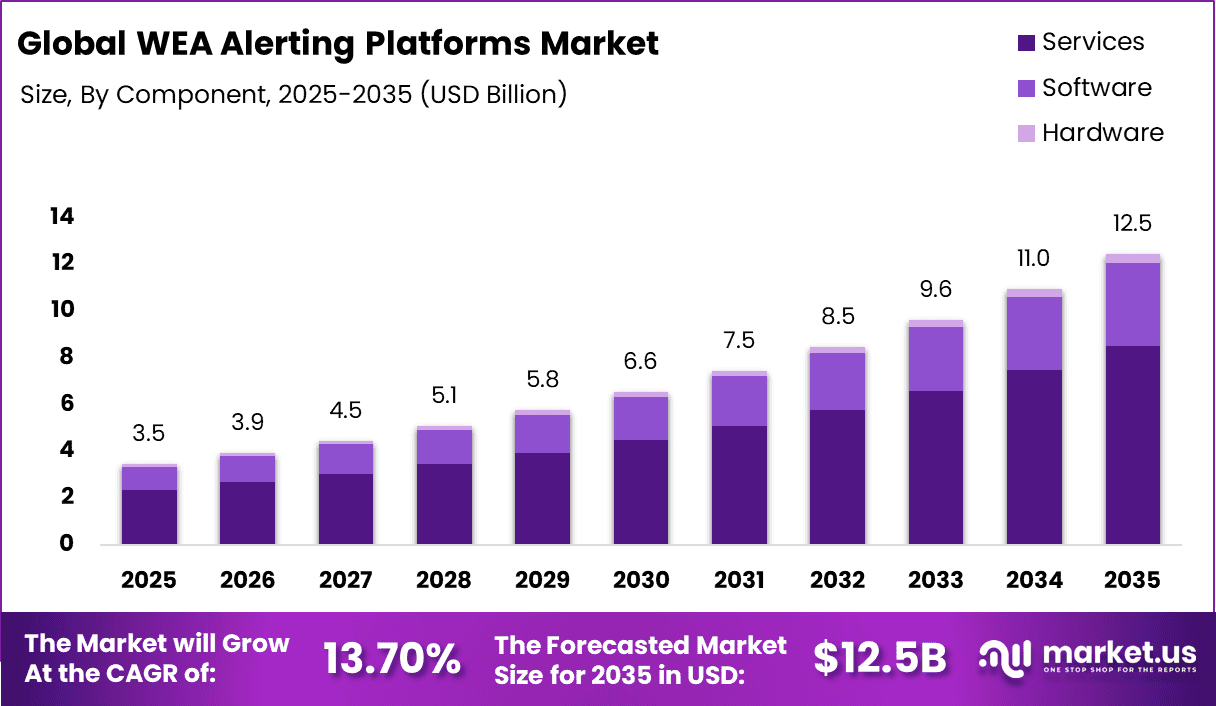
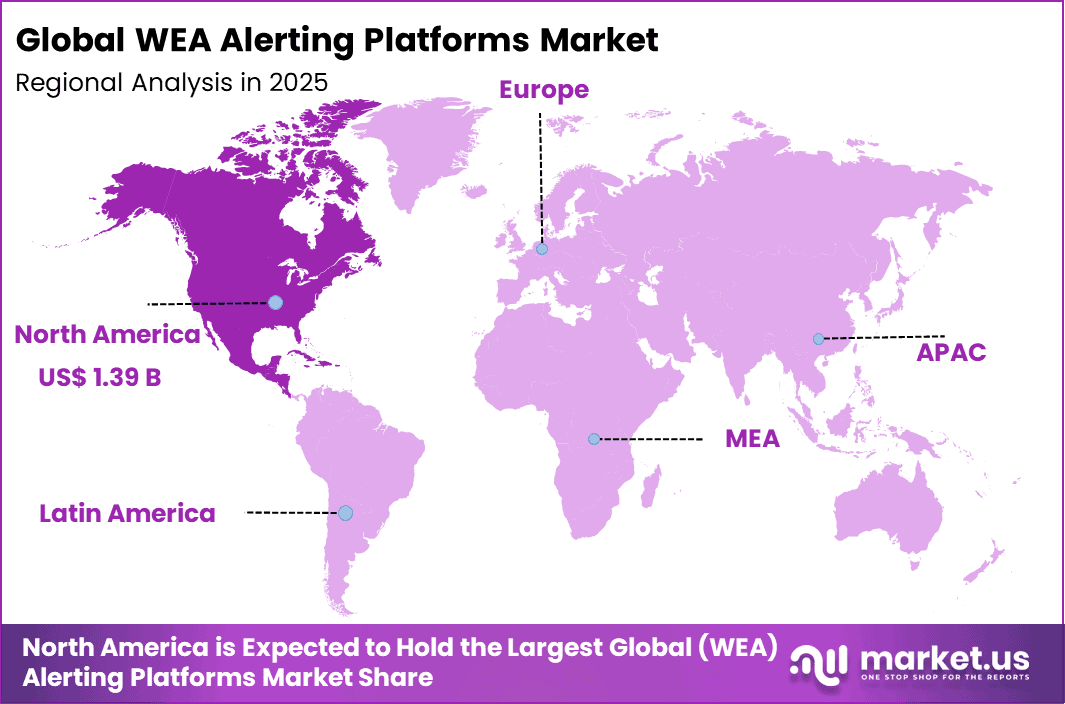
The Global Wireless Emergency Alert (WEA) Alerting Platforms Market generated USD 3.5 billion in 2025 and is predicted to register growth from USD 3.9 billion in 2026 to about USD 12.5 billion by 2035, recording a CAGR of 13.70% throughout the forecast span. In 2025, North America held a dominant market position, capturing more than a 40.3% share, holding USD 1.39 Billion revenue.
Top Market Takeaways
- Services command 68.2%, providing integration, maintenance, and customization for carrier-grade alert dissemination across IPAWS and CMF networks.
- Life-threatening emergencies capture 34.5%, enabling geo-targeted presidential alerts, imminent threat warnings, and extreme weather notifications.
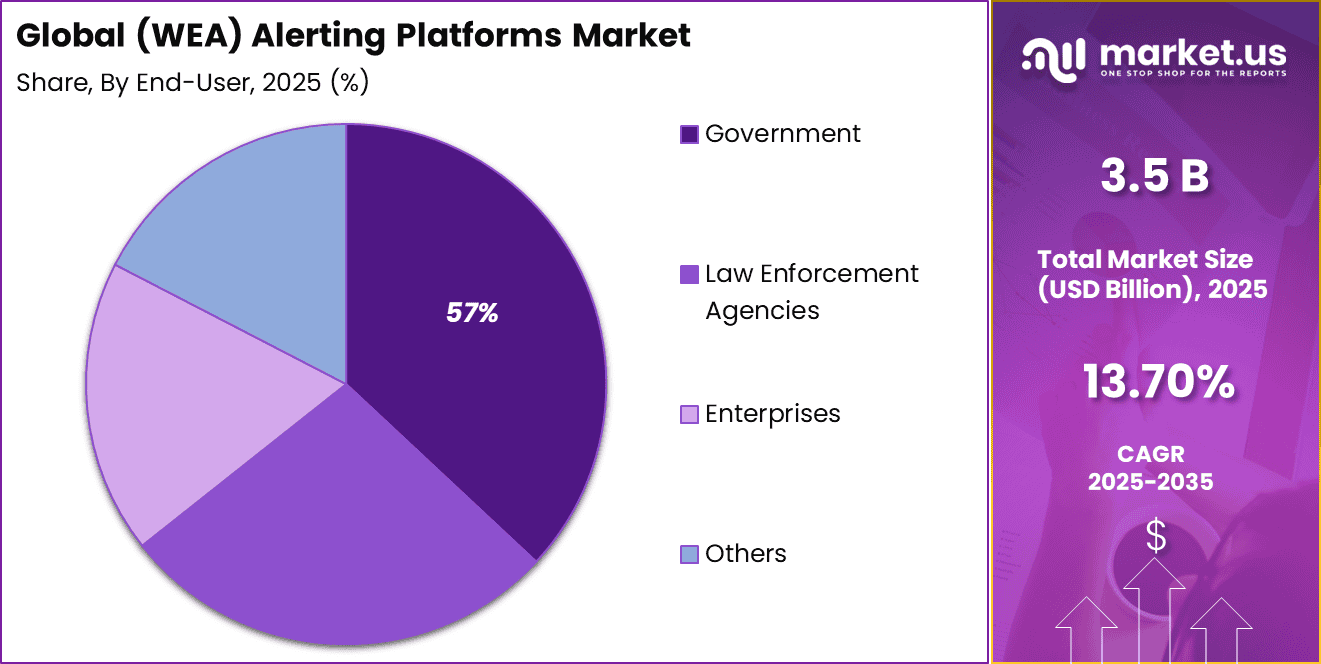
- Government end-users hold 56.7%, leveraging platforms for FEMA coordination, state-local interoperability, and real-time population reach.
- North America drives 40.3% global value, with U.S. market at USD 1.26 billion and 11.2% CAGR, fueled by regulatory mandates and disaster response enhancements.
Wireless emergency alert alerting platforms are used to deliver urgent messages to the public through mobile networks during critical situations such as natural disasters, public safety threats, and severe weather events. These platforms enable authorities to send location based alerts directly to mobile devices without requiring user subscription.
They play an important role in public safety by ensuring that timely and reliable information reaches a large population within seconds. As communication infrastructure becomes more advanced, these platforms are being integrated with broader emergency response systems to improve coordination and response efficiency.
One of the main driving factors is the increasing need for fast and reliable public warning systems. Governments and emergency agencies are focusing on improving disaster preparedness and response capabilities, which is encouraging the adoption of advanced alerting platforms.
In addition, the growing frequency of extreme weather events and other emergencies is creating demand for systems that can deliver accurate and targeted alerts. The expansion of mobile network coverage is also supporting the reach of these platforms, allowing alerts to be delivered across urban and remote areas. Improvements in location based technologies are further enhancing the ability to send alerts to specific regions without causing unnecessary disruption.
Demand for wireless emergency alert alerting platforms is rising as authorities look for effective ways to communicate with the public during emergencies. There is a strong preference for solutions that can deliver messages quickly, support multiple alert types, and operate reliably under high traffic conditions.
Organizations are also seeking platforms that can integrate with existing emergency management systems and provide clear reporting for accountability. The demand is particularly strong in regions that are prone to natural disasters or have large populations requiring coordinated communication. As public safety continues to be a priority, the need for dependable and scalable alerting platforms is expected to grow steadily.
Drivers Impact Analysis
| Key Driver | Impact on CAGR Forecast (~%) | Geographic Relevance | Impact Timeline | Additional Insight |
|---|---|---|---|---|
| Rising frequency of natural disasters and public emergencies | +3.8% | North America, Asia Pacific, Europe | Short to long term | Emergencies increase alert system demand |
| Growing government focus on public safety communication | +3.4% | North America, Europe, Middle East | Medium term | Public agencies invest in warning platforms |
| Expansion of mobile network coverage and smartphone usage | +3.0% | Global | Medium to long term | Wider mobile reach improves alert delivery |
| Increasing need for real-time mass notification systems | +2.7% | Global | Medium term | Fast alerts support timely response |
| Regulatory mandates for emergency preparedness | +2.4% | Developed markets | Medium to long term | Compliance drives platform adoption |
Restraints Impact Analysis
| Key Restraint | Impact on CAGR Forecast (~%) | Geographic Relevance | Impact Timeline | Additional Insight |
|---|---|---|---|---|
| High deployment and integration costs | -2.9% | Emerging markets | Short to medium term | Costs slow modernization projects |
| Dependence on telecom network reliability | -2.5% | Global | Medium term | Network outages affect alerts |
| Public concerns over false or excessive alerts | -2.1% | North America, Europe | Medium term | Alert fatigue reduces effectiveness |
| Complexity in multi-agency coordination | -1.8% | Global | Medium to long term | Coordination delays implementation |
| Cybersecurity and data protection risks | -1.6% | Global | Medium to long term | Security concerns impact trust |
By Component Analysis
The services segment accounted for 68.2% of the market share, reflecting its strong role in supporting deployment, integration, and ongoing management of alerting systems. This dominance is supported by the need for reliable configuration, maintenance, and real-time monitoring to ensure alerts are delivered without failure. Service providers help agencies implement systems effectively and maintain operational readiness during critical situations.
Another factor driving this segment is the increasing complexity of emergency communication networks. Organizations rely on expert support to manage system updates, compliance requirements, and performance optimization. Continuous service support ensures that alerting platforms remain functional and responsive during high-pressure scenarios.
By Application Analysis
The life-threatening emergencies segment held 34.5% share, driven by the critical need to deliver timely alerts during natural disasters, public safety threats, and severe weather events. These applications require high reliability and immediate communication to protect lives and reduce risk. Alerting platforms are designed to broadcast warnings quickly across large populations.
In addition, the rising frequency of extreme events and public safety concerns has increased the demand for effective alerting systems. Authorities are focusing on improving response times and ensuring message accuracy. This has strengthened the adoption of WEA platforms for life-threatening emergency applications.
By End-User Analysis
The government segment captured 57% of the market, reflecting its primary role in managing public safety and emergency communication systems. Government agencies are responsible for issuing alerts and ensuring that critical information reaches citizens during emergencies. This has led to strong investment in advanced alerting platforms.
Furthermore, increasing focus on disaster preparedness and national security has encouraged governments to enhance their communication infrastructure. These platforms enable efficient coordination and timely information dissemination, which is essential for effective emergency response. This has reinforced the importance of WEA alerting platforms among government users.
Investor Enablement Analysis
| Investor Type | Growth Sensitivity | Risk Exposure | Geographic Focus | Investment Outlook |
|---|---|---|---|---|
| Venture capital firms | Moderate to high | High | US, Europe | Investing in emergency communication technology |
| Private equity firms | Moderate | Moderate | North America and Europe | Scaling public safety software providers |
| Corporate investors | High | Moderate | Global | Strategic investments in telecom and safety systems |
| Institutional investors | Moderate | Low to moderate | Developed markets | Prefer stable govtech and infrastructure firms |
| Government and public funding bodies | Very high | Low | Global | Supporting national emergency readiness programs |
Technology Enablement Analysis
| Technology | Impact on CAGR Forecast (~%) | Geographic Relevance | Impact Timeline | Additional Insight |
|---|---|---|---|---|
| Cell broadcast and next-gen alert protocols | +3.9% | Global | Medium to long term | Improves rapid mass delivery |
| AI-based emergency detection and targeting | +3.4% | US, Europe | Medium term | Enhances alert accuracy |
| Cloud-based alert management platforms | +3.0% | Global | Short to medium term | Enables scalable operations |
| GIS mapping and geofencing integration | +2.7% | Global | Medium to long term | Supports location-specific alerts |
| Multi-channel notification integration | +2.4% | Global | Medium term | Expands reach across platforms |
Key Challenges
- Limited network coverage in remote or rural areas.
- Dependence on mobile network availability during emergencies.
- Risk of message delays or delivery failures.
- Difficulty in targeting alerts to the correct geographic area.
- Public confusion or panic due to unclear messages.
- Integration challenges with existing emergency systems.
- High setup and maintenance cost for alerting platforms.
- Regulatory requirements vary across regions.
- Limited awareness among users about alert features.
- Risk of system overload during large-scale emergencies.
Emerging Trends
The wireless emergency alert alerting platforms market is moving toward more intelligent and targeted communication systems that improve how alerts are delivered and understood during critical situations. One of the key emerging trends is the shift toward geo precise alerting, where messages can be sent to very specific locations such as neighborhoods or even buildings, instead of wide regional broadcasts. This improves accuracy and ensures that only relevant users receive alerts.
Another important trend is the introduction of richer alert formats that include maps, instructions, and visual cues to help people respond quickly and correctly. There is also increasing use of automated alert generation systems that can trigger warnings based on real time data from sensors and monitoring networks. In addition, integration with multiple communication channels is becoming more common, allowing alerts to reach users through mobile devices, public systems, and connected platforms at the same time. The focus on making alerts more inclusive through language options and accessibility features is also shaping product development.
Growth Factors
The growth of this market is driven by the increasing importance of timely and reliable public safety communication. As natural disasters and emergency events become more frequent and complex, authorities are focusing on systems that can deliver clear and immediate alerts to large populations. The widespread use of mobile devices is also supporting this demand, as it provides a direct and effective way to reach individuals during emergencies.
Another major factor is the need to improve coordination and response time among emergency services, which requires dependable and fast communication platforms. Governments are also investing in upgrading their warning systems to ensure better preparedness and risk management. Additionally, public awareness about safety and emergency readiness is increasing, encouraging the adoption of advanced alerting solutions that can provide accurate and actionable information when it is most needed.
Key Market Segments
By Component
- Hardware
- Software
- Services
- Professional Services
- Managed Services
By Application
- Life-Threatening Emergencies
- Public Safety & Law Enforcement
- Critical Infrastructure & Utility Alerts
- Transportation & Logistics
- Health & Pandemic Alerts
- Others
By End-User
- Government
- Law Enforcement Agencies
- Enterprises
- Others
Regional Analysis
North America accounted for 40.3% of the Wireless Emergency Alert (WEA) Alerting Platforms market, supported by strong public safety infrastructure and high adoption of mobile communication technologies. The region has well-established emergency response systems that rely on alerting platforms to deliver timely warnings during natural disasters, public threats, and critical incidents.
Government agencies are continuously upgrading alerting capabilities to ensure wider reach, faster delivery, and improved message accuracy. In addition, increasing focus on disaster preparedness and community safety is encouraging the integration of advanced alerting systems with telecom networks and digital platforms.
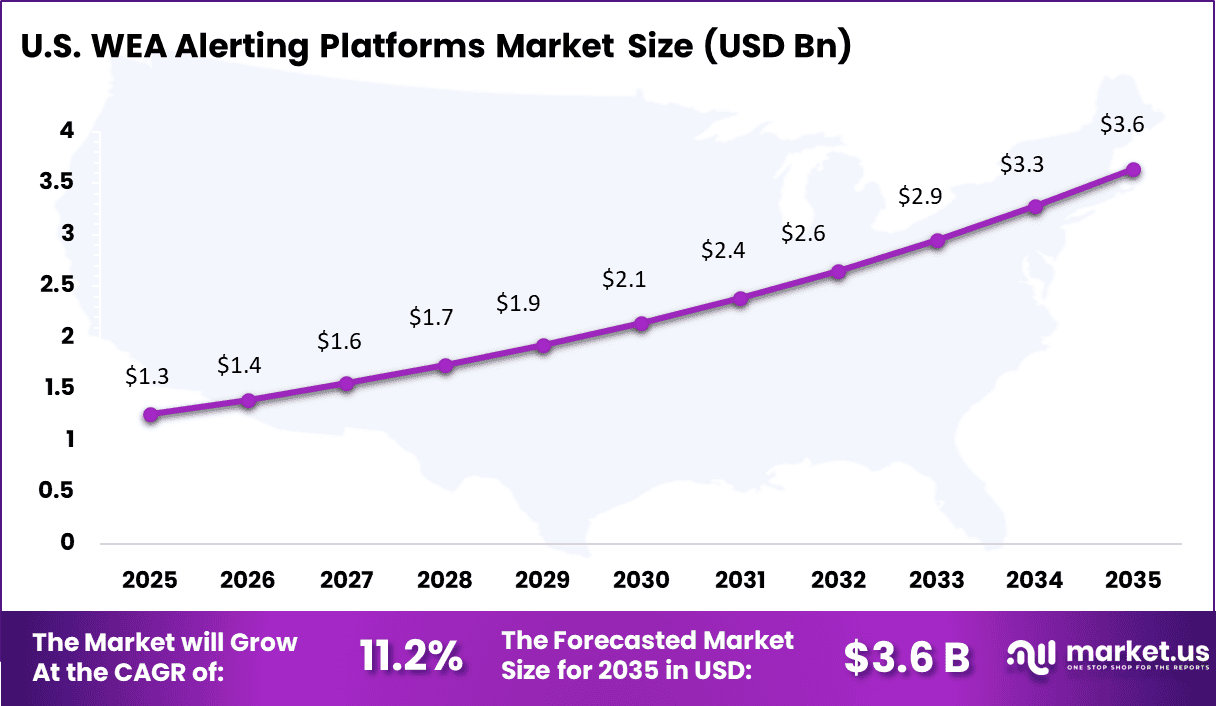
The U.S. market reached USD 1.26 Billion and is projected to grow at a CAGR of 11.2%, driven by ongoing investments in emergency communication systems and regulatory support for public alerting services. Authorities are adopting more advanced platforms to enhance real-time communication and ensure reliable message delivery across diverse geographic areas.
The growing frequency of extreme weather events and public safety concerns is also increasing the importance of effective alerting systems. Integration with modern technologies such as location-based services and multi-channel communication is expected to support steady growth in the US market over the coming years.
Key Regions and Countries
- North America
- US
- Canada
- Europe
- Germany
- France
- The UK
- Spain
- Italy
- Russia
- Netherlands
- Rest of Europe
- Asia Pacific
- China
- Japan
- South Korea
- India
- Australia
- Singapore
- Thailand
- Vietnam
- Rest of APAC
- Latin America
- Brazil
- Mexico
- Rest of Latin America
- Middle East & Africa
- South Africa
- Saudi Arabia
- UAE
- Rest of MEA
Competitive Analysis
The competitive landscape of the Wireless Emergency Alert Alerting Platforms Market is shaped by a mix of mass notification solution providers and large technology companies. Companies such as Everbridge, OnSolve, Rave Mobile Safety, Alertus Technologies, and Regroup Mass Notification focus on delivering reliable emergency communication platforms for governments, enterprises, and public safety agencies.
These players provide features such as real-time alert delivery, multi-channel communication, and integration with public warning systems. Their strong focus on reliability, scalability, and compliance with emergency standards helps them maintain a leading position in the market.
At the same time, companies such as One2many (Cell Broadcast), AtHoc (BlackBerry), Singlewire Software, Omnilert, Desktop Alert, Crises Control, and Konexus focus on specialized alerting technologies and targeted communication solutions.
Large firms like Siemens, Honeywell International, Motorola Solutions, and F24 AG integrate alerting platforms with broader safety, security, and infrastructure systems. Competition in this market is driven by speed of message delivery, system reliability, and the ability to reach large populations across multiple communication channels during critical situations.
Top Key Players in the Market
- Everbridge
- One2many (Cell Broadcast)
- AtHoc (BlackBerry)
- Rave Mobile Safety
- Alertus Technologies
- Regroup Mass Notification
- OnSolve
- Singlewire Software
- Omnilert
- Siemens
- Honeywell International
- Motorola Solutions
- F24 AG
- Desktop Alert
- Crises Control
- Konexus
- Others
Future Outlook
The future outlook for the Wireless Emergency Alert (WEA) Alerting Platforms Market looks strong as governments and public safety agencies continue to invest in faster and more reliable communication systems. The market is expected to grow with increasing need to deliver real-time alerts during natural disasters, emergencies, and security threats. More advanced alerting systems are anticipated to provide location-based targeting and multi-language support to reach wider populations. In the coming years, integration with 5G networks, mobile apps, and smart devices is expected to improve alert speed, accuracy, and coverage, making these platforms more effective in protecting public safety.
Recent Developments
- March, 2026 – Everbridge Critical Event Management adds WEA geo-fencing for campus lockdowns. AI threat scoring prioritizes alerts while bi-directional feedback confirms receipt from 1M users. Mass notification leader.
- February, 2026 – One2many CBC platform supports WEA 2.0 Spanish alerts nationwide. Carrier aggregation broadcasts to 500M phones/minute while API integrates FEMA IPAWS seamlessly. Cell broadcast specialist.
Report Scope
| Report Features | Description |
|---|---|
| Market Value (2025) | USD 3.5 Billion |
| Forecast Revenue (2035) | USD 12.5 Billion |
| CAGR(2025-2035) | 13.70% |
| Base Year for Estimation | 2024 |
| Historic Period | 2020-2024 |
| Forecast Period | 2025-2035 |
| Report Coverage | Revenue forecast, AI impact on Market trends, Share Insights, Company ranking, competitive landscape, Recent Developments, Market Dynamics and Emerging Trends |
| Segments Covered | By Component (Hardware, Software, Services (Professional Services, Managed Services)), By Application (Life-Threatening Emergencies, Public Safety & Law Enforcement, Others), By End-User (Government, Law Enforcement Agencies, Others) |
| Regional Analysis | North America – US, Canada; Europe – Germany, France, The UK, Spain, Italy, Russia, Netherlands, Rest of Europe; Asia Pacific – China, Japan, South Korea, India, New Zealand, Singapore, Thailand, Vietnam, Rest of Latin America; Latin America – Brazil, Mexico, Rest of Latin America; Middle East & Africa – South Africa, Saudi Arabia, UAE, Rest of MEA |
| Competitive Landscape | Everbridge, One2many (Cell Broadcast), AtHoc (BlackBerry), Rave Mobile Safety, Alertus Technologies, Regroup Mass Notification, OnSolve, Singlewire Software, Omnilert, Siemens, Honeywell International, Motorola Solutions, F24 AG, Desktop Alert, Crises Control, Konexus, Others |
| Customization Scope | Customization for segments, region/country-level will be provided. Moreover, additional customization can be done based on the requirements. |
| Purchase Options | We have three license to opt for: Single User License, Multi-User License (Up to 5 Users), Corporate Use License (Unlimited User and Printable PDF) |