


Report Overview
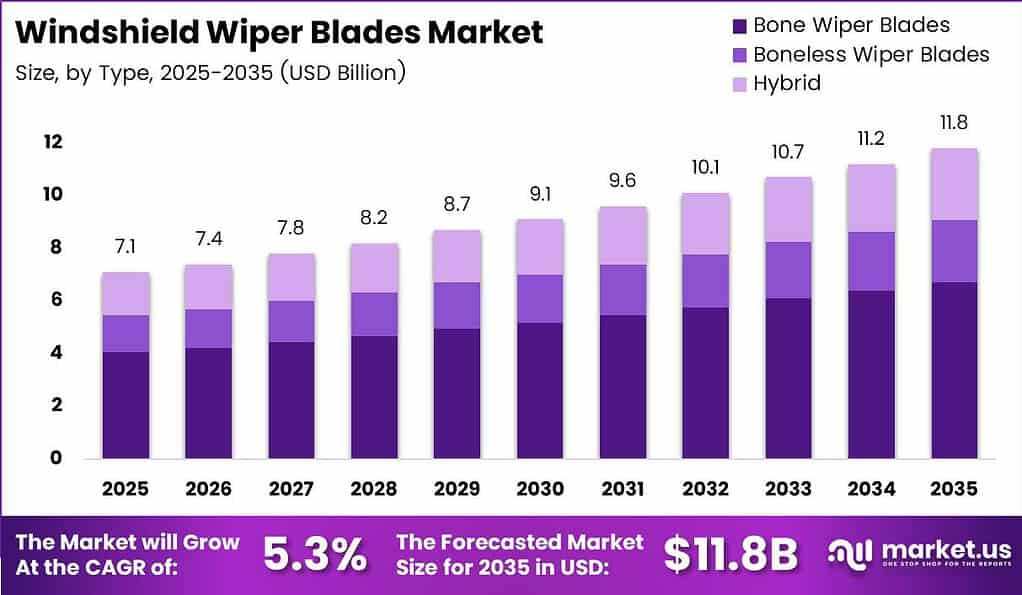
Global Windshield Wiper Blades Market size is expected to be worth around USD 11.8 Billion by 2035 from USD 7.1 Billion in 2026, growing at a CAGR of 5.3% during the forecast period 2026 to 2035. Windshield wiper blades remove rain, snow, dirt, and road spray from vehicle glass. Effective wiping protects visibility and supports safe vehicle operation.
The market combines original equipment contracts with recurring replacement sales across passenger and commercial vehicles. According to ACEA, global passenger car registrations reached 37,350,591 units during the first half of 2025, rising 5.0%. Each registration expands the future replacement base because rubber edges degrade through sunlight, friction, contamination, and temperature changes. Suppliers with broad fitment coverage can convert vehicle production into repeat aftermarket revenue.
Safety oversight creates financial consequences when a wiping system fails. As reported by NHTSA, a windshield wiper motor recall covered 86,852 vehicles, with 68,946 remedied by January 2026. Recall exposure raises repair, warranty, and reputation costs across the supply chain. Manufacturers that strengthen testing and component traceability can reduce failure risk, while distributors benefit from stocking verified products matched to vehicle specifications.
Key Takeaways
- The Windshield Wiper Blades Market was valued at USD 7.1 Billion in 2026.
- Revenue is forecast to reach USD 11.8 Billion by 2035.
- The market expands at a CAGR of 5.3% from 2026 to 2035.
- Bone Wiper Blades led the type segment with a 58.90% share in 2026.
- Indirect Sales led the distribution channel segment with a 66.21% share in 2026.
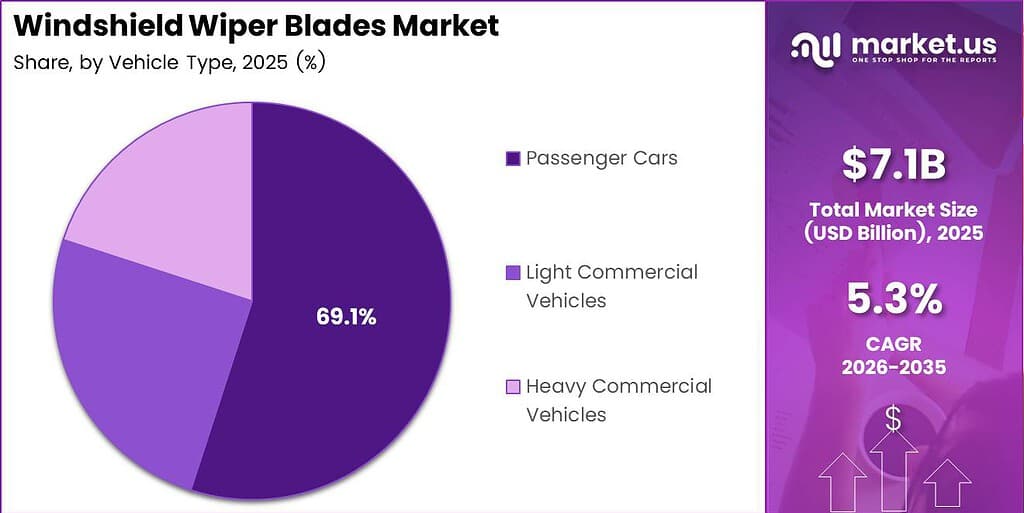
- Passenger Cars led the vehicle type segment with a 54.78% share in 2026.
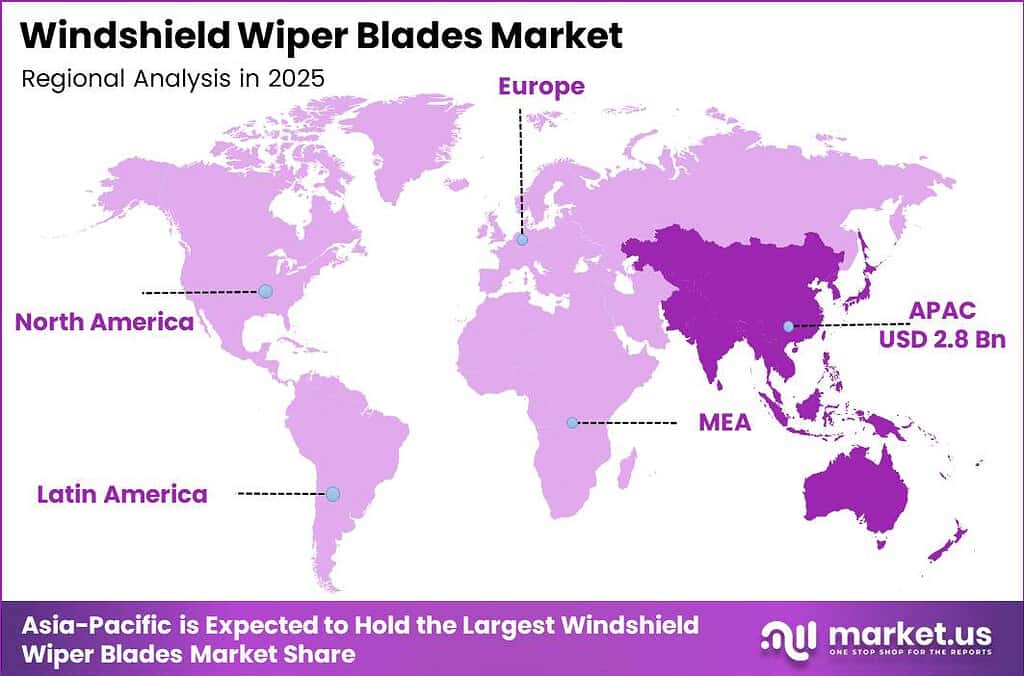
- Asia-Pacific led the regional market with a 40.21% share worth USD 2.8 Billion in 2026.
- Middle East and Africa represented the fastest-growing regional market.
- The forecast period runs from 2026 to 2035.
Service consolidation gives component suppliers more opportunities to influence replacement decisions. Data from Bosch shows that the company acquired Roadside Protect for EUR 141 Million in January 2025. The transaction expanded access to automakers, fleets, insurers, and aftermarket customers across the United States and Canada. Service platforms can identify worn blades during roadside or maintenance events, creating an added route for converting safety checks into replacement sales.
Asia-Pacific held a 40.21% share worth USD 2.8 Billion in 2026. Bosch Group found that global vehicle production reached approximately 96 Million units in 2025, increasing 2.8%. Asian manufacturing concentration supports original equipment orders, local component sourcing, and a widening replacement base. Regional producers can use manufacturing scale to compete on price, while international brands must defend fitment quality and channel availability.
Long-term capital supports factory upgrades, product development, and lower emission production. Based on Valeo data, the company placed EUR 500 Million in green bonds during September 2025, with maturity in March 2032. Such funding can improve manufacturing efficiency and product engineering across mobility operations. Investors should assess whether capital spending lowers production costs, improves blade durability, or strengthens distribution rather than measuring investment by size alone.
Product Selection Guide
Blade selection depends on vehicle fitment, climate, expected service life, wiping noise, and buyer budget. Bone blades offer economical replacement for a broad installed fleet, while boneless designs support cleaner airflow and consistent glass pressure. Hybrid blades combine frame support with an aerodynamic cover. Buyers should confirm blade length and connector compatibility before comparing price because an incorrect fit can reduce wiping coverage and increase noise.
| Selection Factor | Bone Wiper Blades | Boneless Wiper Blades | Hybrid Wiper Blades |
|---|---|---|---|
| Construction | Articulated metal or composite frame | Tensioned internal strip | Framed structure with aerodynamic cover |
| Best Fit | Older and value-focused vehicles | Newer vehicles and premium replacements | Drivers seeking balanced performance |
| Airflow Performance | Basic | High | Medium to high |
| Snow and Dirt Exposure | Exposed joints require cleaning | Limited exposed joints | Covered structure protects joints |
| Relative Price Position | Value | Premium | Midrange to premium |
| Buyer Priority | Affordability and availability | Low noise and clean appearance | Durability and balanced performance |
Type Analysis
Bone Wiper Blades dominate with 58.90% share in 2026 due to affordable fitment and broad compatibility.
In 2026, Bone Wiper Blades held a 58.90% share in the type segment of the Windshield Wiper Blades Market. Figures from DENSO show that its conventional range offered 4 blade profiles, 4 installation systems, and 3 clip options. The articulated frame distributes pressure across curved glass at a low production cost. Sellers can serve older vehicles while limiting premium pricing risk.
Boneless Wiper Blades use a tensioned strip instead of an exposed metal frame, supporting lower airflow resistance and consistent glass contact. According to HELLA, flat blade products covered more than 90% of the European vehicle market. The integrated structure reduces exposed joints that can collect dirt, ice, or corrosion. Manufacturers can target newer vehicles, while distributors gain broad vehicle coverage with fewer references.
Hybrid Wiper Blades combine a conventional pressure structure with an aerodynamic outer cover. As reported by DENSO, its hybrid portfolio contained 21 part numbers in lengths from 350 mm to 700 mm. The covered frame maintains contact pressure while reducing airflow disturbance and joint exposure. Suppliers can position hybrid blades between basic framed products and premium flat designs, supporting upgrades without requiring attachment conversion.
Distribution Channel Analysis
Indirect Sales dominate with 66.21% share in 2026 due to broad retail and workshop access.
In 2026, Indirect Sales held a 66.21% share in the distribution channel segment of the Windshield Wiper Blades Market. Data from Valeo shows that the company operated 19 distribution platforms as of February 2025. Distributors aggregate fitment references and move stock closer to workshops, retailers, and vehicle owners. Manufacturers gain wider reach, although channel discounts and inventory support reduce revenue captured per blade.
Direct Sales connect manufacturers with fleets, service networks, and high-volume customers that need predictable replacement schedules. Bosch found that its United States Factory Direct network expanded beyond 100 stores. Direct control improves stock visibility, customer feedback, and fitment data because fewer intermediaries handle each transaction. Suppliers can retain more margin, but they must fund warehousing, fulfillment, sales support, and account management.
Vehicle Type Analysis
Passenger Cars dominate with 54.78% share in 2026 due to the largest replacement vehicle base.
In 2026, Passenger Cars held a 54.78% share in the vehicle type segment of the Windshield Wiper Blades Market. Based on ACEA data, the European Union passenger car fleet reached 255,999,373 vehicles in 2024, rising 1.4%. High vehicle density creates recurring replacement transactions across retail and workshop channels. Suppliers need wide model coverage because windscreen shapes, arm connections, and blade lengths vary.
Light Commercial Vehicles require durable blades because delivery vans operate for longer daily periods and face repeated exposure to rain, dirt, and road spray. ACEA indicates that the European Union van fleet reached 31,113,763 vehicles in 2024, increasing 1.9%. Frequent operation raises wear on rubber edges and attachment systems. Fleet-focused suppliers can capture scheduled replacements by linking blades with inspections, servicing, and uptime contracts.
Heavy Commercial Vehicles require high contact pressure, durable structures, and dependable wiping across large windscreens. Figures from Bosch Group show that global heavy commercial vehicle production totaled 3.4 Million units in 2025, declining 0.2%. Lower production can restrict original equipment orders, but long operating lives protect replacement activity. Vendors can defend revenue through fleet maintenance programs, retrofit bundles, and dependable regional availability.
Key Market Segments
Type
- Bone Wiper Blades
- Boneless Wiper Blades
- Hybrid
Distribution Channel
- Indirect Sales
- Direct Sales
Vehicle Type
- Passenger Cars
- Light Commercial Vehicles
- Heavy Commercial Vehicles
Regional Analysis
Asia-Pacific
Asia-Pacific led the Windshield Wiper Blades Market with a 40.21% share, valued at USD 2.8 Billion in 2026. The region combines large vehicle-production bases, expanding passenger-car ownership, and extensive component-supply networks. China and India remain especially important because their production scale creates both original-equipment demand and a growing installed base for future replacement sales.
Local manufacturing enables suppliers to compete on price while serving vehicle manufacturers and independent aftermarket channels. Market participants must nevertheless manage wide differences in vehicle age, consumer income, climate, and distribution quality. Suppliers with local production, broad fitment catalogues, and access to organized retail channels are positioned to convert regional fleet expansion into recurring replacement revenue.
North America
North America represents an established replacement market supported by high vehicle ownership, long vehicle retention, and developed retail and workshop networks. OICA reported that vehicle sales across the Americas reached 24.86 Million units in 2025, increasing 2.9%, while the United States alone recorded 16.7 Million vehicle sales. A large installed fleet creates recurring demand even when regional vehicle production weakens.
Beam blades, all-weather products, and vehicle-specific fitment systems support premiumization in the region. The market also faces intense competition among national brands, retailer-owned products, and value suppliers. Manufacturers need strong fitment data, seasonal availability, simple installation, and visible consumer branding to protect market share.
Europe
Europe offers a large replacement base shaped by ageing vehicles and strong demand for flat-blade technology. ACEA reported approximately 256 Million passenger cars on European Union roads in 2024, representing annual growth of 1.4%. The average EU passenger car reached 12.7 years, extending the number of model years that aftermarket catalogues must cover.
European suppliers compete through original-equipment quality, aerodynamic designs, low-noise wiping, and model-specific connectors. The ageing fleet supports recurring demand, but the variety of vehicle platforms increases inventory complexity. Suppliers with accurate electronic catalogues and modular adapter systems can reduce selection errors and simplify workshop installation.
Latin America
Latin America combines growing vehicle production with price-sensitive replacement demand. OICA reported that Brazilian vehicle production reached approximately 2.64 Million units in 2025. The production base supports local component sourcing, while the wider regional vehicle parc creates demand across workshops, parts stores, informal retailers, and digital channels.
Extreme rainfall, sunlight, road dust, and uneven product availability influence replacement behavior across the region. Conventional blades remain important in value-focused applications, while flat and hybrid designs can gain adoption among newer vehicles. Manufacturers must balance affordable pricing with rubber durability and dependable regional distribution.
Middle East and Africa
Middle East and Africa represents the fastest-growing regional market. Passenger-car registrations reached approximately 2.01 Million units during the first half of 2025, increasing 9.5%, according to ACEA. Fleet growth expands both immediate original-equipment demand and the future replacement base.
Heat, ultraviolet exposure, dust, and sand can harden or damage wiping edges even where rainfall is seasonal. This makes climate-resistant rubber and dependable product availability important purchasing factors. Suppliers can improve penetration through local distributors, service workshops, fleet accounts, and affordable products designed for harsh environmental exposure.
Key Regions and Countries
North America
- US
- Canada
Europe
- Germany
- France
- The UK
- Spain
- Italy
- Rest of Europe
Asia Pacific
- China
- Japan
- South Korea
- India
- Australia
- Rest of APAC
Latin America
- Brazil
- Mexico
- Rest of Latin America
Middle East and Africa
- GCC
- South Africa
- Rest of MEA
Market Dynamics
The market operates through two connected demand cycles. New-vehicle production creates original-equipment volume, while the installed vehicle fleet generates recurring aftermarket purchases. Replacement demand is generally more stable because rubber deterioration continues even when vehicle production slows. However, consumers can postpone replacement, making demand sensitive to visible wiping failure, weather events, inspections, and service recommendations.
Fitment complexity determines inventory efficiency and customer satisfaction. Differences in blade length, arm geometry, connector design, windscreen curvature, and rear-blade configuration create thousands of potential applications. DENSO’s March 2026 range expansion alone added 31 part numbers covering more than 3,500 applications and approximately 14 Million vehicles. Accurate digital catalogues and modular adapters therefore create commercial value beyond the physical blade.
Product quality also carries meaningful safety and warranty exposure. NHTSA recall 26V117 covered 604,533 vehicles that could experience intermittent or inoperative front windshield wipers, with Ford recording 1,374 associated warranty claims by February 2026. Another 2026 Ford recall covered 422,613 vehicles with potentially stripped wiper-arm splines. These cases demonstrate why suppliers must control motor compatibility, linkage strength, fastening, electronics, and blade attachment.
Drivers
Ageing vehicle fleets expand the installed base requiring repeated blade replacement. The average United States light vehicle reached 12.6 years in 2024 and 12.8 years in 2025, while vehicles in operation approached 289 Million. Europe reported approximately 249 Million passenger cars and an average age of 12.5 years. Older fleets protect aftermarket transactions when new vehicle orders weaken.
Blade replacement intervals of 6-12 months turn long vehicle ownership into recurring revenue. The driver contributes an estimated +1.2% within the 5.3% baseline CAGR. Suppliers must cover more than a decade of vehicle model years to convert this replacement need. Broad fitment catalogues, local inventory, and simple installation systems determine which brands capture repeat purchases across workshops, retailers, and digital channels.
| Driver | (~) % Impact on CAGR Forecast | Geographic Relevance | Impact Timeline |
|---|---|---|---|
| Ageing Vehicle-Fleet Replacement | +1.2% | North America, Europe, Japan | Short term (≤ 2 years) |
| New-Vehicle Production Recovery | +0.8% | Asia-Pacific, North America | Short term (≤ 2 years) |
| Extreme-Weather Blade Wear | +0.7% | Global, climate-exposed regions | Short term (≤ 2 years) |
| Visibility-Safety Compliance | +0.5% | Europe, North America | Medium term (2–4 years) |
| SUV Rear-Blade Content | +0.4% | North America, Europe, China | Medium term (2–4 years) |
| Organized Aftermarket Access | +0.3% | India, Southeast Asia, Latin America | Medium term (2–4 years) |
Restraints
Discretionary replacement allows drivers to postpone purchases until streaking or poor visibility becomes difficult to ignore. Extending the average purchase cycle from 9 months to 12 months lowers annual purchases from approximately 1.33 sets to 1.00. That change cuts unit volume by roughly 25% among deferring customers. Value brands face the highest exposure because buyers can tolerate declining performance before replacing blades.
The restraint applies an estimated -0.8% CAGR adjustment. Promotional support equal to 3-6% of sales can reduce gross margin by approximately 100-250 basis points without shortening replacement intervals. Sellers need service reminders, seasonal inspections, and clear wear education rather than relying only on discounts. Investors should favor operators that improve replacement compliance while protecting price discipline and channel profitability.
| Restraint | (~) % Impact on CAGR Forecast | Geographic Relevance | Impact Timeline |
|---|---|---|---|
| Discretionary Replacement Deferral | -0.8% | Global, price-sensitive consumers | Short term (≤ 2 years) |
| Extended-Life Blade Cannibalization | -0.6% | North America, Europe, Japan | Medium term (2–4 years) |
| OEM Sourcing Lock-Ins | -0.4% | Global vehicle-production hubs | Long term (≥ 4 years) |
| Unbranded Channel Leakage | -0.3% | Asia-Pacific, Africa, Latin America | Short term (≤ 2 years) |
| Low-Value Shipping Economics | -0.25% | Global online aftermarket | Short term (≤ 2 years) |
| Warranty Coverage Withdrawal | -0.2% | North America, selected OEM channels | Medium term (2–4 years) |
Challenges
Rubber feedstock volatility exposes blade producers to concentrated supply and weather disruptions. Natural rubber prices stood approximately 24% higher in May 2024 as production fell by more than 9% in Thailand and 15% in Indonesia. Production later declined 1.3% in Thailand and 17.8% in Vietnam during the 12 months ending March 2025. Such movements can outrun customer price adjustments.
Natural rubber prices could rise approximately 14% in 2025 while consumption advances nearly 2%. The challenge creates an estimated -0.6% growth drag and temporary margin pressure of 100-200 basis points. Manufacturers need multiple sourcing countries, flexible synthetic rubber formulations, indexed contracts, and safety stocks covering 8-12 weeks. Investors should assess purchasing discipline because revenue expansion cannot offset uncontrolled material costs.
| Challenge | (~) % CAGR Friction Drag | Geographic Relevance | Mitigation Horizon |
|---|---|---|---|
| Rubber Feedstock Volatility | -0.6% | Global, Southeast Asian sourcing | Medium term (2–4 years) |
| SKU-Fitment Proliferation | -0.5% | Global aftermarket channels | Long term (≥ 4 years) |
| Seasonal Inventory Imbalance | -0.4% | Monsoon, winter and arid markets | Short term (≤ 2 years) |
| Low-Noise Wiping Tolerances | -0.35% | Europe, China, North America | Medium term (2–4 years) |
| Quality Consistency at Scale | -0.3% | Global manufacturing hubs | Medium term (2–4 years) |
| Tooling-Supplier Concentration | -0.25% | Asia-Pacific, Europe | Long term (≥ 4 years) |
Opportunities
Connected replenishment can replace condition-based purchasing with timed service prompts and preconfigured fitment subscriptions. Shortening an enrolled customer’s replacement cycle from 12 months to 10 months raises annual purchases from 1.00 to 1.20 units per vehicle. The timing remains inside the recommended 6-12 month replacement window. Early operators can improve retention while removing fitment uncertainty from the buying process.
A program with 10% enrollment and a 20% improvement in timely replacement could add up to +0.8% CAGR upside. Direct replenishment may expand gross margin by 300-500 basis points after fulfillment and engagement costs of USD 1.50-3.00 per shipment. Suppliers need accurate vehicle data and efficient delivery to convert the opportunity into profitable recurring revenue instead of expensive customer acquisition.
| Opportunity | (~) % Potential CAGR Upside | Geographic Relevance | Execution Window |
|---|---|---|---|
| Connected Replenishment Subscriptions | +0.8% | North America, Europe, advanced Asia | Medium term (2–4 years) |
| Fleet Uptime Contracts | +0.6% | Global commercial fleets | Short term (≤ 2 years) |
| EV Low-Noise Premiumization | +0.45% | China, Europe, North America | Medium term (2–4 years) |
| Sensor-Cleaning Adjacencies | +0.4% | Europe, Japan, South Korea, China | Long term (≥ 4 years) |
| Commercial-Vehicle Retrofit Bundles | +0.3% | North America, Europe, India | Medium term (2–4 years) |
| Refill-Only Blade Platforms | +0.25% | Europe, Japan, urban Asia | Long term (≥ 4 years) |
Technology Outlook
Current Technologies
Current innovation focuses on flat-blade construction, aerodynamic spoilers, friction-reducing coatings, modular adapters, and vehicle-specific pressure distribution. Bosch offers original, universal, modular, and retrofit flat-blade configurations for different attachment requirements. These technologies improve installation convenience and wiping consistency while allowing distributors to serve more vehicles with a controlled number of references.
Material engineering remains equally important. Graphite-coated synthetic rubber can reduce friction, noise, and blade chatter, while beam structures maintain pressure across curved windscreens. Rain-X applies this combination in its PrecisionClear product line. Manufacturers must balance better durability with production cost and replacement frequency because excessively long product life can reduce recurring unit demand.
Emerging Technologies
Integrated washing systems represent an important premium direction. Valeo AquaBlade distributes washer fluid along the blade rather than spraying it from separate bonnet-mounted nozzles. Valeo states that the system can reduce reaction time by 288 milliseconds, corresponding to approximately 4 metres of stopping distance at 50 km/h. The technology connects blade design directly with visibility performance and vehicle safety.
Digital installation support is also becoming a competitive tool. Rain-X introduced an AI-powered web application in September 2026 to provide vehicle-specific blade installation guidance, with coverage planned across all its blade programs by the end of 2026. Such tools can lower return rates, reduce installation errors, and improve direct relationships with consumers.
Long-Term Technologies
Sensor cleaning creates an adjacent market as vehicles use more cameras and lidar units. Valeo already offers dedicated lidar-cleaning systems in series production alongside AquaBlade, remote defrost, and insect-removal functions. The commercial opportunity extends beyond conventional windscreen wiping because automated-driving systems require clear sensor surfaces to operate reliably.
Longer-term development may combine weather data, mileage, service history, and blade-condition monitoring to recommend replacement before visibility declines. Adoption will depend on access to vehicle software, dependable wear models, customer acceptance, and the economics of connected maintenance. Companies with both physical wiping products and electronic visibility systems may hold an advantage.
Value Chain Analysis
| Value-Chain Stage | Primary Role | Value Driver | Main Risk |
|---|---|---|---|
| Material Suppliers | Provide natural rubber, synthetic rubber, steel, plastics, coatings, and adhesives | Compound performance and material consistency | Commodity prices and supply concentration |
| Component Suppliers | Produce rubber profiles, rails, frames, adapters, spoilers, and packaging | Precision, scale, and delivery reliability | Tooling dependence and quality variation |
| Blade Manufacturers | Design, assemble, test, and catalogue finished blades | Wiping performance and fitment coverage | Warranty exposure and excessive SKU counts |
| Vehicle Manufacturers | Approve and install original-equipment systems | Long production programs and validation | Pricing pressure and sourcing concentration |
| Distributors | Aggregate references and hold regional inventory | Availability and catalogue accuracy | Working capital and obsolete inventory |
| Retailers and Workshops | Recommend, sell, and install replacement blades | Customer access and installation service | Returns, promotions, and brand switching |
| Vehicle Owners and Fleets | Purchase blades based on condition, schedule, or safety needs | Visibility, convenience, and total cost | Replacement deferral and price sensitivity |
Fitment information connects every stage of the value chain. A technically sound blade can still generate returns when a catalogue lists the wrong connector, length, or vehicle application. DENSO distributes its range information through its electronic catalogue and TecDoc, demonstrating the importance of standardized digital product data in aftermarket sales.
Commercial power differs by channel. Vehicle manufacturers control original-equipment qualification, large distributors influence aftermarket access, and retailers influence the brands visible to consumers. Digital sellers can reach buyers directly but carry fulfillment and compatibility-return costs. Suppliers that control accurate fitment data, dependable inventory, and installation guidance can retain more value across the chain.
Pricing and Profitability
Pricing generally follows product construction and service proposition. Conventional framed blades occupy the value tier, hybrid products serve the middle and upper tiers, and advanced beam blades support premium pricing through low-noise wiping, aerodynamic performance, coatings, and simplified installation. Vehicle-specific original-equipment replacements can command higher prices when buyers value exact fit and factory-equivalent performance.
| Pricing Tier | Typical Product Position | Primary Buyer Priority | Profitability Consideration |
|---|---|---|---|
| Value | Conventional framed blade | Low purchase price and basic fit | High price competition and limited gross profit per unit |
| Midrange | Hybrid or improved conventional blade | Durability and better wiping | Balanced unit margin and market reach |
| Premium | Beam, silicone, coated, or OE-specific blade | Low noise, appearance, and all-weather performance | Higher margin but greater brand and performance expectations |
| Fleet | Commercial-vehicle and scheduled replacement product | Uptime, availability, and service life | Predictable volume with strong contract-price pressure |
| Direct Digital | Vehicle-specific online replacement | Convenience and guided installation | More customer data but higher fulfillment and return costs |
Profitability depends on inventory productivity as much as product margin. Each additional vehicle-specific reference consumes warehouse space and working capital. Modular adapters and high-coverage references can reduce complexity, but universal designs must still deliver secure attachment and consistent pressure. DENSO’s 2026 addition of 31 references covering approximately 14 Million vehicles illustrates how manufacturers measure range productivity through vehicle and application coverage.
Manufacturers must also account for distributor discounts, promotional allowances, packaging, freight, catalogue maintenance, returns, warranty claims, and seasonal stock. A premium selling price does not guarantee strong profitability if fitment errors or slow-moving inventory remain high. Investors should therefore monitor gross margin together with return rates, stock rotation, coverage per SKU, and channel-acquisition costs.
Competitive Positioning
| Strategic Group | Representative Companies | Competitive Strength | Primary Exposure |
|---|---|---|---|
| Diversified OE Suppliers | Bosch, Valeo, DENSO, HELLA, Mitsuba | Automaker access, engineering resources, and international distribution | Wiper products compete internally with larger mobility businesses for investment |
| Wiper Specialists | Trico, DOGA, CAP, KCW, AIDO | Category expertise, specialized fitment, and focused product development | Greater exposure to category pricing and replacement cycles |
| Consumer Aftermarket Brands | Rain-X, PIAA, Michelin | Retail recognition, premium positioning, and direct consumer influence | Promotion costs and retailer bargaining power |
| Portfolio Brand Owners | ITW Global Brands and Federal-Mogul Motorparts | Cross-category distribution and established aftermarket relationships | Complex brand portfolios and channel overlap |
The strongest competitive barrier is not simply blade construction. Fitment coverage, application data, distribution reach, original-equipment credibility, installation simplicity, and dependable quality collectively influence customer retention. DENSO’s 2026 expansion covered more than 3,500 applications, showing how range breadth can become a measurable competitive asset.
Technology can support differentiation when it solves a clear customer problem. Valeo uses integrated fluid delivery to improve washing visibility, Bosch offers modular adapter strategies, and Rain-X combines blade products with installation guidance and water-management technologies. Competitors relying only on low price remain more exposed to unbranded substitution and retail margin pressure.
Key Company Insights
Bosch
Bosch competes through original-equipment knowledge, aftermarket distribution, coatings, flat-blade technology, and multiple adapter systems. Its product architecture includes original, universal, modular, and retrofit flat-blade configurations, allowing the company to serve both factory-equivalent replacement and vehicle-upgrade demand. This range structure is directly relevant to fitment coverage and inventory management.
In October 2026, Bosch launched its ENFORCER all-weather blade line in North America. The range was designed to cover more than 90% of vehicles in operation, linking commercial scale with simplified maintenance and fitment coverage. This development is more relevant to the market than Bosch’s unrelated HVAC acquisition.
Valeo
Valeo combines blade production with complete front and rear wiping systems, motors, linkages, washer systems, software, and sensor-cleaning technologies. Its Bietigheim-Bissingen site develops and produces these systems, with AquaBlade positioned as a leading product. This system-level capability provides access to both original-equipment and aftermarket opportunities.
Valeo presented AquaBlade at the September 2026 Paris Motor Show, reporting a 288-millisecond reaction-time improvement and approximately 4 metres less stopping distance at 50 km/h under the company’s stated scenario. The development provides a category-specific example of premiumization through integrated washing and wiping.
DENSO
DENSO competes through original-equipment quality, vehicle-specific connectors, electronic catalogue integration, and frequent aftermarket range expansion. Its products cover conventional, flat, hybrid, and rear-blade applications. The company uses application and vehicle coverage to demonstrate the commercial value of each new product release.
In March 2026, DENSO introduced 31 flat and rear wiper references covering more than 3,500 applications and approximately 14 Million vehicles. This directly strengthens DENSO’s aftermarket reach and is more relevant than the previously included logistics, solar, or semiconductor developments.
Key Players
- Bosch
- Valeo
- Denso
- Trico
- Mitsuba
- HELLA
- DOGA
- FederalMogul Motorparts
- PIAA
- RainX
- Michelin
- ITW Global Brands
- AIDO
- CAP
- KCW
- Other Key Players
Recent Developments
- October 2026: Bosch launched its ENFORCER all-weather wiper-blade line in North America, designed to cover more than 90% of vehicles in operation.
- September 2026: Rain-X introduced an AI-powered web application for personalized blade installation, with expansion across all blade programs scheduled by the end of 2026.
- September 2026: Valeo presented AquaBlade technology with a claimed 288-millisecond reaction-time improvement and approximately 4 metres less stopping distance at 50 km/h.
- March 2026: DENSO added 31 flat and rear wiper part numbers covering more than 3,500 applications and approximately 14 Million vehicles.
- June 2025: DENSO introduced 23 wiper-blade references covering approximately 450,000 Chinese-manufactured vehicles operating in Europe.
- April 2025: DENSO added 12 flat-blade references covering more than 390 applications and approximately 1.7 Million European vehicles.
- February 2025: DENSO introduced 3 Japan-manufactured flat-blade references covering approximately 200,000 European vehicles.
- April 2024: DENSO launched 11 flat-blade references covering more than 260 applications and approximately 6 Million vehicles.
Geopolitical Impact Analysis
Global shipping disruption affects the cost and timing of rubber, steel frames, plastic adapters, packaging, and finished blades. According to UNCTAD, maritime trade volume was forecast to rise only 0.5% in 2025 after expanding 2.2% in 2024. UNCTAD found that ship tonnage transiting the Suez Canal remained 70% below the 2023 average by early May 2025. Longer routes increase fuel use, transit time, and container requirements. Wiper suppliers face added exposure because blades carry low unit values relative to package volume. Manufacturers need regional inventory and alternative ports to protect delivery reliability. Distributors may hold more safety stock, raising working capital and warehouse costs. Buyers could face less predictable availability during winter and monsoon replacement peaks.
Trade expansion can remain positive while tariffs and policy uncertainty disrupt sourcing decisions. Data from WTO shows that merchandise trade volume increased 0.5% quarter over quarter and 3.6% year over year during the third quarter of 2025. Volume during the first 9 months stood 4.5% above the comparable 2024 period. IMF indicates that world trade volume growth could slow from 5.0% in 2025 to 3.5% in 2026, before reaching 4.3% in 2027. Slower expansion can intensify competition among rubber processors, blade assemblers, and exporters. Tariffs can alter the economics of steel rails, molded connectors, and packaged blades. Producers with factories near major vehicle fleets can reduce border exposure. Import-dependent distributors need flexible contracts and broader supplier networks.
Investment View
Revenue Catalysts
Revenue growth depends on the expanding installed vehicle fleet, ageing vehicles, periodic rubber deterioration, premium flat-blade adoption, and better access to organized aftermarket channels. Range expansions covering millions of vehicles show that catalogue breadth can produce growth without requiring an entirely new product category. Fleet contracts and connected replacement reminders could make demand more predictable.
Margin Catalysts
Premium blade structures, integrated washer systems, universal adapters, accurate application data, and direct digital support can improve revenue per customer or lower operating costs. Installation guidance can reduce returns, while modular fitment can improve coverage per SKU. Regional production can also reduce freight exposure and lead times.
Main Risks
The principal risks are rubber-price volatility, delayed consumer replacement, unbranded competition, retailer bargaining power, excessive SKU counts, and product-quality failures. NHTSA’s 2026 wiper-related recalls covering hundreds of thousands of vehicles demonstrate that component or assembly defects can create substantial warranty and reputation exposure.
Watch Indicators
- Average vehicle age and vehicles in operation
- Regional vehicle production and registration growth
- Natural and synthetic rubber prices
- Vehicle coverage per blade reference
- Inventory rotation and obsolete-stock levels
- Product return and warranty rates
- Flat and hybrid blade adoption
- Direct-channel customer acquisition and fulfillment costs
Winning Profile
The most defensible suppliers combine broad fitment coverage, original-equipment credibility, dependable inventory, climate-specific products, disciplined material sourcing, and user-friendly installation. Companies that connect physical blades with digital catalogues, service reminders, and visibility technologies can build stronger customer relationships than competitors relying mainly on price.
Editorial action: Delete the earlier unrelated corporate developments and replace the corresponding sections with the material above. The remaining Type, Distribution Channel, Vehicle Type, DORT, Geopolitical Impact, and Report Scope sections can remain, subject to source-link and HTML-ID corrections.
Report Scope
| Report Features | Description |
|---|---|
| Market Value (2026) | USD 7.1 Billion |
| Forecast Revenue (2035) | USD 11.8 Billion |
| CAGR (2026-2035) | 5.3% |
| Base Year for Estimation | 2026 |
| Historic Period | 2021-2025 |
| Forecast Period | 2026-2035 |
| Report Coverage | Revenue Forecast, Market Dynamics, Market Opportunity Analysis, Technology and Innovation Landscape, Value Chain Analysis, Pricing and Profitability, Competitive Landscape, Recent Developments |
| Segments Covered | Type: Bone Wiper Blades, Boneless Wiper Blades, Hybrid; Distribution Channel: Indirect Sales, Direct Sales; Vehicle Type: Passenger Cars, Light Commercial Vehicles, Heavy Commercial Vehicles |
| Regional Analysis | North America (US and Canada), Europe (Germany, France, The UK, Spain, Italy, and Rest of Europe), Asia Pacific (China, Japan, South Korea, India, Australia, and Rest of APAC), Latin America (Brazil, Mexico, and Rest of Latin America), Middle East and Africa (GCC, South Africa, and Rest of MEA) |
| Competitive Landscape | Bosch, Valeo, Denso, Trico, Mitsuba, HELLA, DOGA, FederalMogul Motorparts, PIAA, RainX, Michelin, ITW Global Brands, AIDO, CAP, KCW, Other Key Players |
| Customization Scope | Customization for segments, region / country-level will be provided. Additional customization can be done based on requirements. |
| Purchase Options | We have three licenses to opt for: Single User License | Multi-User License (Up to 5 Users) | Corporate Use License (Unlimited User and Printable PDF) |





































