Wi-Fi Site Survey Software Market By Component (Software, Services), By Deployment Mode (On-Premises, Cloud-Based), By Application (Network Planning, Performance Analysis, Troubleshooting, Security Assessment, Others), By End-User (Enterprises, Service Providers, Educational Institutions, Healthcare, Retail, Hospitality, Others), By Regional Analysis, Global Trends and Opportunity, Future Outlook By 2026-2035
The Global Wi-Fi Site Survey Software Market generated USD 1.6 billion in 2025 and is predicted to register growth from USD 1.8 billion in 2026 to about USD 7.4 billion by 2035, recording a CAGR of 16.80% throughout the forecast span. In 2025, North America held a dominan market position, capturing more than a 34.7% share, holding USD 0.54 Billion revenue.
Top Market Takeaways
Software commands 76.4% market share, delivering predictive heatmapping, AP placement simulation, and interference analysis for pre-installation validation.
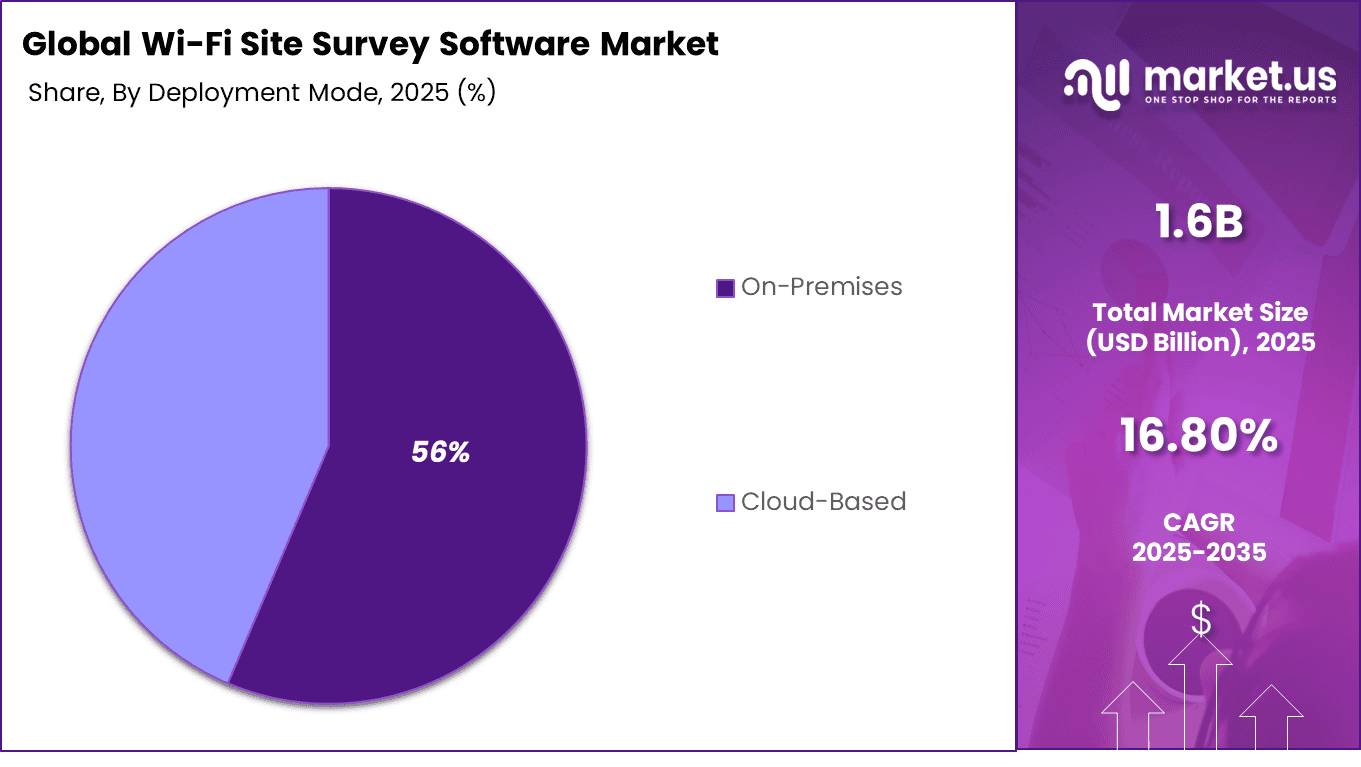
On-premises deployment captures 56.4%, enabling air-gapped security scanning, custom RF modeling, and integration with enterprise CMDB systems.
Network planning applications claim 38.6%, powering capacity forecasting, channel allocation, and brownfield optimization across multi-floor campuses.
Enterprises hold 32.5%, leveraging site survey tools for digital twin creation, post-installation verification, and ongoing RF health monitoring.
North America drives 34.7% global value, with U.S. market at USD 0.46 billion and 14.5% CAGR, fueled by office return-to-work mandates and dense IoT connectivity.
Wi-Fi Site Survey Software market refers to digital tools used to plan, assess, and optimize wireless network coverage before and after deployment. These solutions help network teams study signal strength, access point placement, interference levels, roaming quality, and coverage gaps across offices, campuses, hospitals, warehouses, and public facilities.
The market is gaining importance as businesses depend more on stable wireless connectivity for daily operations and need better planning to support growing device density and more complex indoor environments.
One of the main factors driving this market is the increasing need for reliable wireless performance in business environments. Organizations want software that can improve network design, reduce coverage blind spots, and support smoother deployment without relying on manual guesswork. Another important driver is the rising complexity of modern Wi-Fi environments, where higher user density, connected devices, and application demands require more structured planning and validation.
Demand for Wi-Fi Site Survey Software is increasing among enterprises, managed service providers, educational institutions, healthcare facilities, warehouses, and commercial buildings that rely heavily on wireless connectivity.
These users want practical tools that can improve coverage accuracy, simplify troubleshooting, and support better network upgrades. Demand is also rising because many organizations now treat wireless quality as an essential part of business continuity, user experience, and operational efficiency.
Drivers Impact Analysis
Key Driver
Impact on CAGR Forecast (~%)
Geographic Relevance
Impact Timeline
Strategic Effect
Increasing demand for reliable and high performance Wi Fi networks
+3.2%
North America, Europe, Asia Pacific
Short to Mid Term (2025–2031)
Improves network planning accuracy
Rapid growth of enterprise wireless infrastructure
+2.9%
Global
Mid Term (2026–2032)
Expands need for site survey tools
Expansion of smart buildings and IoT deployments
+2.7%
Asia Pacific, North America, Europe
Mid to Long Term (2026–2035)
Supports advanced network design
Rising adoption of remote work and digital workplaces
+2.5%
Global
Mid Term (2026–2032)
Increases demand for optimized connectivity
Growing complexity of indoor and outdoor wireless environments
+2.3%
Global
Mid to Long Term (2026–2035)
Drives advanced survey solutions
Restraints Impact Analysis
Key Restraint
Impact on CAGR Forecast (~%)
Geographic Relevance
Impact Timeline
Strategic Effect
High cost of advanced survey software and tools
-2.3%
Global
Mid Term (2026–2032)
Limits adoption among small enterprises
Need for skilled professionals to conduct surveys
-2.0%
Global
Mid Term (2026–2032)
Slows deployment
Complexity in analyzing large scale network environments
-1.8%
Global
Mid Term (2026–2032)
Increases operational challenges
Integration challenges with existing network management systems
-1.6%
North America, Europe
Mid Term (2026–2032)
Delays implementation
Limited awareness in emerging markets
-1.5%
Asia Pacific, Latin America
Short to Mid Term (2025–2030)
Reduces adoption
By Component Analysis
Software accounted for 76.4% of the Wi-Fi Site Survey Software Market. This segment leads because organizations rely on specialized tools to design, analyze, and optimize wireless network coverage. These platforms help identify signal strength, interference, and access point placement for better network performance.
The segment is also supported by increasing demand for reliable connectivity in offices, campuses, and public spaces. Software based solutions allow faster survey execution and accurate planning, which strengthens their adoption across enterprise environments.
By Deployment Mode Analysis
On premises deployment held 56% of the market. This segment leads because many organizations prefer to keep network planning tools within their internal systems to maintain control over sensitive network data and configurations. It allows direct management of survey results and network designs.
The segment is also driven by the need for stable performance and data security. Enterprises often use on premises solutions to ensure consistent operation and protect network information during planning and optimization processes.
By Application Analysis
Network planning represented 38.6% of the market. This segment dominates because site survey tools are primarily used to design wireless networks and ensure proper coverage across facilities. Accurate planning helps avoid signal gaps and improves overall network efficiency.
The segment is supported by increasing deployment of wireless networks in commercial and industrial spaces. Organizations rely on planning tools to optimize access point placement and deliver consistent connectivity across different environments.
By End User Analysis
Enterprises accounted for 32.5% of the market. This segment leads because businesses require strong and reliable Wi-Fi networks to support daily operations, communication, and digital workflows. Site survey software helps them design and maintain efficient network infrastructure.
The segment is driven by growing dependence on wireless connectivity in workplaces. Enterprises adopt these tools to improve network performance, reduce connectivity issues, and support seamless digital operations across departments.
Investor Type Impact Analysis
Investor Type
Growth Sensitivity
Risk Exposure
Geographic Focus
Investment Outlook
Venture Capital Firms
High
Medium
US, Europe
Growth in network optimization tools
Private Equity Firms
High
Medium
North America, Europe
Expansion in enterprise networking solutions
Strategic Technology Investors
Very High
Medium
US, China, Japan
Strengthens wireless ecosystem
Corporate Venture Arms
High
Medium
Global
Supports enterprise connectivity solutions
Government and Digital Infrastructure Funds
Medium
Low
Asia Pacific, Europe
Supports connectivity initiatives
Technology Enablement Analysis
Technology Enabler
Impact on CAGR Forecast (~%)
Geographic Relevance
Impact Timeline
Implementation Significance
AI driven network planning and optimization tools
+3.3%
Global
Short to Mid Term (2025–2031)
Improves survey accuracy
Cloud based Wi Fi site survey platforms
+3.0%
Global
Short to Mid Term (2025–2030)
Enables scalable deployment
Integration with IoT and smart building systems
+2.7%
Global
Mid to Long Term (2026–2035)
Enhances network design
Real time signal analysis and heat mapping tools
+2.5%
Global
Mid Term (2026–2032)
Improves coverage planning
Mobile based survey applications and tools
+2.3%
Global
Mid to Long Term (2026–2035)
Increases accessibility
Key Challenges
Signal interference is a major challenge because walls, metal structures, nearby devices, and changing user density can affect Wi Fi behavior and make survey results harder to interpret accurately.
Survey accuracy can be reduced when floor plans are not scaled correctly or when calibration and walking paths are incomplete during data collection.
Predictive survey software can miss real world conditions because software models do not always capture actual field measurements, live interference, or on site performance changes.
Integration can be difficult because site survey software must work with different access points, adapters, client devices, and deployment requirements across varied environments.
Keeping survey results useful over time is also a challenge because Wi Fi environments change, and networks need regular re evaluation, documentation, and updates after deployment.
Emerging Trends
A key trend in the Wi-Fi Site Survey Software market is the increasing use of predictive planning tools that simulate wireless coverage before physical deployment. These solutions help network teams visualize signal strength, identify interference sources, and optimize access point placement in advance.
Modern software also integrates with real time analytics to validate performance after deployment. This trend reflects a shift toward more accurate and data driven network design, where planning and validation are closely connected.
Growth Factors
The growing reliance on stable and high quality wireless connectivity is supporting the expansion of Wi-Fi site survey software solutions. Businesses, campuses, and public spaces require strong network coverage to support daily operations and user demand.
Poor network performance can disrupt productivity, which increases the need for precise planning tools. Site survey software helps organizations design and maintain efficient wireless networks, encouraging adoption as connectivity becomes a critical part of operational infrastructure.
Key Market Segments
By Component
Software
Services
By Deployment Mode
On-Premises
Cloud-Based
By Application
Network Planning
Performance Analysis
Troubleshooting
Security Assessment
Others
By End-User
Enterprises
Service Providers
Educational Institutions
Healthcare
Retail
Hospitality
Others
Regional Analysis
North America accounted for 34.7% of the Wi Fi Site Survey Software Market, reflecting strong demand for reliable wireless network planning and optimization tools across enterprises. Organizations across the region increasingly deploy site survey software to design, analyze, and improve Wi Fi coverage in offices, campuses, warehouses, and public spaces. The growing reliance on wireless connectivity and the expansion of digital workplaces continue to drive the need for accurate network assessment and performance optimization solutions across North America.
The U.S. generated about USD 0.46 Billion within the regional market and is projected to expand at a CAGR of 14.5%. Businesses across the country continue to invest in tools that help ensure consistent network performance and minimize connectivity issues.
Wi Fi site survey software enables network engineers to identify coverage gaps, reduce interference, and optimize access point placement. As demand for high speed and stable wireless connectivity increases across commercial and industrial environments, adoption of site survey solutions continues to grow steadily across the US market.
Key Regions and Countries
North America
US
Canada
Europe
Germany
France
The UK
Spain
Italy
Russia
Netherlands
Rest of Europe
Asia Pacific
China
Japan
South Korea
India
Australia
Singapore
Thailand
Vietnam
Rest of APAC
Latin America
Brazil
Mexico
Rest of Latin America
Middle East & Africa
South Africa
Saudi Arabia
UAE
Rest of MEA
Competitive Analysis
The competitive landscape of the Wi-Fi Site Survey Software market includes network testing specialists, enterprise networking companies, and wireless performance management providers. Ekahau, NetAlly, Cisco Systems, NetSpot, TamoSoft, iBwave Solutions, SolarWinds, Ubiquiti Networks, AirMagnet (NetScout), MetaGeek, Extreme Networks, Fluke Networks, Ruckus Wireless, Aruba Networks (HPE), Cambium Networks, and CommScope compete by offering tools that help users plan, test, and optimize wireless network coverage. These companies focus on signal accuracy, network visibility, troubleshooting, and easier deployment of Wi-Fi infrastructure.
Other players such as Acrylic Wi-Fi, VisiWave, SoftPerfect, and 7SIGNAL add competition by providing software for site mapping, spectrum analysis, monitoring, and performance validation. The market is shaped by ease of use, reporting quality, integration with enterprise networks, and the ability to support high density wireless environments. Overall, companies compete by improving survey precision, troubleshooting speed, and wireless network reliability.
The future outlook for the Wi-Fi Site Survey Software Market looks positive as more businesses, schools, hospitals, and industrial sites upgrade wireless networks and need better planning before deployment. Cisco says proper site surveys are important for coverage, interference, and equipment placement, while HPE Aruba notes that newer Wi-Fi upgrades such as Wi-Fi 6E need fresh survey and validation work. As wireless networks become denser and more performance driven, demand for site survey software is expected to grow steadily in the coming years.
Recent Developments
February, 2026 – Ekahau leads big-firm design with smart AI fixes and adds Wi-Fi 7 on 6 GHz for top coverage maps. It teams up with gear makers for smooth large-site installs and focuses on auto-reports for network pros to speed compliance checks.
February, 2026 – NetSpot wins 9.1/10 for simple use and stands as best free maps for shops and homes. March 2026 fix boosts multi-floor views while it exports clean images for reports, making it ideal for quick SMB planning.
Report Scope
Report Features
Description
Market Value (2025)
USD 1.6 Billion
Forecast Revenue (2035)
USD 7.4 Billion
CAGR(2025-2035)
16.80%
Base Year for Estimation
2024
Historic Period
2020-2024
Forecast Period
2026-2035
Report Coverage
Revenue forecast, AI impact on Market trends, Share Insights, Company ranking, competitive landscape, Recent Developments, Market Dynamics and Emerging Trends
Segments Covered
By Component (Software, Services), By Deployment Mode (On-Premises, Cloud-Based), By Application (Network Planning, Performance Analysis, Troubleshooting, Security Assessment, Others), By End-User (Enterprises, Service Providers, Educational Institutions, Healthcare, Retail, Hospitality, Others)
Regional Analysis
North America – US, Canada; Europe – Germany, France, The UK, Spain, Italy, Russia, Netherlands, Rest of Europe; Asia Pacific – China, Japan, South Korea, India, New Zealand, Singapore, Thailand, Vietnam, Rest of Latin America; Latin America – Brazil, Mexico, Rest of Latin America; Middle East & Africa – South Africa, Saudi Arabia, UAE, Rest of MEA