Footfall Heatmap Analytics Market By Component (Software, Hardware, Services), By Application (Retail, Transportation, Hospitality, Healthcare, Banking, Others), By Deployment Mode (On-Premises, Cloud), By Organization Size (Small and Medium Enterprises, Large Enterprises), By End-User (Shopping Malls, Airports, Stadiums, Hospitals, Banks, Others), By Regional Analysis, Global Trends and Opportunity, Future Outlook By 2026-2035
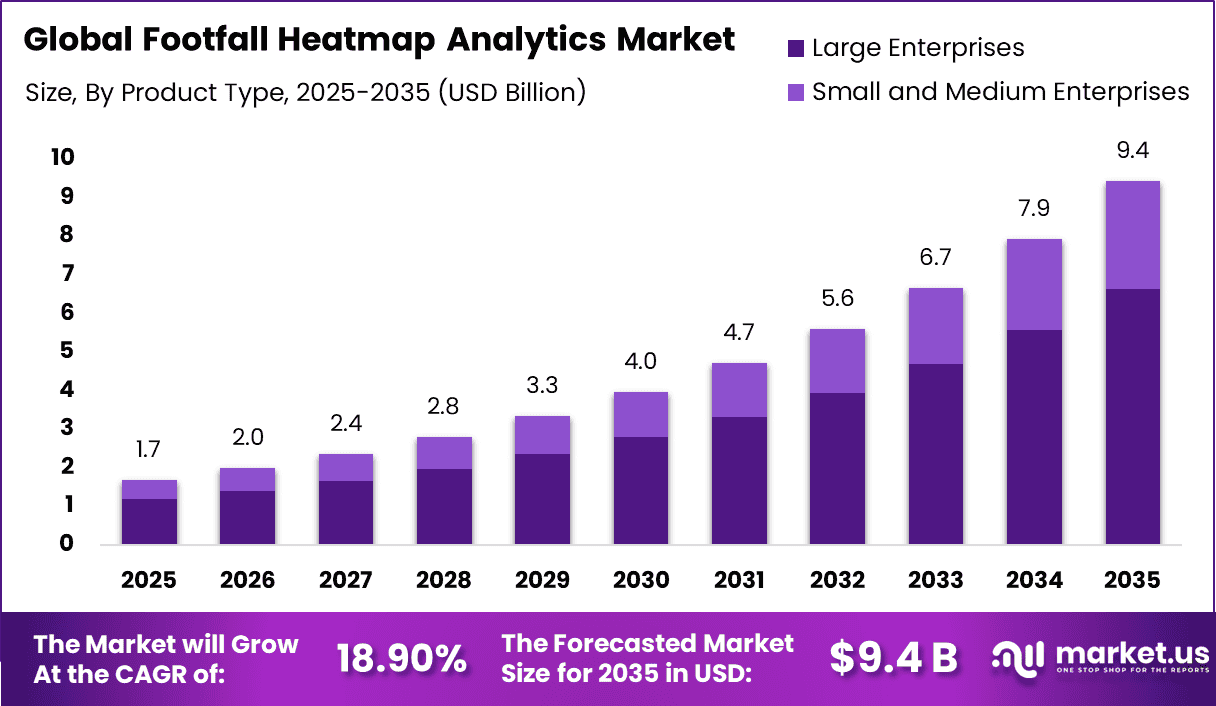
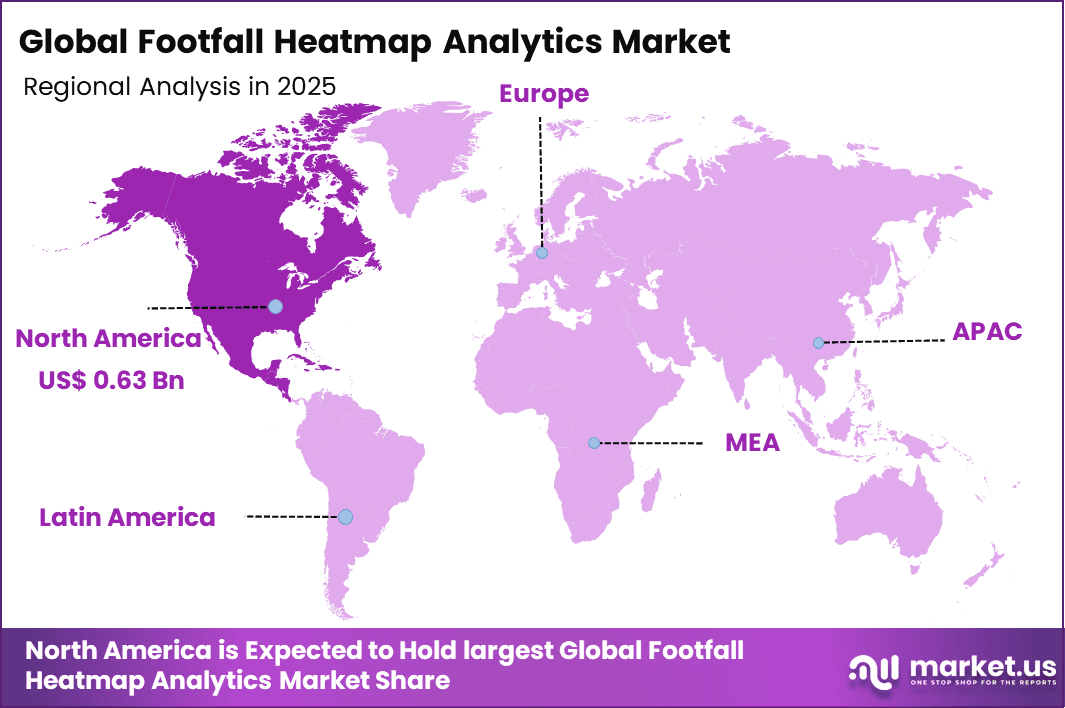
The Global Footfall Heatmap Analytics Market generated USD 1.7 billion in 2025 and is predicted to register growth from USD 2 billion in 2026 to about USD 9.4 billion by 2035, recording a CAGR of 18.90% throughout the forecast span. In 2025, North America held a dominant market position, capturing more than a 38.3% share, holding USD 0.63 Billion revenue.
Top Market Takeaways
Hardware commands 56.7% market share, delivering overhead cameras, LiDAR sensors, and edge processors for privacy-preserving people counting and dwell time tracking.
Retail applications capture 37.6%, enabling store layout optimization, promotional zone effectiveness, and conversion funnel analysis through anonymized traffic patterns.
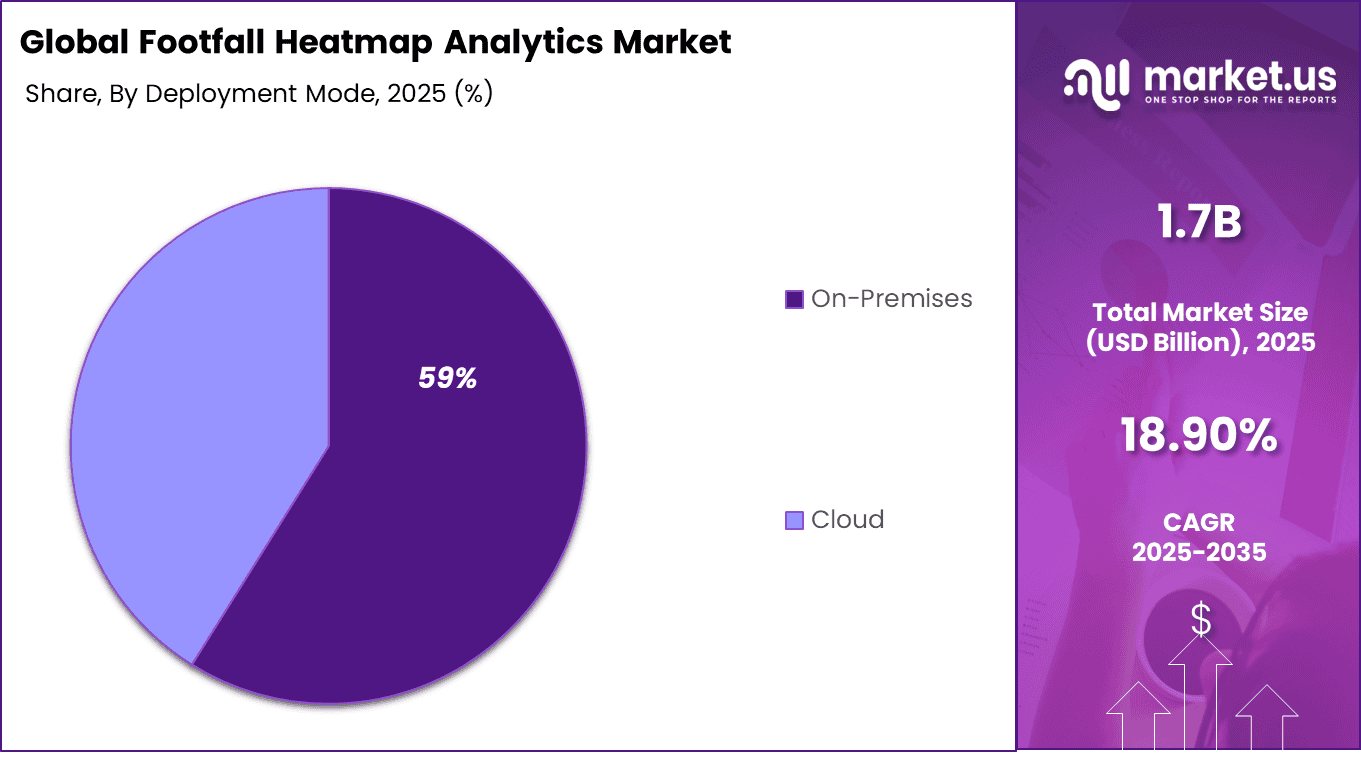
On-premises deployment dominates at 58.9%, ensuring real-time processing, data sovereignty, and integration with POS/inventory systems without cloud latency.
Large enterprises hold 70.4%, leveraging enterprise-grade platforms for multi-location benchmarking, staff scheduling, and peak-hour capacity planning.
Shopping malls represent 34.5%, powering tenant performance measurement, common area utilization, and dynamic signage based on real-time crowd density.
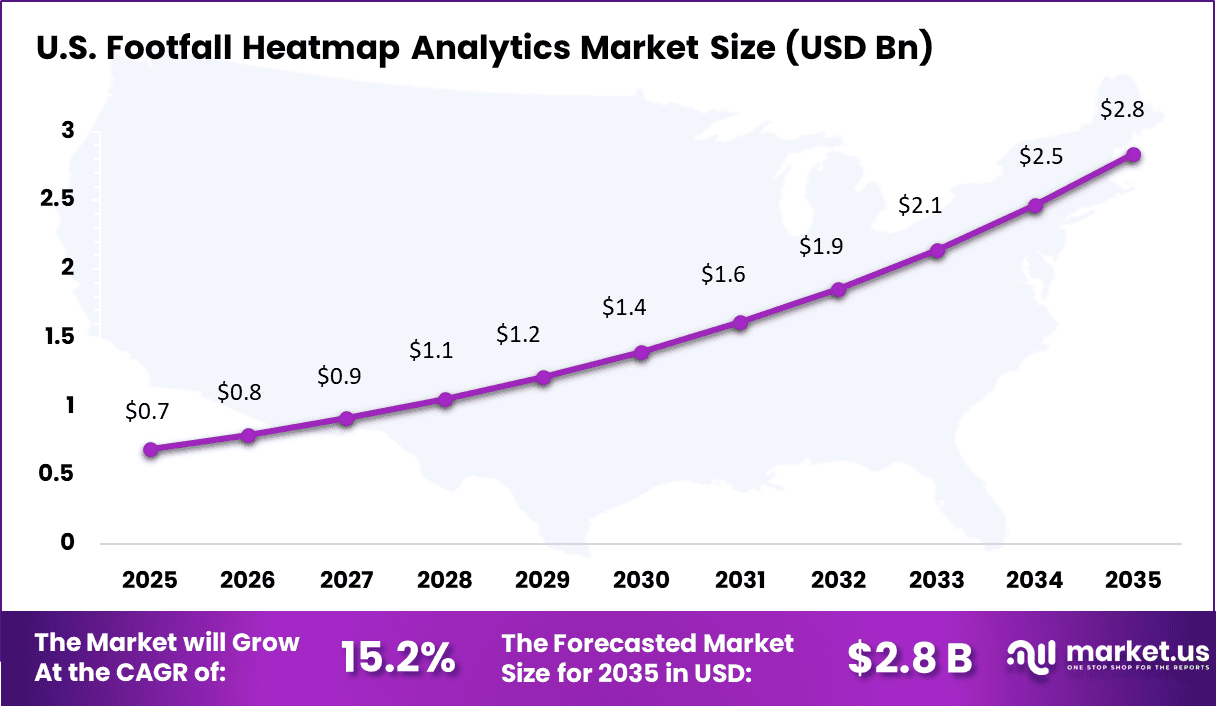
North America drives 38.3% global value, with U.S. market at USD 0.69 billion and 15.2% CAGR, fueled by omnichannel retail strategies and post-pandemic traffic recovery.
Footfall Heatmap Analytics market refers to software and analytics solutions that track how people move through physical spaces and convert that movement into visual heatmaps and traffic insights. These tools are widely used in retail stores, malls, airports, offices, public venues, and commercial buildings to understand visitor flow, high activity zones, low engagement areas, and dwell behavior. The market is gaining importance as businesses want clearer visibility into how customers and visitors interact with physical spaces and how layout decisions affect engagement and operational performance.
One of the main factors driving this market is the growing need to improve space performance and customer experience through better movement analysis. Businesses want tools that can show where visitors spend more time, which paths are used most often, and which areas receive less attention so they can improve layout, staffing, promotions, and product placement.
Another important driver is the wider use of people counting, video analytics, and in store behavior analysis, which makes heatmap based decision making more practical across many commercial environments.
Demand for footfall heatmap analytics is increasing among retailers, shopping centers, airports, property managers, and venue operators that need stronger insight into visitor movement and space utilization. These buyers want practical tools that can support layout planning, campaign measurement, staffing decisions, and overall site performance review. Demand is also rising because organizations now treat physical space analytics as an important part of operational planning, customer engagement, and revenue improvement.
Drivers Impact Analysis
Driver Factor
Impact on CAGR Forecast (~%)
Geographic Relevance
Impact Timeline
Strategic Effect
Increasing demand for retail store optimization
+2.1%
North America, Europe
Short to Mid Term
Enhances store layout and customer flow efficiency
Rising adoption of data-driven decision making
+1.8%
Global
Short Term
Improves business intelligence and planning
Growth of smart cities and intelligent infrastructure
+1.6%
APAC, Europe
Mid to Long Term
Expands deployment across public spaces
Integration with AI and video analytics
+1.7%
Global
Mid Term
Enables advanced behavioral insights
Expansion of e-commerce analytics into physical retail
+1.3%
North America, APAC
Mid Term
Bridges online and offline consumer insights
Restraints Impact Analysis
Restraint Factor
Impact on CAGR Forecast (~%)
Geographic Relevance
Impact Timeline
Strategic Limitation
High initial deployment and infrastructure costs
-1.5%
Global
Short Term
Limits adoption among small retailers
Data privacy and surveillance concerns
-1.3%
Europe, North America
Mid to Long Term
Increases regulatory pressure
Lack of skilled professionals for analytics interpretation
-1.1%
Emerging Markets
Mid Term
Reduces effective utilization of solutions
Integration issues with legacy retail systems
-0.9%
Global
Mid Term
Slows implementation timelines
Accuracy limitations in crowded environments
-0.8%
APAC, Latin America
Short to Mid Term
Affects reliability of insights
By Component Analysis
Hardware accounted for 56.7% of the Footfall Heatmap Analytics Market. This segment leads because sensors, cameras, and tracking devices are essential for capturing movement patterns and generating accurate heatmap data. These components enable real time tracking of customer behavior within physical spaces.
The segment is also supported by increasing adoption of in store analytics solutions. Businesses invest in reliable hardware to ensure precise data collection, which helps improve store layout decisions and customer engagement strategies.
By Application Analysis
Retail represented 37.6% of the market. This segment dominates because retailers use heatmap analytics to understand customer movement, identify high traffic zones, and optimize product placement. It helps improve sales performance and enhance the shopping experience.
The segment is driven by growing focus on data driven retail strategies. Businesses rely on footfall insights to refine store layouts, manage crowd flow, and increase conversion rates, which strengthens demand in this segment.
By Deployment Mode Analysis
On premises deployment held 58.9% of the market. This segment leads because organizations prefer to manage customer data within their own infrastructure to maintain privacy and security. It allows direct control over analytics systems and data processing.
The segment is also supported by the need for reliable performance and compliance with data regulations. On premises solutions ensure consistent operation and reduce dependency on external platforms, which supports adoption across retail environments.
By Organization Size Analysis
Large enterprises accounted for 70.4% of the market. This segment dominates because large organizations operate multiple stores and locations, requiring advanced analytics to monitor customer behavior across sites. Heatmap solutions help them standardize insights and improve operational efficiency.
The segment is driven by higher investment capacity and strong focus on performance optimization. Large enterprises adopt analytics tools to enhance decision making, improve store design, and increase overall business efficiency.
By End User Analysis
Shopping malls represented 34.5% of the market. This segment leads because malls require detailed insights into visitor movement to manage crowd flow, tenant placement, and overall customer experience. Heatmap analytics helps optimize space utilization and improve foot traffic management.
The segment is supported by increasing need for better space planning and operational efficiency. Mall operators use these solutions to analyze visitor behavior, enhance layout strategies, and improve engagement across retail environments.
Investor Type Impact Analysis
Investor Type
Growth Sensitivity
Risk Exposure
Geographic Focus
Investment Outlook
Venture Capital Firms
High
High
North America, APAC
Focus on AI-driven analytics startups
Private Equity Firms
Medium
Medium
Global
Invest in scalable analytics platforms
Corporate Investors
High
Low
Global
Strategic alignment with retail and smart infra
Institutional Investors
Medium
Low
North America, Europe
Preference for stable and mature solution providers
Impact Investors
Medium
Medium
Europe, APAC
Interest in smart city and urban optimization projects
Technology Enablement Analysis
Technology Enabler
Impact on CAGR Forecast (~%)
Geographic Relevance
Impact Timeline
Implementation Significance
AI-powered video analytics
+2.0%
Global
Mid Term
Improves accuracy of behavioral tracking
Cloud-based analytics platforms
+1.7%
Global
Short to Mid Term
Enables scalable and real-time data processing
IoT sensors and smart cameras
+1.5%
APAC, North America
Short to Mid Term
Enhances real-time footfall data collection
Edge computing for real-time insights
+1.3%
North America, Europe
Mid Term
Reduces latency and improves responsiveness
Integration with retail POS and CRM systems
+1.2%
Global
Mid to Long Term
Enables unified customer analytics ecosystem
Key Challenges
Data accuracy is a major challenge because footfall heatmap analytics depends on reliable tracking of customer movement, dwell time, and path patterns inside busy spaces.
Privacy concerns remain important because these systems may collect location and behavior related data that must be handled carefully and in line with data protection rules.
Integration with cameras, sensors, Wi Fi systems, and retail software can be difficult, especially when businesses use older or mixed technology setups.
Interpreting the data correctly can be challenging because high traffic in one area does not always mean strong customer interest or higher sales.
Cost can limit adoption because businesses may need to invest in hardware, software, analytics tools, and ongoing system maintenance to get useful results.
Emerging Trends
A key trend in the Footfall Heatmap Analytics market is the growing use of visual data mapping tools that track movement patterns within physical spaces. These systems convert visitor activity into heatmaps that show high and low engagement areas across stores, malls, and public venues.
Businesses use this insight to improve layout design, product placement, and crowd management. This trend reflects a shift toward using location based analytics to better understand how people interact with physical environments in real time.
Growth Factors
The increasing focus on improving customer experience and space utilization is supporting the growth of footfall heatmap analytics solutions. Retailers and facility managers aim to understand visitor behavior to optimize store layouts and reduce congestion.
These tools help identify patterns that support better decision making and improve operational efficiency. At the same time, rising adoption of smart infrastructure encourages the use of analytics platforms that provide actionable insights into how spaces are used across different environments.
Key Market Segments
By Component
Software
Hardware
Services
By Application
Retail
Transportation
Hospitality
Healthcare
Banking
Others
By Deployment Mode
On-Premises
Cloud
By Organization Size
Small and Medium Enterprises
Large Enterprises
By End-User
Shopping Malls
Airports
Stadiums
Hospitals
Banks
Others
Regional Analysis
North America accounted for 38.3% of the Footfall Heatmap Analytics Market, reflecting strong adoption of data driven customer behavior analysis across retail, shopping malls, and public venues. Businesses across the region increasingly use heatmap analytics to understand movement patterns, optimize store layouts, and improve customer engagement. The growing focus on enhancing in store experience and maximizing space utilization continues to drive demand for advanced footfall analytics solutions across North America.
The U.S. generated about USD 0.69 Billion within the regional market and is projected to expand at a CAGR of 15.2%. Retailers and commercial facility operators across the country continue to invest in analytics tools that provide insights into visitor flow and dwell time.
These platforms help improve merchandising strategies, staffing decisions, and overall operational efficiency. As competition in physical retail intensifies and businesses seek to improve performance through data insights, demand for footfall heatmap analytics solutions continues to grow steadily across the US market.
Key Regions and Countries
North America
US
Canada
Europe
Germany
France
The UK
Spain
Italy
Russia
Netherlands
Rest of Europe
Asia Pacific
China
Japan
South Korea
India
Australia
Singapore
Thailand
Vietnam
Rest of APAC
Latin America
Brazil
Mexico
Rest of Latin America
Middle East & Africa
South Africa
Saudi Arabia
UAE
Rest of MEA
Competitive Analysis
The competitive landscape of the Footfall Heatmap Analytics market includes companies that specialize in people counting, in store movement tracking, and customer behavior analysis. RetailNext, ShopperTrak (Sensormatic Solutions), V-Count, Dor Technologies, Countwise, Xovis, FootfallCam, Irisys, Trax, and Brickstream (FLIR Systems) hold strong positions because they offer tools that help retailers and commercial spaces measure visitor traffic, understand movement patterns, and improve store layout decisions. These companies compete through tracking accuracy, real time analytics, and ease of deployment.
Other players such as Springboard, Sensalytx, Kepler Analytics, Scanalytics Inc., Walkbase (Stratacache), Placer.ai, Density Inc., People Counting Systems (PCS), Gazelle.ai, and Pygmalios add competition through AI based analytics, heat mapping, and occupancy insight tools.
The market is shaped by data accuracy, privacy support, software integration, and the ability to turn footfall data into useful business decisions. Overall, companies compete by improving analytics depth, reporting quality, and customer insight.
The future outlook for the Footfall Heatmap Analytics Market looks strong as retailers, malls, and other physical spaces increasingly use heatmaps to understand customer movement, identify busy and low traffic zones, improve store layout, and plan staffing more effectively.
Current industry use cases show that heatmap and footfall analytics are already helping businesses improve product placement, customer flow, and space utilization in real time and through historical traffic analysis. As businesses focus more on customer behavior, operational efficiency, and smarter location planning, demand for footfall heatmap analytics solutions is expected to grow steadily in the coming years.
Recent Developments
March, 2026 – RetailNext adds 6G edge AI for 3D heatmaps in 5,000 US stores and tracks shelf dwell. Boosts conversion 15% and partners Walmart with real-time staff tweaks. Adds AR planogram overlays and sells anonymized data to CPG brands for stocking.
February, 2026 – Sensormatic 20/20 maps multi-floor malls with 99.5% accuracy and links sales to traffic. Serves 10K sites and adds weather-adjusted forecasts. Integrates POS data for basket insights and pilots hybrid work office flows.
Report Scope
Report Features
Description
Market Value (2025)
USD 1.7 Billion
Forecast Revenue (2035)
USD 9.4 Billion
CAGR(2025-2035)
18.90%
Base Year for Estimation
2024
Historic Period
2020-2024
Forecast Period
2026-2035
Report Coverage
Revenue forecast, AI impact on Market trends, Share Insights, Company ranking, competitive landscape, Recent Developments, Market Dynamics and Emerging Trends
Segments Covered
By Component (Software, Hardware, Services), By Application (Retail, Transportation, Hospitality, Healthcare, Banking, Others), By Deployment Mode (On-Premises, Cloud), By Organization Size (Small and Medium Enterprises, Large Enterprises), By End-User (Shopping Malls, Airports, Stadiums, Hospitals, Banks, Others)
Regional Analysis
North America – US, Canada; Europe – Germany, France, The UK, Spain, Italy, Russia, Netherlands, Rest of Europe; Asia Pacific – China, Japan, South Korea, India, New Zealand, Singapore, Thailand, Vietnam, Rest of Latin America; Latin America – Brazil, Mexico, Rest of Latin America; Middle East & Africa – South Africa, Saudi Arabia, UAE, Rest of MEA
Competitive Landscape
RetailNext, ShopperTrak (Sensormatic Solutions), V-Count, Dor Technologies, Countwise, Xovis, FootfallCam, Irisys, Trax, Brickstream (FLIR Systems), Springboard, Sensalytx, Kepler Analytics, Scanalytics Inc., Walkbase (Stratacache), Placer.ai, Density Inc., People Counting Systems (PCS), Gazelle.ai, Pygmalios, Others
Customization Scope
Customization for segments, region/country-level will be provided. Moreover, additional customization can be done based on the requirements.
Purchase Options
We have three license to opt for: Single User License, Multi-User License (Up to 5 Users), Corporate Use License (Unlimited User and Printable PDF)