


Global Wi‑Fi Based Asset Tracking Market Size, Share, Growth Analysis By Band Type (2.4 GHz, 5 GHz, 6 GHz), By Application (Smartphones, Laptops, Tablets, Routers, IoT Devices, Others), By Technology (802.11ax, 802.11ac, 802.11n, Others), By End-User (Residential, Commercial, Industrial), By Region and Companies - Industry Segment Outlook, Market Assessment, Competition Scenario, Statistics, Trends and Forecast 2025-2035
- Published date: Mar 2026
- Report ID: 182023
- Number of Pages: 304
- Format:
-
keyboard_arrow_up
Quick Navigation
- Report Overview
- Core Key Insights
- Future Predictions
- Market Outlook
- Key Market Segments
- Research-Based Segments
- By Band Type
- By Application
- By Application
- By End-User
- Regional Analysis
- US Market Size
- Driving Factors
- Restraint Factors
- Growth Opportunities
- Trending Factors
- Competitive Analysis
- Recent Developments
- Report Scope
Report Overview
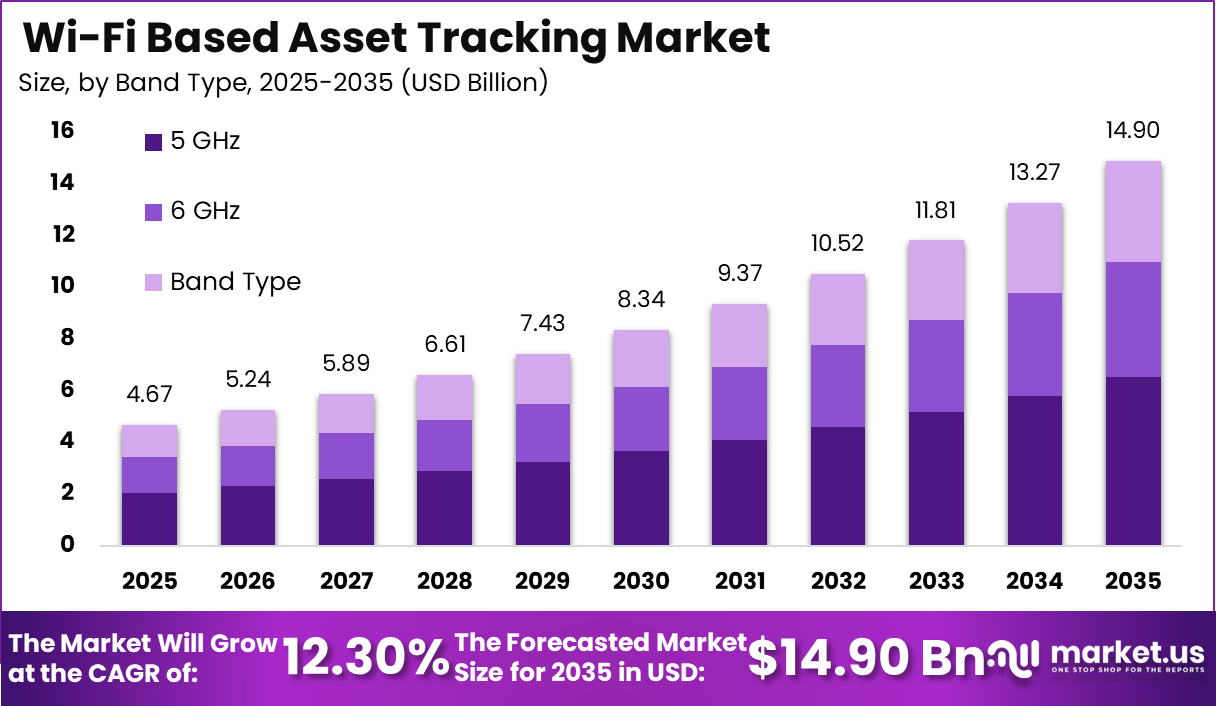
The Wi-Fi Based Asset Tracking Market is witnessing steady growth as organizations increasingly focus on improving asset visibility, operational efficiency, and real-time tracking capabilities. In 2025, the market is valued at USD 4.67 billion and is projected to reach USD 14.90 billion by 2035, expanding at a CAGR of 12.30%.
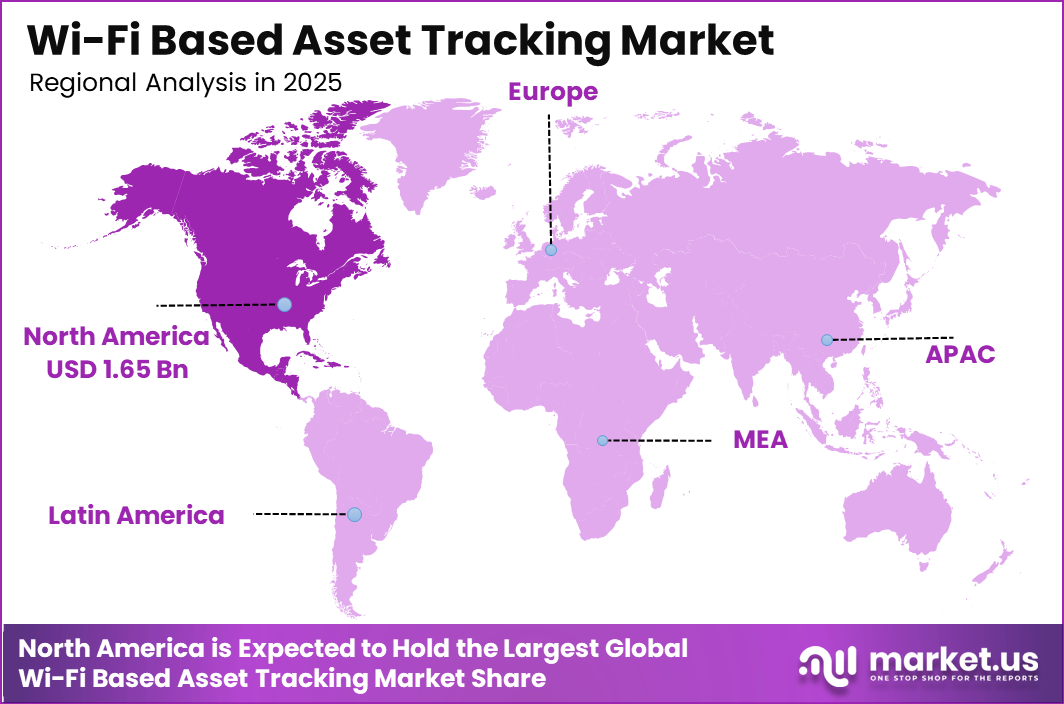
North America holds a leading share of 35.4%, accounting for USD 1.65 billion in 2025. Within the region, the US contributes USD 1.42 billion and is expected to reach USD 4.14 billion by 2035, growing at a CAGR of 11.3%.
From a client perspective, this market reflects a strong shift toward leveraging existing Wi-Fi infrastructure for cost-effective asset tracking solutions. Businesses across healthcare, manufacturing, retail, and logistics are increasingly adopting Wi-Fi-based systems to monitor equipment, inventory, and personnel in real time without requiring significant additional infrastructure investment. This approach reduces deployment costs while improving operational transparency.
The growing need for efficient inventory management, reduction in asset loss, and better utilization of resources is driving adoption across large enterprises and institutions. Additionally, the rise of smart facilities and digital transformation initiatives is supporting the integration of tracking systems with enterprise software platforms. Clients looking to invest in this market are likely to benefit from scalable solutions that offer accurate indoor positioning, seamless connectivity, and compatibility with existing wireless networks.
The Wi-Fi-based asset tracking ecosystem is supported by the widespread availability of wireless infrastructure and growing demand for real-time visibility. Globally, more than 22 billion Wi-Fi-enabled devices are currently in use, with enterprise networks handling a significant share of connected endpoints. Over 70% of businesses operate indoor Wi Fi networks across offices, warehouses, and industrial facilities, creating a strong foundation for asset tracking deployment without additional infrastructure investment.
In logistics and warehousing, over 35,000 large distribution centers worldwide rely on wireless networks for inventory and asset monitoring. The healthcare sector is also a key adopter, with more than 60% of hospitals in developed regions using real time location systems to track medical equipment and improve patient care. Additionally, global e-commerce shipments exceeded 160 billion parcels annually, increasing the need for efficient asset tracking across supply chains.
The rise of smart buildings is further supporting demand, with over 115 million connected building systems deployed globally. These trends highlight a strong data-driven foundation for Wi-Fi-based tracking solutions across industries.
Core Key Insights
- The market is valued at USD 4.67 billion in 2025. It is expected to reach USD 14.90 billion by 2035. CAGR stands at 12.30%.
- North America holds 35.4% share in 2025. The market size is USD 1.65 billion.
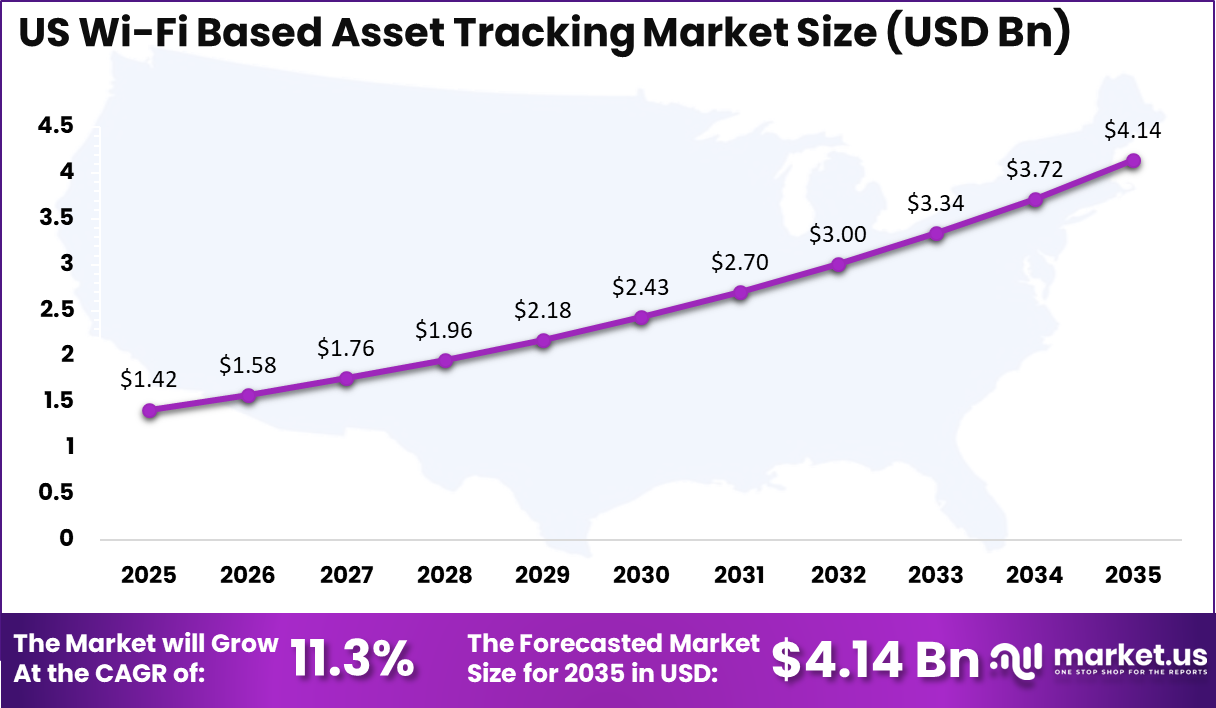
- The US market is USD 1.42 billion in 2025. It is projected to reach USD 4.14 billion by 2035. CAGR is 11.3%.
- 5 GHz leads the band type segment with 43.8% share.
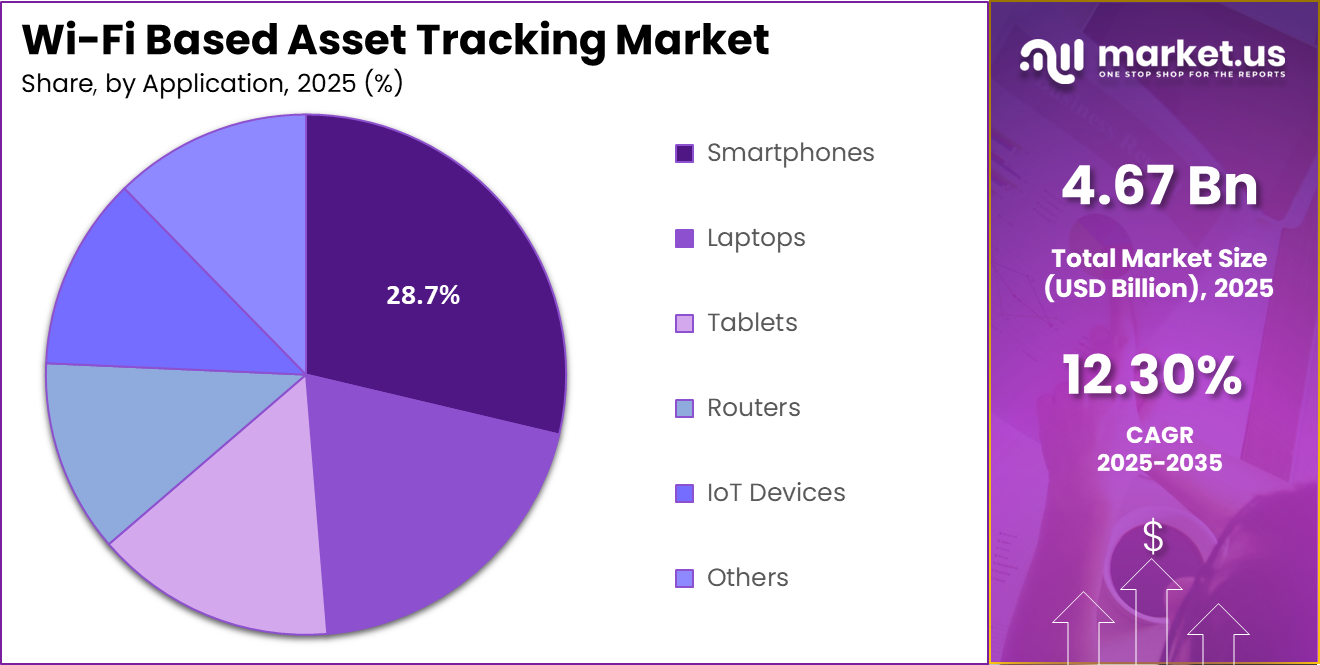
- Smartphones lead the application segment with 28.7% share.
- 802.11ax dominates the technology segment with 40.7% share.
- The commercial segment leads the end-user category with 52.6% share.
Future Predictions
The future of the Wi-Fi-based asset tracking market is expected to be strongly influenced by the rapid expansion of connected ecosystems and enterprise digitalization. Global IoT connections are projected to grow from about 21 billion in 2025 to nearly 39 billion by 2030, creating a large demand base for real-time tracking solutions across industries. This surge in connected devices is expected to directly increase the need for Wi-Fi-based tracking systems, especially in indoor environments such as warehouses, hospitals, and retail spaces.
In logistics and supply chain operations, global asset tracking adoption is accelerating, with the broader asset tracking market projected to cross USD 50 billion before 2030. This indicates strong parallel growth opportunities for Wi-Fi-based solutions, particularly where cost-efficient infrastructure reuse is critical. Additionally, smart building deployments are rising globally, with millions of connected building systems being installed to support automation and monitoring, further boosting indoor tracking demand.
The healthcare sector is also expected to expand adoption, as more hospitals implement real-time location systems for equipment and patient tracking. At the same time, enterprise Wi Fi networks are evolving with next-generation standards, enabling higher accuracy and faster data transmission. These trends indicate that Wi-Fi-based asset tracking will play a central role in future connected environments, driven by large-scale device growth and increasing reliance on real-time operational data.
Market Outlook
The Wi-Fi-based asset tracking market is positioned for steady expansion, supported by the widespread presence of wireless infrastructure and rising enterprise demand for real-time visibility. Globally, Wi Fi networks handle more than 60% of total internet traffic, making them a reliable backbone for indoor tracking solutions. Over 70% of enterprises operate managed Wi Fi networks across offices, warehouses, and production facilities, creating a strong foundation for deploying asset tracking without additional connectivity investments.
From an operational perspective, industries are increasingly prioritizing efficiency and loss prevention. In logistics, global warehouse capacity has expanded significantly, with thousands of large distribution centers relying on wireless systems for inventory control.
The healthcare sector is also advancing, with a majority of hospitals in developed regions using location-based technologies to track equipment and improve workflow management. Retail and manufacturing sectors are adopting similar systems to monitor assets, reduce downtime, and enhance productivity.
Technological advancements are further shaping the outlook. Newer Wi Fi standards such as Wi Fi 6 and Wi Fi 6E are enabling improved device density, faster speeds, and better positioning accuracy. With billions of connected devices already operating globally and enterprise networks continuing to expand, the market outlook remains positive, driven by practical deployment needs and scalable infrastructure.
Key Market Segments
The 5 GHz segment holds a leading share of 43.8% in the Wi Fi Based Asset Tracking Market. This dominance is driven by its ability to support higher data speeds, lower interference, and better performance in dense environments compared to lower frequency bands. It is widely used in enterprise networks, warehouses, and healthcare facilities where multiple devices operate simultaneously and require stable connectivity for real-time tracking.
The smartphones segment accounts for 28.7% of the application category, supported by the widespread use of mobile devices for tracking and monitoring assets. Smartphones are increasingly used as tracking endpoints or management tools, enabling real-time visibility and control through dedicated applications across industries such as retail, logistics, and healthcare.
The 802.11ax technology segment leads with a 40.7% share, reflecting the growing adoption of Wi Fi 6 standards. This technology supports higher device density, improved efficiency, and faster data transmission, making it suitable for large-scale deployments in smart buildings and industrial environments.
The commercial segment dominates the end-user category with a 52.6% share. Businesses are adopting Wi-Fi-based tracking systems to improve asset utilization, reduce losses, and enhance operational efficiency across offices, warehouses, retail stores, and healthcare facilities.
Research-Based Segments
By Band Type
- 2.4 GHz
- 5 GHz
- 6 GHz
By Application
- Smartphones
- Laptops
- Tablets
- Routers
- IoT Devices
- Others
By Technology
- 802.11ax
- 802.11ac
- 802.11n
- Others
By End-User
- Residential
- Commercial
- Industrial
By Band Type
The 5 GHz segment holds a dominant share of 43.8% in the Wi Fi Based Asset Tracking Market. This is mainly due to its ability to deliver higher data speeds and reduced interference compared to lower frequency bands. It performs well in dense environments such as warehouses, hospitals, and commercial buildings where multiple devices operate simultaneously. The 5 GHz band supports more channels, which helps improve tracking accuracy and ensures stable connectivity for real-time asset monitoring.
The 2.4 GHz segment remains widely used due to its longer range and better wall penetration capabilities. It is suitable for larger facilities and environments where coverage is more important than speed, such as manufacturing plants and outdoor storage areas. However, it faces challenges from congestion as many devices operate on this frequency.
The 6 GHz segment is an emerging category, driven by the adoption of newer Wi Fi standards such as Wi Fi 6E. It offers significantly higher bandwidth, minimal interference, and improved performance for high-density deployments. This band is expected to gain traction in advanced enterprise environments and smart buildings where high precision and faster data transmission are required for asset tracking applications.
By Application
The smartphones segment holds a leading share of 28.7% in the Wi Fi Based Asset Tracking Market. This dominance is driven by the widespread use of smartphones as both tracking tools and management interfaces. These devices enable real-time monitoring through mobile applications, allowing users to track assets, receive alerts, and manage operations efficiently across industries such as retail, logistics, and healthcare.
The laptops segment is also significant, particularly in enterprise environments where asset tracking platforms are accessed through centralized systems. Laptops are commonly used for monitoring dashboards, analytics, and control functions within offices and operational facilities. The tablets segment supports mobility in field operations, offering a balance between portability and functionality, especially in sectors like healthcare and warehousing.
Routers play a critical role as infrastructure components, acting as access points that enable tracking systems to function effectively. Their placement and performance directly influence tracking accuracy and network coverage. IoT devices represent a fast-growing segment, as connected sensors and tags are increasingly deployed for automated tracking in industrial and commercial settings.
The other segment includes specialized devices such as handheld scanners and wearable technologies, which support niche applications across different industries, contributing to overall market expansion.
By Application
The 802.11ax segment holds a dominant share of 40.7% in the Wi-Fi-based asset tracking market. This leadership is driven by the growing adoption of Wi Fi 6 technology, which offers higher data capacity, improved efficiency, and better performance in high-density environments. It enables more devices to connect simultaneously while maintaining stable performance, making it suitable for large facilities such as warehouses, hospitals, and commercial buildings where real-time tracking is critical.
The 802.11ac segment continues to maintain a strong presence, supported by its widespread deployment in existing enterprise networks. It provides reliable speed and performance for medium-density environments and remains a cost-effective solution for organizations that have not yet transitioned to newer standards.
The 802.11n segment is gradually declining, but is still used in legacy systems where basic connectivity requirements are sufficient. It offers lower speeds compared to newer technologies but remains relevant in cost-sensitive applications.
The other segment includes emerging and specialized technologies that support niche use cases. These may include advanced wireless protocols and hybrid systems designed to enhance tracking accuracy, coverage, and integration across different environments.
By End-User
The commercial segment holds a dominant share of 52.6% in the Wi Fi Based Asset Tracking Market. This is driven by widespread adoption across offices, retail stores, hospitals, and warehouses where asset visibility is critical. Businesses use these systems to track equipment, manage inventory, and improve operational efficiency. The presence of strong Wi Fi infrastructure in commercial spaces further supports easy deployment without major additional investment.
The residential segment is relatively smaller but is gradually growing with the rise of smart homes and connected devices. Consumers are increasingly using Wi-Fi-based tracking for personal assets such as electronics, pets, and home equipment. The expansion of home automation systems and affordable tracking solutions is supporting adoption in this segment.
The industrial segment is expanding steadily, supported by increasing digital transformation in manufacturing and logistics. Industries are adopting Wi-Fi-based tracking to monitor tools, machinery, and raw materials in real time. This helps reduce downtime, improve asset utilization, and enhance production efficiency. Large-scale facilities with established wireless networks are key contributors to growth in this segment.
Regional Analysis
North America holds a dominant share of 35.4% in the Wi Fi Based Asset Tracking Market, with a market size of USD 1.65 billion in 2025. This leadership is supported by strong digital infrastructure and early adoption of wireless technologies across industries. Enterprises in the region have widely deployed Wi Fi networks across offices, hospitals, warehouses, and retail environments, enabling easy integration of asset tracking solutions without significant additional investment.
The United States plays a major role in regional growth, driven by high adoption in healthcare, logistics, and retail sectors. Hospitals are increasingly using real-time location systems to track medical equipment and improve operational efficiency, while logistics companies rely on Wi Fi tracking to manage inventory and optimize supply chains. The rapid expansion of e-commerce and large distribution networks is further supporting demand for accurate indoor tracking systems.
Canada is also contributing to market growth through investments in smart infrastructure and digital transformation initiatives. The adoption of advanced Wi Fi technologies, such as Wi Fi 6, is improving tracking accuracy and network performance across commercial and industrial facilities. Overall, North America is expected to maintain its leading position, supported by continuous innovation and strong demand for real-time asset visibility.
US Market Size
The US Wi-Fi-based asset tracking market is valued at USD 1.42 billion in 2025. It is projected to reach USD 4.14 billion by 2035, growing at a CAGR of 11.3%. This growth is supported by strong adoption of digital tracking solutions across commercial and industrial sectors, where real-time asset visibility is becoming a key operational requirement.
The healthcare sector is a major contributor, with hospitals increasingly using Wi-Fi-based tracking systems to monitor medical equipment, manage patient flow, and reduce asset loss. In logistics and retail, companies are deploying these solutions to improve inventory accuracy and streamline supply chain operations. The rapid expansion of e-commerce and warehouse networks across the country is further strengthening demand for indoor tracking technologies.
In addition, the presence of advanced Wi Fi infrastructure across enterprises allows for cost-effective deployment without the need for new connectivity systems. Businesses are also adopting newer standards such as Wi Fi 6 to enhance tracking accuracy and support higher device density. With continuous investments in smart buildings and digital transformation, the US market is expected to witness steady and sustained growth over the forecast period.
Regional Analysis and Coverage
- North America
- US
- Canada
- Europe
- Germany
- France
- The UK
- Spain
- Italy
- Russia
- Netherlands
- Rest of Europe
- Asia Pacific
- China
- Japan
- South Korea
- India
- Australia
- Singapore
- Thailand
- Vietnam
- Rest of Latin America
- Latin America
- Brazil
- Mexico
- Rest of Latin America
- Middle East & Africa
- South Africa
- Saudi Arabia
- UAE
- Rest of MEA
Driving Factors
The market is driven by the rapid expansion of enterprise Wi Fi infrastructure and the increasing need for real-time asset visibility. Globally, over 70% of enterprises operate managed Wi Fi networks, creating a ready platform for tracking solutions without additional connectivity investment. In logistics, global warehouse capacity continues to expand, with tens of thousands of large distribution centers relying on wireless systems for inventory control.
The healthcare sector is also a key driver, as more than half of hospitals in developed regions use location tracking technologies to manage equipment and improve patient care. Additionally, global e-commerce shipments have crossed 150 billion parcels annually, increasing the need for accurate tracking across supply chains. Businesses are focusing on reducing asset loss, improving utilization, and enhancing operational efficiency, which is accelerating the adoption of Wi-Fi-based tracking systems across commercial environments.
Restraint Factors
The market is driven by the rapid expansion of enterprise Wi Fi infrastructure and the increasing need for real-time asset visibility. Globally, over 70% of enterprises operate managed Wi Fi networks, creating a ready platform for tracking solutions without additional connectivity investment. In logistics, global warehouse capacity continues to expand, with tens of thousands of large distribution centers relying on wireless systems for inventory control.
The healthcare sector is also a key driver, as more than half of hospitals in developed regions use location tracking technologies to manage equipment and improve patient care. Additionally, global e-commerce shipments have crossed 150 billion parcels annually, increasing the need for accurate tracking across supply chains. Businesses are focusing on reducing asset loss, improving utilization, and enhancing operational efficiency, which is accelerating the adoption of Wi-Fi-based tracking systems across commercial environments.
Growth Opportunities
The market presents strong opportunities driven by the evolution of advanced Wi Fi technologies and smart infrastructure development. New standards such as Wi Fi 6 and Wi Fi 6E support higher device density and improved efficiency, enabling more accurate tracking in large-scale environments. Globally, billions of connected devices are expected to operate within enterprise networks, creating a large addressable market for asset tracking solutions.
Smart building deployments are increasing, with millions of connected systems installed worldwide to support automation and monitoring. The industrial sector is also adopting digital solutions, with factories integrating connected devices for real-time monitoring and predictive maintenance.
Additionally, the expansion of IoT ecosystems, with connected devices projected to exceed tens of billions globally, is opening new opportunities for seamless integration of tracking systems. These developments are expected to drive demand for scalable and cost-effective Wi-Fi-based asset tracking solutions across industries.
Trending Factors
The market is witnessing strong momentum due to the growing adoption of advanced Wi Fi standards and connected ecosystems. One of the key trends is the transition toward Wi Fi 6 and Wi Fi 6E technologies, which are now being adopted across enterprise environments.
These technologies support higher device density, improved efficiency, and faster data speeds, with gigabit-level throughput becoming increasingly common in modern networks. This enables more accurate and responsive asset tracking in high-traffic environments such as warehouses and hospitals.
Another major trend is the rise of smart buildings and digital workplaces. Globally, over 100 million smart building systems are already deployed, integrating lighting, security, and asset tracking into unified platforms. Businesses are increasingly using Wi Fi networks not just for connectivity but also for real-time location intelligence. In addition, the number of connected IoT devices continues to grow rapidly, crossing 20 billion units worldwide, which is increasing demand for scalable tracking solutions.
Edge computing is also emerging as a trend, allowing data processing closer to devices for faster decision-making. Combined with AI-based analytics, organizations are improving asset utilization and reducing operational delays. These trends highlight a shift toward intelligent, data-driven tracking systems within enterprise environments.
Competitive Analysis
The Wi-Fi-based asset tracking market shows a moderately competitive landscape, with a mix of established technology providers and emerging solution vendors. The broader asset tracking industry is valued at over USD 25 billion globally, indicating strong competition across multiple technologies, including Wi Fi, RFID, and Bluetooth-based systems. Within this ecosystem, Wi-Fi-based solutions compete by offering cost advantages through existing network infrastructure, which is a key differentiator for enterprise adoption.
Large technology companies dominate the market through strong portfolios in networking hardware, cloud platforms, and IoT integration. These players leverage global distribution networks and invest heavily in innovation, particularly in Wi Fi 6 and real-time location analytics. At the same time, the wireless asset management sector is characterized by medium market concentration, with several players contributing to innovation and pricing competition. This creates a balanced environment where both global firms and regional providers can compete effectively.
Startups and niche vendors are increasingly focusing on software-driven solutions and analytics platforms, offering flexible and scalable systems for specific industries such as healthcare and logistics. The rapid growth of the real-time location systems segment, which is expected to exceed USD 15 billion before 2030, further intensifies competition by attracting new entrants and encouraging product differentiation. Overall, competition is driven by innovation, pricing strategies, and the ability to deliver accurate and scalable tracking solutions.
Top Key Players in the Market
- Qualcomm Technologies, Inc.
- Broadcom Inc.
- Intel Corporation
- MediaTek Inc.
- Marvell Technology Group Ltd.
- Texas Instruments Incorporated
- Cypress Semiconductor Corporation
- Skyworks Solutions, Inc.
- Qorvo, Inc.
- NXP Semiconductors N.V.
- STMicroelectronics N.V.
- Realtek Semiconductor Corp.
- Renesas Electronics Corporation
- ON Semiconductor Corporation
- Microchip Technology Inc.
- Infineon Technologies AG
- Analog Devices, Inc.
- Samsung Electronics Co., Ltd.
- Huawei Technologies Co., Ltd.
- ASUS (ASUSTeK Computer Inc.)
- Others
Recent Developments
- In 2025, global Wi Fi asset tracking adoption accelerated as enterprises expanded real-time visibility systems, supported by the broader asset tracking market reaching over USD 16 billion in value.
- In 2025, Wi-Fi-based tracking continued gaining traction within IoT ecosystems, contributing to nearly 18% share of connected asset tracking deployments across industries such as logistics, healthcare, and manufacturing.
- In 2025, next-generation Wi-Fi 6 chipsets were introduced with ultra-low power consumption below 50 mA during scanning, enabling longer battery life for tracking devices.
Report Scope
Report Features Description Market Value (2025) USD 4.67 Billion Forecast Revenue (2035) USD 14.90 Billion CAGR(2025-2035) 12.30% Base Year for Estimation 2025 Historic Period 2020-2024 Forecast Period 2026-2035 Report Coverage Revenue forecast, AI impact on Market trends, Share Insights, Company ranking, competitive landscape, Recent Developments, Market Dynamics, and Emerging Trends Segments Covered By Band Type (2.4 GHz, 5 GHz, 6 GHz), By Application (Smartphones, Laptops, Tablets, Routers, IoT Devices, Others), By Technology (802.11ax, 802.11ac, 802.11n, Others), By End-User (Residential, Commercial, Industrial) Regional Analysis North America – US, Canada; Europe – Germany, France, The UK, Spain, Italy, Russia, Netherlands, Rest of Europe; Asia Pacific – China, Japan, South Korea, India, New Zealand, Singapore, Thailand, Vietnam, Rest of Latin America; Latin America – Brazil, Mexico, Rest of Latin America; Middle East & Africa – South Africa, Saudi Arabia, UAE, Rest of MEA Competitive Landscape Qualcomm Technologies, Inc., Broadcom Inc., Intel Corporation, MediaTek Inc., Marvell Technology Group Ltd., Texas Instruments Incorporated, Cypress Semiconductor Corporation, Skyworks Solutions, Inc., Qorvo, Inc., NXP Semiconductors N.V., STMicroelectronics N.V., Realtek Semiconductor Corp., Renesas Electronics Corporation, ON Semiconductor Corporation, Microchip Technology Inc., Infineon Technologies AG, Analog Devices, Inc., Samsung Electronics Co., Ltd., Huawei Technologies Co., Ltd., ASUS (ASUSTeK Computer Inc.), Others Customization Scope Customization for segments, region/country-level will be provided. Moreover, additional customization can be done based on the requirements. Purchase Options We have three licenses to opt for: Single User License, Multi-User License (Up to 5 Users), Corporate Use License (Unlimited Users and Printable PDF)  Wi‑Fi Based Asset Tracking MarketPublished date: Mar 2026add_shopping_cartBuy Now get_appDownload Sample
 -
-
- Qualcomm Technologies, Inc.
- Broadcom Inc.
- Intel Corporation
- MediaTek Inc.
- Marvell Technology Group Ltd.
- Texas Instruments Incorporated
- Cypress Semiconductor Corporation
- Skyworks Solutions, Inc.
- Qorvo, Inc.
- NXP Semiconductors N.V.
- STMicroelectronics N.V.
- Realtek Semiconductor Corp.
- Renesas Electronics Corporation
- ON Semiconductor Corporation
- Microchip Technology Inc.
- Infineon Technologies AG
- Analog Devices, Inc.
- Samsung Electronics Co., Ltd.
- Huawei Technologies Co., Ltd.
- ASUS (ASUSTeK Computer Inc.)
- Others
Our Clients

- 182023
- Mar 2026









