


Global Wearable Breast Pump Market By Product Type (Closed System, Open System and All-in-One), By Type (Battery-Operated and Manual), By Application (Personal Use and Hospital Grade), Region and Companies – Industry Segment Outlook, Market Assessment, Competition Scenario, Trends and Forecast 2026-2035
- Published date: March 2026
- Report ID: 180606
- Number of Pages: 373
- Format:
-
keyboard_arrow_up
Quick Navigation
Report Overview
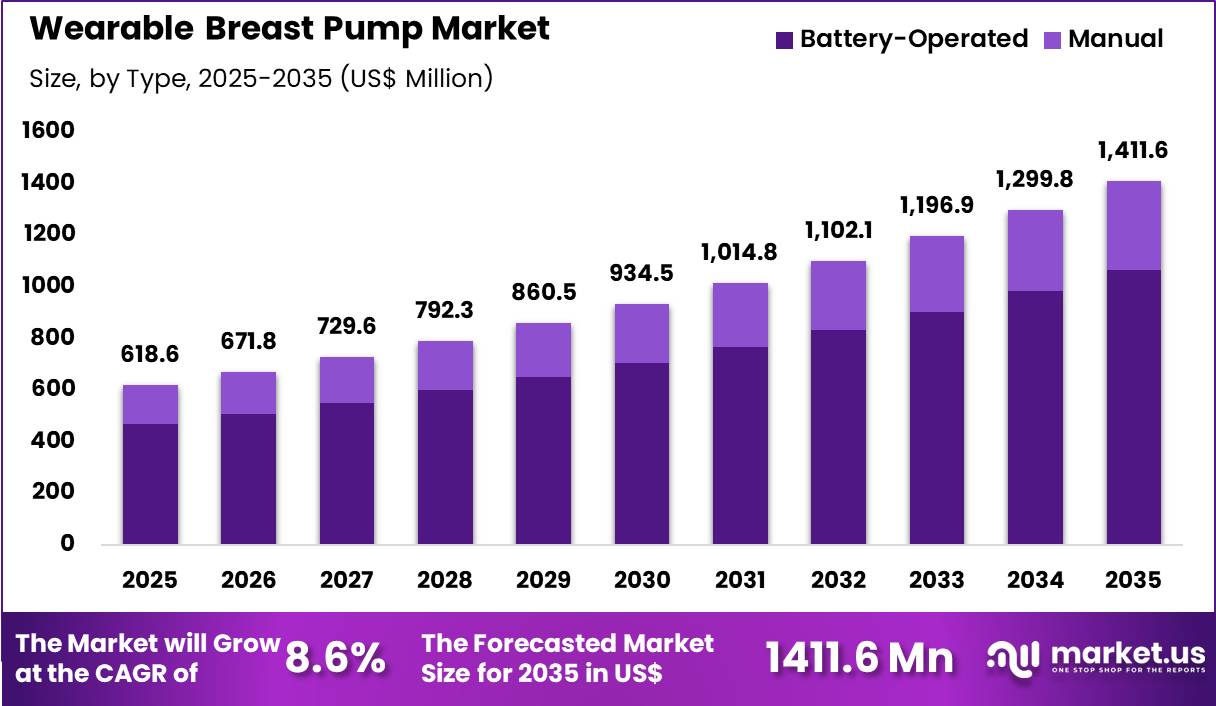
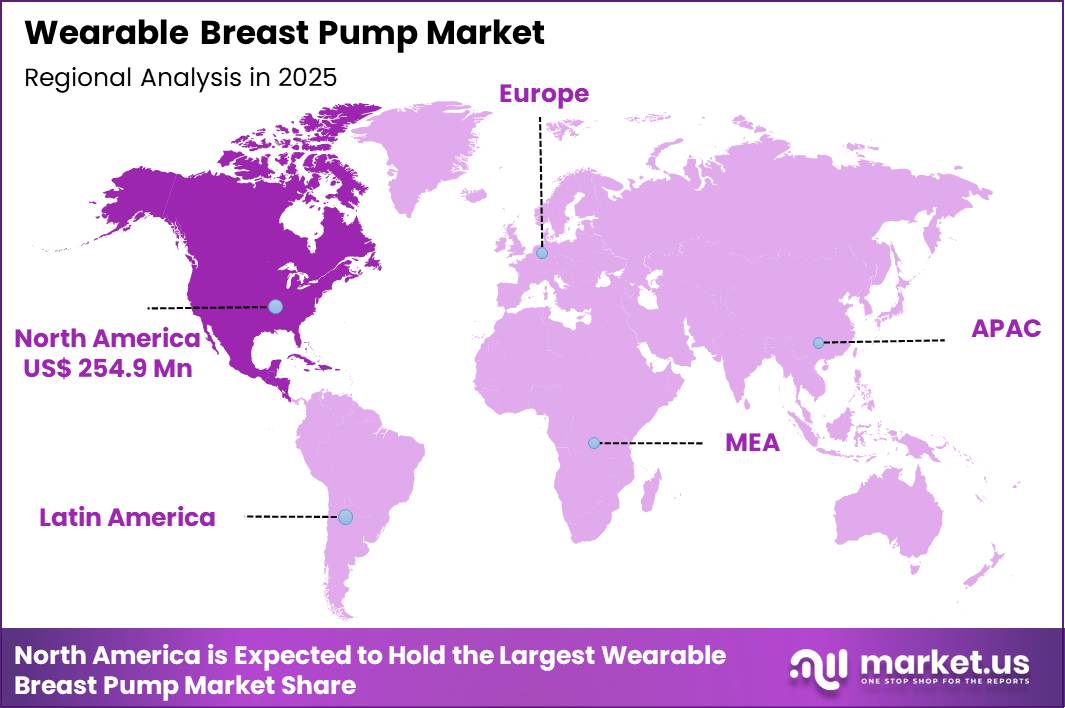
The Global Wearable Breast Pump Market size is expected to be worth around US$ 1411.6 Million by 2035 from US$ 618.6 Million in 2025, growing at a CAGR of 8.6% during the forecast period 2026-2035. In 2025, North America led the market, achieving over 41.2% share with a revenue of US$ 254.9 Million.
Increasing participation of women in the workforce and greater emphasis on breastfeeding compatibility with professional life drive the wearable breast pump market as mothers seek discreet, hands-free solutions that support continued lactation without disrupting daily routines.
Working mothers increasingly rely on wearable breast pumps during office hours to express milk privately at their desks or in lactation rooms, maintaining supply and enabling them to meet breastfeeding recommendations while returning to employment. These devices support active lifestyles by allowing pumping during commutes, errands, or light exercise, where traditional pumps prove cumbersome and impractical.
New mothers utilize wearable pumps for on-demand expression in the early postpartum period, capturing milk during unpredictable letdown moments or when away from home. In neonatal intensive care settings, mothers use compact wearable pumps to build and maintain supply while their infants receive care, providing expressed milk for tube feeding or supplementation. The hands-free design also facilitates multitasking, such as caring for older children or completing household tasks during pumping sessions.
Manufacturers pursue opportunities to incorporate advanced suction patterns and app connectivity, expanding applications in personalized pumping where users track milk output, adjust settings remotely, and monitor session history for optimized production. Developers advance quieter motors and ergonomic fit improvements, broadening utility for extended wear in professional and social environments.
These innovations support integration with smart bottles and milk storage systems, streamlining the entire expression-to-feeding workflow. Opportunities emerge in subscription-based accessories and replacement parts that enhance long-term usability for extended breastfeeding journeys. Companies invest in hospital-grade inspired technologies that mimic natural feeding rhythms to maximize milk yield.
In June 2025, Ameda’s GLO Wearable Breast Pump received recognition at the 2025 Baby Innovation Awards for advancements in breast pump technology. The device integrates Milk Optimizing Technology inspired by hospital-grade pump systems, aiming to improve milk expression efficiency while maintaining a compact wearable design.
Recent trends emphasize comfort-focused designs, extended battery life, and discreet aesthetics, positioning wearable breast pumps as essential tools in modern breastfeeding support and maternal wellness.
Key Takeaways
- In 2025, the market generated a revenue of US$ 618.6 Million, with a CAGR of 8.6%, and is expected to reach US$ 1411.6 Million by the year 2035.
- The product type segment is divided into closed system, open system and all-in-one, with battery-operated taking the lead with a market share of 75.6%.
- Considering type, the market is divided into battery-operated and manual. Among these, all-in-one held a significant share of 48.6%.
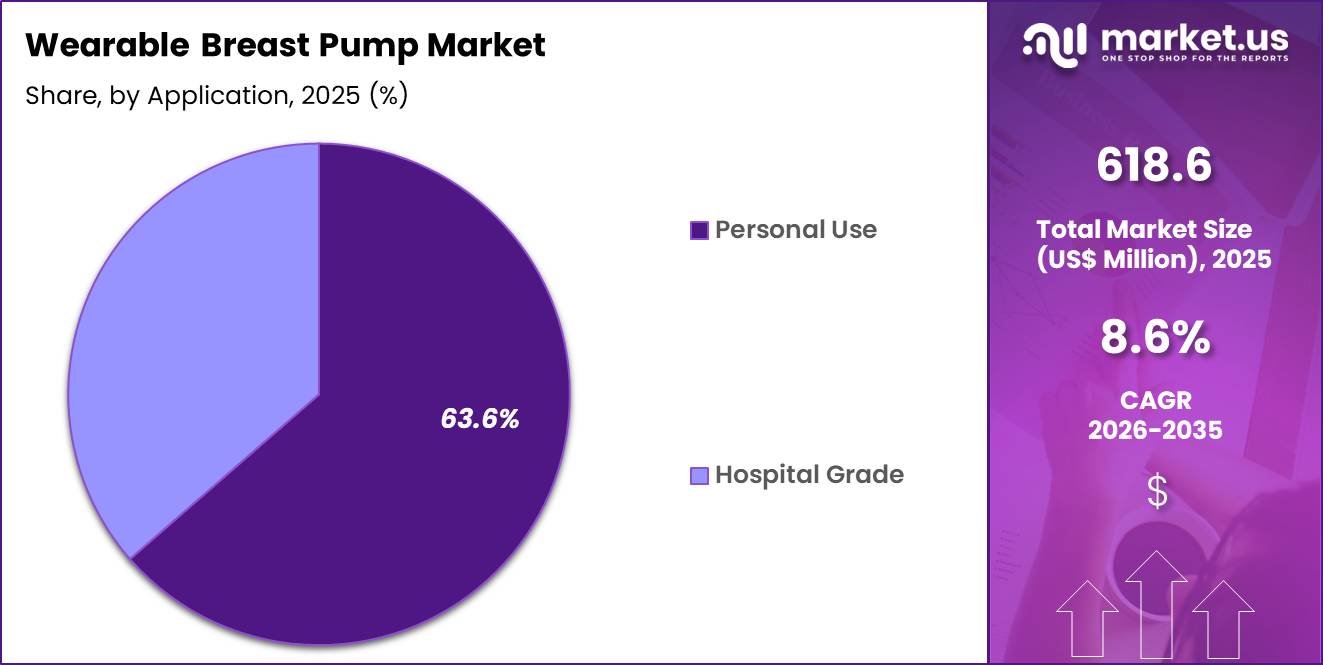
- Furthermore, concerning the application segment, the market is segregated into personal use and hospital grade. The personal use sector stands out as the dominant player, holding the largest revenue share of 63.6% in the market.
- North America led the market by securing a market share of 41.2%.
Product Type Analysis
All-in-one wearable breast pumps accounted for 48.6% of growth within product type and dominate the market due to their integrated design that combines pump, motor, and milk collection container into a single compact device. Mothers prefer all-in-one systems because they simplify pumping routines and reduce the need for multiple components.
The segment growth is projected to strengthen as manufacturers focus on hands-free pumping technology that fits discreetly inside clothing. Compact designs improve comfort and allow mothers to continue daily activities while pumping milk. Technological innovation supports improved suction patterns that replicate natural infant feeding rhythms.
Demand is likely to expand as digital connectivity features allow mothers to monitor pumping sessions through mobile applications. Increasing awareness of breastfeeding benefits further encourages adoption of efficient pumping technologies. Hospitals and maternity care professionals also recommend wearable solutions that support frequent milk expression during early lactation stages.
Type Analysis
Battery-operated wearable breast pumps accounted for 75.6% of growth within type and dominate the wearable breast pump market due to the increasing demand for convenient and portable lactation solutions. Working mothers increasingly seek flexible pumping options that support mobility and allow discreet use during daily routines. Battery-powered devices eliminate the need for constant electrical connections and support pumping at workplaces or during travel.
Segment growth is expected to strengthen as female workforce participation continues to rise across many regions. Health organizations including the U.S. Centers for Disease Control and Prevention report that breastfeeding initiation rates exceed 80% in the United States, which supports sustained demand for efficient pumping devices.
Manufacturers integrate quieter motors, rechargeable batteries, and app-based monitoring features to improve usability. Demand is anticipated to increase as parents prioritize products that support multitasking and comfort during pumping sessions. Continuous improvements in battery efficiency and compact design further reinforce adoption across modern parenting lifestyles.
Application Analysis
Personal use accounted for 63.6% of growth within applications and dominate the wearable breast pump market due to the rising number of mothers choosing to pump milk at home or during work hours. Breastfeeding support programs and maternal health campaigns encourage continued breastfeeding for at least the first six months of infant life.
Parents increasingly purchase personal wearable pumps to maintain consistent milk supply without relying on hospital equipment. Segment growth is expected to accelerate as consumer awareness regarding breastfeeding health benefits continues to expand. Retail distribution and e-commerce platforms improve product accessibility for new parents.
Many mothers prefer personal devices because they offer privacy and flexible pumping schedules. Demand is anticipated to rise as family lifestyles require greater mobility and convenience during childcare routines. Continuous improvements in ergonomic design and quieter pumping mechanisms further support the growth of personal wearable breast pumps.
Key Market Segments
By Product Type
- Closed System
- Open System
- All-in-One
By Type
- Battery-Operated
- Manual
By Application
- Personal Use
- Hospital Grade
Drivers
Increasing labor force participation rates among mothers with children under 6 is driving the market.
The U.S. Bureau of Labor Statistics reported a labor force participation rate of 66.5 percent for mothers with children under 6 years old in 2022. This figure rose to 68.9 percent in 2023, indicating stronger workforce engagement among new mothers.
In 2024, the rate stood at 68.3%, maintaining elevated levels compared to prior years. Such sustained increases reflect policy supports and cultural shifts enabling mothers to balance parenting with professional commitments. Working mothers require convenient tools to maintain breastfeeding routines during employment hours.
Wearable breast pumps address this need by allowing discreet milk expression without interrupting daily activities. The upward trend in participation correlates directly with demand for portable, hands-free pumping solutions.
Employers offering lactation accommodations further amplify adoption in professional settings. Healthcare providers recommend these devices to support extended breastfeeding durations. This driver facilitates market expansion through heightened consumer accessibility and necessity.
Restraints
Slight decline in labor force participation rates from 2023 to 2024 is restraining the market.
The U.S. Bureau of Labor Statistics documented a labor force participation rate of 68.9 percent for mothers with children under 6 in 2023. This decreased marginally to 68.3 percent in 2024, signaling potential economic pressures on maternal employment. The 0.6 percentage point drop may stem from childcare challenges and return-to-office mandates post-pandemic. Reduced workforce re-entry tempers immediate demand for daily-use pumping devices.
Manufacturers observe moderated sales velocity in response to fluctuating consumer priorities. Facilities delay inventory expansions amid uncertain participation recovery. The restraint highlights vulnerabilities in segments reliant on consistent working-mother demographics.
Providers must navigate promotional strategies to sustain engagement during transitional periods. Economic analyses link such dips to broader family support gaps. This factor constrains short-term growth projections for wearable breast pump innovations.
Opportunities
Proliferation of FDA-cleared wearable breast pump models in 2025 is creating growth opportunities.
The U.S. Food and Drug Administration granted 510(k) clearance to the eufy Wearable Breast Pump series on April 2, 2025. This approval covers models S1, E10, S1 Pro, and E20, classified under regulation 884.5160 for powered breast pumps. Later in the year, on October 29, 2025, clearance was issued for the Momcozy Wearable Breast Pump models BP334 through BP434.
These devices feature up to 15 suction levels and maximum pressures of 315 mmHg, enhancing user customization. Opportunities emerge for diversified product lines targeting varied anatomical needs and preferences. Manufacturers can leverage these validations to expand distribution through retail and online channels.
The clearances enable integration of advanced features like app connectivity for tracking sessions. Educational campaigns can highlight safety and efficacy to build prescriber trust. Such regulatory milestones foster competitive differentiation and international export potential. This development positions the sector for accelerated innovation and market share gains.
Impact of Macroeconomic / Geopolitical Factors
Macroeconomic conditions influence the wearable breast pump market through consumer purchasing power, insurance reimbursement policies, and healthcare retail spending. Inflation increases the cost of compact motors, sensors, rechargeable batteries, and medical grade plastics used in pump systems. Higher interest rates reduce venture funding and limit expansion plans for emerging femtech manufacturers.
Geopolitical tensions affect global supply chains for electronic components and precision molded parts, which creates production delays and cost fluctuations. Current US tariffs on imported electronics and device components increase manufacturing expenses and narrow margins for brands serving the US market. These pressures can slow product launches and raise retail prices for consumers.
At the same time, companies strengthen domestic assembly partnerships and diversify supplier networks to stabilize production. Rising demand for discreet, mobile breastfeeding solutions continues to support steady and confident market growth.
Latest Trends
Acquisition of Elvie by Willow Innovations in 2025 is driving the market.
Willow Innovations completed the acquisition of Elvie’s assets on April 8, 2025, amid the UK firm’s administration proceedings. This strategic move consolidates two leading wearable pump portfolios under unified ownership. Willow, valued for its hands-free designs, gains Elvie’s European manufacturing and intellectual property assets.
The integration enhances global supply chains and accelerates product development timelines. Combined technologies promise hybrid solutions blending app-driven tracking with ergonomic enhancements. Stakeholders anticipate expanded R&D investments post-merger to address user feedback on comfort. The 2025 transaction reflects maturing consolidation in maternal health tech.
Practices benefit from broader availability of compatible accessories and replacement parts. The development stimulates cross-border marketing synergies. Overall, this trend propels efficiency and positions the market for robust post-acquisition growth.
Regional Analysis
North America is leading the Wearable Breast Pump Market
North America accounted for 41.2% of the wearable breast pump market in 2025 as demand accelerated among working mothers seeking discreet and hands-free lactation solutions. Growing participation of women in the workforce and supportive maternity policies in the United States and Canada encouraged adoption of portable pumping technologies that allow milk expression during daily activities.
According to the Centers for Disease Control and Prevention, about 83.2% of infants born in the United States in 2022 began breastfeeding, reflecting strong maternal awareness of breastfeeding benefits and reinforcing demand for convenient pumping tools. Hospitals and maternity care providers increasingly recommend advanced pumping systems that support milk supply maintenance after childbirth.
Insurance coverage for breastfeeding equipment under healthcare programs has also encouraged greater access to modern lactation devices. Technology improvements such as quieter motors, wearable designs, and smartphone connectivity have improved usability and convenience for new mothers.
Digital parenting communities and lactation consultants actively promote wearable solutions that support flexible feeding routines. Retail expansion through e-commerce platforms has made innovative lactation products more accessible to consumers. These combined developments supported steady expansion of wearable pumping technologies across North America in 2025.
The Asia Pacific region is expected to experience the highest CAGR during the forecast period
Asia Pacific is expected to register strong growth during the forecast period as maternal health awareness and breastfeeding support initiatives expand across emerging healthcare systems. Governments and public health organizations across the region are promoting breastfeeding through national nutrition and maternal health programs.
The World Health Organization reported that about 48% of infants globally were exclusively breastfed during the first six months in 2022, and several Asian countries have launched initiatives to improve this rate through improved maternal support services. Increasing urbanization and rising employment among women in countries such as China, India, and South Korea are encouraging demand for convenient lactation solutions that support busy lifestyles.
Hospitals and maternity clinics are strengthening lactation counseling programs that recommend modern pumping technologies for milk expression and storage. Growing middle-class income levels are enabling families to purchase advanced maternal care devices that were previously limited to developed markets.
Manufacturers are introducing compact and cost-effective pumping products designed specifically for Asian consumers. Expansion of online retail channels and parenting platforms is improving product awareness and accessibility across urban and semi-urban populations. These trends are expected to drive continued adoption of innovative lactation technologies throughout Asia Pacific in the coming years.
Key Regions and Countries
North America
- US
- Canada
Europe
- Germany
- France
- The UK
- Spain
- Italy
- Russia
- Netherland
- Rest of Europe
Asia Pacific
- China
- Japan
- South Korea
- India
- Australia
- New Zealand
- Singapore
- Thailand
- Vietnam
- Rest of APAC
Latin America
- Brazil
- Mexico
- Rest of Latin America
Middle East & Africa
- South Africa
- Saudi Arabia
- UAE
- Rest of MEA
Key Players Analysis
Key players in the Wearable Breast Pump market accelerate expansion by introducing hands-free pumping technologies, improving portability, and integrating smart digital features that allow mothers to track milk production through connected mobile applications.
Companies actively invest in ergonomic designs, quieter motors, and longer battery performance to improve convenience for working mothers who require flexible breastfeeding solutions. The strong focus on innovation and product differentiation helps manufacturers strengthen brand recognition and capture demand from modern parenting lifestyles.
Willow Innovations represents a prominent participant in the Wearable Breast Pump market and operates as a health-technology company headquartered in California that develops wireless breast pumps and digital lactation solutions for mothers. The firm focuses on research-driven product development and consumer-centric design to improve comfort, mobility, and efficiency during milk expression.
Industry competitors also pursue partnerships with telehealth platforms, e-commerce expansion, and targeted marketing campaigns to broaden consumer reach. Continuous product launches and technology upgrades therefore strengthen competitive positioning and support long-term growth across the Wearable Breast Pump market.
Top Key Players
- Momcozy
- Lansinoh Laboratories, Inc.
- Mamma Bump
- Tommee Tippee
- Haakaa
- Ardo medical AG
- Medela
- Willow
- Elvie
- Freemie
- Uzin Medicare
- LaVie Mom
- Ameda
- Annabella-Pump
Recent Developments
- In October 2025, Medela AG launched the Motion InBra Wearable Breast Pump, a hands-free pumping device designed to fit comfortably inside a bra. The system is engineered to maintain effective milk expression while enabling mothers to move freely during daily activities. The product rollout began in Europe, with additional launches planned across Australia, Canada, Japan, and the US.
- In October 2025, Hegen introduced its PCTO Wearable Breast Pump, marking the company’s entry into the wearable lactation technology segment. The device was developed to support greater flexibility for breastfeeding mothers by enabling discreet, hands-free pumping while maintaining comfort and portability.
Report Scope
Report Features Description Market Value (2025) US$ 618.6 Million Forecast Revenue (2035) US$ 1411.6 Million CAGR (2026-2035) 8.6% Base Year for Estimation 2025 Historic Period 2020-2024 Forecast Period 2026-2035 Report Coverage Revenue Forecast, Market Dynamics, COVID-19 Impact, Competitive Landscape, Recent Developments Segments Covered By Product Type (Closed System, Open System and All-in-One), By Type (Battery-Operated and Manual), By Application (Personal Use and Hospital Grade) Regional Analysis North America – US, Canada; Europe – Germany, France, The UK, Spain, Italy, Russia, Netherlands, Rest of Europe; Asia Pacific – China, Japan, South Korea, India, Australia, New Zealand, Singapore, Thailand, Vietnam, Rest of APAC; Latin America – Brazil, Mexico, Rest of Latin America; Middle East & Africa – South Africa, Saudi Arabia, UAE, Rest of MEA Competitive Landscape Momcozy, Lansinoh, Mamma Bump, Tommee Tippee, Haakaa, Ardo medical, Medela, Willow, Elvie, Freemie, Uzin Medicare, LaVie Mom, Ameda, Annabella-Pump. Customization Scope Customization for segments, region/country-level will be provided. Moreover, additional customization can be done based on the requirements. Purchase Options We have three licenses to opt for: Single User License, Multi-User License (Up to 5 Users), Corporate Use License (Unlimited User and Printable PDF)  Wearable Breast Pump MarketPublished date: March 2026add_shopping_cartBuy Now get_appDownload Sample
 -
-
- Momcozy
- Lansinoh Laboratories, Inc.
- Mamma Bump
- Tommee Tippee
- Haakaa
- Ardo medical AG
- Medela
- Willow
- Elvie
- Freemie
- Uzin Medicare
- LaVie Mom
- Ameda
- Annabella-Pump
Our Clients

- 180606
- March 2026






