


Market Overview
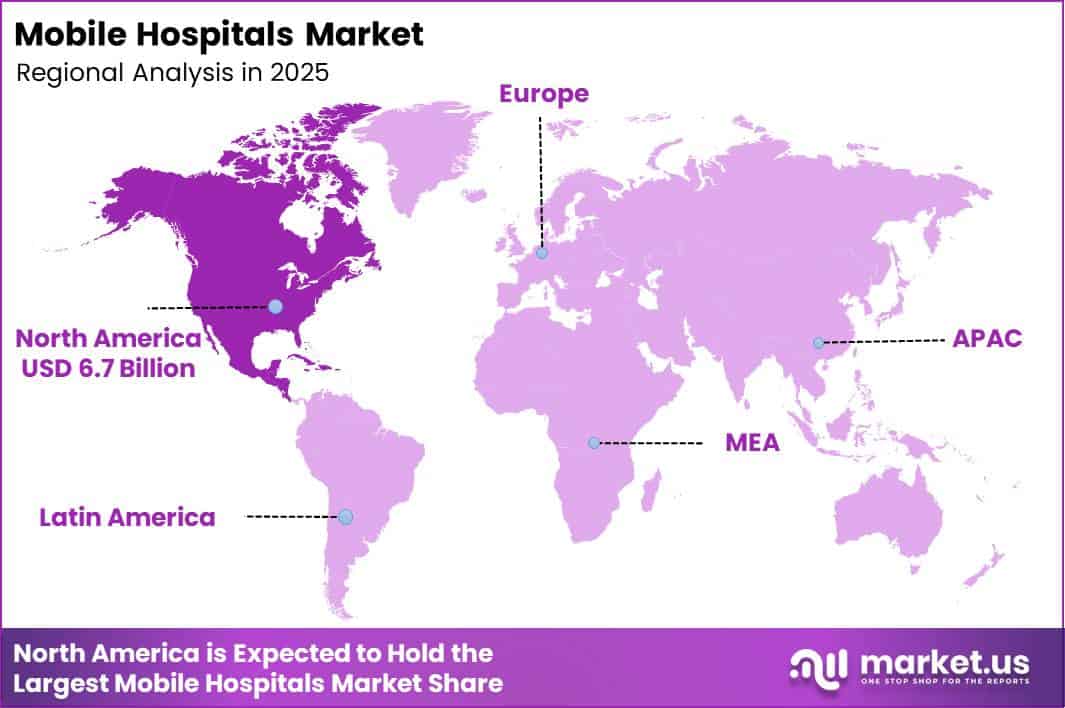
Global Mobile Hospitals Market size is expected to be worth around US$ 45.5 Billion by 2035 from US$ 17.1 Billion in 2025, growing at a CAGR of 10.3% during the forecast period from 2026 to 2035. In 2025, North America led the market, achieving over 39.0% share with a revenue of US$ 6.7 Billion.
Mobile hospitals are increasingly becoming an essential component of modern healthcare systems by delivering medical services directly to underserved, remote, disaster-affected, and conflict-prone regions.
These facilities are designed as transportable healthcare units equipped with diagnostic tools, surgical suites, intensive care capabilities, and telemedicine technologies, enabling rapid deployment during emergencies and public health crises.
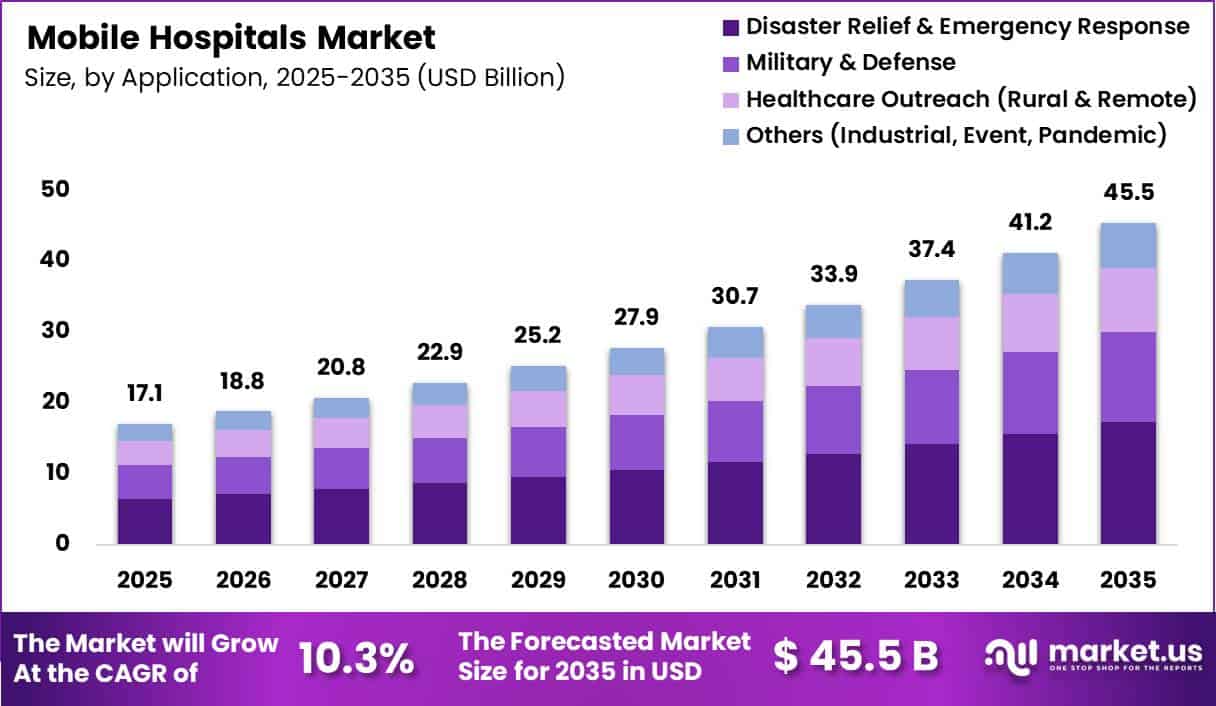
According to the World Health Organization (WHO), nearly half of the global population still lacks access to essential health services, highlighting the growing importance of mobile healthcare infrastructure. The WHO also estimates that approximately 2 billion people worldwide face significant barriers to obtaining timely medical care. Mobile hospitals help bridge this gap by extending healthcare delivery beyond traditional hospital settings.
Government agencies have increasingly supported mobile healthcare initiatives to strengthen emergency preparedness and improve access in rural communities. The U.S. Department of Health and Human Services emphasizes the role of mobile medical units in disaster response, vaccination campaigns, and community-based healthcare programs.
Similarly, the United Nations reports that humanitarian mobile clinics serve millions of patients annually in regions experiencing natural disasters, disease outbreaks, and humanitarian emergencies.
Advancements in portable imaging systems, digital diagnostics, satellite communications, and telehealth platforms continue to enhance the operational efficiency and clinical capabilities of mobile hospitals, supporting broader healthcare accessibility worldwide.
Key Takeaways
- Market Size : Mobile Hospitals Market size is expected to be worth around US$ 45.5 Billion by 2035 from US$ 17.1 Billion in 2025.
- Market Share : The Market is growing at a CAGR of 10.3% during the forecast period from 2026 to 2035.
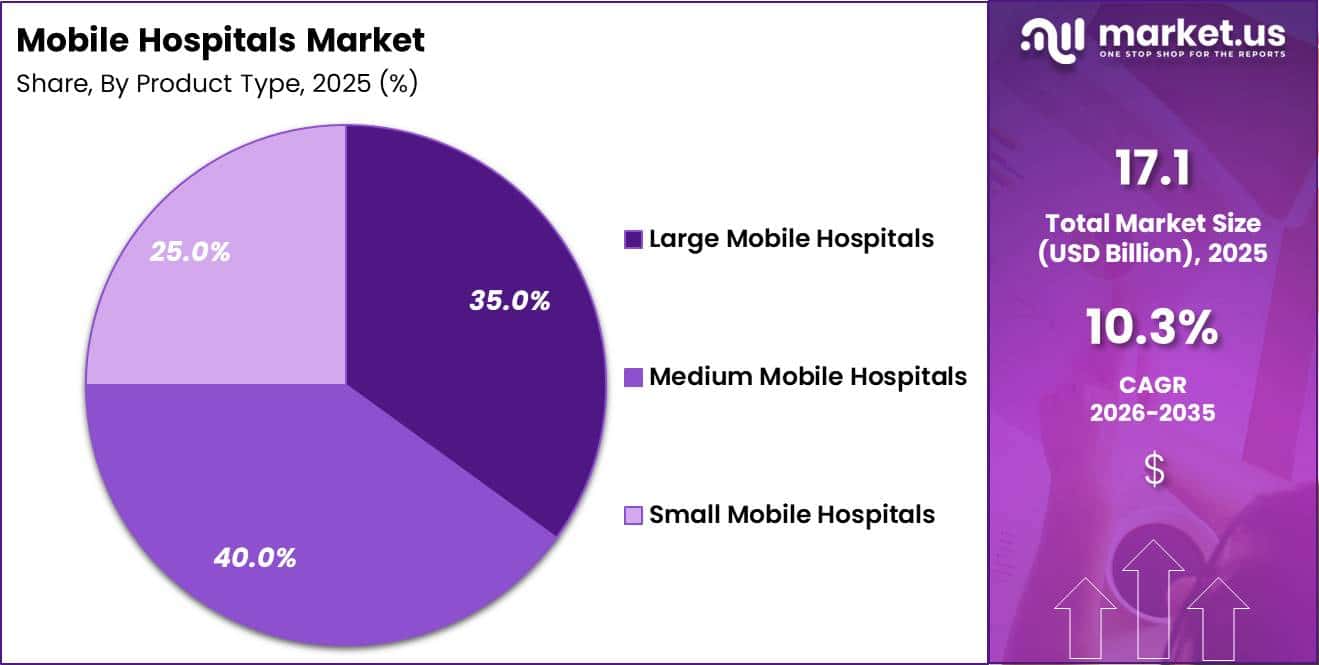
- Product Type Analysis : Medium Mobile Hospitals dominated the Mobile Hospitals Market with a 40% market share in 2025
- Application Analysis : Disaster Relief & Emergency Response held the largest share of the Mobile Hospitals Market, accounting for 38% in 2025.
- End User Analysis : Government & Defense dominated the Mobile Hospitals Market with a 45% market share in 2025.
- Regional Analysis : In 2025, North America led the market, achieving over 39.0% share with a revenue of US$ 6.7 Billion.
Product Type Analysis
Medium Mobile Hospitals dominated the Mobile Hospitals Market with a 40% market share in 2025, owing to their balance between mobility, treatment capacity, and operational efficiency. These units are widely adopted for emergency medical services, temporary healthcare facilities, and regional healthcare programs because they can accommodate essential diagnostic, surgical, and inpatient functions while remaining relatively easy to transport and deploy.
Medium-sized mobile hospitals are particularly suitable for disaster management, public health campaigns, and military medical support, where rapid setup and flexibility are important.
Large Mobile Hospitals accounted for 35% of the market share in 2025, supported by increasing demand for advanced field hospitals equipped with intensive care units, operating theaters, imaging systems, and specialized treatment departments.
These facilities are commonly utilized during humanitarian crises, pandemics, and large-scale emergency situations requiring high patient handling capacity. Small Mobile Hospitals represented 25% of the market, driven by their affordability, quick deployment capabilities, and suitability for rural healthcare outreach, vaccination drives, and community-based medical services in remote and underserved locations.
Application Analysis
Disaster Relief & Emergency Response held the largest share of the Mobile Hospitals Market, accounting for 38% in 2025. Growing occurrences of natural disasters, disease outbreaks, and humanitarian emergencies have significantly increased demand for rapidly deployable healthcare facilities.
Mobile hospitals provide immediate access to trauma care, diagnostics, surgical procedures, and emergency treatment services, making them essential assets for governments, relief agencies, and emergency responders. Their ability to operate in challenging environments supports their widespread use during crises.
Military & Defense represented 28% of the market share in 2025, driven by the need for advanced medical support systems during military operations, peacekeeping missions, and border healthcare deployments. These mobile facilities ensure continuous medical assistance in remote and conflict-prone areas.
Healthcare Outreach (Rural & Remote) accounted for 20% of the market, supported by efforts to improve healthcare accessibility in underserved regions where permanent medical infrastructure remains limited.
The Others segment, including industrial sites, large public events, and pandemic response activities, captured 14% of the market, reflecting the expanding applications of mobile healthcare infrastructure across multiple sectors.
End User Analysis
Government & Defense dominated the Mobile Hospitals Market with a 45% market share in 2025, primarily due to substantial investments in emergency preparedness, disaster management capabilities, military healthcare infrastructure, and public health initiatives.
Governments increasingly deploy mobile hospitals to strengthen healthcare accessibility, enhance response capacities during crises, and support healthcare delivery in geographically isolated regions. Defense agencies also utilize these facilities for battlefield medical services, humanitarian missions, and temporary healthcare operations.
NGOs & Humanitarian Organizations constituted a significant portion of the market, benefiting from increased global humanitarian activities, refugee assistance programs, and international disaster relief operations. These organizations depend on mobile hospitals to provide essential healthcare services in conflict zones and disaster-affected communities.
Private Healthcare Providers have also expanded their adoption of mobile hospitals, leveraging these facilities for outreach programs, specialty healthcare services, preventive screenings, and temporary treatment centers.
The Others segment, comprising corporate organizations, event organizers, mining companies, and industrial operators, continues to witness growing demand, as mobile hospitals offer flexible healthcare solutions for workforce wellness programs, large gatherings, and remote operational environments
Market Segmentations
By Product Type
- Large Mobile Hospitals
- Medium Mobile Hospitals
- Small Mobile Hospitals
By Application
- Disaster Relief & Emergency Response
- Military & Defense
- Healthcare Outreach (Rural & Remote)
- Others (Industrial, Event, Pandemic)
By End User
- Government & Defense
- NGOs & Humanitarian Organizations
- Private Healthcare Providers
- Others (Corporate, Event Organizers)
Drivers
Climate linked emergency preparedness and surge care investment
CDC’s emergency preparedness materials continue to highlight floods, severe weather, evacuations, and related public health disruptions, while India’s National Programme on Climate Change and Human Health identifies reduction of morbidity, mortality, and health vulnerability from climate variability and extreme weather as an active policy objective.
This creates a direct market driver because climate linked emergencies increasingly generate short notice patient surges in areas where hospitals remain structurally intact but temporarily inaccessible, overloaded, or utility constrained.
In those conditions, mobile hospitals solve a narrower but faster funded problem than greenfield hospital construction restoring triage, outpatient stabilization, maternal care, dialysis continuity, and basic inpatient overflow within days rather than years.
The commercial effect is strongest in coastal, flood prone, wildfire prone, and cyclone exposed corridors where emergency management budgets can justify standby assets on resilience grounds, not just on healthcare access grounds.
| Driver | (~) % Impact on CAGR Forecast | Geographic Relevance | Impact Timeline |
|---|---|---|---|
| Disaster-response capacity buildout under WHO EMT frameworks | +2.4% | APAC core, MENA, Africa, South Asia, island states | Short term (≤ 2 years) |
| Climate-linked emergency preparedness and surge care investment | +1.9% | North America, EU, South Asia, East Asia, climate-exposed corridors | Short term (≤ 2 years) |
| Hospital-at-home and decentralized acute-care models validating mobile capacity economics | +1.6% | North America core, EU, GCC, advanced urban APAC | Medium term (2-4 years) |
| Regulatory and resilience pressure on medical-device supply chains | +1.3% | North America core, EU, Japan, Korea, Australia | Short term (≤ 2 years) |
| Rural access and temporary capacity expansion for underserved populations | +1.8% | India, Sub-Saharan Africa, Latin America, remote North America, ASEAN | Medium term (2-4 years) |
| Shift toward self-sufficient modular field infrastructure | +1.2% | Conflict-adjacent zones, humanitarian corridors, disaster-prone coastal regions | Long term (≥ 4 years) |
Challenges
Capital-Heavy Modular Mobile Hospitals and Logistics Constraints
Capital-heavy, modular logistics distinguish true mobile hospitals from smaller mobile clinics. These units include emergency, surgical, diagnostic, and sometimes ICU capabilities housed in modular trailers or expandable shelters, requiring multi-million-dollar capital investment and complex deployment logistics.
Disaster-response studies show that activation typically involves multi-vehicle convoys, generators, and 3–7 days of autonomous supplies, with coordination needs that can add 2–4 days before clinical operations begin. Cost structures are also heavy, with 10–20% of budgets tied to maintenance, fuel, and spare parts, plus redundant imaging and lab systems to prevent service disruption.
As a result, per-patient capital amortization can be 20–40% higher than in high-volume urban hospitals unless utilization consistently exceeds 50–80 patients per day. This slows market expansion, trimming potential CAGR by about 1 % point as procurement is phased across budget cycles and funding is split with other priorities like fixed clinics and telehealth.
Operators are responding with standardized chassis, leasing models, shared regional fleets, and lightweight, solar-assisted systems targeting 10–20% opex savings, but adoption remains gradual due to long 7–10 year equipment cycles.
| Challenge | (~) % CAGR Friction Drag | Geographic Relevance | Mitigation Horizon |
|---|---|---|---|
| Complex multi-jurisdiction licensing | -1.2% | North America, EU hubs, emerging LMICs | Medium term (2–4 years) |
| Workforce and specialty staffing gaps | -1.5% | North America core, rural APAC, Sub-Saharan Africa | Long term (≥ 4 years) |
| Capital-heavy, modular logistics | -1.0% | Global humanitarian corridors, remote regions | Long term (≥ 4 years) |
| Data integration and interoperability lag | -0.8% | North America, EU, high-connectivity APAC | Medium term (2–4 years) |
| Clinical quality assurance at scale | -0.9% | Global deployments, disaster zones | Medium term (2–4 years) |
| Long-run funding volatility and payer misalignment | -1.3% | LMICs, fragmented insurance markets | Long term (≥ 4 years) |
Restraints
Supply Chain and Chassis Constraints in Mobile Hospitals
Supply chain and chassis availability bottlenecks significantly constrain mobile hospital deployment by extending build lead times from the pre pandemic 5-7 months to around 9-12 months in 2025 2026, as healthcare and automotive supply chains remain under pressure.
About 80% of providers and 84% of suppliers expect these challenges to persist or worsen, reflecting sustained global disruption. Heavy duty truck and trailer chassis compete with logistics and construction sectors, while shortages in key components such as imaging systems, HVAC units, medical grade electrical panels (UL 60601 1 compliant), and medical gas systems cause production delays, partial build stoppages, and higher working capital requirements of 15-20%.
This also pushes revenue recognition into later periods. In emerging markets like India, fragmented distribution and weak forecasting further disrupt availability of critical consumables, reducing operational continuity and forcing some units to operate below capacity for 10-20% of scheduled days.
Meanwhile, strong humanitarian demand in regions such as Syria and Sudan diverts manufacturing capacity toward basic mobile clinics, limiting supply for advanced hospital grade units. Overall, these bottlenecks increase acquisition costs by 8-12%, reduce utilization, and slow expansion, leading to an estimated 1.7 % point drag on mobile hospital market CAGR through 2026 2030.
| Restraint | (~) % Impact on CAGR Forecast | Geographic Relevance | Impact Timeline |
|---|---|---|---|
| Fragmented licensing & reimbursement | -2.3% | North America core, EU, selected APAC corridors | Medium term (2-4 years) |
| CapEx intensity & funding constraints | -2.0% | Global, with higher drag in emerging markets | Medium term (2-4 years) |
| Supply chain & chassis availability bottlenecks | -1.7% | North America, EU, India, Middle East corridors | Short to medium term (≤ 4 years) |
| Workforce availability & accreditation burden | -1.5% | North America core, EU, GCC, urban APAC | Medium term (2-4 years) |
| Digital health integration & data compliance | -1.4% | North America, EU, advanced APAC | Long term (≥ 4 years) |
| Operational reliability & maintenance compliance | -1.3% | Global, especially multi-unit fleets | Medium term (2-4 years) |
Opportunity
Hospital-at-Home Enabled Mobile Acute Care Hubs
Hospital at home waivers and payment pilots (e.g., Medicare) have made home based acute care clinically accepted, but current models still rely mainly on telehealth and static home visits rather than fully equipped mobile hospital infrastructure. This creates a gap for high acuity mobile hubs that can extend care beyond what traditional hospital at home programs can support.
Most existing mobile units focus on low acuity outreach, serving about 60–100 patients per day with limited diagnostics, rather than functioning as integrated acute care platforms. As a result, they are underutilized for higher complexity care delivery.
By 2030, if 5–8% of hospital at home episodes in North America and Europe shift to mobile hubs capable of services like IV therapy, telemetry, and portable imaging, providers could capture additional value equivalent to 1–2% of hospital inpatient spending and improve episode margins by 300–500 basis points through reduced bed days and higher efficiency. OEMs would also benefit from 20–30% higher unit prices and recurring service revenues.
However, scaling this model requires integration with hospital EMRs, remote monitoring systems, and centralized logistics, involving 2–4 years of capex and IT investment. If successfully implemented, fleet utilization could rise to 250–300 acute episodes per unit annually (vs. 100–150 today), adding an estimated 2.5 % points of CAGR upside through 2030.
| Opportunity | (~) % Potential CAGR Upside | Geographic Relevance | Execution Window |
|---|---|---|---|
| Hospital-at-home integrated mobile hubs | +2.5% | North America, EU, high-income APAC | Medium term (2-4 years) |
| Chronic disease mobile care corridors | +2.0% | North America, EU, APAC urban, GCC | Short term (≤ 2 years) |
| Disaster-ready modular mobile hospital networks | +1.8% | APAC, Africa, Latin America, Small Island States | Long term (≥ 4 years) |
| Value-based, outcome-linked mobile hospital contracting | +1.5% | North America, EU, select Latin America | Medium term (2-4 years) |
| Data-rich mobile hospitals as payer & pharma platforms | +1.3% | Global tier-1 cities, emerging APAC | Long term (≥ 4 years) |
| Cross-border mobile surgical & diagnostics franchises | +1.2% | EU cross-border, GCC, ASEAN corridors | Medium term (2-4 years) |
Regional Analysis
North America dominated the Mobile Hospitals Market in 2025, accounting for more than 39.0% of the global market and generating approximately US$ 6.7 billion in revenue. The region’s leadership is supported by advanced healthcare infrastructure, strong government investment in emergency preparedness, and widespread adoption of mobile healthcare technologies.
The United States remains the largest contributor, driven by increasing demand for rapid-response medical units, disaster relief capabilities, and healthcare services in remote and underserved communities. Rising emphasis on military medical support, public health initiatives, and emergency response systems further strengthens market expansion across the region.
Europe represents another significant market, supported by growing investments in disaster management programs, aging populations, and efforts to improve healthcare accessibility in rural areas. Countries such as Germany, France, and the United Kingdom are increasingly integrating mobile healthcare units into national healthcare strategies.
The Asia-Pacific region is expected to witness the fastest growth during the forecast period due to expanding healthcare infrastructure, increasing population density, and rising demand for accessible medical services in developing economies. Governments across China, India, and Southeast Asian countries are investing in mobile medical facilities to address healthcare disparities.
Latin America and the Middle East & Africa are also experiencing steady growth, supported by humanitarian healthcare initiatives, emergency medical programs, and improving healthcare infrastructure development.
Key Regions and Countries
North America
- The US
- Canada
Europe
- Germany
- France
- The U.K.
- Italy
- Spain
- Russia & CIS
- Rest of Europe
Asia Pacific
- China
- India
- Japan
- South Korea
- ASEAN
- Australia & New Zealand
- Rest of Asia Pacific
Middle East & Africa
- GCC
- South Africa
- Rest of Middle East & Africa
Latin America
- Brazil
- Mexico
- Rest of Latin America
Key Player Analysis
The Mobile Hospitals Market is characterized by the presence of specialized manufacturers and solution providers focused on delivering flexible and rapidly deployable healthcare infrastructure.
Companies such as Odulair LLC and Medigo Mobile Health Solutions (Odulair) are recognized for their expertise in designing mobile hospitals, surgical units, diagnostic centers, and emergency medical facilities that support healthcare delivery in remote locations, disaster zones, and underserved communities.
Neat Vehicles Ltd., Medical Coaches, Farber Specialty Vehicles, LifeLine Mobile Inc., Matthews Specialty Vehicles, and Mobile Healthcare Facilities LLC play an important role in the market by developing customized mobile healthcare units equipped with advanced medical technologies.
These companies emphasize vehicle innovation, modular designs, and adaptable configurations to meet the needs of hospitals, government agencies, military organizations, and humanitarian groups.
Market participants are increasingly focusing on technological advancements, sustainable mobile solutions, and integrated telemedicine capabilities to strengthen their competitive position. Strategic collaborations with healthcare providers and public institutions are also helping companies expand their geographic reach and address the growing demand for accessible and emergency healthcare services worldwide.
Top Key Players
- Odulair LLC
- Medigo Mobile Health Solutions (Odulair)
- Neat Vehicles Ltd.
- Medical Coaches
- Farber Specialty Vehicles
- LifeLine Mobile Inc.
- Matthews Specialty Vehicles
- Mobile Healthcare Facilities LLC
- Wille GmbH
- Ambulancemed
- LAUNCH Mobile Healthcare Solutions
- On the Road Mobile Health Solutions
- Vanguard Healthcare Solutions
- UMB World
- MeTraX XXR (Diverse Medical Solutions)
- Others
Recent Developments
- In February 2026, Matthews Specialty Vehicles became an industry partner supporting the launch of the Center for Mobile Health established by the National Association of Community Health Centers (NACHC). The initiative aims to expand mobile healthcare delivery nationwide and support the 674 community health centers (45%) already operating at least one mobile unit in the United States.
- In March 2025, Vanguard Healthcare Solutions announced a strategic expansion of its mobile clinic fleet to support community health programs across the U.S., adding modular exam and diagnostics units to serve rural areas.
Report Scope
| Report Features | Description |
|---|---|
| Market Value (2025) | US$ 17.1 Billion |
| Forecast Revenue (2035) | US$ 45.5 Billion |
| CAGR (2026-2035) | 10.3 % |
| Base Year for Estimation | 2025 |
| Historic Period | 2020-2024 |
| Forecast Period | 2026-2035 |
| Report Coverage | Revenue Forecast, Market Dynamics, Competitive Landscape, Recent Developments |
| Segments Covered | By Product Type (Large Mobile Hospitals, Medium Mobile Hospitals, Small Mobile Hospitals), By Application (Disaster Relief & Emergency Response, Military & Defense, Healthcare Outreach (Rural & Remote), Others (Industrial, Event, Pandemic)), By End User (Government & Defense, NGOs & Humanitarian Organizations, Private Healthcare Providers, Others (Corporate, Event Organizers)) |
| Regional Analysis | North America – The US, Canada; Europe – Germany, France, U.K., Italy, Spain, Russia & CIS, Rest of Europe; Asia Pacific – China, India, Japan, South Korea, ASEAN, Australia & New Zealand, Rest of Asia Pacific; Middle East & Africa – GCC, South Africa, Rest of Middle East & Africa; Latin America – Brazil, Mexico, Rest of Latin America |
| Competitive Landscape | Odulair LLC, Medigo Mobile Health Solutions (Odulair), Neat Vehicles Ltd., Medical Coaches, Farber Specialty Vehicles, LifeLine Mobile Inc., Matthews Specialty Vehicles, Mobile Healthcare Facilities LLC, Wille GmbH, Ambulancemed, LAUNCH Mobile Healthcare Solutions, On the Road Mobile Health Solutions, Vanguard Healthcare Solutions, UMB World, MeTraX XXR (Diverse Medical Solutions), Others |
| Customization Scope | Customization for segments, region/country-level will be provided. Moreover, additional customization can be done based on the requirements. |
| Purchase Options | We have three licenses to opt for: Single User License, Multi-User License (Up to 5 Users), Corporate Use License (Unlimited User and Printable PDF) |





































