


Market Overview
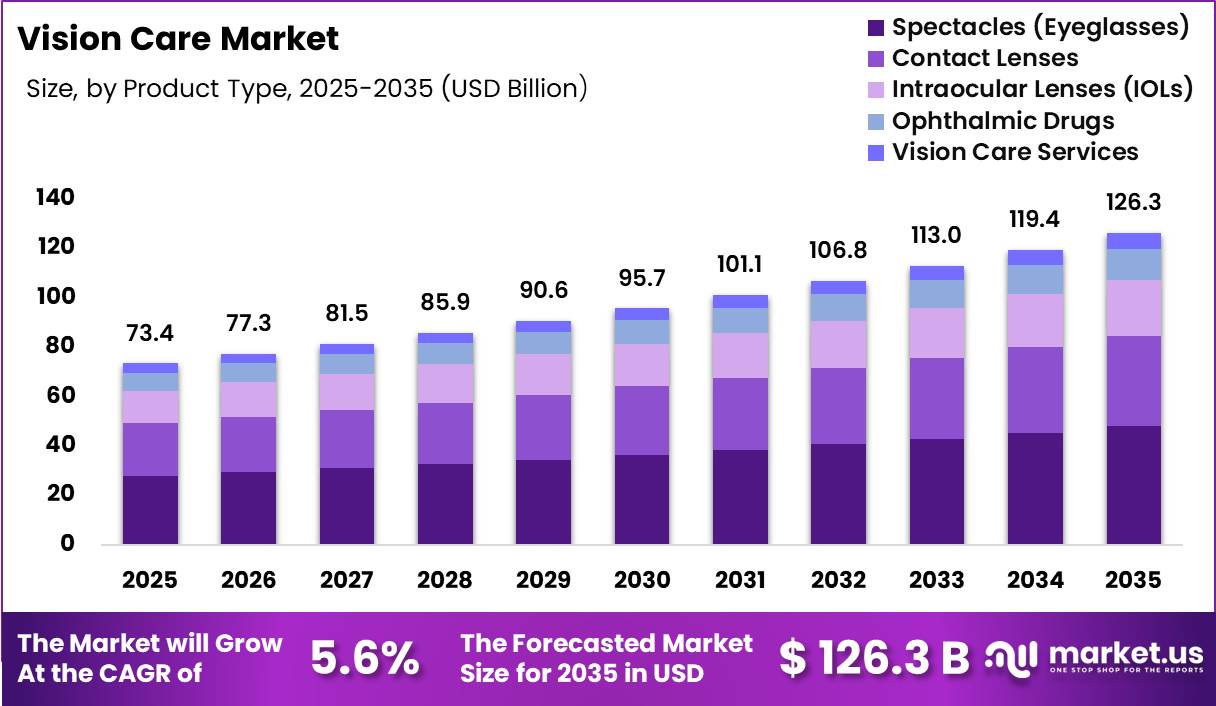
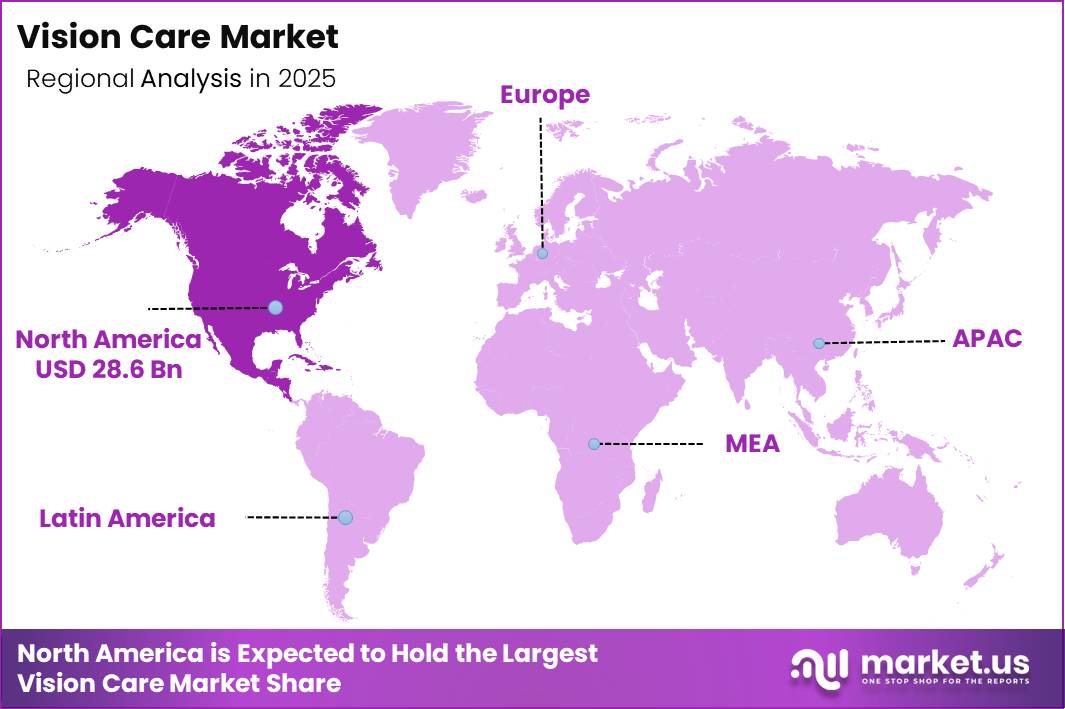
Global Vision Care Market size is expected to be worth around US$ 126.3 Billion by 2035 from US$ 73.4 Billion in 2025, growing at a CAGR of 5.6% during the forecast period from 2026 to 2035. In 2025, North America led the market, achieving over 39.0% share with a revenue of US$ 28.6 Billion.
Vision care is becoming an increasingly important component of global healthcare as aging populations, rising screen exposure, diabetes, and refractive errors continue to increase demand for preventive eye examinations, corrective lenses, surgical interventions, and digital diagnostic technologies.
According to the World Health Organization (WHO), at least 2.2 billion people worldwide live with near or distance vision impairment, and at least 1 billion of these cases could have been prevented or remain untreated due to inadequate access to eye care services. Cataracts and uncorrected refractive errors remain the leading causes of vision impairment globally.
Healthcare systems are expanding investments in comprehensive eye care programs, teleophthalmology, artificial intelligence-based retinal screening, and community vision screening initiatives to improve early diagnosis and treatment.
In May 2025, the WHO reported that data collected from more than 815,000 people across 76 countries showed global progress in eyeglass coverage remains below the pace required to achieve the World Health Assembly target of a 40% increase in effective eyeglass coverage by 2030. Between 2000 and 2023, appropriate eyeglass coverage improved by 50%, with an average increase of 5% per decade, demonstrating steady but insufficient progress.
The economic impact of vision impairment is also significant. WHO estimates annual global productivity losses of approximately US$ 411 billion due to vision impairment, highlighting the importance of expanding access to affordable eye care.
Continued technological innovation, strengthened public health initiatives, and improved accessibility are expected to support sustainable growth in the global vision care ecosystem while reducing the burden of preventable blindness worldwide.
Key Takeaways
- Market Size: Global Vision Care Market size is expected to be worth around US$ 126.3 Billion by 2035 from US$ 73.4 Billion in 2025.
- Market Share: The market is growing at a CAGR of 5.6% during the forecast period from 2026 to 2035.
- Product Type: The Spectacles (Eyeglasses) segment dominated the Vision Care Market with 38.0% of the market share in 2025.
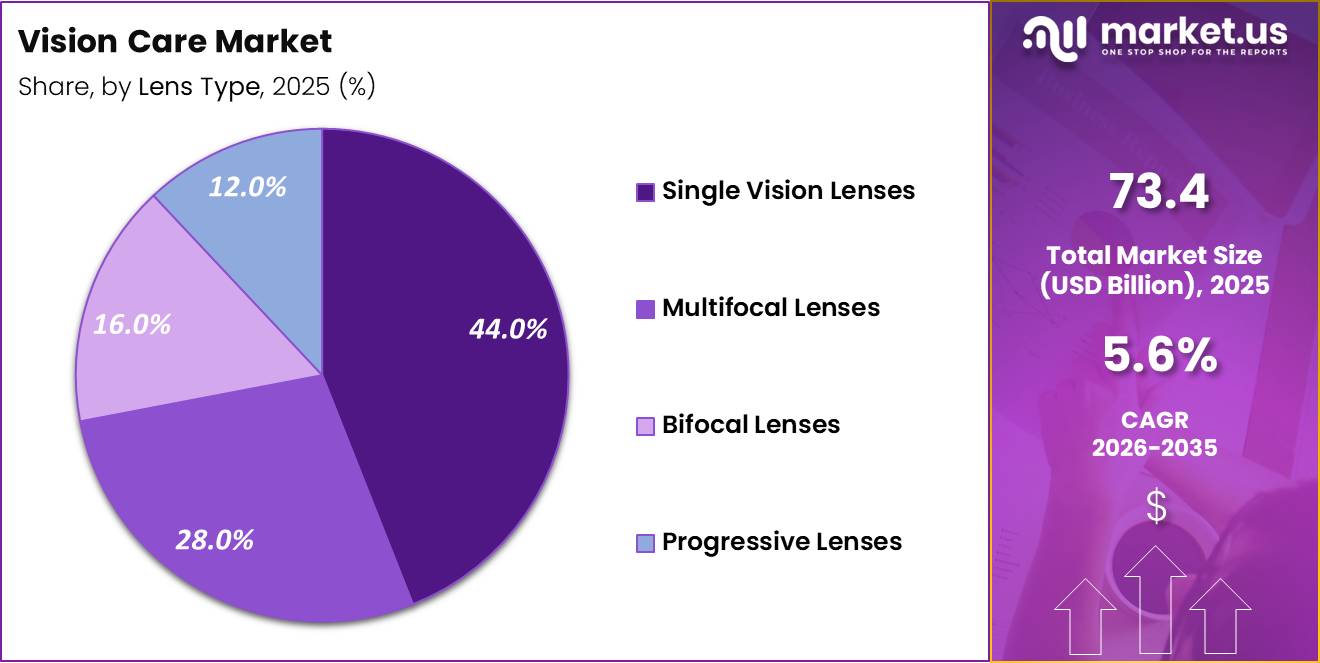
- Lens Type: The Single Vision Lenses segment held the largest share of the Vision Care Market, accounting for 44.0% in 2025.
- Contact Lens Type: The Soft Contact Lenses segment dominated the Vision Care Market with 72.0% of the market share in 2025.
- Distribution Channel: The Optical Stores segment led the Vision Care Market with 46.0% of the market share in 2025.
- End User: The Adults segment accounted for the largest share of the Vision Care Market, representing 61.0% in 2025.
- Application: The Myopia segment dominated the Vision Care Market with 41.0% of the market share in 2025.
- Regional Analysis: In 2025, North America led the market, achieving over 39.0% share with a revenue of US$ 28.6 Billion.
Product Type Analysis
Spectacles (Eyeglasses) segment dominated the Vision Care Market.
The Spectacles (Eyeglasses) segment dominated the Vision Care Market with 38.0% of the market share in 2025, supported by the growing prevalence of refractive errors, increasing digital screen exposure, and continuous consumer demand for prescription and fashion eyewear.
Advancements in lightweight materials, blue light filtering coatings, photochromic lenses, and premium frame designs have further strengthened demand across both developed and emerging markets. Spectacles remain the most affordable and accessible vision correction solution, encouraging widespread adoption across all age groups.
The Contact Lenses segment accounted for 29.0% of the market, driven by rising consumer preference for convenience, cosmetic appeal, and daily disposable lenses. Intraocular Lenses (IOLs) represented 18.0%, supported by increasing cataract surgeries, premium multifocal IOL adoption, and expanding access to ophthalmic surgical care.
The Ophthalmic Drugs segment captured 10.0%, benefiting from the growing incidence of glaucoma, dry eye disease, allergies, and retinal disorders requiring long-term treatment. Meanwhile, Vision Care Services contributed 5.0%, reflecting expanding demand for routine eye examinations, preventive screening programs, optical consultations, and tele-optometry services.
Together, these product categories demonstrate the market’s balanced growth across preventive care, corrective solutions, surgical interventions, and therapeutic treatments.
Lens Type Analysis
Single Vision Lenses segment held the largest share of the Vision Care Market.
The Single Vision Lenses segment held the largest share of the Vision Care Market, accounting for 44.0% in 2025. Their dominance is attributed to the high prevalence of myopia and hyperopia, straightforward prescriptions, affordability, and widespread availability.
Single vision lenses remain the preferred option for children, young adults, and first-time eyewear users requiring correction for either distance or near vision. Continuous improvements in lens coatings, scratch resistance, UV protection, and blue light filtering have further enhanced consumer acceptance.
The Multifocal Lenses segment represented 28.0% of the market, supported by increasing demand among aging populations requiring correction for multiple viewing distances without changing eyewear. Bifocal Lenses accounted for 16.0%, maintaining relevance among users seeking cost-effective presbyopia management despite growing competition from advanced lens technologies.
Progressive Lenses captured 12.0% of the market, benefiting from their seamless transition between viewing distances, superior aesthetics, and improved visual comfort. Rising disposable incomes, greater awareness of premium optical products, and ongoing innovation in digital lens design continue to support demand across all lens categories while enabling personalized vision correction solutions for diverse patient requirements.
Contact Lens Type Analysis
Soft Contact Lenses segment dominated the Vision Care Market.
The Soft Contact Lenses segment dominated the Vision Care Market with 72.0% of the market share in 2025, reflecting their superior comfort, ease of adaptation, and suitability for daily wear.
Increasing adoption of silicone hydrogel materials, daily disposable products, and toric and multifocal designs has strengthened their popularity among consumers seeking convenient vision correction. Growing awareness of eye health, improved oxygen permeability, and reduced maintenance requirements continue to support widespread use across various age groups.
Rigid Gas Permeable (RGP) Lenses maintained a significant position in the market due to their exceptional optical clarity, durability, and effectiveness in correcting irregular corneal conditions such as keratoconus. Although adaptation periods are longer than soft lenses, their long-term performance and precise vision correction sustain demand in specialized clinical settings.
Hybrid Lenses represent a smaller but steadily expanding segment by combining the sharp vision of rigid lenses with the comfort of soft lens skirts. Their increasing use among patients requiring enhanced visual performance and improved comfort has contributed to gradual market growth. Continuous product innovation, personalized fitting technologies, and expanding eye care services are expected to support further development across all contact lens categories.
Distribution Channel Analysis
Optical Stores segment led the Vision Care Market.
The Optical Stores segment led the Vision Care Market with 46.0% of the market share in 2025, supported by professional eye examinations, personalized frame fitting, lens customization, and extensive product availability.
Consumers continue to prefer optical stores because they offer comprehensive vision assessments, expert guidance, after-sales services, and immediate access to prescription eyewear. The presence of branded retail chains and independent opticians further strengthens this segment through enhanced customer experience and premium product offerings.
Online Retail has experienced rapid expansion as consumers increasingly purchase spectacles, contact lenses, and accessories through digital platforms offering competitive pricing, virtual try-on technologies, and convenient home delivery.
Hospitals & Eye Clinics remain an important distribution channel, particularly for prescription eyewear, intraocular lenses, ophthalmic drugs, and post-surgical vision care. These facilities provide integrated diagnostic and treatment services that support product adoption.
Supermarkets & Hypermarkets contribute to market growth by offering affordable reading glasses, sunglasses, eye care accessories, and selected vision care products to price-sensitive consumers. The continued integration of omnichannel retail strategies, digital eye testing solutions, and enhanced customer engagement is expected to strengthen all distribution channels while improving accessibility and convenience for vision care products worldwide.
End User Analysis
Adults segment accounted for the largest share of the Vision Care Market.
The Adults segment accounted for the largest share of the Vision Care Market, representing 61.0% in 2025. High screen exposure, increasing prevalence of refractive errors, expanding workforce participation, and growing awareness of preventive eye care continue to drive demand among adult consumers.
Regular vision examinations, rising adoption of premium eyewear, contact lenses, and digital eye protection solutions further support the segment’s leading position. Lifestyle changes and prolonged use of smartphones, computers, and other digital devices have also increased demand for corrective and protective vision products.
The Pediatric segment continues to expand due to rising childhood myopia, increasing school vision screening programs, and greater parental awareness regarding early diagnosis and treatment of visual disorders. Growing utilization of myopia control lenses and pediatric eye care services further contributes to market growth.
The Geriatric segment is witnessing steady expansion owing to the higher incidence of cataracts, presbyopia, glaucoma, age-related macular degeneration, and diabetic eye diseases. Increasing life expectancy and improved access to advanced ophthalmic treatments, intraocular lenses, and routine eye examinations are driving demand among older adults.
Together, these end-user groups highlight the growing importance of age-specific vision care solutions and preventive ophthalmic services.
Application Analysis
Myopia segment dominated the Vision Care Market.
The Myopia segment dominated the Vision Care Market with 41.0% of the market share in 2025, driven by the rapidly increasing prevalence of nearsightedness across children, adolescents, and adults. Greater digital device usage, reduced outdoor activity, urbanization, and changing lifestyles continue to contribute to rising myopia cases worldwide. Demand for spectacles, contact lenses, orthokeratology lenses, and myopia management solutions has significantly strengthened this segment.
The Hyperopia segment maintains a substantial share due to the continued need for corrective lenses among individuals experiencing difficulty focusing on nearby objects. Astigmatism represents another important application area, supported by growing availability of toric contact lenses, customized spectacles, and advanced diagnostic technologies that improve treatment accuracy.
Presbyopia continues to expand as global populations age, increasing demand for multifocal, bifocal, and progressive lenses alongside premium intraocular lens implants. Technological advancements in lens design, personalized vision correction, digital eye examination equipment, and expanding access to comprehensive ophthalmic care continue to improve treatment outcomes across all application segments.
These developments collectively support sustained growth throughout the vision care ecosystem while addressing diverse patient needs across multiple refractive conditions.
Key Market Segments
Product Type
- Spectacles (Eyeglasses)
- Contact Lenses
- Intraocular Lenses (IOLs)
- Ophthalmic Drugs
- Vision Care Services
Lens Type
- Single Vision Lenses
- Multifocal Lenses
- Bifocal Lenses
- Progressive Lenses
Contact Lens Type
- Soft Contact Lenses
- Rigid Gas Permeable Lenses
- Hybrid Lenses
Distribution Channel
- Optical Stores
- Online Retail
- Hospitals & Eye Clinics
- Supermarkets & Hypermarkets
End User
- Adults
- Pediatric
- Geriatric
Application
- Myopia
- Hyperopia
- Astigmatism
- Presbyopia
Drivers
Unmet refractive error and presbyopia correction demand.
The single largest structural demand driver remains the sheer size of untreated need: WHO states that at least 2.2 billion people globally have near or distance vision impairment, with at least 1 billion cases either preventable or still unaddressed, including 88.4 million with unaddressed refractive error and 826 million with presbyopia.
WHO also notes that two out of three people in low income countries who need eyeglasses do not have access, while annual productivity loss linked to vision impairment is about US$411 billion, against an estimated US$25 billion cost gap to address unmet need; that spread is strategically important because it supports payer, employer, and public health investment cases for basic correction, screening, and last mile optical distribution.
Commercially, this driver expands the addressable market first through entry level spectacles and eye exams, then through lens upgrades, coatings, progressive lenses, blue light filtering, and recurring replacement cycles in contact lenses.
The growth mechanism is strongest in APAC, Africa, and Latin America because WHO identifies vision impairment prevalence in low and middle income regions as roughly four times that of high income regions, while unaddressed near vision impairment exceeds 80% across parts of Sub Saharan Africa versus below 10% in high income North America, Western Europe, Australasia, and parts of Asia Pacific; this creates a two speed market in which volume led correction scales in emerging systems while premium mix expands in mature markets.
| Driver | (~) % Impact on CAGR Forecast | Geographic Relevance | Impact Timeline |
|---|---|---|---|
| Unmet refractive error and presbyopia correction demand | +2.4% | APAC core, Sub-Saharan Africa, Latin America, Middle East spill-over | Medium term (2-4 years) |
| Pediatric myopia control commercialization | +1.9% | North America core, East Asia core, EU, urban APAC corridors | Medium term (2-4 years) |
| Dry eye and ocular surface therapeutics expansion | +1.4% | North America core, EU, Japan, South Korea, urban China | Short term (≤ 2 years) |
| Integrated eye care and coverage expansion | +1.2% | LMICs broadly, India, Africa, ASEAN, Latin America | Long term (≥ 4 years) |
| Premiumization through smart, multi-function eyewear | +0.9% | North America, Western Europe, Japan, affluent APAC metros | Short term (≤ 2 years) |
| Retail-medtech convergence and direct-to-consumer scale | +1.1% | North America core, Europe, Brazil, Gulf states, Southeast Asia | Medium term (2-4 years) |
Challenges
Chronic clinician capacity and access bottlenecks in vision care.
The widening gap between ophthalmology and optometry workforce capacity and the rising demand for vision care is creating a long-term constraint on healthcare delivery across major markets.
Many developed countries are operating with 15–25% fewer full-time eye care professionals than required, resulting in median new patient wait times of 45–70 days in urban areas compared to 20–30 days a decade ago. Consequently, diagnostic equipment is often utilized at only 75–80% of its technical capacity, limiting patient throughput and service availability.
In the United States, ophthalmologist supply is projected to decline by 10–15% by the mid-2030s, while demand is expected to increase by 20–25%. This imbalance is already reducing potential procedure volumes and advanced lens adoption by an estimated 8–10% in 2026. Similar workforce shortages and uneven specialist distribution are also evident across several European healthcare systems.
For manufacturers and vision care providers, these shortages reduce examination volumes, slow premium lens conversion, and delay adoption of advanced diagnostic technologies, lowering potential annual growth in devices and consumables by approximately 1–1.5 % points.
To address these challenges, companies are expanding store-based optometry services, adopting AI-enabled screening and tele-ophthalmology, increasing training capacity, and forming partnerships with healthcare providers to improve patient throughput and utilization of advanced vision care technologies.
| Challenge | (~) % CAGR Friction Drag | Geographic Relevance | Mitigation Horizon |
|---|---|---|---|
| Chronic clinician capacity gap | -1.2% | North America, Europe, urban APAC | Long term (≥ 4 years) |
| Volatile optical supply chains | -0.9% | EU, North America, APAC trade hubs | Medium term (2-4 years) |
| Uneven digital eye-care adoption | -1.0% | Emerging APAC, Latin America, MEA | Medium term (2-4 years) |
| Affordability-pressure on premiums | -0.8% | US, EU, middle-income APAC | Short term (≤ 2 years) |
| Regulatory and quality complexity | -0.7% | EU, North America, China | Long term (≥ 4 years) |
| Structural myopia & screening gap | -1.1% | APAC, Africa, LatAm peri-urban | Long term (≥ 4 years) |
Restraints
Limited reimbursement and high vision out of pocket burden.
Limited reimbursement for routine vision care continues to restrain demand for corrective eyewear and contact lenses across global markets. In most countries, eyeglasses, contact lenses, and routine eye examinations are classified as discretionary rather than medically necessary, leaving consumers responsible for 80–100% of associated costs.
In the United States, Medicare Part B provides coverage only for one pair of standard eyeglasses or one set of contact lenses following cataract surgery with an intraocular lens, while beneficiaries must still meet the annual deductible and pay 20% coinsurance. As a result, many patients postpone replacing eyewear, extending usage well beyond the recommended 12–18-month cycle, thereby reducing recurring product demand.
Comparable trends are observed across Europe, where complementary insurance benefits for vision products remain limited, and in emerging Asia-Pacific markets, where high out-of-pocket healthcare spending encourages consumers to choose lower-cost eyewear instead of premium lens coatings, blue-light filters, or advanced contact lenses.
These reimbursement limitations also constrain the adoption of higher-value products such as myopia control lenses and reduce opportunities for premium product sales. Consequently, manufacturers and optical retailers adopt cautious investment strategies, delaying capacity expansion and advanced production technologies, ultimately moderating the global vision care market’s long-term growth potential.
| Restraint | (~) % Impact on CAGR Forecast | Geographic Relevance | Impact Timeline |
|---|---|---|---|
| Limited reimbursement and out-of-pocket burden | -1.8% | North America, EU, selected APAC | Medium term (2-4 years) |
| Regulatory scrutiny on OTC eye drops and solutions | -1.2% | North America, EU, India core | Short term (≤ 2 years) |
| Under-penetration of basic vision correction in low-income markets | -1.5% | Sub-Saharan Africa, South Asia, LATAM periphery | Long term (≥ 4 years) |
| Manufacturing quality and compliance risk in ophthalmic supply chain | -1.0% | India, emerging APAC export hubs | Short–Medium term (≤ 4 years) |
| Inflationary input costs and pricing ceilings | -1.3% | Global, with higher drag in EU, LATAM | Short–Medium term (≤ 4 years) |
| Slow clinical and payment integration of advanced vision technologies | -1.7% | North America core, EU, developed APAC | Long term (≥ 4 years) |
Opportunity
Converting eyewear purchases into recurring subscription models.
This opportunity is distinct from current drivers because baseline growth assumes mostly transactional purchases of spectacles or lenses, while the upside comes from converting vision correction into a recurring access model through annual eyewear memberships, employer sponsored replacement programs, managed contact lens supply, and insurer linked preventive vision benefits.
The logic is strongest in developed markets where replacement cycles are artificially delayed by out of pocket friction even though unmet need remains large globally and health cost burdens still deter use of essential services for many households.
Subscription design can smooth affordability, lock in replenishment, and improve demand visibility, while providers can raise frequency from a 24 to 36 month replacement cycle toward 12 to 18 months, improving revenue predictability and reducing promotional CAC by 20 to 35 %.
With roughly 45 million contact lens wearers in the US alone as a ready recurring care cohort and with WHO policy momentum around affordable refractive access, North America, Europe, and affluent APAC are the best initial markets, where well structured plans can lift category growth by about 1.3 % points through higher replacement adherence, attachment of eye exams, and reduced customer leakage.
| Opportunity | (~) % Potential CAGR Upside | Geographic Relevance | Execution Window |
|---|---|---|---|
| Managed myopia platforms | +2.4% | East Asia core, North America, EU, urban India | Short term (≤ 2 years) |
| Value optical in underpenetrated markets | +2.1% | Sub-Saharan Africa, South Asia, ASEAN, LatAm | Short term (≤ 2 years) |
| Diabetes-linked retinal pathways | +1.7% | North America, GCC, India, China, Brazil | Medium term (2-4 years) |
| Senior care vision bundles | +1.5% | Japan, EU, North America, urban China | Medium term (2-4 years) |
| Subscription and payor-led eyewear | +1.3% | North America core, EU, affluent APAC | Short term (≤ 2 years) |
| Consolidation of fragmented clinics | +1.9% | India, Southeast Asia, LatAm, US secondary markets | Long term (≥ 4 years) |
Regional Analysis
North America dominated the Vision Care Market in 2025.
In 2025, North America dominated the Vision Care Market, accounting for over 39.0% of the global market and generating approximately US$ 28.6 billion in revenue.
The region’s leadership is supported by a high prevalence of refractive errors, cataracts, glaucoma, diabetic retinopathy, and age-related macular degeneration, creating sustained demand for vision correction products and ophthalmic care services. Strong healthcare infrastructure, widespread access to routine eye examinations, and favorable reimbursement policies continue to encourage early diagnosis and treatment.
The United States represents the largest contributor, driven by significant adoption of premium eyeglasses, contact lenses, intraocular lenses, and advanced ophthalmic surgical procedures. Growing consumer awareness regarding preventive eye health, increasing digital screen exposure, and rising demand for blue-light filtering and specialty lenses further strengthen regional market growth.
The presence of leading manufacturers, optical retail chains, and research-driven ophthalmic technology companies supports continuous product innovation and rapid commercialization of advanced vision care solutions.
Canada also contributes steadily through expanding access to eye care services, government-supported vision health initiatives, and an aging population requiring long-term vision correction and surgical interventions. Additionally, increasing adoption of tele-optometry, AI-assisted diagnostic platforms, and digital imaging technologies enhances clinical efficiency and patient outcomes across the region.
Continuous investments in ophthalmic research, expanding availability of minimally invasive eye surgeries, and strong collaboration between healthcare providers and technology developers reinforce North America’s leadership, positioning the region as the primary innovation and revenue center within the global Vision Care Market throughout the forecast period.
Key Regions and Countries
North America
- The US
- Canada
Europe
- Germany
- France
- The U.K.
- Italy
- Spain
- Russia & CIS
- Rest of Europe
Asia Pacific
- China
- India
- Japan
- South Korea
- ASEAN
- Australia & New Zealand
- Rest of Asia Pacific
Middle East & Africa
- GCC
- South Africa
- Rest of Middle East & Africa
Latin America
- Brazil
- Mexico
- Rest of Latin America
Key Player Analysis
The Vision Care Market is moderately consolidated, with established global manufacturers competing through continuous innovation, product differentiation, and expansion of integrated eye care portfolios. Companies are strengthening their competitive positions by investing in advanced lens technologies, ophthalmic surgical systems, diagnostic equipment, and digital vision solutions while expanding their presence across developed and emerging markets.
EssilorLuxottica, Johnson & Johnson Vision, Alcon Inc., Bausch + Lomb, and Carl Zeiss Meditec AG remain among the leading participants, leveraging extensive distribution networks, strong brand recognition, and broad product portfolios to maintain competitive advantages.
At the same time, CooperVision, HOYA Corporation, Nikon Corporation, Topcon Corporation, Santen Pharmaceutical Co., Ltd., Staar Surgical Company, Menicon Co., Ltd., Bausch Health Companies Inc., Glaukos Corporation, and Rayner Intraocular Lenses continue to strengthen competition through specialized expertise across contact lenses, ophthalmic pharmaceuticals, intraocular lenses, surgical technologies, and diagnostic systems.
Competitive strategies increasingly emphasize research and development to improve visual outcomes, enhance patient comfort, and expand minimally invasive treatment options. Companies are pursuing strategic partnerships with healthcare providers, research institutions, and technology developers to accelerate innovation and broaden market reach.
Product innovation remains focused on premium intraocular lenses, smart diagnostic platforms, advanced contact lens materials, and digital imaging technologies. Workflow integration through connected diagnostic devices, surgical planning software, and data-driven clinical solutions is improving operational efficiency for eye care professionals.
Ecosystem-based competition is also becoming more prominent, with companies developing comprehensive portfolios that combine diagnostics, treatment, surgical devices, pharmaceuticals, and vision correction products to deliver end-to-end ophthalmic care solutions.
Top Key Players
- EssilorLuxottica
- Johnson & Johnson Vision
- Alcon Inc.
- Bausch + Lomb
- Carl Zeiss Meditec AG
- CooperVision
- HOYA Corporation
- Nikon Corporation
- Topcon Corporation
- Santen Pharmaceutical Co., Ltd.
- Staar Surgical Company
- Menicon Co., Ltd.
- Bausch Health Companies Inc.
- Glaukos Corporation
- Rayner Intraocular Lenses
Recent Developments
- In May 2026, Alcon Inc. expanded its innovation portfolio through the commercial rollout of new products including Unity VCS, Unity CS, PanOptix Pro, Tryptyr, and Precision7. The launches further strengthened both its surgical and vision care businesses while supporting continued growth through product innovation.
- In June 2026, EssilorLuxottica entered a long-term joint development agreement with Applied Materials to accelerate next-generation augmented reality optical systems for AI-powered smart glasses. The partnership combines expertise in advanced materials, lenses, and smart eyewear to speed commercialization of future optical platforms.
- In December 2025, Carl Zeiss Meditec AG (ZEISS Vision Care) completed the acquisition of Brighten Optix, formally adding its orthokeratology and specialty contact lens technologies to the ZEISS portfolio. The move strengthens the company’s capabilities in addressing the growing global burden of myopia.
Report Scope
| Report Features | Description |
|---|---|
| Market Value (2025) | US$ 73.4 Billion |
| Forecast Revenue (2035) | US$ 126.3 Billion |
| CAGR (2026-2035) | 5.6% |
| Base Year for Estimation | 2025 |
| Historic Period | 2020-2024 |
| Forecast Period | 2026-2035 |
| Report Coverage | Revenue Forecast, Market Dynamics, Competitive Landscape, Recent Developments |
| Segments Covered | By Product Type (Spectacles (Eyeglasses), Contact Lenses, Intraocular Lenses (IOLs), Ophthalmic Drugs, Vision Care Services), By Lens Type (Single Vision Lenses, Multifocal Lenses, Bifocal Lenses, Progressive Lenses), By Contact Lens Type (Soft Contact Lenses, Rigid Gas Permeable Lenses, Hybrid Lenses), By Distribution Channel (Optical Stores, Online Retail, Hospitals & Eye Clinics, Supermarkets & Hypermarkets), By End User (Adults, Pediatric, Geriatric), By Application (Myopia, Hyperopia, Astigmatism, Presbyopia) |
| Regional Analysis | North America – The US, Canada; Europe – Germany, France, U.K., Italy, Spain, Russia & CIS, Rest of Europe; Asia Pacific – China, India, Japan, South Korea, ASEAN, Australia & New Zealand, Rest of Asia Pacific; Middle East & Africa – GCC, South Africa, Rest of Middle East & Africa; Latin America – Brazil, Mexico, Rest of Latin America |
| Competitive Landscape | EssilorLuxottica, Johnson & Johnson Vision, Alcon Inc., Bausch + Lomb, Carl Zeiss Meditec AG, CooperVision, HOYA Corporation, Nikon Corporation, Topcon Corporation, Santen Pharmaceutical Co., Ltd., Staar Surgical Company, Menicon Co., Ltd., Bausch Health Companies Inc., Glaukos Corporation, Rayner Intraocular Lenses |
| Customization Scope | Customization for segments, region/country-level will be provided. Moreover, additional customization can be done based on the requirements. |
| Purchase Options | We have three licenses to opt for: Single User License, Multi-User License (Up to 5 Users), Corporate Use License (Unlimited User and Printable PDF) |





































