


Global Veterinary In-Vitro Fertilization Market By Product Type (Services, Instruments and Reagents/Consumables), By Technique (Artificial Insemination (AI), Embryo Transfer and Others), By End-User (Veterinary Hospitals, Fertility Clinics and Others), Region and Companies – Industry Segment Outlook, Market Assessment, Competition Scenario, Trends and Forecast 2026-2035
- Published date: March 2026
- Report ID: 180456
- Number of Pages: 202
- Format:
-
keyboard_arrow_up
Quick Navigation
Report Overview
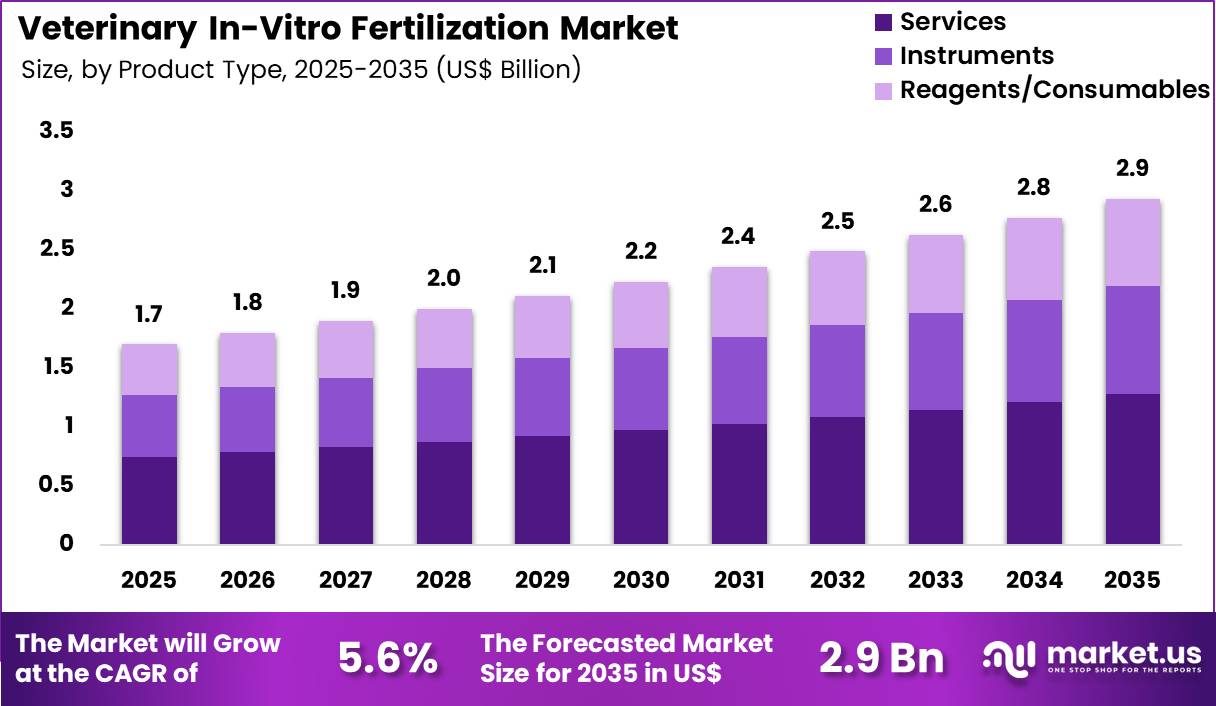
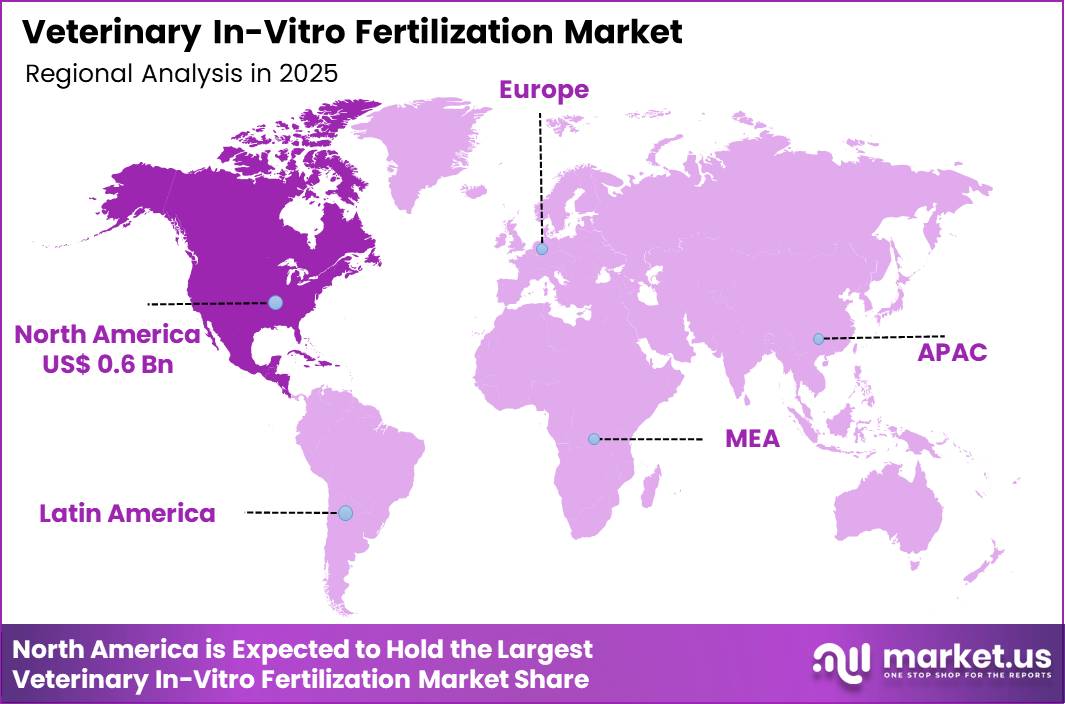
The Global Veterinary In-Vitro Fertilization Market size is projected to be worth around US$ 2.9 Billion by 2035 from US$ 1.7 Billion in 2025, growing at a CAGR of 5.6% during the forecast period 2026-2035. In 2025, North America led the market, achieving over 36.1% share with a revenue of US$ 0.6 Billion.
Increasing global demand for superior genetics in livestock production propels the veterinary in-vitro fertilization market as breeders and producers seek efficient reproductive technologies to accelerate genetic progress and improve herd performance. Dairy cattle operations increasingly apply in-vitro fertilization to generate high-genetic-merit embryos from elite donors, enabling rapid dissemination of desirable traits such as high milk yield and disease resistance across large commercial herds.
These techniques support beef cattle breeding programs by producing sex-sorted embryos that favor female calves, optimizing replacement heifer development and reducing surplus male offspring. Equine practitioners utilize equine in-vitro fertilization for valuable sport horse lines, overcoming subfertility issues in mares and preserving genetics from aged or injured stallions through intracytoplasmic sperm injection.
In small ruminants, veterinarians employ in-vitro fertilization to multiply embryos from superior ewes and does, expanding flocks with enhanced wool quality, meat yield, or parasite resistance. Zoological institutions apply the technology in endangered species conservation, creating viable embryos from cryopreserved gametes to maintain genetic diversity in captive breeding populations.
Biotechnology companies pursue opportunities to refine oocyte maturation protocols and embryo culture media, expanding applications in companion animal reproduction where in-vitro fertilization addresses infertility in high-value dogs and cats.
Developers advance non-surgical embryo transfer techniques that reduce recipient stress, broadening utility in extensive grazing systems for cattle and small ruminants. These innovations facilitate sexed semen integration with in-vitro fertilization, enabling precise gender selection for dairy and beef production goals.
Opportunities emerge in automated embryo assessment systems using time-lapse imaging, improving selection accuracy and pregnancy rates. Companies invest in cryopreservation enhancements that maintain embryo viability during long-distance transport.
Recent trends emphasize sustainable practices and welfare-focused protocols, positioning veterinary in-vitro fertilization as a key tool in precision breeding and genetic conservation efforts across livestock and companion animal sectors.
Key Takeaways
- In 2025, the market generated a revenue of US$ 1.7 Billion, with a CAGR of 5.6%, and is expected to reach US$ 2.9 Billion by the year 2035.
- The product type segment is divided into services, instruments and reagents/consumables, with services taking the lead with a market share of 43.6%.
- Considering technique, the market is divided into artificial insemination, embryo transfer and others. Among these, artificial insemination (AI)held a significant share of 38.5%.
- Furthermore, concerning the end-user segment, the market is segregated into veterinary hospitals, fertility clinics and others. The veterinary hospitals sector stands out as the dominant player, holding the largest revenue share of 68.4% in the market.
- North America led the market by securing a market share of 36.1%.
Product Type Analysis
Services accounted for 43.6% of growth within product type and dominate the veterinary in-vitro fertilization market due to the increasing need for specialized reproductive support in livestock and companion animals. Breeders increasingly depend on professional IVF services to improve conception rates and genetic selection outcomes.
Veterinary service providers enhance reproductive efficiency through controlled breeding programs. Segment growth is expected to accelerate as livestock producers seek productivity improvements. Rising demand for selective breeding strengthens reliance on IVF services.
Veterinary experts provide customized reproductive management plans for herd improvement. Adoption is anticipated to expand as genetic preservation gains importance. Service-based IVF procedures improve reproductive success rates. Expanding commercial breeding operations support demand for assisted reproduction services globally.
Technique Analysis
Artificial insemination accounted for 38.5% of growth within techniques and dominate due to its widespread use in improving herd genetics and reproductive efficiency. Farmers increasingly adopt AI to enhance breeding success without natural mating constraints.
The technique improves disease control during reproductive procedures. Segment growth is projected to strengthen as livestock industries expand globally. Artificial insemination supports efficient breeding management across dairy and meat production farms.
Veterinary professionals utilize AI to maintain genetic diversity within breeding populations. Demand is likely to rise as reproductive technology adoption increases in animal husbandry. Improved conception outcomes enhance breeding program effectiveness. Growing awareness regarding controlled breeding methods supports AI adoption across veterinary settings.
End-User Analysis
Veterinary hospitals accounted for 68.4% of growth within end-users and dominate the veterinary in-vitro fertilization market due to their access to advanced reproductive technologies. Hospitals provide integrated fertility management services for animals. Increasing demand for assisted breeding solutions drives IVF procedure volumes within veterinary facilities.
Segment growth is estimated to expand as hospitals enhance reproductive treatment capabilities. Veterinary specialists utilize IVF technologies to support breeding efficiency. Clinical environments improve procedural accuracy during reproductive interventions.
Demand is expected to increase as animal healthcare infrastructure advances globally. Veterinary hospitals support reproductive health monitoring programs. Growing investments in livestock productivity strengthen IVF adoption within hospital-based settings.
Key Market Segments
By Product Type
- Services
- Instruments
- Reagents/Consumables
By Technique
- Artificial Insemination (AI)
- Embryo Transfer
- Others
By End-User
- Veterinary Hospitals
- Fertility Clinics
- Others
Drivers
Increasing volumes of bovine genetic materials is driving the market.
Genus plc, a key player in bovine reproductive technologies, reported ABS division volumes of 25.9 million straws in the fiscal year ended 30 June 2025. This represented a 5 percent increase from 24.3 million straws in the fiscal year ended 30 June 2024. Sexed genetics volumes within this total rose by 11 percent over the same period.
The expansion reflects heightened demand for advanced reproductive solutions that incorporate in-vitro fertilization techniques for elite embryo production. Practices and producers increasingly utilize these genetic materials to accelerate herd improvement in dairy and beef sectors.
The volume growth contributed directly to broader adoption of veterinary in-vitro fertilization services and related products. Such increases demonstrate sustained market momentum across multiple regions during the 2024-2025 period.
The data underscores the role of genetic volume expansion in supporting overall sector development. Producers benefit from enhanced productivity gains enabled by these technologies. This driver continues to underpin investment and innovation in veterinary in-vitro fertilization applications.
Restraints
Adverse currency movements impacting reported bovine division performance is restraining the market.
Genus plc recorded ABS division revenue of £307.7 million in the fiscal year ended 30 June 2025. This figure reflected a 2 percent decline in actual currency terms from £314.9 million in the fiscal year ended 30 June 2024. The reduction occurred despite a 2 percent increase when measured in constant currency.
Currency headwinds, particularly from the Mexican peso and Brazilian real, affected translational outcomes for international operations. The restraint limited the visibility of underlying demand growth in veterinary in-vitro fertilization technologies.
Regional variations, including pressures in Latin America, compounded the reported slowdown. Such factors influence capital allocation decisions among producers seeking embryo production solutions. The actual currency decline highlights external economic pressures on supply chain participants.
Overall sector expansion in in-vitro fertilization services faced moderation due to these translational effects during 2024-2025. This element constrains the pace of reported market advancement for key players.
Opportunities
Value Acceleration Programme initiatives are creating growth opportunities.
Genus plc implemented the Value Acceleration Programme within its ABS bovine division to enhance operational efficiency and margins. The programme delivered a total adjusted operating profit benefit of £11.8 million in the fiscal year ended 30 June 2025. This comprised £3.8 million from the annualisation of Phase 1 actions initiated in the prior year and £8.0 million from Phase 2 actions completed during 2025.
Phase 2 actions achieved an annualised benefit equivalent to £10 million. The initiatives supported an increase in ABS adjusted operating profit to £19.5 million in 2025 from £14.0 million in 2024. Opportunities arise for scalable improvements in embryo production workflows and genetic supply chains.
Further Phase 3 actions are projected to contribute an additional £6 million benefit in the subsequent fiscal year. The programme fosters long-term structural enhancements without proportional cost escalation. Such frameworks enable key players to capitalise on rising demand for in-vitro fertilization technologies. This opportunity promotes sustained profitability and market expansion in veterinary reproductive services.
Impact of Macroeconomic / Geopolitical Factors
Macroeconomic conditions influence the veterinary in vitro fertilization market through livestock investment cycles, breeding program budgets, and access to farm financing. Inflation raises the cost of culture media, laboratory equipment, cryogenic storage, and transport logistics, which increases procedural expenses for breeding centers.
Higher interest rates limit capital spending on advanced reproductive labs and genetic improvement infrastructure. Geopolitical tensions affect global sourcing of hormones, lab consumables, and temperature control systems, creating supply uncertainty. Current US tariffs on imported laboratory instruments and reproductive technologies increase procurement costs and tighten operating margins.
These pressures can slow adoption among small and mid sized breeders. At the same time, producers invest in domestic genetic programs and local lab partnerships to improve herd quality. Rising demand for superior breeding outcomes and disease resilient livestock continues to support stable and confident market growth.
Latest Trends
Full ownership of the De Novo Genetics joint venture is driving the market.
Genus plc completed the acquisition of the remaining non-controlling interest in its De Novo Genetics joint venture during the first half of the fiscal year ended 30 June 2025. The transaction involved an immediate cash payment of £2.6 million on completion in October 2024.
Deferred consideration of £10.6 million is scheduled over four years, finalising on 1 July 2029. This move granted full control over the internal Holstein programme, directly supporting accelerated genetic progress through advanced in-vitro fertilization capabilities. The development aligns with strategic priorities for proprietary embryo production in dairy applications.
Integration enhances the supply chain for elite genetics derived from in-vitro methods. Practices gain improved access to high-value reproductive technologies as a result of consolidated operations. The acquisition, reported in 2025 documentation, represents a defining evolution in bovine in-vitro fertilization infrastructure during 2024-2025.
Such consolidation strengthens competitive positioning for market participants. This trend accelerates innovation and adoption of specialised veterinary in-vitro fertilization solutions across the sector.
Regional Analysis
North America is leading the Veterinary In-Vitro Fertilization Market
North America accounted for 36.1% of the Veterinary In-Vitro Fertilization market in 2025, driven by rising investments in advanced breeding technologies across dairy, equine, and companion animal sectors. Commercial livestock producers in the US have increasingly adopted embryo transfer and assisted reproduction programs to improve genetic merit and reproductive efficiency.
The US Department of Agriculture reported in 2023 that average milk yield per cow reached over 24,000 pounds annually, encouraging farmers to invest in precision breeding tools that support high productivity herds. Leading cattle breeders now rely on IVF to multiply elite genetics while maintaining disease control within closed herds.
Expanding equine sports breeding programs also support demand for controlled embryo development techniques. Veterinary fertility clinics continue to integrate lab based reproductive technologies into herd management services.
Increasing awareness regarding selective breeding benefits has influenced adoption across commercial farms. These advancements continue to strengthen the role of assisted reproductive solutions in regional livestock production systems.
The Asia Pacific region is expected to experience the highest CAGR during the forecast period
Asia Pacific is expected to experience strong progress during the forecast period as commercial breeders pursue genetic improvement programs across dairy and meat producing animals. Farmers in India and China now invest in embryo transfer labs to enhance herd productivity and disease resistance.
The Food and Agriculture Organization reported in 2022 that Asia accounted for nearly 32% of global cattle inventory, which creates strong demand for structured breeding solutions across commercial farms. Regional governments promote scientific breeding practices through livestock development missions.
Veterinary specialists collaborate with dairy cooperatives to introduce embryo based herd expansion strategies. Expanding access to reproductive biotechnology training strengthens field level adoption. Rapid growth in milk and meat consumption encourages farmers to improve breeding efficiency. These initiatives continue to drive the uptake of lab enabled animal reproduction technologies across emerging agricultural economies.
Key Regions and Countries
North America
- US
- Canada
Europe
- Germany
- France
- The UK
- Spain
- Italy
- Russia
- Netherland
- Rest of Europe
Asia Pacific
- China
- Japan
- South Korea
- India
- Australia
- New Zealand
- Singapore
- Thailand
- Vietnam
- Rest of APAC
Latin America
- Brazil
- Mexico
- Rest of Latin America
Middle East & Africa
- South Africa
- Saudi Arabia
- UAE
- Rest of MEA
Key Players Analysis
Key players in the veterinary in vitro fertilization market strengthen growth by advancing assisted reproductive technologies that help livestock producers improve breeding accuracy and genetic performance. They invest in genomic selection platforms, embryo transfer services, and fertility monitoring tools that support higher quality offspring and improved herd productivity.
Companies also expand through integrated reproductive solutions that combine diagnostics, genetic testing, and breeding support for commercial animal operations. For instance, Zoetis Inc., founded in 1952 and headquartered in New Jersey, operates as a global animal health company that develops medicines, diagnostics, and reproductive technologies for livestock and companion animals .
The company markets its animal health portfolio across more than 100 countries and focuses on innovations that predict, prevent, detect, and treat animal health issues . Through continued investment in precision breeding research and digital reproductive management tools, Zoetis supports improved fertility outcomes and long term livestock productivity.
Top Key Players
- Stroebech Media
- Vytelle, LLC.
- SWINE GENETICS INTERNATIONAL
- Bovine Elite
- Esco Medical
- Minitube Group
- Eppendorf SE
- Hamilton Thorne Inc.
- Charles River Laboratories.
- Vitrolife
Recent Developments
- In September 2024, Zoetis entered into a collaboration with Danone to support more sustainable dairy farming through advancements in genetic selection. The partnership focuses on improving herd health, lowering environmental impact, and building more resilient dairy populations in response to rising demand for sustainable dairy production.
- In October 2024, Esco Medical introduced the MIRI Laminar Flow Cabinet for use in IVF clinics and laboratory environments. The system employs vertical airflow and advanced filtration to protect sensitive samples while supporting safe and efficient laboratory workflows.
Report Scope
Report Features Description Market Value (2025) US$ 1.7 Billion Forecast Revenue (2035) US$ 2.9 Billion CAGR (2026-2035) 5.6% Base Year for Estimation 2025 Historic Period 2020-2024 Forecast Period 2026-2035 Report Coverage Revenue Forecast, Market Dynamics, COVID-19 Impact, Competitive Landscape, Recent Developments Segments Covered By Product Type (Services, Instruments and Reagents/Consumables), By Technique (Artificial Insemination (AI), Embryo Transfer and Others), By End-User (Veterinary Hospitals, Fertility Clinics and Others) Regional Analysis North America – US, Canada; Europe – Germany, France, The UK, Spain, Italy, Russia, Netherlands, Rest of Europe; Asia Pacific – China, Japan, South Korea, India, Australia, New Zealand, Singapore, Thailand, Vietnam, Rest of APAC; Latin America – Brazil, Mexico, Rest of Latin America; Middle East & Africa – South Africa, Saudi Arabia, UAE, Rest of MEA Competitive Landscape Stroebech Media, Vytelle, LLC., SWINE GENETICS INTERNATIONAL, Bovine Elite, Esco Medical, Minitube Group, Eppendorf SE, Hamilton Thorne Inc., Charles River Laboratories., Vitrolife. Customization Scope Customization for segments, region/country-level will be provided. Moreover, additional customization can be done based on the requirements. Purchase Options We have three licenses to opt for: Single User License, Multi-User License (Up to 5 Users), Corporate Use License (Unlimited User and Printable PDF)  Veterinary In-Vitro Fertilization MarketPublished date: March 2026add_shopping_cartBuy Now get_appDownload Sample
 -
-
- Stroebech Media
- Vytelle, LLC.
- SWINE GENETICS INTERNATIONAL
- Bovine Elite
- Esco Medical
- Minitube Group
- Eppendorf SE
- Hamilton Thorne Inc.
- Charles River Laboratories.
- Vitrolife
Our Clients

- 180456
- March 2026






