


Report Overview
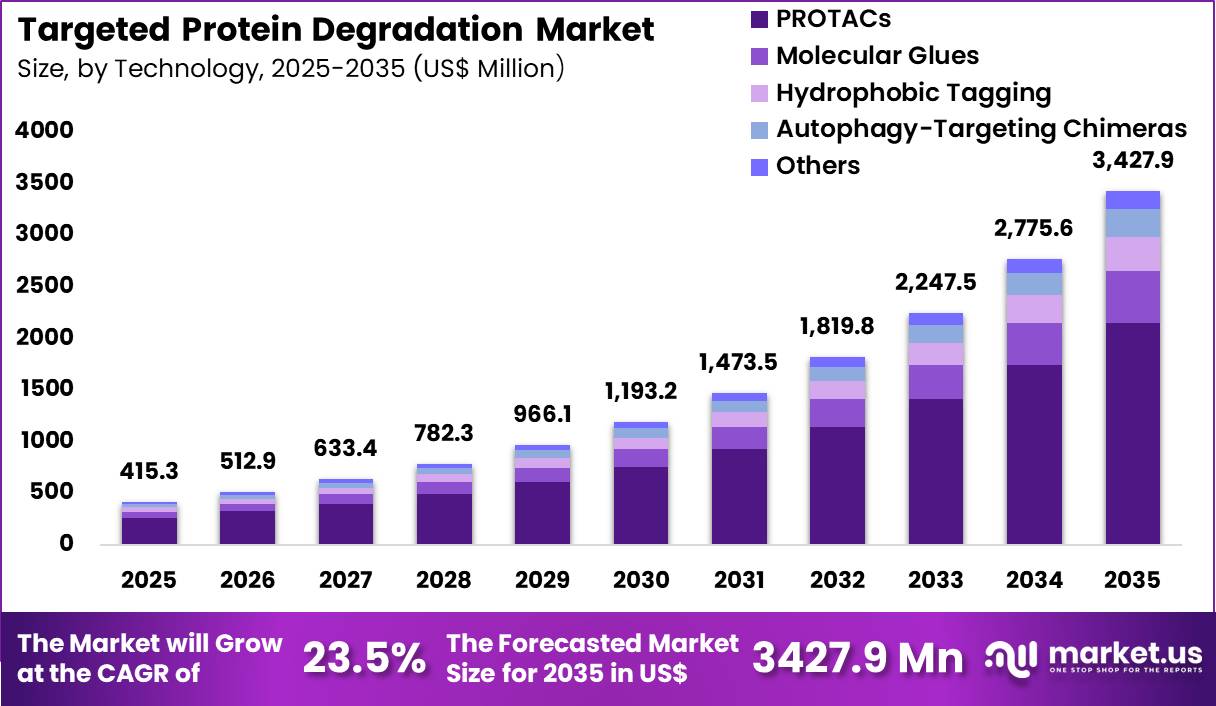
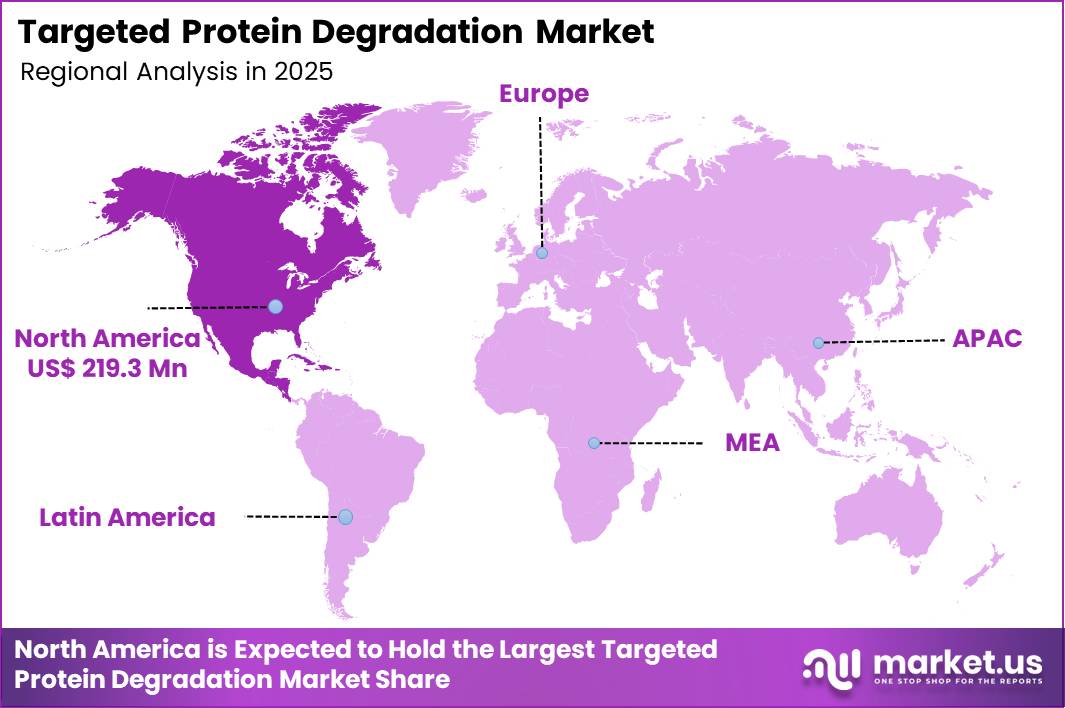
Global Targeted Protein Degradation Market size is expected to be worth around US$ 3427.9 Million by 2035 from US$ 415.3 Million in 2025, growing at a CAGR of 23.5% during the forecast period 2026-2035. In 2025, North America led the market, achieving over 52.8% share with a revenue of US$ 219.3 Million.
Rising interest in innovative mechanisms to address undruggable targets accelerates the Targeted Protein Degradation (TPD) market as pharmaceutical companies and researchers seek novel approaches to selectively eliminate disease-causing proteins rather than merely inhibit their function.
Developers increasingly advance proteolysis-targeting chimeras (PROTACs) that recruit E3 ubiquitin ligases to tag specific proteins for degradation by the proteasome, offering therapeutic potential in oncology where traditional small-molecule inhibitors have proven insufficient.
These degraders support applications in estrogen receptor-positive breast cancer by eliminating pathogenic ERα protein, disrupting oncogenic signaling pathways that drive tumor growth and resistance to endocrine therapies.
In hematologic malignancies, TPD strategies target oncogenic transcription factors and fusion proteins, providing new options for leukemias and lymphomas that rely on proteins previously considered undruggable.
The technology also finds application in neurodegenerative disorders, where degraders aim to clear misfolded or aggregated proteins such as tau or α-synuclein, potentially slowing disease progression.
Biopharmaceutical firms pursue opportunities to expand the TPD toolbox with molecular glues and novel E3 ligase recruiters, broadening the range of degradable targets and improving selectivity across therapeutic areas.
These advancements support the development of orally bioavailable degraders with favorable pharmacokinetic profiles, enhancing patient convenience compared to traditional biologics. In August 2025, Arvinas submitted the first New Drug Application for a PROTAC-based degrader, vepdegestrant (ARV-471), targeting ER-positive and HER2-negative metastatic breast cancer.
The U.S. Food and Drug Administration assigned a PDUFA action date of June 5, 2026, marking a significant milestone for targeted protein degradation therapies and signaling the potential commercialization of this novel drug class.
Recent trends emphasize rational design of heterobifunctional molecules, improved linker chemistry, and combination strategies with existing targeted therapies, positioning the Targeted Protein Degradation market for transformative impact in precision oncology and beyond.
Key Takeaways
- In 2025, the market generated a revenue of US$ 415.3 Million, with a CAGR of 23.5%, and is expected to reach US$ 3427.9 Million by the year 2035.
- The technology segment is divided into proteolysis-targeting chimeras, molecular glues, hydrophobic tagging, autophagy-targeting chimeras and others, with proteolysis-targeting chimeras taking the lead with a market share of 62.8%.
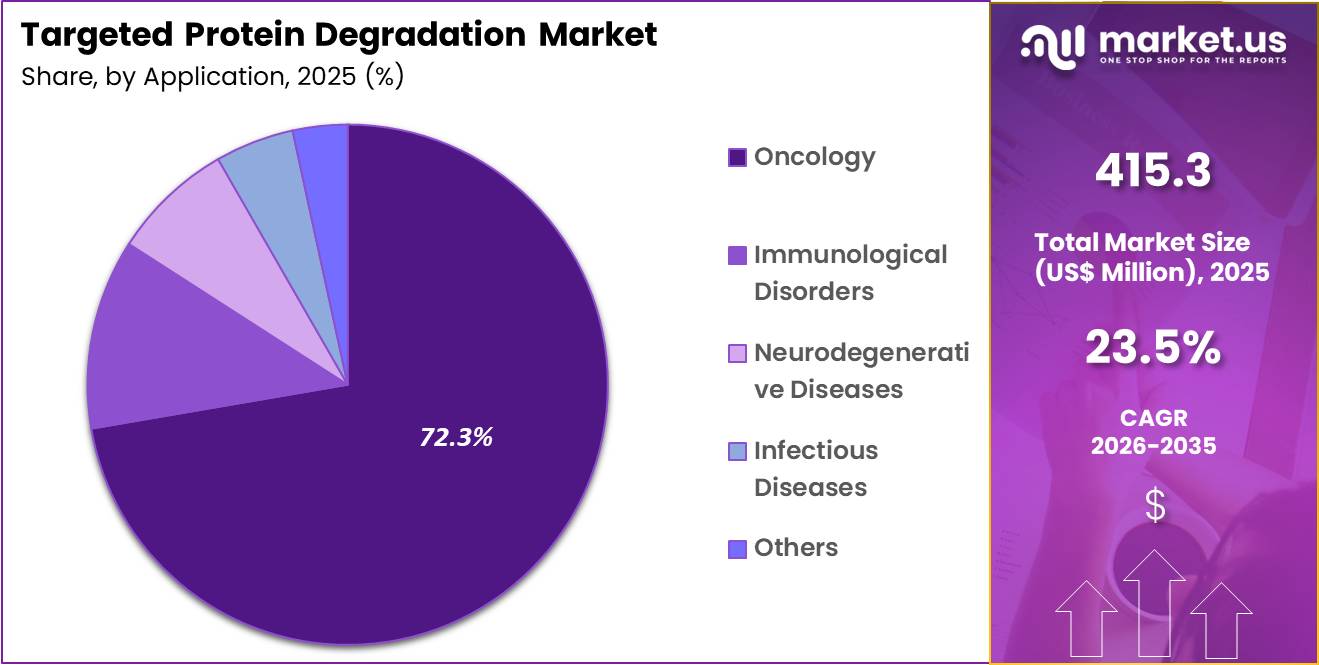
- Considering application, the market is divided into oncology, immunological disorders, neurodegenerative diseases, infectious diseases and others. Among these, oncology held a significant share of 72.3%.
- Furthermore, concerning the end user segment, the market is segregated into pharmaceutical and biotechnology companies, contract research organizations (CROs) and academic and research institutes. The pharmaceutical and biotechnology companies sector stands out as the dominant player, holding the largest revenue share of 58.4% in the market.
- North America led the market by securing a market share of 52.8%..
Technology Analysis
PROTACs accounted for 62.8% of growth within technology and dominate the targeted protein degradation market due to their ability to selectively degrade disease-causing proteins rather than simply inhibiting them. This mechanism allows researchers to target previously undruggable proteins, which significantly expands therapeutic possibilities.
PROTAC-based approaches are expected to grow as pharmaceutical pipelines increasingly focus on precision medicine and novel drug discovery platforms. Researchers are likely to adopt this technology because it offers high specificity and sustained biological effects.
The segment benefits from strong investment in protein degradation research and increasing collaboration between biotechnology firms and academic institutions. Advancements in linker chemistry and target selectivity are projected to enhance clinical success rates.
As drug developers seek more effective treatment strategies, PROTACs are estimated to remain the leading technology in this market.
Application Analysis
Oncology accounted for 72.3% of growth within application and dominates the targeted protein degradation market due to the urgent need for innovative cancer therapies. Cancer continues to represent one of the leading global health burdens, which drives extensive research into new treatment approaches.
Targeted protein degradation offers a unique strategy to eliminate oncogenic proteins that traditional therapies fail to address. Oncology applications are expected to expand as clinical trials increasingly evaluate TPD-based therapies for various cancer types.
Researchers are likely to prioritize oncology because of high unmet medical needs and strong funding support. The segment benefits from rapid advancements in molecular biology and drug design. As precision oncology continues to evolve, this application is anticipated to maintain its dominant position in the market.
End-User Analysis
Pharmaceutical and biotechnology companies accounted for 58.4% of growth within end user and dominate the targeted protein degradation market due to their leading role in drug discovery and development. These companies invest heavily in advanced technologies to develop novel therapies and maintain competitive pipelines.
Targeted protein degradation platforms are expected to gain adoption as companies explore innovative mechanisms of action for new drugs. Pharmaceutical and biotechnology firms are likely to collaborate with research institutions and CROs to accelerate development timelines.
The segment benefits from strong R&D funding and increasing focus on next-generation therapeutics. As drug development strategies shift toward targeted and precision-based approaches, pharmaceutical and biotechnology companies are estimated to remain the dominant end users in this market.
Key Market Segments
By Technology
- Proteolysis-Targeting Chimeras
- Molecular Glues
- Hydrophobic Tagging
- Autophagy-Targeting Chimeras
- Others
By Application
- Oncology
- Immunological Disorders
- Neurodegenerative Diseases
- Infectious Diseases
- Others
By End User
- Pharmaceutical and Biotechnology Companies
- Contract Research Organizations (CROs)
- Academic and Research Institutes
Drivers
Advancements in PROTAC technology and clinical pipeline progression are driving the Targeted Protein Degradation market.
Targeted protein degradation harnesses the cell’s ubiquitin-proteasome system to selectively eliminate disease-causing proteins, offering a novel modality beyond traditional inhibition. This approach addresses previously undruggable targets, including transcription factors and scaffolding proteins implicated in oncology and other therapeutic areas.
Multiple PROTAC candidates have advanced into late-stage clinical evaluation, with several demonstrating promising safety and efficacy profiles in heavily pretreated patient populations. The modality’s catalytic mechanism enables sustained protein knockdown at lower doses compared to occupancy-based inhibitors.
Strategic collaborations between biotechnology firms and large pharmaceutical companies have accelerated development timelines and resource allocation. Regulatory pathways have shown increasing receptivity to degraders, supported by robust preclinical and early clinical data packages.
Investment in platform technologies has expanded the repertoire of E3 ligase recruiters and linker chemistries, enhancing selectivity and pharmacokinetic properties.
These collective scientific and developmental milestones have elevated industry confidence and fostered broader therapeutic exploration. Consequently, technological maturation and pipeline momentum serve as a primary driver sustaining market expansion during the 2022–2025 period.
Restraints
High manufacturing complexity and elevated production costs are restraining the Targeted Protein Degradation market.
Development of heterobifunctional degraders requires sophisticated chemistry, manufacturing, and controls processes that differ substantially from conventional small-molecule therapeutics. Scale-up of these larger, more complex molecules presents significant technical challenges, including purification, stability, and formulation optimization.
Reported cost-of-goods for clinical-grade PROTAC batches have ranged between USD 5,000 and 7,000 per gram in certain disclosures from leading developers, substantially exceeding those of standard kinase inhibitors. These economics constrain pricing flexibility, particularly for indications outside high-value oncology settings.
Intellectual property disputes over linker designs and E3 ligase ligands add legal and licensing uncertainties that delay program advancement. Limited long-term clinical safety datasets for this emerging class further complicate regulatory negotiations and payer evaluations.
Smaller biotechnology entities encounter disproportionate barriers in securing the specialized expertise and infrastructure needed for commercial-scale production. These intertwined technical, economic, and regulatory hurdles moderate the pace of commercialization and broader market penetration.
As a result, manufacturing and cost-related constraints impose measurable restraint on accelerated growth throughout the 2022–2025 timeframe.
Opportunities
Strategic partnerships and expansion into non-oncology indications are creating growth opportunities in the Targeted Protein Degradation market.
Collaborations between specialized degrader platforms and established pharmaceutical companies provide access to global development capabilities, regulatory experience, and commercialization networks. These alliances facilitate risk-sharing while enabling rapid progression of candidates into diverse therapeutic areas, including immunology, neurology, and rare diseases.
Opportunities arise for molecular glue degraders and additional ligase recruiters that complement PROTAC approaches and address distinct biological targets. Expansion beyond oncology leverages the modality’s potential to modulate proteins involved in inflammatory and neurodegenerative pathways.
Integration with emerging delivery technologies and combination regimens supports differentiated product profiles and improved patient outcomes. Potential exists for precision medicine applications that select patients based on target expression or degradation sensitivity biomarkers.
These partnerships also accelerate platform refinements through shared data and resources. Alignment with value-based healthcare models rewards therapies demonstrating superior efficacy or durability compared to existing standards.
Overall, collaborative frameworks and indication diversification generate substantial prospects for sustained innovation and market broadening.
Impact of Macroeconomic / Geopolitical Factors
Macroeconomic forces and geopolitical conditions are exerting a complex influence on the targeted protein degradation market by shaping funding availability, research continuity, and global supply integration. Strong capital inflow into oncology and advanced therapeutics is accelerating innovation, as this technology enables degradation of previously undruggable proteins and expands drug discovery potential.
However, tighter financial conditions and inflation are increasing the cost of clinical trials, specialized chemistry processes, and manufacturing scale-up, which can slow early-stage program progression. Cross-border collaboration remains critical for this field, yet geopolitical tensions are limiting scientific exchange and delaying access to key reagents and catalysts required for complex molecule synthesis.
Trade restrictions and export controls are also introducing uncertainty in sourcing high-value inputs, affecting development timelines and operational planning. Current US tariff structures on laboratory equipment, electronic systems, and chemical intermediates are increasing capital expenditure for research institutions and biotech firms, which can constrain smaller players and emerging innovators.
These pressures may temporarily reduce the pace of pipeline expansion and partnership activity in certain regions. At the same time, organizations are shifting toward regional manufacturing hubs and diversified supplier networks to mitigate exposure to global disruptions.
In strategic terms, despite cost escalation and geopolitical friction, sustained investment in precision medicine and the strong therapeutic promise of protein degradation technologies are expected to reinforce long-term market momentum.
Latest Trends
Progress toward first regulatory approvals and late-stage clinical data readouts represents a recent trend in the Targeted Protein Degradation market.
In 2024 and 2025, the sector has witnessed accelerated clinical maturation, highlighted by New Drug Application submissions and positive Phase 3 results for leading PROTAC candidates. Notably, vepdegestrant (ARV-471) advanced with regulatory filings based on efficacy in estrogen receptor-positive breast cancer, positioning it as a potential first-in-class approved degrader.
Multiple programs targeting androgen receptor, BTK, and other oncology drivers have reported encouraging interim data in late-stage trials, reinforcing confidence in the modality’s therapeutic index. Presentations at major hematology and oncology congresses in 2025 have showcased expanded datasets on CELMoD agents and ligand-directed degraders from leading sponsors.
Industry participants have increasingly disclosed pipeline updates, including IND clearances and dose-escalation completions for next-generation degraders. This trend reflects a shift from early discovery toward registrational development and commercial readiness.
Continued emphasis on combination strategies and biomarker-driven patient selection has further refined development paradigms. Prominent activities observed in 2024–2025 underscore the transition of targeted protein degradation from an emerging concept to a maturing therapeutic class with near-term commercialization potential.
Regional Analysis
North America is leading the Targeted Protein Degradation Market
North America accounted for 52.8% of the targeted protein degradation (TPD) market in 2025, reflecting the region’s leadership in next-generation drug discovery and strong concentration of biotechnology innovation.
Research institutions and pharmaceutical companies across the United States are actively advancing novel therapeutic approaches such as PROTACs and molecular glue technologies that selectively eliminate disease-causing proteins.
The U.S. Food and Drug Administration has continued to support innovative drug development pathways, with dozens of novel drug approvals in recent years, encouraging investment in emerging modalities such as protein degradation.
Biotech firms are expanding pipelines focused on oncology, neurodegenerative diseases, and rare disorders where traditional inhibition strategies show limited effectiveness. Strategic collaborations between academic laboratories and industry players are accelerating early-stage discovery and translational research.
Venture capital funding and public market investments are also fueling rapid growth in this space. Advanced screening platforms and structural biology tools are improving identification of degradable targets and optimizing drug candidates.
Contract research organizations are supporting preclinical evaluation and clinical development of these therapies. These dynamics have collectively positioned North America as a dominant hub for innovation in targeted protein degradation in 2025.
The Asia Pacific region is expected to experience the highest CAGR during the forecast period
Asia Pacific is expected to expand at a notable pace over the forecast period as biotechnology ecosystems mature and investment in advanced therapeutics increases. Countries such as China, Japan, and South Korea are strengthening capabilities in drug discovery, medicinal chemistry, and translational research to support emerging therapeutic approaches.
The World Health Organization highlights the growing global burden of chronic and complex diseases, reinforcing the need for innovative treatment strategies such as selective protein degradation. Regional biotech companies are increasingly entering partnerships with global pharmaceutical firms to co-develop novel drug candidates.
Governments are supporting life sciences innovation through funding programs, research parks, and regulatory incentives. Academic institutions are expanding research in proteomics, structural biology, and molecular pharmacology.
Contract development organizations are also enhancing capabilities to support discovery and early clinical development. Growing interest from investors is accelerating formation of startups focused on advanced therapeutic platforms. These developments are expected to drive continued adoption of targeted protein degradation technologies across Asia Pacific.
Key Regions and Countries
North America
- The US
- Canada
Europe
- Germany
- France
- The U.K.
- Italy
- Spain
- Russia & CIS
- Rest of Europe
Asia Pacific
- China
- India
- Japan
- South Korea
- ASEAN
- Australia & New Zealand
- Rest of Asia Pacific
Middle East & Africa
- GCC
- South Africa
- Rest of Middle East & Africa
Latin America
- Brazil
- Mexico
- Rest of Latin America
Key Players Analysis
Key participants in the Targeted Protein Degradation (TPD) Market expand growth by advancing PROTAC and molecular glue technologies, strengthening collaborations with pharmaceutical companies, and accelerating drug discovery programs focused on previously undruggable targets.
Companies invest in platform technologies, structure-based drug design, and biomarker-driven research that improve selectivity and therapeutic efficacy. They also pursue strategic licensing agreements and pipeline expansion to advance clinical-stage candidates across oncology and other disease areas.
Arvinas Inc. represents a prominent participant in the Targeted Protein Degradation (TPD) Market and operates as a biotechnology company that develops small molecule therapies designed to degrade disease-causing proteins using proprietary PROTAC technology.
The company emphasizes innovative drug discovery platforms and clinical development strategies to address unmet medical needs. Industry competitors continue to expand research pipelines, strengthen strategic alliances, and invest in next-generation degradation technologies to accelerate therapeutic development and sustain long-term market growth.
Top Key Players
- Arvinas Operations, Inc.
- C4 Therapeutics, Inc.
- Kymera Therapeutics, Inc.
- Nurix Therapeutics, Inc.
- Vividion Therapeutics, Inc. (Bayer)
- Plexium, Inc.
- Amphista Therapeutics Ltd.
- Neomorph, Inc.
- Captor Therapeutics S.A.
- Oncopia Therapeutics (Roivant Sciences)
- AbbVie Inc.
- Bristol-Myers Squibb Company
Recent Developments
- At ASH 2025, Bristol Myers Squibb presented updated clinical data for BMS-986458, a ligand-directed degrader targeting BCL6 for the treatment of non-Hodgkin lymphoma. The therapy demonstrated a 65% overall response rate, reinforcing the company’s strategic transition toward next-generation degrader technologies that extend beyond conventional immunomodulatory approaches.
- In January 2026, Kymera Therapeutics outlined its development roadmap centered on KT-621, an oral STAT6 degrader. Following encouraging Phase 1b results in atopic dermatitis reported in December 2025, the company initiated the BREADTH Phase 2b clinical trial for eosinophilic asthma in early 2026. This program aims to offer an oral alternative to injectable biologics, potentially improving patient compliance and treatment accessibility.
- Also in January 2026, Nurix Therapeutics announced the initiation of patient dosing in its DAYBreak registrational program for bexobrutideg (NX-2127). This BTK degrader is currently being evaluated in a Phase 2 study designed to support accelerated regulatory approval for relapsed or refractory chronic lymphocytic leukemia, with expectations for potential approval consideration by late 2026 or early 2027.
Report Scope
| Report Features | Description |
|---|---|
| Market Value (2025) | US$ 415.3 Million |
| Forecast Revenue (2035) | US$ 3427.9 Million |
| CAGR (2026-2035) | 23.5% |
| Base Year for Estimation | 2025 |
| Historic Period | 2020-2024 |
| Forecast Period | 2026-2035 |
| Report Coverage | Revenue Forecast, Market Dynamics, COVID-19 Impact, Competitive Landscape, Recent Developments |
| Segments Covered | By Technology (Proteolysis-Targeting Chimeras, Molecular Glues, Hydrophobic Tagging, Autophagy-Targeting Chimeras and Others), By Application (Oncology, Immunological Disorders, Neurodegenerative Diseases, Infectious Diseases and Others), By End User (Pharmaceutical and Biotechnology Companies, Contract Research Organizations (CROs) and Academic and Research Institutes) |
| Regional Analysis | North America – The US, Canada; Europe – Germany, France, The U.K., Italy, Spain, Russia & CIS, Rest of Europe; Asia Pacific – China, India, Japan, South Korea, ASEAN, Australia & New Zealand, Rest of Asia Pacific; Middle East & Africa – GCC, South Africa, Rest of Middle East & Africa; Latin America – Brazil, Mexico, Rest of Latin America |
| Competitive Landscape | Arvinas Operations, Inc., C4 Therapeutics, Inc., Kymera Therapeutics, Inc., Nurix Therapeutics, Inc., Vividion Therapeutics, Inc., Plexium, Inc., Amphista Therapeutics Ltd., Neomorph, Inc., Captor Therapeutics S.A., Oncopia Therapeutics, AbbVie Inc., Bristol-Myers Squibb Company. |
| Customization Scope | Customization for segments, region/country-level will be provided. Moreover, additional customization can be done based on the requirements. |
| Purchase Options | We have three licenses to opt for: Single User License, Multi-User License (Up to 5 Users), Corporate Use License (Unlimited User and Printable PDF) |





































