Report Overview
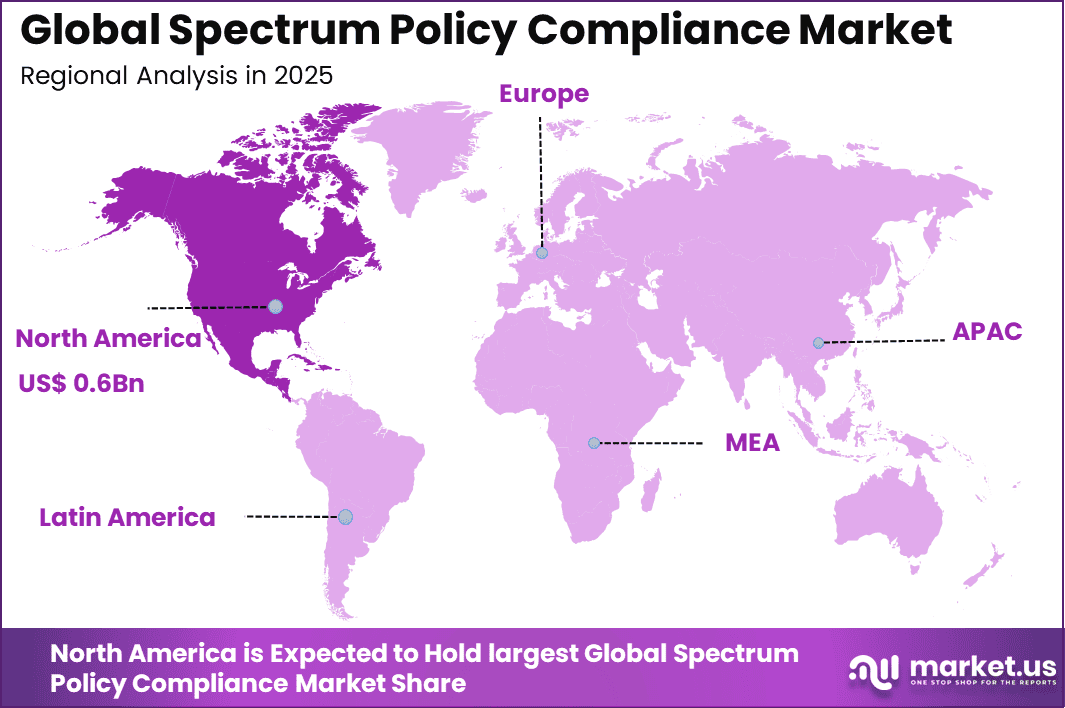
The Global Spectrum Policy Compliance Market size is expected to be worth around USD 5.9 Billion By 2035, from USD 1.8 billion in 2025, growing at a CAGR of 12.6% during the forecast period from 2026 to 2035. North America held a dominant Market position, capturing more than a 35.8% share, holding USD 0.6 Billion revenue.
Top Market Takeaways
- In the spectrum policy compliance market, software held a leading share of 52.4%.
- Cloud-based deployment accounted for 62.6%, reflecting demand for flexible and scalable compliance systems.
- Large enterprises captured 68.5% of the market, supported by broader network operations and regulatory obligations.
- Licensed spectrum management led by policy type with a share of 46.2%.
- Automated spectrum monitoring represented 36.4%, showing strong adoption of real-time compliance and monitoring tools.
- The telecommunications sector held 40.1%, making it the leading end-user segment in the market.
- North America accounted for 35.8% of the global market.
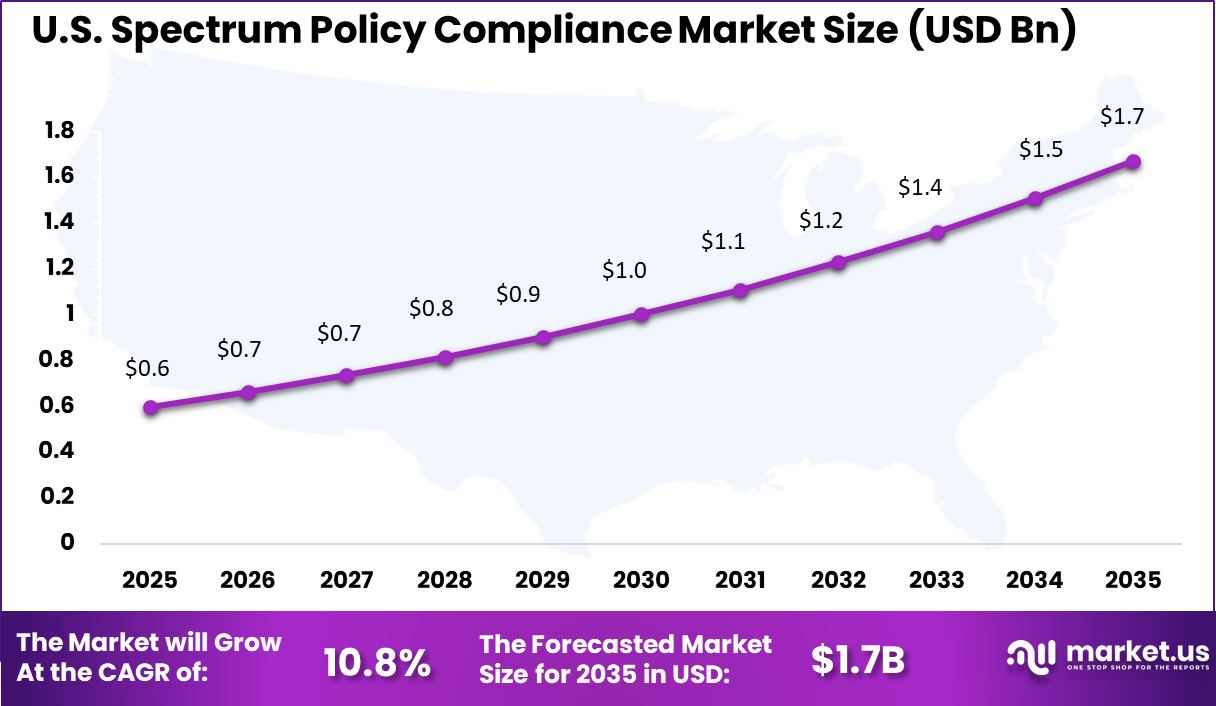
- The U.S. market was valued at USD 0.61 billion and is projected to grow at a CAGR of 10.8%.
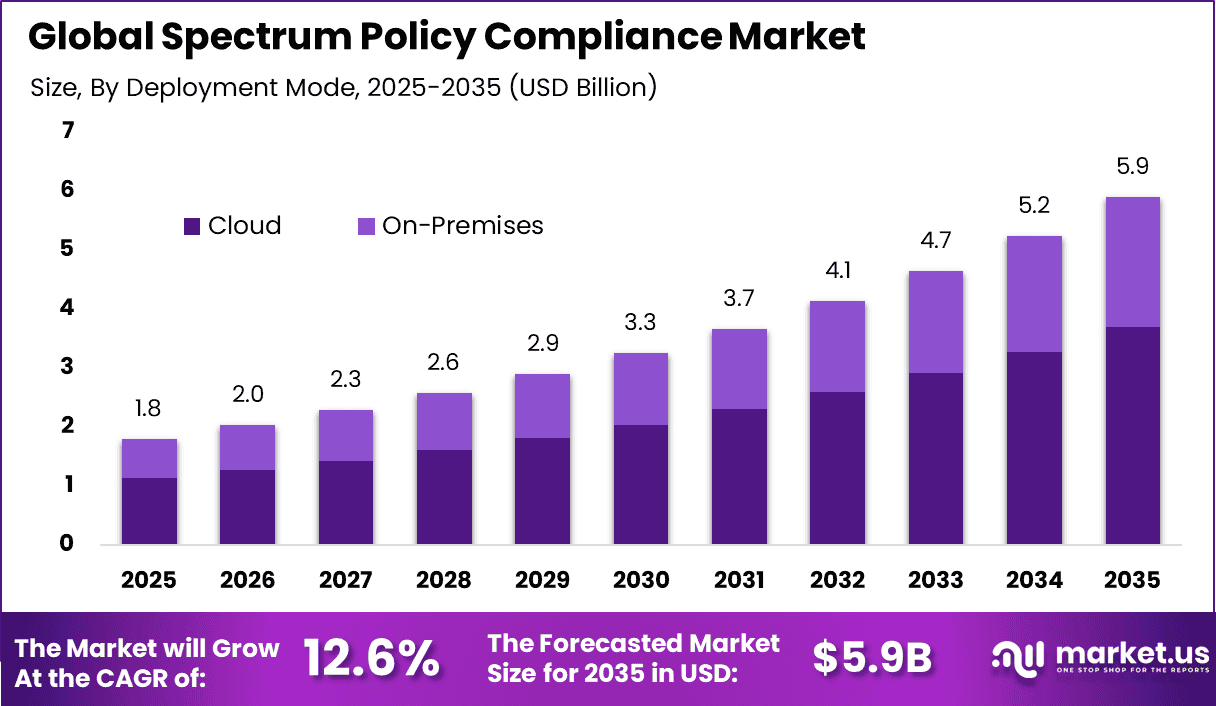
The Spectrum Policy Compliance market refers to the ecosystem of technologies, services, monitoring systems, and regulatory frameworks used to ensure that radio frequency spectrum is utilized in accordance with national and international policies. Spectrum is considered a scarce public resource managed by governments, and its usage is governed through licensing, technical standards, and compliance obligations.
The market is driven by the need to monitor spectrum usage, enforce licensing conditions, prevent interference, and align with global frameworks such as those defined by the International Telecommunication Union. Effective spectrum management ensures optimal utilization while maintaining service quality and avoiding harmful interference across communication systems.
The top driving factor for the Spectrum Policy Compliance market is the rapid growth in wireless communication technologies, including 4G, 5G, satellite systems, and IoT ecosystems. As spectrum demand increases, governments and regulators are required to enforce stricter compliance mechanisms to ensure efficient and interference-free usage.
Digital regulation research highlights that spectrum demand is continuously rising, making efficient allocation and compliance monitoring critical for supporting new technologies and services. This growth in wireless dependency has transformed compliance from a regulatory requirement into a strategic necessity for telecom operators and infrastructure providers.
By Component
In 2025, the software segment held a dominant share of 52.4% in the spectrum policy compliance market, driven by the increasing need for automated compliance management and real-time spectrum monitoring tools. Organizations are adopting software platforms to track spectrum usage, detect interference, and ensure adherence to regulatory standards. These solutions enable efficient management of complex spectrum environments, especially with the expansion of wireless communication networks.
The segment’s growth is further supported by the integration of advanced analytics and automation capabilities. Software solutions allow organizations to process large volumes of data and generate actionable insights for regulatory reporting. They also reduce manual intervention, improving accuracy and operational efficiency. This has reinforced the importance of software as the backbone of spectrum compliance management systems.
By Deployment Mode
In 2025, the cloud-based segment accounted for 62.6% share, reflecting strong adoption of scalable and flexible deployment models. Cloud platforms enable real-time data access, centralized monitoring, and seamless integration across multiple locations. Organizations prefer cloud deployment due to its ability to support dynamic spectrum environments and remote operations. This has significantly improved the efficiency of compliance processes.
The growth of this segment is also driven by lower infrastructure costs and faster implementation timelines. Cloud-based solutions allow organizations to scale operations without heavy upfront investments in hardware. Continuous updates and improved system performance further enhance their attractiveness. As digital transformation accelerates across industries, cloud deployment continues to dominate the market.
By Organization Size
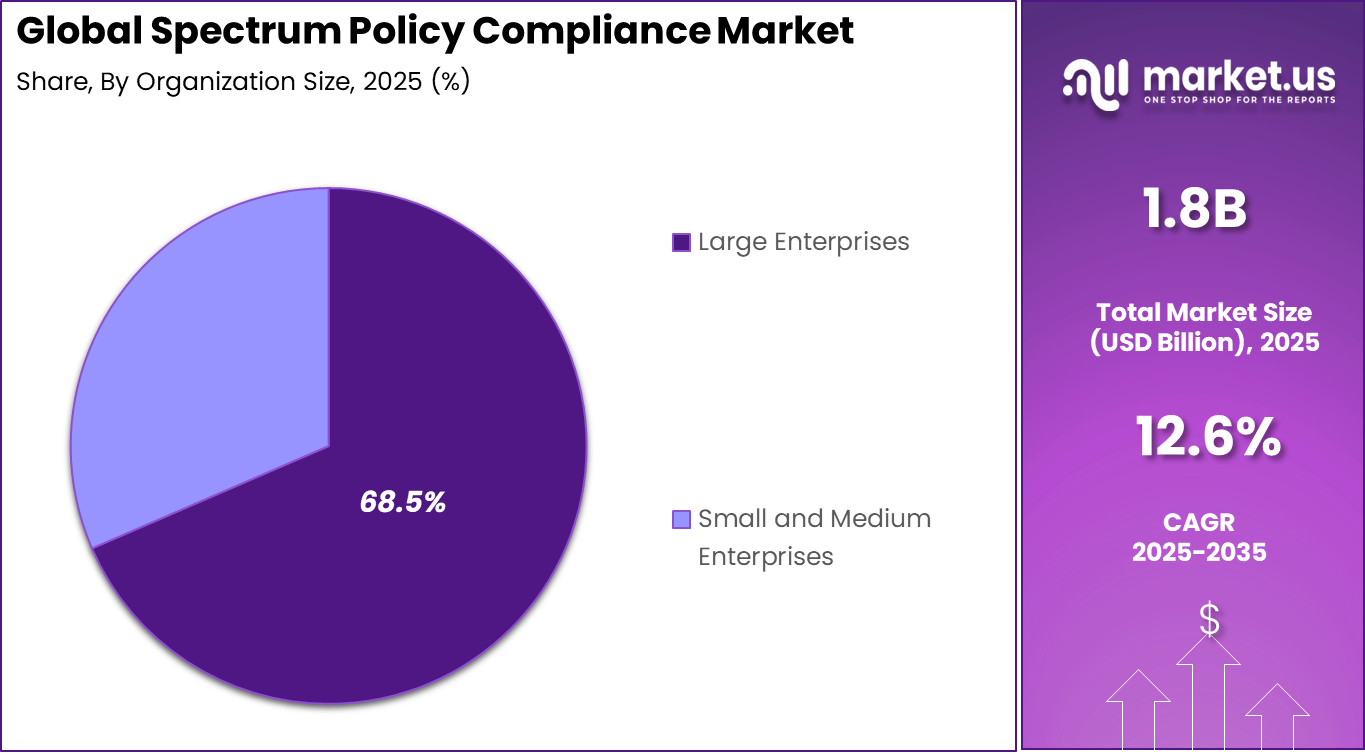
In 2025, the large enterprises segment held 68.5% share, supported by their extensive network operations and higher exposure to regulatory requirements. These organizations manage large-scale communication infrastructure, making spectrum compliance a critical aspect of their operations. They invest significantly in advanced tools to ensure efficient spectrum utilization and avoid regulatory penalties. This has resulted in higher adoption of compliance solutions among large enterprises.
The dominance of this segment is further driven by the need for continuous monitoring and reporting across multiple regions. Large enterprises operate in complex regulatory environments that require strict adherence to spectrum policies. Their financial capacity allows them to implement comprehensive compliance systems. This consistent investment has strengthened their leading position in the market.
By Policy Type
In 2025, the licensed spectrum management segment captured 46.2% share, reflecting the importance of regulated spectrum allocation for communication services. Licensed spectrum is widely used in telecommunications, broadcasting, and other critical applications where reliability and interference control are essential. Organizations rely on compliance solutions to manage licensed spectrum efficiently and meet regulatory standards. This has driven strong demand for licensed spectrum management tools.
The segment’s growth is also supported by increasing regulatory oversight and spectrum scarcity. Governments are implementing stricter policies to ensure fair and efficient spectrum usage. Compliance solutions help organizations monitor usage, prevent violations, and optimize resource allocation. This has reinforced the importance of licensed spectrum management within the market.
By Technology
In 2025, the automated spectrum monitoring segment held 36.4% share, driven by the need for real-time detection of interference and unauthorized spectrum usage. Automated systems enable continuous monitoring without manual intervention, improving accuracy and efficiency. These technologies are essential for managing dynamic and high-density spectrum environments. As wireless communication expands, the demand for automated monitoring solutions continues to increase.
The segment’s expansion is further supported by advancements in artificial intelligence and data analytics. Automated systems can analyze large datasets and identify anomalies more effectively than traditional methods. This helps organizations respond quickly to potential compliance issues. As a result, automated spectrum monitoring has become a critical component of modern compliance strategies.
By End-User
In 2025, the telecommunications segment accounted for 40.1% share, reflecting its heavy reliance on spectrum resources for network operations. Telecom operators require efficient spectrum management to maintain service quality and avoid interference. Compliance solutions help ensure that spectrum usage aligns with regulatory requirements and operational standards. This has driven strong adoption within the telecommunications sector.
The segment’s leadership is also supported by the rapid expansion of mobile networks and increasing data traffic. Telecom companies are investing in advanced technologies to manage spectrum more effectively and support growing demand. The rollout of next-generation networks further increases the need for robust compliance systems. This has positioned telecommunications as a key end-user in the market.
Regional Analysis
In 2025, North America accounted for 35.8% of the spectrum policy compliance market, supported by advanced communication infrastructure and strict regulatory frameworks. The region has a high concentration of telecom operators and technology providers, which drives demand for compliance solutions. Organizations in North America prioritize efficient spectrum management to maintain network performance and regulatory compliance. This has contributed to strong market growth.
The regional dominance is further supported by continuous investment in wireless technologies and innovation. Regulatory bodies enforce strict spectrum usage policies, encouraging adoption of compliance tools. Companies are also focusing on automation and real-time monitoring to improve operational efficiency. These factors collectively strengthen North America’s position in the global market.
Country Analysis
In 2025, the United States spectrum policy compliance market reached USD 0.61 billion and is growing at a CAGR of 10.8%, reflecting steady expansion driven by increasing demand for efficient spectrum management. The country has a large telecommunications sector that relies heavily on spectrum resources.
Organizations are investing in compliance solutions to ensure adherence to regulatory standards and optimize spectrum usage. This has supported consistent market growth. The growth in the U.S. is also influenced by the rapid deployment of advanced communication networks and rising data consumption.
Companies are adopting automated and data-driven solutions to manage spectrum more effectively. Strong regulatory oversight further encourages investment in compliance technologies. As a result, the United States remains a key contributor to the global spectrum policy compliance market.
Key Market Segments
By Component
- Software
- Hardware
- Services
By Deployment Mode
- On-Premises
- Cloud
By Organization Size
- Small and Medium Enterprises
- Large Enterprises
By Policy Type
- Dynamic Spectrum Access
- Licensed Spectrum Management
- Unlicensed Spectrum Compliance
- Shared Spectrum Policy
- Others
By Technology
- Automated Spectrum Monitoring
- Cognitive Radio Compliance
- Policy Enforcement Tools
- Spectrum Analytics Platforms
- Others
By End-user
- Telecommunications
- Government & Defense
- Broadcasting
- Manufacturing & IoT
- Public Safety
- Transportation
- Others
Regional Analysis and Coverage
- North America
- US
- Canada
- Europe
- Germany
- France
- The UK
- Spain
- Italy
- Russia
- Netherlands
- Rest of Europe
- Asia Pacific
- China
- Japan
- South Korea
- India
- Australia
- Singapore
- Thailand
- Vietnam
- Rest of Latin America
- Latin America
- Brazil
- Mexico
- Rest of Latin America
- Middle East & Africa
- South Africa
- Saudi Arabia
- UAE
- Rest of MEA
Emerging Trends Analysis
The spectrum policy compliance market is evolving toward intelligent and automated regulatory monitoring systems. Regulators and telecom operators are increasingly adopting AI-driven tools to track spectrum usage, detect interference, and ensure adherence to licensing conditions in real time. These systems enable continuous monitoring and faster enforcement, reducing manual intervention and improving overall compliance efficiency.
Another important trend is the growing emphasis on flexible and harmonized regulatory frameworks across regions. Governments are shifting from rigid allocation models toward more market-oriented and shared spectrum approaches. This includes spectrum leasing, trading, and sharing mechanisms, which require advanced compliance systems to manage complex usage rights.
Driver Analysis
The primary driver of the spectrum policy compliance market is the rapid increase in demand for wireless communication services. The expansion of mobile networks, IoT devices, and broadband connectivity has intensified the use of radio frequency spectrum, making efficient management essential. Regulatory bodies are focusing on ensuring that spectrum is used optimally and without interference, which is driving the adoption of advanced compliance and monitoring systems.
In addition, the rollout of next-generation technologies such as 5G and upcoming 6G networks is significantly contributing to market growth. These technologies require access to multiple frequency bands and involve complex network architectures, increasing the need for strict compliance with regulatory policies. Ensuring proper allocation, avoiding interference, and maintaining service quality are critical factors that are pushing telecom operators to invest in spectrum compliance solutions.
Restraint Analysis
One of the key restraints in the spectrum policy compliance market is the fragmented nature of regulatory frameworks across different countries. Spectrum policies, licensing conditions, and compliance requirements vary significantly between regions, creating complexity for global telecom operators. This lack of standardization increases operational challenges and requires customized compliance solutions for each jurisdiction.
Another restraint is the high cost associated with implementing advanced monitoring and compliance systems. Deploying technologies such as real-time spectrum analytics, AI-based monitoring, and regulatory reporting tools requires significant investment in infrastructure and expertise. Smaller telecom operators and developing markets may face limitations in adopting these solutions, which can slow overall market growth.
Opportunity Analysis
Significant opportunities are emerging from the adoption of spectrum sharing and dynamic allocation models. Technologies such as licensed shared access and adaptive spectrum management are enabling more efficient use of available frequencies. These models require advanced compliance frameworks to ensure fair access and prevent interference, creating strong demand for innovative compliance solutions.
Furthermore, the expansion of satellite communication and non-terrestrial networks is opening new growth avenues. As these technologies operate alongside traditional terrestrial networks, there is a growing need for coordinated spectrum policies and compliance mechanisms. This creates opportunities for solution providers to develop systems that can manage complex multi-layered spectrum environments effectively.
Challenge Analysis
A major challenge in the spectrum policy compliance market is managing spectrum scarcity and competing demands. The radio frequency spectrum is a finite resource, and increasing demand from various technologies has intensified competition for available bands. Ensuring fair allocation while maintaining compliance with regulatory policies requires advanced planning and coordination among stakeholders.
Another critical challenge is keeping pace with rapid technological advancements. Innovations such as AI-driven networks, satellite-based communication, and hybrid connectivity models are evolving faster than regulatory frameworks. This creates gaps in compliance and enforcement, requiring regulators to continuously update policies and monitoring systems. Addressing these challenges is essential to ensure efficient and secure spectrum utilization in the long term.
Competitive Analysis
The Spectrum Policy Compliance Market is driven by established telecommunications and testing solution providers offering advanced monitoring and regulatory tools. Anritsu Corporation, Keysight Technologies, and Rohde & Schwarz GmbH deliver high-precision spectrum analysis solutions. Nokia Corporation and Ericsson support network compliance through advanced infrastructure. These companies invest in 5G and spectrum efficiency. Their technologies ensure accurate monitoring.
Network infrastructure and service providers play a key role in spectrum optimization and policy enforcement. CommScope Inc. and Huawei Technologies Co., Ltd. offer solutions for network performance and spectrum utilization. Ligado Networks and Motorola Solutions Inc. focus on secure communication systems. These companies enhance operational efficiency through spectrum management tools. Their solutions support public safety and enterprise networks.
Technology and analytics firms contribute to data-driven spectrum monitoring and enforcement. IBM Corporation, Sandvine, and CACI International Inc. provide analytics and network intelligence platforms. These solutions enable real-time visibility and policy enforcement. Increasing regulatory complexity is driving adoption of such tools. Their role supports efficient spectrum allocation. Other key players continue to enhance innovation and competitiveness in this evolving market.
Top Key Players in the Market
- Anritsu Corporation
- Keysight Technologies
- Rohde & Schwarz GmbH
- CommScope Inc.
- Nokia Corporation
- Ericsson
- Ligado Networks
- IBM Corporation
- Huawei Technologies Co., Ltd.
- Sandvine
- CACI International Inc.
- Motorola Solutions Inc.
- Other Key Players
Recent Developments
- January, 2026 – Keysight launched cloud-native spectrum compliance suites with real-time interference detection. Telecoms monitor 5G bands across 100 cities simultaneously. Operators cut violation fines 40% via automated reporting. N6841A analyzers handle mmWave frequencies up to 110 GHz. Integration with RAN assurance platforms serves 3,000 networks.
- February, 2026 – Rohde & Schwarz FSV3000 added cognitive radio policy engines. Defense agencies enforce geofencing with 99.9% accuracy. Military deployments reduced spectrum conflicts 50%. AI-driven analytics predict interference 24 hours ahead. Field units weigh under 15kg for mobile enforcement.
Report Scope
| Report Features | Description |
|---|---|
| Market Value (2025) | USD 1.8 Bn |
| Forecast Revenue (2035) | USD 5.9 Bn |
| CAGR (2026-2035) | 12.6% |
| Base Year for Estimation | 2025 |
| Historic Period | 2020-2024 |
| Forecast Period | 2026-2035 |
| Report Coverage | Revenue forecast, AI impact on Market trends, Share Insights, Company ranking, competitive landscape, Recent Developments, Market Dynamics and Emerging Trends |
| Segments Covered | By Component (Software, Hardware, Services), By Deployment Mode (On-Premises, Cloud), By Organization Size (Small and Medium Enterprises, Large Enterprises), By Policy Type (Dynamic Spectrum Access, Licensed Spectrum Management, Unlicensed Spectrum Compliance, Shared Spectrum Policy, Others), By Technology (Automated Spectrum Monitoring, Cognitive Radio Compliance, and Others), By End-user (Telecommunications, Government & Defense, Broadcasting, Manufacturing & IoT, Public Safety, Transportation, Others) |
| Regional Analysis | North America – US, Canada; Europe – Germany, France, The UK, Spain, Italy, Russia, Netherlands, Rest of Europe; Asia Pacific – China, Japan, South Korea, India, New Zealand, Singapore, Thailand, Vietnam, Rest of Latin America; Latin America – Brazil, Mexico, Rest of Latin America; Middle East & Africa – South Africa, Saudi Arabia, UAE, Rest of MEA |
| Competitive Landscape | Anritsu Corporation, Keysight Technologies, Rohde & Schwarz GmbH, CommScope Inc., Nokia Corporation, Ericsson, Ligado Networks, IBM Corporation, Huawei Technologies Co., Ltd., Sandvine, CACI International Inc., Motorola Solutions Inc., Other Key Players |
| Customization Scope | Customization for segments, region/country-level will be provided. Moreover, additional customization can be done based on the requirements. |
| Purchase Options | We have three license to opt for: Single User License, Multi-User License (Up to 5 Users), Corporate Use License (Unlimited User and Printable PDF) |