


Report Overview
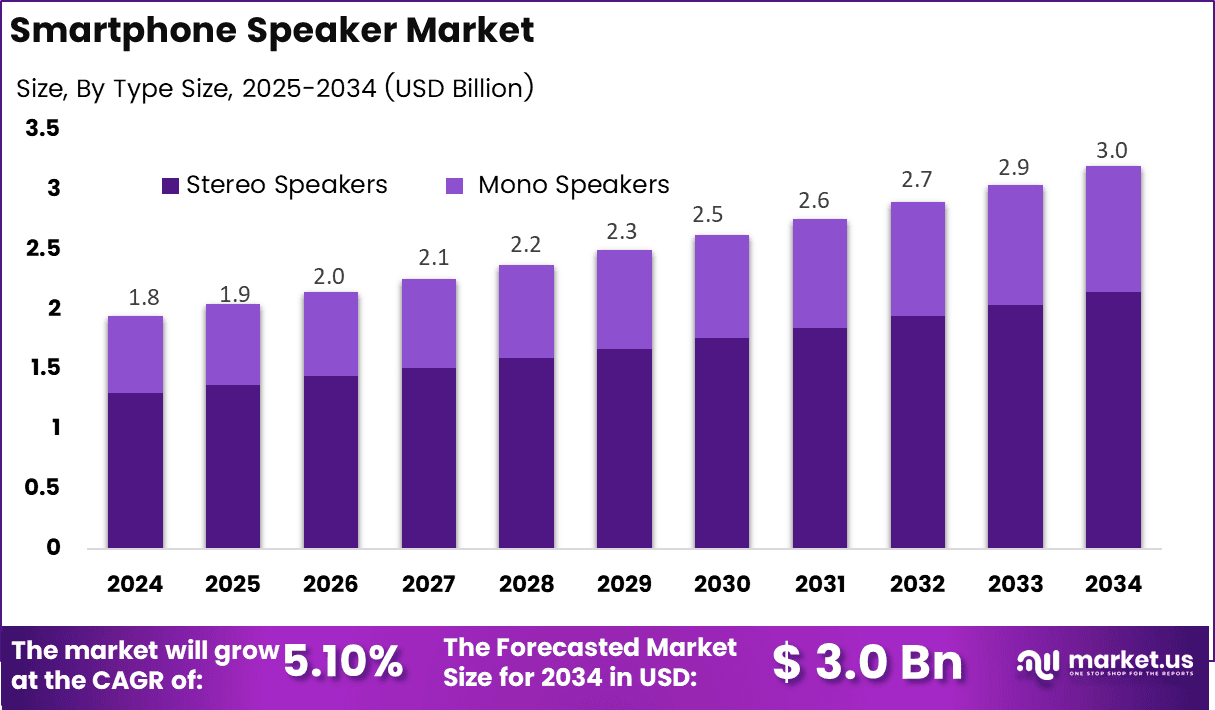
In 2024, the Global Smartphone Speaker Market was valued at USD 1.8 billion. The market is projected to grow at a CAGR of 5.1% during 2024–2034, reaching approximately USD 3.0 billion by 2034. Asia Pacific dominated the global market in 2024, accounting for 63.7% of the total market share and generating approximately USD 1.16 billion in revenue.
The International Telecommunication Union (ITU) reports that global mobile-cellular subscriptions hit 9.2 billion in 2025, equal to 112 subscriptions per 100 people, showing that phone ownership has moved past saturation in many markets and is now spreading into new segments and replacement cycles. On the manufacturing side, global smartphone production reached about 1.254 billion units in 2025, up 2.5% year-on-year, according to industry tracking data, and every one of these units needs at least one embedded speaker unit, directly linking handset output to speaker component demand.
This connection explains why Asia Pacific, home to the world’s largest phone factories, captured more than 63.7% of the market and USD 0.69 billion in 2025 revenue. China alone shipped nearly 32.27 million phones in October 2025, an 8.7% year-on-year jump reported by the China Academy of Information and Communications Technology (CAICT), a body under the Ministry of Industry and Information Technology (MIIT), showing the region’s manufacturing engine is still accelerating rather than slowing down.
India adds a second growth engine to this picture. Government data from the Press Information Bureau (PIB) shows mobile phone production in India grew 33-fold, from INR 18,900 crore in 2014-15 to INR 6.27 lakh crore (about USD 75 billion) in 2025-26, while phone exports jumped 165-fold over the same period, reaching INR 2.60 lakh crore. The India Cellular and Electronics Association (ICEA) further confirms India is on track to touch nearly 30 crore (300 million) units of mobile phone production in FY26, with roughly one in four units made in India now being exported.
Key Takeaways
- The global Smartphone Speaker Market was valued at USD 1.8 billion in 2024.
- The global Smartphone Speaker Market is projected to grow at a CAGR of 5.1% and is estimated to reach USD 3.0 billion by 2034.
- On the basis of type, the Stereo Speakers segment dominated the market, accounting for 71.3% of the total market share.
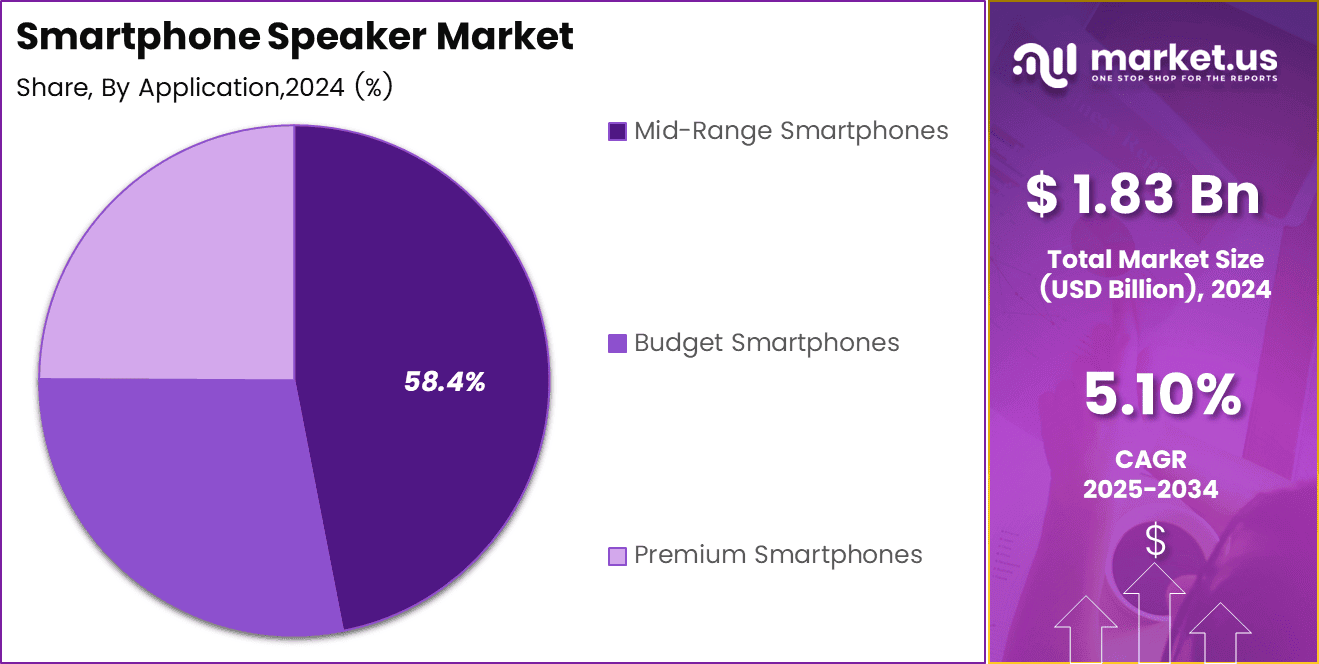
- By application, the Mid-Range Smartphones segment dominated the market, accounting for 58.4% of the total market share.
- In 2024, Asia Pacific was the most dominant region in the Smartphone Speaker Market, accounting for 63.7% of the total market share and generating approximately USD 1.16 billion in revenue.
Role of generative AI
- Generative AI enables advanced acoustic simulations, optimizing sound quality and reducing design time.
- It helps create personalized sound profiles by analyzing user listening patterns and preferences.
- AI-driven algorithms assist in predictive maintenance by detecting potential speaker distortions early.
- It supports lightweight material design and precise placement of micro-speakers for better efficiency.
- Enhances voice recognition systems for improved interaction with virtual assistants.
- Facilitates adaptive soundscapes and real-time audio tuning for immersive experiences.
- Contributes to energy-efficient and sustainable speaker designs in next-generation smartphones.
By Type
In the Smartphone Speaker Market, Stereo Speakers accounted for around 71.3% of the market share, showing an increase of nearly 4.6% compared to the previous assessment period. Their dominance stems from enhanced sound output, wider frequency response, and immersive listening experiences that consumers increasingly prefer.
Mono Speakers hold the remaining share, appealing mainly to cost-sensitive and compact smartphone models. Despite limited sound depth, continuous miniaturization and efficiency improvements are expected to boost their adoption by about 3.2% in the coming years. Overall, the shift toward stereo technology highlights a growing emphasis on superior acoustic performance in mobile devices.
By Application
In the Smartphone Speaker Market, Mid-Range Smartphones captured approximately 58.4% of the total market share, registering an estimated growth of 5.7% over the last cycle. This segment leads due to rising consumer demand for devices that combine affordability with premium features like stereo sound, HD displays, and optimized audio tuning.
Budget Smartphones continue to serve a wide user base, especially in emerging economies, and are anticipated to grow by 2.9% as cost-effective speaker technologies become more accessible. Premium Smartphones, though lower in volume, drive innovation in multi-channel audio and high-fidelity sound reproduction.
Key Market Segment
By Type
- Mono Speakers
- Stereo Speakers
By Application
- Budget Smartphones
- Mid-Range Smartphones
- Premium Smartphones
Investment and Business Benefits
Investment in the smartphone speaker market is expected to grow by around 18.6% over the next decade as global consumers continue to demand enhanced audio quality in smartphones. The sector is attracting strong investor confidence due to the integration of AI-based sound tuning, smart acoustic engineering, and miniaturized speaker designs that improve performance while reducing production costs.
Government initiatives supporting electronics manufacturing and widespread 5G deployment are further projected to drive investments by approximately 21.4%, especially across Asia-Pacific and North America. From a business perspective, companies focusing on advanced material innovation and sustainable production processes could experience profit margin growth of nearly 16.7%, supported by lower energy use and longer component life cycles.
Additionally, embedding intelligent sound systems helps smartphone brands strengthen user engagement and reinforce brand loyalty through superior audio experiences. Overall, continuous innovation, improved manufacturing efficiency, and rising global smartphone penetration make this segment a strong investment opportunity for long-term business growth.
Regional Analysis
The smartphone speaker market in the Asia-Pacific (APAC) region is witnessing rapid expansion, supported by strong domestic manufacturing and increasing consumer demand for enhanced audio quality. In 2024, the market is valued at approximately USD 1.16 billion, driven primarily by China, South Korea, Japan, and India. The region’s growth is fueled by the widespread adoption of 5G smartphones, rising disposable incomes, and a growing preference for multimedia-rich mobile experiences.
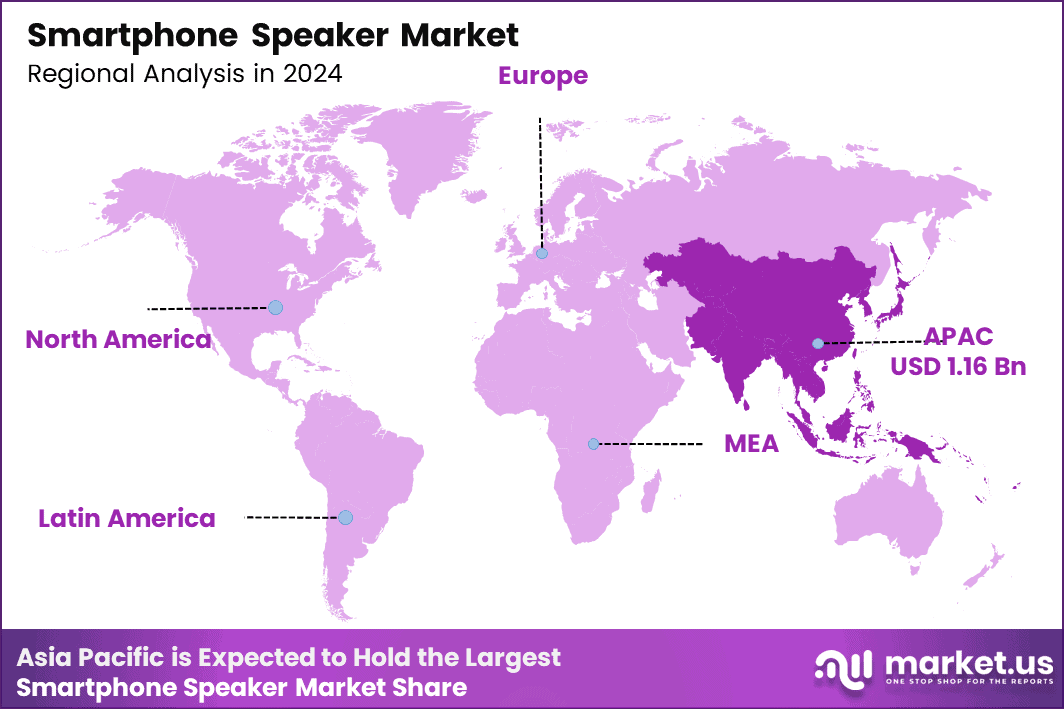
APAC serves as the global hub for smartphone production, with manufacturers integrating high-performance stereo speakers, water-resistant designs, and AI-driven sound optimization. Continuous technological innovations in micro-acoustics and lightweight materials have improved energy efficiency and sound output, aligning with the trend toward thinner and more powerful devices.
China Market Size
The China smartphone speaker market is demonstrating steady expansion, growing at a CAGR of 6.2% from 2024 to 2034. The market size, currently estimated at USD 0.7 billion in 2024, is projected to reach around USD 1.3 billion by 2034, supported by rising smartphone penetration and advancements in mobile audio technology. The demand for high-performance stereo speakers is increasing due to the growing popularity of gaming, streaming, and entertainment applications among Chinese consumers.
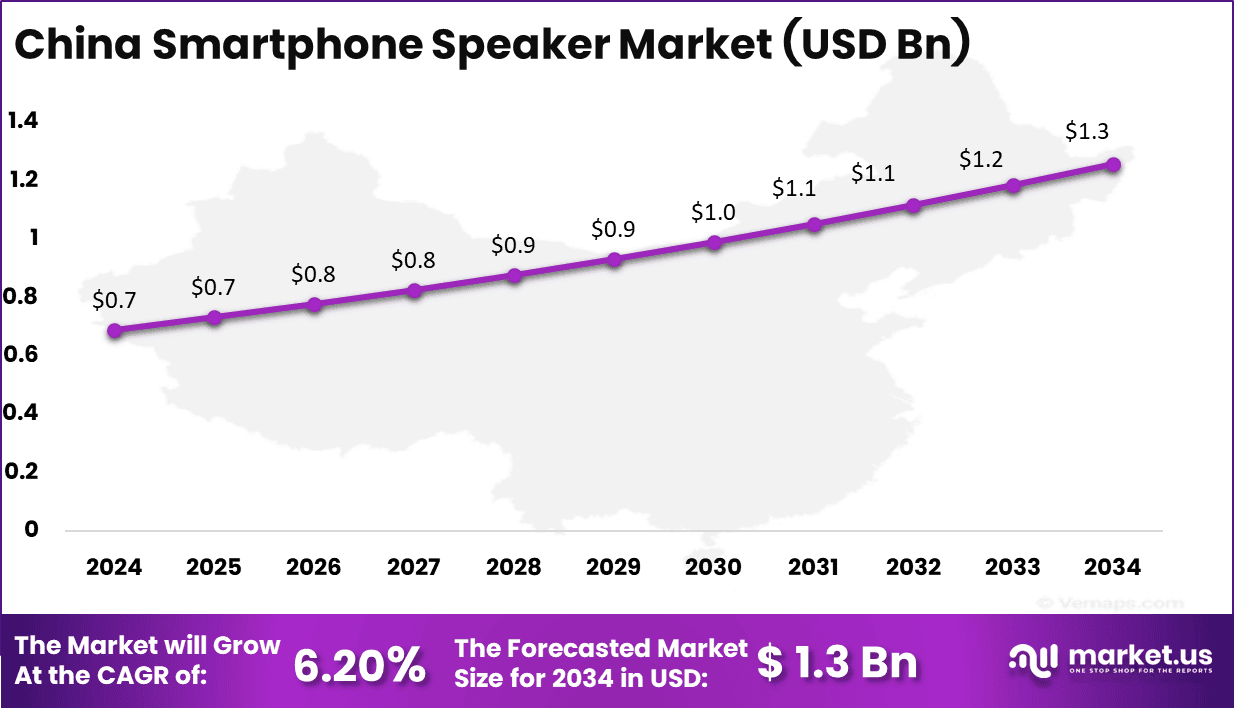
Continuous innovation in miniaturized speaker modules and waterproof acoustic designs is improving sound quality while reducing manufacturing costs. Domestic manufacturers are integrating AI-based tuning systems and advanced materials like neodymium magnets and graphene membranes to enhance performance and durability.
Furthermore, China’s strong electronics supply chain and government initiatives supporting local production have significantly contributed to market expansion. Overall, China’s smartphone speaker market reflects a healthy upward trend driven by technology adoption, production efficiency, and evolving user preferences for superior audio experiences.
Key Regions and Countries
- North America
- US
- Canada
- Europe
- Germany
- France
- The UK
- Spain
- Italy
- Rest of Europe
- Asia Pacific
- China
- Japan
- South Korea
- India
- Australia
- Rest of APAC
- Latin America
- Brazil
- Mexico
- Rest of Latin America
- Middle East & Africa
- GCC
- South Africa
- Rest of MEA
Drivers
| Driver | (~) % Impact on CAGR Forecast | Geographic Relevance | Impact Timeline |
|---|---|---|---|
| Stereo dual-speaker adoption in mid-range tiers | +1.4% | Asia-Pacific, North America | Short term (≤ 2 years) |
| Rising content consumption on device (streaming, short-video) | +1.1% | Global | Short term (≤ 2 years) |
| OEM co-branded audio tuning partnerships | +0.9% | Global | Medium term (2–4 years) |
| Miniaturized micro-speaker and MEMS driver advances | +0.8% | East Asia, Southeast Asia | Medium term (2–4 years) |
| Gaming-optimized audio as a flagship differentiator | +0.5% | North America, Europe | Short term (≤ 2 years) |
Stereo dual-speaker adoption in mid-range tiers
Following the wave of flagship stereo-speaker rollouts that began roughly two years before the baseline year, component-level cost reductions in secondary voice-coil drivers pulled dual-speaker configurations down into the sub-$300 mid-range tier by 2023, a segment that historically carried single-speaker mono setups almost exclusively
The bill-of-materials premium for stereo output has declined from around 18%–22% above mono configurations to 8%–10% per unit as driver production scaled. This cost reduction has enabled OEMs to redirect about 1–2 percentage points of device budgets toward acoustic chamber design and amplifier tuning, adding approximately +1.4% to the baseline 5.1% CAGR as mid-range devices increasingly adopt higher-value stereo speaker systems.
Restraints
| Restraint | (~) % Impact on CAGR Forecast | Geographic Relevance | Impact Timeline |
|---|---|---|---|
| Semiconductor and rare-earth magnet tariff exposure | -1.2% | United States, China | Short term (≤ 2 years) |
| Ultra-thin chassis constraints on driver cavity volume | -0.9% | Global | Short term (≤ 2 years) |
| Flat unit price ceiling in entry-level smartphone segment | -0.7% | South Asia, Africa, Latin America | Short term (≤ 2 years) |
| High interest-rate environment delaying OEM component CapEx | -0.5% | Global | Short term (≤ 2 years) |
Semiconductor and rare-earth magnet tariff exposure
The underlying bottleneck traces directly to neodymium magnet and voice-coil driver inputs, where roughly 80%–85% of refined rare-earth processing capacity remains concentrated in a single country, and escalations in bilateral tariff schedules through 2023–2024 layered duties of roughly 15%–25% onto specific acoustic component categories crossing certain trade lanes.
This quantitatively raises landed per-unit driver costs by an estimated 6%–9%, a swing large enough that several tier-two OEMs deferred qualification of next-generation micro-speaker modules rather than absorb the margin hit, which strategically compresses acoustic-component gross margins by an estimated 150–200 basis points and freezes a portion of current-quarter unit sales in tariff-exposed corridors, translating into a -1.2% drag against the baseline 5.1% CAGR.
Challenges
| Challenge | (~) % CAGR Friction Drag | Geographic Relevance | Mitigation Horizon |
|---|---|---|---|
| Acoustic engineering talent shortage | -0.8% | East Asia, North America | Medium term (2–4 years) |
| Multi-tier supplier qualification lead times | -0.6% | Global | Medium term (2–4 years) |
| Thermal and vibration durability testing complexity | -0.5% | Global | Medium term (2–4 years) |
| Fragmented regional audio-tuning certification standards | -0.4% | Europe, Asia-Pacific | Long term (≥ 4 years) |
| Recycled-material sourcing for driver components | -0.3% | Europe | Long term (≥ 4 years) |
Acoustic engineering talent shortage
The structural vulnerability originates in a persistent shortfall of electroacoustic and DSP tuning engineers, with industry association hiring data indicating a talent deficit on the order of several thousand qualified specialists globally relative to the pace of annual acoustic-module design-win cycles, a gap that widened as flagship OEMs simultaneously scaled dual-driver and spatial-audio programs
This quantitatively extends average acoustic module qualification cycles by roughly 4–6 weeks per design generation and inflates R&D cost-per-project allocations by an estimated 10%–14% as firms rely on premium contract-engineering rates to backfill capacity, forcing long-term corporate adjustments such as expanded university partnership pipelines and offshored tuning labs, and collectively imposing a -0.8% friction drag on the market’s achievable ceiling above the baseline 5.1% CAGR.
Opportunities
| Opportunity | (~) % Potential CAGR Upside | Geographic Relevance | Execution Window |
|---|---|---|---|
| Spatial and object-based audio licensing monetization | +1.6% | Global | Medium term (2–4 years) |
| Entry-tier stereo upgrade white space in emerging markets | +1.3% | South Asia, Africa, Southeast Asia | Medium term (2–4 years) |
| Aftermarket acoustic-module refurbishment and repair ecosystem | +0.7% | Latin America, South Asia | Long term (≥ 4 years) |
| Screen-as-speaker and bone-conduction hybrid architectures | +0.6% | East Asia, North America | Long term (≥ 4 years) |
| Sustainable magnet material substitution roll-up | +0.4% | Europe | Long term (≥ 4 years) |
Spatial and object-based audio licensing monetization
This remains untapped rather than an active driver because current flagship stereo rollouts monetize speaker hardware only at the point of device sale, whereas object-based spatial audio codecs and per-device software licensing frameworks are only beginning pilot integration at the baseline year and have not yet been priced into OEM revenue models at scale.
Capturing this white space could shift component and platform licensors from a one-time hardware margin of 12%–15% toward recurring software licensing fees equal to 2%–4% of device audio-stack value. Premium-tier gross margins could expand by around 300–400 basis points through reusable tuning IP, creating an estimated +1.6% upside to the baseline forecast over the medium term.
Key Player Analysis
Tier-1 Leaders (silicon and full-stack acoustic OEMs): Qualcomm anchors the ecosystem at the chipset layer, reporting fiscal 2025 revenue of $44.3 billion, up 14% YoY, while its Handsets business grew 16%. Qualcomm spent $9.04 billion on R&D in fiscal 2025, supporting Snapdragon audio DSPs and aptX codec integration used across premium Android audio systems. Goertek remains a leading acoustic-component manufacturer, generating RMB 96.55 billion (~$13.4 billion) in 2025 revenue, despite a 4.36% YoY decline.
Its precision components business, including MEMS microphones and micro-speakers, grew 19.45%. AAC Technologies reported record FY2025 revenue of RMB 31.82 billion (~$4.4 billion), up 16.4% YoY, with its acoustics segment contributing roughly RMB 7 billion annually and gross margins near 30%. Knowles reported 2025 revenue of $593.2 million, up from $553.5 million in 2024. Together, Qualcomm, Goertek, and AAC are estimated to hold 55% to 60% combined influence over global smartphone speaker component supply.
Tier-2 Challengers (specialty acoustic and premium audio players): Sonion, under Demant, operates within a group that generated DKK 22.97 billion (~$3.3 billion) in 2025 revenue, up 5%. Tymphany and Vifa, under the Fii/DAS Group, compete in premium drivers and Bluetooth speaker components, focusing on acoustic engineering rather than volume.
Beyerdynamic was acquired by Cosonic Intelligent Technologies for approximately €122 million in 2025, highlighting continued consolidation of premium audio IP. Zound Industries and Shenzhen AITech Electronics remain smaller regional players focused on consumer Bluetooth speakers and smartphone accessories, with limited disclosed financial data compared with larger manufacturers.
Top Key Players
- Qualcomm Technologies
- AAC Technologies
- Knowles Corporation
- Goertek
- Tymphany
- Vifa
- Beyerdynamic
- Sonion
- Zound Industries
- Shenzhen AITech Electronics
- Other Major Players
Recent Development
- In June 2026, Qualcomm agreed to acquire AI-software company Modular, with consideration of up to 19.2 million Qualcomm shares; the reported transaction value was approximately US$3.92 billion. The acquisition extends Qualcomm’s software stack for Snapdragon-class edge AI platforms that underpin advanced on-device audio and voice-processing workloads.
- In March 2026, AAC Technologies reported record 2025 operating scale following its acoustic-portfolio expansion: group revenue reached RMB31.82 billion, up 16.4% year on year, while net profit rose 39.8% to RMB2.51 billion; automotive-acoustics revenue was RMB4.12 billion, up 16.1%. The company cited its 2025 Chuguang and PSG acquisitions as building a full-range audio-system capability.
Report Scope
| Report Features | Description |
|---|---|
| Market Value (2024) | USD 1.8 Billion |
| Forecast Revenue (2034) | USD 3.0 Billion |
| CAGR(2025-2034) | 5.1 % |
| Base Year for Estimation | 2024 |
| Historic Period | 2020-2023 |
| Forecast Period | 2025-2034 |
| Report Coverage | Revenue forecast, AI impact on Market trends, Share Insights, Company ranking, competitive landscape, Recent Developments, Market Dynamics, and Emerging Trends |
| Segments Covered | By Type (Mono Speakers, Stereo Speakers), By Application (Budget Smartphones, Mid-Range Smartphones, Premium Smartphones) |
| Regional Analysis | North America – US, Canada; Europe – Germany, France, The UK, Spain, Italy, Russia, Netherlands, Rest of Europe; Asia Pacific – China, Japan, South Korea, India, New Zealand, Singapore, Thailand, Vietnam, Rest of Latin America; Latin America – Brazil, Mexico, Rest of Latin America; Middle East & Africa – South Africa, Saudi Arabia, UAE, Rest of MEA |
| Competitive Landscape | Qualcomm Technologies, AAC Technologies, Knowles Corporation, Goertek, Tymphany, Vifa, Beyerdynamic, Sonion, Zound Industries, Shenzhen AITech Electronics, Other Major Players |
| Customization Scope | Customization for segments, region/country-level will be provided. Moreover, additional customization can be done based on the requirements. |
| Purchase Options | We have three licenses to choose from: Single User License, Multi-User License (Up to 5 Users), Corporate Use License (Unlimited Users, Printable PDF) |





































