


Report Overview
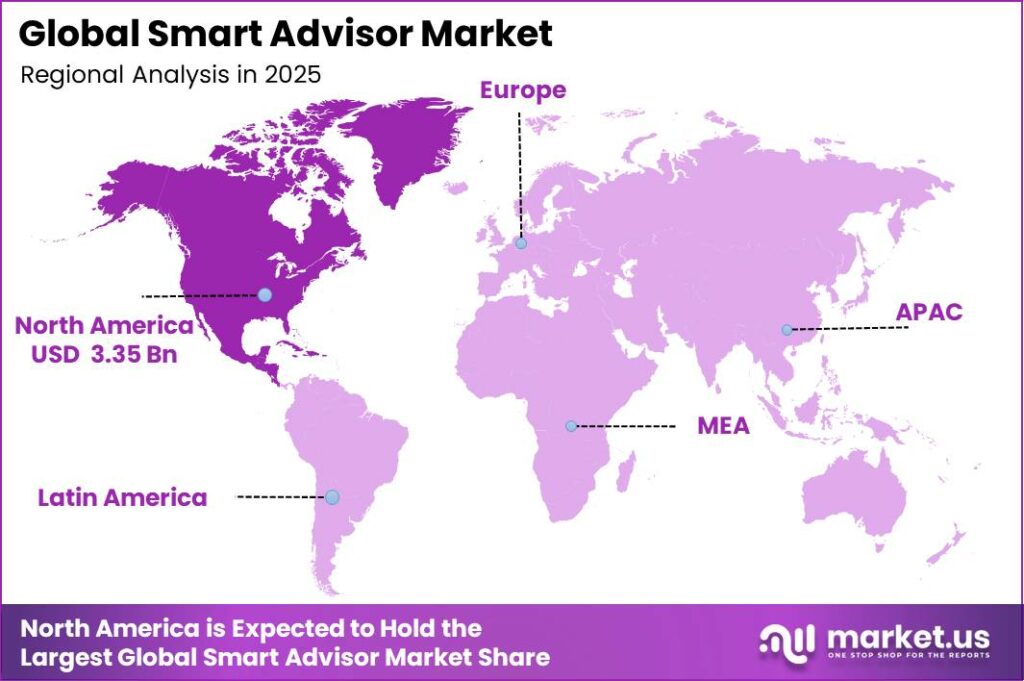
In 2025, the Global Smart Advisor Market was valued at USD 8.0 billion. The market is projected to grow at a CAGR of 20.7% during 2026–2035, reaching approximately USD 52.6 billion by 2035. North America dominated the global market in 2025, accounting for more than 41.9% of the total market share and generating approximately USD 3.35 billion in revenue.
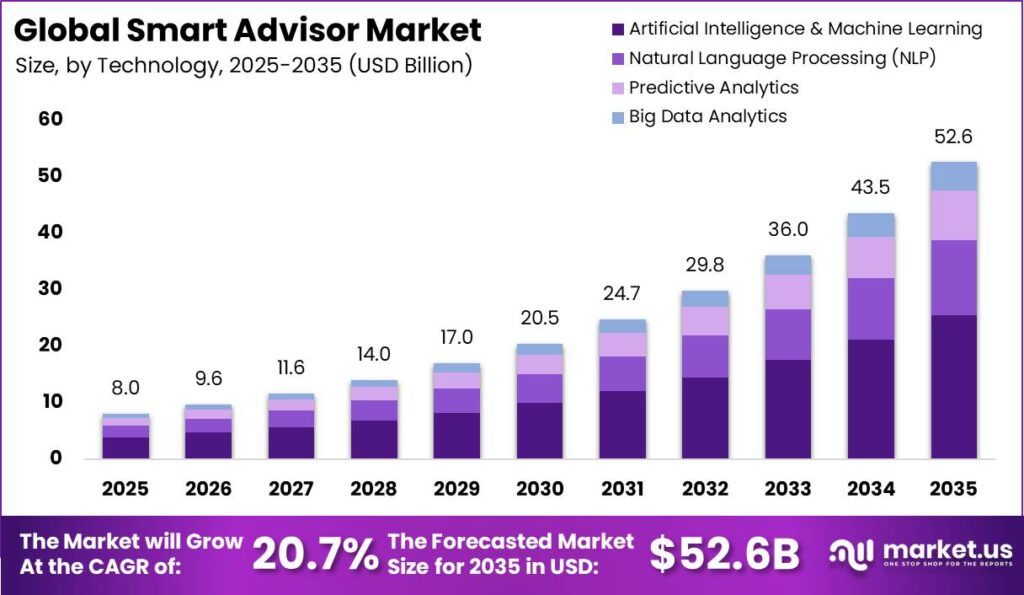
This market growth is primarily driven by the rapid adoption of artificial intelligence (AI) across businesses and consumers. According to the OECD, 20.2% of firms across member countries used AI in 2025, more than doubling from 8.7% in 2023, highlighting a significant shift toward AI-powered business operations. In the United States, the U.S. Census Bureau’s Business Trends and Outlook Survey reported that around 18% of all businesses had adopted AI by the end of 2025, with adoption increasing to 37% among large enterprises.
The U.S. Federal Government allocated USD 3.32 billion for AI research and development through the NITRD Program in FY2025, supporting wider deployment of intelligent advisory technologies. The Federal Reserve Bank of St. Louis also reported that AI-related investments contributed 0.97 percentage points to U.S. real GDP growth during the first three quarters of 2025, demonstrating AI’s growing economic impact.
The market is also benefiting from strong global AI adoption across enterprises and consumers. The World Bank’s Digital Progress and Trends Report 2025 noted that middle- and low-income countries currently hold only 23% of global data center capacity, indicating significant future investment opportunities for cloud-based AI solutions. In the financial sector, a joint survey by the Bank of England and the Financial Conduct Authority (FCA) found that 75% of regulated financial firms in the UK were already using AI, while another 10% planned to adopt it within the next three years.
The Lloyds Banking Group Consumer Digital Index 2025 reported that more than 28 million UK adults use AI to help manage their finances. At the consumer level, Microsoft’s AI Economy Institute estimated that global adoption of generative AI tools reached 16.3% of the world’s population in the second half of 2025, up from 15.1% in the first half of the year.
Key Takeaways
- In 2025, the Global Smart Advisor Market was valued at USD 8.0 billion and is projected to reach approximately USD 52.6 billion by 2035, expanding at a CAGR of 20.7% during the forecast period from 2026 to 2035.
- By solution type, Robo-Advisors (Wealth Management) held the largest market share of 42.1% in 2025, while AI Financial Advisors (Personal Finance Assistants) are expected to register the fastest growth during the forecast period.
- By technology, Artificial Intelligence (AI) and Machine Learning (ML) dominated the market with a 48.6% share in 2025. Natural Language Processing (NLP) is projected to be the fastest-growing technology segment.
- By deployment mode, cloud-based platforms accounted for the largest market share of 71.4% in 2025, driven by their scalability, flexibility, and lower infrastructure costs.
- By advisory domain, Financial Advisory emerged as the leading segment with a 39.8% market share in 2025, whereas Healthcare Advisory is anticipated to record the fastest growth over the forecast period.
- By end user, Retail Investors and Individuals dominated the market, capturing 58.3% of the total revenue in 2025.
- By platform type, Mobile-Based Smart Advisor Apps accounted for the largest share of 44.9% in 2025, while API-Based Advisory Engines are expected to witness the fastest growth through 2035.
- By functionality, Investment Advisory led the market with a 36.7% share in 2025. Risk Profiling and Portfolio Optimization is projected to be the fastest-growing functionality segment.
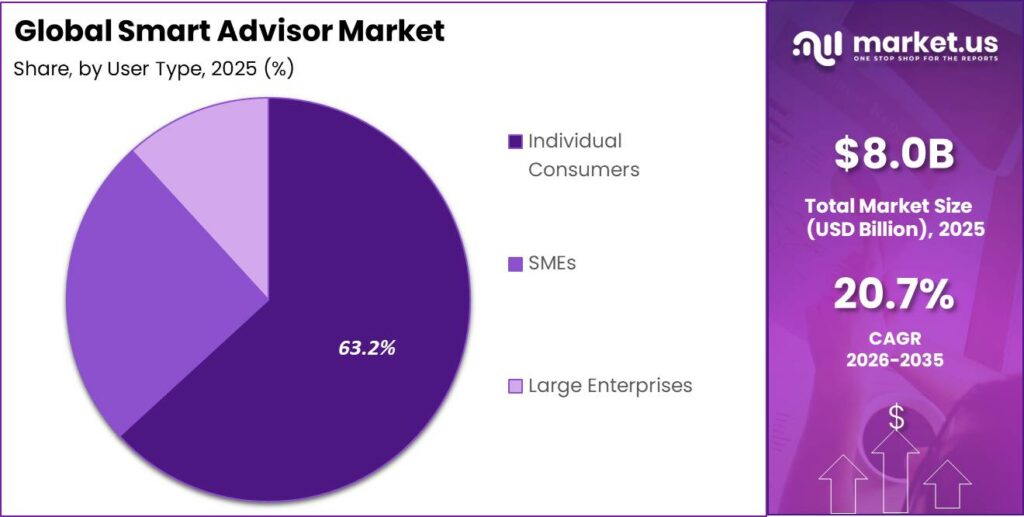
- By user type, Individual Consumers held the dominant position with a 63.2% market share in 2025, while the SME segment is expected to expand at the fastest rate during the forecast period.
- North America led the global market in 2025, accounting for more than 41.9% of the total market and generating approximately USD 3.35 billion in revenue.
By Solution Type
Robo-Advisors accounted for the largest share of the Smart Advisor market in 2025, capturing 42.10% of the total market. Their leadership is supported by the rapid growth in global investable wealth and the increasing preference for digital wealth management. According to the Capgemini Research Institute’s World Wealth Report 2026, global high-net-worth individual (HNWI) wealth increased by 8.7% in 2025 to reach a record USD 98.3 trillion, while the global millionaire population grew by nearly 2 million, reaching 25.3 million.
This expansion has significantly increased demand for automated investment platforms. The Capgemini World Wealth Report 2025 also estimates that USD 83.5 trillion in HNWI wealth will transfer to younger generations by 2048. Robo-advisors typically charge around 0.25% in annual management fees compared with about 1% for traditional financial advisors, making them a more affordable option for many investors.
AI Personal Finance Assistants are expected to register the fastest CAGR during the forecast period. According to the TIAA Institute and GFLEC Personal Finance Index 2026, Americans correctly answered only 47% of financial literacy questions, the lowest level recorded in the study’s history, while the share of adults with very low financial literacy increased from 20% in 2017 to 25% in 2026.
Individuals with low financial knowledge spend nearly 11 hours per week managing financial issues, creating strong demand for AI-powered financial assistance. At the same time, Plaid’s State of Intelligent Finance: Spring 2026 found that 55% of Americans used AI tools for financial activities during the past year, and 86% of those users reported that AI improved their understanding of their financial health.
By Technology
Artificial Intelligence (AI) and Machine Learning (ML) dominated the Smart Advisor market in 2025, accounting for 48.6% of the total market share. Their leadership is driven by their ability to deliver real-time, personalized recommendations by analyzing large volumes of user data, identifying behavioral patterns, and improving decision-making accuracy.
According to the Stanford HAI 2026 AI Index Report, global organizational AI adoption reached 88% in 2025, up from 78% in 2024 and 55% in 2023. In addition, the World Economic Forum reported that financial services firms invested around USD 35 billion in AI in 2023, with total cross-industry AI investment expected to reach USD 97 billion by 2027.
Natural Language Processing (NLP) is projected to register the fastest CAGR during the forecast period. Growth is supported by increasing demand for conversational AI that enables users to interact with smart advisors through natural language, voice, and multilingual communication.
According to the World Intellectual Property Organization (WIPO) 2025 Generative AI Patent Landscape, published generative AI patent families increased from 18,862 in 2024 to 37,808 in 2025, with large language models (LLMs) becoming the largest category of innovation.
By Deployment Mode
Cloud-Based Platforms dominated the Smart Advisor Market in 2025, accounting for 71.4% of the total market share. The segment’s leadership is driven by the rapid shift of businesses toward cloud infrastructure, which provides a more cost-effective and scalable environment for AI-powered advisory platforms than traditional on-premises systems.
According to Eurostat, 52.7% of EU enterprises used paid cloud computing services in 2025, up from 45.3% in 2023. Cloud adoption for finance and accounting software reached 58.2% of EU enterprises, while adoption among medium-sized businesses increased from 59.1% in 2023 to 66.8% in 2025.
At the infrastructure level, the International Energy Agency (IEA) reported that global data center electricity consumption reached approximately 415 TWh in 2024, growing by around 12% annually since 2017, with the United States accounting for 45% of global demand. This continued expansion of cloud and AI infrastructure is expected to support the long-term growth of cloud-based smart advisor platforms.
By Advisory Domain
Financial Advisory dominated the Smart Advisor Market in 2025, accounting for 39.8% of the total market share. According to the Financial Stability Board (FSB), global financial sector assets exceed USD 480 trillion, creating strong demand for AI-powered advisory platforms that improve investment planning, risk analysis, compliance, and customer support.
According to OECD Health at a Glance 2025, OECD countries spent an average of 9.3% of GDP on healthcare in 2024, up from 8.8% before the pandemic, while the United States spent 17.2% of GDP, or approximately USD 14,885 per person. The report also noted that 1 in 9 jobs across OECD economies is now in health or social care, increasing demand for AI tools that improve care coordination and clinical decision-making.
By End User
Retail Investors and Individuals dominated the Smart Advisor market in 2025, accounting for 58.3% of the total market share. According to the ITU Facts and Figures 2025, around 6 billion people, or 75% of the global population, were using the internet in 2025, an increase of more than 240 million users in one year.
At the same time, the Allianz Global Wealth Report 2025 reported that the financial assets of private households increased by 8.7% in 2025, bringing more individuals into investing, savings, and personal financial planning.
By Platform Type
Mobile-Based Smart Advisor Apps accounted for the largest share of the Smart Advisor Market, capturing 44.9% in 2025. The segment leads the market because smartphones have become the primary device for accessing digital financial services.
According to the ITU Facts and Figures 2025, around 82% of individuals aged 10 years and above, or approximately 5.7 billion people, own a mobile phone globally. In addition, the GSMA State of Mobile Internet Connectivity 2025 reported that 4.7 billion people, representing 58% of the global population, use mobile internet services, providing a large and connected user base for smart advisor applications.
The GSMA Mobile Economy Report 2026 stated that mobile technologies and services contributed approximately USD 7.6 trillion to the global economy in 2025, accounting for 6.4% of global GDP. The widespread use of smartphones, growing mobile internet adoption, and increasing demand for digital financial services continue to strengthen the leadership of mobile-based smart advisor apps in the market.
By Functionality
Investment Advisory dominated the Smart Advisor Market in 2025, accounting for 36.7% of the total market share. The segment leads because global investment activity continues to expand, increasing the need for fast and data-driven financial advice. According to the SIFMA Capital Markets Fact Book 2025, global equity market capitalization reached USD 126.7 trillion in 2024, rising 8.7% year-over-year, while global equity issuance increased 21.5% to USD 504.8 billion.
In addition, the OECD reported that global foreign direct investment (FDI) flows grew 15% in 2025, reaching USD 1.66 trillion. This growing investment universe across equities, bonds, and other asset classes has increased demand for AI-powered investment advisory platforms that can analyze large volumes of market data, provide real-time insights, and deliver personalized recommendations at scale.
Growth is driven by the rapid expansion of pension funds, retirement savings, and long-term investment planning worldwide. According to the Thinking Ahead Institute’s Global Pension Assets Study 2025, the world’s 22 largest pension markets manage assets equal to around 80% of their combined GDP, while the top 300 pension funds account for 41% of total global pension assets.
The IMF also reported that U.S. pension fund assets reached USD 38.97 trillion in 2023. As aging populations and defined-contribution retirement plans place greater responsibility on individuals to manage their investments, demand is increasing for AI-powered tools that continuously assess risk, optimize portfolios, and automatically rebalance investments to match changing financial goals and market conditions.
By User Type
Individual Consumers dominated the Smart Advisor Market, accounting for 63.2% of the total market share in 2025. The segment leads because individual users represent the largest customer base for AI-powered advisory platforms. Growing digital banking adoption and increasing use of online financial services continue to expand the number of people seeking affordable financial guidance.
The high volume of daily activities such as budgeting, savings, investments, insurance, and tax planning further strengthens demand. Compared with the world’s approximately 400 million SMEs (World Economic Forum), the much larger global consumer population generates the highest platform usage and revenue, supporting the segment’s market leadership.
According to the World Bank, SMEs account for around 90% of businesses worldwide and contribute more than 50% of global employment. The International Labour Organization (ILO) estimates that MSMEs represent nearly 70% of global employment, with around 80% operating in informal economies where affordable digital advisory solutions provide significant value.
In addition, the UN’s 2025 Global MSME Report estimates that 65 million firms in developing countries face an annual financing gap of approximately USD 5.2 trillion, increasing demand for AI-based financial guidance. The OECD also reported that AI adoption among SMEs increased from 26% in 2024 to 39% in 2025, highlighting the rapid shift toward smart advisory solutions across the business sector.
Key Market Segments
Solution Type
- Robo-Advisors (Wealth Management)
- AI Financial Advisors (Personal Finance Assistants)
- Enterprise Smart Advisory Platforms
- Hybrid Human + AI Advisory Systems
Technology
- Artificial Intelligence & Machine Learning
- Natural Language Processing (NLP)
- Predictive Analytics
- Big Data Analytics
Deployment Mode
- Cloud-Based
- On-Premises
Advisory Domain
- Financial Advisory
- Healthcare Advisory
- Legal Advisory
- HR & Career Advisory
- Business Strategy Advisory
End User
- Retail Investors / Individuals
- Enterprises
- Wealth Management Firms
- Banks & NBFCs
Platform Type
- Mobile-Based Smart Advisor Apps
- Web-Based Platforms
- API-Based Advisory Engines
Functionality
- Investment Advisory
- Risk Profiling & Portfolio Optimization
- Financial Planning & Budgeting
- Customer Engagement Bots
User Type
- Individual Consumers
- SMEs
- Large Enterprises
Market Dynamics
Drivers
| Driver | (~) % Impact on CAGR Forecast | Geographic Relevance | Impact Timeline |
|---|---|---|---|
| AI-led personalization shift in digital advisory | +4.0% | North America, Europe, Asia-Pacific | Short term (≤ 2 years) |
| Proliferation of voice & chat interfaces | +3.2% | Global | Short term (≤ 2 years) |
| Enterprise automation & cost-to-serve reduction | +3.0% | North America, Europe | Medium term (2–4 years) |
| Hybrid human–AI advisory operating models | +2.6% | North America, Europe, developed Asia | Medium term (2–4 years) |
| Digitization of financial & benefits advice | +2.3% | Global urban markets | Long term (≥ 4 years) |
| Smart home ecosystem integration | +1.8% | North America, China, Western Europe | Long term (≥ 4 years) |
AI-led personalization shift in digital advisory
Over the past 2 years, wealth managers, insurers, and HR platforms have shifted from static robo-advice to AI-driven recommendation engines that dynamically optimize portfolios, benefits, and everyday financial decisions at the individual user level, materially changing how advisory revenue is generated and priced globally.
Large institutions now report that algorithmic advisory flows can handle upwards of 60–70% of routine client interactions, cutting marginal advisory costs per interaction to low single-digit dollars and improving advice response times from days to near real time, which directly supports a baseline smart advisor CAGR in the high teens to low twenties, with this driver alone adding roughly 4.0 percentage points.
By embedding AI smart advisors into digital channels rather than selling advice as a standalone product, providers are shifting from one-time commission-heavy models to recurring fee or usage-based models where incremental advisory capacity scales almost linearly with compute rather than headcount, allowing advisory operating margins in digital-first units to trend toward mid- to high-20% ranges even after absorbing incremental cloud and model-governance spend.
Restraints
| Restraint | (~) % CAGR | Geographic Relevance | Impact Timeline |
|---|---|---|---|
| Regulatory scrutiny of automated advice | -3.2% | North America, Europe | Short term (≤ 2 years) |
| High compliance & model-governance costs | -2.7% | Global developed markets | Medium term (2–4 years) |
| Consumer trust and liability concerns | -2.3% | Global | Short term (≤ 2 years) |
| Data localization and privacy mandates | -1.9% | Europe, India, selected APAC | Medium term (2–4 years) |
| Legacy IT constraints in financial institutions | -1.8% | Global Tier-1 and Tier-2 banks | Long term (≥ 4 years) |
| Tight funding for early-stage AI vendors | -1.6% | North America, Europe | Short term (≤ 2 years) |
Regulatory scrutiny of automated advice
Securities and conduct regulators have tightened oversight of algorithmic advice, requiring automated platforms to meet full fiduciary-duty, disclosure, and suitability standards, which raises onboarding and compliance costs and slows deployment of new smart advisor features.
In practice, firms must now maintain detailed documentation of model assumptions, periodic stress tests, and explainability audits, adding mid- to high-single-digit percentage points to compliance operating expense and delaying go-live timelines for new AI advisory modules by 6–12 months, effectively shaving an estimated 3.2 percentage points off the otherwise unconstrained CAGR as launches are staggered and some use cases (such as fully automated complex portfolio rebalancing for retirees) are throttled.
This pushes institutions toward more conservative hybrid rollouts, where human advisors must sign off on certain recommendations, increasing cost-to-serve on higher-risk segments by perhaps 20% relative to fully automated flows and constraining the short-term penetration of pure-play smart advisor platforms in tightly regulated markets.
Challenges
| Challenge | (~) % CAGR | Geographic Relevance | Mitigation Horizon |
|---|---|---|---|
| Shortage of AI-risk talent | -2.8% | North America, Europe, advanced Asia | Medium term (2–4 years) |
| Complex integration with legacy cores | -2.5% | Global financial institutions | Long term (≥ 4 years) |
| Model bias and fairness management | -2.1% | Global | Medium term (2–4 years) |
| User experience fragmentation across channels | -1.9% | Global multi-channel enterprises | Short term (≤ 2 years) |
| Cloud cost volatility for AI workloads | -1.7% | Global | Short term (≤ 2 years) |
| Evolving standards for AI auditability | -1.5% | OECD markets | Long term (≥ 4 years) |
Shortage of AI-risk talent
Smart advisor deployments increasingly require cross-functional teams that blend data science, domain expertise, and model-risk governance, yet the pool of professionals with both AI literacy and regulatory understanding remains in the low tens of thousands globally, far below the hundreds of thousands of roles implied by large-scale deployment plans in banking, insurance, and consumer-tech platforms.
This shortage inflates total compensation for senior AI-risk and model-validation roles into the low- to mid- six figures annually in major hubs and forces institutions to sequence deployments, creating an estimated friction drag of about 2.8 percentage points on the achievable CAGR as projects queue behind scarce specialist capacity.
Opportunities
| Opportunity | (~) % CAGR | Geographic Relevance | Execution Window |
|---|---|---|---|
| Contextual smart advisors in smart home ecosystems | +3.0% | North America, China, Europe | Long term (≥ 4 years) |
| Embedded advisory in payroll & HR platforms | +2.6% | Global | Medium term (2–4 years) |
| SME-focused AI advisory suites | +2.4% | Global | Medium term (2–4 years) |
| Verticalized compliance-as-a-service advisors | +2.1% | Europe, North America | Short term (≤ 2 years) |
| Advisor platforms for emerging-market retail investors | +2.0% | Asia, Latin America, Africa | Long term (≥ 4 years) |
| Cross-provider orchestration of multi-channel advisors | +1.8% | Global | Long term (≥ 4 years) |
Contextual smart advisors in smart home ecosystems
The rapid expansion of digital voice assistants toward an installed base projected in the high single-digit billions globally by the early 2020s, alongside hundreds of millions of smart homes and smart speakers in use, creates a large but largely untapped channel for context-aware smart advisory services beyond simple queries.
Today, most of these devices are monetized via ecosystem lock-in and commerce search, but embedding smart advisors that can deliver proactive financial nudges, home energy optimization recommendations, or subscription-spend rationalization at the household level could add an estimated 3.0 percentage points of upside to the market CAGR by opening access to tens of millions of additional active users who rarely log into standalone advisory apps.
From a unit-economics perspective, using existing voice endpoints to deliver advisory interactions can reduce incremental customer-acquisition costs by perhaps 30–40% versus app-only onboarding, while context-rich sensor and spending data processed on-device and in the cloud enable more precise advice that can lift conversion to paid advisory tiers by mid-single-digit percentage points and support margin expansion of several percentage points through higher ARPU without commensurate growth in human advisor headcount.
Geopolitical Impact Analysis
Geopolitical tensions are increasing costs and creating operational challenges for the Smart Advisor market by affecting AI infrastructure, global trade, and cross-border regulations. Smart advisor platforms rely on advanced AI chips and cloud infrastructure to train and operate large language models.
The U.S. Bureau of Industry and Security (BIS) introduced export controls on advanced AI semiconductors in October 2022, with additional restrictions in January 2025, limiting access to high-performance AI chips. According to the Congressional Research Service, restrictions on NVIDIA H20 and AMD MI308 chips remain in place, while nearly 120 countries are subject to different limits under the revised U.S. AI diffusion framework.
These measures increase infrastructure costs, especially in Asia-Pacific and the Middle East, where vendors often need to purchase more expensive alternative hardware. At the same time, the IMF’s World Economic Outlook (October 2025) reported global economic growth of 3.2% in 2025, while the World Trade Organization (WTO) lowered its global goods trade growth forecast to 2.4%, indicating slower business investment and longer technology purchasing cycles.
Regulatory changes and higher operating costs are also influencing the market. According to UNCTAD (April 2026), global services trade has grown by 5.3% annually over the past decade, while digitally delivered services have expanded by 9% annually. However, different data privacy and cross-border data transfer rules across the European Union, United States, and China require smart advisor providers to build separate local data infrastructure for each region, increasing compliance costs and delaying international expansion.
The IMF’s World Economic Outlook Update (July 2026) reported that energy prices remain 25% higher than pre-conflict levels following Middle East tensions. Since AI-powered smart advisor platforms depend on energy-intensive cloud data centers, higher electricity costs increase operating expenses and reduce profit margins. As a result, geopolitical uncertainty is encouraging regional technology ecosystems while slowing the global expansion of smart advisor platforms.
Regional Analysis
North America dominated the global Smart Advisor Market in 2025, accounting for 41.9% of the total market and generating approximately USD 3.35 billion in revenue. The region’s leadership is supported by high investment in artificial intelligence, advanced digital infrastructure, and a mature financial services industry. According to the Stanford HAI 2026 AI Index Report, private AI investment in the United States reached USD 285.9 billion in 2025, compared with USD 12.4 billion in China, making the U.S. the world’s largest AI investment market.
The Federal Reserve also reported that cumulative U.S. private AI investment exceeded USD 470 billion during 2013–2024, strengthening the country’s AI ecosystem and enterprise adoption. In addition, North America has one of the world’s largest financial markets, with widespread use of digital investment platforms and robo-advisory services, creating strong demand for smart advisor solutions.
Asia-Pacific is expected to register the fastest CAGR during the forecast period. Growth is driven by rapid AI adoption, expanding internet access, and increasing use of digital financial services across the region. According to Boston Consulting Group’s Asia-Pacific AI Adoption Report (October 2025), 70% of frontline employees in the region regularly use generative AI, compared with the global average of 51%, while India recorded an AI adoption rate of 92% among individuals.
The Asian Development Bank (April 2026) also projected that South Asia’s GDP will grow by more than 6.6% in 2025, supporting rising disposable income and greater demand for digital financial advisory services. Furthermore, the International Telecommunication Union (ITU) reported that Asia-Pacific continues to add the largest number of new internet users globally, expanding the customer base for mobile-based and cloud-based smart advisor platforms.
Key Regions and Countries Covered in this Report
- North America
- The US
- Canada
- Europe
- Germany
- France
- The UK
- Spain
- Italy
- Russia & CIS
- Rest of Europe
- APAC
- China
- Japan
- South Korea
- India
- ASEAN
- Rest of APAC
- Latin America
- Brazil
- Mexico
- Rest of Latin America
- Middle East & Africa
- GCC
- South Africa
- Rest of MEA
Key Players Analysis
Tier-1 companies in the Smart Advisor market include BlackRock, Vanguard, Charles Schwab, Morgan Stanley, Goldman Sachs, and Fidelity Investments. These companies lead the market because of their large assets under management (AUM), strong financial position, and continuous investment in AI-powered advisory platforms.
BlackRock ended 2025 with approximately USD 14 trillion in AUM and attracted a record USD 698 billion in net inflows. Its Aladdin technology platform generated USD 2.0 billion in technology services revenue, growing 24% year-over-year, while annual contract value increased 31%, supported by rising demand for AI-based portfolio management and risk analytics.
Vanguard Digital Advisor manages more than USD 311 billion in assets, making it one of the largest robo-advisory platforms globally. Goldman Sachs reported USD 58.3 billion in total net revenue during 2025, up 9%, while AI-related M&A advisory fees increased 41% to USD 1.36 billion in the fourth quarter. Morgan Stanley also reported record institutional securities revenue of around USD 11 billion in Q4 2025 and continued expanding its AI-powered wealth management platform, which supports more than 15,000 financial advisors.
Tier-2 companies include Betterment, Wealthfront, Intuit, Oracle, Salesforce, and Ant Group, which are strengthening their positions through AI innovation and digital financial advisory solutions. Betterment managed more than USD 70 billion in AUM as of May 2026, serving over 1 million customers.
Wealthfront’s assets under management exceeded USD 95 billion following its December 2025 NASDAQ listing. Intuit reported USD 18.8 billion in fiscal 2025 revenue, an increase of 16%, while its Small Business and Self-Employed segment generated USD 14.9 billion, reflecting strong adoption of AI-powered financial advisory tools across TurboTax, QuickBooks, and Credit Karma.
Oracle recorded USD 11.7 billion in cloud services revenue during FY2025, up 14%, supporting the expansion of its AI solutions for financial services. Ant Group generated approximately RMB 120.6 billion (around USD 16.6 billion) in revenue and uses its Alipay ecosystem, with more than 1 billion users, to deliver AI-driven personal finance advisory services across the Asia-Pacific region.
The Major Players in the Industry
- BlackRock
- Betterment
- Wealthfront
- Charles Schwab
- Vanguard
- Morgan Stanley
- Goldman Sachs
- UBS
- Wells Fargo
- Fidelity Investments
- Intuit
- SAP
- Oracle
- Salesforce
- Ant Group
- Other Key Players
Key Development
- In June 2026, Morgan Stanley announced that external AI agents will be able to connect directly to its ShareWorks and Equity Edge stock-plan administration platforms through the Model Context Protocol (MCP) open standard. These platforms manage approximately USD 1.2 trillion in workplace wealth assets across 3,400 corporate administration clients. A pilot program began in June 2026, with a full rollout planned by 2027.
- In March 2025, BlackRock completed its USD 3.2 billion (£2.55 billion) cash acquisition of Preqin, the world’s largest independent provider of private markets data. At the time of the acquisition, Preqin was generating approximately USD 240 million in annual revenue and growing at nearly 20% per year.
- In December 2025, Wealthfront became the first pure-play robo-advisory company to go public, listing on NASDAQ under the ticker WLTH. The company priced its IPO at USD 14 per share, sold 34.6 million shares, and raised approximately USD 484.6 million, resulting in a fully diluted market valuation of USD 2.63 billion. At the time of its public listing, Wealthfront managed approximately USD 88 billion in assets under management (AUM) across more than 1.3 million client accounts, establishing a significant milestone for the digital wealth advisory industry.
Report Scope
| Report Features | Description |
|---|---|
| Market Value (2025) | USD 8.0 Billion |
| Forecast Revenue (2035) | USD 53.6 Billion |
| CAGR (2026-2035) | 20.7% |
| Base Year for Estimation | 2025 |
| Historic Period | 2020-2024 |
| Forecast Period | 2026-2035 |
| Report Coverage | Revenue Forecast, Market Dynamics, Competitive Landscape, Recent Developments |
| Segments Covered | By Solution Type [Robo-Advisors (Wealth Management), AI Financial Advisors (Personal Finance Assistants), Enterprise Smart Advisory Platforms and Hybrid Human + AI Advisory Systems] By Technology (Artificial Intelligence & Machine Learning, Natural Language Processing (NLP), Predictive Analytics and Big Data Analytics) By Deployment Mode (Cloud-Based and On-Premises) By Advisory Domain (Financial Advisory, Healthcare Advisory, Legal Advisory, HR & Career Advisory and Business Strategy Advisory) By End Use (Retail Investors / Individuals, Enterprises, Wealth Management Firms and Banks & NBFCs) By Platform Type (Mobile-Based Smart Advisor Apps, Web-Based Platforms and API-Based Advisory Engines) By Functionality (Investment Advisory, Risk Profiling & Portfolio Optimization, Financial Planning & Budgeting and Customer Engagement Bots) By User Type (Individual Consumers, SMEs and Large Enterprises) |
| Regional Analysis | North America – The US & Canada; Europe – Germany, France, The UK, Spain, Italy, Russia & CIS, Rest of Europe; APAC- China, Japan, South Korea, India, ASEAN & Rest of APAC; Latin America- Brazil, Mexico & Rest of Latin America; Middle East & Africa- GCC, South Africa, & Rest of MEA |
| Competitive Landscape | BlackRock, Betterment, Wealthfront, Charles Schwab, Vanguard, Morgan Stanley, Goldman Sachs, UBS, Wells Fargo, Fidelity Investments, Intuit, SAP, Oracle, Salesforce, Ant Group and Others |
| Customization Scope | Customization for segments and region/country-level will be provided. Moreover, additional customization can be done based on the requirements. |
| Purchase Options | We have three licenses to opt for: Single User License, Multi-User License (Up to 5 Users), Corporate Use License (Unlimited Users and Printable PDF) |





























