Report Overview
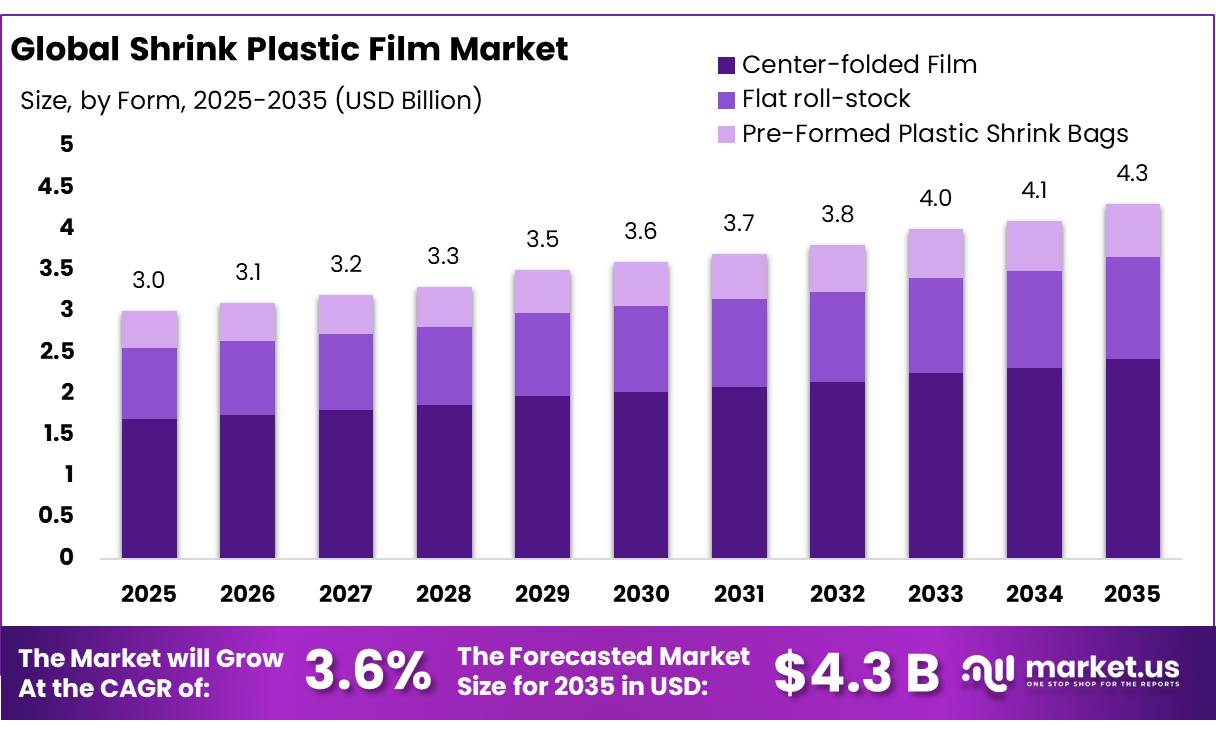
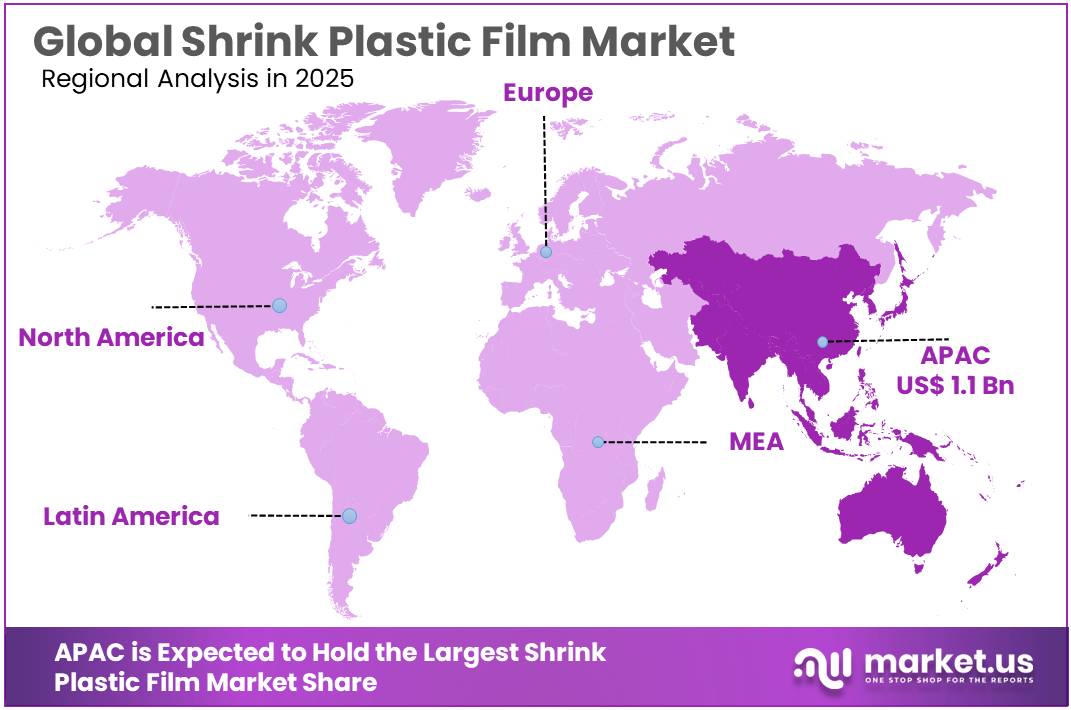
The Global Shrink Plastic Film Market size is expected to be worth around USD 4.3 Billion by 2035, from USD 3.0 Billion in 2025, growing at a CAGR of 3.6% during the forecast period from 2026 to 2035. In 2025, Asia-Pacific held a dominant market position, capturing more than a 36.78% share, holding USD 1.1 Billion revenue.
Shrink plastic film is a flexible packaging material that contracts when exposed to heat, forming a tight protective layer around products. It is commonly manufactured using polyethylene (PE), polyvinyl chloride (PVC), and polyolefin materials. The film is widely used in food and beverage packaging, consumer goods, pharmaceuticals, electronics, construction materials, and industrial transportation. Its ability to secure multiple products together, protect goods from dust and moisture, improve shelf presentation, and support efficient handling makes it an important material in modern packaging operations.
- According to the American Chemistry Council, total United States plastics production reached approximately 136.1 billion pounds in 2025, compared with 136.0 billion pounds in 2024. Within this total, low-density polyethylene production reached 9.249 billion pounds in 2025, while linear low-density polyethylene production reached 27.7 billion pounds. These materials are relevant to flexible film manufacturing because they offer flexibility, sealing performance, and resistance to tearing.
Another important indicator is the scale of packaging consumption and waste. The United States Environmental Protection Agency estimated that 14.5 million tons of plastic containers and packaging were generated in 2018, representing approximately 5.0% of total municipal solid waste generation. Although this figure is not specific to shrink film, it demonstrates the substantial role of plastic packaging in the wider materials economy. Food and beverage manufacturers, logistics companies, and retailers continue to use shrink films for multipacks, pallet wrapping, and product protection.
Driving factors include the need for cost-effective packaging, product protection during transportation, improved retail presentation, and increased efficiency in high-volume packaging operations. Shrink film enables manufacturers to bundle bottles, cans, cartons, and other products while reducing the need for separate outer packaging in suitable applications. Its compatibility with automatic shrink-wrapping equipment also supports faster production and more consistent packaging quality.
Government initiatives and environmental regulations are increasingly influencing future industry development. The European Union’s Packaging and Packaging Waste Regulation, Regulation (EU) 2025/40, entered into force on 11 February 2025 and establishes a framework for improving packaging recyclability, reducing waste, and increasing recycled material use. By 2030, the regulation sets a minimum recycled-content requirement of 35% for plastic packaging outside specified categories, subject to the regulation’s applicable provisions and timelines. It also establishes a direction toward economically viable recyclability for packaging by 2030.
Key Takeaways
- Shrink Plastic Film Market size is expected to be worth around USD 4.3 Billion by 2035, from USD 3.0 Billion in 2025, growing at a CAGR of 3.6%.
- Printed held a dominant market position, capturing more than a 62.34% share of the shrink plastic film market.
- Center-folded Film held a dominant market position, capturing more than a 56.34% share.
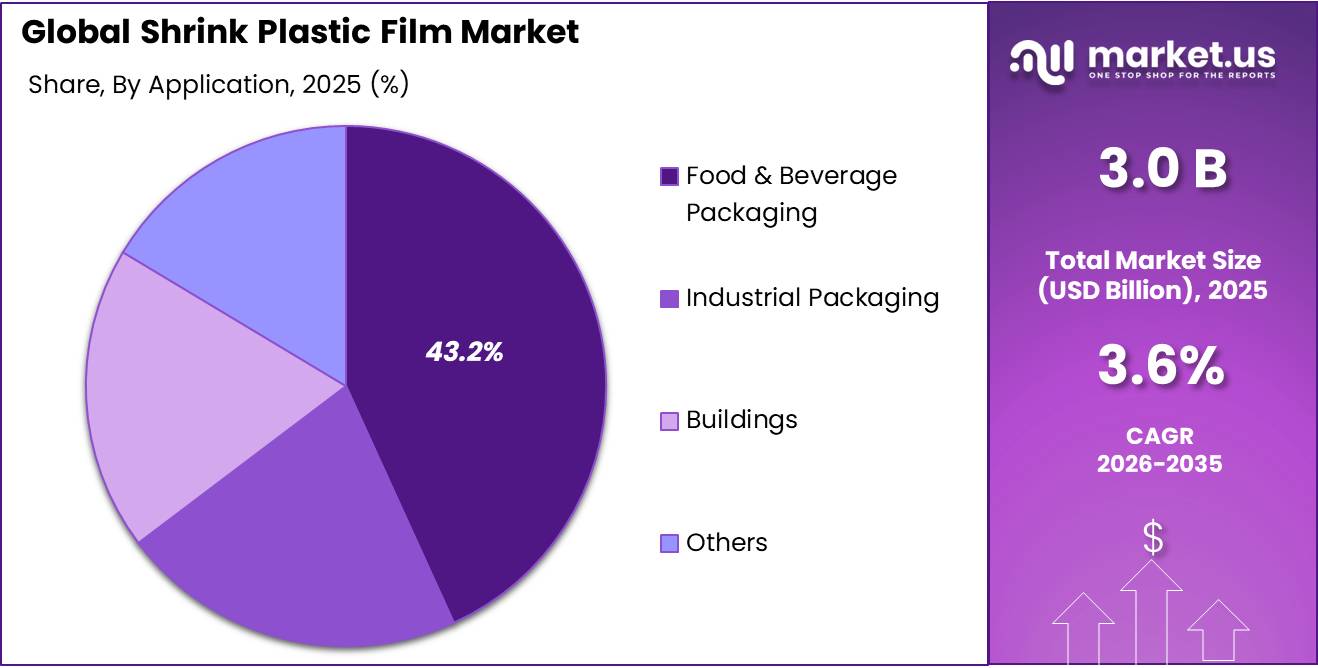
- Food & Beverage Packaging held a dominant market position, capturing more than a 43.23% share.
- North America held a dominant position in the shrink plastic film market, accounting for 35.21% of the market, with a reported value of USD 2.6 billion.
By Type Analysis
Printed Shrink Plastic Film: Dominates with a 62.34% Share in 2025
In 2025, “Printed” held a dominant market position, capturing more than a 62.34% share of the shrink plastic film market. This segment benefits from strong demand for branded packaging, product identification, promotional graphics, and clear product information across food, beverages, personal care, and consumer goods. Printed shrink films help manufacturers improve shelf visibility and communicate product details without requiring separate labels.
Unprinted shrink plastic film serves applications where product bundling, protection, and transportation efficiency are more important than decorative packaging. In 2025, demand was supported by industrial packaging, multipack bundling, and pallet stabilization, where plain film can help reduce printing costs and simplify packaging operations. Its use also suits businesses seeking straightforward packaging for warehouse handling and bulk distribution. The United States Environmental Protection Agency reported that the United States generated 14.5 million tons of plastic containers and packaging in 2018, highlighting the scale of plastic packaging use across the wider industry.
By Form Analysis
Center-folded Film Dominates Through Efficient Packaging and Versatile Use
In 2025, “Center-folded Film” held a dominant market position, capturing more than a 56.34% share of the shrink plastic film market. Its leading position is supported by convenient handling, efficient storage, and compatibility with automatic shrink-wrapping equipment. The folded structure allows the film to open around products while maintaining consistent packaging quality, making it suitable for food and beverage multipacks, consumer goods, and industrial packaging. Manufacturers value this format for its ability to support high-volume packaging operations and reduce manual handling.
Flat roll-stock shrink film is used by manufacturers that require adaptable packaging material for different product sizes and wrapping configurations. In 2025, demand was supported by its suitability for automated packaging lines, custom cutting, and applications requiring flexible film dimensions. It is used across consumer goods, food products, and industrial packaging where consistent wrapping and efficient material handling are important. The format allows packaging operators to adjust film usage according to product requirements, supporting operational flexibility and material control. According to the United States Environmental Protection Agency, the United States generated 14.5 million tons of plastic containers and packaging in 2018.
By Application Analysis
Food & Beverage Packaging Dominates with a 43.23% Share in 2025
In 2025, “Food & Beverage Packaging” held a dominant market position, capturing more than a 43.23% share of the shrink plastic film market. The segment benefits from the growing need to protect packaged food and beverages during storage, transportation, and retail distribution. Shrink plastic film is widely used for bottle multipacks, canned drinks, packaged food products, and promotional bundles because it holds products together and supports efficient handling. Its suitability for automated packaging lines also helps manufacturers maintain packaging speed and consistency.
Industrial Packaging is an important application for shrink plastic film because manufacturers and logistics operators require reliable solutions for securing goods during storage and transportation. In 2025, its use was supported by pallet wrapping, component bundling, and protective packaging for industrial products. According to the United States Environmental Protection Agency, the United States generated 14.5 million tons of plastic containers and packaging in 2018.
Key Market Segments
By Type
- Printed
- Unprinted
By Form
- Flat roll-stock
- Center-folded Film
- Pre-Formed Plastic Shrink Bags
By Application
- Food & Beverage Packaging
- Industrial Packaging
- Buildings
- Others
Driver Analysis
Beverage Multipack Collation Demand
Beverage bundling is the largest single use of polyethylene collation shrink film, and drink volumes are rising again. The Coca-Cola system sold 33.8 billion unit cases in 2025, against 33.7 billion in 2024. Growth came from Central Asia, North Africa and Brazil, and global unit case volume rose 5% in Q2 2026. Monster’s energy drink case sales rose 13.3% to 959.0 million in 2025, with 42% of Q4 sales outside the U.S. (Monster 10-K; Monster). We estimate each 24-bottle shrink bundle uses 25 to 45 g of film.
Each additional billion unit cases of bundled beverages therefore needs about 15,000 to 25,000 t of collation film. Packers are also moving from shrink-wrapped corrugated trays to tray-less pads or film only, which cuts secondary packaging cost by 20% to 35% per case and increases film use per pack. Paperboard competitors such as Graphic Packaging are promoting formats that eliminate shrink film. Converters are responding with thinner, high-PCR mono-PE films and with shrink tunnel and film supply sold together under multi-year contracts.
Drivers Impact Analysis
| Driver | (~) % Impact on CAGR Forecast | Geographic Relevance | Impact Timeline |
|---|---|---|---|
| Beverage Multipack Collation Demand | +1.1% | Global, LatAm, APAC, North America | Short term (≤ 2 years) |
| Recycled-Content Mandates (EU, India, California) | +1.0% | EU core, India, U.S. West | Long term (≥ 4 years) |
| Fresh Protein Barrier Shrink Bags | +0.9% | Brazil, North America, China import | Medium term (2-4 years) |
| Premium Shrink Sleeve Labels | +0.9% | North America, Europe, India | Medium term (2-4 years) |
| PE Resin Oversupply Cost Tailwind | +0.6% | U.S. Gulf, China, Middle East | Short term (≤ 2 years) |
| E-Commerce Unitization Growth | +0.6% | North America core, EU, India | Medium term (2-4 years) |
Restraint Analysis
Gulf War Resin Price Shock
The 2026 Iran war has reversed the resin price relief that shrink film converters were expecting. Polyethylene prices on the Dalian exchange rose nearly 37% after late February. Dow’s CEO said up to 50% of polyethylene supply was offline or constrained, and the Middle East accounted for more than 40% of global PE exports in 2025. That share equals 18.7 Mt out of 43.8 Mt traded (ET Chemicals). In April, Asian LLDPE rose 30.1% in a month to $1,210/t, and naphtha was up 92.7% year on year (Al Jazira Capital).
In March, Middle Eastern naphtha shipments fell to less than one-fifth of February levels (S&P Global). Indian buyers have slowed imports, with LLDPE at $1,180 to $1,220/t delivered to India (Argus), and exporters report packaging plastic costs up 50% to 60% (Economic Times). Resin is 65% to 75% of shrink film cost, so we estimate a $250 to $400/t rise in LLDPE raises converted film prices by 15% to 25%. Price pass-through clauses typically lag by 30 to 90 days, which costs converters 3 to 6 points of margin, and brand owners cut film gauge or switch formats while prices stay high.
Restraint Impact Analysis
| Restraint | (~) % Impact on CAGR Forecast | Geographic Relevance | Impact Timeline |
|---|---|---|---|
| Gulf War Resin Price Shock | -1.0% | Asia, India, Europe | Short term (≤ 2 years) |
| Paperboard Multipack Substitution | -1.0% | EU core, UK, North America | Medium term (2-4 years) |
| PPWR Minimization Restrictions | -0.8% | EU-27 | Long term (≥ 4 years) |
| Plastic Taxes and EPR Fees | -0.7% | UK, Spain, France, EU | Medium term (2-4 years) |
| Recycled Resin Supply Gaps | -0.6% | EU core, North America | Medium term (2-4 years) |
| Film Trade Remedy Duties | -0.4% | India, U.S., China export corridors | Short term (≤ 2 years) |
Opportunity Analysis
Non-Core Carve-Out Roll-Ups
The largest packaging groups are selling non-core film and converting assets, which gives mid-sized buyers a chance to assemble regional shrink platforms at below-replacement cost. This is an M&A opportunity, separate from the demand growth in the baseline. After the Berry merger, Amcor identified non-core businesses with about $2.5B of combined sales for possible sale or restructuring. In fiscal 2026 it completed five divestitures worth about $500M of annual revenue.
Management also said it was exploring a sale of the North American beverage business. Sealed Air became private under CD&R in a $10.3B deal on April 9, 2026 (CD&R), which raises the chance of further portfolio pruning. We estimate that about $2B of non-core sales remains to be sold. If 20% to 30% of it is shrink, stretch and collation film, a buyer could acquire $400M to $600M of revenue at 5 to 7 times EBITDA, compared with 9 to 11 times for strategic packaging assets. Combining plants could save 3 to 5 points of margin in resin purchasing, freight and logistics.
Opportunity Impact Analysis
| Opportunity | (~) % Potential CAGR | Geographic Relevance | Execution Window |
|---|---|---|---|
| Non-Core Carve-Out Roll-Ups | +0.7% | North America, Europe, LatAm | Short term (≤ 2 years) |
| B2B Film Take-Back Loops | +0.7% | France, Benelux, Germany, U.S. | Medium term (2-4 years) |
| Recyclable Mono-PE Barrier Bags | +0.6% | EU core, North America, Brazil | Medium term (2-4 years) |
| 2D Barcode-Enabled Sleeves | +0.5% | North America core, EU retail | Medium term (2-4 years) |
| Pharma Tamper-Evident Bands | +0.4% | India, U.S., EU | Medium term (2-4 years) |
| Certified-Circular Premium Grades | +0.4% | EU, U.S., Japan | Long term (≥ 4 years) |
Challenges Analysis
PFAS Processing Aid Transition
Blown PE shrink film has long relied on fluoropolymer processing aids to prevent melt fracture, but new limits on PFAS in food packaging now mean converters must reformulate. From August 12, 2026, EU food-contact packaging cannot be placed on the market above 25 ppb for any single PFAS measured by targeted analysis, or above the regulation’s limits for total PFAS (European Commission; FDF). The Commission says this is a maximum-level regime rather than an outright ban, but in practice it rules out fluoropolymer processing aids.
Alternatives exist, including Clariant’s AddWorks PPA 101 FG and Baerlocher’s Baerolub AID. Baerlocher notes, however, that many PFAS-free aids based on PEG or siloxane chemistry have limits on processability. We estimate PFAS-free aids need 2 to 4 times the dosage and cost 10% to 30% more per kg of film additive. Each grade change takes 3 to 6 months of line trials and customer requalification, and output falls 3% to 8% on metallocene-rich formulations until die buildup is under control. Converters will need to qualify additives across all their resin types, test incoming material for PFAS, and keep separate PFAS-free production lines.
Challenges Impact Analysis
| Challenge | (~) % CAGR Friction Drag | Geographic Relevance | Mitigation Horizon |
|---|---|---|---|
| PFAS Processing Aid Transition | -0.7% | EU core, U.S. states | Short term (≤ 2 years) |
| PCR Film Performance Variability | -0.7% | EU, North America | Medium term (2-4 years) |
| Sleeve-Bottle Recycling Compatibility | -0.6% | North America, EU | Medium term (2-4 years) |
| Extrusion Workforce Shortage | -0.6% | U.S., Western Europe | Long term (≥ 4 years) |
| European Resin Base Erosion | -0.5% | EU core | Long term (≥ 4 years) |
| Fragmented Compliance Reporting | -0.5% | U.S. EPR states, EU-27 | Medium term (2-4 years) |
Geopolitical Impact Analysis
Geopolitical Impact of the Middle East War on the Shrink Plastic Film Market
The ongoing Middle East war in 2026 has increased uncertainty across the shrink plastic film industry by disrupting oil supplies, petrochemical production, and international shipping routes. Polyethylene (PE), a key raw material used in shrink film manufacturing, is particularly exposed to these disruptions. According to UN Trade and Development (UNCTAD), following the military escalation on 28 February 2026, crude oil prices increased from US$69 to US$113 per barrel, while polyethylene resin prices in European spot markets rose by an estimated 70% to 80% between February and April 2026.
The conflict has also affected shipping through the Strait of Hormuz, an important route for global energy and petrochemical trade. As a result, shrink film producers that depend on Middle Eastern resin suppliers may face longer delivery times, limited material availability, and higher procurement expenses. Smaller manufacturers may find it difficult to absorb these additional costs without increasing selling prices. Food, beverage, and industrial packaging customers could consequently face higher packaging expenses. The International Energy Agency reported continued supply disruptions in its August 2026 oil market assessment, highlighting the wider energy-market risks.
Regional Insights
Dominating Region: North America
In 2025, North America held a dominant position in the shrink plastic film market, accounting for 35.21% of the market, with a reported value of USD 2.6 billion. The region benefits from established food and beverage industries, organized retail networks, industrial distribution, and widespread use of automated packaging systems. Shrink film is widely used to bundle beverage containers, protect consumer products, and secure goods during transportation.
The United States Environmental Protection Agency estimated that 14.5 million tons of plastic containers and packaging were generated in the United States in 2018, representing approximately 5.0% of municipal solid waste generation. This figure covers plastic packaging broadly rather than shrink film alone.
Asia-Pacific presents strong growth opportunities for shrink plastic film manufacturers, supported by expanding food processing, beverage production, retail distribution, and industrial manufacturing. Growing demand for packaged consumer goods and efficient transportation packaging is expected to support regional consumption.
The Organisation for Economic Co-operation and Development’s 2025 Regional Plastics Outlook for Southeast and East Asia identifies packaging as an important application in the region while examining how economic growth, plastics demand, and environmental policies are shaping future material use. These trends create opportunities for manufacturers offering cost-effective films, high-speed packaging compatibility, and recyclable materials.
Key Regions and Countries Insights
- North America
- US
- Canada
- Europe
- Germany
- France
- The UK
- Spain
- Italy
- Rest of Europe
- Asia Pacific
- China
- Japan
- South Korea
- India
- Australia
- Rest of APAC
- Latin America
- Brazil
- Mexico
- Rest of Latin America
- Middle East & Africa
- GCC
- South Africa
- Rest of MEA
Key Players Analysis
Hoshizaki Corporation is a Japanese commercial foodservice equipment manufacturer established on February 5, 1947. Its core products include ice makers, refrigerators, and dishwashers used in foodservice operations. As of December 31, 2025, the company reported 17,041 consolidated employees and 61 consolidated subsidiaries, including 19 in Japan and 42 overseas. Although its equipment serves the foodservice sector, Hoshizaki is not identified as a direct shrink plastic film manufacturer in its official company profile. Source: Hoshizaki Corporation.
Scotsman Industries Inc. is a commercial ice machine manufacturer serving restaurants, hotels, supermarkets, hospitals, and food processing facilities. According to its company information, it operates 5 manufacturing facilities, employs more than 800 people, and serves customers in over 100 countries through a network of more than 1,000 distributors. Its equipment supports foodservice and cold-chain operations, which are relevant to packaged food handling. However, Scotsman is not identified as a direct shrink plastic film producer. Source: Scotsman Ice Systems.
GEA Group AG is a German industrial technology company supplying processing equipment, production systems, and services to the food, beverage, and pharmaceutical industries. In 2025, it reported revenue of EUR 5.495 billion, up 1.4% from 2024, and an order intake of EUR 5.924 billion. Its service business contributed 40.0% of total revenue, while the company employed 18,628 full-time-equivalent employees at year-end. GEA supports food production and processing but is not identified as a direct shrink plastic film manufacturer. Source: GEA Group Annual Report 2025.
Top Key Players Outlook
- Hoshizaki Corporation
- Scotsman Industries Inc
- GEA Group AG
- Electrolux AB
- Follett LLC
- Howe Corp
- Buus Refrigeration AS
- Focusun Refrigeration Corporation
- MAJA Maschinenfabrik Hermann Schill GmbH
- Manitowoc Ice
- Other Key Players
Recent Developments
- In February 2026, Electrolux AB reported 2025 net sales of SEK 131.282 billion, operating income of SEK 3.657 billion excluding non-recurring items, and approximately 39,000 employees.
- In 2026, Howe highlighted its partnership with Sorce Freshwater Co. to support fish processing and the management of invasive Asian carp in Illinois, supplying a 7.5-ton flake ice machine and discussing the possibility of a second unit.
Report Scope
| Report Features | Description |
|---|---|
| Market Value (2025) | USD 3.0 Bn |
| Forecast Revenue (2035) | USD 4.3 Bn |
| CAGR (2026-2035) | 3.6% |
| Base Year for Estimation | 2025 |
| Historic Period | 2020-2024 |
| Forecast Period | 2026-2035 |
| Report Coverage | Revenue Forecast, Market Dynamics, Competitive Landscape, Recent Developments |
| Segments Covered | By Type (Printed, Unprinted), By Form (Flat roll-stock, Center-folded Film, Pre-Formed Plastic Shrink Bags), By Application (Food & Beverage Packaging, Industrial Packaging, Buildings, Others) |
| Regional Analysis | North America – US, Canada; Europe – Germany, France, The UK, Spain, Italy, Rest of Europe; Asia Pacific – China, Japan, South Korea, India, Australia, Singapore, Rest of APAC; Latin America – Brazil, Mexico, Rest of Latin America; Middle East & Africa – GCC, South Africa, Rest of MEA |
| Competitive Landscape | Hoshizaki Corporation, Scotsman Industries Inc, GEA Group AG, Electrolux AB, Follett LLC, Howe Corp, Buus Refrigeration AS, Focusun Refrigeration Corporation, MAJA Maschinenfabrik Hermann Schill GmbH, Manitowoc Ice, Other Key Players |
| Customization Scope | Customization for segments, region/country-level will be provided. Moreover, additional customization can be done based on the requirements. |
| Purchase Options | We have three licenses to opt for: Single User License, Multi-User License (Up to 5 Users), Corporate Use License (Unlimited User and Printable PDF) |