


Report Overview
In 2025, the Global Salesforce CRM Document Generation Software Market was valued at USD 3.9 billion. The market is projected to grow at a CAGR of 10.2% during 2026–2035, reaching approximately USD 10.3 billion by 2035. North America dominated the global market in 2025, accounting for more than 38% of the total market share and generating approximately USD 1.4 billion in revenue.
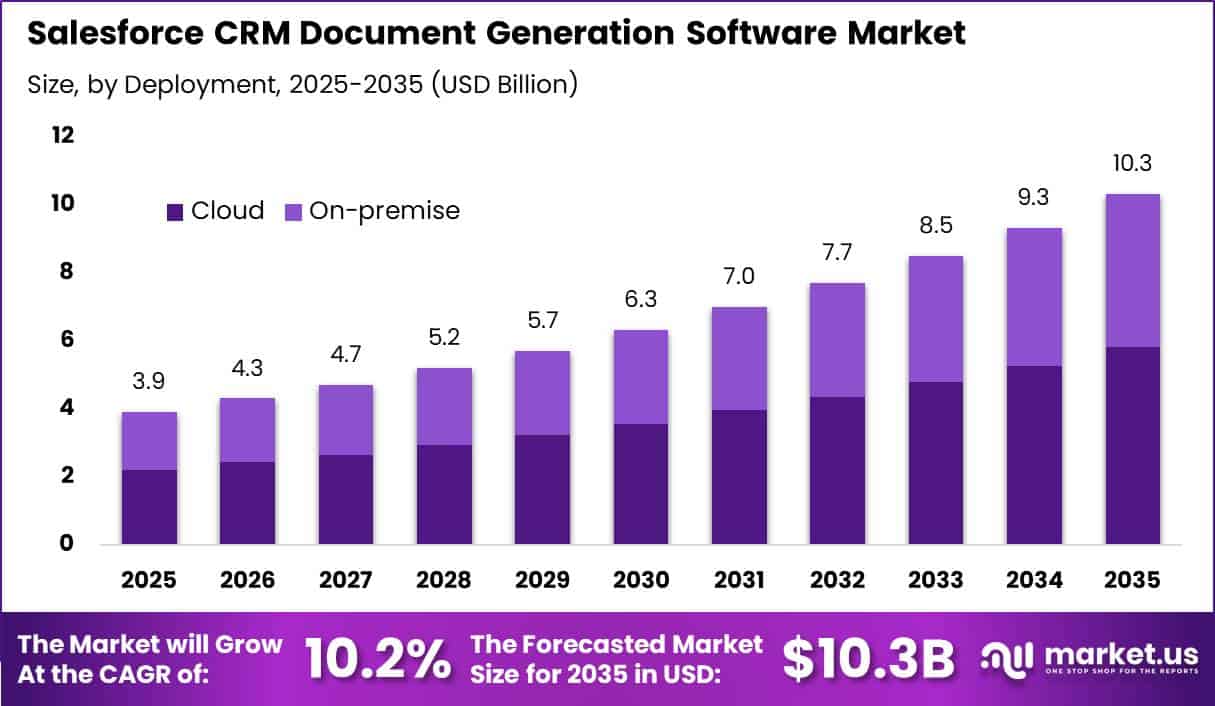
This expansion reflects the wider adoption of CRM platforms and digital business software. The global CRM software industry generates nearly USD 90–100 billion annually. Eurostat data shows that CRM systems are used by around one-quarter of EU enterprises and nearly two-thirds of large companies, indicating a major shift from spreadsheets toward centralized customer data platforms.
The World Bank estimates that the digital economy represents about 15% of global GDP, equivalent to nearly USD 16 trillion of the USD 108 trillion global economy in 2024. As Salesforce becomes a core business platform, companies increasingly require automated tools to prepare proposals, contracts, invoices, reports, and compliance documents.
North America emerged as one of the leading regional markets. The region also generates more than 40% of global CRM revenue, while Salesforce holds close to one-quarter of the worldwide CRM platform market. Strong cloud adoption, high software spending, and growing demand for workflow automation support regional growth.
Eurostat further reports that around 70–73% of businesses in digitally advanced economies, including Denmark, Finland, Belgium, and the Netherlands, use specialized software such as CRM, ERP, and business intelligence solutions.
Key Takeaway
- The market was valued at USD 3.9 billion in 2025 and is projected to reach USD 10.3 billion by 2035, growing at a CAGR of 10.2%.
- Cloud deployment held a dominant 56.4% share, supported by rising enterprise cloud adoption.
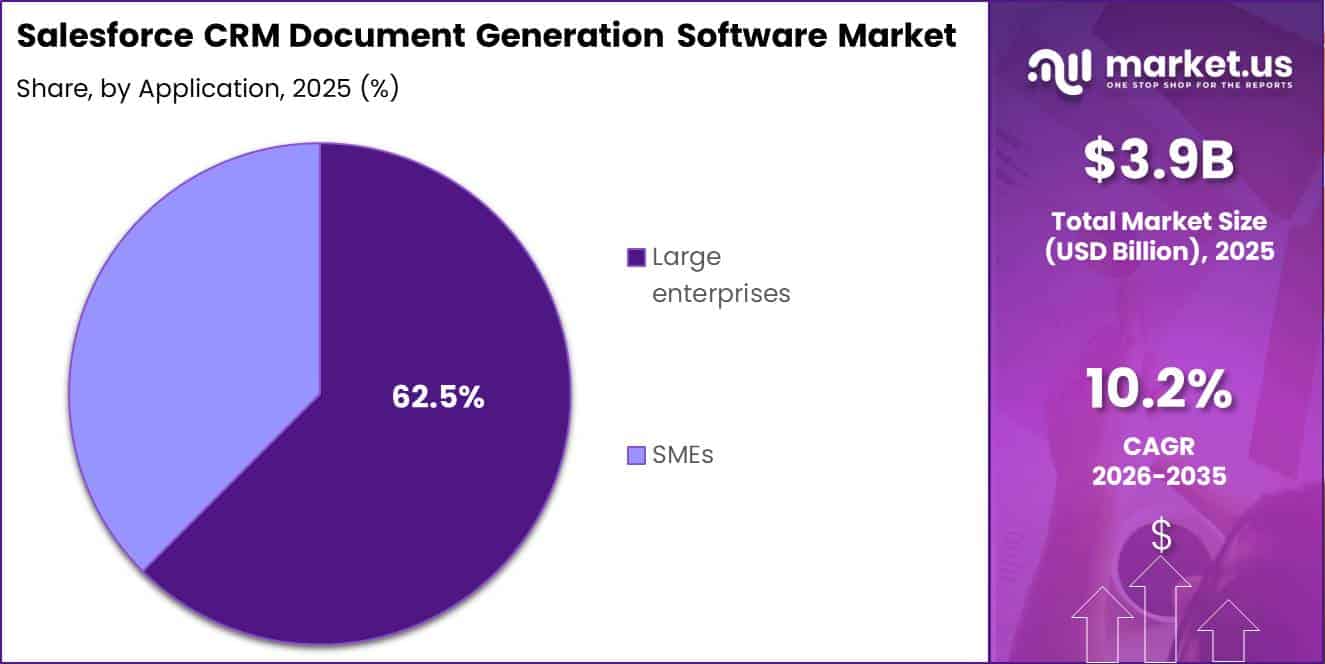
- Large enterprises accounted for a leading 62.5% share, driven by higher CRM adoption and larger document volumes.
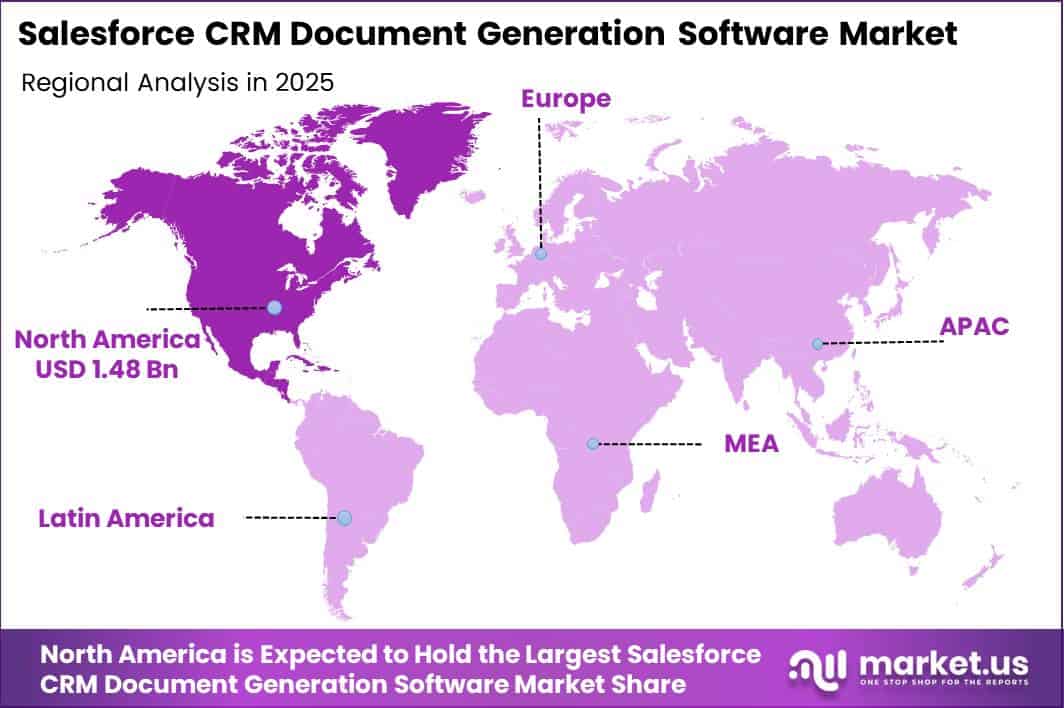
- North America led the market in 2025 with more than 38% share, generating approximately USD 1.4 billion in revenue.
By Deployment
Cloud deployment held a dominant 56.4% share of the Salesforce CRM document generation market, supported by the growing use of cloud-based customer and document workflows. Eurostat reported that 52.7% of EU enterprises purchased cloud computing services in 2025, increasing by 7.4 percentage points from 2023 and reaching more than three times the 17.8% recorded in 2014.
Among cloud users, 85.1% used email services, 71.6% used office software, and 71.5% used cloud file storage. These applications directly support the preparation, editing, sharing, and storage of CRM-based quotations, contracts, invoices, and reports.
Eurostat also found that 27.9% of cloud-using enterprises operated CRM software through the cloud, while 30.1% used cloud-based ERP systems. This shows that almost one in three cloud adopters already manage major sales and business planning processes online.
Industry deployment data further indicates that approximately 87% of CRM systems are cloud-based, compared with only 12% in 2008, while cloud solutions represent nearly 80% of new CRM sales. Cloud-native document generation reduces hardware costs, software maintenance, manual updates, and security management.
By Application
Large enterprises held a dominant 62.5% share of the Salesforce CRM document generation software market, supported by their higher CRM adoption and larger document volumes. Across OECD economies, approximately 30% of businesses use CRM systems. However, adoption is significantly higher among large organizations. Eurostat data shows that only 22% of small EU businesses use CRM software, compared with around 60–61% of large enterprises, representing almost three times higher penetration.
Large companies often employ hundreds of sales representatives and customer service professionals who generate tens of thousands of quotations, contracts, invoices, renewal notices, and compliance documents every year. These documents must be created using accurate CRM data, reviewed according to company policies, and stored in formats suitable for audits.
Document automation provides greater cost benefits at this scale by reducing repetitive work, improving accuracy, and lowering the risk of errors in multi-million-dollar transactions. Large organizations also have stronger technology budgets and more complex compliance requirements, supporting their leading share of the market.
Key Market Segments
By Deployment
- Cloud
- On-premise
By Application
- SMEs
- Large enterprises
Geopolitical Impact Analysis
Geopolitical tensions are increasing the operating costs of Salesforce CRM document generation software by affecting the hardware, energy, and network infrastructure used by cloud-based platforms. These solutions depend on data-center servers, storage systems, and networking equipment supplied through global trade routes. Under the WTO Information Technology Agreement, tariffs on many ICT products were reduced to 0%.
However, recent trade measures have introduced additional charges. U.S. electronics imports classified under HTS Chapters 84–85 now face a 10% Section 122 tariff, while Chinese electronics remain subject to Section 301 duties ranging from 25% to 100%. As a result, a server chassis or network switch imported from China may face an effective tariff of 35% or more, raising cloud infrastructure investment costs.
Energy uncertainty and power-grid limitations are also delaying data-center expansion. Industry estimates indicate that transformers and other critical electrical equipment can require lead times of three to five years, placing around 30–50% of planned U.S. data-center capacity for 2026 at risk of delay. Transportation expenses are adding further pressure.
Flatbed spot rates for moving heavy data-center equipment reached approximately USD 2.9 per mile in mid-2026, nearly 40% higher than the previous year and 31% above the five-year pre-pandemic average.
These pressures increase hosting expenses, restrict regional cloud capacity, and encourage providers to invest in multi-region backup systems. For Salesforce document generation vendors, this may result in higher subscription prices, slower feature deployment, and stronger demand for automation tools that reduce document processing time and labor costs.
Regional Analysis
North America held the leading position in the Salesforce CRM document generation software market, accounting for approximately 38% of global revenue, equal to nearly USD 1.4 billion in 2025. This dominance is supported by the strong adoption of Salesforce and other cloud-based CRM platforms across the United States and Canada. Salesforce’s Americas business generated around USD 25.1 billion in fiscal 2025, representing more than 66% of the company’s total global revenue.
This reflects the large number of enterprises using CRM systems to manage sales, customer service, and business documents. High technology spending, advanced cloud infrastructure, and strict compliance standards also encourage companies to automate proposals, contracts, invoices, and regulatory documents directly from Salesforce data.
Asia Pacific is expected to be the fastest-growing regional market, supported by expanding enterprise digitization and Salesforce adoption across India, Japan, Australia, and China. The region generated approximately USD 3.86–3.96 billion in Salesforce revenue during 2024–2025, accounting for around 10–11% of the company’s total revenue.
Key Regions and Countries
North America
- US
- Canada
Europe
- Germany
- France
- The UK
- Spain
- Italy
- Rest of Europe
Asia Pacific
- China
- Japan
- South Korea
- India
- Australia
- Rest of APAC
Latin America
- Brazil
- Mexico
- Rest of Latin America
Middle East & Africa
- GCC
- South Africa
- Rest of MEA
Market Dynamics
Drivers
| Driver | (~) % CAGR | Geographic Relevance | Impact Timeline |
|---|---|---|---|
| Enterprise shift to cloud CRM-centered workflows | +3.0% | North America, Europe, Asia Pacific | Short term (<= 2 years) |
| Regulatory push for audit-ready digital documentation | +2.0% | Global, strongest in EU & North America | Medium term (2–4 years) |
| AI-assisted document automation embedded in Salesforce | +1.8% | Global | Medium term (2–4 years) |
| Expansion of large-enterprise Salesforce user base | +1.5% | North America, Europe, Asia Pacific | Long term (>= 4 years) |
| Growth in cross-border digital trade documentation | +1.2% | Asia Pacific, Europe | Long term (>= 4 years) |
Enterprise shift to cloud CRM-centered workflows
The largest growth driver for the Salesforce CRM document generation software market is the rapid movement of customer and revenue processes to cloud CRM platforms. More than 45% of enterprises in advanced economies use CRM systems, while cloud solutions represent over 80% of new installations.
CRM adoption also increased by nearly 10 percentage points between 2020 and 2024, expanding the number of businesses able to automate proposals, contracts, invoices, and other customer documents. Digital services now contribute around 15% of global GDP, increasing by approximately 2–3 percentage points over the past decade.
Salesforce’s Americas subscription and support revenue has also grown by more than 10% annually since 2022, indicating continued expansion of its user base. As more sales and billing activities move into Salesforce, demand for template-based and automatically generated documents rises. This structural shift could add an estimated +3.0% to the market’s baseline CAGR.
Restraints
| Restraint | (~) % CAGR | Geographic Relevance | Impact Timeline |
|---|---|---|---|
| High integration complexity with legacy ERP & legal systems | -2.5% | Global, higher in Europe & Asia Pacific | Medium term (2–4 years) |
| Data privacy & cross-border transfer constraints | -2.0% | EU, UK, selected APAC jurisdictions | Medium term (2–4 years) |
| Capital expenditure caution amid elevated interest rates | -1.8% | Global | Short term (<= 2 years) |
| SME reluctance due to upfront implementation & training costs | -1.5% | Global, strongest in emerging markets | Long term (>= 4 years) |
| On-premises compliance requirements in regulated industries | -1.2% | Financial services, public sector, healthcare | Medium term (2–4 years) |
High integration complexity with legacy ERP & legal systems
A major restraint on Salesforce CRM document generation adoption is the difficulty of connecting new automation tools with existing ERP, e-signature, and legal document management systems. Around 43% of EU enterprises use ERP software, increasing to more than 80% among large businesses.
Nearly 30% of firms in upper-middle-income economies also identify IT integration complexity as a major barrier to adopting new digital tools. Complex integration projects can exceed planned timelines by approximately 25%–40%, while large CRM implementations may take 18–36 months. Integration, security, and compliance testing can consume up to 50% of total project budgets.
These costs encourage some organizations to delay deployments, reduce project scope, or remain in pilot stages. As a result, integration complexity could create an estimated -2.5% drag on the market’s potential CAGR.
Challenges
| Challenge | (~) % CAGR | Geographic Relevance | Mitigation Horizon |
|---|---|---|---|
| AI skills & adoption gap | -2.2% | Global | Medium term (2–4 years) |
| Shortage of Salesforce-certified admin & architect talent | -2.0% | North America, Europe | Long term (>= 4 years) |
| Fragmented document templates & governance | -1.8% | Global | Medium term (2–4 years) |
| Multi-cloud & SaaS vendor sprawl | -1.5% | Large enterprises globally | Long term (>= 4 years) |
| Continuous regulatory change in sectoral documentation rules | -1.3% | Financial, health, public sectors | Medium term (2–4 years) |
AI skills & adoption gap
A major challenge is the widening gap between AI-enabled document generation tools and the workforce skills required to use them effectively. More than 60% of enterprises testing AI report shortages of employees capable of designing, monitoring, and governing automated workflows.
Over 70% of workers in advanced economies use digital productivity tools daily, but digital skills training usually represents less than 1% of payroll costs. AI and automation spending is increasing by around 15%–20% annually, yet many projects remain limited to pilot stages due to weak skills, low trust, and limited governance knowledge.
Salesforce tools using Einstein, APIs, and intelligent approval workflows may remain underused, while employees continue making manual document changes. This reduces processing speed and limits productivity gains, creating an estimated -2.2% drag on the market’s potential CAGR.
Opportunities
| Opportunity | (~) % CAGR | Geographic Relevance | Execution Window |
|---|---|---|---|
| Adjacency into regulated, high-volume document verticals | +2.8% | Global, strongest in North America & Europe | Medium term (2–4 years) |
| Usage-based & outcome-linked pricing models | +2.0% | Global | Short term (<= 2 years) |
| Deeper integration with e-signature, CLM & CPQ ecosystems | +1.8% | Global | Medium term (2–4 years) |
| Localization for emerging-market Salesforce adopters | +1.5% | Asia Pacific, Latin America, Middle East & Africa | Long term (>= 4 years) |
| Document analytics & compliance insight overlays | +1.3% | Global | Medium term (2–4 years) |
Adjacency into regulated, high-volume document verticals
A major untapped opportunity lies in expanding Salesforce CRM document generation across regulated sectors such as financial services, healthcare, and the public sector. Banks, insurers, hospitals, and healthcare payers process billions of contracts, disclosures, consent forms, and reimbursement claims each year.
However, many of these documents still depend on disconnected legacy systems. Compliance and reporting requirements in regulated industries have also increased by around 20%–30% over the past decade, strengthening demand for secure, audit-ready, and version-controlled document workflows.
Salesforce-native platforms can capture this opportunity by offering industry-specific templates, approval rules, and regulatory controls. Automated document generation may reduce manual processing costs by approximately 30%–50% compared with paper-based or partly manual systems. Vendors could also introduce premium, outcome-based pricing for high-volume customers.
With targeted industry partnerships and stronger compliance capabilities, this underpenetrated segment could provide an estimated +2.8% upside above the market’s baseline CAGR.
Key Players Analysis
Conga and Nintex are positioned as Tier-1 leaders in the Salesforce CRM document generation software market due to their large customer bases and strong integration with enterprise workflows. Conga serves more than 10,000 customers and 6.4 million users, while its Composer and contract lifecycle management platforms process over 7 million contracts and 46 million documents annually.
Its broader revenue management portfolio operates at a high-hundreds-of-millions-dollar scale, supporting an estimated 25–30% share of the Tier-1 segment. Nintex has developed a broad workflow automation and document generation portfolio and reported consolidated revenue of approximately USD 250–300 million in recent fiscal periods. Its installed base of more than 10,000 enterprise customers supports an estimated 20–25% Tier-1 share.
Tier-2 competitors include PandaDoc, DealHub, S-Docs, WebMerge, Docomotion, Windward Studios, and Documill. These companies compete through flexible pricing, faster deployment, specialized workflows, and industry-focused solutions. PandaDoc increased revenue from USD 90 million in 2022 to USD 250 million in 2023 and USD 380 million in 2024. Its total assets reached USD 850 million, while net income stood at USD 43 million in 2024, supporting an estimated 10–15% share of Salesforce-connected document generation.
DealHub and S-Docs focus on Salesforce CPQ and native document creation. Together with other Tier-2 vendors, these companies are estimated to represent the remaining 30–35% of the market. Tier-1 providers lead large enterprise projects, while Tier-2 vendors are expanding faster among small and medium-sized businesses and specialized industries.
Top Key Players in the Market
- Nintex
- SpringCM
- PandaDoc, Inc
- WebMerge
- Windward Studios
- Documil
- Docomotion
- DealHub
- S-Docs
- Conga
Recent Developments
- In 2025, PandaDoc secured a EUR 5 million investment from Índico Capital Partners to support AI development and expand its operations in Lisbon. The funding is expected to strengthen the company’s engineering capabilities and accelerate the introduction of intelligent document automation features. PandaDoc employs more than 700 people and has served over 65,000 customers worldwide, providing a strong base for further international expansion.
- In 2026, Conga formally deprecated its SpringCM integration, meaning that new updates, technical enhancements, and support assistance would no longer be provided. The transition covers 5 legacy functions: document generation, contract management, document management, workflow automation, and DocuSign connectivity.
- Customers are being directed toward Conga Composer, Trigger, Batch, Collaborate, Contracts, Orchestrate, and Sign. The migration is commercially important because Conga supports more than 10,000 customers and 6.4 million users worldwide. Its platforms also generate over 7 million contracts and 46 million quotations annually, showing the large volume of workflows potentially supported by the unified product suite.
Report Scope
| Report Features | Description |
|---|---|
| Market Value (2025) | USD 3.9 Billion |
| Forecast Revenue (2035) | USD 10.3 Billion |
| CAGR (2026-2035) | 10.2% |
| Base Year for Estimation | 2025 |
| Historic Period | 2020-2024 |
| Forecast Period | 2026-2035 |
| Report Coverage | Revenue Forecast, Market Dynamics, Competitive Landscape, Recent Developments |
| Segments Covered | By Deployment – (Cloud, On-premises); By Application – (SMEs, Large Enterprises) |
| Regional Analysis | North America – US, Canada; Europe – Germany, France, The UK, Spain, Italy, Rest of Europe; Asia Pacific – China, Japan, South Korea, India, Australia, Singapore, Rest of APAC; Latin America – Brazil, Mexico, Rest of Latin America; Middle East & Africa – GCC, South Africa, Rest of MEA |
| Competitive Landscape | Nintex, SpringCM, PandaDoc Inc, WebMerge, Windward Studios, Documil, Docomotion, DealHub, S-Docs, Conga |
| Customization Scope | Customization for segments and region/country-level will be provided. Moreover, additional customization can be done based on the requirements. |
| Purchase Options | We have three licenses to opt for: Single User License, Multi-User License (Up to 5 Users), Corporate Use License (Unlimited Users and Printable PDF) |





























