


Report Overview
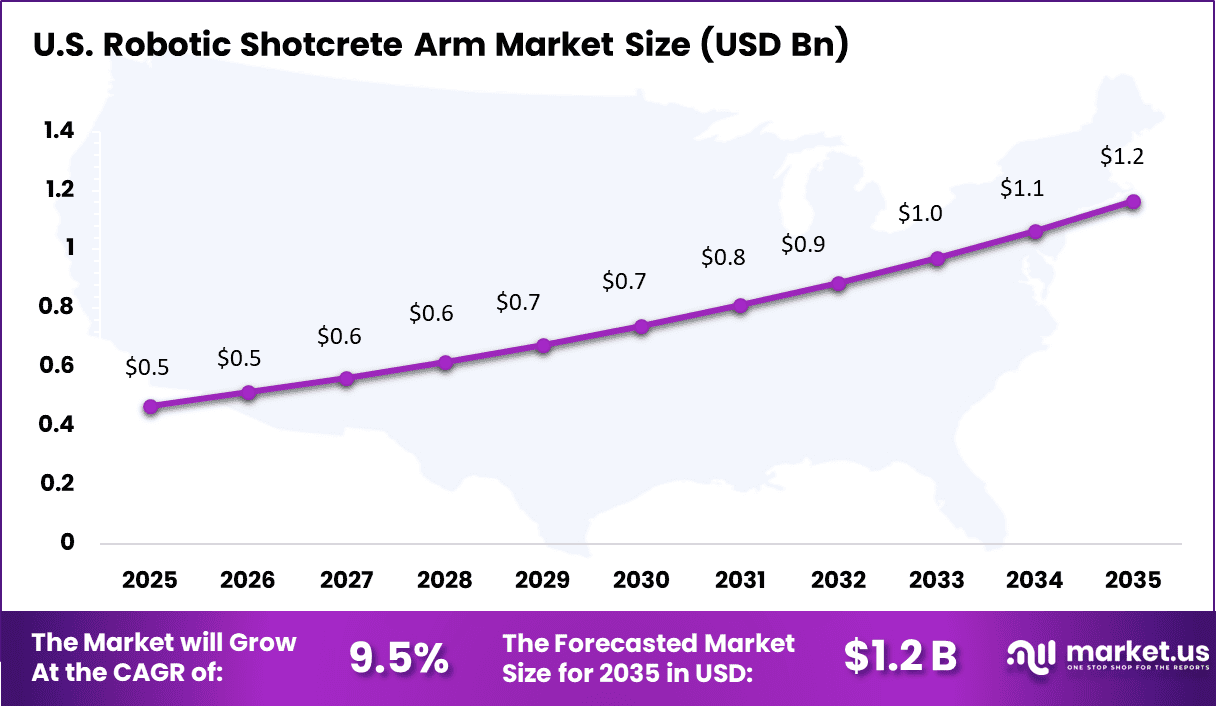
The Global Robotic Shotcrete Arm Market generated USD 1.7 billion in 2025 and is predicted to register growth from USD 1.9 billion in 2026 to about USD 5.1 billion by 2035, recording a CAGR of 11.80% throughout the forecast span. In 2025, North America held a dominant market position, capturing more than a 33.8% share, holding USD 0.56 Billion revenue.
Top Market Takeaways
- Product Type Single arm robotic shotcrete systems account for 48.2% of the market, as they offer a simpler, cost-effective design that is sufficient for most tunnel and mining shotcreting tasks.
- Application Mining represents 43.6% of the market, because robotic shotcrete arms are widely used to stabilize rock surfaces and improve safety in underground mines.
- End-User Construction companies make up 52.7% of demand, reflecting strong use of these systems in tunneling, underground construction, and slope stabilization projects.
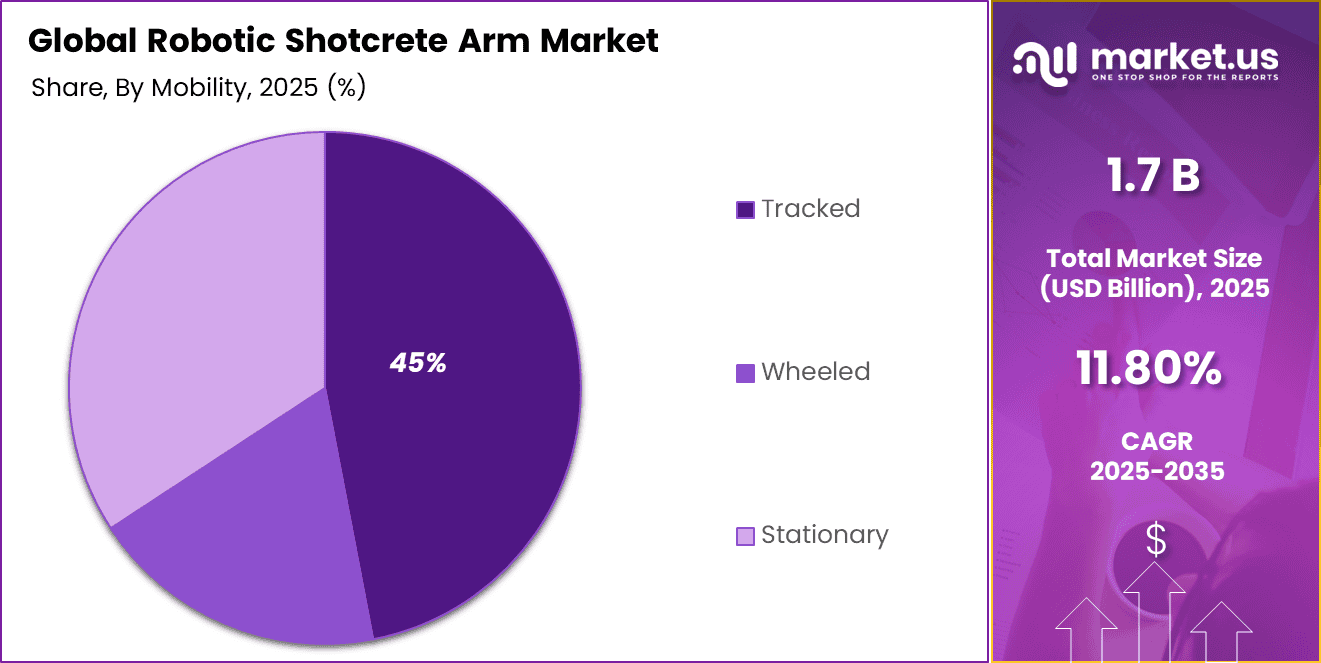
- Mobility Tracked robotic shotcrete arms hold 45.3% of the market, as tracked platforms provide better mobility and stability on rough, uneven, or confined job sites.
- Region North America accounts for 33.8% of the global market, supported by ongoing infrastructure, tunneling, and mining projects adopting mechanized shotcreting.
- Country The US market is valued at USD 0.47 billion and is expected to grow at a CAGR of 9.5%, driven by rising safety standards, labor cost pressures, and demand for efficient spray concrete solutions.
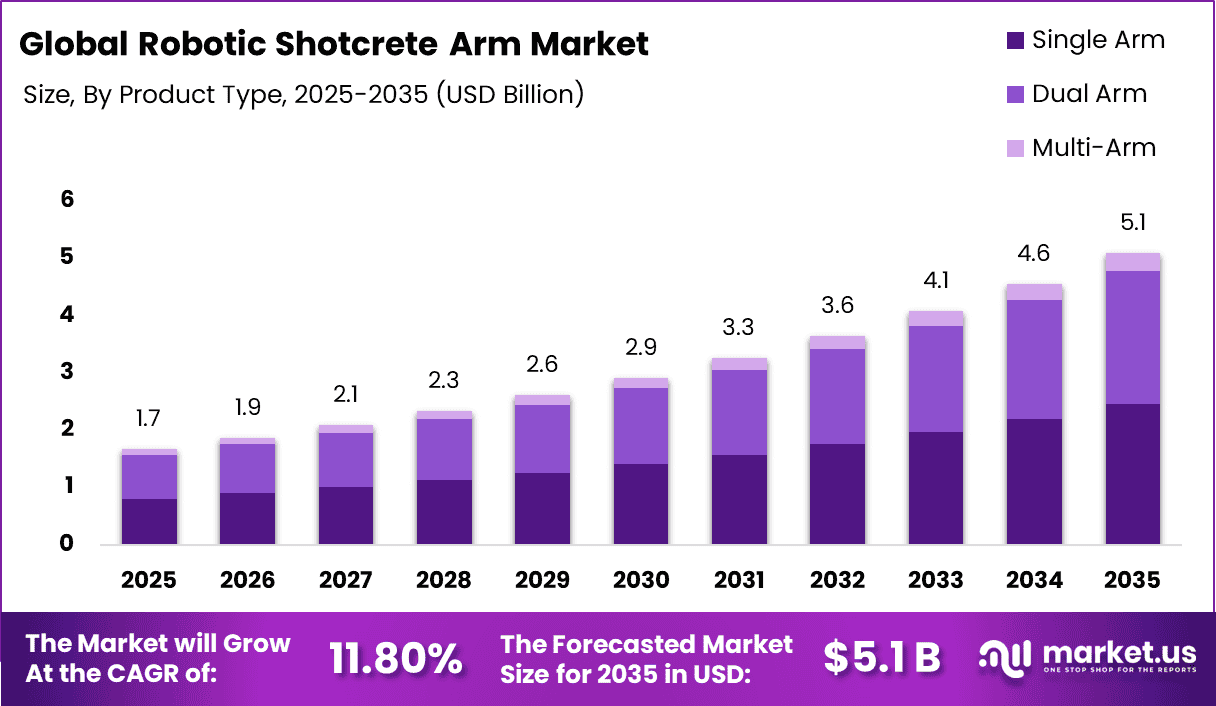
Robotic shotcrete arms are specialized mechanized systems used to spray concrete onto rock surfaces, tunnel walls, slopes, and structural supports with controlled precision. These arms are commonly mounted on construction and mining equipment to apply shotcrete safely and efficiently in difficult environments.
They help improve coverage quality, reduce material waste, and limit direct worker exposure to hazardous zones. As underground construction and infrastructure development become more advanced, robotic shotcrete systems are gaining importance in modern project execution.
One of the main driving factors is the increasing volume of tunneling, mining, and transport infrastructure projects that require rapid ground support and reinforcement. Contractors are looking for equipment that can deliver consistent concrete application while reducing delays and manual labor dependency.
In addition, worker safety regulations are encouraging the use of remote operated systems that keep personnel away from unstable rock faces and confined spaces. The push toward automation in heavy construction is also supporting adoption, as robotic arms improve repeatability, reach, and operational control. Advances in hydraulic systems, sensors, and machine guidance are further strengthening performance.
Demand for robotic shotcrete arms is rising as project operators seek higher productivity and safer site operations. There is a strong preference for systems that offer accurate nozzle positioning, long reach capability, durable construction, and easy control interfaces. Buyers are also looking for equipment that can integrate with modern tunneling rigs and support varied spraying angles and surface conditions.
The demand is particularly strong in mining projects, metro tunnels, hydropower works, and road infrastructure where reinforcement speed and consistency are critical. As construction methods continue to modernize, the need for reliable and efficient robotic shotcrete solutions is expected to grow steadily.
Drivers Impact Analysis
| Key Driver | Impact on CAGR Forecast (~%) | Geographic Relevance | Impact Timeline | Additional Insight |
|---|---|---|---|---|
| Rising tunnel, mining, and underground construction projects | +3.4% | North America, Europe, Asia Pacific | Medium to long term | Infrastructure work increases equipment demand |
| Growing focus on worker safety and remote operations | +3.0% | Global | Short to medium term | Robotics reduce operator exposure |
| Increasing adoption of automation in construction equipment | +2.7% | Developed markets | Medium term | Automation improves spraying precision |
| Demand for faster project completion and productivity gains | +2.4% | Global | Medium to long term | Robotic systems enhance output speed |
| Expansion of transportation and hydropower infrastructure | +2.1% | Asia Pacific, North America, Europe | Medium term | Large projects support market growth |
Restraints Impact Analysis
| Key Restraint | Impact on CAGR Forecast (~%) | Geographic Relevance | Impact Timeline | Additional Insight |
|---|---|---|---|---|
| High upfront equipment acquisition costs | -2.8% | Emerging markets | Short to medium term | Capital cost slows adoption |
| Complex maintenance and spare parts needs | -2.4% | Global | Medium term | Maintenance raises ownership costs |
| Limited skilled operators and technicians | -2.0% | Global | Medium to long term | Skill shortages affect deployment |
| Slow adoption among small contractors | -1.7% | Developing regions | Medium term | Smaller firms prefer manual methods |
| Harsh site conditions affecting equipment uptime | -1.5% | Global | Long term | Tough environments increase downtime |
By Product Type Analysis
The single arm segment accounted for 48.2% of the market share, reflecting its strong position in projects requiring efficient and compact shotcrete application systems. This dominance is supported by the growing demand for equipment that offers easier maneuverability, lower operating complexity, and reliable performance in confined work areas. Single arm units are widely preferred for medium-scale operations where flexibility and productivity are important.
Another factor driving this segment is the cost advantage compared with larger multi-arm systems. Construction and mining operators often choose single arm models for tunnel lining, slope stabilization, and repair work where one spraying unit can meet project requirements. Their simpler maintenance needs also support continued adoption.
By Application Analysis
The mining segment held 43.6% share, driven by the increasing use of shotcrete systems for tunnel reinforcement, underground wall support, and mine safety improvement. Mining operations require dependable equipment that can apply concrete quickly in challenging environments. Robotic shotcrete arms help improve worker safety by reducing manual exposure in hazardous zones.
In addition, expanding underground mining activities and stricter safety standards have increased the need for mechanized support systems. Automated spraying improves consistency, reduces material waste, and speeds up ground stabilization processes, reinforcing strong demand in mining applications.
By End-User Analysis
The construction companies segment captured 52.7% of the market, reflecting their strong reliance on shotcrete equipment for tunnels, retaining walls, bridges, and infrastructure repair projects. These companies use robotic systems to improve efficiency, reduce labor intensity, and achieve more uniform concrete application across surfaces.
Furthermore, rising investment in transportation and urban infrastructure has encouraged contractors to modernize equipment fleets. Robotic shotcrete arms help shorten project timelines and improve quality control, making them increasingly valuable for construction companies managing large and time-sensitive projects.
By Mobility Analysis
The tracked segment accounted for 45% of the market share, driven by its superior stability and movement capability on uneven terrain. Tracked systems are widely used in tunnels, mines, and rough construction sites where wheel-based mobility can be less effective. Their strong traction allows safer and more reliable equipment positioning during spraying operations.
Moreover, tracked mobility supports better maneuverability in narrow or difficult access environments. Operators prefer these systems for demanding job sites that require consistent movement and stable operation. This has strengthened the leading position of tracked robotic shotcrete arms in the market.
Investor Type Impact Analysis
| Investor Type | Growth Sensitivity | Risk Exposure | Geographic Focus | Investment Outlook |
|---|---|---|---|---|
| Venture capital firms | Moderate | High | US, Europe | Investing in construction robotics startups |
| Private equity firms | Moderate to high | Moderate | North America and Europe | Scaling heavy equipment manufacturers |
| Corporate investors | High | Moderate | Global | Strategic investments in smart construction |
| Institutional investors | Moderate | Low to moderate | Developed markets | Prefer stable industrial machinery firms |
| Government and public funding bodies | High | Low | Global | Supporting infrastructure modernization |
Technology Enablement Analysis
| Technology | Impact on CAGR Forecast (~%) | Geographic Relevance | Impact Timeline | Additional Insight |
|---|---|---|---|---|
| AI-assisted spraying control systems | +3.6% | US, Europe, Asia Pacific | Medium to long term | Improves spraying consistency |
| Remote control and teleoperation platforms | +3.2% | Global | Medium term | Enhances operator safety |
| Advanced hydraulic arm precision systems | +2.8% | Developed markets | Medium to long term | Improves reach and placement accuracy |
| IoT-based predictive maintenance tools | +2.4% | Global | Medium term | Reduces unplanned downtime |
| 3D scanning and digital mapping integration | +2.1% | Global | Long term | Supports accurate surface coverage |
Key Challenegs
- High equipment cost makes adoption difficult for small contractors.
- Complex installation and setup require skilled technicians.
- High maintenance needs increase operating costs.
- Limited availability of trained operators in some regions.
- Integration challenges with existing tunneling and mining equipment.
- Performance issues in harsh dust, moisture, or uneven site conditions.
- Dependence on stable power or hydraulic systems.
- Spare parts availability can cause repair delays.
- Resistance to replacing manual spraying methods.
- Safety compliance and operator training requirements add time.
Emerging Trends
The robotic shotcrete arm market is evolving toward safer, more precise, and digitally controlled concrete spraying solutions for underground and heavy construction projects. One of the key emerging trends is the integration of remote operation systems that allow operators to control equipment from safer distances in hazardous environments such as tunnels and mines.
Another important trend is the growing use of automated nozzle guidance and sensor based positioning, which helps achieve more uniform concrete application and reduces material waste. There is also increasing focus on telematics and real time machine monitoring, enabling contractors to track performance, maintenance needs, and productivity across job sites. In addition, electric and low emission equipment designs are gaining attention as project owners seek cleaner construction methods in enclosed spaces. The adoption of semi autonomous functions is also rising, helping improve consistency while reducing operator fatigue during long shifts.
Growth Factors
The growth of this market is driven by the increasing volume of tunnel development, mining expansion, and infrastructure rehabilitation projects that require efficient ground support solutions. Contractors are seeking equipment that can improve worker safety and reduce exposure to unstable rock surfaces, which is encouraging the use of robotic shotcrete arms. The need for faster project execution and better quality control is also supporting demand, as automated spraying systems can deliver more consistent coverage than manual methods.
Another major factor is the shortage of skilled labor in heavy construction environments, pushing companies toward mechanized solutions that reduce dependence on manual spraying crews. Operators are also focusing on lowering material waste, maintenance downtime, and project delays, which strengthens the business case for advanced robotic systems. Furthermore, modernization of underground construction practices is creating sustained demand for intelligent shotcrete equipment across global markets.
Key Market Segments
By Product Type
- Single Arm
- Dual Arm
- Multi-Arm
By Application
- Mining
- Tunneling
- Construction
- Underground Infrastructure
- Others
By End-User
- Construction Companies
- Mining Companies
- Government & Municipalities
- Others
By Mobility
- Tracked
- Wheeled
- Stationary
Regional Analysis
North America accounted for 33.8% of the Robotic Shotcrete Arm market, supported by strong investments in infrastructure rehabilitation, mining activity, and tunnel construction projects. The region is increasingly adopting automated spraying equipment to improve worker safety, reduce material waste, and achieve more uniform concrete application in demanding environments.
Contractors are focusing on faster project execution and lower manual dependency, which is encouraging the use of robotic shotcrete arms in underground and large-scale civil engineering works. In addition, strict workplace safety standards and growing use of mechanized construction methods are strengthening market demand across the region.
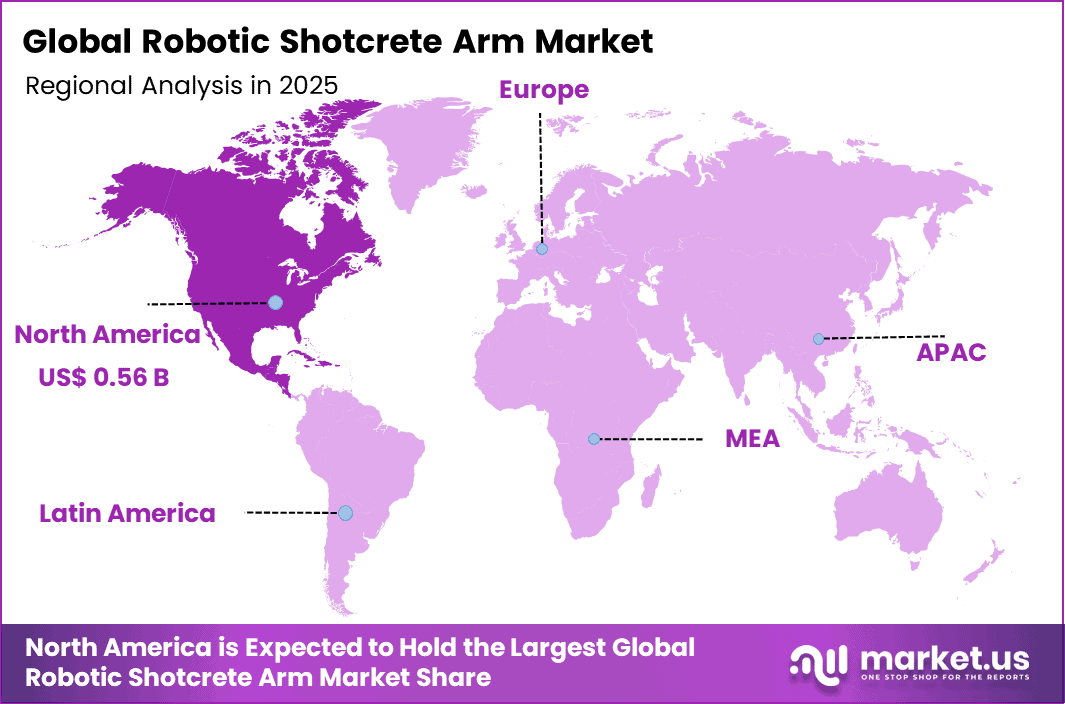
The U.S. market reached USD 0.47 Billion and is projected to grow at a CAGR of 9.5%, driven by rising demand for efficient construction technologies and modernization of aging infrastructure. Construction firms are adopting robotic shotcrete systems to enhance precision, shorten project timelines, and improve performance in tunnels, slopes, retaining walls, and repair projects.
Expansion of transportation upgrades, mining operations, and utility projects is also supporting demand for advanced concrete spraying equipment. In addition, continued investment in automation and safer construction practices is expected to support steady growth of the market in the US over the coming years.
Key Regions and Countries
- North America
- US
- Canada
- Europe
- Germany
- France
- The UK
- Spain
- Italy
- Russia
- Netherlands
- Rest of Europe
- Asia Pacific
- China
- Japan
- South Korea
- India
- Australia
- Singapore
- Thailand
- Vietnam
- Rest of APAC
- Latin America
- Brazil
- Mexico
- Rest of Latin America
- Middle East & Africa
- South Africa
- Saudi Arabia
- UAE
- Rest of MEA
Competitive Analysis
The competitive landscape of the Robotic Shotcrete Arm Market is led by established underground mining, tunneling, and construction equipment manufacturers. Companies such as Normet Group Oy, Putzmeister Holding GmbH, Epiroc AB, MacLean Engineering & Marketing Co. Limited, CIFA S.p.A., and Furukawa Rock Drill Co., Ltd. focus on advanced robotic shotcrete systems designed for tunnels, mines, and large infrastructure projects.
These players emphasize automation, operator safety, precision spraying, and high productivity in demanding work environments. Their strong engineering expertise and global project presence help them maintain a leading position in the market.
At the same time, companies such as Sika AG, Aliva Equipment (A Division of Sika), BASF SE, Antec Engineering, Shotcrete Technologies Inc., Utimec Oy, Colcrete Eurodrill, Concord Concrete Pumps, Changsha Keda Intelligent Equipments Incorporated Co., Ltd., Zhengzhou Sincola Machinery Co., Ltd., Shandong China Coal Industrial & Mining Supplies Group Co., Ltd., KEMING Mechanical Equipment Co., Ltd., Qingdao Saintyol DAWIN Machinery Co., Ltd., and Gunite Supply & Equipment Company compete by offering specialized shotcrete machinery, concrete technologies, and cost-effective regional solutions. Competition in this market is driven by automation capability, equipment durability, spraying accuracy, and the ability to improve safety and efficiency in underground and construction operations.
Top Key Players in the Market
- Normet Group Oy
- Putzmeister Holding GmbH
- Sika AG
- Aliva Equipment (A Division of Sika)
- Furukawa Rock Drill Co., Ltd.
- CIFA S.p.A.
- MacLean Engineering & Marketing Co. Limited
- Epiroc AB
- Changsha Keda Intelligent Equipments Incorporated Co., Ltd.
- Zhengzhou Sincola Machinery Co., Ltd.
- Shandong China Coal Industrial & Mining Supplies Group Co., Ltd.
- KEMING Mechanical Equipment Co., Ltd.
- Antec Engineering
- Shotcrete Technologies Inc.
- BASF SE
- Utimec Oy
- Qingdao Saintyol DAWIN Machinery Co., Ltd.
- Gunite Supply & Equipment Company
- Colcrete Eurodrill
- Concord Concrete Pumps
- Others
Future Outlook
The future outlook for the Robotic Shotcrete Arm Market looks strong as demand for safer and faster construction and mining operations continues to grow. The market is expected to expand with increasing use of automation in tunneling, underground projects, and infrastructure development. Companies are anticipated to adopt robotic shotcrete arms to improve worker safety, reduce manual labor, and achieve more accurate concrete spraying. In the coming years, advancements in remote control systems, sensor technology, and smart construction equipment are expected to improve performance and efficiency, supporting wider market adoption.
Recent Developments
- October, 2025 – a Nature article presents a new PID‑MPC precision control strategy for electro‑hydraulic shotcrete robotic arms that greatly cuts rise and settling time, removes overshoot, and improves tracking accuracy under complex underground conditions.
- April, 2026 – PatSnap’s QKD/robotics trend scan flags robotic shotcrete arms as a key automation theme in heavy civil construction, noting growing patent activity around AI control, electro‑hydraulic precision, and digital‑twin integration for tunnel linings.
Report Scope
| Report Features | Description |
|---|---|
| Market Value (2025) | USD 1.7 Billion |
| Forecast Revenue (2035) | USD 5.1 Billion |
| CAGR(2025-2035) | 11.80% |
| Base Year for Estimation | 2024 |
| Historic Period | 2020-2024 |
| Forecast Period | 2025-2035 |
| Report Coverage | Revenue forecast, AI impact on Market trends, Share Insights, Company ranking, competitive landscape, Recent Developments, Market Dynamics and Emerging Trends |
| Segments Covered | By Product Type (Single Arm, Dual Arm, Multi-Arm), By Application (Mining, Tunneling, Construction, Underground Infrastructure, Others), By End-User (Construction Companies, Mining Companies, Government & Municipalities, Others), By Mobility (Tracked, Wheeled, Stationary) |
| Regional Analysis | North America – US, Canada; Europe – Germany, France, The UK, Spain, Italy, Russia, Netherlands, Rest of Europe; Asia Pacific – China, Japan, South Korea, India, New Zealand, Singapore, Thailand, Vietnam, Rest of Latin America; Latin America – Brazil, Mexico, Rest of Latin America; Middle East & Africa – South Africa, Saudi Arabia, UAE, Rest of MEA |
| Competitive Landscape | Normet Group Oy, Putzmeister Holding GmbH, Sika AG, Aliva Equipment (A Division of Sika), Furukawa Rock Drill Co., Ltd., CIFA S.p.A., MacLean Engineering & Marketing Co. Limited, Epiroc AB, Changsha Keda Intelligent Equipments Incorporated Co., Ltd., Zhengzhou Sincola Machinery Co., Ltd., Shandong China Coal Industrial & Mining Supplies Group Co., Ltd., KEMING Mechanical Equipment Co., Ltd., Antec Engineering, Shotcrete Technologies Inc., BASF SE, Utimec Oy, Qingdao Saintyol DAWIN Machinery Co., Ltd., Gunite Supply & Equipment Company, Colcrete Eurodrill, Concord Concrete Pumps, Others |
| Customization Scope | Customization for segments, region/country-level will be provided. Moreover, additional customization can be done based on the requirements. |
| Purchase Options | We have three license to opt for: Single User License, Multi-User License (Up to 5 Users), Corporate Use License (Unlimited User and Printable PDF) |





























