Global Robotic Pool Skimmer Market Size, Share, Industry Analysis Report By Product Type (Residential Pool Skimmer, Commercial Pool Skimmer), By Cleaning Type (Single-surface cleaning, Multi-surface cleaning), By Connectivity (Corded, Cordless), By Distribution Channel (Online Sales, Home Improvement Stores, Pool Supply Stores, Direct Sales), By Regional Analysis, Global Trends and Opportunity, Future Outlook By 2025-2034
- Published date: Dec.2025
- Report ID: 168938
- Number of Pages: 268
- Format:
-
keyboard_arrow_up
Quick Navigation
- Report Overview
- Key Takeaway
- Role of Generative AI
- Investment and Business Benefits
- U.S. Market Size
- Product Type Analysis
- Cleaning Type Analysis
- Connectivity Analysis
- Distribution Channel Analysis
- Emerging Trends
- Growth Factors
- Key Market Segments
- Drivers
- Restraint
- Opportunities
- Challenges
- Key Players Analysis
- Recent Developments
- Report Scope
Report Overview
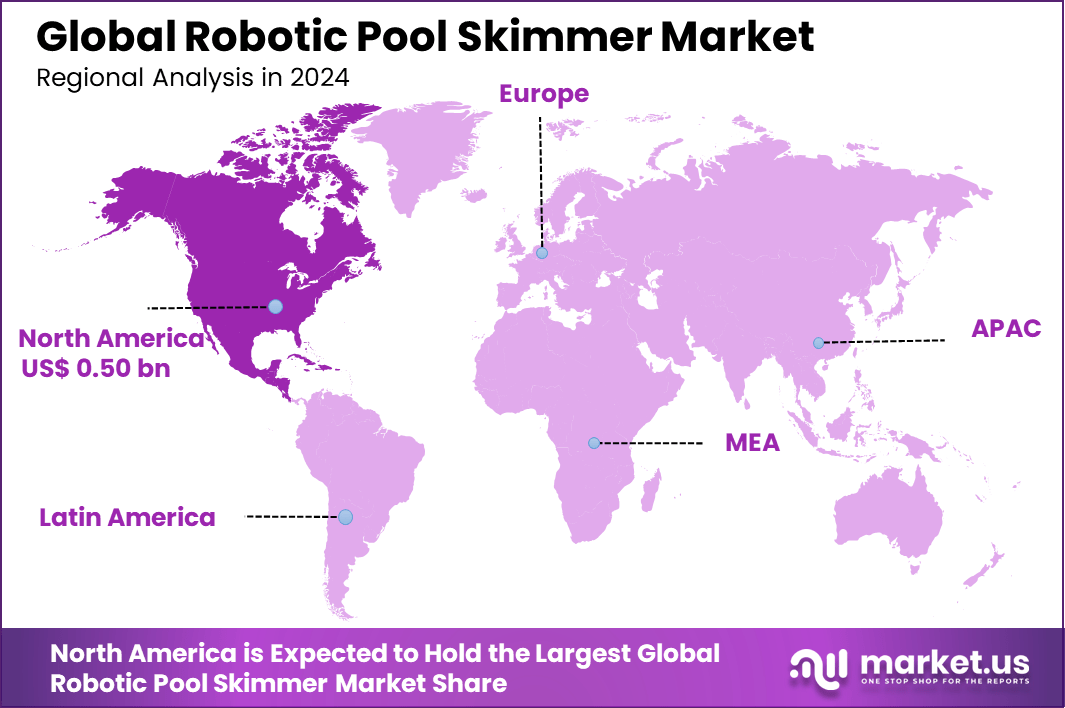
The Global Robotic Pool Skimmer Market size is expected to be worth around USD 9.59 billion by 2034, from USD 1.25 billion in 2024, growing at a CAGR of 22.6% during the forecast period from 2025 to 2034. |In 2024, North America held a dominant market position, capturing more than a 40.3% share, holding USD 0.50 billion in revenue.
The robotic pool skimmers market has expanded as households and commercial pool operators adopt automated devices that remove debris from the water surface without manual effort. Growth reflects rising interest in smart home products, increasing pool ownership and demand for low maintenance cleaning solutions. Robotic skimmers now serve residential pools, hotels, resorts and sports facilities where continuous water cleanliness is essential.
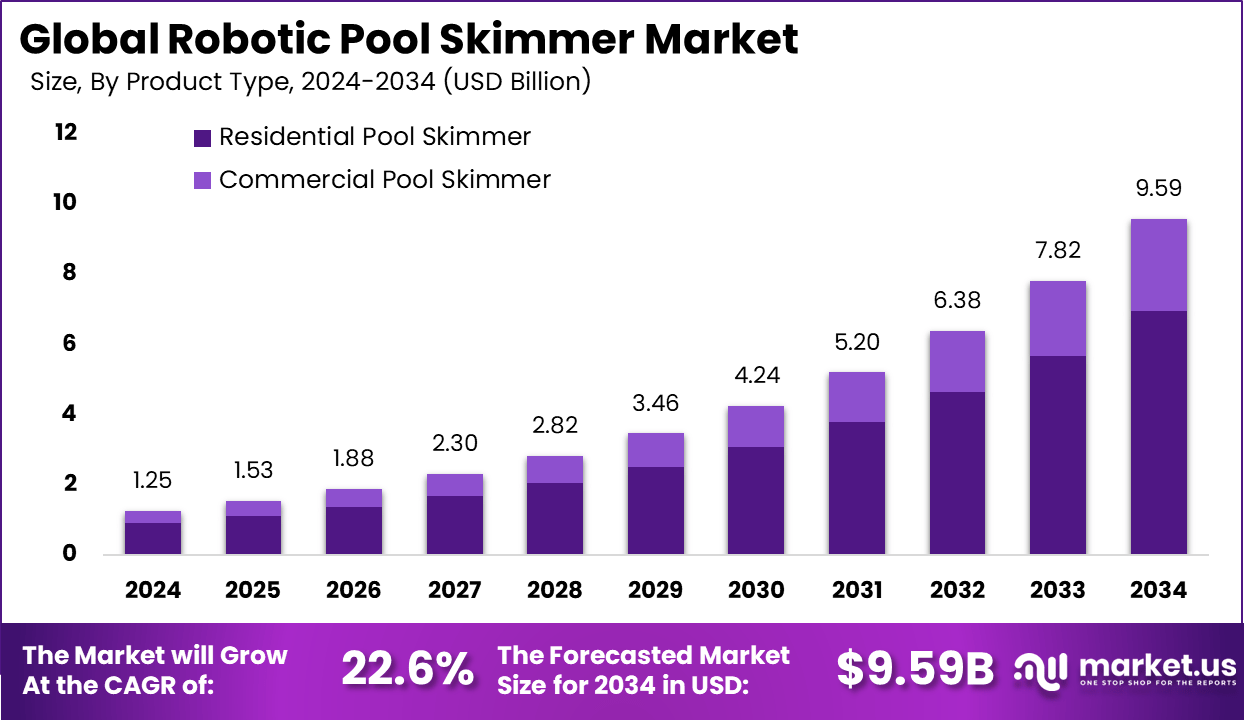
The adoption of robotic pool skimmers has been driven by rising pool ownership, higher awareness of hygiene, and a clear shift toward automated maintenance. Busy lifestyles have encouraged pool owners to choose solutions that reduce manual work, while innovations in energy efficiency, smart sensors, and AI navigation have supported steady improvements in cleaning accuracy and water quality.
The market has also benefited from the preference for convenient and reliable debris removal, supported by advanced navigation and real-time sensing features that enhance performance. The expansion of residential pools and the growing interest in smart home integration have further encouraged uptake, creating a strong foundation for continued demand.
For instance, in November 2024, Kreepy Krauly, under Hayward Industries, continued to innovate automatic skimmer technology, focusing on power efficiency, reliable cleaning across all pool areas, and integration with existing pump systems. Its product line remains popular among consumers who value durability and chemical reduction benefits.
Key Takeaway
- In 2024, the Residential Pool Skimmer segment led the market with a 72.6% share, driven by rising household adoption of automated pool-cleaning devices.
- The Single-surface cleaning category held 59.4%, reflecting strong demand for focused and efficient cleaning systems.
- The Corded segment dominated with 62.1%, supported by continuous-power operation and lower maintenance needs.
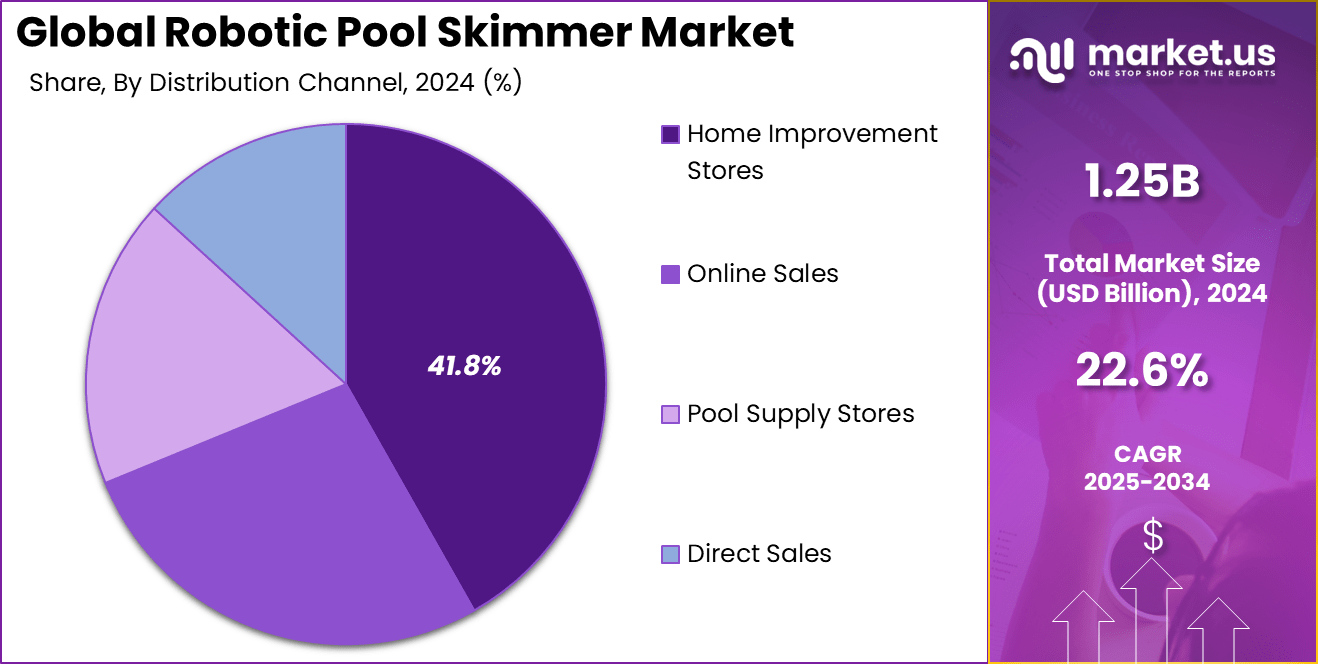
- Home Improvement Stores accounted for 41.8%, remaining the primary distribution channel for consumers purchasing robotic skimmers.
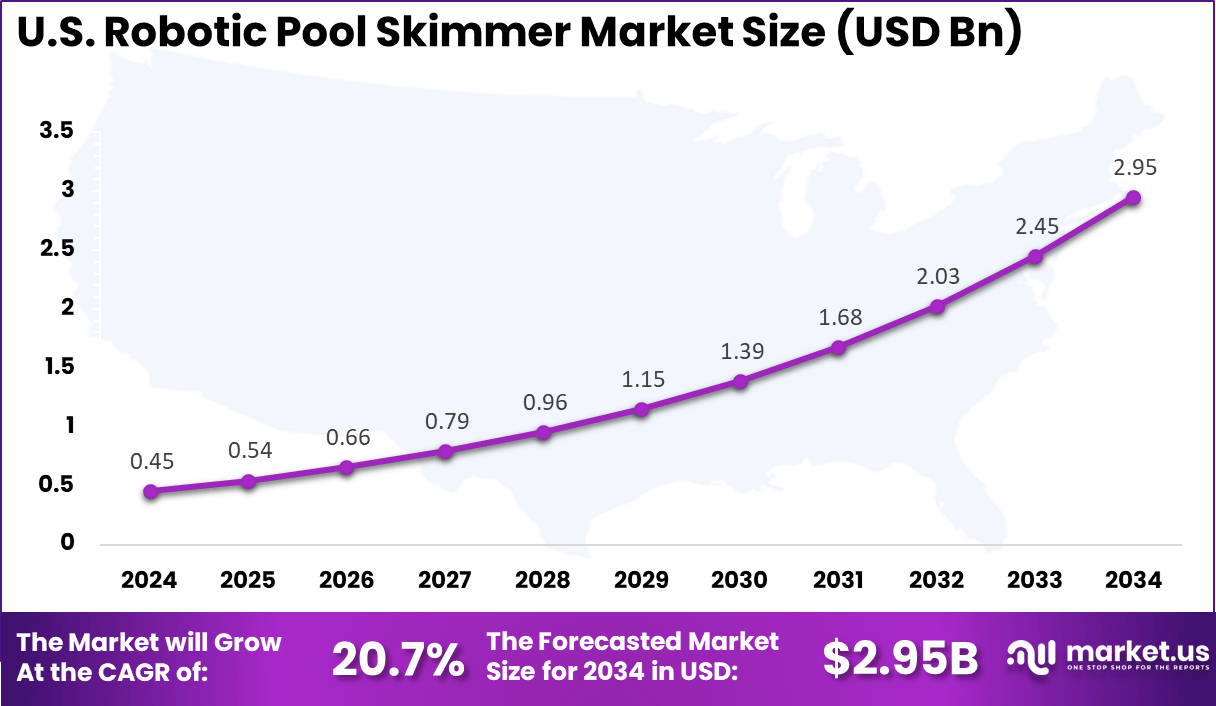
- The U.S. market reached USD 0.45 billion in 2024, expanding at a strong 20.7% CAGR, supported by rising pool ownership and preference for automated cleaning tools.
- North America captured 40.3%, maintaining its leadership due to high consumer spending and early adoption of smart home and outdoor automation products.
Role of Generative AI
Generative AI is playing a transformative role in robotic pool skimmers by enhancing their ability to map pools, detect debris, and adapt cleaning patterns dynamically. Modern robotic skimmers equipped with AI-based sensors and real-time data analysis can learn pool layouts over multiple cleaning sessions, enabling them to optimize coverage and reduce energy consumption.
Statistics show a rise in adoption of AI-powered pool cleaners that feature enhanced path planning and debris recognition, improving cleaning efficiency by up to 30% compared to non-AI models. Additionally, generative AI supports predictive maintenance by monitoring the health of components like brushes and filters, alerting users to issues before breakdowns occur.
This capability extends device lifespan and decreases downtime. Around 40% of next-generation robotic pool skimmers integrate AI algorithms designed to continuously improve cleaning precision and operational scheduling based on user habits and environmental factors.
Investment and Business Benefits
Investment opportunities in the robotic pool skimmer market are driven by continuous innovation and expanding applications across residential and commercial sectors. Manufacturer investments focus on R&D to improve battery life, energy efficiency, and smart navigation capabilities.
Governments supporting water conservation and automation through incentives and regulations add growth momentum. Strategic partnerships between technology providers and pool equipment companies offer prospects for new product development and global market expansion.
Business benefits of robotic pool skimmers include significant labor savings by reducing manual cleaning needs and lowering maintenance costs by easing the workload on pumps and filters. Energy-efficient operation contributes to cost reduction on utility bills. Businesses adopting these solutions can enhance customer satisfaction by offering advanced, reliable maintenance services, improving operational efficiency, and sustainability credentials.
U.S. Market Size
The market for Robotic Pool Skimmer within the U.S. is growing tremendously and is currently valued at USD 0.45 billion, the market has a projected CAGR of 20.7%. The market is growing due to rising pool ownership and consumer demand for time-saving, automated pool maintenance.
Homeowners value these devices for their ability to efficiently remove debris and maintain water cleanliness with minimal effort. Technological advances like AI integration and energy-efficient designs boost appeal. Additionally, growing awareness of eco-friendly pool care solutions and expanding distribution through home improvement stores contribute to market growth.
For instance, in March 2023, Polaris, a Pentair brand, introduced the Polaris FREEDOM, the first cordless robotic pool cleaner from the brand, offering flexible cleaning modes and smart cycle technology tailored to pool size and shape. This innovation enhances convenience by eliminating cord-related limitations.
In 2024, North America held a dominant market position in the Global Robotic Pool Skimmer Market, capturing more than a 40.3% share, holding USD 0.50 billion in revenue. This dominance is driven by a high number of residential swimming pools, high disposable incomes, and a tech-savvy population that prefers automated pool cleaning solutions.
The region’s favorable climate encourages pool ownership and frequent use. Advances in smart technology, energy efficiency, and well-established distribution networks further boost market growth. Additionally, the trend towards eco-friendly and convenient pool maintenance solutions supports sustained demand in North America.
For instance, in April 2025, Hayward Industries continues to lead the U.S. robotic pool skimmer market by launching energy-efficient, advanced robotic cleaners compatible with various pool types, emphasizing automation and ease of maintenance. Their products feature smart cleaning technologies designed to reduce manual pool upkeep.
Product Type Analysis
In 2024, the Residential Pool Skimmer segment held a dominant market position, capturing a 72.6% share of the Global Robotic Pool Skimmer Market. This dominance is due to the strong demand from private pool owners seeking easy-to-use cleaning solutions. These skimmers are designed for convenience and efficiency, catering to homeowners who want reliable pool maintenance without much effort.
Residential skimmers often integrate user-friendly features and energy-saving technology, making them ideal for the growing number of backyard pools in urban and suburban homes. This segment thrives due to lifestyle trends favoring automation and time-saving devices that enhance home comfort. Manufacturers focus on innovations like programmable operations and smart sensors tailored to residential pools.
For Instance, in October 2025, Aiper launched the Scuba V3, an AI-powered cordless robotic pool skimmer that features advanced AI vision cleaning with precise debris targeting and effortless operation. It is designed for residential use with smart home connectivity and wireless charging, enhancing user convenience for homeowners seeking automated pool maintenance.
Cleaning Type Analysis
In 2024, the Single-surface cleaning segment held a dominant market position, capturing a 59.4% share of the Global Robotic Pool Skimmer Market. This method appeals especially to small or residential pools where targeted cleaning of flat surfaces is sufficient for removing debris and algae. Single-surface skimmers are favored for their simplicity and cost-effectiveness, offering good cleaning performance without the complexity of full multi-surface models.
The straightforward functionality of these skimmers suits pool owners who want an affordable and effective solution for routine maintenance. Their niche is defined by ease of use and lower price points, making them practical for focused cleaning tasks where full-coverage features aren’t required. This cleaning type continues to gain traction due to its reliability and specifically targeted performance on flat pool surfaces.
For instance, in April 2025, Ofuzzi introduced its Cyber 1200 Pro cordless robotic pool cleaner, designed for thorough single-surface cleaning with smart features like intelligent navigation and long battery life, making it suitable for detailed floor cleaning of residential pools.
Connectivity Analysis
In 2024, The Corded segment held a dominant market position, capturing a 62.1% share of the Global Robotic Pool Skimmer Market. This dominance is because they offer continuous, stable power. Such devices avoid the limitations of battery life and provide longer cleaning cycles without interruptions, which is essential for thorough debris removal in larger pools.
Users value corded skimmers for their dependable performance and ability to stay operational for extended periods. Though cordless options provide mobility advantages, corded models remain preferred due to their consistent cleaning output.
The preference reflects practical concerns around battery endurance and the need for high suction during the cleaning cycle. Corded skimmers continue to serve traditional users and those with larger pools who prioritize uninterrupted, reliable operation over cordless convenience.
For Instance, in October 2025, Maytronics introduced the Dolphin Liberty 600 cordless robotic pool cleaner, noted for combining energy efficiency with powerful cleaning, marking innovation in cordless technology but maintaining legacy corded products as preferred for longer runs by many users.
Distribution Channel Analysis
In 2024, The Home Improvement Stores segment held a dominant market position, capturing a 41.8% share of the Global Robotic Pool Skimmer Market. Consumers often prefer shopping offline, where they can physically examine products, interact with knowledgeable staff, and receive immediate purchase satisfaction. This hands-on shopping experience builds trust and confidence, especially for higher-value home maintenance products like pool skimmers.
These stores add value through services such as installation help and after-sales support, which appeal to buyers who want assistance beyond the point of sale. While e-commerce is growing, brick-and-mortar home improvement outlets remain critical for customers who value personal service and direct access to products. This channel supports a wide market reach and plays a key role in educating buyers about robotic pool skimmer benefits and features.
For Instance, in September 2025, Polaris leveraged home improvement store partnerships to broaden market penetration, focusing on customer experience enhancement via in-store demonstrations and expert advising to maintain its share within this distribution segment.
Emerging Trends
One emerging trend in robotic pool skimmers is the integration of smart sensors with AI navigation, which allows devices to automatically identify dirt hotspots and adjust cleaning intensity accordingly. Real-time mapping and adaptive route planning are becoming standard, enabling skimmers to avoid obstacles and optimize cleaning cycles tailored to pool shape and usage.
Recent data indicate an 8.5% growth rate in smart pool skimmer market adoption driven by these technological upgrades. Another key trend is the rise of solar-powered robotic skimmers that provide near-continuous operation without dependence on wired power.
These models reduce operational costs and are gaining popularity in regions with high sun exposure. Presently, about 35% of new robotic pool skimmer models feature solar charging, reflecting growing consumer demand for energy-efficient and environmentally friendly pool maintenance solutions.
Growth Factors
The accelerated development of AI and sensor technologies remains a primary driver for the growth of the robotic pool skimmer market. These advancements improve cleaning performance, battery life, and user convenience, which appeal to both residential and commercial pool owners. Current market surveys reveal that over 50% of users prioritize smart, automated features when selecting robotic pool skimmers.
Another significant growth factor is the increasing focus on water hygiene and maintenance regulations that encourage the use of automated cleaning solutions. Stricter policies on pool cleanliness in public and private sectors are pushing adoption rates higher. Government reports indicate that these regulations contribute to an annual increase of 6-7% in revenue for robotic pool skimmer products.
Key Market Segments
By Product Type
- Residential Pool Skimmer
- Commercial Pool Skimmer
By Cleaning Type
- Single-surface cleaning
- Multi-surface cleaning
By Connectivity
- Corded
- Cordless
By Distribution Channel
- Online Sales
- Home Improvement Stores
- Pool Supply Stores
- Direct Sales
Regional Analysis and Coverage
- North America
- US
- Canada
- Europe
- Germany
- France
- The UK
- Spain
- Italy
- Russia
- Netherlands
- Rest of Europe
- Asia Pacific
- China
- Japan
- South Korea
- India
- Australia
- Singapore
- Thailand
- Vietnam
- Rest of Latin America
- Latin America
- Brazil
- Mexico
- Rest of Latin America
- Middle East & Africa
- South Africa
- Saudi Arabia
- UAE
- Rest of MEA
Drivers
Growing Demand for Automated Pool Maintenance
The demand for automated pool care has increased steadily as users look for solutions that lower manual effort and deliver consistent results. The appeal of robotic pool skimmers has grown because these systems operate independently and maintain cleaning quality without constant supervision. Their ability to offer reliable debris detection and improved navigation has supported wider acceptance among residential and commercial users.
The expansion of residential pools in warmer regions has strengthened this trend. Pool owners are choosing devices that keep water clean with minimal effort, making robotic skimmers a practical investment. Their compatibility with smart home ecosystems has further improved convenience, allowing users to manage pool maintenance more efficiently.
A notable example of technological advancement was seen in September 2025 when the Scuba V3 was introduced with AI-based debris detection covering more than 20 debris categories. Its enhanced navigation, wireless charging, and over-the-air updates demonstrated how rising expectations for smart, automated cleaning continue to influence innovation in the robotic pool skimmer market.
Restraint
High Initial and Maintenance Costs
A key restraint on the robotic pool skimmer market is the relatively high purchase price of these advanced devices. Consumers, particularly individual homeowners, may find the upfront cost of robotic skimmers to be a barrier compared to traditional manual or basic suction skimmers. The sophisticated sensors, navigation systems, and filtering technology increase manufacturing costs, which translate into higher retail prices.
Moreover, maintenance and repair expenses can also add to the overall ownership cost. Replacing parts or servicing high-tech models requires specialized skills and can be costly, discouraging budget-conscious buyers. This financial factor remains a significant hurdle, especially in emerging markets where consumer spending power is limited.
For instance, in November 2024, Hayward Industries launched a new line of energy-efficient robotic pool skimmers, but details show that the high technology and automation add to production costs. This reflects a market restraint where the initial price and ongoing maintenance, such as parts replacement, limit wider adoption, especially among residential consumers looking for budget options.
Opportunities
Integration of Smart and Eco-friendly Technologies
The market holds substantial opportunity through the development and adoption of smart and eco-friendly robotic pool skimmers. Innovations such as AI-driven navigation, IoT connectivity, and solar-powered skimmer designs cater to increasing consumer interest in sustainable and energy-efficient products. These advancements allow manufacturers to differentiate their offerings and appeal to environmentally conscious customers.
Additionally, expanding applications of robotic pool skimmers in commercial settings such as hotels, resorts, and public pools create new growth avenues. These sectors demand reliable, large-scale automated solutions that reduce labor costs and enhance water hygiene, making smart robotic skimmers an attractive choice. Growing awareness about waterborne diseases also supports demand for consistent pool maintenance technologies.
For instance, in October 2025, Maytronics announced plans to unveil two next-generation robotic pool cleaner lines focused on energy optimization, better filtration, and broad pool coverage. Their innovation aligns with rising consumer interest in eco-friendly and smart technologies. This advancement represents a major opportunity for growth by meeting sustainability demands and increasing commercial and residential adoption through smarter, energy-saving products.
Challenges
Limited Consumer Awareness and Adoption
A notable challenge facing the robotic pool skimmer market is the limited consumer knowledge about the benefits and functionalities of automated products. Many potential users are unfamiliar with the technology, leading to hesitation in investing in robotic skimmers. This is especially true in less mature markets where manual cleaning remains the norm.
Education and marketing efforts are critical to overcoming this challenge. Manufacturers and distributors must communicate the long-term cost savings, convenience, and performance benefits effectively to broaden adoption. Without sufficient awareness campaigns and demonstration of value, market penetration may remain slow despite technological advances.
For instance, in March 2023, Ofuzzi’s 1200 Pro robotic pool cleaner received positive user reviews, but limited awareness of its advanced capabilities remains a challenge. Despite strong product performance, potential customers in less mature markets still hesitate due to unfamiliarity with robotic skimmer benefits. Consumer education and marketing are critical to overcoming this slow adoption barrier and expanding market presence.
Key Players Analysis
Aiperwq, Aquatron Robotic Technology, Hayward Industries, and iRobot lead the robotic pool skimmer market with advanced autonomous cleaning systems designed for residential and commercial pools. Their devices use sensors, smart navigation, and energy-efficient motors to remove floating debris with minimal human intervention. These companies focus on reliability, easy maintenance, and strong battery performance.
Kreepy Krauly, Mariner 3S, Maytronics, Ofuzzi, Pentair, and Polaris strengthen the competitive landscape with durable, high-efficiency robotic skimmers tailored for varied pool sizes. Their platforms offer improved debris capture, obstacle detection, and long operating cycles. These providers help users maintain cleaner water quality while reducing manual labor. Rising interest in connected pool technologies and app-controlled devices expands their relevance.
Pool Corporation, Smorobot, Zodiac, and other participants broaden the market with accessible, cost-efficient robotic skimmers designed for everyday household use. Their products focus on simple setup, lightweight construction, and effective surface cleaning. These companies serve consumers seeking affordable automation for routine pool maintenance. Increasing preference for smart home outdoor equipment continues to drive adoption of robotic pool skimmers worldwide.
Top Key Players in the Market
- Aiperwq
- AQUATRON ROBOTIC TECHNOLOGY LTD.
- Hayward Industries, Inc
- iRobot Corporation
- Kreepy Krauly
- Mariner 3S AG
- Maytronics
- Ofuzzi
- Pentair
- Polaris
- Pool Corporation
- Smorobot
- ZODIAC
- Others
Recent Developments
- In September 2025, Aiperwq unveiled its most advanced AI-powered robotic pool cleaner, the Scuba V3, at IFA Berlin 2025. This model features AI vision cleaning with object recognition for over 20 debris types and an AI patrol mode that cuts runtime and energy use by up to 40%. The product supports wireless charging and over-the-air updates, marking a leap in pool automation and sustainability focus.
- In September 2025, Maytronics launched the Niya Eclipse 35, a budget-friendly cordless robotic pool cleaner aimed at expanding accessibility to high-quality pool cleaning technology. This device offers cordless freedom combined with reliable performance, targeting everyday pool owners seeking smart, affordable solutions.
Report Scope
Report Features Description Market Value (2024) USD 1.2 Bn Forecast Revenue (2034) USD 9.59 Bn CAGR(2025-2034) 22.6% Base Year for Estimation 2024 Historic Period 2020-2023 Forecast Period 2025-2034 Report Coverage Revenue forecast, AI impact on Market trends, Share Insights, Company ranking, competitive landscape, Recent Developments, Market Dynamics and Emerging Trends Segments Covered By Product Type (Residential Pool Skimmer, Commercial Pool Skimmer), By Cleaning Type (Single-surface cleaning, Multi-surface cleaning), By Connectivity (Corded, Cordless), By Distribution Channel (Online Sales, Home Improvement Stores, Pool Supply Stores, Direct Sales) Regional Analysis North America – US, Canada; Europe – Germany, France, The UK, Spain, Italy, Russia, Netherlands, Rest of Europe; Asia Pacific – China, Japan, South Korea, India, New Zealand, Singapore, Thailand, Vietnam, Rest of Latin America; Latin America – Brazil, Mexico, Rest of Latin America; Middle East & Africa – South Africa, Saudi Arabia, UAE, Rest of MEA Competitive Landscape Aiperwq, AQUATRON ROBOTIC TECHNOLOGY LTD., Hayward Industries, Inc., iRobot Corporation, Kreepy Krauly, Mariner 3S AG, Maytronics, Ofuzzi, Pentair, Polaris, Pool Corporation, Smorobot, ZODIAC, Others Customization Scope Customization for segments, region/country-level will be provided. Moreover, additional customization can be done based on the requirements. Purchase Options We have three license to opt for: Single User License, Multi-User License (Up to 5 Users), Corporate Use License (Unlimited User and Printable PDF)  Robotic Pool Skimmer MarketPublished date: Dec.2025add_shopping_cartBuy Now get_appDownload Sample
 -
-
- Aiperwq
- AQUATRON ROBOTIC TECHNOLOGY LTD.
- Hayward Industries, Inc
- iRobot Corporation
- Kreepy Krauly
- Mariner 3S AG
- Maytronics
- Ofuzzi
- Pentair
- Polaris
- Pool Corporation
- Smorobot
- ZODIAC
- Others
Our Clients

- 168938
- Dec.2025