Report Overview
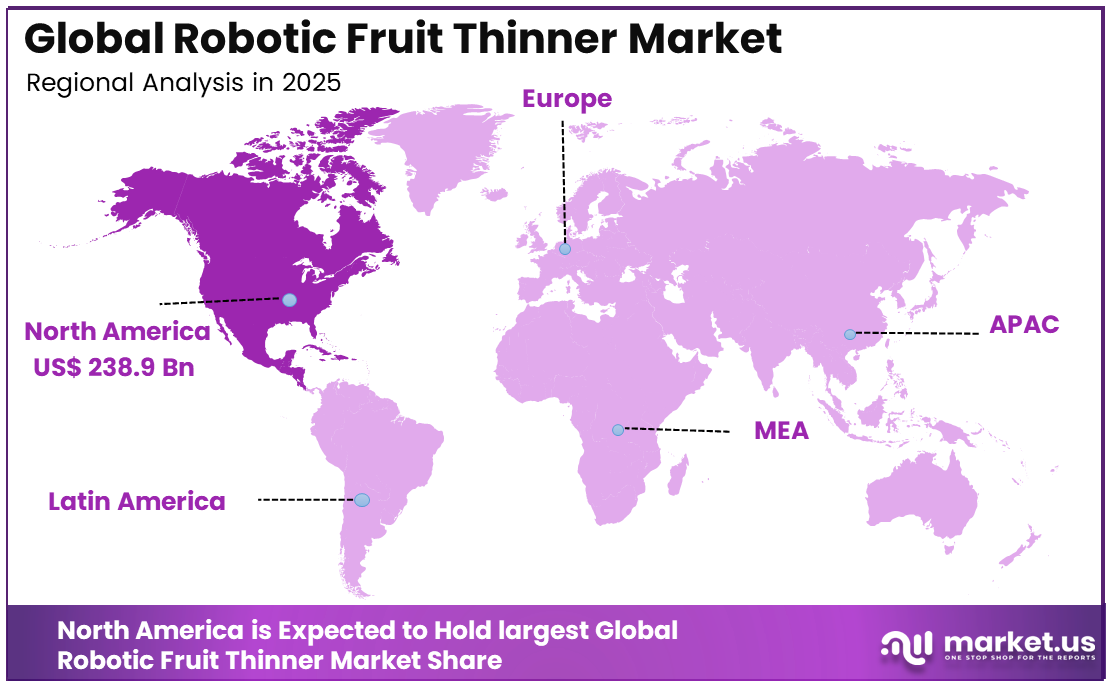
The Global Robotic Fruit Thinner Market size is expected to be worth around USD 2,599.88 billion by 2035, from USD 620.72 billion in 2025, growing at a CAGR of 15.4% during the forecast period from 2025 to 2035. North America held a dominant market position, capturing more than 38.5% share and generating USD 238.9 billion in revenue.
Robotic Fruit Thinner refers to an automated agricultural system, like an agricultural robot, designed to remove excess flowers or young fruits from trees to improve crop quality and yield balance. It uses sensors, cameras, and controlled tools to perform precise thinning tasks. This technology helps growers achieve consistent fruit size, better resource use, and more efficient orchard management.
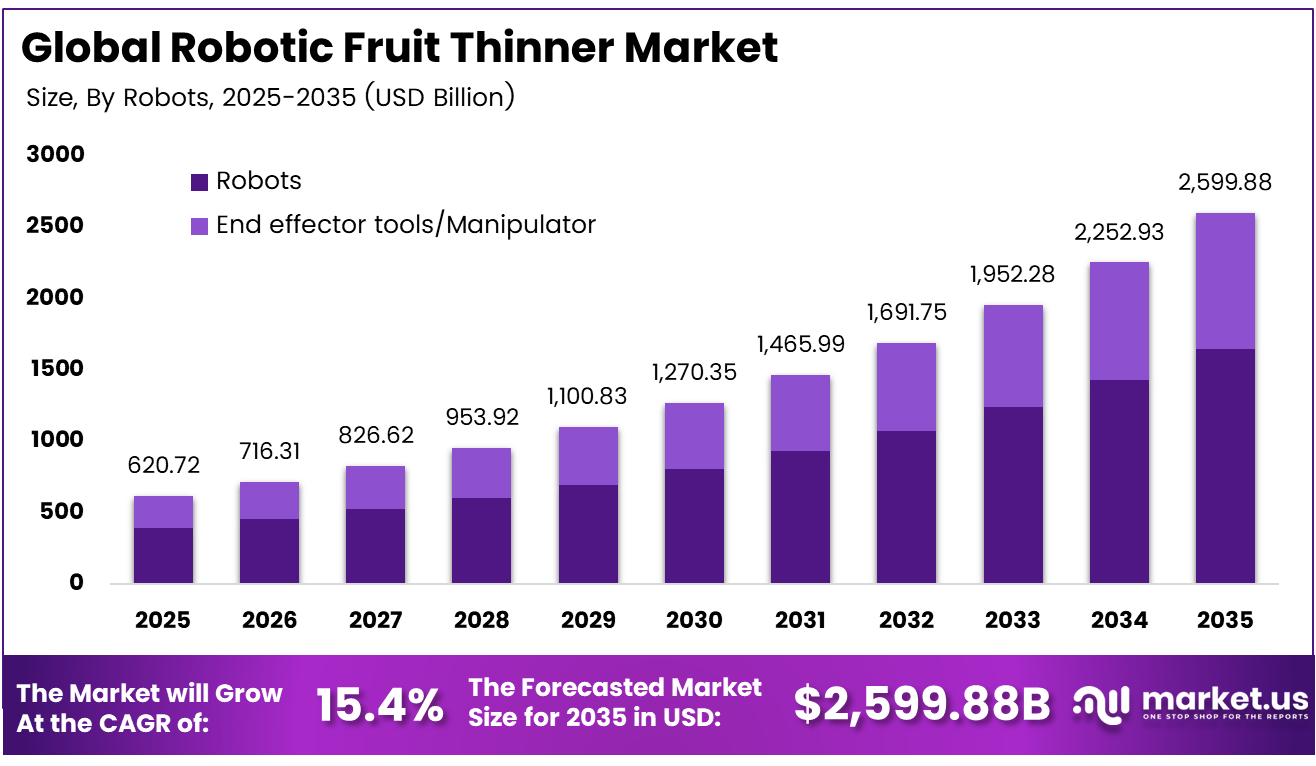
Top driving factors are linked to ongoing shortages of skilled pickers, labour cost inflation of about 10% in recent years, and stricter retail standards for fruit size consistency and fewer defects per 100 fruits inspected. Growers are also under pressure to raise yield per hectare and improve field documentation, which is increasing interest in automated, data-driven thinning systems.
The market for Robotic Fruit Thinner is driven by the need to manage labour shortages, improve thinning accuracy, and maintain consistent fruit quality across orchards. Growers are adopting automated solutions to complete thinning on time and reduce manual effort. Increasing focus on precision farming and data-based decisions is also supporting adoption, as farmers aim to improve yield, efficiency, and long-term orchard performance.
Demand is rising fastest in orchards already using precision tools such as yield mapping and variable rate inputs. In trial plots, robotic thinning has reduced manual thinning hours by 25–30% per hectare. Early adoption has also helped reduce missed rows and support more stable production across blocks, which improves revenue visibility and limits swings in packable volumes.
For instance, in September 2025, Clearpath Robotics and Kubota platforms are being integrated as bases for third-party thinning solutions, especially in research stations and large corporate farms. Their rugged autonomous carriers provide navigation, power, and safety layers, letting agritech startups plug in custom thinning tools instead of building full robots from scratch, saving millions in development.
Key Takeaway
- In 2025, the Robots segment held a dominant market position, capturing a 63.4% share of the Global Robotic Fruit Thinner Market.
- In 2025, the Vision-based segment held a dominant market position, capturing a 48.5% share of the Global Robotic Fruit Thinner Market.
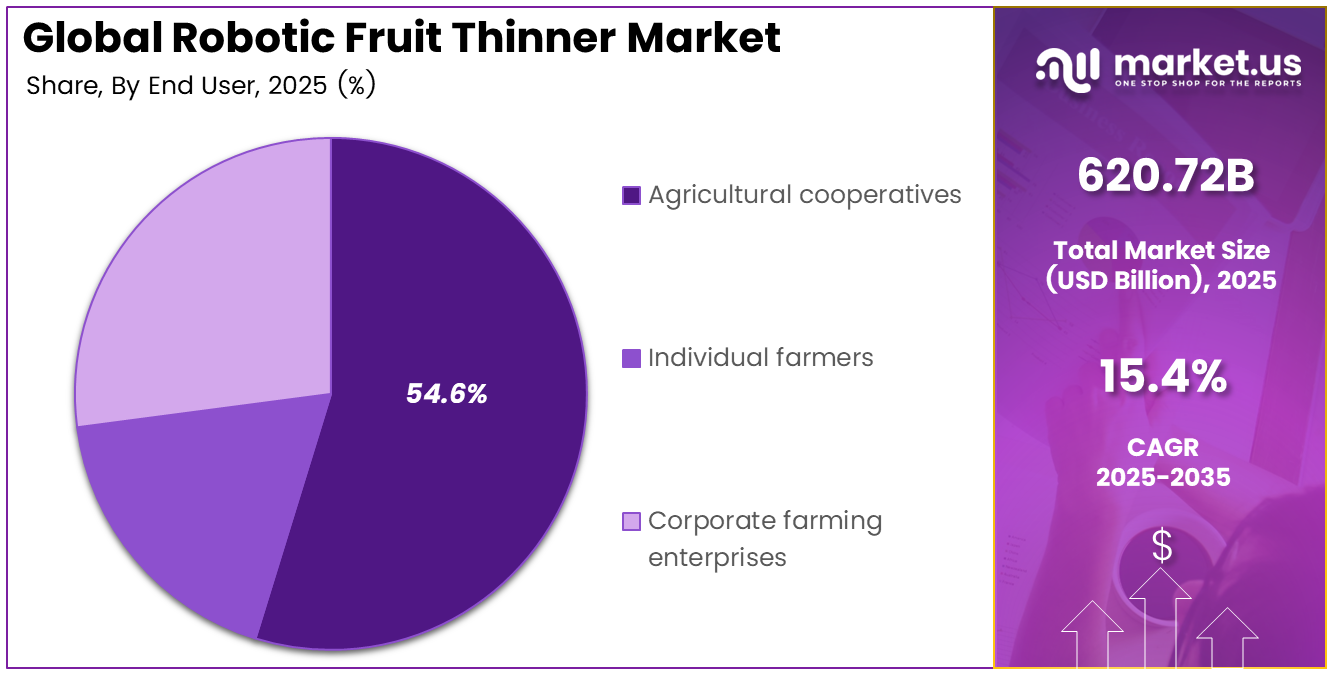
- In 2025, the Agricultural cooperatives segment held a dominant market position, capturing a 54.6% share of the Global Robotic Fruit Thinner Market.
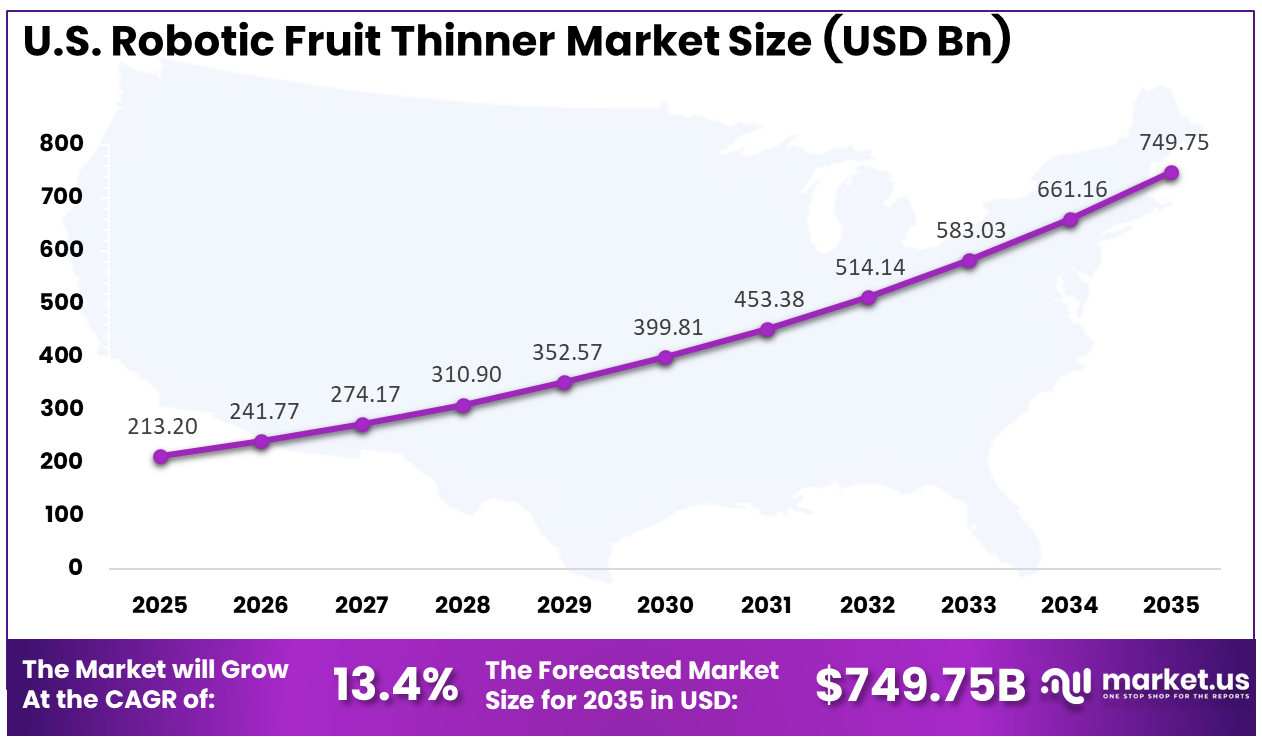
- The U.S. Robotic Fruit Thinner Market was valued at USD 213.20 Billion in 2025, with a robust CAGR of 13.4%.
- In 2025, North America held a dominant market position in the Global Robotic Fruit Thinner Market, capturing more than a 38.5% share.
Role of Generative AI
Generative AI is beginning to support robotic fruit thinning by turning large and complex orchard data into practical field decisions. Instead of relying only on fixed thinning rules, growers can use AI-based systems to study patterns from weather, soil, crop load, and past thinning activity for better planning and execution.
Early pilot use shows that generative AI can combine millions of data points to recommend thinning timing and patterns with better precision. Research on Agriculture 4.0 also shows that such systems can improve yields, lower costs, and strengthen resource use, which makes their role in fruit thinning increasingly important.
Investment and Business Benefits
Investment opportunities are strongest in sensor suites, control software, and specialized end-effectors rather than only full robotic machines. Many orchards prefer modular upgrades that allow costs to be spread over 3–5 seasons. There is also growing potential for per-hectare service models, which reduce upfront capital pressure for mid-sized fruit growers managing a few hundred acres.
Business benefits are visible in lower dependence on seasonal labour, more consistent yields, and better use of water and fertilizer per kilogram of marketable fruit. Trials indicate labour savings of up to 30% for thinning tasks. Over time, robot-collected data on fruit counts and tree vigour can improve pruning and nutrition decisions across multiple crop cycles.
Regional Analysis
In 2025, North America held a dominant market position in the Global Robotic Fruit Thinner Market, capturing more than 38.5% share and generating USD 238.9 billion in revenue. This dominance is due to its strong adoption of agricultural automation, high orchard labour costs, and early use of precision farming tools. Growers in the region are more willing to invest in robotic thinning to improve fruit quality, reduce seasonal labour dependence, and manage large orchards more efficiently. Supportive agri-tech ecosystems, better access to advanced equipment, and a stronger focus on productivity also strengthen regional market leadership.
For instance, in February 2025, Clearpath Robotics leveraged its autonomous mobile platforms to support research and pilot projects in precision agriculture, where growers mount thinning and crop-care implements on Clearpath bases to automate in-row operations. These Canadian-developed robots increasingly serve North American orchards, underscoring the region’s leadership in field-robot platforms for fruit thinning applications.
U.S. Robotic Fruit Thinner Market Size
The market for Robotic Fruit Thinner within the U.S. is growing tremendously and is currently valued at USD 213.20 billion; the market has a projected CAGR of 13.4%. The market is growing due to rising farm labour shortages, higher wage pressure, and the need for more precise orchard management. Fruit growers are adopting robotic thinning systems to improve consistency, reduce manual effort, and protect crop quality. Growth is also supported by wider use of precision agriculture tools, stronger interest in data-based field decisions, and the need to improve yield, input efficiency, and long-term orchard productivity.
For instance, in March 2025, Fruition Sciences expanded deployment of its U.S. vineyard data and decision-support tools, combining canopy sensing, fruit load analytics, and irrigation data to guide when and where robots or crews thin clusters. By optimizing robotic and manual thinning passes in high-value vineyards, the Napa-based firm strengthens U.S. dominance in data-driven fruit thinning.
Key Regions and Countries
North America
- US
- Canada
Europe
- Germany
- France
- The UK
- Spain
- Italy
- Russia
- Netherlands
- Rest of Europe
Asia Pacific
- China
- Japan
- South Korea
- India
- Australia
- Singapore
- Thailand
- Vietnam
- Rest of APAC
Latin America
- Brazil
- Mexico
- Rest of Latin America
Middle East & Africa
- South Africa
- Saudi Arabia
- UAE
- Rest of MEA
Robots Analysis
In 2025, the Robots segment held a dominant market position, capturing a 63.4% share of the Global Robotic Fruit Thinner Market. This dominance is due to the strong need for precise and repeatable thinning work in orchards, where manual methods often lead to uneven results. Robotic systems help growers manage large planting areas with better control, cleaner execution, and more dependable field performance during narrow seasonal windows when timing matters most.
Robots are also preferred because they can work for longer hours with less fatigue and fewer operational gaps than manual crews. Their use supports better crop load management and improves consistency across rows and blocks. This makes them a practical choice for growers seeking stable orchard performance over time.
For instance, in June 2025, EcoRobotix introduced a lettuce thinning algorithm for its ARA platform, showing how the same robotic base can be adapted for different thinning tasks in the field. This type of software upgrade helps explain why dedicated robots are gaining ground in fruit thinning, as growers see one machine doing multiple precision operations across the season.
Sensing Technology Analysis
In 2025, the Vision-based segment held a dominant market position, capturing a 48.5% share of the Global Robotic Fruit Thinner Market. This dominance is due to the critical role of image-based detection in identifying flowers, fruitlets, and canopy conditions before thinning begins. Vision-based systems help machines understand orchard conditions more clearly, which supports better decisions in the field and improves the accuracy of each thinning action.
Growers and technology developers also prefer this approach because it fits well with modern orchard automation systems. It helps connect detection, evaluation, and action in one process. As orchard conditions change throughout the season, vision tools make thinning systems more flexible, reliable, and suitable for commercial use.
For instance, in October 2022, Tevel highlighted commercial use of its flying fruit picking robots, which rely heavily on computer vision to locate and select individual fruits in real orchards. This real-world deployment underlines why vision-based sensing is at the centre of robotic thinning, as growers need machines that can truly see and understand fruit on the tree.
End User Analysis
In 2025, the Agricultural cooperatives segment held a dominant market position, capturing a 54.6% share of the Global Robotic Fruit Thinner Market. This dominance is due to the ability of agricultural cooperatives to support shared access to advanced thinning technology, training, and operational guidance. Many growers find adoption easier when equipment and technical knowledge are available through a group structure rather than through individual investment and management alone.
Cooperatives also help reduce practical barriers that often slow technology use in orchards. They can coordinate deployment across multiple farms, improve the utilization of equipment, and support better learning among members. This shared approach makes robotic thinning more accessible and easier to apply across different fruit-growing operations.
For instance, in January 2025, Naïo showcased upgrades to its Oz and Ted robots, including new tools for vineyard work, at a major field robotics event. These kinds of robust, serviceable machines are attractive to agricultural cooperatives, which can share robots across many members and keep them working on weeding, canopy care, and eventually thinning tasks.
Key Market Segments
By Robots
- Robots
- Autonomous mobile robots
- Stationary robotic gantry system
- Tele-operated
- End effector tools/Manipulator
- Pruning shear
- Pruning saw
- Vacuum pruning
- Looper attachments
- Hedge trimmer
- Grasping tool
By Sensing Technology
- Vision-based
- 2D imaging
- 3D imaging
- Hyperspectral imaging
- Non-vision-based
- Mechanical sensing
- LiDAR
- Others
By End User
- Individual farmers
- Agricultural cooperatives
- Corporate farming enterprises
Emerging Trends
A major trend in this market is the move from basic automation to smart thinning systems built on deep learning and computer vision. These tools are helping robots identify flowers and fruitlets more accurately in orchard conditions, which is making robotic thinning more reliable and more practical for commercial fruit growers.
Hardware is also improving through multi-axis robotic arms and softer gripping or suction tools that reduce damage during operation. At the same time, orchard data collected during thinning is being linked with management platforms, helping growers improve yield prediction, monitor tree health, and plan inputs and harvest activities.
Growth Factors
Growth in this market is being supported by the need to reduce labour pressure in one of the most labour-intensive orchard tasks. In some regions, agricultural labour costs have risen by about 10% in five years, while robotic systems have shown potential to reduce thinning labour bills by up to 30%.
Another important growth factor is the need for better and more consistent yields under rising sustainability expectations. Robotic thinning supports more precise crop management and lowers dependence on broad chemical thinning methods. As systems become suitable for multiple fruit types, growers can spread investment across wider acreage over a few seasons.
Market Dynamics
Drivers - Driver: Rising Labour Shortage in Orchards
Fruit growers are facing growing difficulty in finding enough skilled workers for thinning work during critical crop stages. Orchard tasks are time-sensitive, and any delay can affect fruit size, quality, and overall harvest performance. This labour pressure is making automated thinning systems more relevant across commercial fruit production.
Robotic fruit thinners are gaining attention because they help reduce dependence on seasonal workers and support timely field operations. They also bring more consistency to thinning decisions across orchard blocks. As labour availability becomes less predictable, growers are looking for practical tools that can protect productivity and improve planning.
For instance, in June 2024, Agrobot promoted its smart harvesting and pest control platforms as a response to the difficulty of sourcing reliable labour, offering automated solutions for delicate field and orchard operations so growers can maintain production even when experienced pickers or equipment operators are in short supply during peak crop windows.
Restraint - High Upfront Cost
The high initial cost of robotic fruit thinning systems remains a major barrier for many orchard operators. Buying advanced equipment, installing supporting systems, and training workers can create a heavy financial burden. This is especially difficult for small and medium-sized growers who must manage spending carefully across the season.
Many growers remain cautious because the return on investment may not be immediate. Adoption often depends on orchard size, crop type, and the ability to use the system effectively over time. Until costs become easier to manage, some farms may continue relying on manual thinning or limited automation.
For instance, in April 2025, promotional material for the Bakus robot highlights long-term savings and environmental gains, yet it also underscores that this is a fully electric, RTK-guided platform, which implies a high initial ticket price, so only vineyards with sufficient scale or access to financing can comfortably commit to such a specialized robotic tractor.
Opportunities - Precision Farming Integration
Precision farming integration creates a strong opportunity for robotic fruit thinning because many orchards are already using digital tools to improve field decisions. When robotic systems connect with mapping, crop monitoring, and orchard data platforms, the value of thinning expands beyond a single task.
This integration helps growers understand crop load, tree condition, and block performance more clearly throughout the season. Better information supports stronger decisions for irrigation, pruning, and harvest planning. As orchards become more data-driven, robotic thinning can fit naturally into broader precision agriculture strategies.
For instance, in January 2026, Naïo’s robots use RTK autoguidance and mapping services provided by field experts, creating a foundation for precise routing and documentation of passes in vineyards and vegetable fields, which can be tied into precision farming systems to track when and where weeding or soil operations were carried out.
Challenges - Technical Complexity
Technical complexity remains a major challenge because orchard environments are not uniform. Trees differ in shape, branch density, fruit placement, and lighting conditions, which makes robotic operation difficult. A machine must identify targets correctly and respond quickly without damaging healthy fruit or surrounding plant structures during thinning activity.
This complexity also affects maintenance, calibration, and system performance in real field conditions. Growers want machines that are easy to operate and dependable across different orchard layouts. When a system requires high technical support or frequent adjustment, adoption becomes harder, and confidence in routine use can decline.
For instance, in April 2023, field evaluations of robotic blossom thinning systems reported challenges in detecting flowers, planning robot movements, and maintaining reliability in complex canopies, illustrating that across many companies, the technical complexity of vision, control, and end-effector design remains a key barrier to fully robust commercial thinning robots.
Key Players Analysis
One of the leading players in September 2025, Tevel expanded commercial pilots of its tethered flying robots in European orchards, using AI to identify, pick, and selectively thin fruit on the same platform. By combining machine vision with autonomous swarm management, orchards are seeing labour savings above 30%, which is accelerating interest in fully robotic thinning fleets.
Top Key Players in the Market
- Abundant Robotics
- Agrobot
- Bakus Robotics
- Clearpath Robotics, Inc.
- EcoRobotix
- FFRobotics
- Fruition Sciences
- Kawasaki Robotics
- Kubota Corporation
- Naïo Technologies
- Octinion
- Saga Robotics
- Tevel Aerobotics Technologies
- Umitron
- Vineworks
- Others
Recent Developments
- In September 2025, FFRobotics advanced field deployments of its multi-arm platform from pure harvesting toward targeted thinning in apples and citrus. New end-effectors and vision updates let the robot remove surplus fruit while protecting the best-positioned fruitlets, helping large growers hit strict size and quality specs across hundreds of hectares.
- In September 2025, Kubota’s strategic investment in Abundant Robotics continued to bear fruit, with joint development programs aimed at semi-autonomous thinning and harvesting systems for orchards in the U.S. and Japan. Kubota is weaving Abundant’s perception stack into its broader smart-farm roadmap, using robotics to tackle chronic labour gaps.
Report Scope
| Report Features | Description |
|---|---|
| Market Value (2025) | USD 620.72 Billion |
| Forecast Revenue (2035) | USD 2,599.88 Billion |
| CAGR (2026-2035) | 15.4% |
| Base Year for Estimation | 2025 |
| Historic Period | 2020-2024 |
| Forecast Period | 2026-2035 |
| Report Coverage | Revenue Forecast, Market Dynamics, Competitive Landscape, Recent Developments |
| Segments Covered | By Robots (Robots, End effector tools/Manipulator), By Sensing Technology (Vision-based, Non-vision based, Others), By End User (Individual farmers, Agricultural cooperatives, Corporate farming enterprises) |
| Regional Analysis | North America (US and Canada), Europe (Germany, France, The UK, Spain, Italy, and Rest of Europe), Asia Pacific (China, Japan, South Korea, India, Australia, and Rest of APAC), Latin America (Brazil, Mexico, and Rest of Latin America), Middle East & Africa (GCC, South Africa, and Rest of MEA) |
| Competitive Landscape | Abundant Robotics, Agrobot, Bakus Robotics, Clearpath Robotics, Inc., EcoRobotix, FFRobotics, Fruition Sciences, Kawasaki Robotics, Kubota Corporation, Naïo Technologies, Octinion, Saga Robotics, Tevel Aerobotics Technologies, Umitron, Vineworks, Others |
| Customization Scope | Customization at the segment and region/country levels will be provided. Moreover, customization can be tailored to the requirements. |
| Purchase Options | We have three licenses to opt for: Single User License, Multi-User License (Up to 5 Users), Corporate Use License (Unlimited Users and Printable PDF) |