


Global Reversible Textile Coloring Market Size, Share, And Enhanced Productivity By Type (Thermochromic Textile Coloring, Photochromic Textile Coloring, Electrochromic Textile Coloring, Others), By Fiber Type (Cotton, Polyester, Nylon, Wool, Blends, Others), By Application (Apparel and Fashion, Home Textiles, Smart Textiles, Sports and Outdoor Gear, Automotive Interiors, Others), By Region and Companies - Industry Segment Outlook, Market Assessment, Competition Scenario, Trends, and Forecast 2025-2034
- Published date: January 2026
- Report ID: 174361
- Number of Pages: 254
- Format:
-
keyboard_arrow_up
Quick Navigation
Report Overview
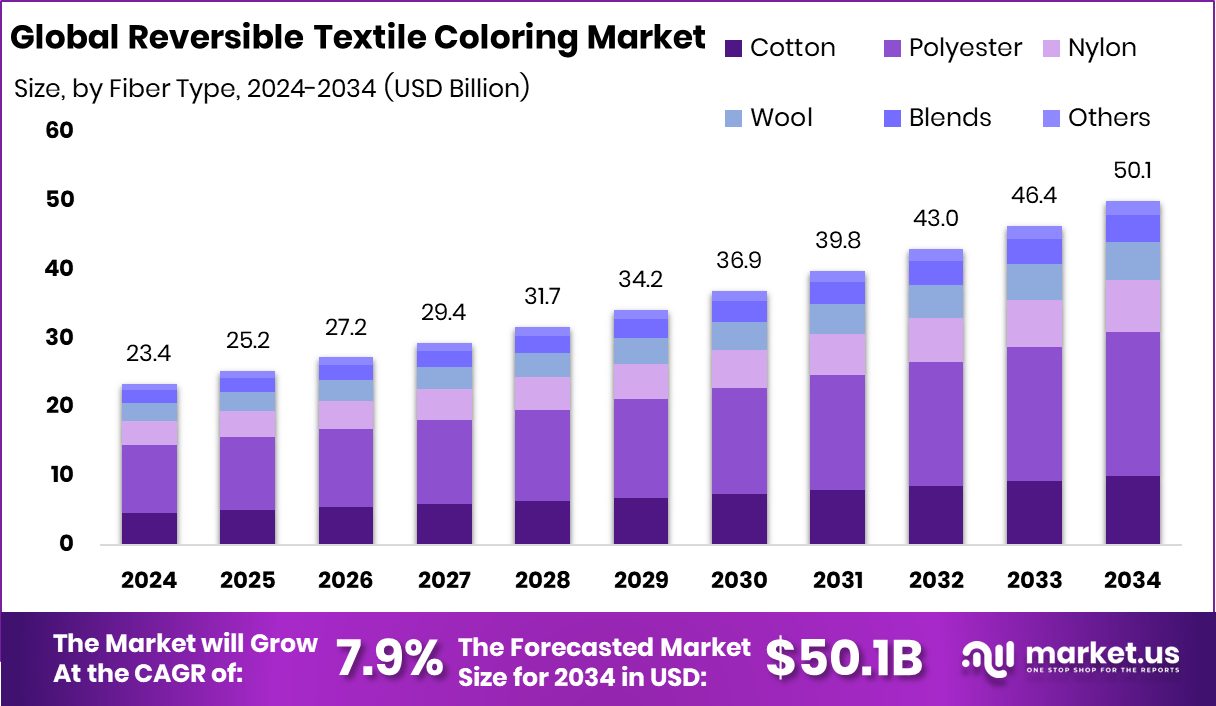
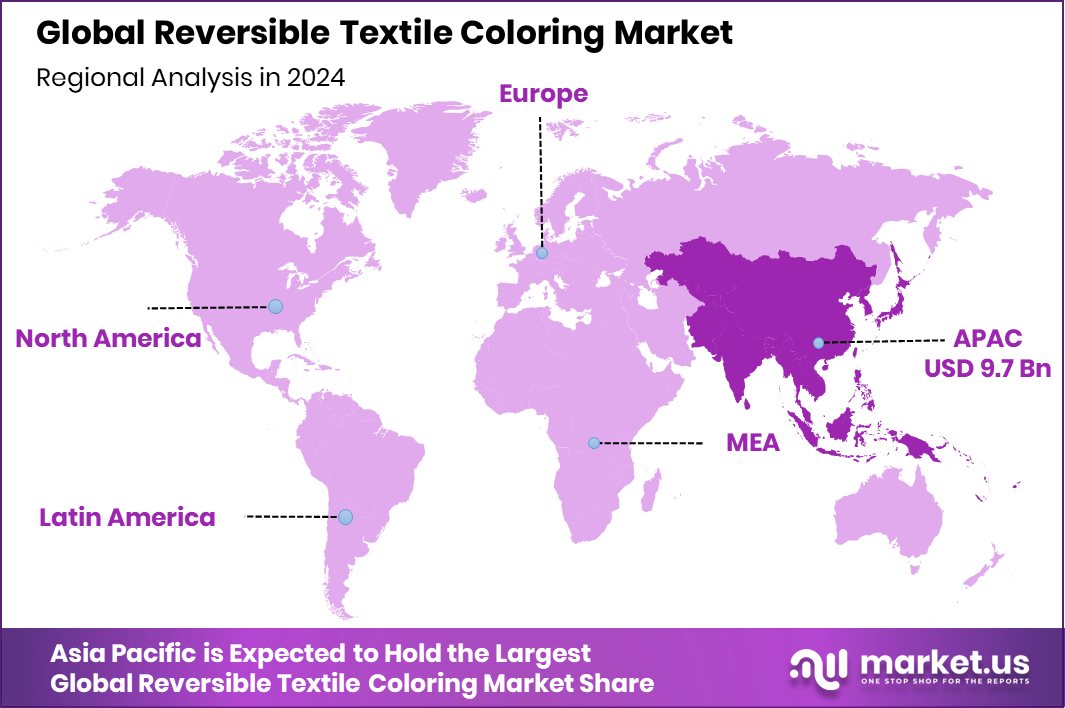
The Global Reversible Textile Coloring Market is expected to be worth around USD 50.1 billion by 2034, up from USD 23.4 billion in 2024, and is projected to grow at a CAGR of 7.9% from 2025 to 2034. Apparel demand positioned Asia Pacific at 41.6%, generating USD 9.7 Bn market value.
Reversible textile coloring refers to advanced coloring techniques that allow fabrics to change color and then return to their original shade when conditions change. These changes can happen due to temperature, light, moisture, or touch. The process adds visual interaction and functionality to textiles without permanently altering the fabric structure. This makes reversible coloring attractive for fashion, sportswear, and functional clothing where design flexibility and user experience matter.
The reversible textile coloring market covers the production, application, and use of these color-changing textiles across apparel and related segments. It connects material science with fashion design, helping brands create garments that respond to the environment or the wearer. The market is also closely linked with sustainability, as innovation increasingly focuses on recyclable fibers and circular textile systems rather than traditional, waste-heavy dyeing practices.
Growth factors are strongly tied to sustainability-led innovation in textiles. Major investments support this shift, including H&M-backed Syre securing $700 million after its Nike deal and Binh Dinh granting an investment licence for SYRE’s USD 1 billion polyester recycling project. These developments strengthen recycled polyester supply, which is widely used in reversible coloring due to its compatibility with smart pigments.
Demand is rising as brands and consumers look for expressive, durable, and environmentally responsible clothing. Recycling-driven innovation supports this demand, highlighted by DePoly securing a total of $30 million, including $23 million to launch an industrial-scale plant turning PET and polyester waste into raw materials. This improves access to high-quality recycled inputs for advanced coloring applications.
Opportunities lie in circular textile systems and scalable recycling. Textile recycler Eeden, raising €18 million, shows growing confidence in textile-to-textile recycling, opening long-term opportunities for reversible coloring solutions built on clean, reusable fiber streams.
Key Takeaways
- The Global Reversible Textile Coloring Market is expected to be worth around USD 50.1 billion by 2034, up from USD 23.4 billion in 2024, and is projected to grow at a CAGR of 7.9% from 2025 to 2034.
- Thermochromic textile coloring leads the Reversible Textile Coloring Market with 47.5% share, driven by temperature demand.
- Polyester dominates usage in the Reversible Textile Coloring Market, holding 41.9% due to its durability affinity.
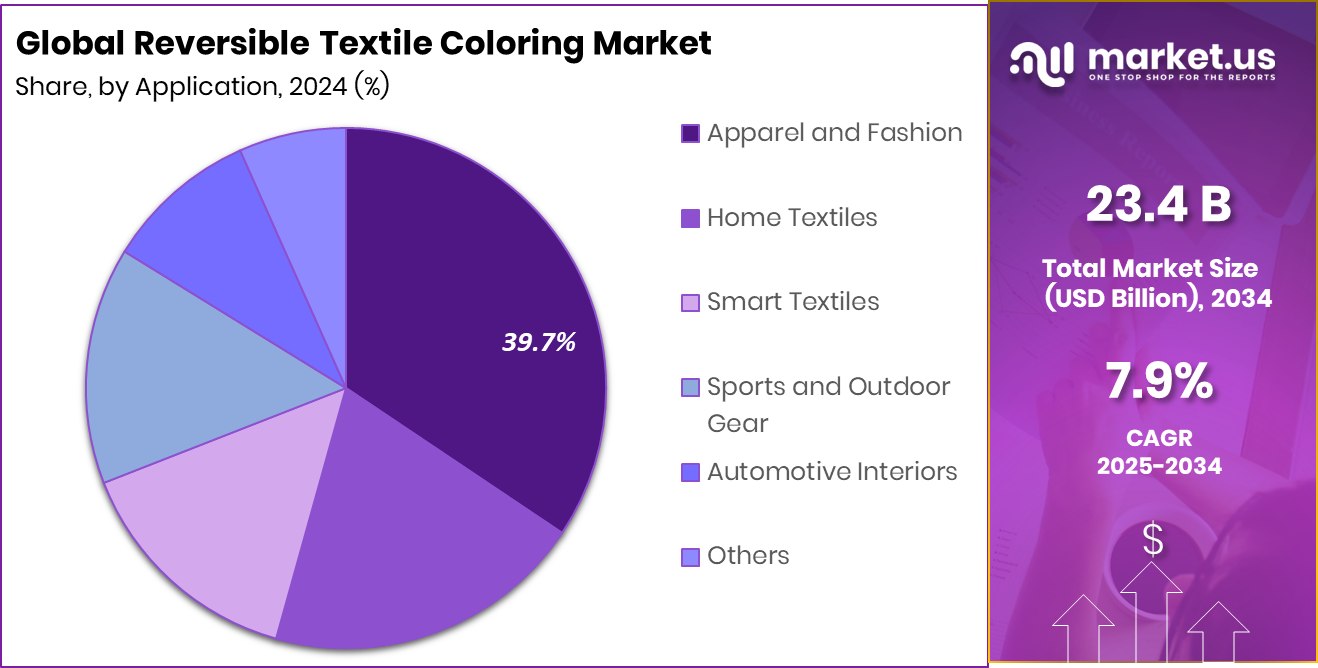
- Apparel and fashion applications account for 39.7% of the Reversible Textile Coloring Market demand globally today.
- Asia Pacific dominance reached 41.6%, valuing the Reversible Coloring Market at USD 9.7 Bn.
By Type Analysis
Thermochromic textile coloring leads the Reversible Textile Coloring Market by type with 47.5%.
In 2024, Thermochromic Textile Coloring held a dominant 47.5% share in the Reversible Textile Coloring Market, driven by its ability to visibly change color with temperature variations. This technology is widely adopted in fashion, sportswear, and functional apparel because it creates interactive and visually engaging designs. Designers use thermochromic effects to reflect body heat, weather changes, or external touch, adding novelty and premium value.
Brands also favor this coloring type for seasonal collections and limited editions, as it helps differentiate products on retail shelves. Additionally, improvements in pigment stability and wash durability have increased commercial acceptance. As consumer interest in smart and expressive clothing rises, thermochromic textile coloring continues to shape innovation, creativity, and product differentiation across global apparel markets.
By Fiber Type Analysis
Polyester fiber dominates the Reversible Textile Coloring Market by fiber type, holding 41.9%.
In 2024, Polyester accounted for a leading 41.9% share in the Reversible Textile Coloring Market due to its compatibility with advanced color-changing pigments. Polyester fibers offer strong heat resistance, durability, and color retention, making them ideal for reversible and smart coloring applications. Manufacturers prefer polyester because it allows consistent bonding of thermochromic and photochromic dyes without compromising fabric strength.
Its widespread use in mass-market apparel, sportswear, and performance clothing further supports demand. Polyester is also cost-effective and easily scalable for large production volumes, which benefits brands targeting both premium and affordable segments. With growing emphasis on functional fashion and long-lasting visual effects, polyester remains the most reliable fiber base for reversible textile coloring solutions worldwide.
By Application Analysis
Apparel and fashion applications drive the Reversible Textile Coloring Market demand with 39.7%.
In 2024, Apparel and Fashion represented a strong 39.7% share of the Reversible Textile Coloring Market, reflecting rising demand for interactive and trend-driven clothing. Consumers increasingly seek garments that offer visual transformation, personalization, and emotional appeal, which reversible coloring delivers effectively. Fashion brands use color-changing textiles in jackets, dresses, athleisure, and accessories to create statement pieces and experiential wear.
Social media influence and fast-fashion cycles also accelerate adoption, as dynamic color effects enhance digital visibility and consumer engagement. Moreover, designers leverage reversible coloring to support limited editions and premium collections. As fashion continues blending technology with creativity, apparel remains the primary commercial driver for reversible textile coloring growth.
Key Market Segments
By Type
- Thermochromic Textile Coloring
- Photochromic Textile Coloring
- Electrochromic Textile Coloring
- Others
By Fiber Type
By Application
- Apparel and Fashion
- Home Textiles
- Smart Textiles
- Sports and Outdoor Gear
- Automotive Interiors
- Others
Driving Factors
Sustainable Recycling Innovation Drives Market Expansion
Reversible Textile Coloring Market growth is strongly driven by advances in textile recycling and waste reduction technologies. New solutions are making it easier to reuse plastic-based textiles while supporting advanced coloring methods. A strong example is how AI-accelerated enzymes moved from a high-school science project to securing $18.3 million, helping break down fast-fashion plastic waste more efficiently. This supports cleaner base materials for reversible coloring.
At the same time, Samsara Eco is commercializing Nylon 6,6 recycling, improving access to recycled fibers suitable for smart and reversible color treatments. These innovations lower environmental impact while improving material consistency. As recycling becomes faster and more scalable, manufacturers gain confidence to invest in reversible textile coloring, making sustainability a clear driver of long-term market expansion.
Restraining Factors
High Costs And Financial Instability Slow Adoption
A major restraining factor for the Reversible Textile Coloring Market is the high cost of raw materials and financial uncertainty across the textile value chain. While innovation is advancing, many companies still struggle with profitability and stability. Bioweg landing a $19 million Series A to replace microplastics with bio alternatives highlights how much funding is needed just to shift materials.
On the other side, financial stress is visible as nylon maker Ascend received approval for $650 million in Chapter 11 financing, showing pressure in the traditional fiber supply. These cost and financing challenges make brands cautious about adopting newer, reversible coloring technologies that may increase production complexity and upfront investment.
Growth Opportunity
Bio-Based Materials Create Strong Growth Opportunities
Growth opportunities in the Reversible Textile Coloring Market are emerging from bio-based chemistry and advanced recycling pathways. New biotech players are improving the quality of recycled and alternative fibers that work well with reversible color systems. This is supported by Digestiva closing an $18 million funding round, enabling the development of bio-based processes, while Syntetica secured $4.5 million for nylon recycling, strengthening circular fiber supply.
In addition, Genomatica raised $118 million to triple sustainable material production capacity, which improves the availability of next-generation polymers. These developments create a strong opportunity to pair reversible coloring with sustainable fibers, allowing brands to deliver innovation without compromising environmental goals.
Latest Trends
Advanced Nylon Recycling Shapes Industry Color Trends
One of the latest trends shaping the Reversible Textile Coloring Market is the rapid improvement of nylon recycling technologies for fashion. Recycled nylon offers consistent performance and compatibility with smart color-changing pigments. This trend is reinforced as Syntetica secured €4.2 million to revolutionise nylon recycling for the fashion industry, focusing on high-quality output suitable for advanced textile treatments.
With better recycled nylon streams, reversible coloring becomes more practical for everyday apparel rather than niche products. This trend supports broader adoption across sportswear and fashion, where durability, responsiveness, and sustainability are increasingly expected by both brands and consumers.
Regional Analysis
In 2024, Asia Pacific led the coloring market with 41.6% share, USD 9.7 Bn.
The Reversible Textile Coloring Market shows clear regional variation in adoption and maturity across major global regions. Asia Pacific dominates the market with a share of 41.6%, generating a value of USD 9.7 Bn, supported by strong apparel manufacturing bases, large consumer populations, and faster acceptance of functional and color-changing textiles. The region benefits from fashion-driven demand and large-scale textile production ecosystems, making it the primary growth engine.
North America follows with steady adoption, driven by interest in smart apparel, lifestyle fashion, and innovation-focused textile applications, particularly in premium and performance clothing. Europe reflects stable demand, supported by design-centric fashion houses and an emphasis on advanced textile technologies.
The Middle East & Africa represent an emerging landscape where gradual growth is linked to expanding apparel markets and rising awareness of specialty textiles. Meanwhile, Latin America shows moderate progress, influenced by developing fashion industries and increasing exposure to innovative textile solutions. Overall, regional dynamics highlight the Asia Pacific’s clear leadership, while other regions contribute through steady, application-specific demand.
Key Regions and Countries
- North America
- US
- Canada
- Europe
- Germany
- France
- The UK
- Spain
- Italy
- Rest of Europe
- Asia Pacific
- China
- Japan
- South Korea
- India
- Australia
- Rest of APAC
- Latin America
- Brazil
- Mexico
- Rest of Latin America
- Middle East & Africa
- GCC
- South Africa
- Rest of MEA
Key Players Analysis
Chromatic Technologies Inc. (CTI) continues to play a defining role in the global Reversible Textile Coloring Market in 2024 through its strong focus on intelligent color-change solutions. The company’s expertise in thermochromic and photochromic technologies supports apparel brands seeking interactive, responsive, and visually distinctive textiles. CTI’s strength lies in translating complex material science into scalable textile applications, enabling designers to integrate reversible coloring without sacrificing fabric performance or durability. This positioning makes CTI especially relevant for fashion, sportswear, and lifestyle segments demanding innovation-led differentiation.
LCR Hallcrest remains a key contributor due to its long-standing specialization in thermochromic pigments tailored for textile use. In 2024, the company’s value is anchored in pigment reliability, consistency, and adaptability across diverse fabric types. LCR Hallcrest’s solutions allow textile manufacturers to achieve repeatable color transitions, which is critical for commercial apparel production. Its technical depth supports stable adoption of reversible coloring in both creative and functional clothing applications.
Meanwhile, OliKrom brings a strong innovation-driven outlook to the market. The company’s advanced chromic technologies emphasize precision, responsiveness, and next-generation design possibilities. OliKrom’s approach aligns with premium fashion and experimental textile applications, where visual transformation and material intelligence are central to product value.
Top Key Players in the Market
- Chromatic Technologies Inc. (CTI)
- LCR Hallcrest
- OliKrom
- Matsui Shikiso Chemical Co.
- QCR Solutions Corp.
- Smarol Industry Co. Ltd.
- New Color Chemical Co. Ltd.
- Devine Chemicals Ltd.
- BASF SE
- Flint Group
Recent Developments
- In 2024, New Color Chemical Co. Ltd. continued to manufacture and promote thermochromic pigments, photochromic pigments, and other color-effect powders suitable for textile and specialty color applications. This ongoing focus supports growth in markets that want reversible color effects in fabrics and materials. There was no specific press release announcing a new product launch or acquisition publicly available, but product line details are actively highlighted on their communications platforms in 2024.
- In June 2024, Devine Chemicals exhibited at Surfex 2024, a major surface coatings and materials technology event held on 4-5 June in the UK. The company presented its range of pigments and chemicals, including thermochromic products relevant to reversible textile applications and other specialty uses. This participation helped boost its visibility among industry professionals and potential customers.
Report Scope
Report Features Description Market Value (2024) USD 23.4 Billion Forecast Revenue (2034) USD 50.1 Billion CAGR (2025-2034) 7.9% Base Year for Estimation 2024 Historic Period 2020-2023 Forecast Period 2025-2034 Report Coverage Revenue Forecast, Market Dynamics, Competitive Landscape, Recent Developments Segments Covered By Type (Thermochromic Textile Coloring, Photochromic Textile Coloring, Electrochromic Textile Coloring, Others), By Fiber Type (Cotton, Polyester, Nylon, Wool, Blends, Others), By Application (Apparel and Fashion, Home Textiles, Smart Textiles, Sports and Outdoor Gear, Automotive Interiors, Others) Regional Analysis North America – US, Canada; Europe – Germany, France, The UK, Spain, Italy, Rest of Europe; Asia Pacific – China, Japan, South Korea, India, Australia, Singapore, Rest of APAC; Latin America – Brazil, Mexico, Rest of Latin America; Middle East & Africa – GCC, South Africa, Rest of MEA Competitive Landscape Chromatic Technologies Inc. (CTI), LCR Hallcrest, OliKrom, Matsui Shikiso Chemical Co., QCR Solutions Corp., Smarol Industry Co. Ltd., New Color Chemical Co. Ltd., Devine Chemicals Ltd., BASF SE, Flint Group Customization Scope Customization for segments, region/country-level will be provided. Moreover, additional customization can be done based on the requirements. Purchase Options We have three licenses to opt for: Single User License, Multi-User License (Up to 5 Users), Corporate Use License (Unlimited User and Printable PDF)  Reversible Textile Coloring MarketPublished date: January 2026add_shopping_cartBuy Now get_appDownload Sample
 -
-
- Chromatic Technologies Inc. (CTI)
- LCR Hallcrest
- OliKrom
- Matsui Shikiso Chemical Co.
- QCR Solutions Corp.
- Smarol Industry Co. Ltd.
- New Color Chemical Co. Ltd.
- Devine Chemicals Ltd.
- BASF SE
- Flint Group
Our Clients

- 174361
- January 2026






