


Retinol Beauty Products Market Size, Share, Growth Analysis Product (Creams and Lotions, Oils and Serums, Gels, Others), End Use (Women, Men), Distribution Channel (Supermarkets and Hypermarkets, Specialty Beauty Stores, Pharmacies and Drugstores, E-commerce, Others), Region and Companies - Industry Segment Outlook, Market Assessment, Competition Scenario, Statistics, Trends and Forecast 2026-2035
- Published date: Mar 2026
- Report ID: 181024
- Number of Pages: 308
- Format:
-
keyboard_arrow_up
Quick Navigation
Report Overview
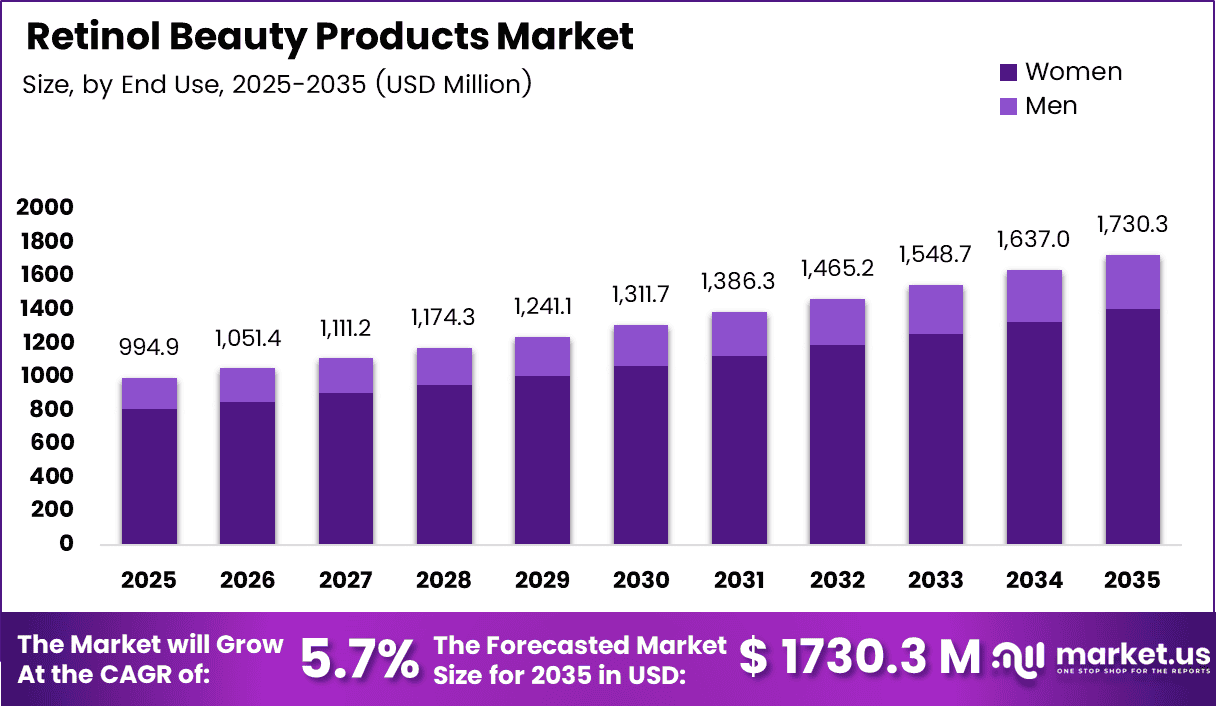
Global Retinol Beauty Products Market size is expected to be worth around USD 1,730.3 Million by 2035 from USD 994.9 Million in 2025, growing at a CAGR of 5.7% during the forecast period 2026 to 2035.
The retinol beauty products market encompasses a broad range of skincare formulations that use retinol, a derivative of vitamin A, as the primary active ingredient. These products include creams, serums, oils, and gels designed to address anti-aging, wrinkle reduction, acne scarring, and skin texture concerns in daily skincare routines.
Retinol is widely recognized as a gold-standard active ingredient in dermatology. It works by accelerating skin cell turnover, stimulating collagen production, and reducing the appearance of fine lines. Moreover, its proven clinical efficacy has driven consistent adoption across both mass-market and premium skincare product categories globally.
Growing consumer awareness of ingredient-focused skincare is a key market driver. Mature demographics are increasingly seeking clinically proven anti-aging formulations, while younger consumers use retinol for acne management and post-scarring treatment. Consequently, brands are expanding their retinol product portfolios to address a wider range of skin concerns and age groups.
Retail expansion across pharmacies, specialty beauty stores, and e-commerce platforms has significantly improved retinol product accessibility. Additionally, dermatologist and aesthetician endorsements continue to validate retinol’s effectiveness, driving consumer confidence and trial. Government regulatory frameworks in key markets are also encouraging accurate labeling and safety testing of active skincare formulations.
Investment in advanced delivery technologies such as encapsulation and controlled-release systems is opening new product innovation opportunities. These technologies reduce irritation risk while improving retinol efficacy. Therefore, brands investing in next-generation formulations are well positioned to attract both first-time users and experienced skincare consumers seeking upgraded retinol solutions.
According to Allure, encapsulated retinol formulations such as lipid-encapsulated variants combine active retinol benefits with moisturizing lipids, with available strengths including 0.25% and 0.5% retinol concentrations. These innovations reflect the market’s shift toward gentler, more effective delivery formats that reduce the common side effects associated with traditional retinol use.
Key Takeaways
- The global Retinol Beauty Products Market was valued at USD 994.9 Million in 2025.
- The market is projected to reach USD 1,730.3 Million by 2035, growing at a CAGR of 5.7%.
- By Product, Creams and Lotions dominate with a market share of 45.7% in 2025.
- By End Use, Women account for the largest share at 81.2%.
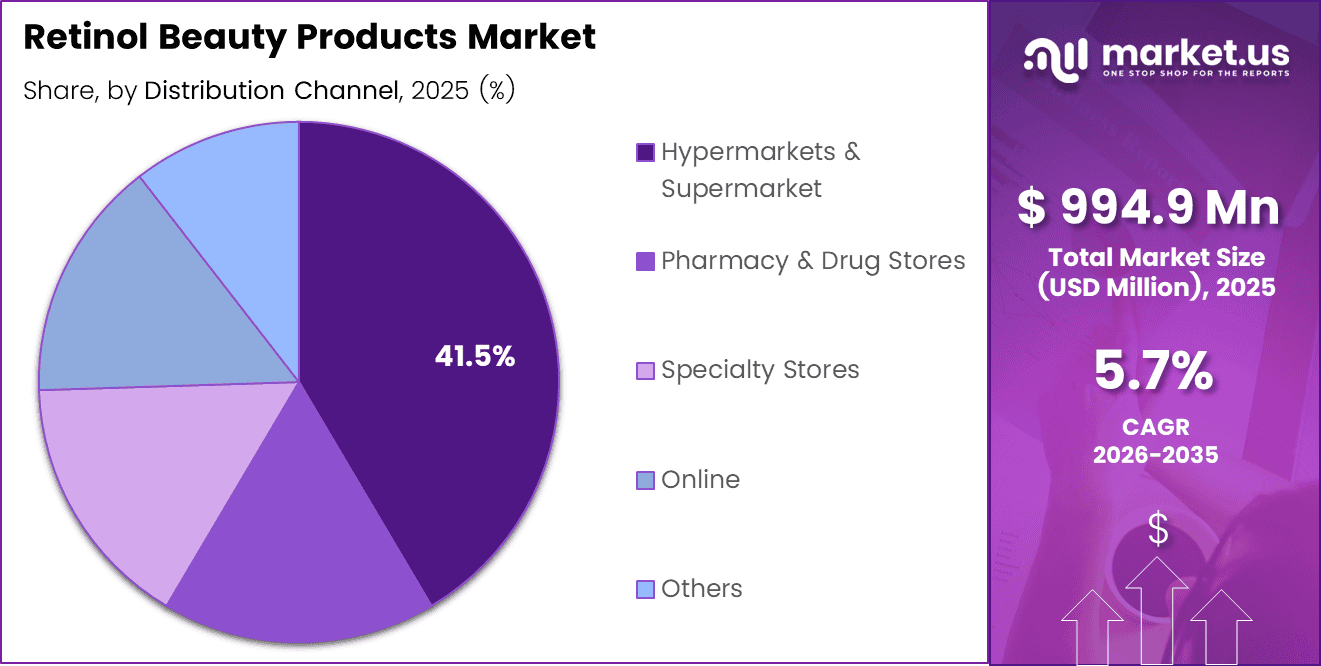
- By Distribution Channel, Supermarkets and Hypermarkets lead with a 41.5% share.
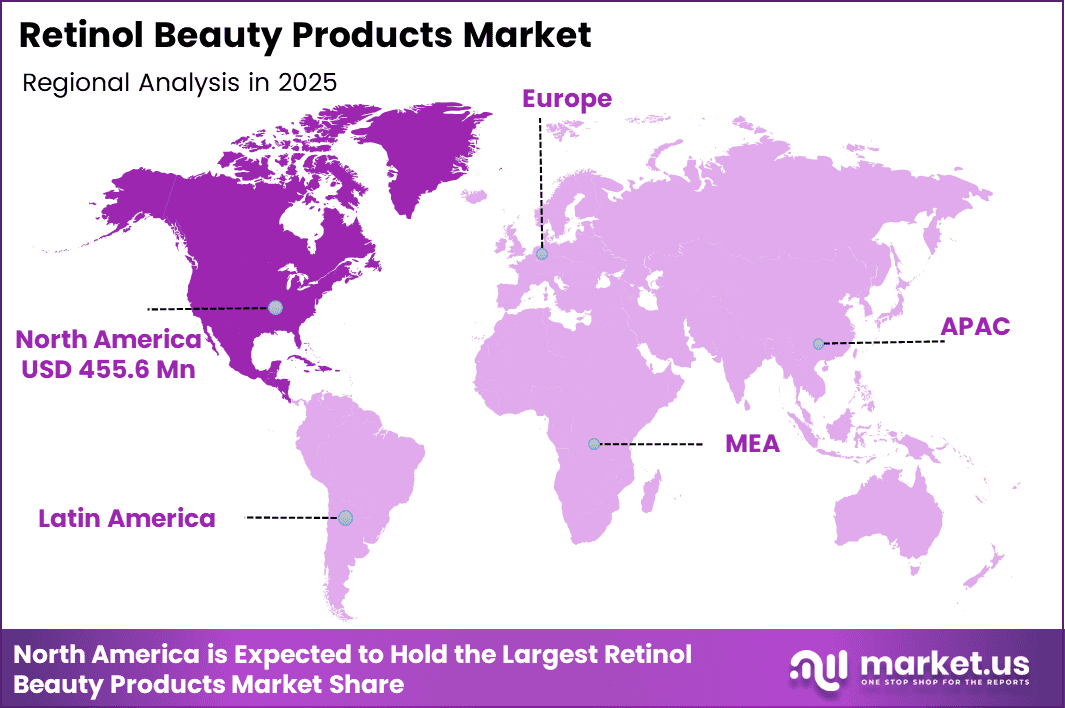
- North America dominates the regional landscape with a 45.80% share, valued at USD 455.6 Million.
Product Analysis
Creams and Lotions dominate with 45.7% due to widespread consumer familiarity and ease of daily application.
In 2025, Creams and Lotions held a dominant market position in the Product segment of the Retinol Beauty Products Market, with a 45.7% share. These formulations are preferred for their rich texture, moisturizing properties, and suitability for nightly anti-aging routines. Moreover, they appeal broadly across age groups seeking accessible and easy-to-use retinol skincare solutions.
Oils and Serums represent a fast-growing product category within the retinol market. These lightweight, high-concentration formulations deliver retinol efficiently into the skin, making them popular among advanced skincare users. Additionally, serums are frequently recommended by dermatologists for targeted treatment of fine lines, uneven texture, and post-acne scarring in concentrated doses.
Gels offer a lightweight, non-greasy alternative well suited for oily and combination skin types. Their fast-absorbing texture makes them appealing to consumers who prefer minimalist skincare routines. Others, including eye treatments, neck creams, and body lotions infused with retinol, are expanding the product category beyond traditional facial skincare applications.
End Use Analysis
Women dominate with 81.2% due to significantly higher engagement with anti-aging and skincare treatment routines.
In 2025, Women held a dominant market position in the End Use segment of the Retinol Beauty Products Market, with an 81.2% share. Women represent the core consumer base for retinol skincare, driven by strong interest in anti-aging, wrinkle reduction, and skin renewal. Furthermore, women are more likely to follow structured multi-step skincare routines incorporating active ingredient formulations regularly.
Men represent a growing end-use segment as awareness of skin health continues to rise among male consumers. Simplified retinol formulations in face washes, moisturizers, and targeted treatments are attracting men seeking effective anti-aging and texture-improvement solutions. Consequently, brands are expanding gender-neutral and men-specific retinol product lines to capture this underserved and increasingly valuable market segment.
Distribution Channel Analysis
Supermarkets and Hypermarkets dominate with 41.5% due to wide availability and high consumer footfall driving impulse purchases.
In 2025, Supermarkets and Hypermarkets held a dominant market position in the Distribution Channel segment of the Retinol Beauty Products Market, with a 41.5% share. These large-format retail outlets provide broad product visibility and competitive pricing. Moreover, in-store displays and promotional offers continue to support strong retinol product sales volumes across mass-market consumer segments.
Specialty Beauty Stores attract informed consumers seeking expert advice and premium retinol formulations. These stores offer curated product selections with trained staff guidance, creating a high-trust purchasing environment. Additionally, exclusive brand partnerships and in-store consultations help specialty retailers maintain a loyal customer base focused on results-driven active skincare routines.
Pharmacies and Drugstores serve health-conscious buyers who prioritize clinically tested and dermatologist-recommended retinol products. The pharmacy environment reinforces product credibility and safety perceptions. Therefore, this channel remains a trusted destination for consumers seeking reliable retinol formulations, particularly those transitioning from prescription retinoids to over-the-counter skincare alternatives.
E-commerce is a rapidly expanding channel driven by convenience, competitive pricing, and influencer-led product discovery. Online platforms give consumers access to a wider range of retinol brands and formulations than physical retail.
Others, including direct sales and beauty subscription services, serve niche segments seeking personalized retinol recommendations and curated skincare experiences.
Key Market Segments
By Product
- Creams and Lotions
- Oils and Serums
- Gels
- Others
By End Use
- Women
- Men
By Distribution Channel
- Supermarkets and Hypermarkets
- Specialty Beauty Stores
- Pharmacies and Drugstores
- E-commerce
- Others
Drivers
Surging Demand for Clinically Proven Anti-Aging Formulations and Expanding Retail Availability Drive Retinol Market Growth
Consumer demand for clinically proven anti-aging and wrinkle-reduction skincare is a primary market driver. Mature demographics are actively seeking retinol formulations that deliver visible results. Moreover, rising awareness of retinol’s efficacy in treating post-acne scarring, uneven texture, and visible signs of photoaging is broadening its adoption across multiple consumer age groups.
Dermatologist and aesthetician endorsements play a significant role in validating retinol as a gold-standard active ingredient for skin cell turnover. Professional recommendations build consumer trust and encourage consistent product use. Consequently, brands that align with clinical credibility and professional skincare guidance are gaining stronger market positioning in both pharmacy and premium retail channels.
The expanding retail availability of over-the-counter retinol products across mass-market, pharmacy, and premium beauty channels is making the ingredient more accessible than ever. Additionally, social media content and dermatologist-led digital education are accelerating consumer awareness. Therefore, both first-time buyers and experienced skincare users are increasingly incorporating retinol into their daily routines.
Restraints
Skin Sensitivity Risks and Regulatory Concentration Restrictions Restrain Broader Retinol Market Adoption
The risk of purging, peeling, and photosensitivity reactions remains a significant barrier to retinol adoption, particularly among first-time and sensitive-skin users. These side effects create hesitation at the point of purchase. Consequently, many consumers abandon retinol products before experiencing their full benefits, leading to higher return rates and reduced repeat purchases.
Regulatory restrictions on retinol concentration limits in cosmetic products, especially across European and international markets, present a meaningful challenge for product development. Brands must reformulate products to comply with evolving standards, which increases development costs and timelines. Moreover, varying regulations across regions complicate global product launches and limit concentration options available to consumers.
Consumer misinformation about retinol interactions with other skincare actives also restrains market confidence. Many users are uncertain about safe usage practices, application frequency, and potential ingredient conflicts. Therefore, brands must invest significantly in consumer education, clear on-pack guidance, and digital content to reduce confusion and support long-term product retention among new users.
Growth Factors
Advanced Formulation Innovation and Expanding Product Applications Accelerate Retinol Beauty Products Market Growth
Rising demand for encapsulated and slow-release retinol formulations is creating strong growth momentum. These technologies minimize irritation while maximizing efficacy, making retinol accessible to sensitive-skin consumers. Moreover, innovation in lipid-encapsulated and microencapsulated delivery systems is enabling brands to develop gentler, more effective products that attract a broader and more diverse consumer base.
Expanding product innovation in retinol alternatives such as bakuchiol-retinol blends is targeting the fast-growing clean beauty segment. These hybrid formulations appeal to consumers who seek natural ingredient credentials without sacrificing retinol performance. Additionally, the increasing adoption of retinol-infused eye creams, neck treatments, and body lotions is extending market growth beyond traditional facial skincare categories.
The growth of prescription-strength retinoid transition products is bridging the gap between over-the-counter cosmetics and clinical dermatology. These products allow consumers to progress from lower-concentration formulations to higher-efficacy options within the same brand ecosystem. Consequently, this approach supports long-term consumer loyalty, increases average order value, and sustains premium segment revenue growth throughout the forecast period.
Emerging Trends
Skin Cycling Routines and Hybrid Retinol Innovations Are Reshaping the Retinol Beauty Products Market
The rising popularity of retinol cycling and skin cycling routines, promoted through dermatologist-led social media content, is reshaping how consumers use active ingredients. These structured approaches alternate retinol use with recovery nights, reducing irritation risk. Moreover, this trend is directly increasing demand for entry-level and mid-strength retinol formulations tailored to scheduled skincare routines.
Increasing consumer interest in low-concentration, beginner-friendly retinol products is opening a significant new growth segment. Teen and young adult consumers are entering the retinol market earlier, supported by accessible digital skincare education. Additionally, the growing adoption of retinol in gender-neutral and men’s grooming lines targeting anti-aging and texture refinement is expanding the overall addressable consumer base.
The surge in hybrid retinol products combining SPF protection and moisturization is simplifying morning skincare routines for time-conscious consumers. These multifunctional formulations reduce the number of products needed daily. Consequently, brands investing in retinol-SPF and retinol-moisturizer hybrid innovations are capturing strong consumer interest and responding effectively to the broader skinimalism and routine-simplification trend.
Regional Analysis
North America Dominates the Retinol Beauty Products Market with a Market Share of 45.80%, Valued at USD 455.6 Million
North America leads the global retinol beauty products market, holding a dominant share of 45.80% and valued at USD 455.6 Million in 2025. The region benefits from high consumer awareness of active skincare, strong dermatologist influence, and broad over-the-counter retinol product availability. Additionally, well-established e-commerce and specialty retail infrastructure supports consistent market growth across the United States and Canada.
Europe Retinol Beauty Products Market Trends
Europe is a significant market for retinol beauty products, driven by strong consumer demand for clinically tested and premium-grade active skincare formulations. Key markets including Germany, the UK, and France lead regional adoption. However, evolving EU regulatory restrictions on retinol concentration levels are prompting brands to reformulate products and invest in compliant next-generation retinol delivery technologies.
Asia Pacific Retinol Beauty Products Market Trends
Asia Pacific is a high-growth region for retinol beauty products, supported by a deeply rooted skincare culture and rising consumer interest in anti-aging and skin renewal solutions. Markets such as South Korea, Japan, China, and India are key contributors. Moreover, the expansion of affordable direct-to-consumer brands is increasing retinol product accessibility across emerging APAC economies.
Latin America Retinol Beauty Products Market Trends
Latin America presents growing opportunities for retinol beauty products, driven by rising disposable incomes and increasing consumer interest in premium and results-driven skincare. Brazil and Mexico are the leading markets in the region. Additionally, rapid e-commerce expansion and greater availability of international skincare brands are accelerating retinol product discovery and adoption among Latin American consumers.
Middle East and Africa Retinol Beauty Products Market Trends
The Middle East and Africa market for retinol beauty products is at an emerging stage, with growing interest in anti-aging and skin-brightening skincare solutions. GCC countries lead regional demand due to high beauty spending and a strong modern retail environment. Consequently, global brands are increasingly entering this region with targeted retinol formulations suited to local skin types and climate conditions.
Key Regions and Countries
North America
- US
- Canada
Europe
- Germany
- France
- The UK
- Spain
- Italy
- Rest of Europe
Asia Pacific
- China
- Japan
- South Korea
- India
- Australia
- Rest of APAC
Latin America
- Brazil
- Mexico
- Rest of Latin America
Middle East & Africa
- GCC
- South Africa
- Rest of MEA
Key Company Insights
Johnson & Johnson holds a well-established presence in the retinol beauty products market through its consumer health and skincare divisions. The company leverages strong clinical research capabilities and broad retail distribution to deliver dermatologist-aligned retinol formulations. Moreover, its focus on safety-tested, accessible skincare positions it as a trusted brand across pharmacy and mass-market retail channels globally.
L’Oréal Group is one of the most active innovators in the global retinol skincare segment, investing heavily in advanced delivery technologies and premium active ingredient formulations. The company’s diverse brand portfolio allows it to serve consumers across all price points. Additionally, L’Oréal’s recent strategic acquisitions in clinical skincare reinforce its commitment to expanding its dermocosmetics and retinol product leadership.
Procter & Gamble competes in the retinol beauty products market through its established personal care and skincare brand portfolio. The company focuses on consumer-accessible retinol formulations backed by clinical validation and large-scale retail distribution. Consequently, its investment in product efficacy, packaging innovation, and consumer education supports sustained brand relevance in a competitive and ingredient-driven skincare marketplace.
Unilever maintains a strong position in the retinol beauty segment through its broad range of personal care and premium skincare brands. The company prioritizes sustainability, ingredient transparency, and dermatological credibility in its product development approach. Furthermore, Unilever’s global distribution reach and investment in clean beauty innovation position it effectively to capture growth across both developed and emerging retinol markets.
Key Players
- Johnson & Johnson
- L’Oréal Group
- Procter & Gamble
- Unilever
- Estée Lauder Companies
- Shiseido Company, Limited
- Beiersdorf AG
- Amorepacific Corporation
- Kao Corporation
- Colgate-Palmolive Company
Recent Developments
- June 2025 – L’Oréal confirmed the acquisition of a majority stake in British clinical skincare brand Medik8, marking a strategic expansion of its dermocosmetics portfolio. This move strengthens L’Oréal’s position in the premium active skincare segment, including retinol-based product categories.
- January 2024 – Bridgepoint announced its acquisition of beauty brand RoC Skincare, a well-known player in the retinol skincare category. This transaction reflects continued private equity interest in clinically validated, ingredient-focused beauty brands with strong consumer recognition.
Report Scope
Report Features Description Market Value (2025) USD 994.9 Million Forecast Revenue (2035) USD 1,730.3 Million CAGR (2026-2035) 5.7% Base Year for Estimation 2025 Historic Period 2020-2024 Forecast Period 2026-2035 Report Coverage Revenue Forecast, Market Dynamics, Competitive Landscape, Recent Developments Segments Covered Product (Creams and Lotions, Oils and Serums, Gels, Others), End Use (Women, Men), Distribution Channel (Supermarkets and Hypermarkets, Specialty Beauty Stores, Pharmacies and Drugstores, E-commerce, Others) Regional Analysis North America (US and Canada), Europe (Germany, France, The UK, Spain, Italy, and Rest of Europe), Asia Pacific (China, Japan, South Korea, India, Australia, and Rest of APAC), Latin America (Brazil, Mexico, and Rest of Latin America), Middle East & Africa (GCC, South Africa, and Rest of MEA) Competitive Landscape Johnson & Johnson, L’Oréal Group, Procter & Gamble, Unilever, Estée Lauder Companies, Shiseido Company, Limited, Beiersdorf AG, Amorepacific Corporation, Kao Corporation, Colgate-Palmolive Company Customization Scope Customization for segments, region/country-level will be provided. Moreover, additional customization can be done based on the requirements. Purchase Options We have three licenses to opt for: Single User License, Multi-User License (Up to 5 Users), Corporate Use License (Unlimited User and Printable PDF)  Retinol Beauty Products MarketPublished date: Mar 2026add_shopping_cartBuy Now get_appDownload Sample
 -
-
- Johnson & Johnson
- L'Oréal Group
- Procter & Gamble
- Unilever
- Estée Lauder Companies
- Shiseido Company, Limited
- Beiersdorf AG
- Amorepacific Corporation
- Kao Corporation
- Colgate-Palmolive Company
Our Clients

- 181024
- Mar 2026






