


Report Overview
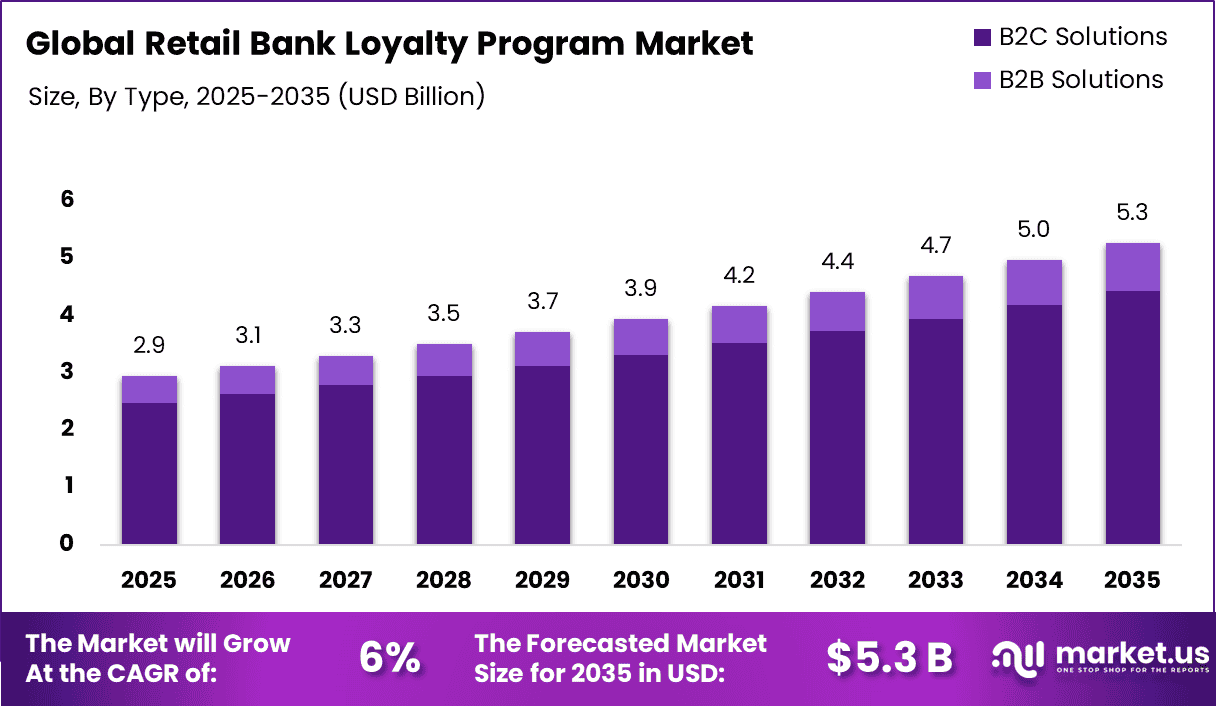
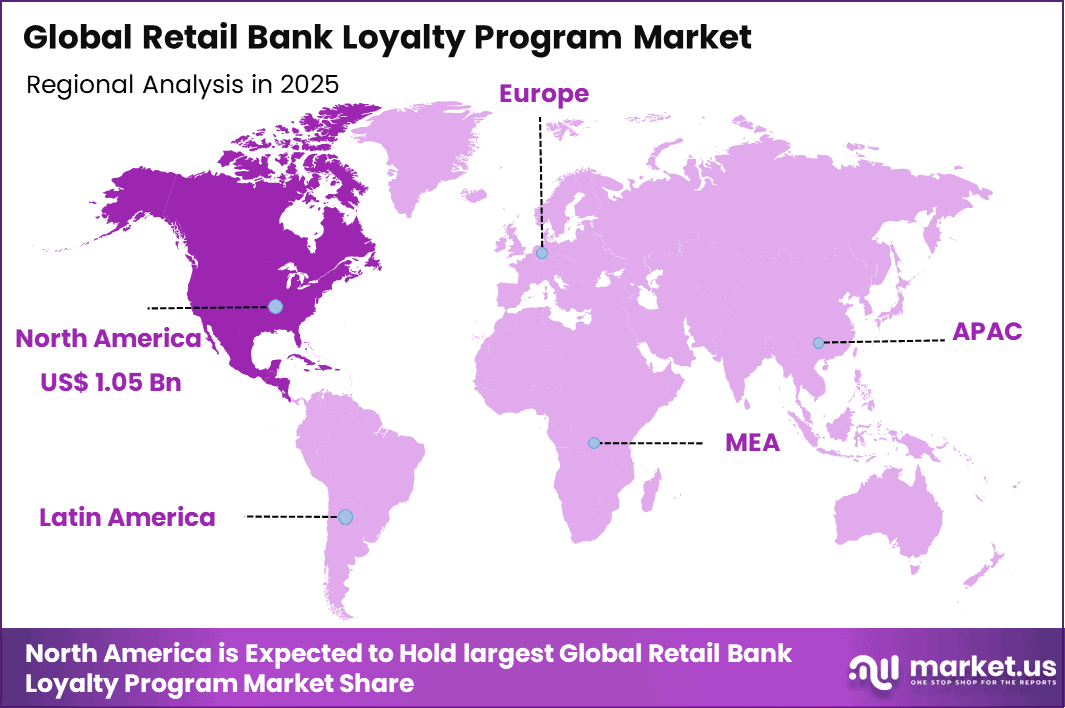
The Global Retail Bank Loyalty Program Market generated USD 2.9 billion in 2025 and is predicted to register growth from USD 3.1 billion in 2026 to about USD 5.3 billion by 2035, recording a CAGR of 6% throughout the forecast span. In 2025, North America held a dominant market position, capturing more than a 35.8% share, holding USD 1.05 Billion revenue.
Top Market Takeaways
- B2C solutions command 84.3%, delivering personalized points accumulation, tiered rewards, and seamless redemption across digital banking channels.
- Large enterprises hold 71.5% by size, leveraging enterprise-grade platforms for omnichannel integration, data analytics, and scalable campaign management.
- Personal end-use dominates at 78.2%, powering everyday banking rewards like cashback, travel perks, and exclusive offers for individual account holders.
- North America drives 35.8% global value, with U.S. market at USD 0.95 billion and 4.7% CAGR, fueled by competitive banking landscape and fintech partnerships.
Retail bank loyalty programs are designed to strengthen customer relationships by rewarding users for their banking activities such as transactions, savings, and product usage. These programs offer benefits like cashback, reward points, and exclusive offers, encouraging customers to stay engaged with the bank over time.
As banking services become more digital and competitive, loyalty programs are evolving from basic reward systems to more personalized and data driven engagement tools. Banks are using these platforms to improve customer retention and create long term value through continuous interaction.
One of the main driving factors is the increasing competition among banks to retain customers in a highly digital environment. Customers now have more choices and can easily switch providers, which is pushing banks to offer added value beyond core services.
In addition, the growing use of digital banking channels is enabling banks to track customer behavior and design more targeted rewards. The focus on enhancing customer experience is also encouraging the use of loyalty programs that can deliver personalized offers based on individual preferences. Partnerships with retail and service providers are further expanding the range of rewards, making these programs more attractive.
Demand for retail bank loyalty programs is rising as customers expect more value and engagement from their financial service providers. There is a strong preference for programs that are simple to understand, easy to use, and provide relevant rewards.
Banks are also looking for solutions that can integrate with their existing systems and offer real time insights into customer activity. The demand is particularly strong in digital banking environments where interaction is frequent and data driven strategies can be applied effectively. As customer expectations continue to evolve, the need for flexible and personalized loyalty solutions is expected to grow steadily.
Drivers Impact Analysis
| Key Driver | Impact on CAGR Forecast (~%) | Geographic Relevance | Impact Timeline | Additional Insight |
|---|---|---|---|---|
| Increasing competition among banks to retain customers | +2.3% | North America, Europe, Asia Pacific | Medium term | Loyalty programs improve retention |
| Rising adoption of digital banking and mobile apps | +2.1% | Global | Short to medium term | Digital channels enable engagement |
| Growing focus on personalized customer experience | +1.9% | Developed markets | Medium to long term | Personalization increases customer loyalty |
| Expansion of credit card and reward-based programs | +1.7% | Global | Medium term | Rewards drive customer participation |
| Integration of loyalty programs with partner ecosystems | +1.5% | Global | Medium to long term | Partnerships enhance program value |
Restraints Impact Analysis
| Key Restraint | Impact on CAGR Forecast (~%) | Geographic Relevance | Impact Timeline | Additional Insight |
|---|---|---|---|---|
| High operational and program management costs | -2.2% | Global | Short to medium term | Costs impact profitability |
| Low customer engagement in traditional programs | -1.9% | Global | Medium term | Engagement challenges reduce effectiveness |
| Data privacy and regulatory compliance issues | -1.7% | North America, Europe | Medium to long term | Regulations limit data usage |
| Complexity in program design and implementation | -1.5% | Global | Medium term | Complex systems slow adoption |
| Limited differentiation among loyalty offerings | -1.3% | Global | Medium to long term | Similar programs reduce appeal |
By Type Analysis
The B2C solutions segment accounted for 84.3% of the market share, reflecting its strong role in driving customer engagement and retention in retail banking. This dominance is supported by the need for banks to offer personalized rewards, cashback, and incentive programs to individual customers. B2C loyalty platforms help financial institutions strengthen relationships with customers by encouraging frequent transactions and improving overall satisfaction.
Another factor driving this segment is the growing competition among banks to differentiate their services. Loyalty programs targeted at consumers provide a direct way to influence customer behavior and increase brand loyalty. These solutions also enable banks to analyze spending patterns and tailor offers, which enhances customer experience and long-term engagement.
By Enterprise Size Analysis
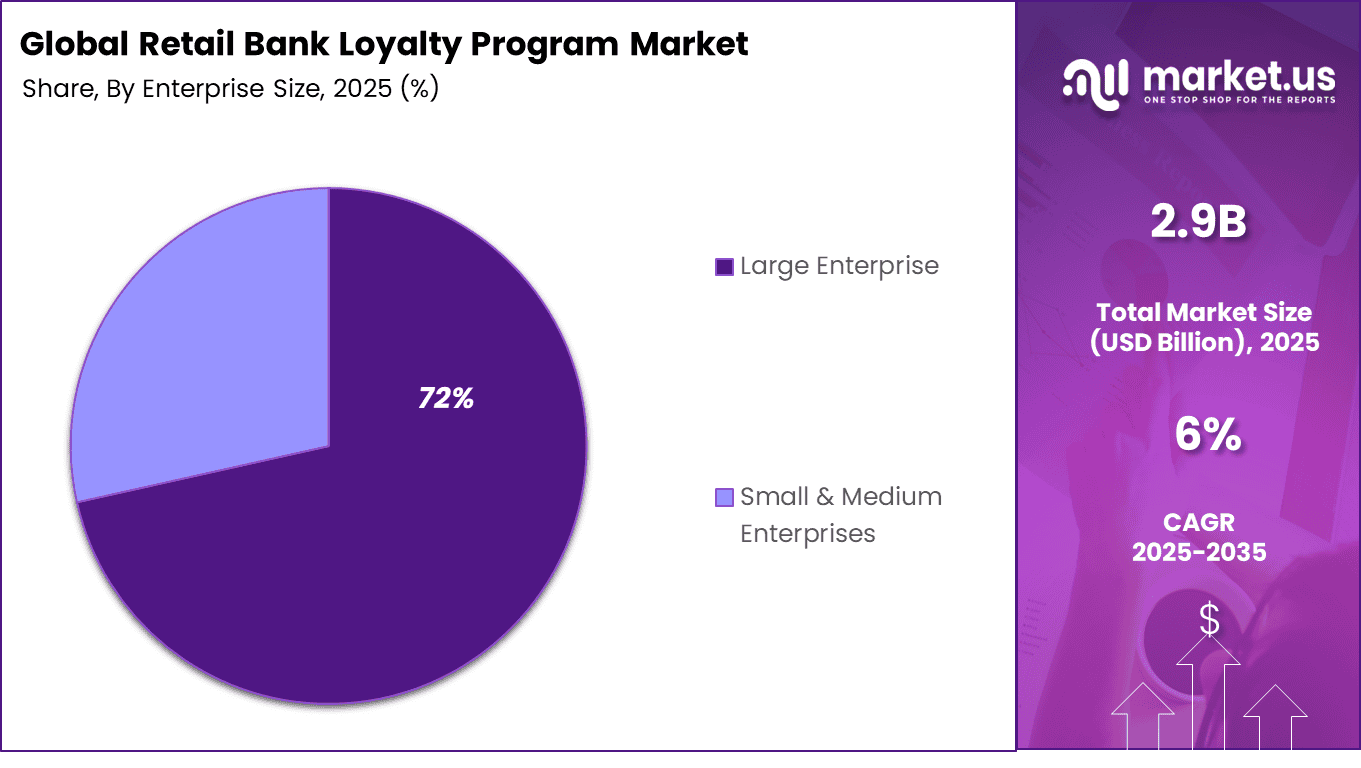
The large enterprise segment held 72% share, driven by the strong presence of established banking institutions with extensive customer bases. These organizations require advanced loyalty platforms to manage large-scale programs and deliver consistent experiences across multiple channels. Their ability to invest in sophisticated systems supports the adoption of comprehensive loyalty solutions.
In addition, large enterprises focus on strengthening customer relationships through data-driven strategies. They leverage analytics and automation to design targeted campaigns and improve program effectiveness. This has increased the demand for scalable and integrated loyalty platforms within this segment.
By End-Use Analysis
The personal segment captured 78.2% of the market, driven by the widespread use of loyalty programs among individual banking customers. Personal banking services rely heavily on engagement strategies to retain customers and increase product usage. Loyalty programs provide incentives that encourage regular transactions and deeper customer interaction with banking services.
Furthermore, the shift toward digital banking has made it easier to implement and manage personalized reward systems. Customers expect tailored offers and seamless experiences, which has encouraged banks to enhance their loyalty programs. This trend continues to support the growth of personal end-use applications in the retail bank loyalty program market.
Investor Type Impact Analysis
| Investor Type | Growth Sensitivity | Risk Exposure | Geographic Focus | Investment Outlook |
|---|---|---|---|---|
| Venture capital firms | Moderate | High | US, Europe | Investing in fintech and engagement platforms |
| Private equity firms | Moderate | Moderate | North America and Europe | Scaling loyalty and customer engagement firms |
| Corporate investors | High | Moderate | Global | Strategic investments in digital banking solutions |
| Institutional investors | Moderate | Low to moderate | Developed markets | Prefer stable banking technology providers |
| Government and public funding bodies | Low to moderate | Low | Global | Supporting financial inclusion initiatives |
Technology Enablement Analysis
| Technology | Impact on CAGR Forecast (~%) | Geographic Relevance | Impact Timeline | Additional Insight |
|---|---|---|---|---|
| AI-driven customer personalization engines | +2.5% | US, Europe | Medium to long term | Enhances targeted engagement |
| Cloud-based loyalty management platforms | +2.2% | Global | Short to medium term | Enables scalable deployment |
| Integration with digital wallets and payment apps | +2.0% | Global | Medium term | Improves accessibility and usage |
| Advanced data analytics for customer insights | +1.8% | Developed markets | Medium to long term | Supports better decision-making |
| Omnichannel engagement platforms | +1.6% | Global | Medium to long term | Provides seamless customer experience |
Key Challenges
- High cost of setting up and managing loyalty programs.
- Difficulty in keeping customers engaged over time.
- Data privacy concerns related to customer information.
- Complex integration with banking and CRM systems.
- Limited personalization due to lack of quality customer data.
- Regulatory requirements increase compliance burden.
- Measuring program success and return on investment is challenging.
- Risk of low redemption rates reducing program effectiveness.
- Competition from fintech and alternative reward programs.
- Frequent updates needed to keep offers attractive and relevant.
Emerging Trends
The retail bank loyalty program market is evolving toward more personalized and experience driven engagement models that go beyond traditional reward points. One of the key emerging trends is the use of data analytics and AI to design highly targeted loyalty offerings based on customer spending behavior, preferences, and financial habits. This is helping banks deliver more relevant rewards that increase engagement and retention.
Another important trend is the integration of loyalty programs with digital banking platforms, allowing customers to track rewards, redeem benefits, and receive personalized offers directly through mobile apps. There is also growing adoption of lifestyle based rewards, where customers gain access to travel, dining, and entertainment benefits rather than only financial incentives. In addition, partnerships with external merchants are expanding, enabling a broader ecosystem of rewards and creating more value for customers. Gamification features are also being introduced to make engagement more interactive and continuous.
Growth Factors
The growth of this market is driven by the increasing competition among banks to retain customers and strengthen long term relationships. As switching between financial service providers becomes easier, loyalty programs are being used as a key tool to differentiate offerings and improve customer retention. The rise of digital banking is also supporting this demand, as customers expect seamless and engaging experiences within mobile platforms.
Another major factor is the growing focus on customer lifetime value, where banks aim to deepen relationships by encouraging repeat usage of services. The shift toward cashless transactions and digital payments is further contributing to the expansion of loyalty programs, as more transaction data becomes available for designing targeted rewards. Additionally, changing consumer expectations toward personalized experiences are pushing banks to continuously enhance their loyalty strategies, supporting sustained growth in this market.
Key Market Segments
By Type
- B2C Solutions
- B2B Solutions
By Enterprise Size
- Large Enterprise
- Small & Medium Enterprises
By End-Use
- Personal
- Business
Regional Analysis
North America accounted for 35.8% of the Retail Bank Loyalty Program market, supported by the strong presence of large banking institutions and high adoption of digital banking services. Banks in the region are increasingly focusing on customer retention strategies, where loyalty programs play a key role in improving engagement and long-term relationships.
The growing use of data analytics allows banks to offer personalized rewards and targeted offers, which enhances customer satisfaction. In addition, increasing competition among financial institutions is encouraging the use of loyalty platforms to differentiate services and strengthen brand value.
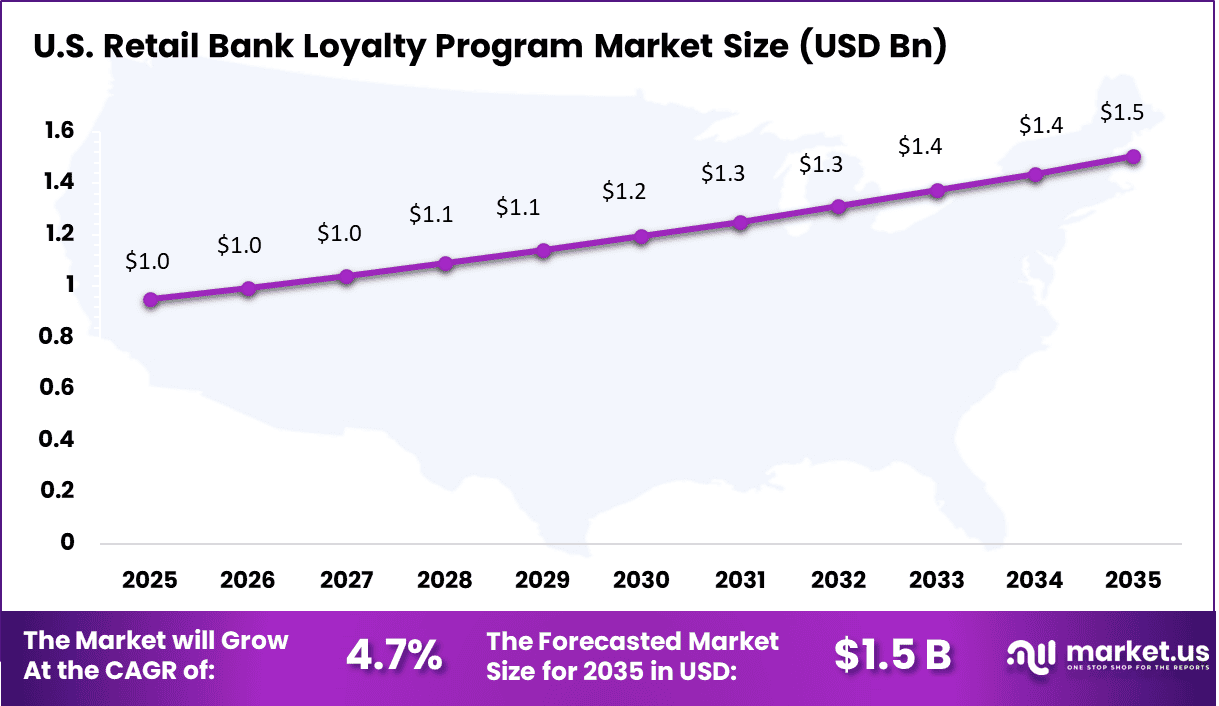
The U.S. market reached USD 0.95 Billion and is projected to grow at a CAGR of 4.7%, driven by rising focus on customer-centric banking and digital engagement. Financial institutions are adopting loyalty programs to improve customer experience and encourage frequent usage of banking services such as cards, mobile apps, and digital payments.
The integration of rewards with everyday transactions and partnerships with retail and service providers is also supporting adoption. As digital banking continues to expand, the demand for structured loyalty programs in the US is expected to maintain steady growth over the coming years.
Key Regions and Countries
- North America
- US
- Canada
- Europe
- Germany
- France
- The UK
- Spain
- Italy
- Russia
- Netherlands
- Rest of Europe
- Asia Pacific
- China
- Japan
- South Korea
- India
- Australia
- Singapore
- Thailand
- Vietnam
- Rest of APAC
- Latin America
- Brazil
- Mexico
- Rest of Latin America
- Middle East & Africa
- South Africa
- Saudi Arabia
- UAE
- Rest of MEA
Competitive Analysis
The competitive landscape of the Retail Bank Loyalty Program Market includes a mix of financial technology providers and customer engagement solution companies. Companies such as FIS Corporate, IBM, Oracle Corporation, TIBCO Software, and Hitachi-solutions focus on providing enterprise-level loyalty platforms integrated with banking systems.
These players offer advanced analytics, customer data management, and personalized reward programs that help banks improve customer retention and engagement. Their strong technology infrastructure and experience in financial services support their leading position in the market.
At the same time, companies such as Aimia, Maritz, Comarch, Exchange Solutions, Creatio, Customer Portfolios, and Antavo focus on specialized loyalty and customer engagement solutions tailored for banking and financial institutions.
These players emphasize flexible program design, real-time rewards, and omnichannel engagement to enhance customer experience. Competition in this market is driven by personalization, data-driven insights, and the ability to deliver seamless and engaging loyalty programs across digital and physical channels.
Top Key Players in the Market
- FIS Corporate
- Maritz
- IBM
- TIBCO Software
- Hitachi-solutions
- Oracle Corporation
- Aimia
- Comarch
- Exchange Solutions
- Creatio
- Customer Portfolios
- Antavo
- Others
Future Outlook
The future outlook for the Retail Bank Loyalty Program Market looks strong as banks continue to focus on improving customer retention and engagement. The market is expected to grow with increasing use of digital banking and personalized reward programs that attract and retain customers. Banks are anticipated to use data analytics to understand customer behavior and offer more relevant benefits. In the coming years, integration with mobile apps, real-time rewards, and AI-based personalization is expected to enhance user experience, making loyalty programs a key part of banking strategies.
Recent Developments
- March, 2026 – Hitachi Banking Insights integrates loyalty with CRM predicting next-best offers. Dynamics 365 connectors while Japanese precision analytics serve APAC banks. Microsoft ecosystem specialist.
- January, 2026 – IBM Watson Loyalty uses blockchain for cross-bank point pooling serving 50M customers. Hyperledger secures fraud-proof redemptions while AI predicts churn 90 days early. Enterprise AI pioneer.
Report Scope
| Report Features | Description |
|---|---|
| Market Value (2025) | USD 2.9 Billion |
| Forecast Revenue (2035) | USD 5.3 Billion |
| CAGR(2025-2035) | 6% |
| Base Year for Estimation | 2024 |
| Historic Period | 2020-2024 |
| Forecast Period | 2025-2035 |
| Report Coverage | Revenue forecast, AI impact on Market trends, Share Insights, Company ranking, competitive landscape, Recent Developments, Market Dynamics and Emerging Trends |
| Segments Covered | By Type (B2C Solutions, B2B Solutions), By Enterprise Size (Large Enterprise, Small & Medium Enterprises), By End-Use (Personal, Business) |
| Regional Analysis | North America – US, Canada; Europe – Germany, France, The UK, Spain, Italy, Russia, Netherlands, Rest of Europe; Asia Pacific – China, Japan, South Korea, India, New Zealand, Singapore, Thailand, Vietnam, Rest of Latin America; Latin America – Brazil, Mexico, Rest of Latin America; Middle East & Africa – South Africa, Saudi Arabia, UAE, Rest of MEA |
| Competitive Landscape | FIS Corporate, Maritz, IBM, TIBCO Software, Hitachi-solutions, Oracle Corporation, Aimia, Comarch, Exchange Solutions, Creatio, Customer Portfolios, Antavo, Others |
| Customization Scope | Customization for segments, region/country-level will be provided. Moreover, additional customization can be done based on the requirements. |
| Purchase Options | We have three license to opt for: Single User License, Multi-User License (Up to 5 Users), Corporate Use License (Unlimited User and Printable PDF) |





































