Global Reality Modeling Software Market Size, Share, Growth Analysis By Deployment Mode (Cloud-based, On-premises), By Application (Planning & Design, Construction Monitoring, Asset Management & Operations, Surveying & Mapping, Others), By End-User Industry (Architecture, Engineering, & Construction (AEC), Utilities & Energy, Government & Public Sector, Mining & Aggregates, Transportation & Infrastructure, Others), By Region and Companies - Industry Segment Outlook, Market Assessment, Competition Scenario, Statistics, Trends and Forecast 2025-2034
- Published date: Dec 2025
- Report ID: 170282
- Number of Pages: 336
- Format:
-
keyboard_arrow_up
Quick Navigation
Report Overview
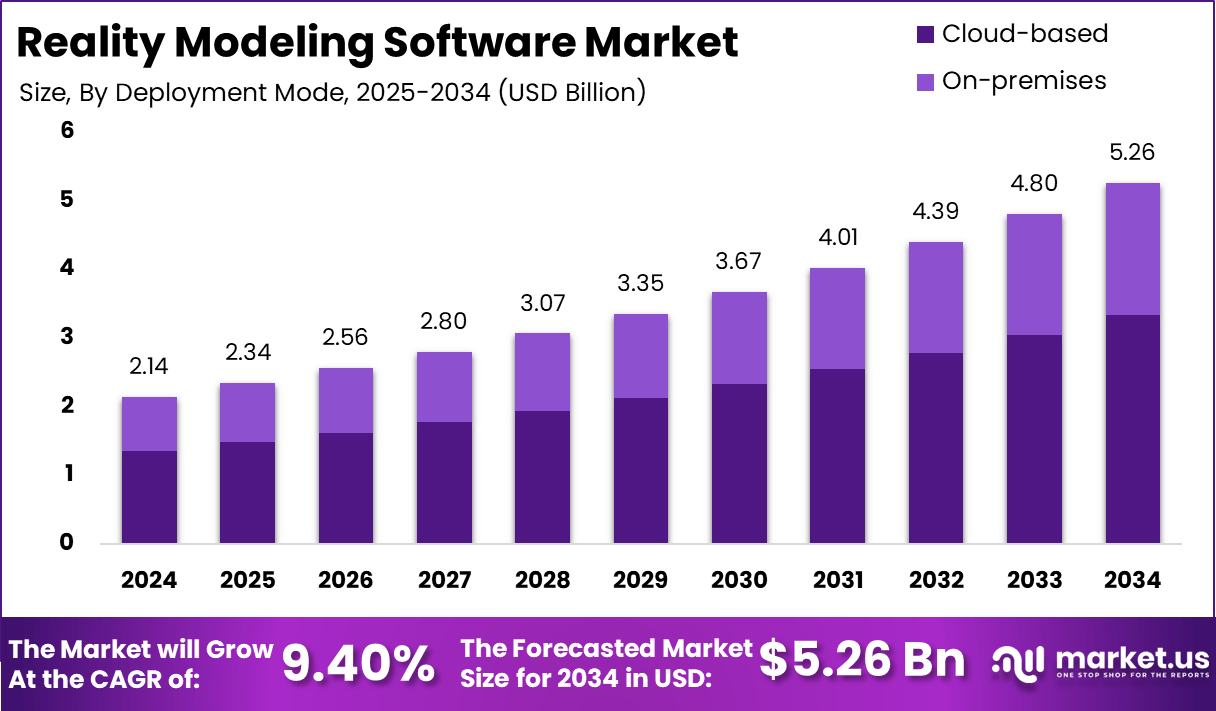
The Reality Modeling Software Market is expanding steadily as industries increasingly adopt digital tools to capture, visualize, and analyze real-world environments with high accuracy. In 2024, the market is valued at USD 2.14 billion, supported by rising demand across construction, infrastructure, urban planning, mining, and industrial asset management.
Reality modeling software enables the creation of detailed 3D representations using data from laser scanning, photogrammetry, drones, and LiDAR, helping organizations improve planning accuracy, reduce rework, and enhance decision-making. The growing emphasis on digital transformation and data-driven project execution is accelerating adoption. These solutions allow stakeholders to visualize existing site conditions, simulate design changes, and monitor progress against real-world conditions.
Integration with building information modeling, geographic information systems, and digital twin platforms further strengthens their role in end to end project workflows. As projects become larger and more complex, reality modeling software supports better coordination among engineers, designers, and operators by providing a shared and reliable digital context.
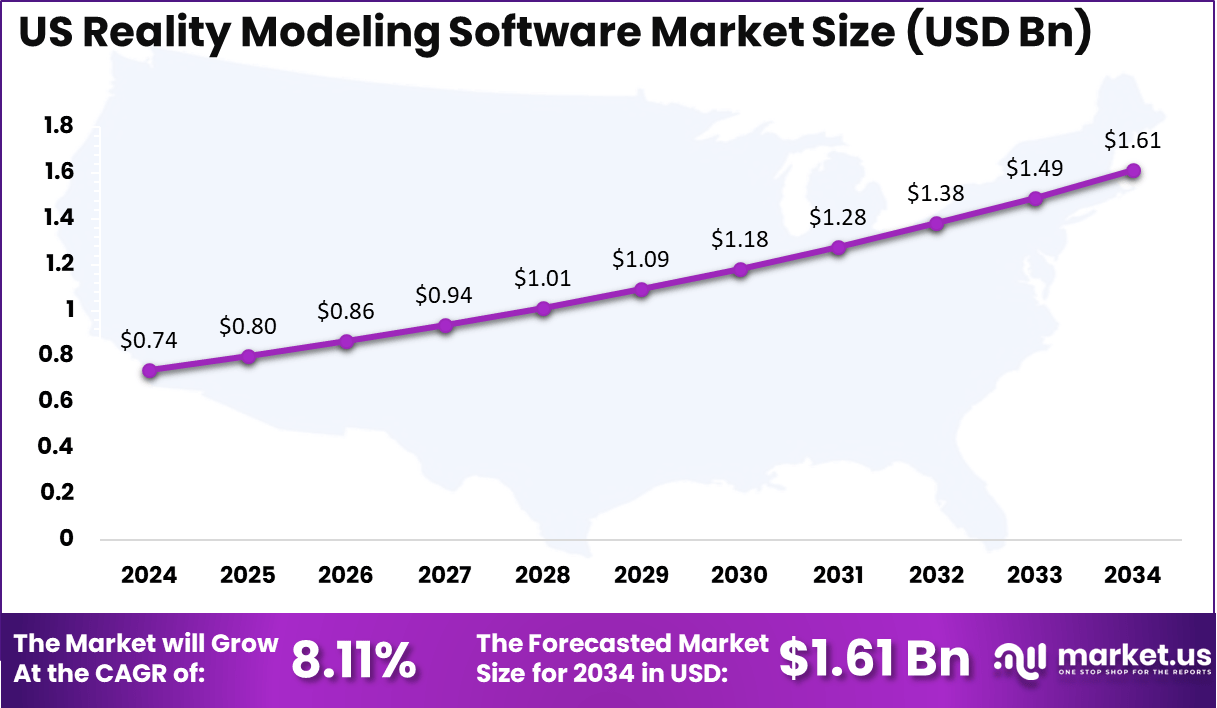
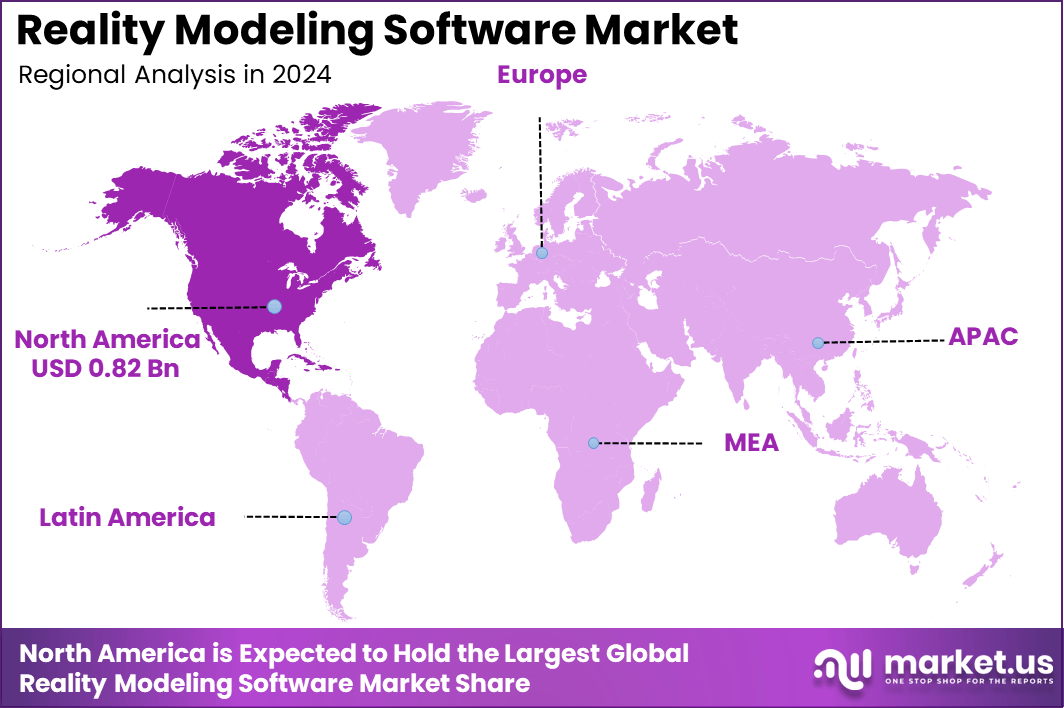
The market is projected to grow at a CAGR of 9.40%, reaching USD 5.26 billion by 2034. North America leads with a 38.5% share and a 2024 market size of USD 0.82 billion, driven by early technology adoption and strong infrastructure investment. The US alone accounts for USD 0.74 billion in 2024 and is anticipated to reach USD 1.16 billion by 2034, reflecting sustained demand for advanced reality capture and modeling solutions.
Reality modeling software is a digital solution used to capture, process, and visualize real-world environments in a highly accurate and interactive format. These platforms transform raw data collected from technologies such as laser scanning, photogrammetry, drones, and terrestrial imaging into detailed three-dimensional models. By creating a precise digital representation of physical spaces, reality modeling software enables organizations to better understand existing conditions before design, construction, or operational decisions are made.
The software plays a critical role in improving collaboration across project teams by providing a shared visual reference that reflects actual site conditions. Engineers, architects, planners, and operators can access the same model to review constraints, validate assumptions, and identify potential issues early in project lifecycles. This reduces rework, improves design accuracy, and supports more informed planning.
Reality modeling software is widely used across construction, infrastructure development, mining, urban planning, and industrial asset management. It supports applications such as site analysis, progress monitoring, clash detection, and long-term asset documentation. Integration with building information modeling, geographic information systems, and digital twin platforms further enhances its value by linking real-world conditions with design and operational data.
Overall, reality modeling software strengthens decision-making by improving visibility, accuracy, and coordination, making it an essential tool for organizations seeking efficient, data-driven management of complex physical environments.
Recent developments in reality modeling software highlight key funding rounds, acquisitions, mergers, and product launches. In early 2025, Augment secured $227 million in a Series B round to expand its enterprise AR tools for 3D modeling integration. MEMGPT followed with a $7.5 million Series A by late 2024, focusing on AI-driven spatial data processing for reality capture.
Mergers and acquisitions picked up in Q2 2024, with major deals consolidating photogrammetry firms and drone tech providers to enhance LiDAR workflows. Bentley Systems acquired a key AR startup in Q1 2025, bolstering its reality modeling suite for infrastructure projects.
New product launches include Hexagon’s HxDR platform in Q4 2024, automating point cloud generation from reality scans, and cloud-based collaboration tools from Virtuosity in Q1 2025, supporting real-time 3D twin edits. These moves underscore growing enterprise adoption in construction and urban planning.
Key Takeaways
- The Reality Modeling Software Market reached a value of USD 2.14 billion in 2024 and is projected to grow at a CAGR of 9.40%, reaching USD 5.26 billion by 2034.
- North America leads the global market with a 38.5% share, accounting for a 2024 market size of USD 0.82 billion due to early adoption across infrastructure and construction projects.
- The US represents the largest national market, valued at USD 0.74 Billion in 2024 and expected to reach USD 1.16 billion by 2034, supported by a CAGR of 8.11%.
- Cloud-based deployment dominates by deployment mode with a 63.4% share, reflecting demand for scalable access, collaboration, and centralized data management.
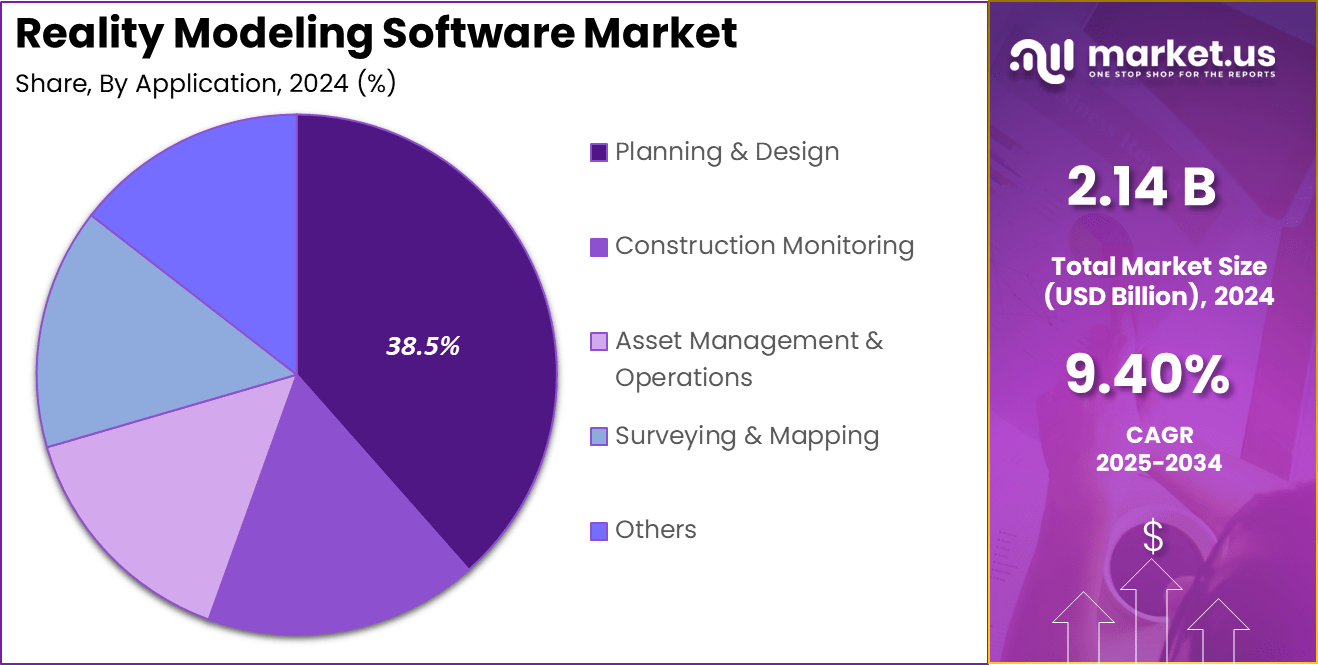
- Planning and design is the leading application segment with a 38.5% share, driven by the need for accurate visualization of real-world conditions during early project stages.
- Architecture, engineering, and construction remains the dominant end-user industry, holding a 52.9% share due to widespread use of reality modeling in design coordination and project execution.
Role of Software
Reality modeling software plays a critical role in converting physical environments into accurate digital representations that support planning, design, and operational decision-making. These platforms process large volumes of spatial data collected from drones, laser scanners, and imaging systems, often handling datasets exceeding several terabytes per project.
Advanced processing engines can generate high-resolution 3D meshes and point clouds with spatial accuracy measured in millimeters, enabling precise analysis of terrain, structures, and existing assets. The software improves project efficiency by reducing site visits and minimizing design assumptions. Studies across construction and infrastructure projects indicate that early use of reality models can reduce rework by over 20% by identifying clashes and constraints during preconstruction stages.
Automated feature extraction tools also accelerate workflows by detecting surfaces, edges, and objects, shortening modeling timelines that traditionally required weeks of manual effort. Reality modeling software supports collaboration by enabling multi-user access to shared visual environments. Cloud-enabled platforms allow teams to review models remotely, annotate issues, and compare progress over time.
Integration with digital twins and simulation tools allows users to test design alternatives, evaluate environmental impacts, and monitor changes throughout asset lifecycles. Overall, the software acts as a foundational layer for digital project delivery, enhancing accuracy, improving coordination, and enabling data-driven decisions across complex physical environments.
Industry Adoption
Industry adoption of reality modeling software is accelerating as organizations seek more accurate and efficient ways to understand and manage physical environments. Architecture, engineering, and construction firms are among the earliest adopters, using these tools to capture existing site conditions, validate designs, and improve coordination across multidisciplinary teams. Reality models provide a shared visual reference that reduces misinterpretation and improves communication between designers, contractors, and project owners.
Infrastructure operators and urban planning authorities are increasingly adopting reality modeling software to support transportation projects, utilities planning, and city development initiatives. These platforms enable detailed analysis of terrain, structures, and surrounding environments, supporting better decision-making during planning and execution phases. Adoption is also growing in mining, energy, and industrial sectors, where accurate spatial data improves safety planning, asset monitoring, and operational efficiency.
The use of drones and mobile scanning technologies has further accelerated adoption by making data capture faster and more accessible. Organizations are integrating reality modeling software into broader digital workflows that include building information modeling, geographic information systems, and digital twin platforms. This integration supports continuous data exchange from design through operations.
Overall, industry adoption is driven by the need for higher accuracy, reduced project risk, and improved collaboration. As digital transformation initiatives expand, reality modeling software is increasingly viewed as a standard tool rather than a specialized capability across multiple industries.
Emerging Trends
Reality modeling software is evolving rapidly as new technologies reshape how physical environments are captured and analyzed. One major trend is the increasing use of artificial intelligence to automate data processing tasks such as object recognition, surface classification, and change detection. AI-driven workflows are reducing manual modeling effort and enabling faster turnaround from data capture to usable 3D models, improving productivity across project teams.
Another key trend is the deeper integration of reality modeling with digital twin platforms. Organizations are moving beyond static models toward dynamic representations that update as site conditions change, supporting continuous monitoring throughout project lifecycles. This trend is particularly visible in infrastructure and industrial asset management, where long-term visibility into physical conditions is essential.
Cloud-based collaboration is also becoming more prominent. Reality modeling platforms are increasingly designed to support remote access, real-time annotations, and version control, enabling geographically distributed teams to work on shared models without local hardware constraints. Advances in data compression and streaming technologies are making it easier to visualize complex models on standard devices.
Additionally, the use of drones, mobile scanners, and wearable capture tools is expanding, increasing data availability and model frequency. Together, these trends highlight a shift toward faster, more connected, and intelligence-driven reality modeling workflows across industries.
US Market Size
The US Reality Modeling Software Market reflects steady expansion as digital capture and visualization technologies become integral to project planning and asset management workflows. In 2024, the market size reached USD 0.74 billion, supported by strong adoption across construction, infrastructure development, urban planning, and industrial facilities management.
Organizations across the US increasingly rely on reality modeling software to gain accurate visibility into existing site conditions, reduce uncertainty during design phases, and improve coordination among project stakeholders.
The market is projected to grow consistently, reaching USD 1.16 billion by 2034 at a CAGR of 8.11%. This growth is driven by continued investments in digital construction practices, smart infrastructure initiatives, and advanced project delivery methods. Reality modeling software supports these initiatives by enabling high-fidelity 3D representations that align design intent with real-world conditions, reducing delays and cost overruns.
US based firms are also leveraging reality modeling tools to support large-scale infrastructure upgrades and redevelopment projects, where precise spatial understanding is critical. Integration with building information modeling, geographic information systems, and digital twin platforms further strengthens adoption by enabling seamless data flow across project stages.
Overall, the US market demonstrates strong fundamentals, with sustained demand for accurate, scalable, and collaborative reality modeling solutions, positioning the software as a core component of modern digital workflows.
By Deployment Mode
Cloud-based deployment leads the Reality Modeling Software Market with a 63.4% share, reflecting strong demand for scalable access, collaboration, and centralized data management. Cloud platforms enable users to process, store, and visualize large reality capture datasets without heavy local hardware requirements.
This deployment model supports remote access for distributed teams, allowing architects, engineers, planners, and project owners to work on shared models in real time. Cloud-based solutions also simplify software updates, version control, and data synchronization, which is critical for projects involving frequent site changes and multi-stakeholder coordination.
On-premises deployment continues to be used by organizations with strict data governance, security, or regulatory requirements. Some enterprises prefer on-premises systems to maintain full control over sensitive project data, especially for government facilities, industrial plants, or defense-related infrastructure.
These deployments allow tighter integration with internal IT systems and customized workflows, but often require higher upfront infrastructure investment and dedicated maintenance resources. While on-premises solutions remain relevant for specific use cases, the shift toward digital collaboration and flexible project execution is accelerating cloud adoption.
As reality modeling datasets grow in size and complexity, cloud-based deployment is increasingly viewed as the most practical and efficient option for long term scalability and cross-project accessibility.
By Application
Planning and design is the leading application segment in the Reality Modeling Software Market with a 38.5% share, as an accurate representation of existing conditions is critical during early project stages. Reality models provide planners and designers with detailed visual context, helping them evaluate site constraints, optimize layouts, and validate design assumptions before construction begins. This reduces design errors, minimizes rework, and supports more confident decision-making across complex projects.
Construction monitoring represents a growing application area, where reality modeling software is used to track project progress and compare actual site conditions with planned designs. Regular reality capture enables teams to identify deviations early, improve schedule control, and enhance communication between contractors and project owners. Asset management and operations also benefit from reality modeling by maintaining digital records of facilities and infrastructure that support maintenance planning, inspections, and long-term lifecycle management.
Surveying and mapping applications rely on reality modeling software to generate accurate terrain models, point clouds, and spatial measurements. These capabilities improve efficiency compared to traditional surveying methods and support large-scale land development and infrastructure projects.
Other applications include environmental analysis, historical documentation, and compliance reporting. Together, these use cases highlight the versatility of reality modeling software across the full project lifecycle, from early planning through construction execution and long-term operations.
By End-User Industry
Architecture, engineering, and construction account for the largest share of the Reality Modeling Software Market at 52.9%, driven by the need for accurate visualization and coordination across complex projects.
AEC firms rely on reality modeling software to capture existing site conditions, validate designs, and reduce uncertainty during planning and construction phases. High-fidelity reality models support clash identification, constructability reviews, and coordination among multidisciplinary teams, improving project efficiency and reducing rework.
Utilities and energy companies use reality modeling software to document facilities, corridors, and assets for planning upgrades, inspections, and maintenance activities. These models improve safety planning and enable better access management for large and often remote sites.
Government and public sector organizations adopt reality modeling to support urban planning, public works projects, and infrastructure management, benefiting from improved transparency and data-driven decision-making.
Mining and aggregates operators apply reality modeling software for site planning, volume analysis, and operational monitoring, where accurate spatial data supports productivity and compliance. Transportation and infrastructure stakeholders use these tools to manage roads, bridges, rail corridors, and airports by maintaining detailed digital representations of assets. Other industries, including manufacturing and real estate, also adopt reality modeling software to support facility planning and asset documentation, reflecting its broad applicability across sectors.
Key Market Segments
By Deployment Mode
- Cloud-based
- On-premises
By Application
- Planning & Design
- Construction Monitoring
- Asset Management & Operations
- Surveying & Mapping
- Others
By End-User Industry
- Architecture, Engineering, & Construction (AEC)
- Utilities & Energy
- Government & Public Sector
- Mining & Aggregates
- Transportation & Infrastructure
- Others
Regional Analysis
North America dominates the Reality Modeling Software Market with a 38.5% share, reflecting strong adoption of advanced digital visualization and reality capture technologies across multiple industries. In 2024, the regional market size reached USD 0.82 billion, supported by the widespread use of reality modeling tools in construction, infrastructure development, urban planning, and industrial asset management. Organizations across the region increasingly prioritize accurate digital representations to improve project planning, coordination, and risk reduction.
The region benefits from early technology adoption, a strong presence of software innovators, and mature digital construction practices. Reality modeling software is widely integrated with building information modeling, geographic information systems, and digital twin platforms, enabling seamless data exchange across project stages. Public and private sector investments in infrastructure modernization further support regional demand, particularly for transportation, utilities, and large-scale redevelopment projects.
North America also leads in the adoption of cloud-based collaboration and drone-enabled data capture, which enhance the efficiency and scalability of reality modeling workflows. The growing emphasis on data-driven decision-making and lifecycle asset management strengthens long-term adoption across sectors. Overall, the region’s leadership is underpinned by technological maturity, strong digital infrastructure, and sustained demand for accurate, collaborative, and scalable reality modeling solutions.
Regional Analysis and Coverage
- North America
- US
- Canada
- Europe
- Germany
- France
- The UK
- Spain
- Italy
- Russia
- Netherlands
- Rest of Europe
- Asia Pacific
- China
- Japan
- South Korea
- India
- Australia
- Singapore
- Thailand
- Vietnam
- Rest of Latin America
- Latin America
- Brazil
- Mexico
- Rest of Latin America
- Middle East & Africa
- South Africa
- Saudi Arabia
- UAE
- Rest of MEA
Driving Factors
The Reality Modeling Software Market is driven by the growing demand for accurate digital representation of physical environments across complex projects. Increasing project scale and complexity have made traditional surveying and documentation methods inefficient, pushing organizations toward reality capture solutions.
Industry studies indicate that early use of reality modeling can reduce design-related errors by over 25%, improving project predictability. Rapid adoption of drones, LiDAR, and mobile scanning tools is also accelerating demand, as these technologies enable faster data collection with higher precision. The shift toward digital construction workflows and integrated project delivery models further supports adoption, as stakeholders require shared visual environments for coordination.
Additionally, the growing emphasis on safety planning, remote site assessment, and reduced site visits is strengthening reliance on software-based reality modeling. These factors collectively position reality modeling software as a foundational tool for modern planning, construction, and asset management workflows.
Restraint factors
Despite strong demand, several factors limit the wider adoption of reality modeling software. High data processing requirements remain a challenge, as reality capture projects often generate large datasets that strain storage and computing resources. Skilled personnel shortages also restrict adoption, with many organizations lacking trained staff to manage data capture and model processing workflows.
Integration challenges with legacy systems and existing project management tools can slow deployment and reduce operational efficiency. Data accuracy concerns may arise when capture conditions are suboptimal, affecting model reliability.
Additionally, some organizations remain cautious due to cybersecurity and data privacy risks associated with centralized digital models. These restraints highlight the need for improved automation, training, and system interoperability to support broader market penetration.
Growth opportunities
Significant growth opportunities exist as industries expand digital transformation initiatives. Increasing adoption of digital twins creates a strong demand for continuously updated reality models that reflect real-world conditions. Infrastructure modernization programs and smart city initiatives are opening new use cases for large-scale spatial modeling.
Advances in cloud computing and data compression are reducing hardware barriers, enabling wider access to reality modeling tools. Emerging markets investing in construction, transportation, and energy infrastructure present additional opportunities for early adoption.
Software providers can also expand value by offering analytics, simulation, and lifecycle management capabilities on top of core modeling functions. As organizations seek higher productivity and better risk control, reality modeling software is well positioned to support long term growth.
Trending factors
Several trends are shaping the evolution of reality modeling software. Artificial intelligence is increasingly used to automate feature extraction, object classification, and change detection, reducing manual processing effort by nearly 40% in some workflows. Cloud-based collaboration is becoming standard, enabling real-time model access and cross-team coordination.
Integration with augmented and virtual reality tools is gaining traction, supporting immersive design reviews and training applications. More frequent reality capture using drones and mobile scanners is improving project visibility and progress tracking.
Interoperability with building information modeling and asset management platforms is also expanding. Together, these trends indicate a shift toward faster, more intelligent, and fully connected reality modeling ecosystems.
Competitive Analysis
The Reality Modeling Software Market is characterized by a diverse and competitive landscape featuring specialized reality capture platforms, broader modeling tools, and software that integrates 3D data into digital workflows. Several established and emerging vendors are advancing capabilities in point cloud processing, photogrammetry, 3D reconstruction, and collaborative project delivery.
One of the widely recognized software solutions in the space is RealityCapture, known for its high-performance 3D reconstruction from images and laser scans. Its ecosystem includes competitors such as Agisoft PhotoScan (Metashape) and Meshroom, which are commonly evaluated alternatives for photogrammetry and model generation.
Pix4Dmapper and ArcGIS Drone2Map also serve as competitive offerings with strong capabilities for mapping and model generation from aerial or drone-based data. Companies focused on linked reality capture and project management include OpenSpace, which combines 360° capture with construction workflows, and specialized platforms like Track3D that emphasize automated monitoring and deviation analysis.
Cintoo Cloud is notable for integrating point cloud data into cloud-based collaboration environments, appealing to larger enterprise users. Hardware and software ecosystem players such as Leica Geosystems and Hexagon enhance competitive pressure by offering integrated capture-to-model solutions that blend laser scanning with advanced processing. Overall, the competitive dynamics emphasize innovation in data processing speed, cloud integration, interoperability with BIM and GIS systems, and automation driven by artificial intelligence to meet evolving industry requirements.
Top Key Players in the Market
- Bentley Systems, Incorporated
- Autodesk, Inc.
- Trimble, Inc.
- AECOM
- WSP Global, Inc.
- SAP SE
- Oracle Corporation
- IBM Corporation
- AssetIntel, LLC
- AgileAssets, Inc.
- GISGRO Oy
- Innovyze, Inc. (an Autodesk company)
- Roadware, Inc.
- Deighton Associates, Ltd. (dTIMS)
- mPower, Inc.
- Others
Recent Developments
- February 2025: Infrastructure and construction firms increased adoption of reality modeling software integrated with drone-based data capture to improve site visibility and reduce repeat site visits during early planning and design stages.
- May 2025: Industry updates highlighted growing use of AI-enabled reality modeling platforms to automate point cloud classification and change detection, supporting faster decision-making across large-scale construction projects.
- August 2025: Public sector organizations expanded use of reality modeling software for urban planning and infrastructure assessment, driven by the need for accurate digital representations to support redevelopment and resilience initiatives.
Report Scope
Report Features Description Market Value (2024) USD 2.14 Billion Forecast Revenue (2034) USD 5.26 Billion CAGR(2025-2034) 9.40% Base Year for Estimation 2024 Historic Period 2020-2023 Forecast Period 2025-2034 Report Coverage Revenue forecast, AI impact on Market trends, Share Insights, Company ranking, competitive landscape, Recent Developments, Market Dynamics, and Emerging Trends Segments Covered By Deployment Mode (Cloud-based, On-premises), By Application (Planning & Design, Construction Monitoring, Asset Management & Operations, Surveying & Mapping, Others), By End-User Industry (Architecture, Engineering, & Construction (AEC), Utilities & Energy, Government & Public Sector, Mining & Aggregates, Transportation & Infrastructure, Others) Regional Analysis North America – US, Canada; Europe – Germany, France, The UK, Spain, Italy, Russia, Netherlands, Rest of Europe; Asia Pacific – China, Japan, South Korea, India, New Zealand, Singapore, Thailand, Vietnam, Rest of Latin America; Latin America – Brazil, Mexico, Rest of Latin America; Middle East & Africa – South Africa, Saudi Arabia, UAE, Rest of MEA Competitive Landscape Bentley Systems, Incorporated, Autodesk, Inc., Trimble, Inc., AECOM, WSP Global, Inc., SAP SE, Oracle Corporation, IBM Corporation, AssetIntel, LLC, AgileAssets, Inc., GISGRO Oy, Innovyze, Inc. (an Autodesk company), Roadware, Inc., Deighton Associates, Ltd. (dTIMS), mPower, Inc., Others Customization Scope Customization for segments, region/country-level will be provided. Moreover, additional customization can be done based on the requirements. Purchase Options We have three licenses to opt for: Single User License, Multi-User License (Up to 5 Users), Corporate Use License (Unlimited Users and Printable PDF)  Reality Modeling Software MarketPublished date: Dec 2025add_shopping_cartBuy Now get_appDownload Sample
 -
-
- Bentley Systems, Incorporated
- Autodesk, Inc.
- Trimble, Inc.
- AECOM
- WSP Global, Inc.
- SAP SE
- Oracle Corporation
- IBM Corporation
- AssetIntel, LLC
- AgileAssets, Inc.
- GISGRO Oy
- Innovyze, Inc. (an Autodesk company)
- Roadware, Inc.
- Deighton Associates, Ltd. (dTIMS)
- mPower, Inc.
- Others
Our Clients

- 170282
- Dec 2025