


Global Ready-to-Drink Cocktails Market By Type (Malt-based, Spirit-based, Wine-based, and Others), By Packaging (Bottles and Cans), By Distribution Channel (On-trade and Off -trade), By Region and Companies - Industry Segment Outlook, Market Assessment, Competition Scenario, Trends and Forecast 2025-2035
- Published date: Mar 2026
- Report ID: 180960
- Number of Pages: 387
- Format:
-
keyboard_arrow_up
Quick Navigation
Report Overview
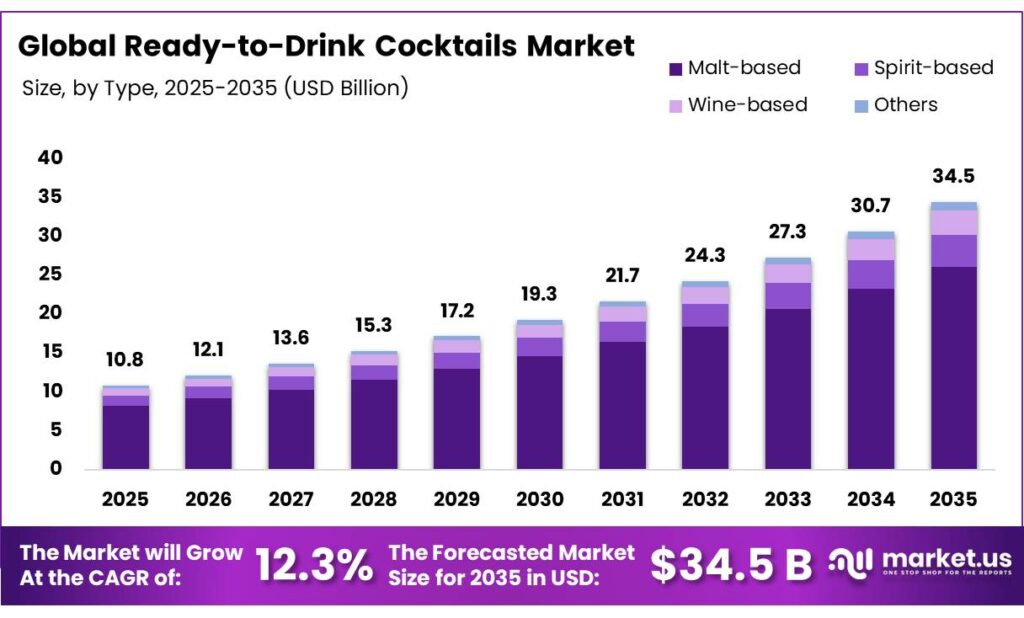
The Global Ready-to-Drink Cocktails Market size is expected to be worth around USD 34.5 Billion by 2035, from USD 10.8 Billion in 2025, growing at a CAGR of 12.3% during the forecast period from 2026 to 2035. In 2025, North America held a dominant market position, capturing more than a 34.8% share, holding USD 2.3 Billion revenue.
Ready-to-Drink (RTD) cocktails are pre-mixed alcoholic beverages packaged in single-serve containers such as cans, bottles, or pouches that are ready for immediate consumption. They eliminate the need for measuring ingredients, shaking, or stirring, providing a consistent bar-quality experience without requiring mixology expertise. Its market is characterized by convenience, portability, and product diversification, with North America serving as the largest regional market.
Canned formats dominate due to portability, rapid chilling, shelf stability, and recyclability, while off-trade channels, such as supermarkets, convenience stores, and liquor retailers, account for the majority of sales, reflecting the product’s alignment with home and on-the-go consumption. Product innovation drives differentiation, including spirit-based, malt-based, low- and no-alcohol variants, non-carbonated formulations, and diverse flavor profiles.
- In the RTD cocktails sector, manufacturers are reformulating to meet the World Health Organization’s Global Alcohol Action Plan 2022-2030, which targets a 20% relative reduction in harmful alcohol use by 2030.
Furthermore, regulatory frameworks, excise taxes, and labeling requirements influence production and distribution, while geopolitical tensions and energy costs can impact supply chains. Malt-based RTDs are prevalent due to moderate alcohol content, stable mixing characteristics, and regulatory advantages. Collectively, convenience, regulatory alignment, and packaging innovation underpin the market’s structure and consumer adoption patterns.
Key Takeaways:
- The global ready-to-drink cocktails market was valued at USD 10.8 billion in 2025.
- The global ready-to-drink cocktails market is projected to grow at a CAGR of 12.3% and is estimated to reach USD 34.5 billion by 2035.
- On the basis of product type, malt-based ready-to-drink cocktails dominated the market, constituting 75.8% of the total market share.
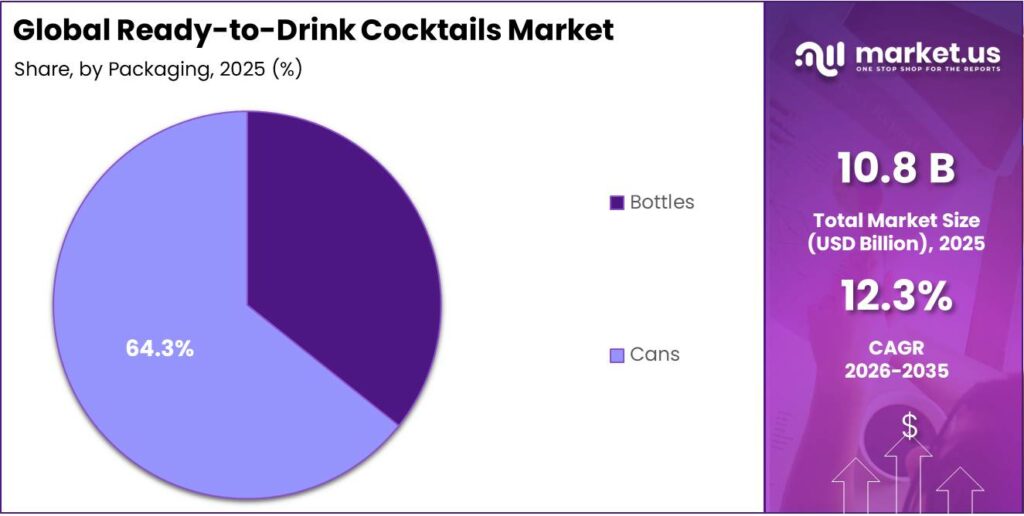
- Based on the packaging of the ready-to-drink cocktails, cans led the market, comprising 64.3% of the total market.
- Among the distribution channels, off-trade channels held a major share of the market, accounting for around 56.8% of the revenue.
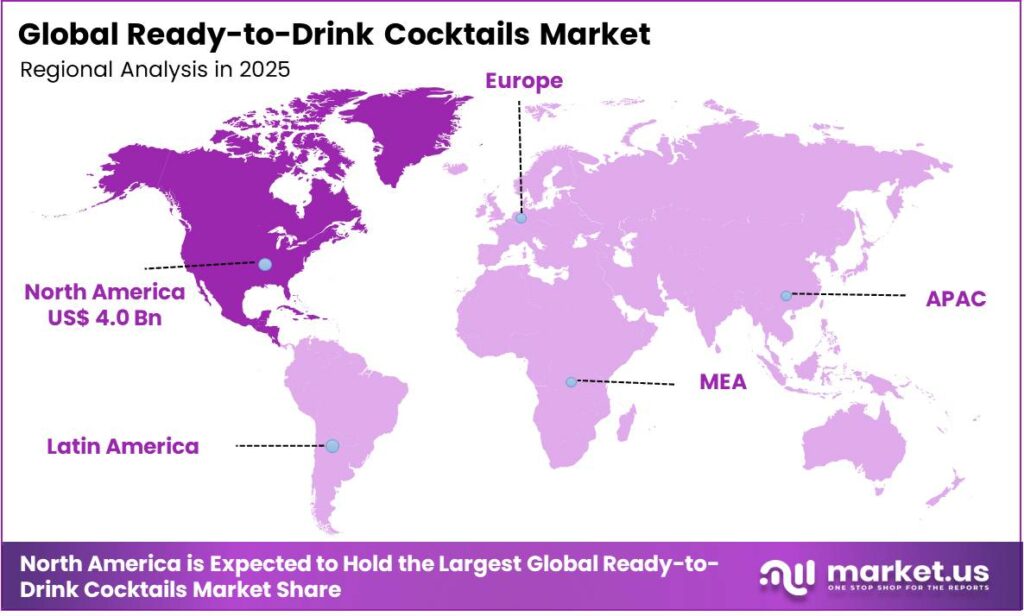
- In 2025, North America was the most dominant region in the ready-to-drink cocktails market, accounting for 36.8% of the total global consumption.
Type Analysis
Malt-based Ready-to-Drink Cocktails Are a Prominent Segment in the Market.
The market is segmented based on the product type into malt-based, spirit-based, wine-based, and others. The malt-based cocktails led the market, comprising 75.8% of the market share, due to regulatory, production, and consumer convenience factors. In many jurisdictions, malt-based beverages face lower excise taxes and simpler licensing requirements compared with spirit- or wine-based drinks, making production and distribution more stable. Their alcohol content, typically moderate, allows single-serve formats that appeal to casual or social consumption occasions.
In addition, malt provides a stable base that mixes well with flavors such as fruit, cola, or energy ingredients without extensive processing, ensuring product consistency and shelf stability. Additionally, malt-based RTDs are often carbonated, enhancing refreshment and perceived value, and their familiarity to consumers accustomed to beer-like beverages supports broader acceptance across diverse demographics.
Packaging Analysis
Canned Ready-to-Drink Cocktails Dominated the Market.
On the basis of packaging, the ready-to-drink cocktails market is segmented into bottles and cans. The canned ready-to-drink cocktails dominated the market, comprising 64.3% of the market share, due to convenience, portability, and functional efficiency. Cans are lightweight, easy to transport, and rapidly chillable, making them ideal for outdoor activities, on-the-go consumption, and single-serve occasions. Their compact form enables efficient storage and shelf placement in retail outlets, supporting impulse purchases.
Similarly, cans offer superior protection from light and oxygen, preserving flavor and carbonation, which is especially important for carbonated or fruit-flavored RTDs. From a sustainability perspective, aluminum cans are highly recyclable, appealing to environmentally conscious consumers. Additionally, cans allow consistent portion control and are often easier to open without tools, enhancing user convenience. The portability, preservation, sustainability, and ease of use position canned RTDs as the preferred format over traditional glass bottles in everyday consumption contexts.
Distribution Channel Analysis
Ready-to-Drink Cocktails Are Mostly Sold Through Off-Trade Channels.
Among the distribution channels, 56.8% of the total global consumption of ready-to-drink cocktails is sold through off-trade channels, such as supermarkets/hypermarkets, specialty stores, convenience stores, and online stores, outperforming on-trade channels, such as pubs, bars & cafes, hotels & restaurants, and others.
Most ready-to-drink (RTD) cocktails are sold through off-trade channels, as these outlets align with the product’s convenience and portability attributes. Off-trade channels allow consumers to purchase RTDs for at-home consumption, picnics, or outdoor events, supporting single-serve or multi-pack purchases without the time or service constraints of on-trade venues such as bars or restaurants.
The packaging of RTDs, often cans or small bottles, facilitates transport and storage, making them well-suited for retail shelves and home refrigeration. Off-trade sales further provide broader geographic coverage, enabling consistent availability across urban and suburban markets. By contrast, on-trade channels often emphasize freshly mixed cocktails, personalized service, and consumption on-site, which diminishes the functional advantage of pre-mixed, ready-to-serve RTD products.
Key Market Segments:
By Type
- Malt-based
- Spirit-based
- Wine-based
- Others
By Packaging
- Bottles
- Cans
By Distribution Channel
- On-trade
- Pubs, Bars & Cafes
- Hotels & Restaurants
- Others
- Off -trade
- Supermarkets/Hypermarkets
- Specialty Stores
- Convenience Stores
- Online Stores
Drivers
Demand for Convenience and Portability Drives the Ready-to-Drink Cocktails Market.
The ready-to-drink (RTD) cocktail market is fundamentally driven by a shift toward on-the-go consumption and convenience-oriented lifestyles, particularly among younger demographic segments. They materially shape consumer adoption by reducing preparation requirements and enabling immediate consumption across informal settings. Consumers, specifically Millennials and Gen Z, increasingly prioritize products that align with fast-paced, urbanized schedules where time for manual cocktail preparation is limited.
The producers explicitly design RTD formats to simplify cocktail preparation and broaden consumption occasions. For instance, Diageo introduced canned cocktails combining rum and coconut water at 5% alcohol by volume (ABV) in 12-ounce, 355 ml cans, intended to offer consumers a convenient way to enjoy classic drinks without mixing ingredients.
In addition, market shifts toward digital commerce have optimized convenience. Portability is reinforced through standardized single-serve packaging. For instance, a joint product from The Coca‑Cola Company and Bacardi Limited packages a pre-mixed rum-and-cola cocktail in about 355 ml cans with about 5-5.9% ABV, enabling transportable, ready-to-consume servings comparable in strength to typical mixed drinks.
By standardizing alcohol strength, portion size, and packaging, manufacturers convert multi-ingredient cocktails into single-unit beverages suitable for rapid retail purchase and on-the-go consumption, reinforcing convenience as a primary adoption driver.
Restraints
Regulatory Hurdles and Shifting Consumer Health Preferences Might Hamper the Demand for the Ready-to-Drink Cocktails.
Regulatory constraints and evolving health preferences pose structural challenges to the ready-to-drink cocktails segment. Alcoholic beverages are subject to excise taxation, marketing controls, and public-health policies implemented by governments. The World Health Organization reports that alcohol consumption causes about 2.6 million deaths globally in a year, including 1.6 million from non-communicable diseases and 700,000 from injuries, prompting regulatory measures such as taxation and labeling requirements.
Consequently, governments increasingly use fiscal tools to discourage consumption. For instance, WHO policy guidance emphasizes higher taxes on alcohol and sugar-sweetened beverages to reduce health risks, highlighting taxation as a primary regulatory intervention affecting beverage markets.
Furthermore, shifting consumer health awareness further constrains demand for alcoholic RTDs. The WHO states that alcohol is a toxic, dependence-producing substance and a Group 1 carcinogen, with risk increasing even at low consumption levels. There are links of alcohol use to over 200 disease and injury conditions and accounts for about 5.3% of global deaths, reinforcing policy campaigns and consumer caution toward alcoholic products. These regulatory and health-risk signals influence purchasing behavior and product positioning, particularly for RTD cocktails that combine alcohol with sweetened flavoring components, placing them within the scope of both alcohol-control and nutrition-related policy frameworks.
Opportunity
Adoption of Spirit-Based, Low- and No-Alcohol RTD Choices Creates Opportunities in the Ready-to-Drink Cocktails Market.
Adoption of spirit-based and low- or no-alcohol ready-to-drink beverages presents an opportunity for product diversification as consumers increasingly moderate alcohol intake, driven by a convergence of sober curious movements and premiumization. Spirit-based cocktails have transitioned from a niche segment to a market leader in recent years. Unlike traditional malt-based beverages, these products leverage recognized spirit brands, such as vodka, tequila, and gin, to meet consumer demand for bar-quality authenticity.
Additionally, the legislative shifts, such as Pennsylvania’s 2024 Senate Bill 688, permit the sale of spirit-based RTDs (up to 12.5% ABV) in expanded retail channels, further lowering barriers to entry. Similarly, health-conscious consumption is driving a surge in non-alcoholic (NA) alternatives. As of July 2025, only 54% of U.S. adults report consuming alcohol, an 8-percentage-point decline since 2023. This has popularized zebra striping, where consumers alternate between alcoholic and non-alcoholic drinks in a single session. By adjusting alcohol concentration within defined regulatory bands, producers can address varied consumption preferences, ranging from traditional spirit-based cocktails to reduced-alcohol or alcohol-free alternatives, while maintaining the ready-to-consume format.
Trends
Adoption of Non-Carbonated Spiked Ready-to-Drink Cocktails.
The adoption of non-carbonated spiked ready-to-drink cocktails reflects a diversification trend within the alcoholic beverage sector, emphasizing flavor authenticity and alternative consumption experiences. Non-carbonated formats, such as pre-mixed spirits combined with fruit juice or botanical infusions, remove effervescence to replicate classic cocktail textures and taste profiles.
For instance, Diageo’s products are spirit-based RTDs in 250-355 ml bottles with 4-7% ABV, blending rum, vodka, or gin with natural fruit flavors without carbonation to preserve the intended cocktail mouthfeel. In the United States, the Alcohol and Tobacco Tax and Trade Bureau (TTB) classifies RTDs as pre-mixed alcoholic beverages containing spirits with or without carbonation, with alcohol content labeled per bottle.
The non-carbonated approach supports applications in settings where carbonation is undesirable, such as culinary pairings, premium tasting experiences, or home consumption. By maintaining ABV within regulated bands while removing carbonation, producers can offer differentiated RTD products that emulate traditional cocktail textures and flavor integrity, broadening consumer choice within the ready-to-drink segment.
Geopolitical Impact Analysis
Geopolitical Tensions Have Led to Severe Disruptions of the Supply Chains of Ready-to-Drink Cocktails.
The geopolitical tensions exert multifaceted effects on the ready-to-drink (RTD) cocktails market through supply chain disruptions, trade restrictions, and shifts in regulatory frameworks. The U.S. Department of Agriculture (USDA) reports that global disruptions in agricultural commodity supply chains, including grains and fruits used in RTD formulations, have increased logistics complexity, with international shipping costs rising by 12-15% between 2022 and 2024 for containerized goods.
Similarly, trade sanctions and import/export controls influence ingredient sourcing. For instance, EU sanctions on Russia in response to geopolitical conflicts restrict exports of certain spirits and spirits-derived flavoring agents, compelling manufacturers to secure alternative supply routes.
Furthermore, geopolitical volatility heightens the production energy costs. The International Energy Agency reported that electricity and fuel prices in Europe increased by 21% in 2023 compared with 2022 due to supply chain and geopolitical pressures, directly influencing RTD beverage manufacturing and refrigeration requirements. The geopolitical tensions affect RTD cocktail production, ingredient accessibility, and logistics efficiency, prompting regulatory compliance adjustments and operational recalibration across global supply chains.
Regional Analysis
North America Held the Largest Share of the Global Ready-to-Drink Cocktails Market.
In 2025, North America dominated the global ready-to-drink cocktails market, holding about 36.8% of the total global consumption, driven by high consumer adoption of pre-mixed alcoholic beverages and established regulatory frameworks. According to the Alcohol and Tobacco Tax and Trade Bureau (TTB), RTDs in the United States are defined as pre-mixed beverages containing spirits with or without carbonation, with alcohol by volume (ABV) clearly labeled per container.
In the U.S., canned RTDs typically range from 4% to 12% ABV, aligning with consumer preferences for convenient, portion-controlled servings suitable for off-premise consumption. Moreover, consumer surveys conducted by the Distilled Spirits Council of the United States (DISCUS) report that over 90% of RTD purchasers cite convenience as a primary motivator, while 80% value portability for home or outdoor use. This combination of regulatory clarity, consumer convenience orientation, and retail accessibility underpins North America’s leading position in the RTD cocktail segment.
Key Regions and Countries
- North America
- The US
- Canada
- Europe
- Germany
- France
- The UK
- Spain
- Italy
- Russia & CIS
- Rest of Europe
- APAC
- China
- Japan
- South Korea
- India
- ASEAN
- Rest of APAC
- Latin America
- Brazil
- Mexico
- Rest of Latin America
- Middle East & Africa
- GCC
- South Africa
- Rest of MEA
Key Players Analysis:
Manufacturers of ready-to-drink cocktails focus on strategic activities that differentiate products, expand consumer appeal, and strengthen distribution. Product innovation is central, including the development of low- or no-alcohol variants, non-carbonated formulations, and flavor diversification to meet evolving taste preferences. Regulatory compliance and labeling accuracy are emphasized to ensure legal adherence across jurisdictions. Marketing and brand engagement leverage social media campaigns, influencer partnerships, and experiential promotions to increase visibility and drive trial. Supply chain efficiency, including sourcing of spirits, mixers, and packaging materials, is further prioritized to ensure consistent availability.
The Major Players in The Industry
- Mark Anthony Brands International Unlimited Company
- Constellation Brands, Inc.
- Anheuser-Busch InBev SA/NV
- Ranch Rider Spirits Co.
- House of Delola, LLC
- Diageo plc
- Brown-Forman
- Bacardi Limited
- Asahi Group Holdings, Ltd.
- Pernod Ricard
- Halewood Wines & Spirits
- Shanghai Bacchus Liquor Co., Ltd.
- Suntory Holdings Limited
- Manchester Drinks Company Ltd.
- Anheuser-Busch InBev
- Other Key Players
Key Development:
- In July 2025, Diageo commenced the rollout of a premix margarita line from high-profile tequila brand Casamigos in the US.
- In August 2025, Pernod Ricard announced a partnership with fresh produce and juice company Dole to introduce a ready-to-drink beverage line in the United States. This range, Malibu & Dole Ready-to-Drink Cocktails, is scheduled for release in 2026.
Report Scope:
Report Features Description Market Value (2025) US$10.8 Bn Forecast Revenue (2035) US$34.5 Bn CAGR (2025-2035) 12.3% Base Year for Estimation 2025 Historic Period 2021-2024 Forecast Period 2025-2035 Report Coverage Revenue Forecast, Market Dynamics, Competitive Landscape, Recent Developments Segments Covered By Type (Malt-based, Spirit-based, Wine-based, and Others), By Packaging (Bottles and Cans), By Distribution Channel (On-trade and Off -trade) Regional Analysis North America – The US & Canada; Europe – Germany, France, The UK, Spain, Italy, Russia & CIS, Rest of Europe; APAC– China, Japan, South Korea, India, ASEAN & Rest of APAC; Latin America– Brazil, Mexico & Rest of Latin America; Middle East & Africa– GCC, South Africa, & Rest of MEA Competitive Landscape Mark Anthony Brands International Unlimited Company, Constellation Brands, Inc., Anheuser-Busch InBev SA/NV, Ranch Rider Spirits Co., House of Delola, LLC, Diageo plc, Brown-Forman, Bacardi Limited, Asahi Group Holdings, Ltd., Pernod Ricard, Halewood Wines & Spirits, Shanghai Bacchus Liquor Co., Ltd., Suntory Holdings Limited, Manchester Drinks Company Ltd., Anheuser-Busch InBev, and Other Players. Customization Scope Customization for segments, region/country-level will be provided. Moreover, additional customization can be done based on the requirements. Purchase Options We have three licenses to opt for: Single User License, Multi-User License (Up to 5 Users), Corporate Use License (Unlimited Users and Printable PDF)  Ready-to-Drink Cocktails MarketPublished date: Mar 2026add_shopping_cartBuy Now get_appDownload Sample
 -
-
- Mark Anthony Brands International Unlimited Company
- Constellation Brands, Inc.
- Anheuser-Busch InBev SA/NV
- Ranch Rider Spirits Co.
- House of Delola, LLC
- Diageo plc
- Brown-Forman
- Bacardi Limited
- Asahi Group Holdings, Ltd.
- Pernod Ricard
- Halewood Wines & Spirits
- Shanghai Bacchus Liquor Co., Ltd.
- Suntory Holdings Limited
- Manchester Drinks Company Ltd.
- Anheuser-Busch InBev
- Other Key Players
Our Clients

- 180960
- Mar 2026






